fuel TOYOTA CAMRY 2012 XV50 / 9.G Owners Manual
[x] Cancel search | Manufacturer: TOYOTA, Model Year: 2012, Model line: CAMRY, Model: TOYOTA CAMRY 2012 XV50 / 9.GPages: 532, PDF Size: 6.44 MB
Page 2 of 532

TABLE OF CONTENTSIndex
2
1-1. Key informationKeys ..................................... 28
1-2. Opening, closing and
locking the doors and
trunk
Smart key system................. 32
Wireless remote control ....... 46
Doors.................................... 52
Trunk .................................... 58
1-3. Adjustable components
(seats, mirrors,
steering wheel)
Front seats ........................... 62
Rear seats ............................ 65
Head restraints ..................... 67
Seat belts ............................. 69
Steering wheel ..................... 76
Anti-glare inside rear view mirror.......................... 77
Outside rear view mirrors ..... 79
1-4. Opening a nd closing the
windo ws and moon roof
Power windows .................... 81
Moon roof ............................. 84
1-5. Refueling Opening the fuel tank cap .... 88 1-6. Theft deterrent system
Engine immobilizer system ... 92
Alarm .................................... 95
1-7. Safety information Correct driving posture ......... 98
SRS airbags ....................... 100
Front passenger occupant classification system ......... 113
Child restraint systems ....... 118
Installing child restraints ..... 122
2-1. Driving procedures Driving the vehicle .............. 134
Engine (ignition) switch (vehicles without a
smart key system) ............ 145
Engine (ignition) switch (vehicles with a smart
key system) ...................... 148
Automatic transmission (vehicles without
paddle shift switches) ....... 155
Automatic transmission (vehicles with paddle
shift switches) ................... 159
Turn signal lever ................. 166
Parking brake ..................... 167
Horn .................................... 168
1Before driving
2When driving
Page 5 of 532

1
2
3
4
5
6
7
5
5-1. Essential informationEmergency flashers ............ 414
If your vehicle needs to be towed ........................... 415
If you think something is wrong ................................ 418
Fuel pump shut off system .............................. 419
5-2. Steps to take in an emergency
If a warning light turns on or a warning buzzer
sounds... .......................... 420
If you have a flat tire............ 435
If the engine will not start .... 447
If the shift lever cannot be shifted from P............... 449
If you lose your keys ........... 450
If the electronic key does not operate properly.......... 451
If the battery is discharged ........................ 454
If your vehicle overheats ..... 459
If the vehicle becomes stuck ................................. 462
If your vehicle has to be stopped in an
emergency ........................ 463 6-1. Specifications
Maintenance data (fuel, oil level, etc.) ........... 466
Fuel information.................. 478
Tire information .................. 481
6-2. Customization Customizable features........ 493
6-3. Initialization Items to initialize ................. 499
Reporting safety defects for U.S. owners ................ 502
Seat belt instructions for Canadian owners
(in French) ........................ 503
SRS airbag instructions for Canadian owners
(in French) ........................ 505
Abbreviation list ........................ 516
Alphabetical index .................... 518
What to do if... .......................... 528
5When trouble arises6Vehicle specifications
7For owners
Index
Page 7 of 532
7
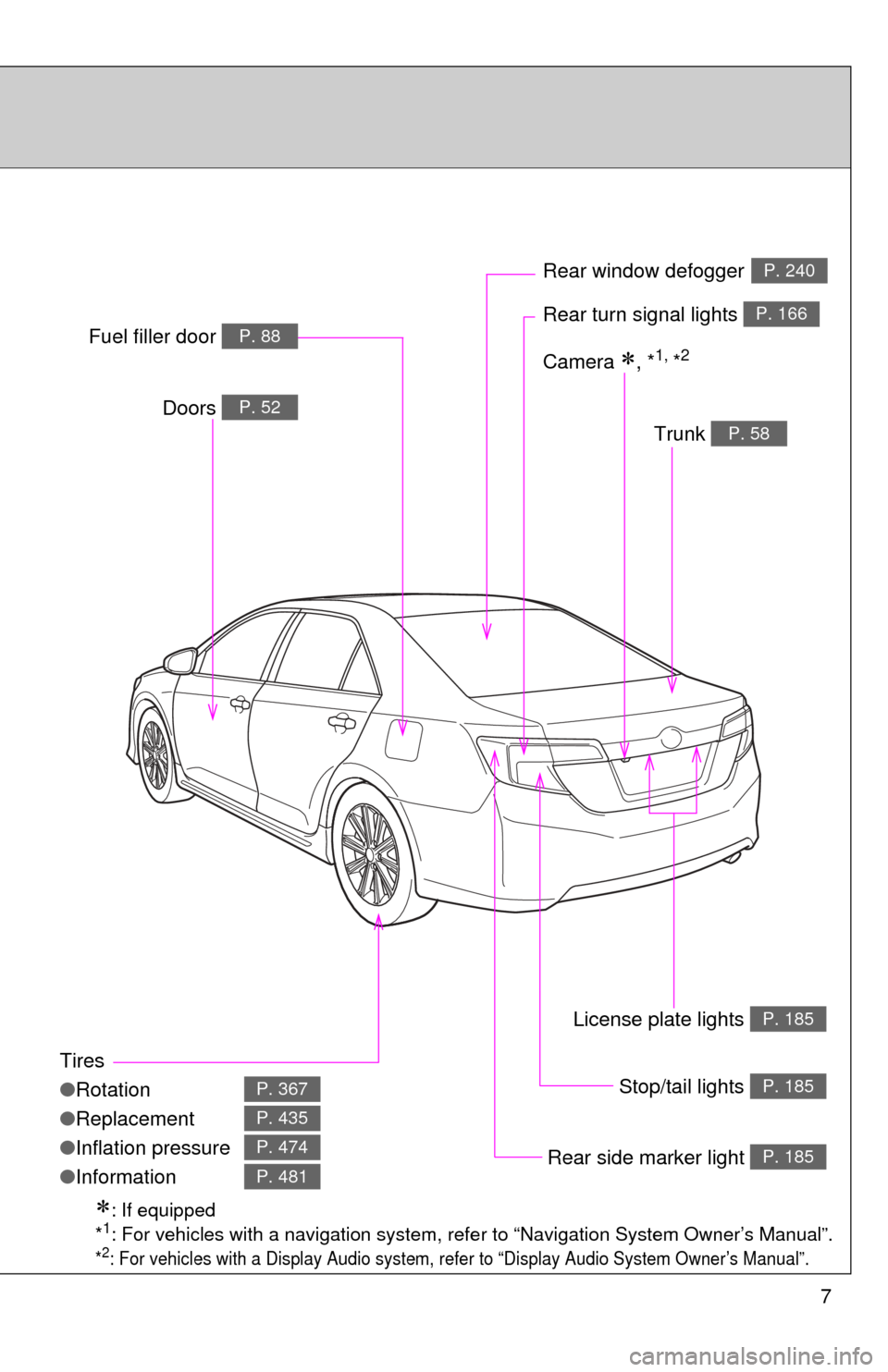
Tires
●Rotation
● Replacement
● Inflation pressure
● Information
P. 367
P. 435
P. 474
P. 481
Trunk P. 58
Doors P. 52
Rear turn signal lights P. 166
Rear window defoggerP. 240
Stop/tail lights P. 185
Rear side marker light P. 185
Fuel filler door P. 88
: If equipped
*1: For vehicles with a navigation system, refe r to “Navigation System Owner’s Manual”.
*2: For vehicles with a Display Audio system, re fer to “Display Audio System Owner’s Manual”.
Camera , *1, *2
License plate lights P. 185
Page 13 of 532
13
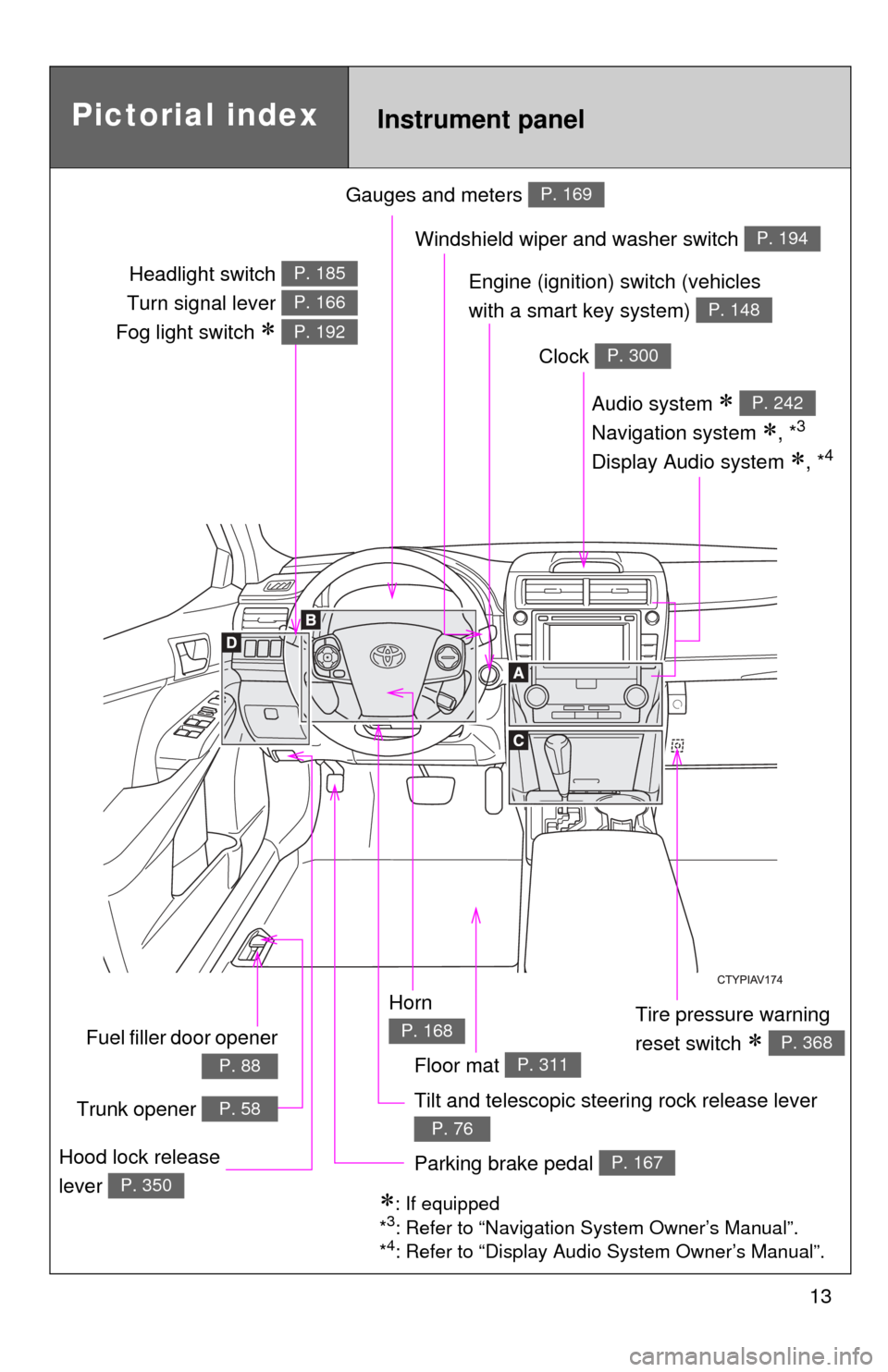
Gauges and meters P. 169
Tilt and telescopic steering rock release lever
P. 76
Pictorial indexInstrument panel
Audio system
Navigation system
, *3
Display Audio system , *4
P. 242
Windshield wiper and washer switch P. 194
Clock P. 300
Tire pressure warning
reset switch
P. 368
Parking brake pedal P. 167Hood lock release
lever
P. 350: If equipped
*3: Refer to “Navigation System Owner’s Manual”.
*4: Refer to “Display Audio System Owner’s Manual”.
Horn
P. 168
Engine (ignition) switch (vehicles
with a smart key system)
P. 148
Headlight switch
Turn signal lever
Fog light switch
P. 185
P. 166
P. 192
Fuel filler door opener
P. 88
Trunk opener P. 58
Floor mat P. 311
Page 19 of 532

19
For your information
Main Owner’s Manual
Please note that this manual covers all models and all equipment, including
options. Therefore, you may find some explanations for equipment not
installed on your vehicle.
All specifications provided in this manual are current at the time of printing.
However, because of the Toyota policy of continual product improvement, we
reserve the right to make changes at any time without notice.
Depending on specifications, the vehicle shown in the illustrations may differ
from your vehicle in terms of equipment.
Noise from under vehicle after turning off the engine
Approximately five hours after the engine is turned off, you may hear sound
coming from under the vehicle for several minutes. This is the sound of a fuel
evaporation leakage check and, it does not indicate a malfunction.
Accessories, spare parts and modification of your Toyota
A wide variety of non-genuine spare parts and accessories for Toyota
vehicles are currently available on the market. You should know that Toyota
does not warrant these products and is not responsible for their
performance, repair, or replacement, or for any damage they may cause to,
or adverse effect they may have on, your Toyota vehicle.
This vehicle should not be modified with non-genuine Toyota products.
Modification with non-genuine Toyota products could affect its performance,
safety or durability, and may even violate governmental regulations. In
addition, damage or performance problems resulting from the modification
may not be covered under warranty.
Page 20 of 532

20
Installation of a mobile two-way radio system
The installation of a mobile two-way radio system in your vehicle could affect
electronic systems such as:
●Multiport fuel injection system /sequential multiport fuel injection system
● Cruise control system
● Anti-lock brake system
● SRS airbag system
● Seat belt pretensioner system
Be sure to check with your Toyota dealer for precautionary measures or spe-
cial instructions regarding installation of a mobile two-way radio system.
Page 27 of 532
Before driving1
27
1-1. Key informationKeys ................................... 28
1-2. Opening, closing and locking the doors and
trunk
Smart key system .............. 32
Wireless remote control ..... 46
Doors ................................. 52
Trunk .................................. 58
1-3. Adjustable components (seats, mirrors,
steering wheel)
Front seats ......................... 62
Rear seats.......................... 65
Head restraints................... 67
Seat belts ........................... 69
Steering wheel ................... 76
Anti-glare inside rear view mirror ....................... 77
Outside rear view mirrors.............................. 79
1-4. Opening and closing the windows and
moon roof
Power windows .................. 81
Moon roof ........................... 84
1-5. Refueling Opening the fuel tank cap ................................... 88 1-6. Theft deterrent system
Engine immobilizer system ............................. 92
Alarm.................................. 95
1-7. Safety information Correct driving posture....... 98
SRS airbags ..................... 100
Front passenger occupant classification
system ........................... 113
Child restraint systems..... 118
Installing child restraints ........................ 122
Page 88 of 532
88
1-5. Refueling
Opening the fuel tank cap
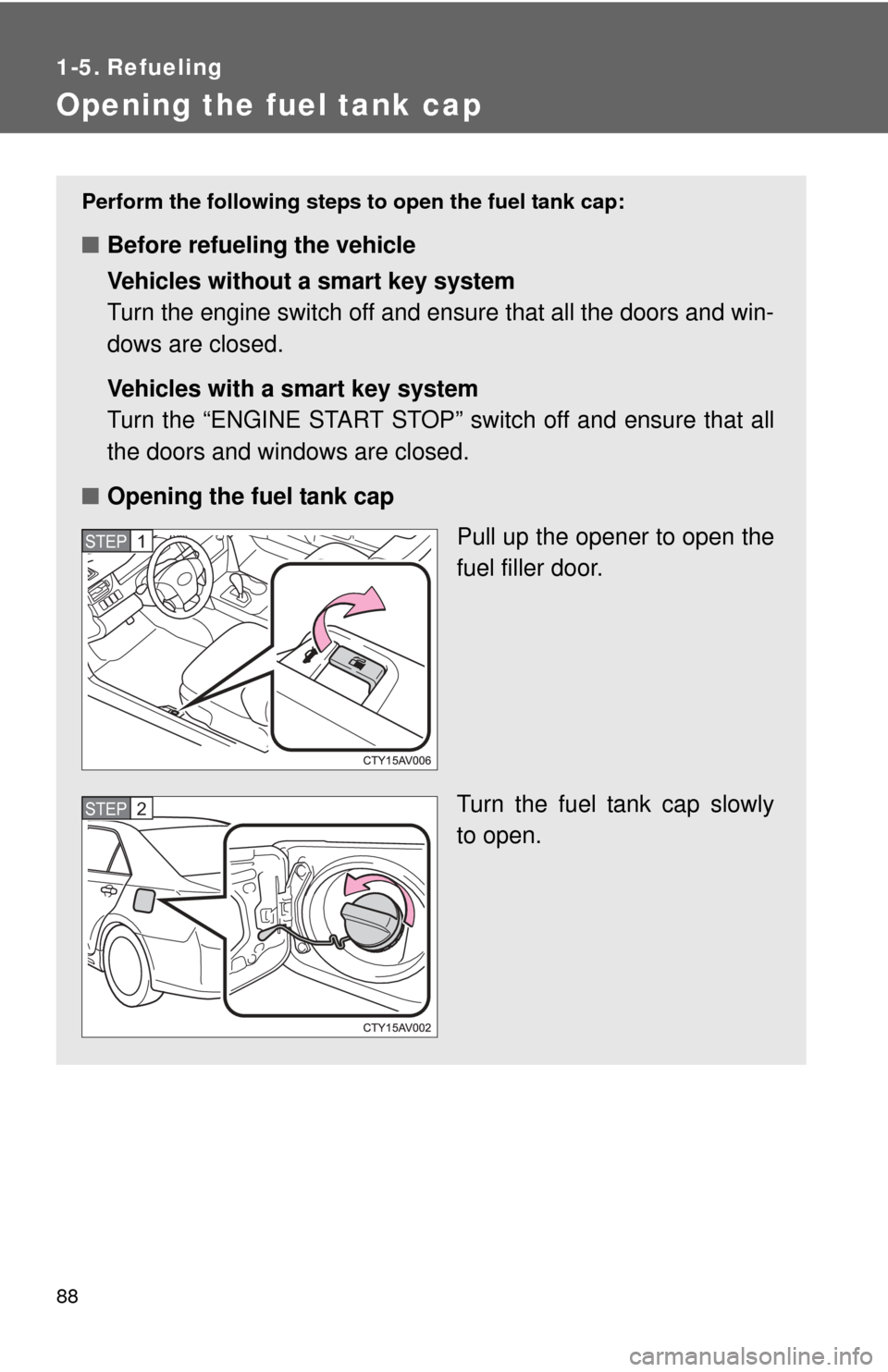
Perform the following steps to open the fuel tank cap:
■Before refueling the vehicle
Vehicles without a smart key system
Turn the engine switch off and ensure that all the doors and win-
dows are closed.
Vehicles with a smart key system
Turn the “ENGINE START STOP” switch off and ensure that all
the doors and windows are closed.
■ Opening the fuel tank cap
Pull up the opener to open the
fuel filler door.
Turn the fuel tank cap slowly
to open.
STEP1
STEP2
Page 89 of 532
89
1-5. Refueling
1
Before driving
Closing the fuel tank cap
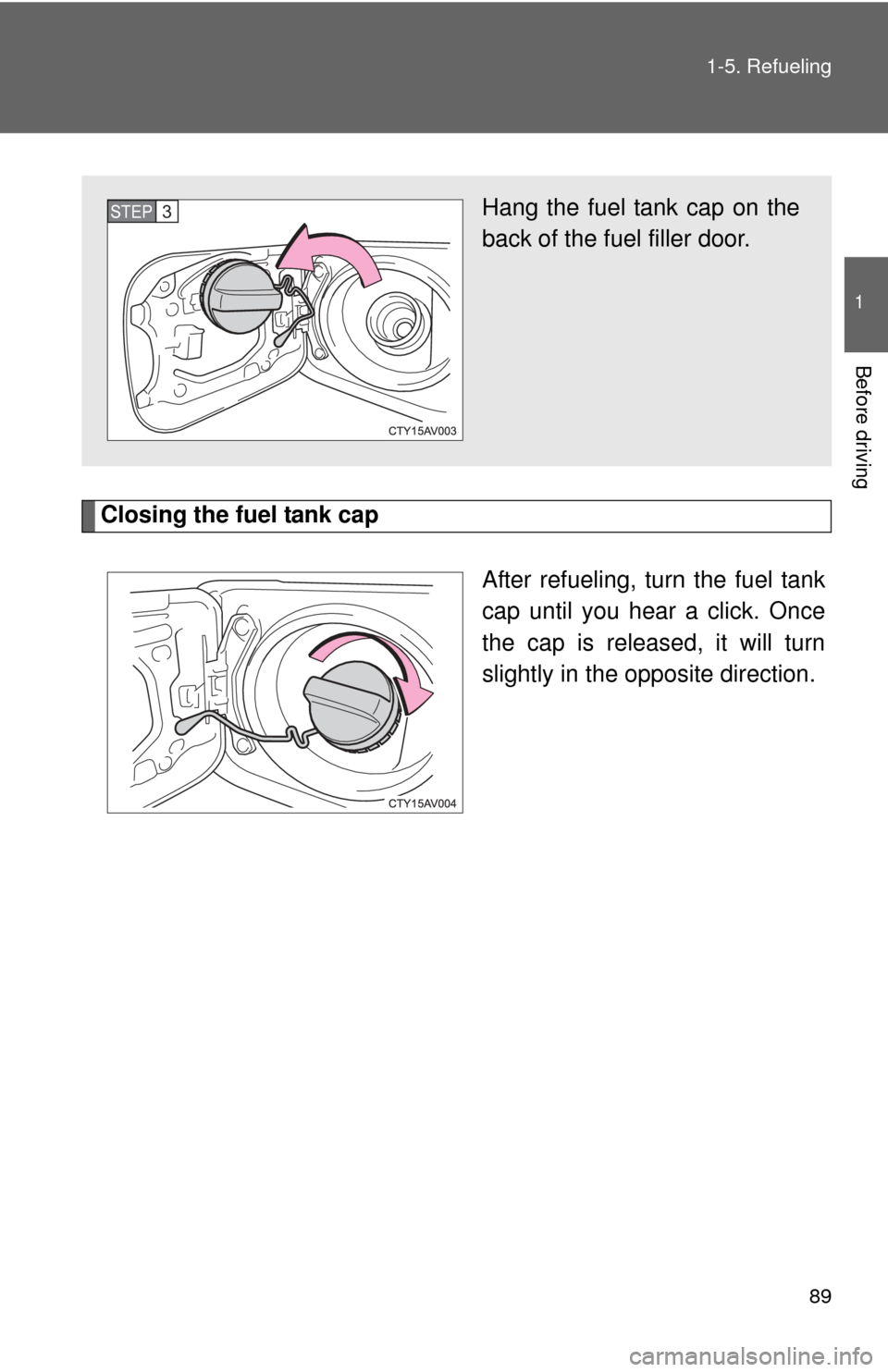
After refueling, turn the fuel tank
cap until you hear a click. Once
the cap is released, it will turn
slightly in the opposite direction.
Hang the fuel tank cap on the
back of the fuel filler door.STEP3
Page 90 of 532
90 1-5. Refueling
CAUTION
■When refueling the vehicle
Observe the following precautions while refueling the vehicle. Failure to do
so may result in death or serious injury.
●After exiting the vehicle and before opening the fuel door, touch an
unpainted metal surface to discharge any static electricity. It is important to
discharge static electricity before refueling because sparks resulting from
static electricity can cause fuel vapors to ignite while refueling.
● Always hold the grips on the fuel tank cap and turn it slowly to remove it.
A whooshing sound may be heard when the fuel tank cap is loosened.
Wait until the sound cannot be heard before fully removing the cap. In hot
weather, pressurized fuel may spray out the filler neck and cause injury.
● Do not allow anyone that has not discharged static electricity from their
body to come close to an open fuel tank.
● Do not inhale vaporized fuel.
Fuel contains substances that are harmful if inhaled.
● Do not smoke while refueling the vehicle.
Doing so may cause the fuel to ignite and cause a fire.
● Do not return to the vehicle or touch any person or object that is statically
charged.
This may cause static electricity to build up, resulting in a possible ignition
hazard.
■ When refueling
Securely insert the fuel nozzle into the fuel filler neck. If fuel is added with
the nozzle slightly lifted away from the fuel filler neck, the automatic shut off
function may not operate, resulting in fuel overflowing from the tank.
■ When replacing the fuel cap
Do not use anything but a genuine Toyota fuel tank cap designed for your
vehicle. Doing so may cause a fire or other incident which may result in
death or serious injury.