speed TOYOTA COROLLA 2019 (in English) Owner's Manual
[x] Cancel search | Manufacturer: TOYOTA, Model Year: 2019, Model line: COROLLA, Model: TOYOTA COROLLA 2019Pages: 608, PDF Size: 10.15 MB
Page 155 of 608

1554-1. Before driving
4
Driving
COROLLA_TMMMS_TMMC_U■
Engine speed while driving (vehic les with a continuously variable trans-
mission)
In the following conditions, the engine speed may become high w hile driving.
This is due to automatic up-shifting control or down-shifting implementation to
meet driving conditions. It does not indicate sudden acceleration.
● The vehicle is judged to be driving uphill or downhill
● When the accelerator pedal is released
● When the brake pedal is depressed while sport mode is selected (if
equipped)
● When the brake pedal is depressed suddenly and vehicle speed is reduced
sharply
■ Breaking in your new Toyota
To extend the life of the vehicle, observing the following prec autions is recom-
mended:
● For the first 186 miles (300 km):
Avoid sudden stops.
● For the first 621 miles (1000 km):
• Do not drive at extremely high speeds.
• Avoid sudden acceleration.
• Do not drive continuously in low gears.
• Do not drive at a constant speed for extended periods.
■ Operating your vehicle in a foreign country
Comply with the relevant vehicle registration laws and confirm the availability
of the correct fuel. ( P. 540)
WARNING
Observe the following precautions.
Failure to do so may result in death or serious injury.
■When starting the vehicle (vehic les with a continuously variable trans-
mission)
Always keep your foot on the brake pedal while stopped with the engine
running. This prevents the vehicle from creeping.
Page 156 of 608

1564-1. Before driving
COROLLA_TMMMS_TMMC_U
WARNING
Observe the following precautions.
Failure to do so may result in death or serious injury.
■When driving the vehicle
● Do not drive if you are unfamiliar with the location of the brake and accel-
erator pedals to avoid depressing the wrong pedal.
• Accidentally depressing the accelerator pedal instead of the b rake
pedal will result in sudden acceleration that may lead to an ac cident.
• When backing up, you may twist your body around, leading to a diffi-
culty in operating the pedals. Make sure to operate the pedals properly.
• Make sure to keep a correct driving posture even when moving t he
vehicle only slightly. This allows you to depress the brake and accelera-
tor pedals properly.
• Depress the brake pedal using your right foot. Depressing the brake
pedal using your left foot may delay response in an emergency, result-
ing in an accident.
● Do not drive the vehicle over or stop the vehicle near flammable materials.
The exhaust system and exhaust gases can be extremely hot. Thes e hot
parts may cause a fire if there is any flammable material nearb y.
● During normal driving, do not turn off the engine. Turning the engine off
while driving will not cause loss of steering or braking contro l, but the
power assist to these systems will be lost. This will make it m ore difficult to
steer and brake, so you should pull over and stop the vehicle a s soon as it
is safe to do so.
However, in the event of an emergency, such as if it becomes im possible
to stop the vehicle in the normal way: P. 471
● Use engine braking (downshift) to maintain a safe speed when driving
down a steep hill.
Using the brakes continuously may cause the brakes to overheat and lose
effectiveness. ( P. 181, 184, 189)
● Do not adjust the display, the positions of the steering wheel, the seat, or
the inside or outside rear view mirrors while driving.
Doing so may result in a loss of vehicle control.
● Always check that all passengers’ arms, heads or other parts of their body
are not outside the vehicle.
● Do not drive in excess of the speed limit. Even if the legal sp eed limit per-
mits it, do not drive over 85 mph (140 km/h) unless your vehicl e has high-
speed capability tires. Driving over 85 mph (140 km/h) may resu lt in tire
failure, loss of control and possible injury. Be sure to consult a tire dealer
to determine whether the tires on your vehicle are high-speed c apability
tires or not before driving at such speeds.
Page 157 of 608

1574-1. Before driving
4
Driving
COROLLA_TMMMS_TMMC_U
WARNING
Observe the following precautions.
Failure to do so may result in death or serious injury.
■When driving on slippery road surfaces
● Sudden braking, acceleration and steering may cause tire slippa ge and
reduce your ability to control the vehicle.
● Sudden acceleration, engine braking due to shifting, or changes in engine
speed could cause the vehicle to skid.
● After driving through a puddle, lightly depress the brake pedal to make
sure that the brakes are functioning properly. Wet brake pads m ay prevent
the brakes from functioning properly. If the brakes on only one side are wet
and not functioning properly, steering control may be affected.
■ When shifting the shift lever
● Vehicles with a continuously variable transmission: Do not let the vehicle
roll backward while the shift lever is in a driving position, o r roll forward
while the shift lever is in R.
Doing so may cause the engine to stall or lead to poor brake an d steering
performance, resulting in an accident or damage to the vehicle.
● Vehicles with a continuously variable transmission: Do not shift the shift
lever to P while the vehicle is moving.
Doing so can damage the transmission and may result in a loss o f vehicle
control.
● Do not shift the shift lever to R while the vehicle is moving f orward.
Doing so can damage the transmission and may result in a loss o f vehicle
control.
● Do not shift the shift lever to a driving position while the ve hicle is moving
backward.
Doing so can damage the transmission and may result in a loss o f vehicle
control.
● Moving the shift lever to N while the vehicle is moving will disengage the
engine from the transmission. Engine braking is not available w hen N is
selected.
● Vehicles with a continuously variable transmission: Be careful not to shift
the shift lever with the accelerator pedal depressed. Shifting the shift lever
to a gear other than P or N may lead to unexpected rapid acceleration of
the vehicle that may cause an accident and result in death or s erious
injury.
Page 158 of 608

1584-1. Before driving
COROLLA_TMMMS_TMMC_U
WARNING
Observe the following precautions.
Failure to do so may result in death or serious injury.
■If you hear a squealing or scrap ing noise (brake pad wear limit indica-
tors)
Have the brake pads checked and replaced by your Toyota dealer as soon
as possible.
Rotor damage may result if the pads are not replaced when needed.
It is dangerous to drive the vehicle when the wear limits of the brake pads
and/or those of the brake discs are exceeded.
■ When the vehicle is stopped
● Do not race the engine.
If the vehicle is in any gear other than P (continuously variab le transmis-
sion) or N, the vehicle may accelerate suddenly and unexpectedl y, caus-
ing an accident.
● Vehicles with a continuously variable transmission: In order to prevent
accidents due to the vehicle rolling away, always keep depressi ng the
brake pedal while the engine is running, and apply the parking brake as
necessary.
● If the vehicle is stopped on an incline, in order to prevent ac cidents caused
by the vehicle rolling forward or backward, always depress the brake pedal
and securely apply the parking brake as needed.
● Avoid revving or racing the engine.
Running the engine at high speed while the vehicle is stopped m ay cause
the exhaust system to overheat, which could result in a fire if combustible
material is nearby.
■ When the vehicle is parked
● Do not leave glasses, cigarette lighters, spray cans, or soft d rink cans in
the vehicle when it is in the sun.
Doing so may result in the following:
• Gas may leak from a cigarette lighter or spray can, and may le ad to a
fire.
• The temperature inside the vehicle may cause the plastic lenses and
plastic material of glasses to deform or crack.
• Soft drink cans may fracture, causing the contents to spray ov er the
interior of the vehicle, and may also cause a short circuit in the vehicle’s
electrical components.
Page 185 of 608
1854-2. Driving procedures
4
Driving
COROLLA_TMMMS_TMMC_U
*1: To improve fuel efficiency and reduce noises, set the shift lever in D for
normal driving.
*2: Selecting gear step using the M position achieves suitable eng ine braking
forces by operating the shift lever.
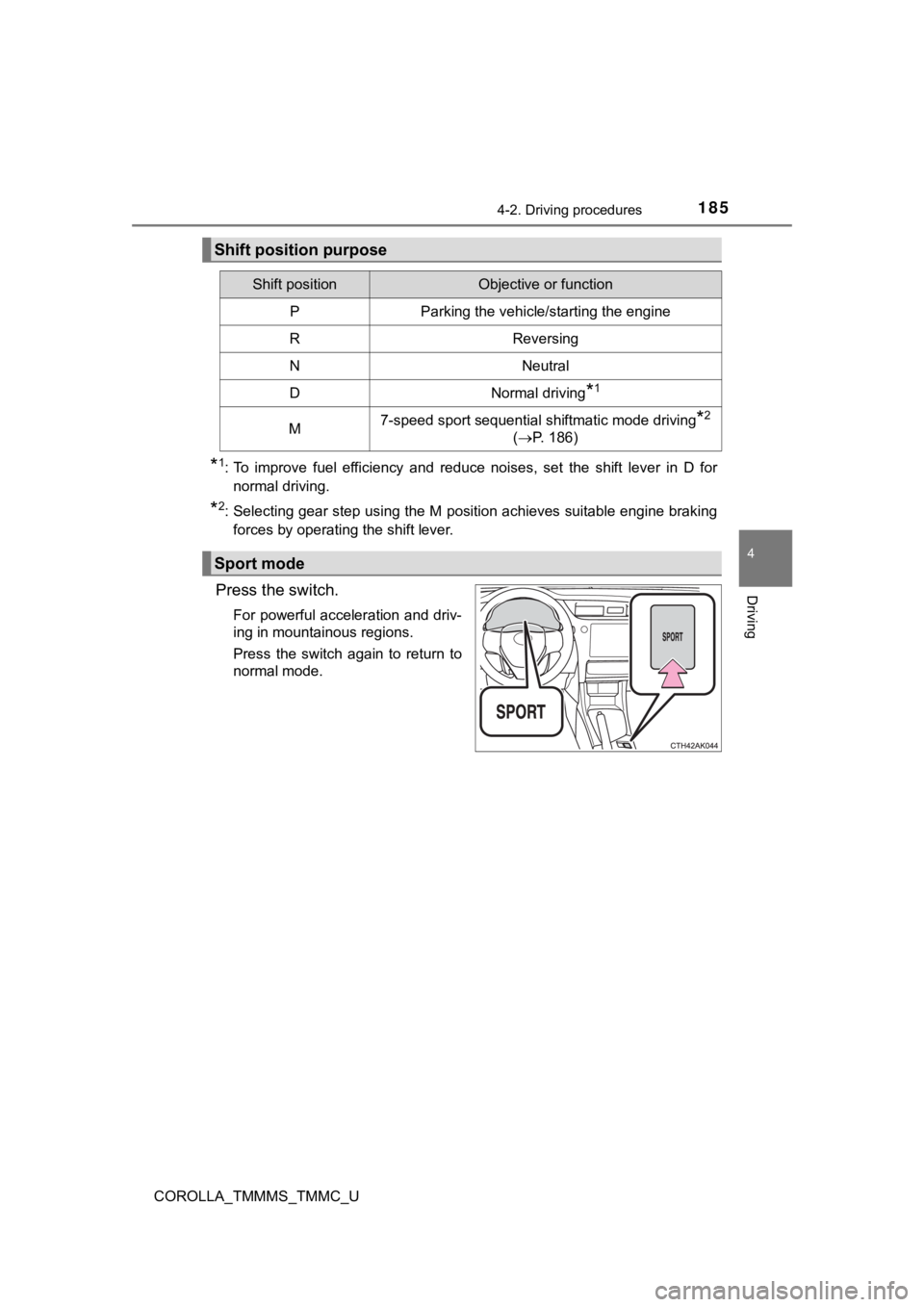
Press the switch.
For powerful acceleration and driv-
ing in mountainous regions.
Press the switch again to return to
normal mode.
Shift position purpose
Shift positionObjective or function
PParking the vehicle/starting the engine
RReversing
NNeutral
DNormal driving*1
M7-speed sport sequential shiftmatic mode driving*2
( P. 186)
Sport mode
Page 186 of 608
1864-2. Driving procedures
COROLLA_TMMMS_TMMC_U
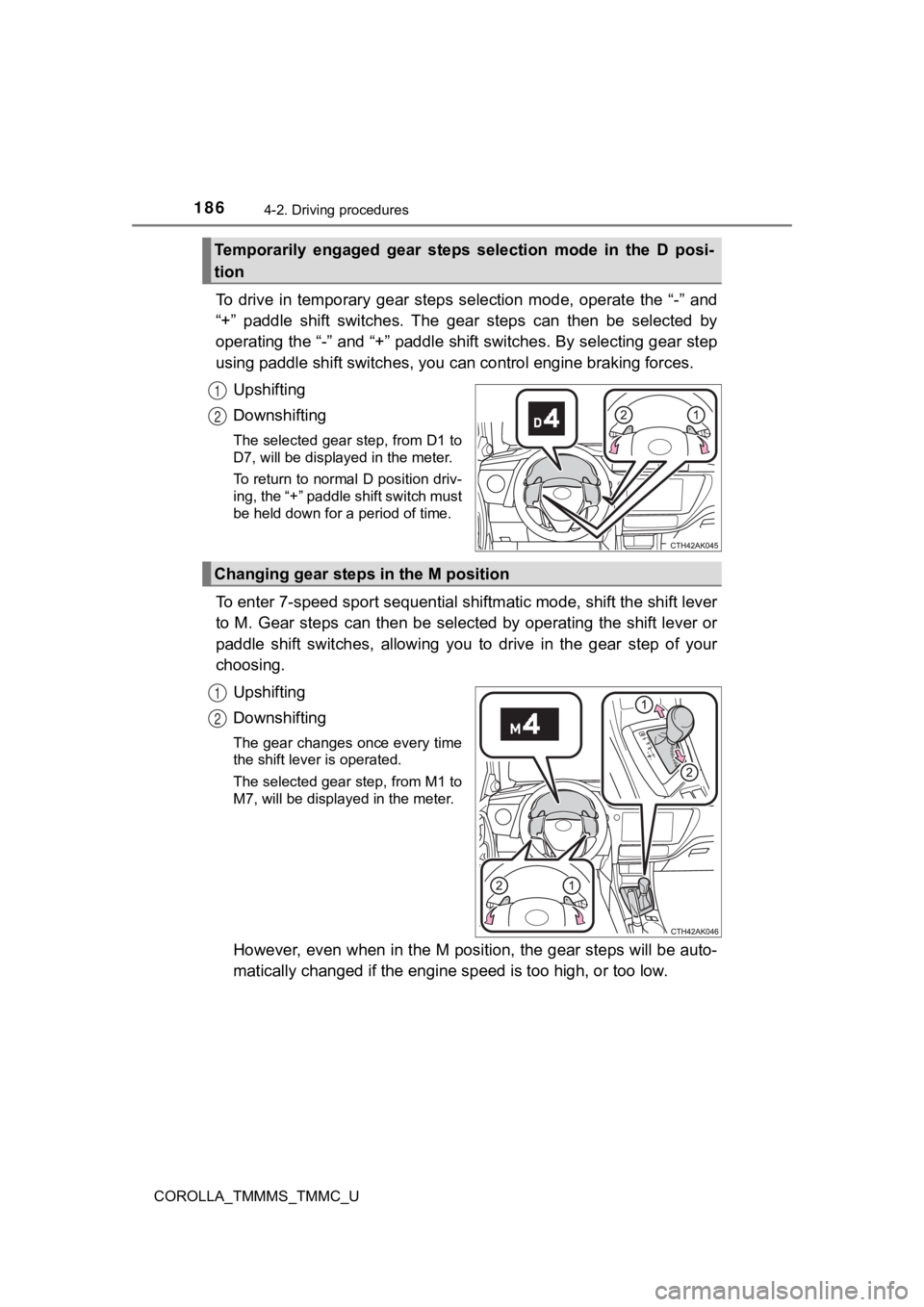
To drive in temporary gear steps selection mode, operate the “-” and
“+” paddle shift switches. The gear steps can then be selected by
operating the “-” and “+” paddle shift switches. By selecting gear step
using paddle shift switches, you can control engine braking forces.
Upshifting
Downshifting
The selected gear step, from D1 to
D7, will be displayed in the meter.
To return to normal D position driv-
ing, the “+” paddle shift switch must
be held down for a period of time.
To enter 7-speed spor t sequential shiftmatic mode, shift the sh ift lever
to M. Gear steps can then be selected by operating the shift lever or
paddle shift switches, allowing you to drive in the gear step o f your
choosing.
Upshifting
Downshifting
The gear changes once every time
the shift lever is operated.
The selected gear step, from M1 to
M7, will be displayed in the meter.
However, even when in the M position, the gear steps will be au to-
matically changed if the engine speed is too high, or too low.
Temporarily engaged gear steps selection mode in the D posi-
tion
1
2
Changing gear steps in the M position
1
2
Page 187 of 608
1874-2. Driving procedures
4
Driving
COROLLA_TMMMS_TMMC_U
■Gear step functions
●You can choose from 7 levels of engine braking force.
● A lower gear step will provide greater engine braking force tha n a higher
gear step, and the engine speed will also increase.
■ If the “M” indicator flashes or a buzzer beeps after shifting the shift lever
to M
This may indicate a malfunction in the continuously variable tr ansmission
system. Have the vehicle inspected by your Toyota dealer immediately.
(In this situation, the transmission will operate in the same m anner as when
the shift lever is in D.)
■ When the vehicle comes to a stop with the shift lever in the M position
● The transmission will automatically downshift to M1 once the ve hicle is
stopped.
● After a stop, the vehicle will start off in M1.
● When the vehicle is stopped, the transmission is set at M1.
■ When driving with the dynamic r adar cruise control activated
Even when performing the following actions with the intent of e nabling engine
braking, engine braking will not activate because the dynamic r adar cruise
control will not be canceled.
● While driving in D or 7-speed sport sequential shiftmatic mode, downshifting
to 6, 5 or 4. ( P. 186)
● When switching the driving mode to sport mode while driving in D position.
( P. 185)
■ Downshifting restrictions warning buzzer
To help ensure safety and driving performance, downshifting ope ration may
sometimes be restricted. In some circumstances, downshifting ma y not be
possible even when the shift lever is operated. (A buzzer will sound twice.)
■ Sport mode automatic deactivation
Sport mode is automatically deactivated if the engine switch is turned off after
driving in sport mode.
■ Shift lock system
The shift lock system is a system to prevent accidental operation of the shift
lever in starting.
The shift lever can be shifted from P only when the engine switch is in the
“ON” position (vehicles without a smart key system) or IGNITION ON mode
(vehicles with a smart key system) and the brake pedal is being depressed.
Page 190 of 608
1904-2. Driving procedures
COROLLA_TMMMS_TMMC_U
■Maximum allowable speeds
Observe the following maximum allowable speeds in each gear whe n maxi-
mum acceleration is necessary.
mph (km/h)
Shift position
Maximum speed
Vehicles with 15-inch and 16-inch tiresVehicles with 17-inch tires
130 (49)30 (49)
256 (91)56 (90)
382 (133)82 (132)
4111 (179)111 ( 1 7 9 )
5
NOTICE
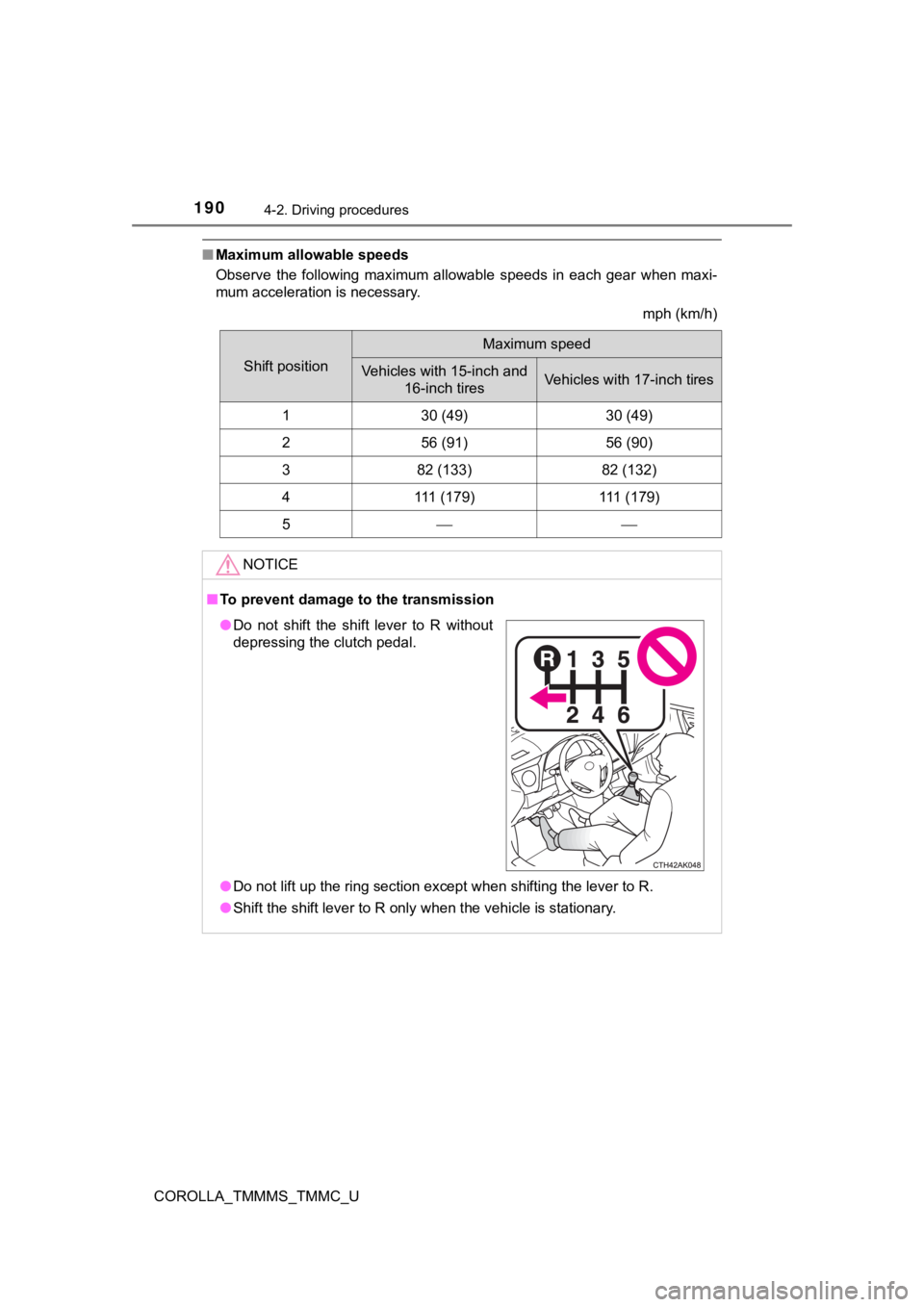
■To prevent damage to the transmission
● Do not lift up the ring section except when shifting the lever to R.
● Shift the shift lever to R only when the vehicle is stationary.
●Do not shift the shift lever to R without
depressing the clutch pedal.
Page 192 of 608
1924-2. Driving procedures
COROLLA_TMMMS_TMMC_U
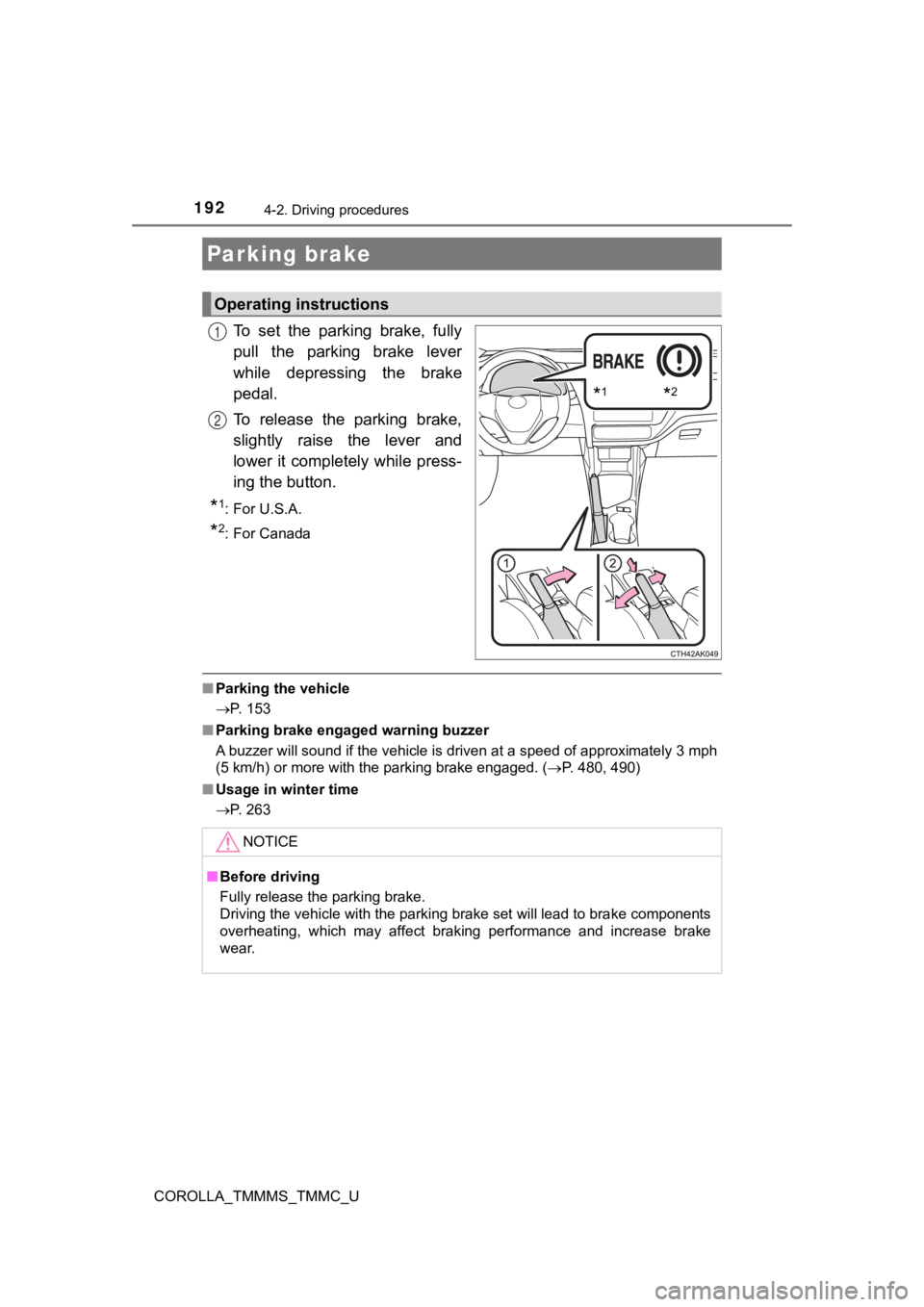
To set the parking brake, fully
pull the parking brake lever
while depressing the brake
pedal.
To release the parking brake,
slightly raise the lever and
lower it completely while press-
ing the button.
*1: For U.S.A.
*2: For Canada
■Parking the vehicle
P. 153
■ Parking brake engaged warning buzzer
A buzzer will sound if the vehicle is driven at a speed of appr oximately 3 mph
(5 km/h) or more with the parking brake engaged. ( P. 480, 490)
■ Usage in winter time
P. 263
Parking brake
Operating instructions
*1*2
1
2
NOTICE
■Before driving
Fully release the parking brake.
Driving the vehicle with the parking brake set will lead to bra ke components
overheating, which may affect braking performance and increase brake
wear.
Page 199 of 608
1994-3. Operating the lights and wipers
4
Driving
COROLLA_TMMMS_TMMC_U■
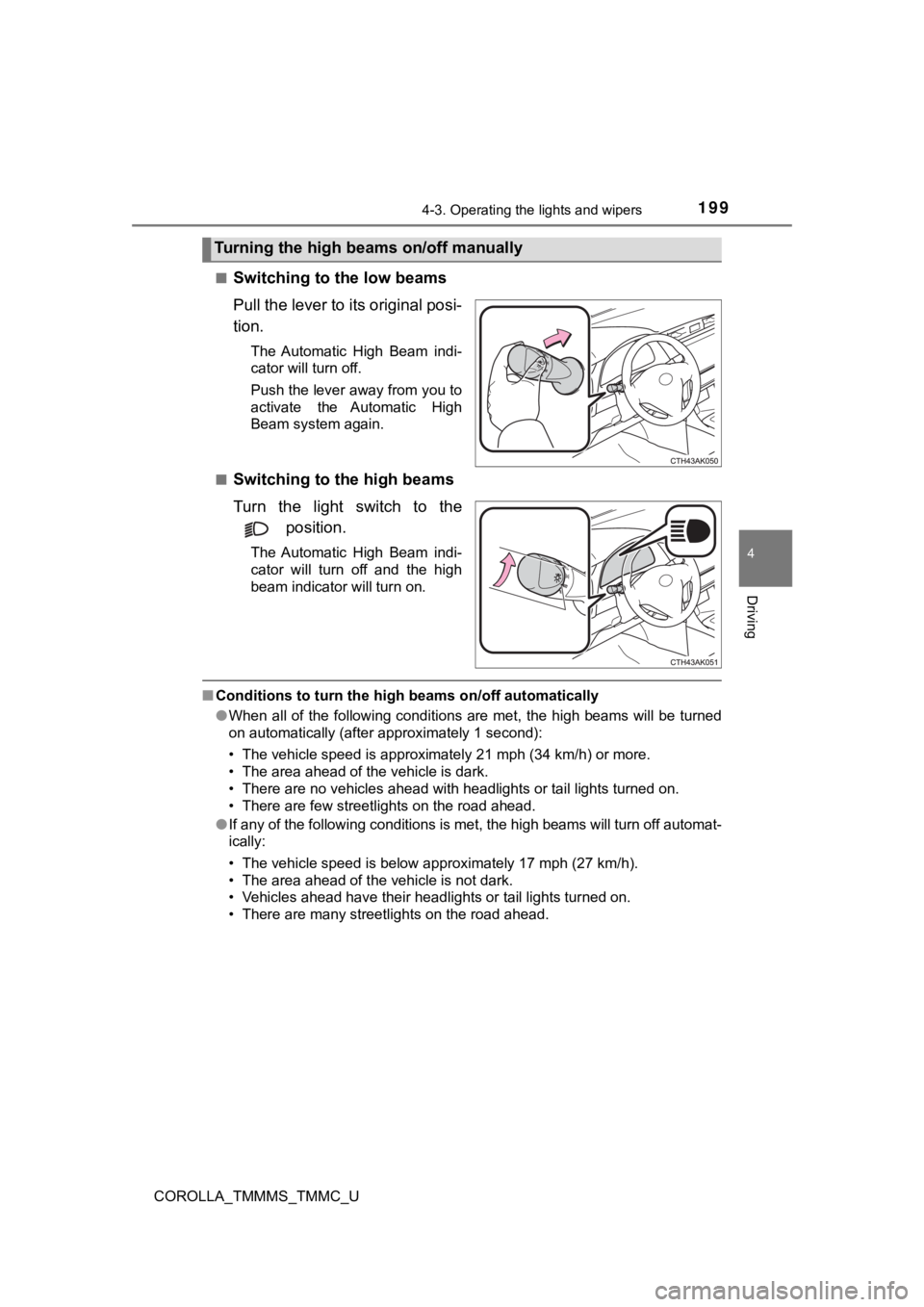
Switching to the low beams
Pull the lever to its original posi-
tion.
The Automatic High Beam indi-
cator will turn off.
Push the lever away from you to
activate the Automatic High
Beam system again.
■
Switching to the high beams
Turn the light switch to the position.
The Automatic High Beam indi-
cator will turn off and the high
beam indicator will turn on.
■Conditions to turn the high beams on/off automatically
●When all of the following conditions are met, the high beams will be turned
on automatically (after approximately 1 second):
• The vehicle speed is approximately 21 mph (34 km/h) or more.
• The area ahead of the vehicle is dark.
• There are no vehicles ahead with headlights or tail lights turned on.
• There are few streetlights on the road ahead.
● If any of the following conditions is met, the high beams will turn off automat-
ically:
• The vehicle speed is below approximately 17 mph (27 km/h).
• The area ahead of the vehicle is not dark.
• Vehicles ahead have their headlights or tail lights turned on.
• There are many streetlights on the road ahead.
Turning the high beams on/off manually