speed TOYOTA COROLLA 2019 Owners Manual (in English)
[x] Cancel search | Manufacturer: TOYOTA, Model Year: 2019, Model line: COROLLA, Model: TOYOTA COROLLA 2019Pages: 608, PDF Size: 10.15 MB
Page 9 of 608

9
COROLLA_TMMMS_TMMC_UThe installation of a mobile two-way radio system in your vehic
le could affect
electronic systems such as:
● Multiport fuel injection system/sequential multiport fuel injection system
● Toyota Safety Sense P
● Anti-lock brake system
● SRS airbag system
● Seat belt pretensioner system
Be sure to check with your Toyota dealer for precautionary meas ures or spe-
cial instructions regarding instal lation of a mobile two-way radio system.
Your Toyota is equipped with several sophisticated computers th at will record
certain data, such as:
• Engine speed
• Accelerator status
• Brake status
• Vehicle speed
• Shift position (vehicles with a continuously variable transmission)
The recorded data varies according to the vehicle grade level and options
with which it is equipped. These computers do not record conver sations or
sounds, and only record images outside of the vehicle in certai n situations.
●Data Transmission
Your vehicle may transmit the data recorded in these computers to Toyota
without notification to you.
●Data usage
Toyota may use the data recorded in these computers to diagnose malfunc-
tions, conduct research and development, and improve quality.
Toyota will not disclose the recorded data to a third party exc ept:
• With the consent of the vehicle owner or with the consent of the lessee if the vehicle is leased
• In response to an official request by the police, a court of l aw or a govern-
ment agency
• For use by Toyota in a lawsuit
• For research purposes where the data is not tied to a specific vehicle or
vehicle owner
●To learn more about the vehicle data collected, used and shared by
Toyota, please visit www.toyota.com/privacyvts/
.
Installation of a mobile two-way radio system
Vehicle data recordings
Page 25 of 608
251-1. For safe use
1
For safety and security
COROLLA_TMMMS_TMMC_U
WARNING
Observe the following precautions.
Failure to do so may cause the driver’s floor mat to slip, possibly interfering
with the pedals while driving. An unexpectedly high speed may result or it may
become difficult to stop the vehicle. This could lead to an acc ident, resulting in
death or serious injury.
■ When installing the driver’s floor mat
● Do not use floor mats designed for other models or different mo del year
vehicles, even if they are Toyota Genuine floor mats.
● Only use floor mats designed for the driver’s seat.
● Always install the floor mat securely using the retaining hooks (clips) pro-
vided.
● Do not use two or more floor mats on top of each other.
● Do not place the floor mat bottom-side up or upside-down.
■ Before driving
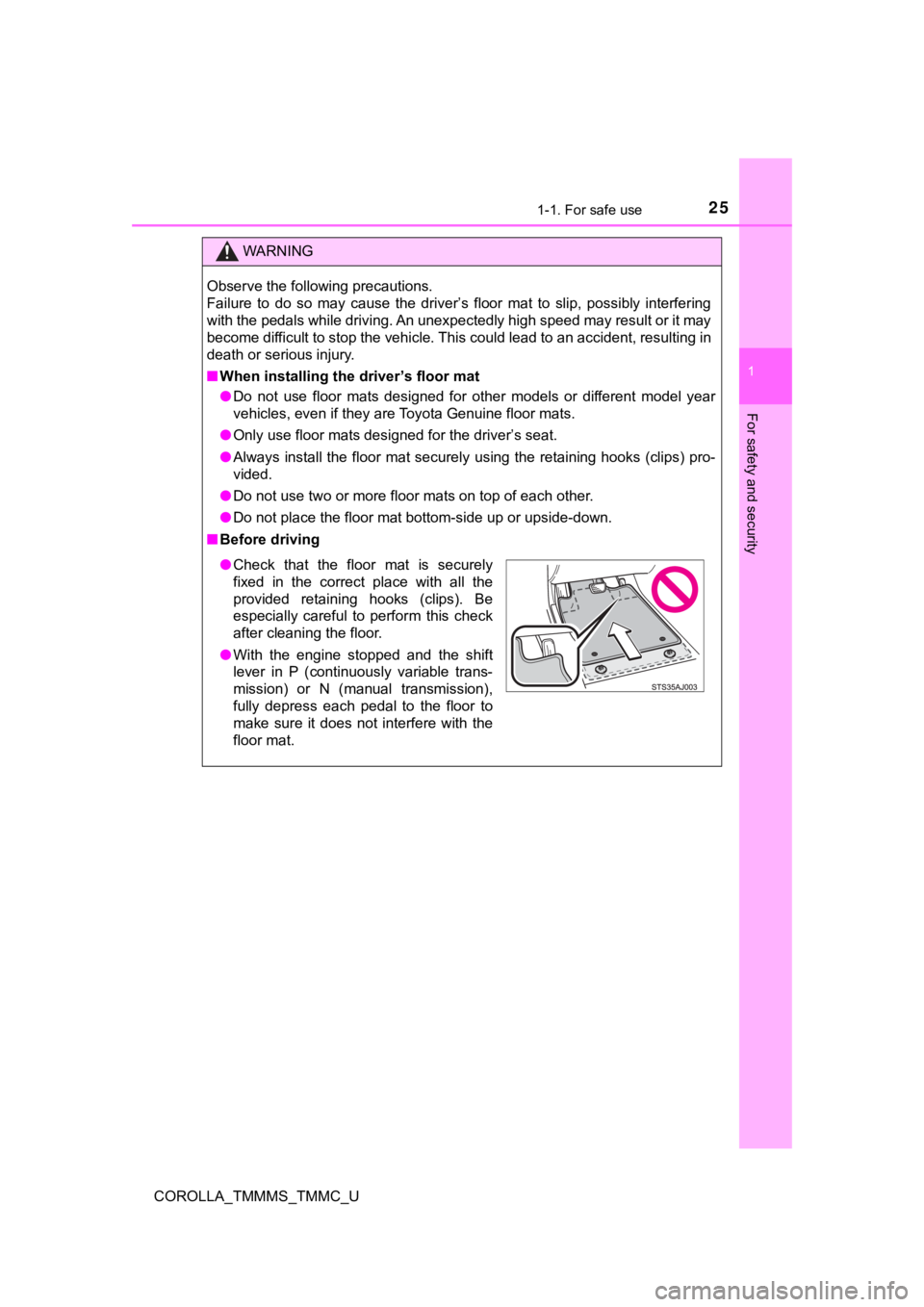
● Check that the floor mat is securely
fixed in the correct place with all the
provided retaining hooks (clips). Be
especially careful to perform this check
after cleaning the floor.
● With the engine stopped and the shift
lever in P (continuously variable trans-
mission) or N (manual transmission),
fully depress each pedal to the floor to
make sure it does not interfere with the
floor mat.
Page 27 of 608
271-1. For safe use
1
For safety and security
COROLLA_TMMMS_TMMC_U
Make sure that you can see backward clearly by adjusting the inside
and outside rear view mirrors properly. (P. 139, 141)
Adjusting the mirrors
WARNING
Observe the following precautions.
Failure to do so may result in death or serious injury.
● Do not adjust the position of the driver’s seat while driving.
Doing so could cause the driver to lose control of the vehicle.
● Do not place a cushion between the driver or passenger and the seatback.
A cushion may prevent correct posture from being achieved, and reduce
the effectiveness of the seat belt and head restraint.
● Do not place anything under the front seats.
Objects placed under the front seats may become jammed in the s eat
tracks and stop the seat from locking in place. This may lead t o an acci-
dent and the adjustment mechanism may also be damaged.
● Always observe the legal speed limit when driving on public roads.
● When driving over long distances, take regular breaks before yo u start to
feel tired.
Also, if you feel tired or sleepy while driving, do not force y ourself to con-
tinue driving and take a break immediately.
Page 42 of 608
421-1. For safe use
COROLLA_TMMMS_TMMC_U
■If the SRS airbags deploy (inflate)
●Slight abrasions, burns, bruising etc.,may be sustained from SR S airbags,
due to the extremely high speed deployment (inflation) by hot g ases.
● A loud noise and white powder will be emitted.
● Parts of the airbag module (steering wheel hub, airbag cover an d inflator) as
well as the front seats, parts of the front and rear pillars, and roof side rails,
may be hot for several minutes. The airbag itself may also be h ot.
● The windshield may crack.
■ SRS airbag deployment condi tions (SRS front airbags)
● The SRS front airbags will deploy i n the event of an impact tha t exceeds the
set threshold level (the level of force corresponding to an app roximately 12 -
18 mph [20 - 30 km/h] frontal collision with a fixed wall that does not move or
deform).
However, this threshold velocity will be considerably higher in the following
situations:
• If the vehicle strikes an object, such as a parked vehicle or sign pole,
which can move or deform on impact
• If the vehicle is involved in an underride collision, such as a collision in
which the front of the vehicle “underrides”, or goes under, the bed of a
truck
● Depending on the type of collision, it is possible that only th e seat belt pre-
tensioners will activate.
● The SRS front airbags for the front passenger will not activate if there is no
passenger sitting in the front passenger seat. However, the SRS front air-
bags for the front passenger may deploy if luggage is put in the seat, even if
the seat is unoccupied.
● The SRS seat cushion airbag on the front seats will not operate if the occu-
pant is not wearing a seat belt.
■ SRS airbag deployment conditions (SRS side and curtain shield a irbags)
● The SRS side and curtain shield airbags will deploy in the even t of an
impact that exceeds the set threshold level (the level of force corresponding
to the impact force produced by an approximately 3300 lb. [1500 kg] vehicle
colliding with the vehicle cabin from a direction perpendicular to the vehicle
orientation at an approximate speed of 12 - 18 mph [20 - 30 km/ h]).
● The SRS curtain shield airbags will deploy in the event of vehi cle rollover.
● The SRS side and curtain shield airbags will deploy in the even t of a severe
frontal collision.
Page 43 of 608
431-1. For safe use
1
For safety and security
COROLLA_TMMMS_TMMC_U■
Conditions under which the SRS ai rbags may deploy (inflate), other than
a collision
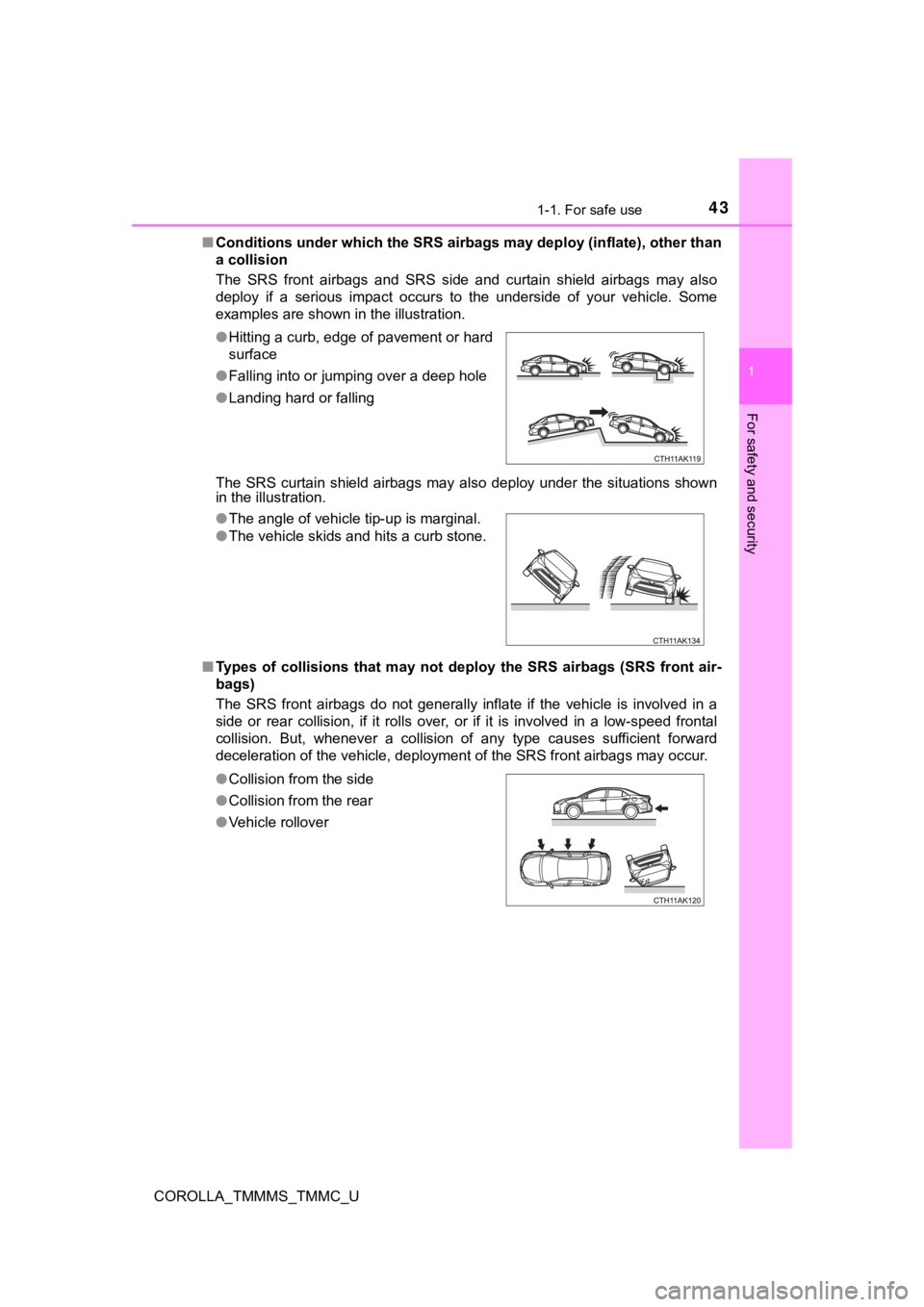
The SRS front airbags and SRS side and curtain shield airbags m ay also
deploy if a serious impact occurs to the underside of your vehi cle. Some
examples are shown in the illustration.
The SRS curtain shield airbags may also deploy under the situat ions shown
in the illustration.
■ Types of collisions that may not deploy the SRS airbags (SRS fr ont air-
bags)
The SRS front airbags do not generally inflate if the vehicle i s involved in a
side or rear collision, if it rolls over, or if it is involved in a low-speed frontal
collision. But, whenever a collision of any type causes suffici ent forward
deceleration of the vehicle, deployment of the SRS front airbag s may occur.
●
Hitting a curb, edge of pavement or hard
surface
● Falling into or jumping over a deep hole
● Landing hard or falling
● The angle of vehicle tip-up is marginal.
● The vehicle skids and hits a curb stone.
● Collision from the side
● Collision from the rear
● Vehicle rollover
Page 44 of 608
441-1. For safe use
COROLLA_TMMMS_TMMC_U■
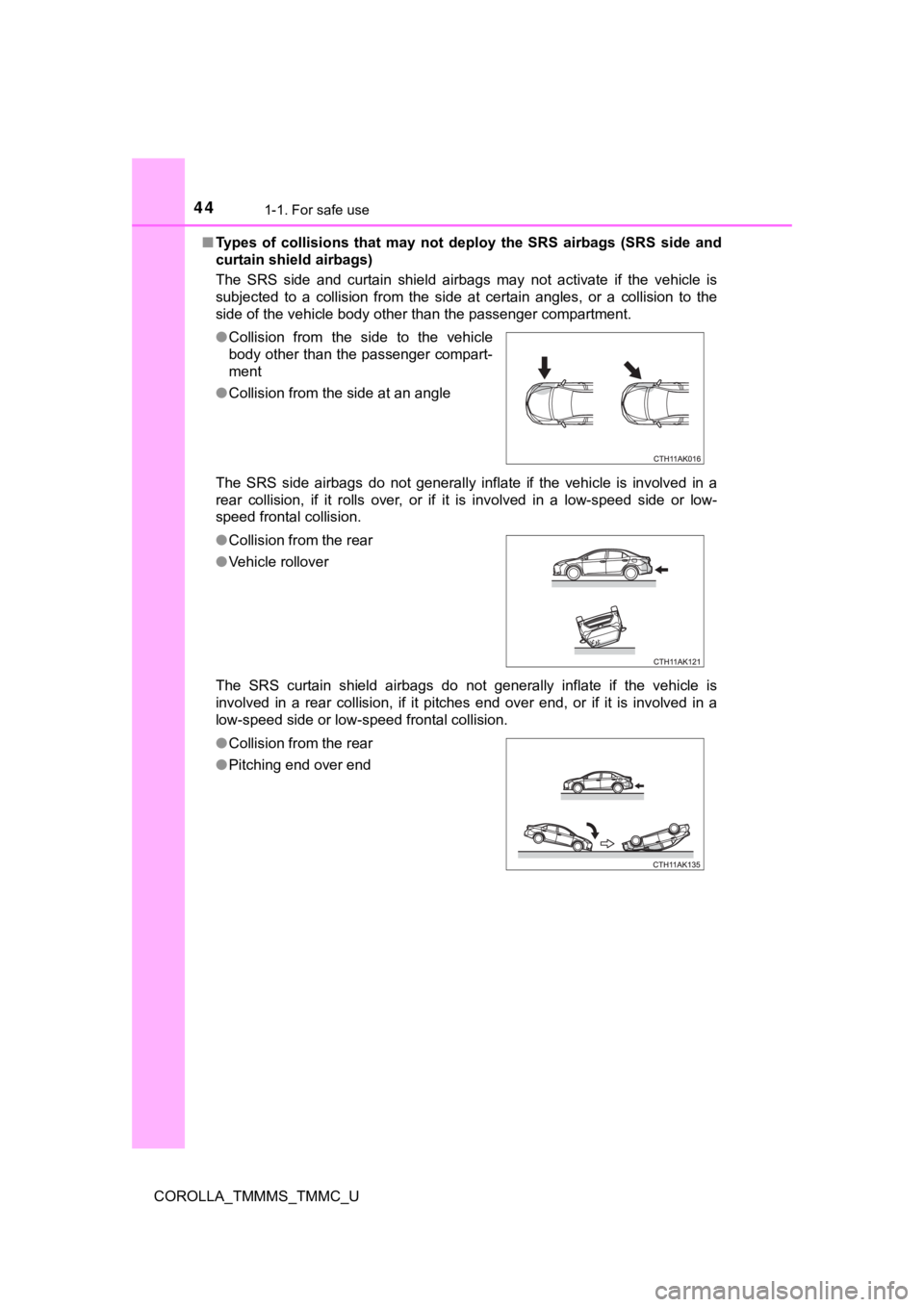
Types of collisions that may not deploy the SRS airbags (SRS si de and
curtain shield airbags)
The SRS side and curtain shield airbags may not activate if the vehicle is
subjected to a collision from the side at certain angles, or a collision to the
side of the vehicle body other than the passenger compartment.
The SRS side airbags do not generally inflate if the vehicle is involved in a
rear collision, if it rolls over, or if it is involved in a low -speed side or low-
speed frontal collision.
The SRS curtain shield airbags do not generally inflate if the vehicle is
involved in a rear collision, if it pitches end over end, or if it is involved in a
low-speed side or low-speed frontal collision. ● Collision from the side to the vehicle
body other than the passenger compart-
ment
● Collision from the side at an angle
● Collision from the rear
● Vehicle rollover
● Collision from the rear
● Pitching end over end
Page 56 of 608
561-1. For safe use
COROLLA_TMMMS_TMMC_U
WARNING
■Child restraint precautions
● For effective protection in automobile accidents and sudden sto ps, a child
must be properly restrained, using a seat belt or child restrai nt system
depending on the age and size of the child. Holding a child in your arms is
not a substitute for a child restraint system. In an accident, the child can be
crushed against the windshield, or between you and the vehicle’ s interior.
● Toyota strongly urges the use of a proper child restraint syste m that con-
forms to the size of the child, installed on the rear seat. According to acci-
dent statistics, the child is safer when properly restrained in the rear seat
than in the front seat.
● Never install a rear-facing child restraint system on the front passenger
seat even if the “AIR BAG OFF” indicator light is illuminated. In the event
of an accident, the force of the rapid inflation of the front p assenger airbag
can cause death or serious injury to the child if the rear-faci ng child
restraint system is installed on the front passenger seat.
● A forward-facing child restraint system may be installed on the front pas-
senger seat only when it is unavoidable. A child restraint syst em that
requires a top tether strap should not be used in the front passenger seat
since there is no top tether strap anchor for the front passeng er seat.
Adjust the seatback as upright as possible and always move the seat as
far back as possible even if the “AIR BAG OFF” indicator light is illumi-
nated, because the front passenger airbag could inflate with considerable
speed and force. Otherwise, the child may be killed or seriously injured.
● Do not use the seat belt extender when installing a child restr aint system
on the front or rear passenger seat. If installing a child rest raint system
with the seat belt extender connected to the seat belt, the seat belt will not
securely hold the child restraint system, which could cause dea th or seri-
ous injury to the child or other passengers in the event of a s udden stop,
sudden swerve or accident.
● Do not allow the child to lean his/her head or any part of his/ her body
against the door or the area of the seat, front and rear pillars or roof side
rails from which the SRS side airbags or SRS curtain shield air bags deploy
even if the child is seated in the child restraint system. It is dangerous if
the SRS side airbags and curtain shield airbags inflate, and th e impact
could cause death or serious injury to the child.
● Make sure you have complied with all installation instructions provided by
the child restraint manufacturer and that the system is properly secured. If
it is not secured properly, it may cause death or serious injury to the child
in the event of a sudden stop or accident.
Page 75 of 608
752. Instrument cluster
2
Instrument cluster
COROLLA_TMMMS_TMMC_U
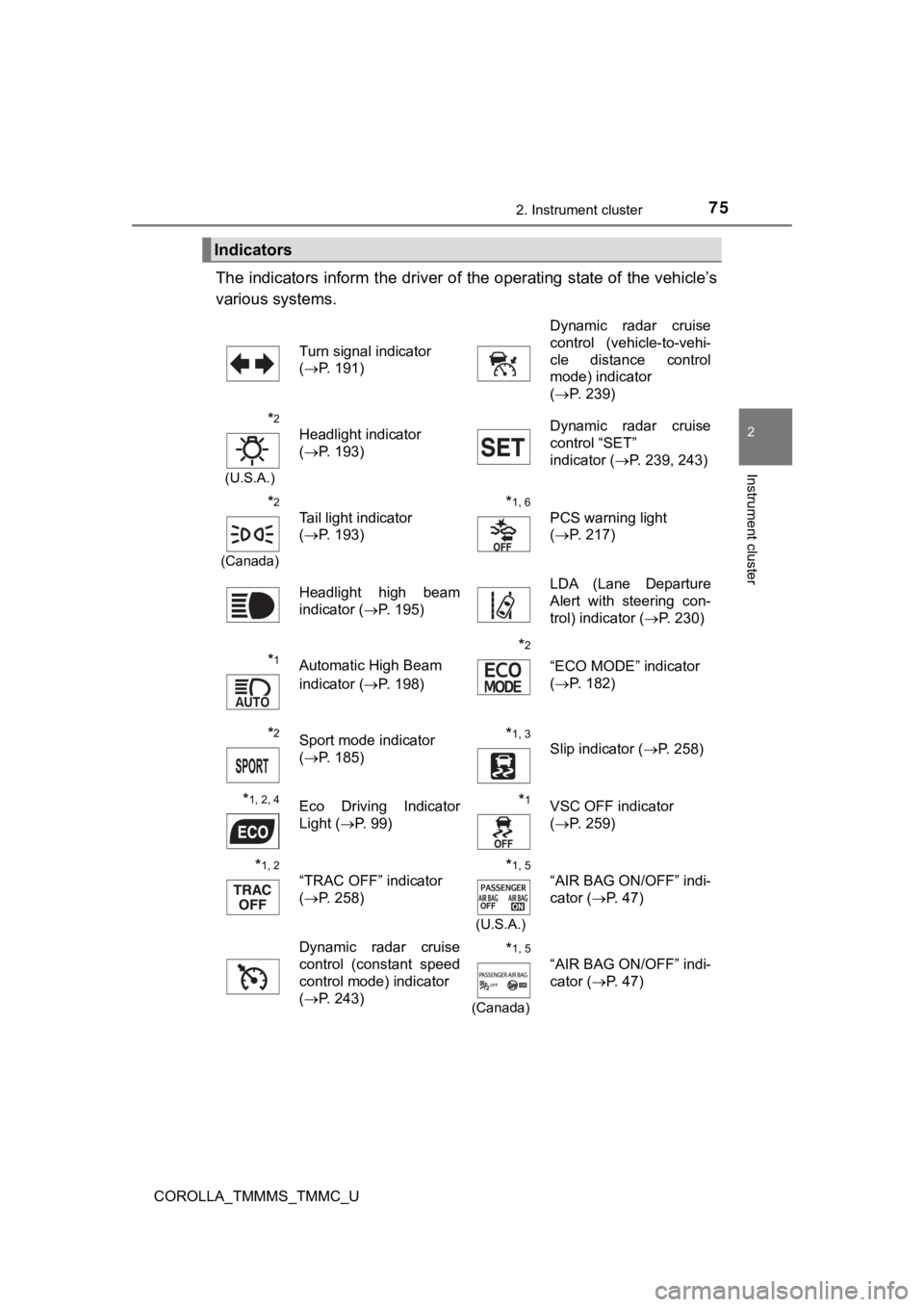
The indicators inform the driver of the operating state of the vehicle’s
various systems.
Indicators
Turn signal indicator
( P. 191) Dynamic radar cruise
control (vehicle-to-vehi-
cle distance control
mode) indicator
(
P. 239)
*2
(U.S.A.)
Headlight indicator
(P. 193) Dynamic radar cruise
control “SET”
indicator (
P. 239, 243)
*2
(Canada)
Tail light indicator
(P. 193) *1, 6
PCS warning light
(P. 217)
Headlight high beam
indicator ( P. 195) LDA (Lane Departure
Alert with steering con-
trol) indicator (
P. 230)
*1Automatic High Beam
indicator (P. 198)
*2
“ECO MODE” indicator
(P. 182)
*2Sport mode indicator
(P. 185)*1, 3 Slip indicator ( P. 258)
*1, 2, 4Eco Driving Indicator
Light (P. 99)*1VSC OFF indicator
(P. 259)
*1, 2
“TRAC OFF” indicator
(P. 258)*1, 5
(U.S.A.)
“AIR BAG ON/OFF” indi-
cator ( P. 47)
Dynamic radar cruise
control (constant speed
control mode) indicator
( P. 243)
*1, 5
(Canada)
“AIR BAG ON/OFF” indi-
cator ( P. 47)
Page 77 of 608
772. Instrument cluster
2
Instrument cluster
COROLLA_TMMMS_TMMC_U
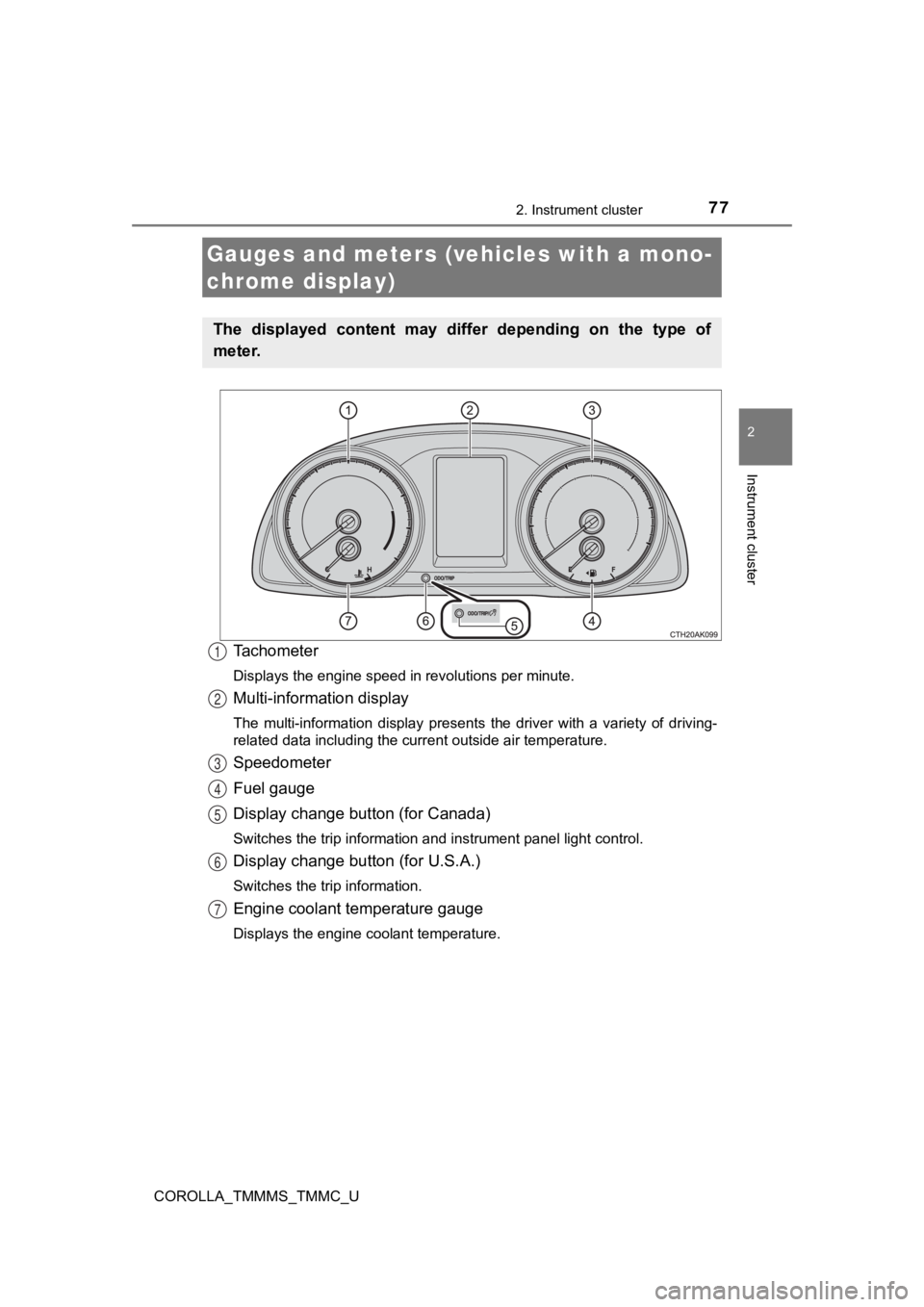
Tachometer
Displays the engine speed in revolutions per minute.
Multi-information display
The multi-information display presents the driver with a variety of driving-
related data including the current outside air temperature.
Speedometer
Fuel gauge
Display change button (for Canada)
Switches the trip information and instrument panel light contro l.
Display change button (for U.S.A.)
Switches the trip information.
Engine coolant temperature gauge
Displays the engine coolant temperature.
Gauges and meters (vehicles with a mono-
chrome display)
The displayed content may differ depending on the type of
meter.
1
2
3
4
5
6
7
Page 82 of 608

822. Instrument cluster
COROLLA_TMMMS_TMMC_U■
Driving range
Displays the estimated maximum distance that can be driven with
the quantity of fuel remaining.
• This distance is computed based on your average fuel consumpti
on. As
a result, the actual distance that can be driven may differ fro m that dis-
played.
• When only a small amount of fuel is added to the tank, the dis play may
not be updated.
When refueling, turn the engine switch off. If the vehicle is r efueled with-
out turning the engine switch off, the display may not be updat ed.
■
Average vehicle speed
Displays the average vehicle speed since the engine was last
started.
■Elapsed time
Displays the elapsed time sin ce the engine was started.
■Customization
Some settings can be changed . (Customizable features: P. 5 6 4 )
■Eco Driving Indicator Zone Disp lay (vehicles with a continu-
ously variable transmission)
P. 1 0 0