light TOYOTA COROLLA HATCHBACK 2022 (in English) Workshop Manual
[x] Cancel search | Manufacturer: TOYOTA, Model Year: 2022, Model line: COROLLA HATCHBACK, Model: TOYOTA COROLLA HATCHBACK 2022Pages: 758, PDF Size: 155.26 MB
Page 145 of 758
143
3
3-3. Adjusting the seats
Before driving
WA R N I N G
●Do not allow children to enter the
luggage compartment.
●Be careful not to get your hand
caught when folding the rear
seatbacks.
●Adjust the position of the front seats
before folding down the rear
seatbacks so that th e front seats do not interfere with the rear seatbacks
when folding down the rear
seatbacks.
●Make sure that the rear seat is free
of passengers before operating the luggage room lever (if equipped).
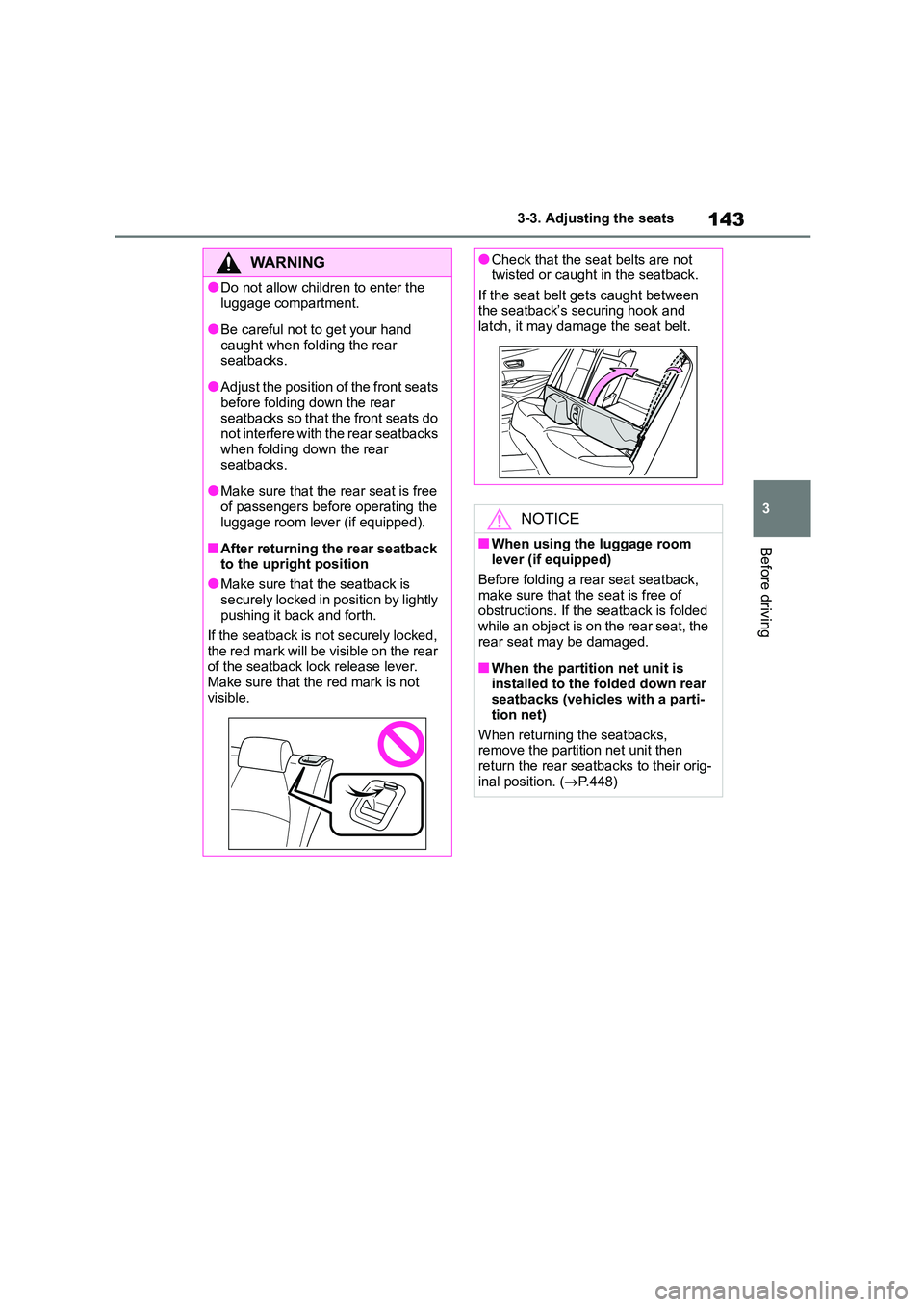
■After returning the rear seatback to the upright position
●Make sure that the seatback is
securely locked in position by lightly pushing it back and forth.
If the seatback is not securely locked,
the red mark will be visible on the rear of the seatback lock release lever.
Make sure that the red mark is not
visible.
●Check that the seat belts are not twisted or caught in the seatback.
If the seat belt gets caught between
the seatback’s securing hook and latch, it may damage the seat belt.
NOTICE
■When using the luggage room
lever (if equipped)
Before folding a rear seat seatback, make sure that the seat is free of
obstructions. If the seatback is folded
while an object is on the rear seat, the rear seat may be damaged.
■When the partition net unit is installed to the folded down rear
seatbacks (vehicles with a parti-
tion net)
When returning the seatbacks,
remove the partition net unit then
return the rear seatbacks to their orig- inal position. ( P.448)
Page 149 of 758
147
3
3-4. Adjusting the steering wheel and mirrors
Before driving
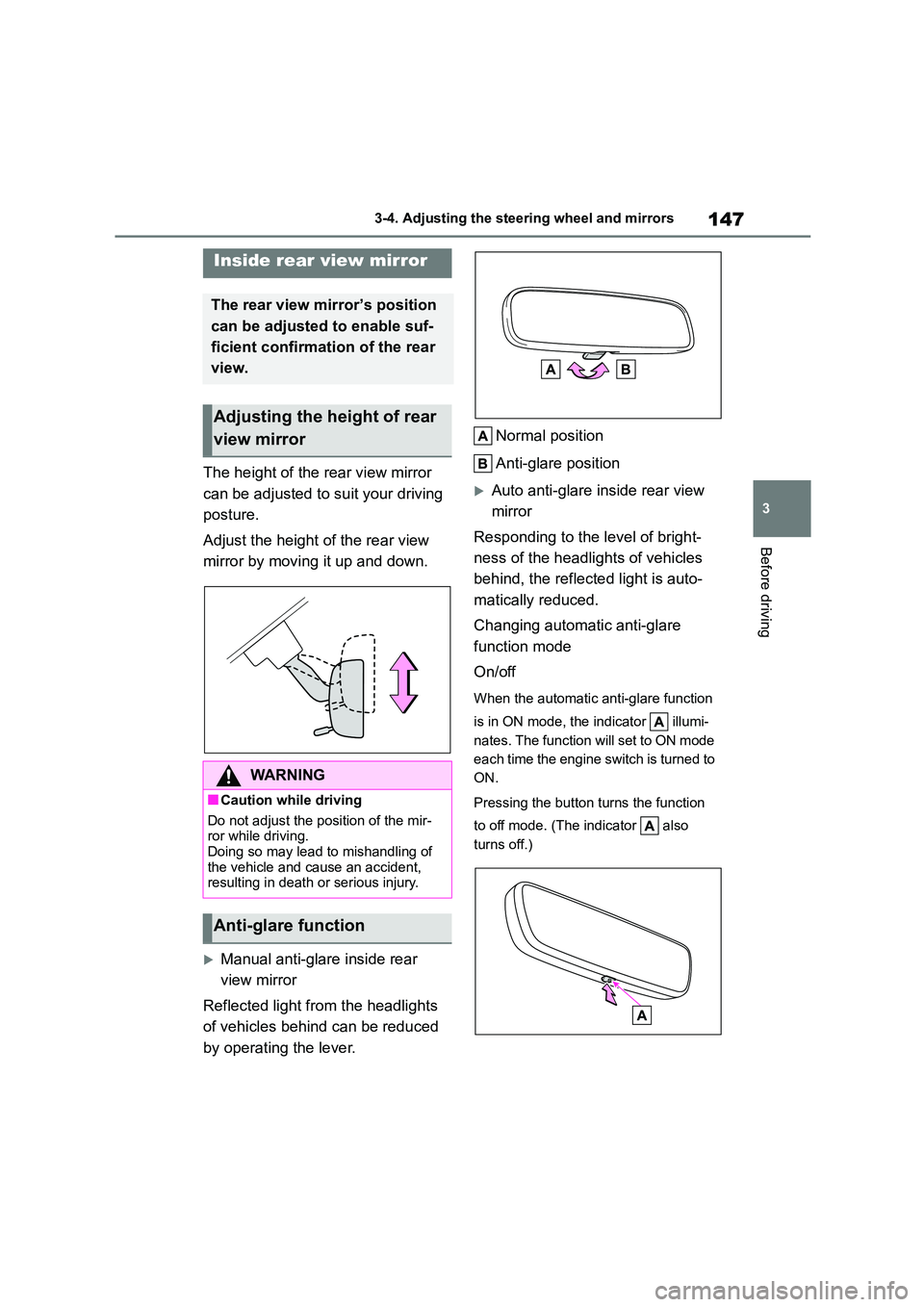
The height of the rear view mirror
can be adjusted to suit your driving
posture.
Adjust the height of the rear view
mirror by moving it up and down.
Manual anti-glare inside rear
view mirror
Reflected light from the headlights
of vehicles behind can be reduced
by operating the lever.
Normal position
Anti-glare position
Auto anti-glare inside rear view
mirror
Responding to the level of bright-
ness of the headlig hts of vehicles
behind, the reflected light is auto-
matically reduced.
Changing automatic anti-glare
function mode
On/off
When the automatic anti-glare function
is in ON mode, the indicator illumi-
nates. The function will set to ON mode
each time the engine switch is turned to
ON.
Pressing the button turns the function
to off mode. (The indicator also
turns off.)
Inside rear view mirror
The rear view mirror’s position
can be adjusted to enable suf-
ficient confirmation of the rear
view.
Adjusting the height of rear
view mirror
WA R N I N G
■Caution while driving
Do not adjust the position of the mir-
ror while driving. Doing so may lead to mishandling of
the vehicle and cause an accident,
resulting in death or serious injury.
Anti-glare function
Page 153 of 758
151
3
3-5. Opening and closing the windows
Before driving
3-5.Opening and closing the windows
The power windows can be opened
and closed using the switches.
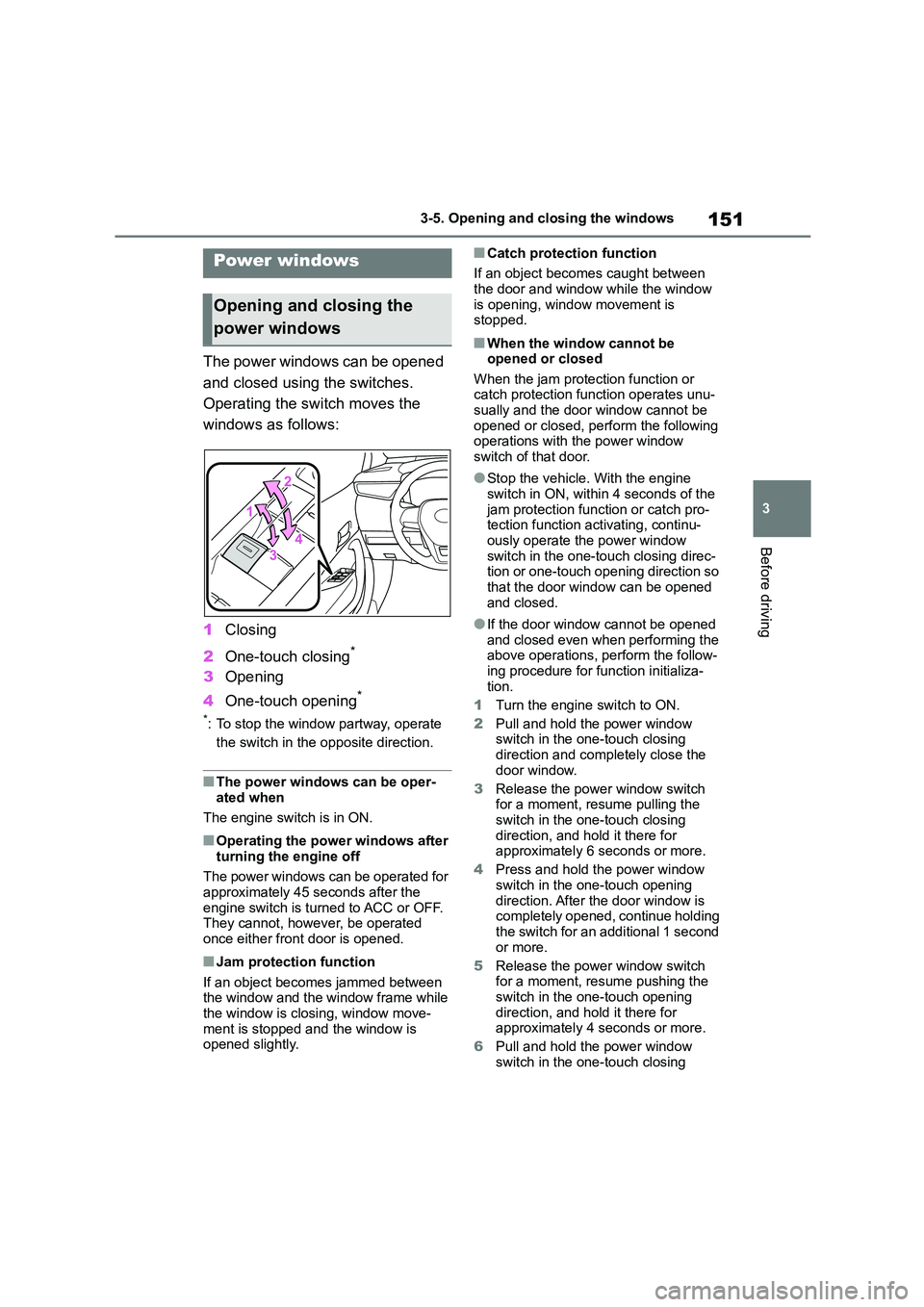
Operating the switch moves the
windows as follows:
1 Closing
2 One-touch closing*
3Opening
4 One-touch opening*
*: To stop the window partway, operate
the switch in the opposite direction.
■The power windows can be oper-
ated when
The engine switch is in ON.
■Operating the power windows after
turning the engine off
The power windows can be operated for approximately 45 seconds after the
engine switch is turned to ACC or OFF.
They cannot, however, be operated once either front door is opened.
■Jam protection function
If an object becomes jammed between
the window and the window frame while the window is closing, window move-
ment is stopped and the window is
opened slightly.
■Catch protection function
If an object becomes caught between the door and window while the window
is opening, window movement is
stopped.
■When the window cannot be opened or closed
When the jam protection function or
catch protection function operates unu- sually and the door window cannot be
opened or closed, perform the following
operations with the power window switch of that door.
●Stop the vehicle. With the engine switch in ON, within 4 seconds of the
jam protection function or catch pro-
tection function activating, continu- ously operate the power window
switch in the one-touch closing direc-
tion or one-touch opening direction so that the door window can be opened
and closed.
●If the door window cannot be opened
and closed even when performing the
above operations, perform the follow- ing procedure for function initializa-
tion.
1 Turn the engine switch to ON.
2 Pull and hold the power window
switch in the one-touch closing direction and completely close the
door window.
3 Release the power window switch
for a moment, resume pulling the switch in the one-touch closing
direction, and hold it there for
approximately 6 seconds or more.
4 Press and hold the power window switch in the one-touch opening
direction. After the door window is
completely opened, continue holding
the switch for an additional 1 second or more.
5 Release the power window switch
for a moment, resume pushing the
switch in the one-touch opening direction, and hold it there for
approximately 4 seconds or more.
6 Pull and hold the power window
switch in the one-touch closing
Power windows
Opening and closing the
power windows
Page 156 of 758
1543-5. Opening and closing the windows
*: If equipped
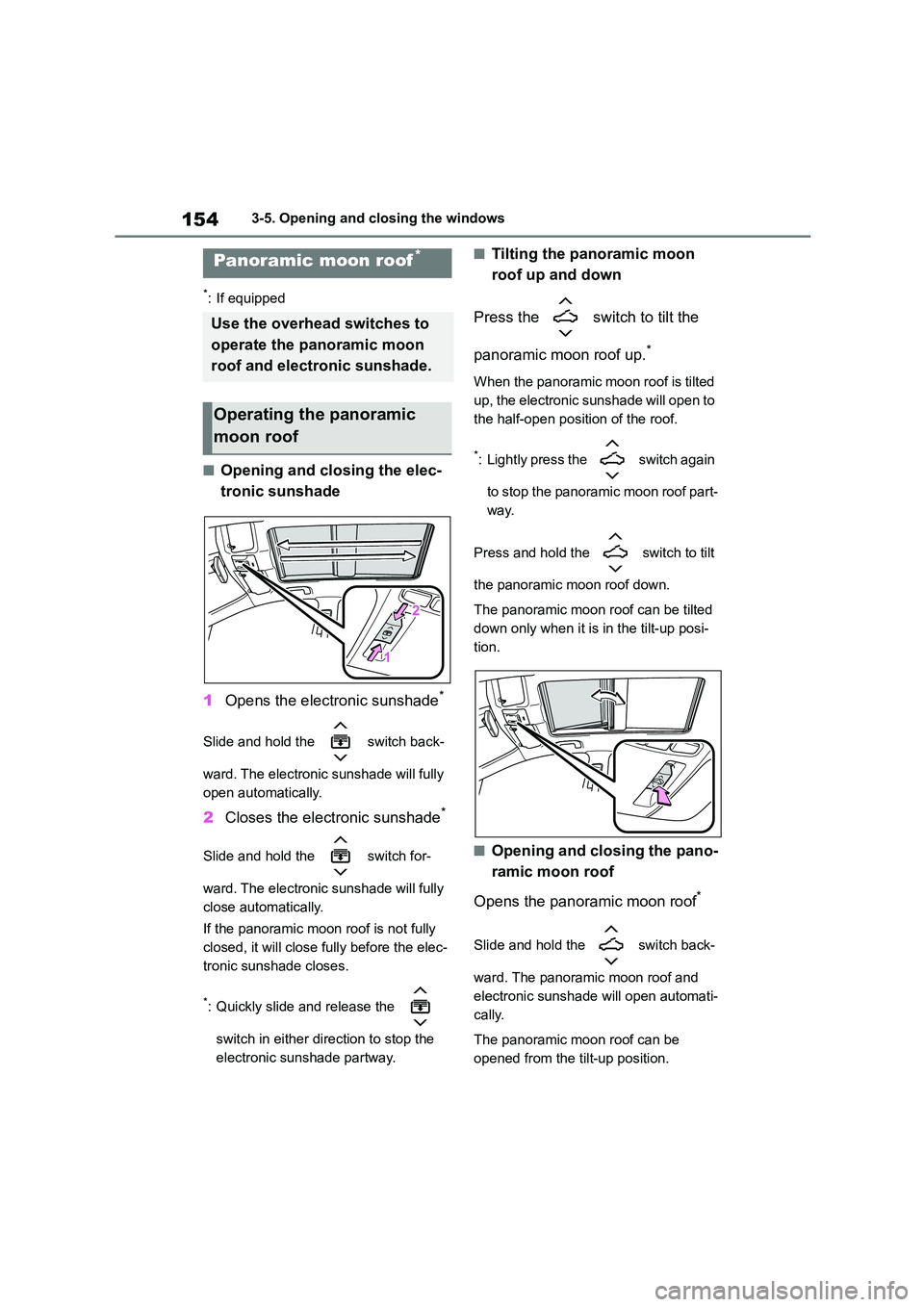
■Opening and closing the elec-
tronic sunshade
1 Opens the electronic sunshade*
Slide and hold the switch back-
ward. The electronic sunshade will fully
open automatically.
2 Closes the electronic sunshade*
Slide and hold the switch for-
ward. The electronic sunshade will fully
close automatically.
If the panoramic moon roof is not fully
closed, it will close fully before the elec-
tronic sunshade closes.
*: Quickly slide and release the
switch in either di rection to stop the
electronic sunshade partway.
■Tilting the panoramic moon
roof up and down
Press the switch to tilt the
panoramic moon roof up.*
When the panoramic moon roof is tilted
up, the electronic sunshade will open to
the half-open position of the roof.
*: Lightly press the switch again
to stop the panoramic moon roof part-
way.
Press and hold the switch to tilt
the panoramic moon roof down.
The panoramic moon roof can be tilted
down only when it is in the tilt-up posi-
tion.
■Opening and closing the pano-
ramic moon roof
Opens the panoramic moon roof*
Slide and hold the switch back-
ward. The panoramic moon roof and
electronic sunshade will open automati-
cally.
The panoramic moon roof can be
opened from the tilt-up position.
Panoramic moon roof*
Use the overhead switches to
operate the panoramic moon
roof and electronic sunshade.
Operating the panoramic
moon roof
Page 157 of 758
155
3
3-5. Opening and closing the windows
Before driving
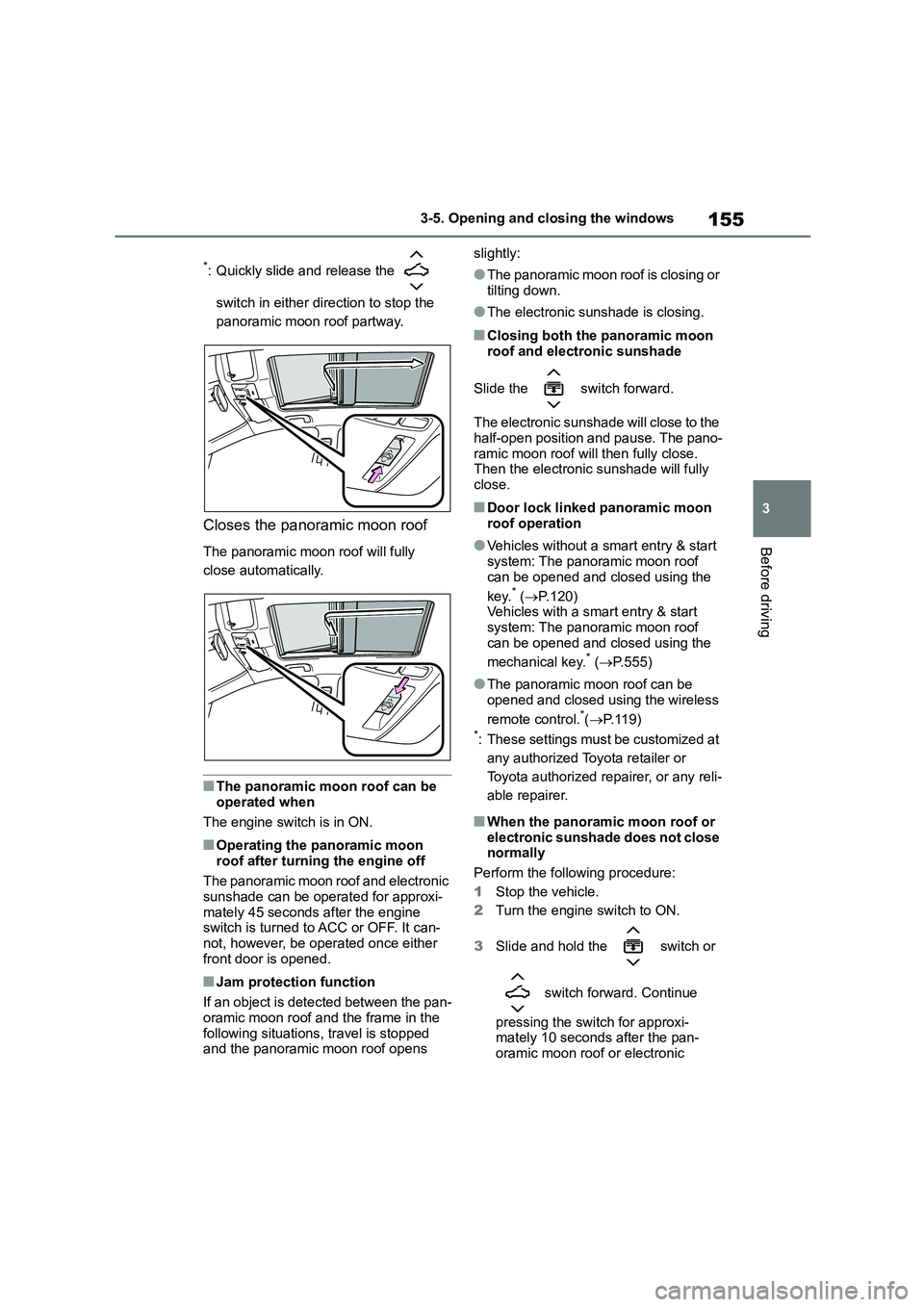
*: Quickly slide and release the
switch in either di rection to stop the
panoramic moon roof partway.
Closes the panoramic moon roof
The panoramic moon roof will fully
close automatically.
■The panoramic moon roof can be
operated when
The engine switch is in ON.
■Operating the panoramic moon
roof after turning the engine off
The panoramic moon roof and electronic sunshade can be operated for approxi-
mately 45 seconds after the engine
switch is turned to ACC or OFF. It can- not, however, be operated once either
front door is opened.
■Jam protection function
If an object is detected between the pan-
oramic moon roof and the frame in the following situations, travel is stopped
and the panoramic moon roof opens
slightly:
●The panoramic moon roof is closing or
tilting down.
●The electronic sunshade is closing.
■Closing both the panoramic moon
roof and electronic sunshade
Slide the switch forward.
The electronic sunshade will close to the half-open position and pause. The pano-
ramic moon roof will then fully close.
Then the electronic sunshade will fully close.
■Door lock linked panoramic moon
roof operation
●Vehicles without a smart entry & start
system: The panoramic moon roof
can be opened and closed using the
key.* ( P.120) Vehicles with a smart entry & start
system: The panoramic moon roof
can be opened and closed using the
mechanical key.* ( P.555)
●The panoramic moon roof can be
opened and closed using the wireless
remote control.*( P.119)*: These settings must be customized at
any authorized Toyota retailer or
Toyota authorized repairer, or any reli-
able repairer.
■When the panoramic moon roof or
electronic sunshade does not close
normally
Perform the following procedure:
1 Stop the vehicle.
2 Turn the engine switch to ON.
3 Slide and hold the switch or
switch forward. Continue
pressing the switch for approxi- mately 10 seconds after the pan-
oramic moon roof or electronic
Page 159 of 758
157
3
3-5. Opening and closing the windows
Before driving
WA R N I N G
●When using the wireless remote
control, key or mechanical key and
operating the panoramic moon roof, operate the panoramic moon roof
after checking to make sure that
there is no possibility of any pas- senger having any of their body
parts caught in the panoramic moon
roof. Also, do not let a child operate
panoramic moon roof by the wire- less remote control, key or mechan-
ical key. It is possible for children
and other passengers to get caught in the panoramic moon roof.
●When exiting the vehicle, turn the engine switch off, carry the key and
exit the vehicle along with the child.
There may be accidental opera- tion, due to mischief, etc., that may
possibly lead to an accident.
■Jam protection function
●Never use any part of your body to
intentionally activate the jam pro- tection function.
●The jam protection function may not work if something gets caught just
before the panoramic moon roof or
electronic sunshade is fully closed. Also, the jam protection function is
not designed to operate while the
switch is being pr essed. Take care so that your fingers, etc. do not get
caught.
■To prevent burns or injuries
Do not touch the area between the
underside of the panoramic moon roof and the electronic sunshade.
Your hand may get caught and you
could injure yourself. Also, if the vehi- cle is left in direct sunlight for a long
time, the underside of the panoramic
moon roof could become very hot and could cause burns.
NOTICE
■To prevent damage to the pano-
ramic moon roof
●Before opening the panoramic moon roof, make sure that there are
no foreign objects, such as stones
or ice, around the opening.
●Do not hit the surface or edge of the
panoramic moon roof with hard
objects.
■After the vehicle has been
washed or rained on
Before opening the panoramic moon
roof, wipe any water off the pano-
ramic moon roof. Otherwise, water may enter the cabin when the pano-
ramic moon roof is opened.
Page 161 of 758
4
159
4
Driving
Driving
.4-1. Before driving
Driving the vehicle ............ 161
Cargo and luggage ........... 168
Trailer towing .................... 170
4-2. Driving procedures
Engine (ignition) switch (vehi-
cles without a smart entry &
start system) ................... 177
Engine (ignition) switch (vehi-
cles with a smart entry & start
system) ........................... 178
Multidrive .......................... 182
Manual transmission ......... 186
Turn signal lever ............... 189
Parking brake ................... 189
Brake Hold ........................ 192
4-3. Operating the lights and wip-
ers
Headlight switch ............... 195
Automatic High Beam ....... 199
AHS (Adaptive High-beam
System) .......................... 201
Fog light switch ................. 205
Windshield wipers and washer
....................................... 206
Rear window wiper and washer
....................................... 209
4-4. Refueling
Opening the fuel tank cap
....................................... 211
4-5. Using the driving support
systems
Toyota Safety Sense......... 213
PCS (Pre-Collision System)
........................................ 224
LTA (Lane Tracing Assist)
........................................ 231
LDA (Lane Departure Alert with
steering control) .............. 241
Dynamic radar cruise control
with full-speed range ...... 249
Dynamic radar cruise control
........................................ 260
Cruise control.................... 271
Speed limiter ..................... 273
RSA (Road Sign Assist) .... 276
Stop & Start system .......... 280
BSM (Blind Spot Monitor)
........................................ 288
Toyota parking assist-sensor
........................................ 303
RCTA (Rear Crossing Traffic
Alert) function ................. 312
PKSB (Parking Support Brake)
........................................ 317
Parking Support Brake function
(static objects) ................ 324
Parking Support Brake function
(rear-crossing vehicles) .. 327
S-IPA (Simple Intelligent Park-
ing Assist System) .......... 329
Driving mode select switch
........................................ 355
Exhaust Gas Filter system
........................................ 356
Driving assist systems ...... 357
Page 164 of 758
1624-1. Before driving
Vehicles with a smart entry &
start system: Press the engine
switch to stop the engine.
4 Slowly release the brake pedal.
5 Lock the door, making sure that
you have the key on your per-
son.
If parking on a hill, block the wheels as
needed.
Manual transmission
1 While depressing the clutch
pedal, depress the brake pedal.
2 If the parking brake is in manual
mode, set the parking brake.
( P.189)
Check that the parking brake indicator
is illuminated.
3 Shift the shift lever to N.
( P.186)
If parking on a hill, shift the shift lever to
1 or R and block the wheels as needed.
4 Vehicles without a smart entry &
start system: Turn the engine
switch to OFF to stop the
engine.
Vehicles with a smart entry &
start system: Press the engine
switch to stop the engine.
5 Slowly release the brake pedal.
6 Lock the door, making sure that
you have the key on your per-
son.
■Starting off on a steep uphill
Multidrive
1 Make sure that the parking
brake is set and shift the shift
lever to D.
2 Gently depress the accelerator
pedal.
3 Release the parking brake.
Manual transmission
1 Make sure that the parking
brake is set and shift the shift
lever to 1.
2 Lightly depress the accelerator
pedal at the same time as grad-
ually releasing the clutch pedal.
3 Release the parking brake.
■Driving in the rain
●Drive carefully when it is raining,
because visibility will be reduced, the
windows may become fogged-up, and the road will be slippery.
●Drive carefully when it starts to rain, because the road surface will be
especially slippery.
●Refrain from high speeds when driv-
ing on an expressway in the rain,
because there may be a layer of water between the tires and the road sur-
face, preventing the steering and
brakes from operating properly.
■Engine speed while driving (vehi-
cles with a Multidrive)
In the following conditions, the engine
speed may become high while driving.
This is due to automatic up-shifting con- trol or down-shifting implementation to
meet driving conditions. It does not indi-
cate sudden acceleration.
●The vehicle is judged to be driving
uphill or downhill
●When the accelerator pedal is
released
●When the brake pedal is depressed
while Sport mode is selected
■Restraining the engine output (Brake Override System)
●When the accelerator and brake ped-
Page 166 of 758
1644-1. Before driving
WA R N I N G
• When backing up, you may twist
your body around, leading to a diffi-
culty in operating the pedals. Make sure to operate the pedals properly.
• Make sure to keep a correct driving posture even when moving the
vehicle only slightly. This allows you
to depress the brake and accelera-
tor pedals properly.
• Depress the brake pedal using your
right foot. Depressing the brake pedal using your left foot may delay
response in an emergency, result-
ing in an accident.
●Do not drive the vehicle over or
stop the vehicle near flammable materials.
The exhaust system and exhaust
gases can be extremely hot. These hot parts may cause a fire if there is
any flammable material nearby.
●During normal driving, do not turn
off the engine. Turning the engine
off while driving will not cause loss of steering or braking control, but
the power assist to these systems
will be lost. This will make it more difficult to steer and brake, so you
should pull over and stop the vehi-
cle as soon as it is safe to do so. However, in the event of an emer-
gency, such as if it becomes impos-
sible to stop the vehicle in the normal way: P. 5 0 2
●Use engine braking (downshift) to maintain a safe speed when driving
down a steep hill.
Using the brakes continuously may cause the brakes to overheat and
lose effectiveness. (P.182, 186)
●Do not adjust the positions of the
steering wheel, the seat, or the
inside or outside rear view mirrors while driving.
Doing so may result in a loss of
vehicle control.
●Always check that all passengers’ arms, heads or other parts of their
body are not outside the vehicle.
■When driving on slippery road
surfaces
●Sudden braking, acceleration and steering may cause tire slippage
and reduce your ability to control
the vehicle.
●Sudden acceleration, engine brak-
ing due to shifting, or changes in engine speed could cause the vehi-
cle to skid.
●After driving through a puddle,
lightly depress the brake pedal to
make sure that the brakes are func- tioning properly. Wet brake pads
may prevent the brakes from func-
tioning properly. If the brakes on only one side are wet and not func-
tioning properly, steering control
may be affected.
■When shifting the shift lever
●Vehicles with a Multidrive: Do not let the vehicle roll backward while a
forward driving position is selected,
or roll forward while the shift lever is in R.
Doing so may cause the engine to
stall or lead to poor brake and steering performance, resulting in
an accident or damage to the vehi-
cle.
●Vehicles with a Multidrive: Do not
shift the shift lever to P while the vehicle is moving.
Doing so can damage the transmis-
sion and may result in a loss of vehicle control.
●Do not shift the shift lever to R while
the vehicle is moving forward. Doing so can damage the transmis-
sion and may result in a loss of
vehicle control.
Page 167 of 758
165
4
4-1. Before driving
Driving
WA R N I N G
●Do not shift the shift lever to a driv-
ing position while the vehicle is
moving backward. Doing so can damage the transmis-
sion and may result in a loss of
vehicle control.
●Moving the shift lever to N while the
vehicle is moving will disengage the
engine from the transmission. Engine braking is not available
when N is selected.
●Vehicles with a Multidrive: Be care-
ful not to shift the shift lever with the
accelerator pedal depressed. Shift- ing the shift lever to any positions
other than P or N may lead to unex-
pected rapid acceleration of the vehicle that may cause an accident
and result in death or serious injury.
■If you hear a squealing or scrap-
ing noise (brake pad wear indica-
tors)
Have the front and rear brake pads
checked at the same time and
replaced by any authorized Toyota retailer or Toyota authorized repairer,
or any reliable repairer as soon as
possible.
Rotor damage may result if the pads
are not replaced when needed.
It is dangerous to drive the vehicle
when the wear limits of the brake pads and/or those of the brake discs
are exceeded.
■When the vehicle is stopped
●Do not race the engine.
If the vehicle is in any gear other than P (Multidrive) or N, the vehicle
may accelerate suddenly and unex-
pectedly, causing an accident.
●Vehicles with a Multidrive: In order to prevent accidents due to the
vehicle rolling away, always keep
depressing the brake pedal while the engine is running, and apply the
parking brake as necessary.
●If the vehicle is stopped on an
incline, in order to prevent acci-
dents caused by the vehicle rolling forward or backward, always
depress the brake pedal and
securely apply the parking brake as needed.
●Avoid revving or racing the engine.Running the engine at high speed
while the vehicle is stopped may
cause the exhaust system to over- heat, which could result in a fire if
combustible material is nearby.
■When the vehicle is parked
●Do not leave glasses, cigarette
lighters, spray cans, or soft drink cans in the vehicle when it is in the
sun.
Doing so may result in the follow- ing:
• Gas may leak from a cigarette
lighter or spray can, and may lead to a fire.
• The temperature inside the vehicle may cause the plastic lenses and
plastic material of glasses to
deform or crack.
• Soft drink cans may fracture, caus-
ing the contents to spray over the interior of the vehicle, and may also
cause a short circuit in the vehicle’s
electrical components.
●Do not leave cigarette lighters in the
vehicle. If a cigarette lighter is in a
place such as the glove box or on the floor, it may be lit accidentally
when luggage is loaded or the seat
is adjusted, causing a fire.