light TOYOTA COROLLA HATCHBACK 2022 (in English) Repair Manual
[x] Cancel search | Manufacturer: TOYOTA, Model Year: 2022, Model line: COROLLA HATCHBACK, Model: TOYOTA COROLLA HATCHBACK 2022Pages: 758, PDF Size: 155.26 MB
Page 168 of 758
1664-1. Before driving
WA R N I N G
●Do not attach adhesive discs to the
windshield or windows. Do not
place containers such as air fresh- eners on the instrument panel or
dashboard. Adhesive discs or con-
tainers may act as lenses, causing a fire in the vehicle.
●Do not leave a door or window
open if the curved glass is coated with a metallized film such as a sil-
ver-colored one. Reflected sunlight
may cause the glass to act as a lens, causing a fire.
●Always apply the parking brake, shift the shift lever to P (vehicles
with a Multidrive), stop the engine
and lock the vehicle. Do not leave the vehicle unat-
tended while the engine is running.
If the vehicle is parked with the shift lever in P but the parking brake is
not set, the vehicl e may start to
move, possibly leading to an acci- dent.
●Do not touch the exhaust pipes while the engine is running or
immediately after turning the engine
off. Doing so may cause burns.
■When taking a nap in the vehicle
Always turn the engine off. Otherwise,
if you accidentally move the shift lever
or depress the accelerator pedal, this could cause an accident or fire due to
engine overheating. Additionally, if the
vehicle is parked in a poorly ventilated area, exhaust gases may collect and
enter the vehicle, leading to death or
a serious health hazard.
■When braking
●When the brakes are wet, drive
more cautiously.
Braking distance increases when the brakes are wet, and this may
cause one side of the vehicle to
brake differently than the other side. Also, the parking brake may
not securely hold the vehicle.
●If the brake booster device does not
operate, do not follow other vehi-
cles closely and avoid hills or sharp turns that require braking.
In this case, braking is still possible,
but the brake pedal should be depressed more firmly than usual.
Also, the braking distance will
increase. Have your brakes fixed immediately.
●Do not pump the brake pedal if the engine stalls.
Each push on the brake pedal uses
up the reserve for the power-assisted brakes.
●The brake system consists of 2 indi-vidual hydraulic systems; if one of
the systems fails, the other will still
operate. In this case, the brake pedal should be depressed more
firmly than usual and the braking
distance will increase. Have your brakes fixed immediately.
■If the vehicle becomes stuck
Do not spin the wheels excessively
when a driven wheel is up in the air,
or the vehicle is stuck in sand, mud, etc. This may damage the driveline
components or propel the vehicle for-
ward or backward, causing an acci-
dent.
Page 173 of 758
171
4
4-1. Before driving
Driving
Capacity), and permissible drawbar
load before towing. ( P.566)
Toyota recommends the use of the
Toyota hitch/bracket for your vehi-
cle. Other products of a suitable
nature and comparable quality may
also be used.
For vehicles where the towing
device blocks any of the lights or
license plate, the following shall be
observed:
Do not use towing devices that
cannot be easily removed or
repositioned.
Towing devices must be
removed or repositioned when
not in use.
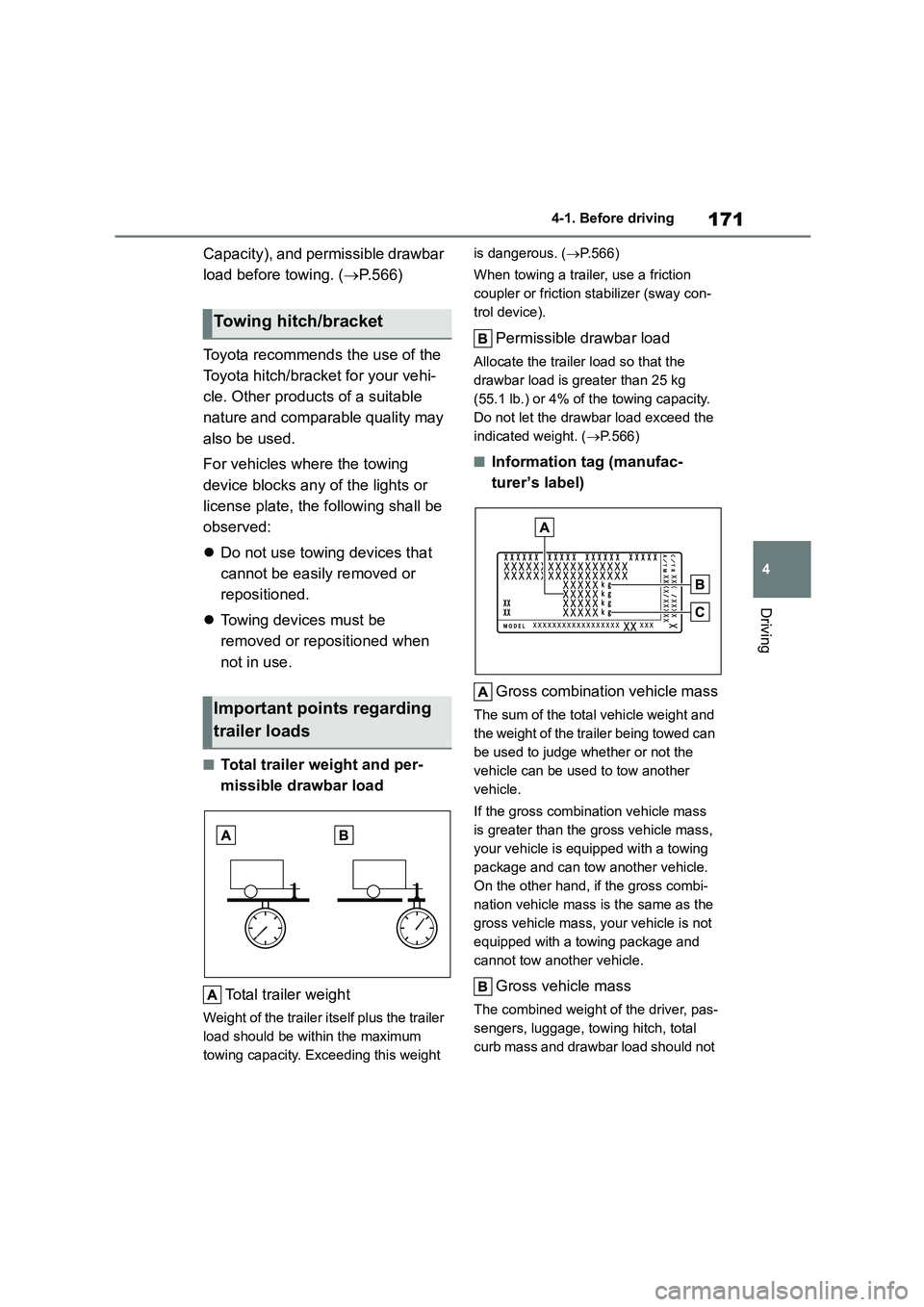
■Total trailer weight and per-
missible drawbar load
Total trailer weight
Weight of the trailer itself plus the trailer
load should be within the maximum
towing capacity. Exceeding this weight
is dangerous. ( P.566)
When towing a trailer, use a friction
coupler or friction stabilizer (sway con-
trol device).
Permissible drawbar load
Allocate the trailer load so that the
drawbar load is greater than 25 kg
(55.1 lb.) or 4% of the towing capacity.
Do not let the drawbar load exceed the
indicated weight. ( P.566)
■Information tag (manufac-
turer’s label)
Gross combination vehicle mass
The sum of the total vehicle weight and
the weight of the trailer being towed can
be used to judge whether or not the
vehicle can be used to tow another
vehicle.
If the gross combination vehicle mass
is greater than the gross vehicle mass,
your vehicle is equipped with a towing
package and can tow another vehicle.
On the other hand, if the gross combi-
nation vehicle mass is the same as the
gross vehicle mass, your vehicle is not
equipped with a towing package and
cannot tow another vehicle.
Gross vehicle mass
The combined weight of the driver, pas-
sengers, luggage, towing hitch, total
curb mass and drawbar load should not
Towing hitch/bracket
Important points regarding
trailer loads
Page 176 of 758
1744-1. Before driving
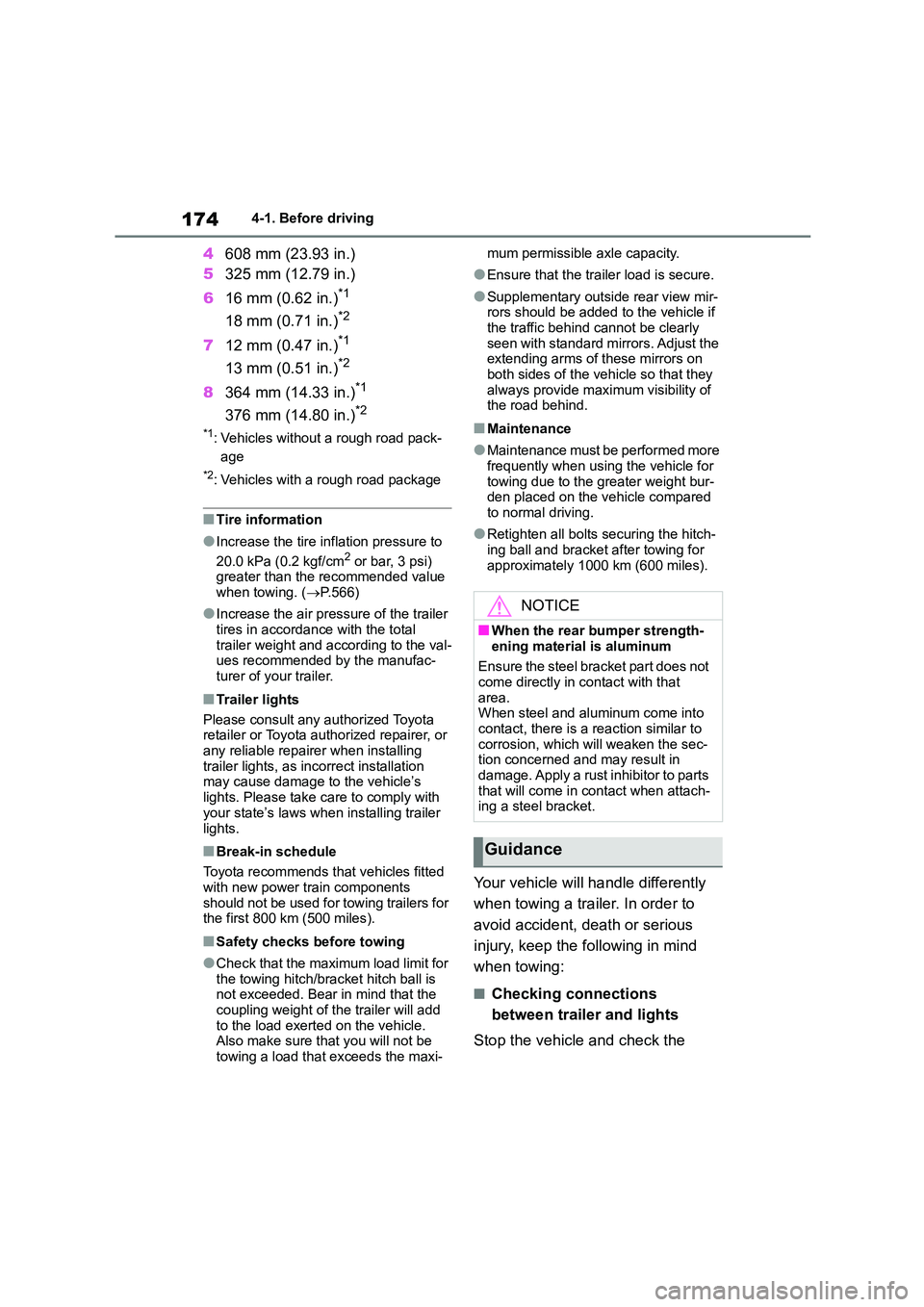
4608 mm (23.93 in.)
5 325 mm (12.79 in.)
6 16 mm (0.62 in.)*1
18 mm (0.71 in.)*2
712 mm (0.47 in.)*1
13 mm (0.51 in.)*2
8364 mm (14.33 in.)*1
376 mm (14.80 in.)*2
*1: Vehicles without a rough road pack-
age
*2: Vehicles with a rough road package
■Tire information
●Increase the tire inflation pressure to
20.0 kPa (0.2 kgf/cm2 or bar, 3 psi) greater than the recommended value
when towing. ( P.566)
●Increase the air pressure of the trailer
tires in accordance with the total
trailer weight and according to the val- ues recommended by the manufac-
turer of your trailer.
■Trailer lights
Please consult any authorized Toyota retailer or Toyota authorized repairer, or
any reliable repairer when installing
trailer lights, as in correct installation may cause damage to the vehicle’s
lights. Please take care to comply with
your state’s laws when installing trailer
lights.
■Break-in schedule
Toyota recommends that vehicles fitted
with new power train components
should not be used for towing trailers for the first 800 km (500 miles).
■Safety checks before towing
●Check that the maximum load limit for the towing hitch/bracket hitch ball is
not exceeded. Bear in mind that the
coupling weight of the trailer will add to the load exerted on the vehicle.
Also make sure that you will not be
towing a load that exceeds the maxi-
mum permissible axle capacity.
●Ensure that the trailer load is secure.
●Supplementary outside rear view mir- rors should be added to the vehicle if
the traffic behind cannot be clearly
seen with standard mirrors. Adjust the extending arms of these mirrors on
both sides of the vehicle so that they
always provide maximum visibility of the road behind.
■Maintenance
●Maintenance must be performed more frequently when using the vehicle for
towing due to the greater weight bur-
den placed on the vehicle compared to normal driving.
●Retighten all bolts securing the hitch-ing ball and bracket after towing for
approximately 1000 km (600 miles).
Your vehicle will handle differently
when towing a trailer. In order to
avoid accident, death or serious
injury, keep the following in mind
when towing:
■Checking connections
between trailer and lights
Stop the vehicle and check the
NOTICE
■When the rear bumper strength-
ening material is aluminum
Ensure the steel bracket part does not
come directly in contact with that
area. When steel and aluminum come into
contact, there is a reaction similar to
corrosion, which will weaken the sec- tion concerned and may result in
damage. Apply a rust inhibitor to parts
that will come in contact when attach- ing a steel bracket.
Guidance
Page 177 of 758
175
4
4-1. Before driving
Driving
operation of the connection
between the trailer and lights after
driving for a brief period as well as
before starting off.
■Practicing driving with a cou-
pled trailer
Get the feel for turning, stopping
and reversing with the trailer
coupled by practicing in an area
with no or light traffic.
When reversing with a coupled
trailer, hold the section of the
steering wheel nearest to you
and rotate clockw ise to turn the
trailer left or counterclockwise to
turn it right. Always rotate a little
at a time to prevent steering
error. Have someone guide you
when reversing to lessen the risk
of an accident.
■Increasing vehicle-to-vehicle
distance
At a speed of 10 km/h (6 mph), the
distance to the vehicle running
ahead of you should be equivalent
to or greater than the combined
length of your vehicle and trailer.
Avoid sudden braking that may
cause skidding. Otherwise, the
vehicle may spin out of control. This
is especially true when driving on
wet or slippery road surfaces.
■Sudden acceleration/steering
input/cornering
Executing sharp turns when towing
may result in th e trailer colliding
with your vehicle. Decelerate well in
advance when approaching turns
and take them slowly and carefully
to avoid sudden braking.
■Important points regarding
turning
The wheels of the tr ailer will travel
closer to the inside of the curve
than the wheels of the vehicle. To
make allowance for this, take the
turns wider than you would nor-
mally do.
■Important points regarding
stability
Vehicle movement resulting from
uneven road surfaces and strong
crosswinds will affect handling. The
vehicle may also be rocked by
passing buses or large trucks. Fre-
quently check behind when moving
alongside such vehicles. As soon
as such vehicle movement occurs,
immediately start to decelerate
smoothly by slowly applying the
brakes. Always steer the vehicle
straight ahead while braking.
■Passing other vehicles
Consider the total combined length
of your vehicle and trailer and
ensure that the vehicle-to-vehicle
distance is sufficient before execut-
ing lane changes.
■Transmission information
Multidrive
To maintain engine braking effi-
ciency and charging system perfor-
mance when using engine braking,
do not use the transmission in D,
Page 178 of 758
1764-1. Before driving
must be in M and select gear step 4
or lower. ( P. 1 8 2 )
Manual transmission
Refrain from driving in 6th gear to
maintain the effectiveness of
engine braking and to maintain
charging system performance.
■If the engine overheats
Towing a loaded trailer up a long,
steep incline in temperatures
exceeding 30°C (85°F) may result
in the engine overheating. If the
engine coolant temperature gauge
indicates that the engine is over-
heating, turn the air conditioning off
immediately, leave the road and
stop the vehicle in a safe place.
( P.560)
■When parking the vehicle
Always place wheel chocks under
the wheels of both the vehicle and
trailer. Firmly set the parking brake
and shift the shift lever to P
(Multidrive) and 1 or R (manual
transmission).
WA R N I N G
Follow all the instructions described in this section. Failure to do so could
cause an accident resulting in death
or serious injury.
■Trailer towing precautions
When towing, make sure that none of the weight limits are exceeded.
( P.171)
■Vehicle speed in towing
Observe the legal maximum speeds
for trailer towing.
■Before descending hills or long declines
Reduce speed and downshift. How-
ever, never downshift suddenly while descending steep or long downhill
grades.
■Operation of the brake pedal
Do not hold the brake pedal
depressed often or for long periods of time. Doing so may result in the brake
overheating or reduce braking effects.
■To avoid accident or injury
●Vehicles with a compact spare tire:
Do not tow a trailer when the com- pact spare tire is installed on your
vehicle.
●Vehicles with the emergency tire
puncture repair kit: Do not tow a
trailer when the tire installed is repaired with the emergency tire
puncture repair kit.
●Do not use the following systems
when trailer towing.
• Cruise control (if equipped)
• Dynamic radar cruise control (if
equipped)
• Dynamic radar cruise control with
full-speed range (if equipped)
NOTICE
■Do not directly splice trailer lights
Directly splicing trailer lights may
damage your vehicle’s electrical sys- tem and cause a malfunction.
Page 179 of 758
177
4
4-2. Driving procedures
Driving
4-2.Driving procedures
1 Pull the parking brake switch to
check that the parking brake is
set. ( P.189)
2 Check that the shift lever is in P
(Multidrive) or N (manual trans-
mission).
3 Firmly depress the brake pedal
(Multidrive) or clutch pedal
(manual transmission).
4 Turn the engine switch to
START to start the engine.
■If the engine does not start
The engine immobilizer system may not
have been deactivated. ( P.79) Contact
any authorized Toyota retailer or Toyota authorized repairer, or any reliable
repairer.
■When the steering lock cannot be
released
When starting the engine, the engine switch may seem stuck in OFF. To free
it, turn the key while turning the steering
wheel slightly left and right.
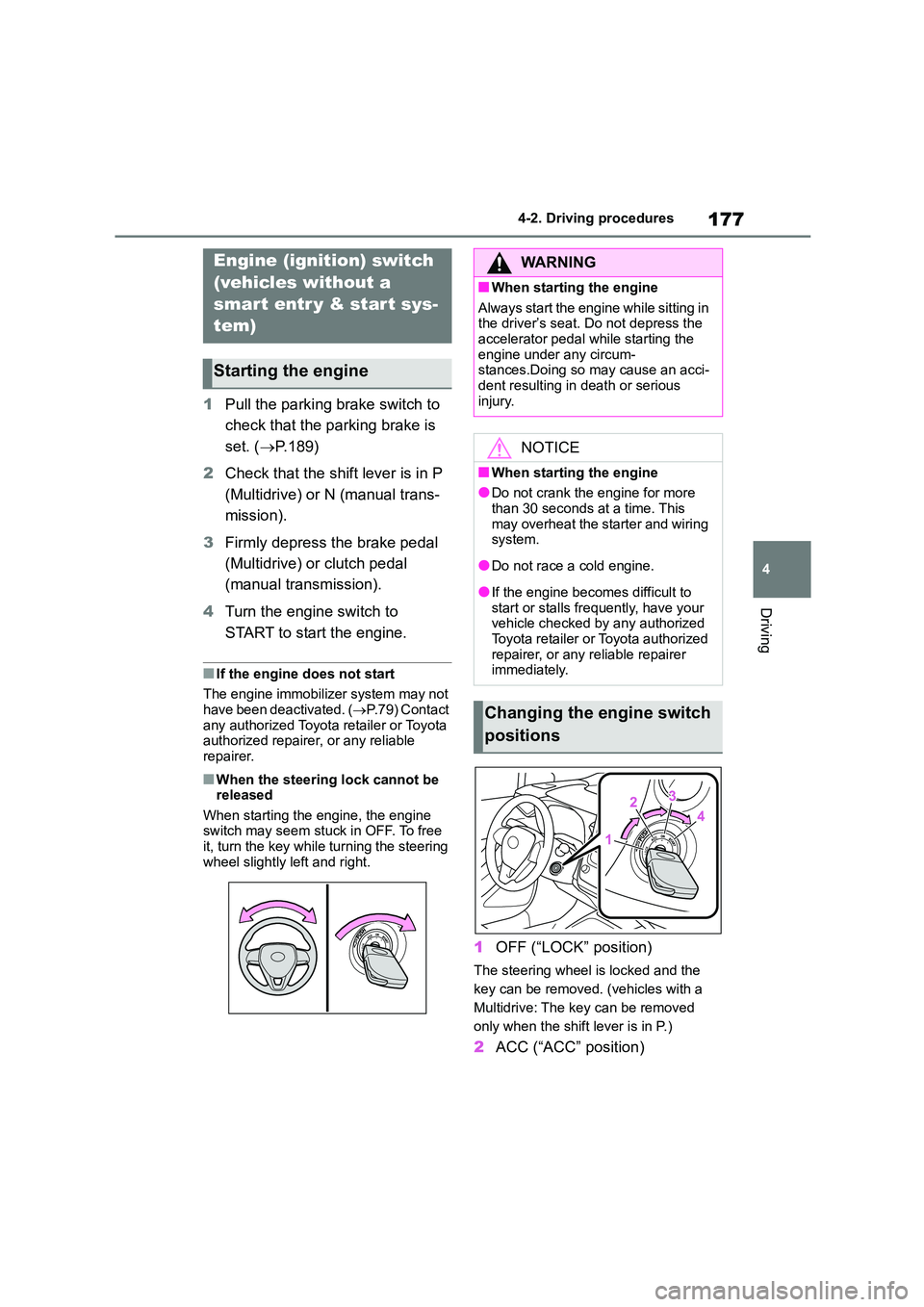
1 OFF (“LOCK” position)
The steering wheel is locked and the
key can be removed. (vehicles with a
Multidrive: The key can be removed
only when the shift lever is in P.)
2 ACC (“ACC” position)
Engine (ignition) switch
(vehicles without a
smar t entr y & start sys-
tem)
Starting the engine
WA R N I N G
■When starting the engine
Always start the engine while sitting in
the driver’s seat. Do not depress the accelerator pedal while starting the
engine under any circum-
stances.Doing so may cause an acci- dent resulting in death or serious
injury.
NOTICE
■When starting the engine
●Do not crank the engine for more
than 30 seconds at a time. This
may overheat the starter and wiring system.
●Do not race a cold engine.
●If the engine becomes difficult to
start or stalls frequently, have your vehicle checked by any authorized
Toyota retailer or Toyota authorized
repairer, or any reliable repairer immediately.
Changing the engine switch
positions
Page 182 of 758
1804-2. Driving procedures
Multidrive
1 Stop the vehicle completely.
2 Set the parking brake (P.189),
and shift the shift lever to P.
Check the parking brake indicator is
illuminated.
3 Press the engine switch.
The engine will stop, and the meter dis-
play will be extinguished.
4 Release the brake pedal and
check that “ACCESSORY” or
“IGNITION ON” is not shown on
the multi-information display.
Manual transmission
1 Stop the vehicle completely.
2 If the parking brake is in manual
mode, set the parking brake.
( P.189)
Check the parking brake indicator is illuminated.
3 Shift the shift lever to N.
( P.186)
4 Press the engine switch.
The engine will stop, and the meter dis-
play will be extinguished.
5 Release the brake pedal and
check that “ACCESSORY” or
“IGNITION ON” is not shown on
the multi-information display.
WA R N I N G
■Caution while driving
If engine failure occurs while the vehi-
cle is moving, do not lock or open the doors until the vehicle reaches a safe
and complete stop. Activation of the
steering lock in this circumstance may lead to an accident, resulting in death
or serious injury.
NOTICE
■When starting the engine
●Do not race a cold engine.
●If the engine becomes difficult to
start or stalls frequently, have your vehicle checked by any authorized
Toyota retailer or Toyota authorized
repairer, or any reliable repairer immediately.
■Symptoms indicating a malfunc-tion with the engine switch
If the engine switch seems to be oper-
ating somewhat differently than usual,
such as the switch sticking slightly, there may be a malfunction. Contact
any authorized Toyota retailer or
Toyota authorized repairer, or any reli- able repairer immediately.
Stopping the engine
WA R N I N G
■Stopping the engine in an emer-gency
●If you want to stop the engine in an
emergency while driving the vehi- cle, press and hold the engine
switch for more than 2 seconds, or
press it briefly 3 times or more in succession. (P.502)
However, do not touch the engine
switch while driving except in an emergency. Turning the engine off
while driving will not cause loss of
steering or braking control, but the power assist to these systems will
be lost. This will make it more diffi-
cult to steer and brake, so you should pull over and stop the vehi-
cle as soon as it is safe to do so.
●If the engine switch is operated
while the vehicle is running, a warn-
ing message will be shown on the multi-information display and a
buzzer sounds.
Page 189 of 758
187
4
4-2. Driving procedures
Driving
The iMT optimally controls the
engine speed to suit the driver’s
operation of the clutch pedal and
shift lever, helping the driver to shift
gears more smoothly.
Additionally, when the clutch pedal
is operated, the iMT helps reduce
shift shock, allowing for lighter shift
operations when driving on a wind-
ing road or incline.
When Sport mode is selected by
operating the driving mode select
switch, the iMT will be enabled and
the iMT indicator will come on.
( P. 3 5 5 )
■The iMT may not operate when
In the following situations, iMT may not operate. However, this does not indicate
a malfunction.
●The clutch pedal is not fully depressed
●The clutch pedal is not fully released,
such as if a foot is resting on the
clutch pedal*
●Shift operation is performed after the vehicle has been coasting with the
shift lever in N
●The shift lever is not operated for a
long time after the clutch pedal is
depressed*: After the shift lever is moved, unless
your foot is completely removed from
the clutch pedal, the iMT may not
operate and the engine speed may
not be controlled optimally for the next
gear change.
To enable the iMT, release the clutch
pedal completely and then depress it
again before operating the shift lever.
■If the iMT indicator illuminates in
amber
The iMT may be temporarily unavailable
or malfunctioning. Have the vehicle
inspected at any authorized Toyota retailer or Toyota authorized repairer, or
any reliable repairer.
NOTICE
■To prevent damage to the vehicle
When shifting gears, observe the fol-
lowing precautions. Failure to do so may cause damage to the engine,
manual transmission, and/or clutch.
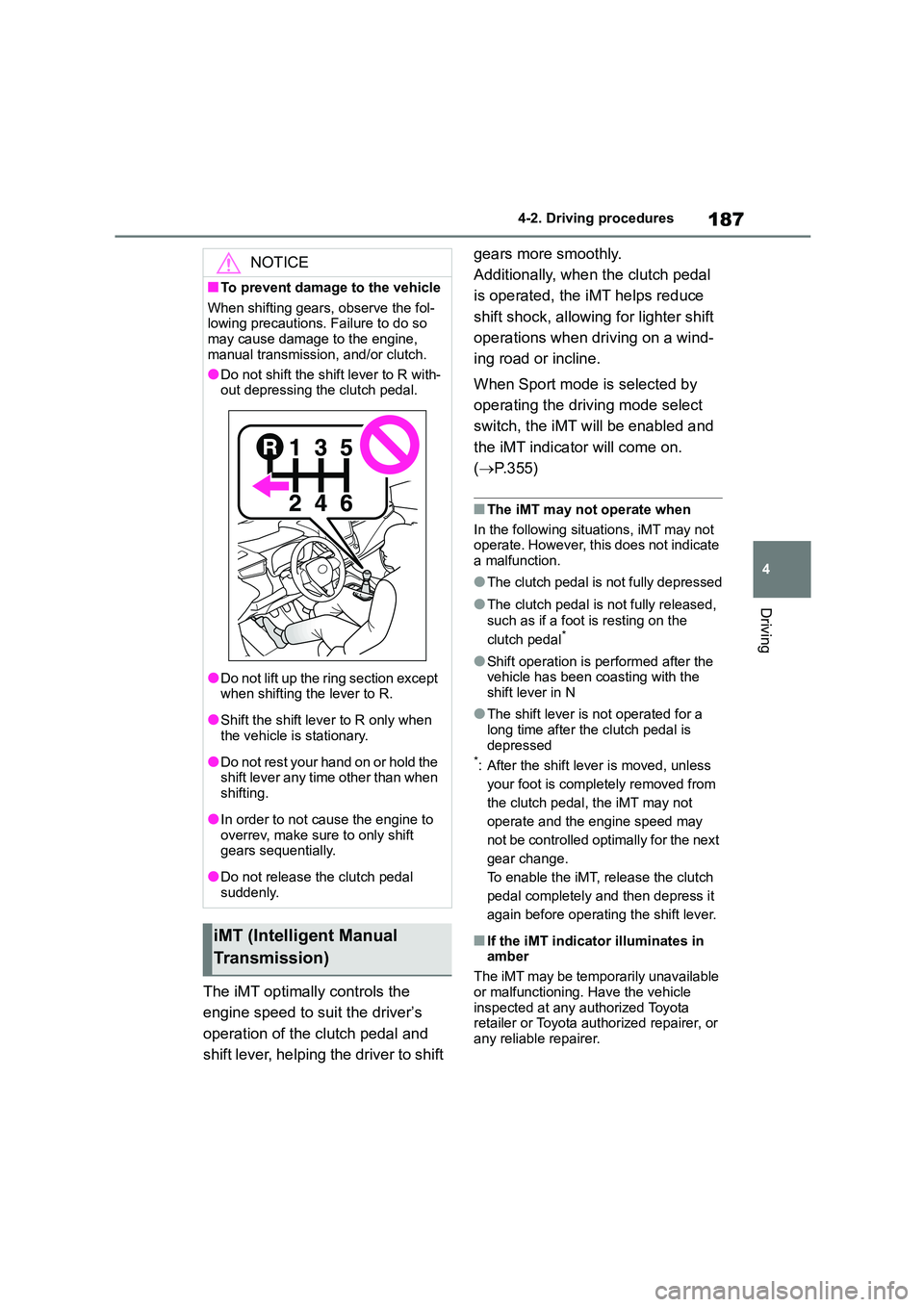
●Do not shift the shift lever to R with- out depressing the clutch pedal.
●Do not lift up the ring section except when shifting the lever to R.
●Shift the shift lever to R only when the vehicle is stationary.
●Do not rest your hand on or hold the shift lever any time other than when
shifting.
●In order to not cause the engine to
overrev, make sure to only shift
gears sequentially.
●Do not release the clutch pedal
suddenly.
iMT (Intelligent Manual
Transmission)
Page 191 of 758
189
4
4-2. Driving procedures
Driving
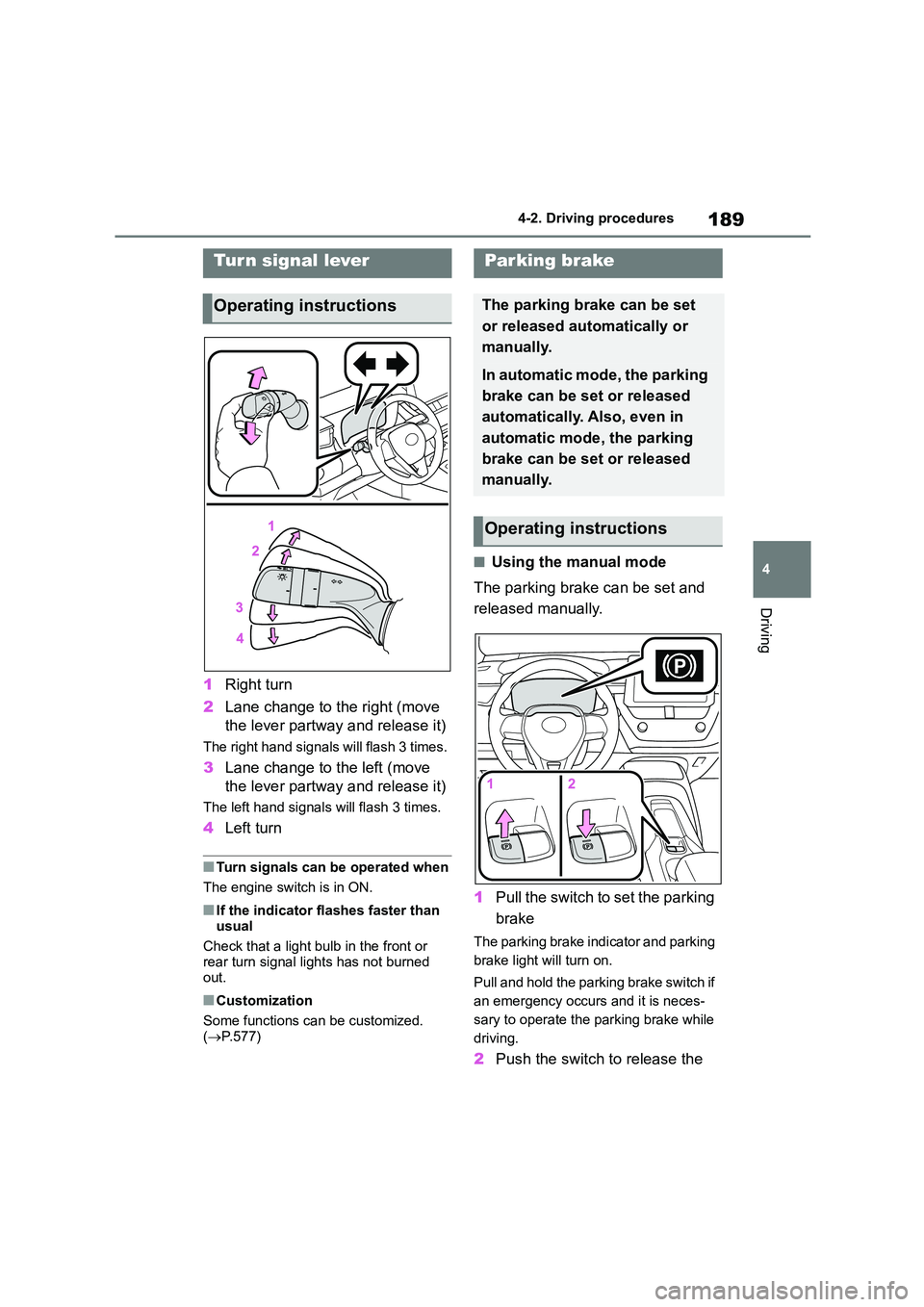
1 Right turn
2 Lane change to the right (move
the lever partway and release it)
The right hand signals will flash 3 times.
3 Lane change to the left (move
the lever partway and release it)
The left hand signals will flash 3 times.
4 Left turn
■Turn signals can be operated when
The engine switch is in ON.
■If the indicator flashes faster than
usual
Check that a light bulb in the front or rear turn signal lights has not burned
out.
■Customization
Some functions can be customized. ( P.577)
■Using the manual mode
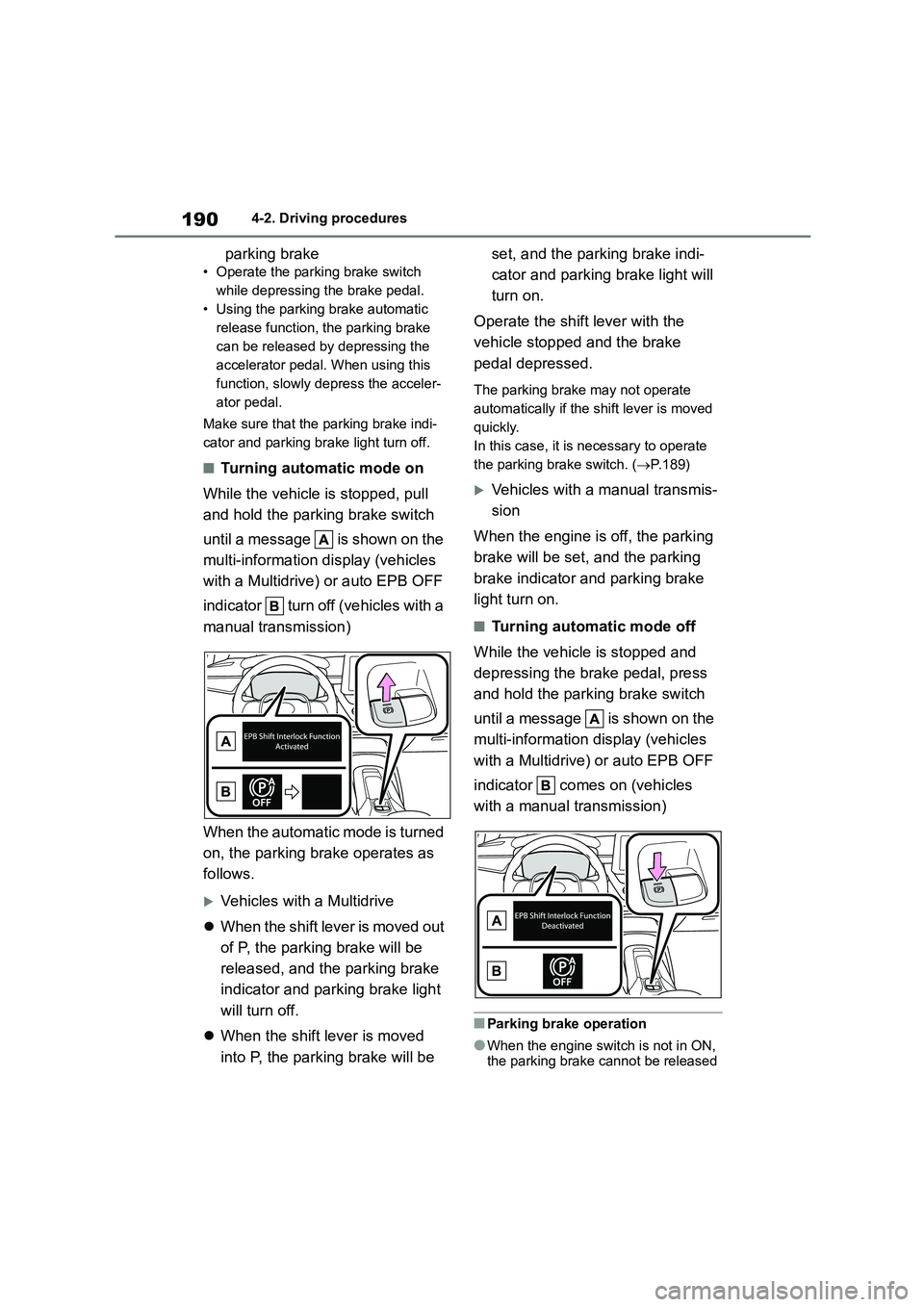
The parking brake can be set and
released manually.
1 Pull the switch to set the parking
brake
The parking brake indicator and parking
brake light will turn on.
Pull and hold the parking brake switch if
an emergency occurs and it is neces-
sary to operate the parking brake while
driving.
2 Push the switch to release the
Turn signal lever
Operating instructions
Parking brake
The parking brake can be set
or released automatically or
manually.
In automatic mode, the parking
brake can be set or released
automatically. Also, even in
automatic mode , the parking
brake can be set or released
manually.
Operating instructions
Page 192 of 758
1904-2. Driving procedures
parking brake
• Operate the parking brake switch
while depressing the brake pedal.
• Using the parking brake automatic
release function, the parking brake
can be released by depressing the
accelerator pedal. When using this
function, slowly depress the acceler-
ator pedal.
Make sure that the parking brake indi-
cator and parking brake light turn off.
■Turning automatic mode on
While the vehicle is stopped, pull
and hold the parking brake switch
until a message is shown on the
multi-information display (vehicles
with a Multidrive ) or auto EPB OFF
indicator turn off (vehicles with a
manual transmission)
When the automatic mode is turned
on, the parking brake operates as
follows.
Vehicles with a Multidrive
When the shift lever is moved out
of P, the parking brake will be
released, and the parking brake
indicator and parking brake light
will turn off.
When the shift lever is moved
into P, the parking brake will be
set, and the parking brake indi-
cator and parking brake light will
turn on.
Operate the shift lever with the
vehicle stopped and the brake
pedal depressed.
The parking brake may not operate
automatically if the shift lever is moved
quickly.
In this case, it is necessary to operate
the parking brake switch. ( P.189)
Vehicles with a manual transmis-
sion
When the engine is off, the parking
brake will be set, and the parking
brake indicator and parking brake
light turn on.
■Turning automatic mode off
While the vehicle is stopped and
depressing the brake pedal, press
and hold the parking brake switch
until a message is shown on the
multi-information display (vehicles
with a Multidrive) or auto EPB OFF
indicator comes on (vehicles
with a manual transmission)
■Parking brake operation
●When the engine switch is not in ON, the parking brake cannot be released