tow TOYOTA HIGHLANDER 2020 (in English) User Guide
[x] Cancel search | Manufacturer: TOYOTA, Model Year: 2020, Model line: HIGHLANDER, Model: TOYOTA HIGHLANDER 2020Pages: 560, PDF Size: 14.42 MB
Page 141 of 560
1413-3. Adjusting the seats
HIGHLANDER_U
3
Before driving
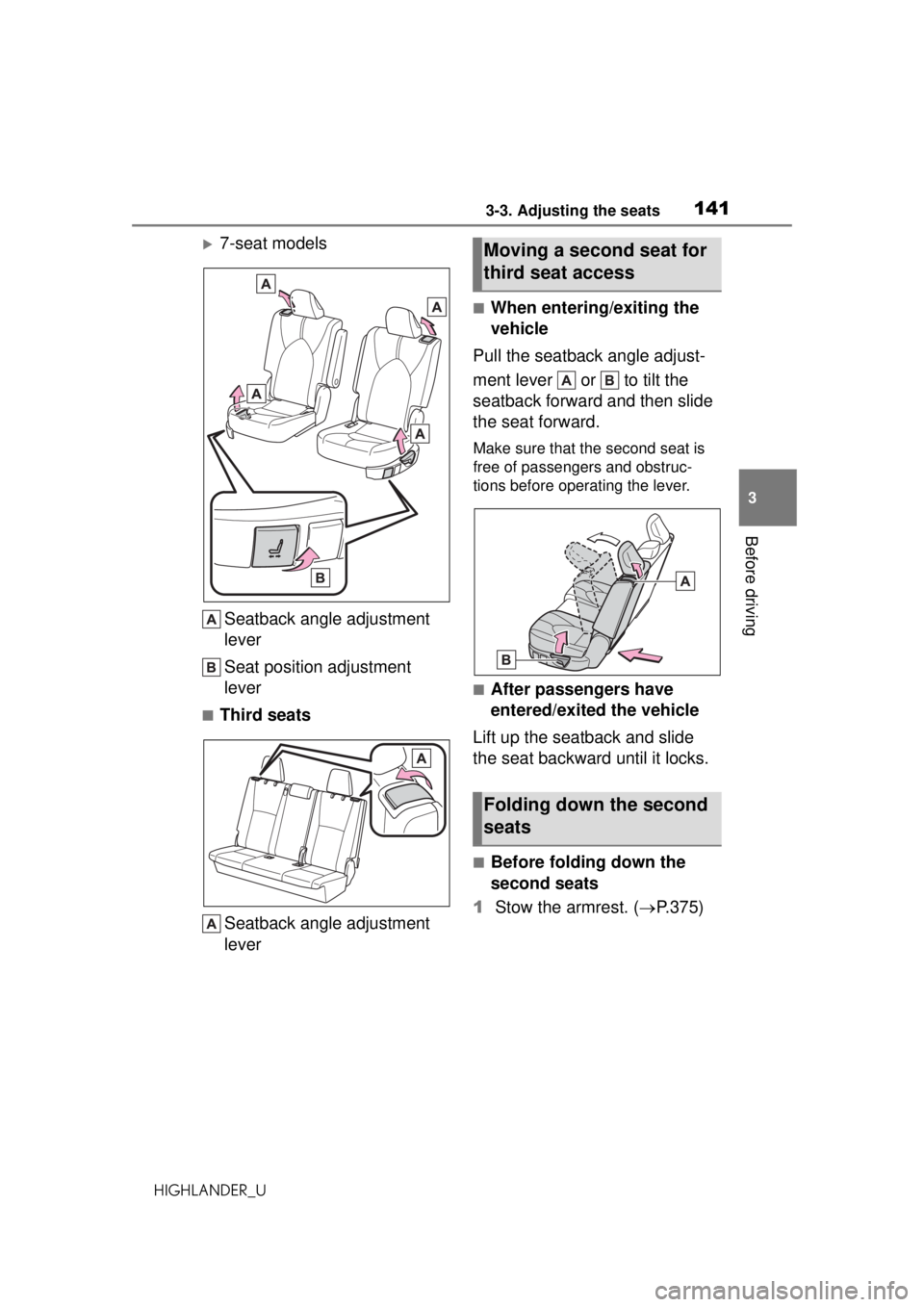
7-seat models Seatback angle adjustment
lever
Seat position adjustment
lever
■Third seatsSeatback angle adjustment
lever
■When entering/exiting the
vehicle
Pull the seatback angle adjust-
ment lever or to tilt the
seatback forward and then slide
the seat forward.
Make sure that the second seat is
free of passengers and obstruc-
tions before operating the lever.
■After passengers have
entered/exited the vehicle
Lift up the seatback and slide
the seat backward until it locks.
■Before folding down the
second seats
1 Stow the armrest. ( P.375)
Moving a second seat for
third seat access
Folding down the second
seats
Page 142 of 560
1423-3. Adjusting the seats
HIGHLANDER_U
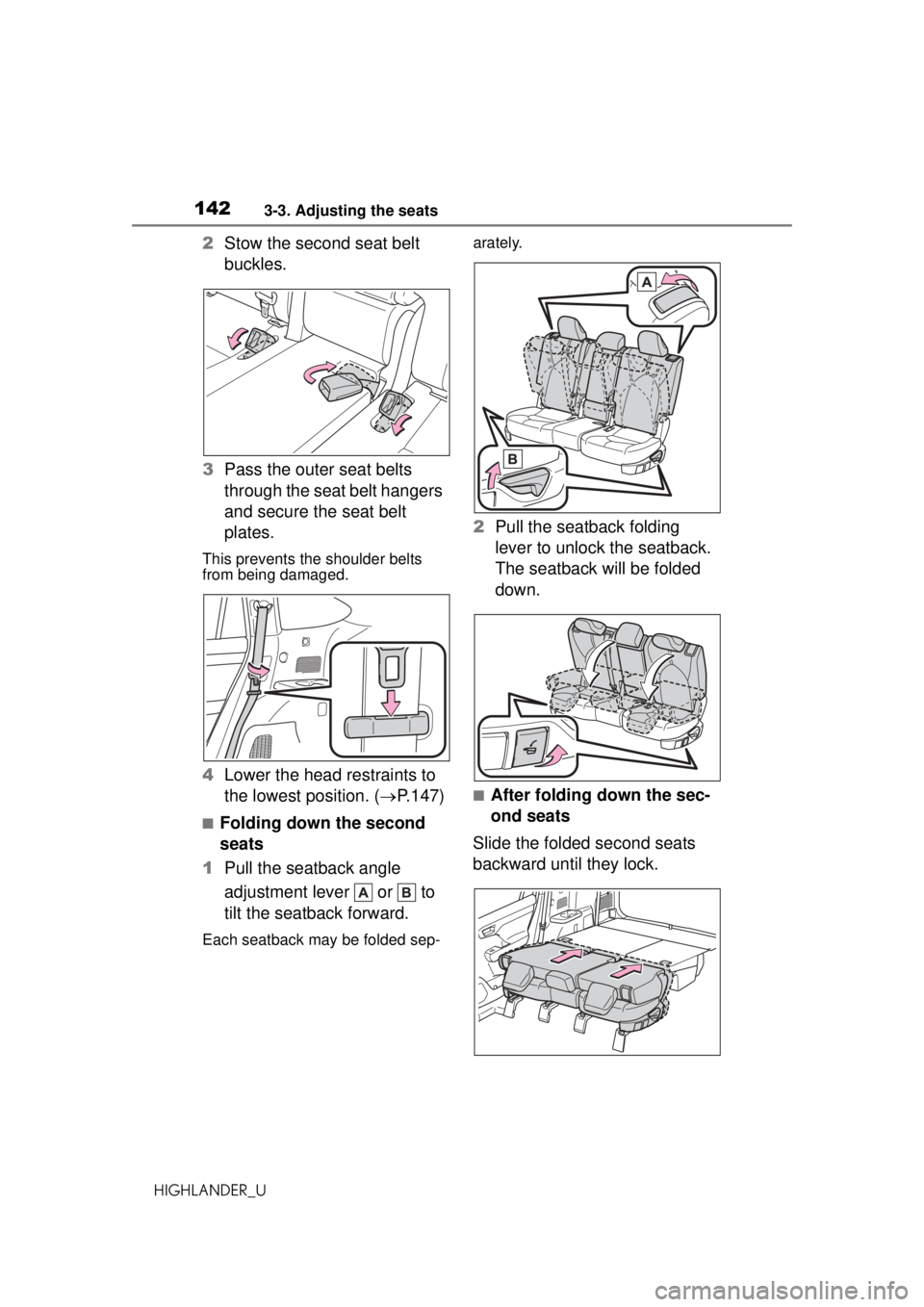
2Stow the second seat belt
buckles.
3 Pass the outer seat belts
through the seat belt hangers
and secure the seat belt
plates.
This prevents the shoulder belts
from being damaged.
4Lower the head restraints to
the lowest position. ( P.147)
■Folding down the second
seats
1 Pull the seatback angle
adjustment lever or to
tilt the seatback forward.
Each seatback may be folded sep- arately.
2
Pull the seatback folding
lever to unlock the seatback.
The seatback will be folded
down.
■After folding down the sec-
ond seats
Slide the folded second seats
backward until they lock.
Page 143 of 560
1433-3. Adjusting the seats
HIGHLANDER_U
3
Before driving
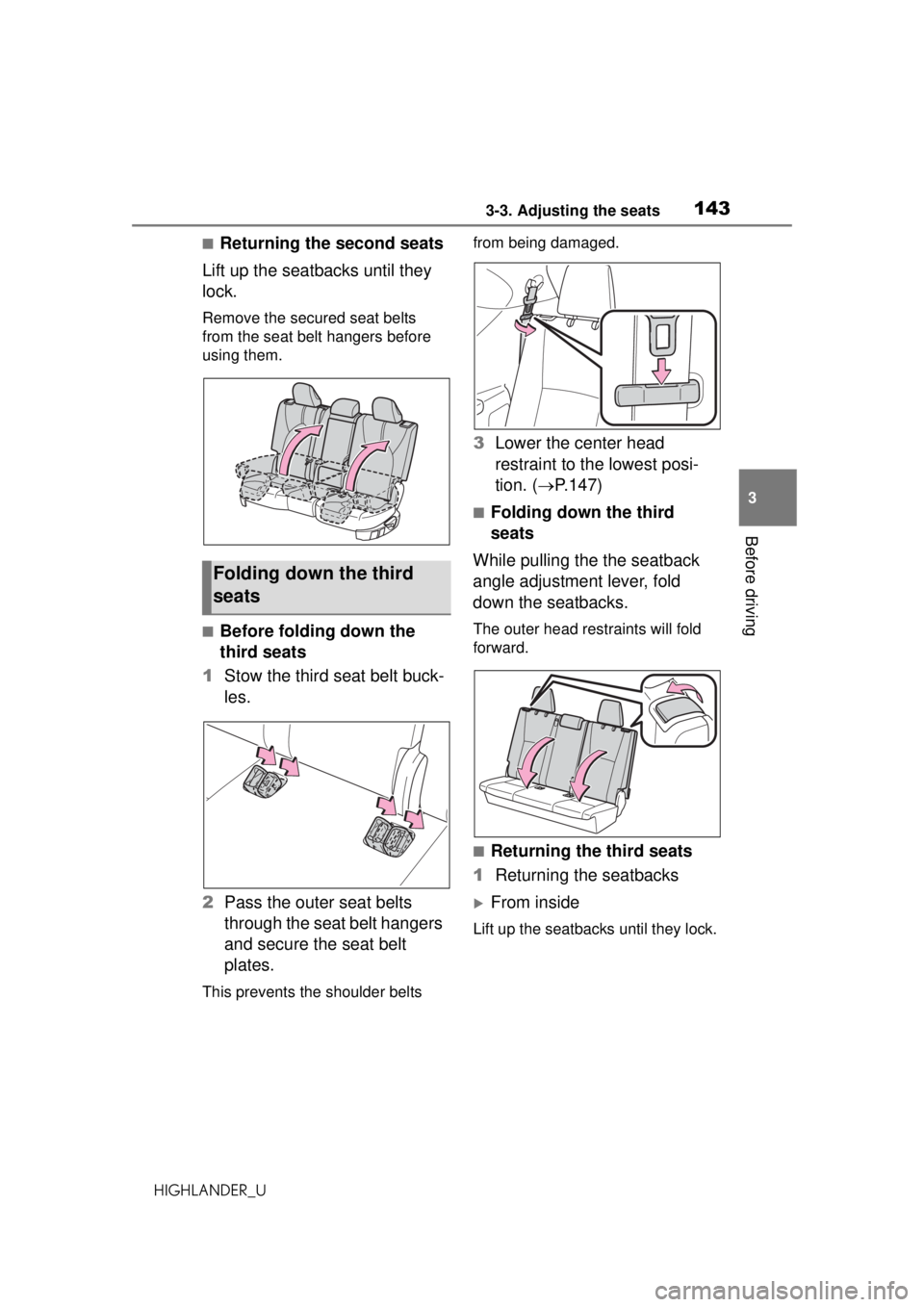
■Returning the second seats
Lift up the seatbacks until they
lock.
Remove the secu red seat belts
from the seat belt hangers before
using them.
■Before folding down the
third seats
1 Stow the third seat belt buck-
les.
2 Pass the outer seat belts
through the seat belt hangers
and secure the seat belt
plates.
This prevents the shoulder belts from being damaged.
3
Lower the center head
restraint to the lowest posi-
tion. ( P.147)
■Folding down the third
seats
While pulling the the seatback
angle adjustment lever, fold
down the seatbacks.
The outer head rest raints will fold
forward.
■Returning the third seats
1 Returning the seatbacks
From inside
Lift up the seatbacks until they lock.
Folding down the third
seats
Page 148 of 560
1483-3. Adjusting the seats
HIGHLANDER_UMake sure that the head restraints
are adjusted so that the center of
the head restraint is closest to the
top of your ears.
■Adjusting the third center seat
head restraint
Always raise the head restraint one
level from the stowed position when
using.
■When using the outboard third
seats
If a head restraint is folded forward,
make sure to return it to the upright
position. ( P.143)
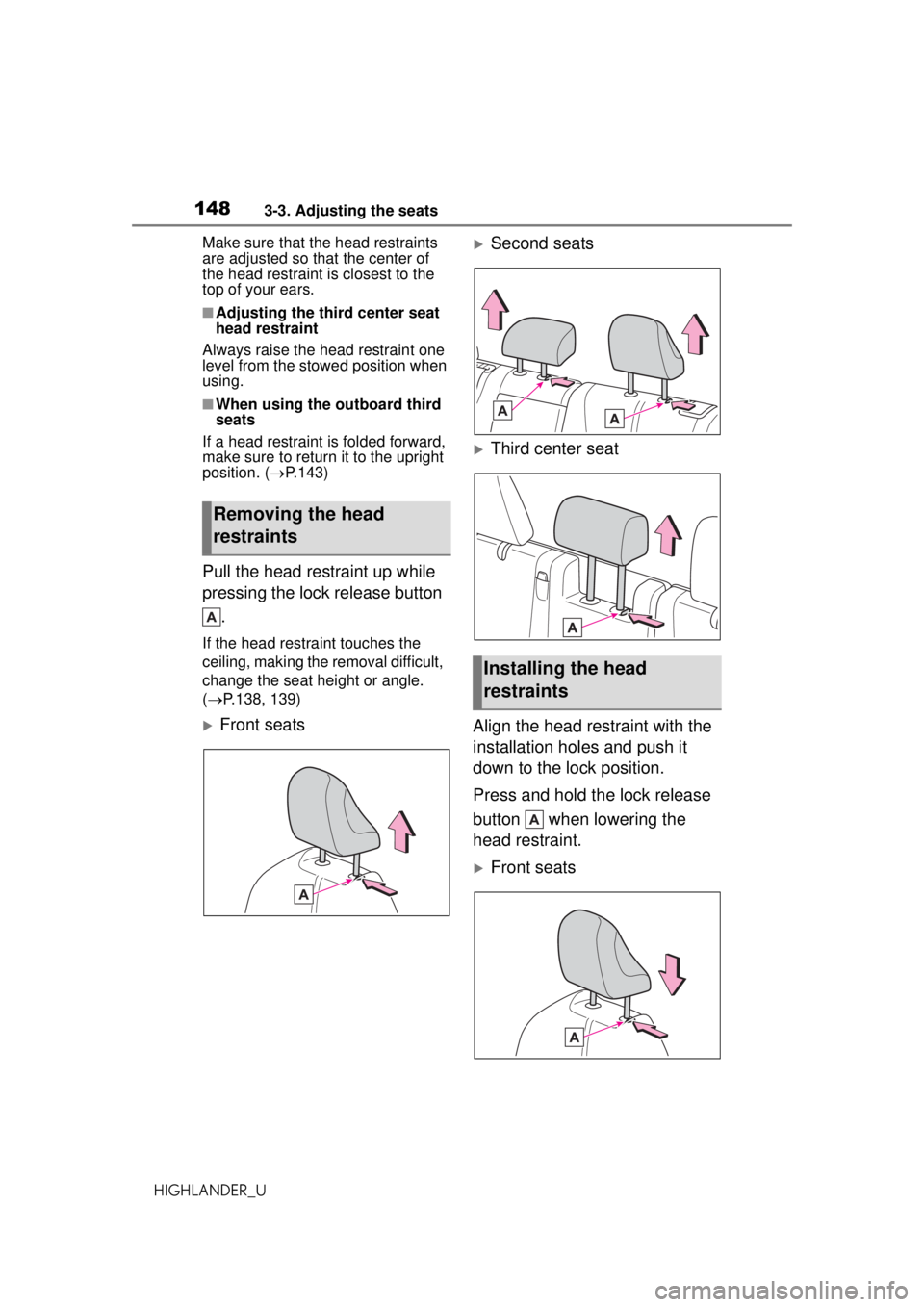
Pull the head restraint up while
pressing the lock release button
.
If the head restraint touches the
ceiling, making the removal difficult,
change the seat he ight or angle.
( P.138, 139)
Front seats
Second seats
Third center seat
Align the head restraint with the
installation holes and push it
down to the lock position.
Press and hold the lock release
button when lowering the
head restraint.
Front seats
Removing the head
restraints
Installing the head
restraints
Page 159 of 560
1593-4. Adjusting the steering wheel and mirrors
HIGHLANDER_U
3
Before driving
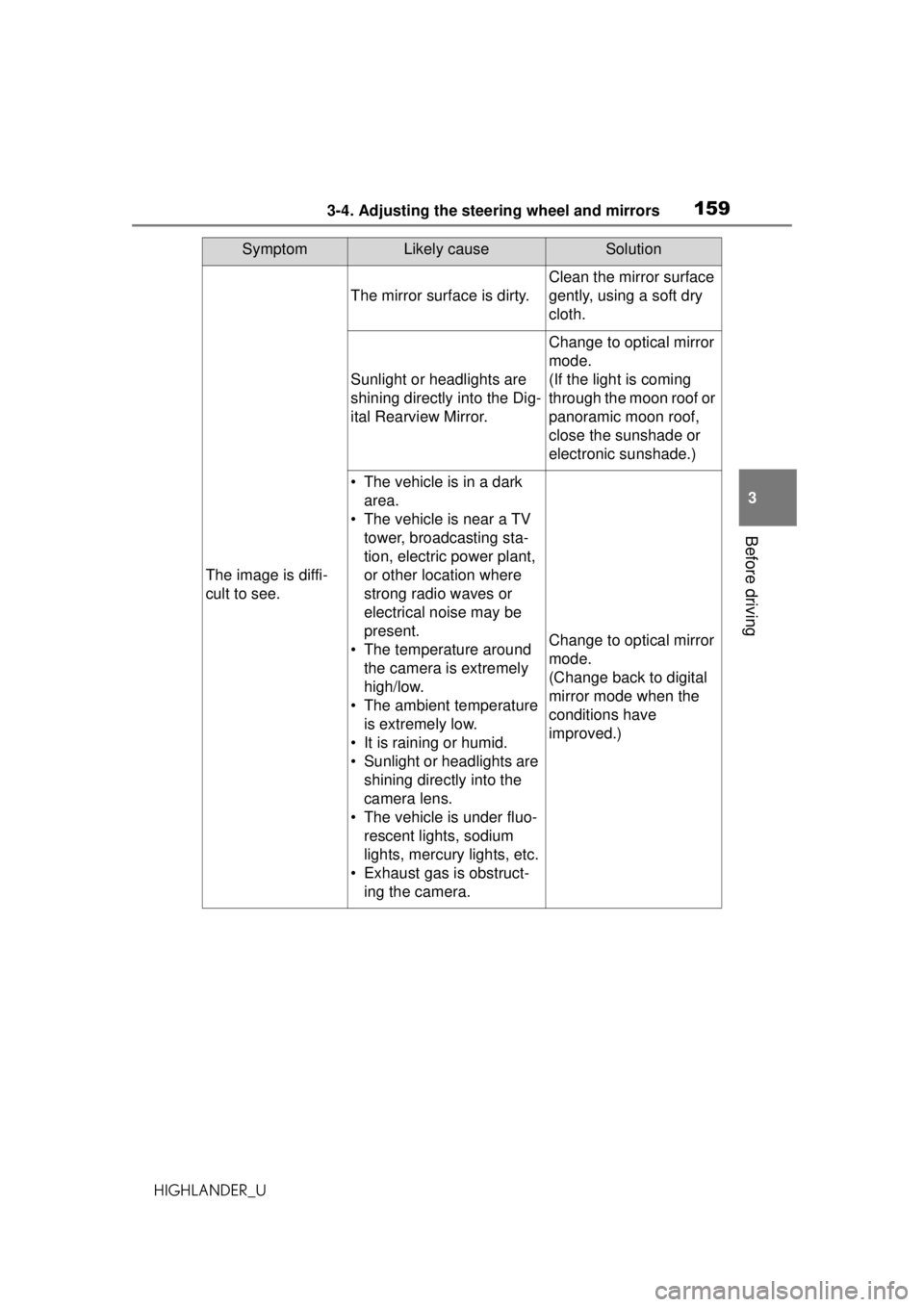
SymptomLikely causeSolution
The image is diffi-
cult to see.
The mirror surface is dirty.
Clean the mirror surface
gently, using a soft dry
cloth.
Sunlight or headlights are
shining directly into the Dig-
ital Rearview Mirror.
Change to optical mirror
mode.
(If the light is coming
through the moon roof or
panoramic moon roof,
close the sunshade or
electronic sunshade.)
• The vehicle is in a dark area.
• The vehicle is near a TV tower, broadcasting sta-
tion, electric power plant,
or other location where
strong radio waves or
electrical noise may be
present.
• The temperature around the camera is extremely
high/low.
• The ambient temperature is extremely low.
• It is raining or humid.
• Sunlight or headlights are shining directly into the
camera lens.
• The vehicle is under fluo- rescent lights, sodium
lights, mercury lights, etc.
• Exhaust gas is obstruct- ing the camera.
Change to optical mirror
mode.
(Change back to digital
mirror mode when the
conditions have
improved.)
Page 175 of 560
175
HIGHLANDER_U
4
4
Driving
Driving
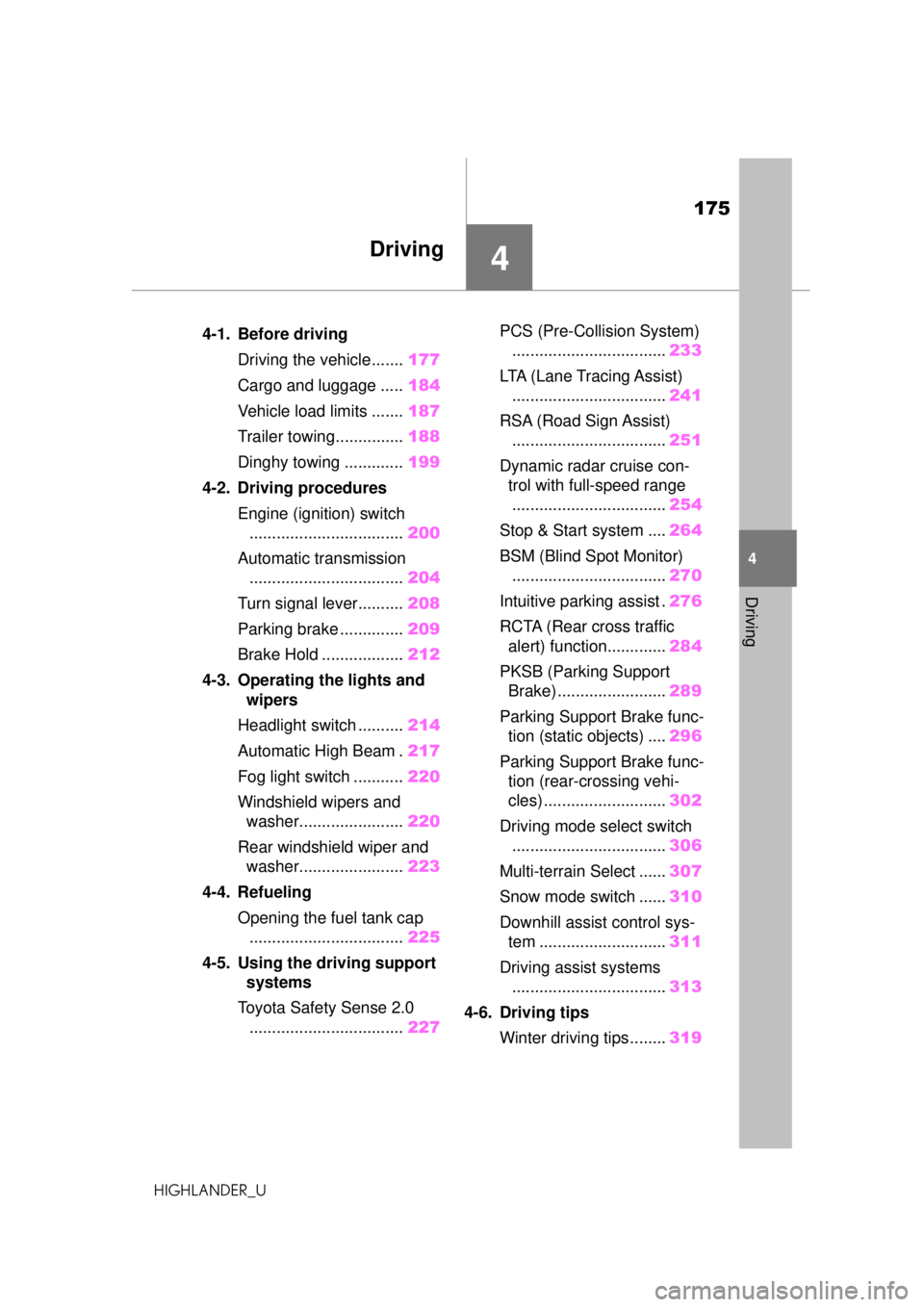
.4-1. Before drivingDriving the vehicle....... 177
Cargo and luggage ..... 184
Vehicle load limits ....... 187
Trailer towing............... 188
Dinghy towing ............. 199
4-2. Driving procedures Engine (ignition) switch.................................. 200
Automatic transmission .................................. 204
Turn signal lever.......... 208
Parking brake .............. 209
Brake Hold .................. 212
4-3. Operating the lights and wipers
Headlight switch .......... 214
Automatic High Beam . 217
Fog light switch ........... 220
Windshield wipers and washer....................... 220
Rear windshield wiper and washer....................... 223
4-4. Refueling Opening the fuel tank cap.................................. 225
4-5. Using the driving support systems
Toyota Safety Sense 2.0 .................................. 227PCS (Pre-Collision System)
.................................. 233
LTA (Lane Tracing Assist) .................................. 241
RSA (Road Sign Assist) .................................. 251
Dynamic radar cruise con- trol with full-speed range.................................. 254
Stop & Start system .... 264
BSM (Blind Spot Monitor) .................................. 270
Intuitive parking assist . 276
RCTA (Rear cross traffic alert) function............. 284
PKSB (Parking Support Brake) ........................ 289
Parking Support Brake func- tion (static objects) .... 296
Parking Support Brake func- tion (rear-crossing vehi-
cles) ........................... 302
Driving mode select switch .................................. 306
Multi-terrain Select ...... 307
Snow mode switch ...... 310
Downhill assist control sys- tem ............................ 311
Driving assist systems .................................. 313
4-6. Driving tips Winter driving tips........ 319
Page 178 of 560
1784-1. Before driving
HIGHLANDER_Urain, because the road surface will
be especially slippery.
●Refrain from high speeds when
driving on an expressway in the
rain, because there may be a
layer of water between the tires
and the road surface, preventing
the steering and brakes from
operating properly.
■Engine speed while driving
In the following conditions, the
engine speed may become high
while driving. This is due to auto-
matic up-shifting control or
down-shifting implementation to
meet driving conditions. It does not
indicate sudden acceleration.
●The vehicle is judged to be driving
uphill or downhill
●When the accelerator pedal is
released
●When the brake pedal is
depressed while sport mode is
selected
■Restraining the engine output
(Brake Override System)
●When the accelerator and brake
pedals are depressed at the same
time, the engine output may be
restrained.
●A warning message is displayed
on the multi-information display
and head-up display (if equipped)
while the system is operating.
■Restraining sudden start
(Drive-Start Control)
●When the following unusual oper-
ation is performed, the engine out-
put may be restrained.
• When the shift lever is shifted from
R to D, D to R, N to R, P to D, or P
to R (D includes M) with the accel-
erator pedal depressed, a warning
message appears on the
multi-information display and
head-up display (if equipped). If a
warning message is shown on the
multi-information display and
head-up display (if equipped), read the message and follow the
instructions.
• When the accelerator pedal is
depressed too much while the
vehicle is in reverse.
●While Drive-Start Control is being
activated, your vehicle may have
trouble escaping from the mud or
fresh snow. In su ch case, deacti-
vate TRAC ( P.314) to cancel
Drive-Start Control so that the
vehicle may become able to
escape from the mud or fresh
snow.
●AWD models: Drive-Start Control
does not work when Mud & Sand
or Rock & Dirt mode is selected
for Multi-terrain Select.
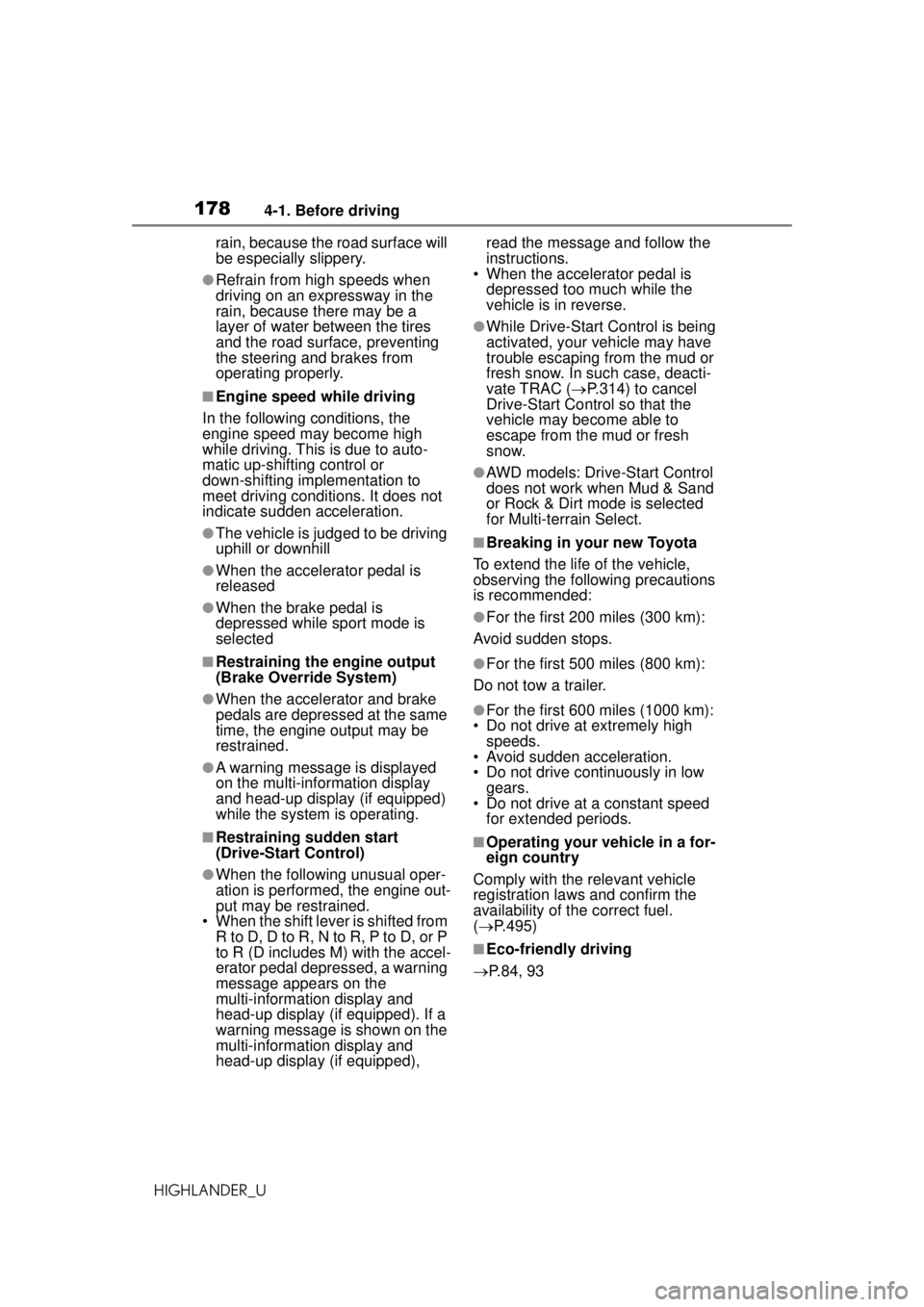
■Breaking in your new Toyota
To extend the life of the vehicle,
observing the following precautions
is recommended:
●For the first 200 miles (300 km):
Avoid sudden stops.
●For the first 500 miles (800 km):
Do not tow a trailer.
●For the first 600 miles (1000 km):
• Do not drive at extremely high
speeds.
• Avoid sudden acceleration.
• Do not drive continuously in low gears.
• Do not drive at a constant speed for extended periods.
■Operating your vehicle in a for-
eign country
Comply with the relevant vehicle
registration laws and confirm the
availability of th e correct fuel.
( P.495)
■Eco-friendly driving
P.84, 93
Page 184 of 560
1844-1. Before driving
HIGHLANDER_U
Cargo capacity depends on the
total weight of the occupants.
(Cargo capacity) = (Total load
capacity) — (Total weight of
occupants)
Steps for Determining Correct
Load Limit —
(1) Locate the statement “The
combined weight of occupants
and cargo should never exceed
XXX kg or XXX lbs.” on your
vehicle’s placard.
(2) Determine the combined
weight of the driver and passen-
gers that will be riding in your
vehicle.
(3) Subtract the combined
weight of the driver and passen-
gers from XXX kg or XXX lbs.
(4) The resulting figure equals
the available amount of cargo
and luggage load capacity.
For example, if the “XXX”
amount equals 1400 lbs. and
there will be five 150 lb passen-
gers in your vehicle, the amount
of available cargo and luggage
load capacity is 650 lbs. (1400 − 750 (5
150) = 650 lbs.)
(5) Determine the combined
weight of luggage and cargo
being loaded on the vehicle.
That weight may not safely
exceed the available cargo and
luggage load capacity calcu-
lated in Step 4.
(6) If your vehicle will be towing
a trailer, load from your trailer
will be transferred to your vehi-
cle. Consult this manual to
determine how this reduces the
available cargo and luggage
load capacity of your vehicle.
( P.187)
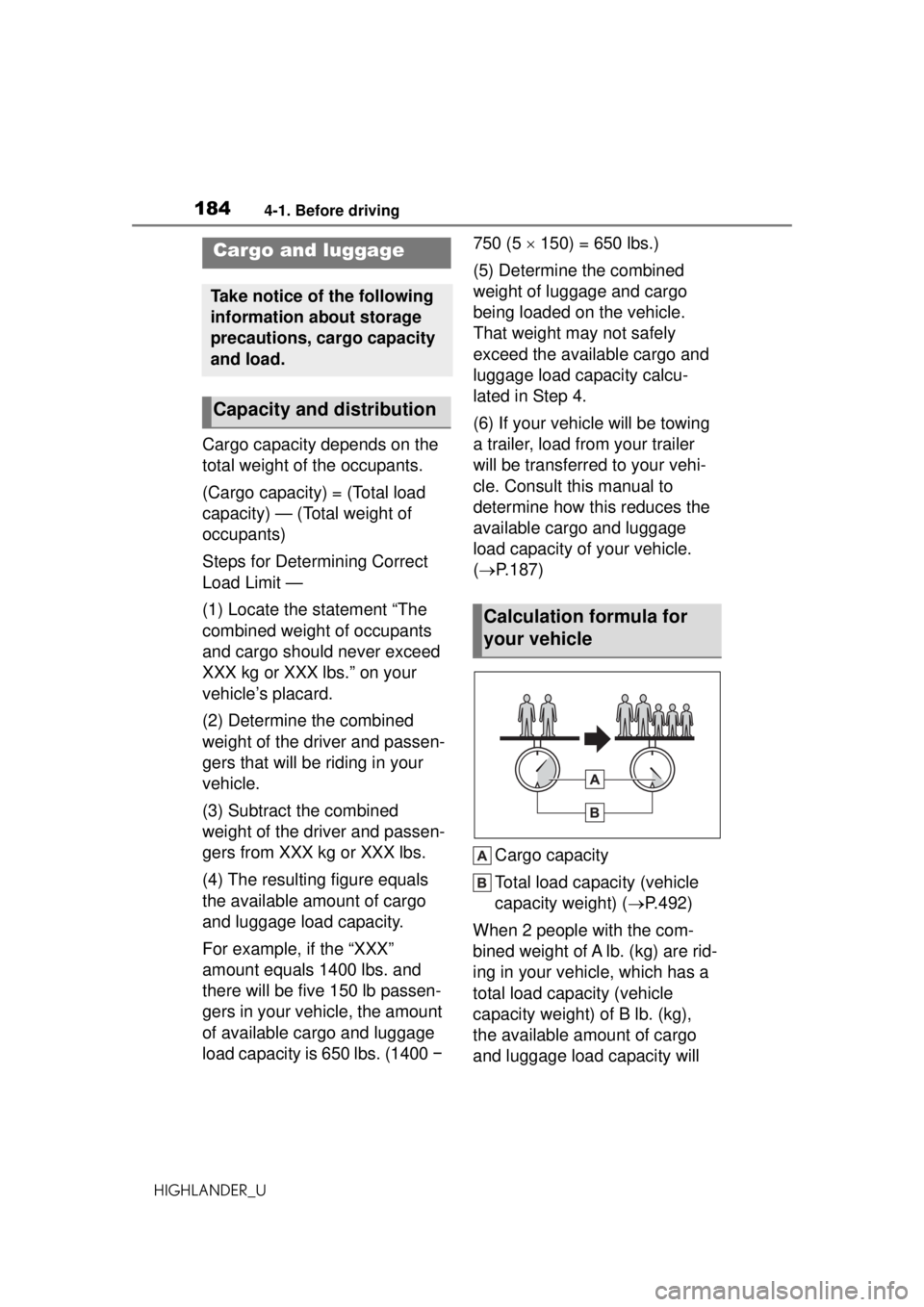
Cargo capacity
Total load capacity (vehicle
capacity weight) ( P.492)
When 2 people with the com-
bined weight of A lb. (kg) are rid-
ing in your vehicle, which has a
total load capacity (vehicle
capacity weight) of B lb. (kg),
the available amount of cargo
and luggage load capacity will
Cargo and luggage
Take notice of the following
information about storage
precautions, cargo capacity
and load.
Capacity and distribution
Calculation formula for
your vehicle
Page 185 of 560
1854-1. Before driving
HIGHLANDER_U
4
Driving
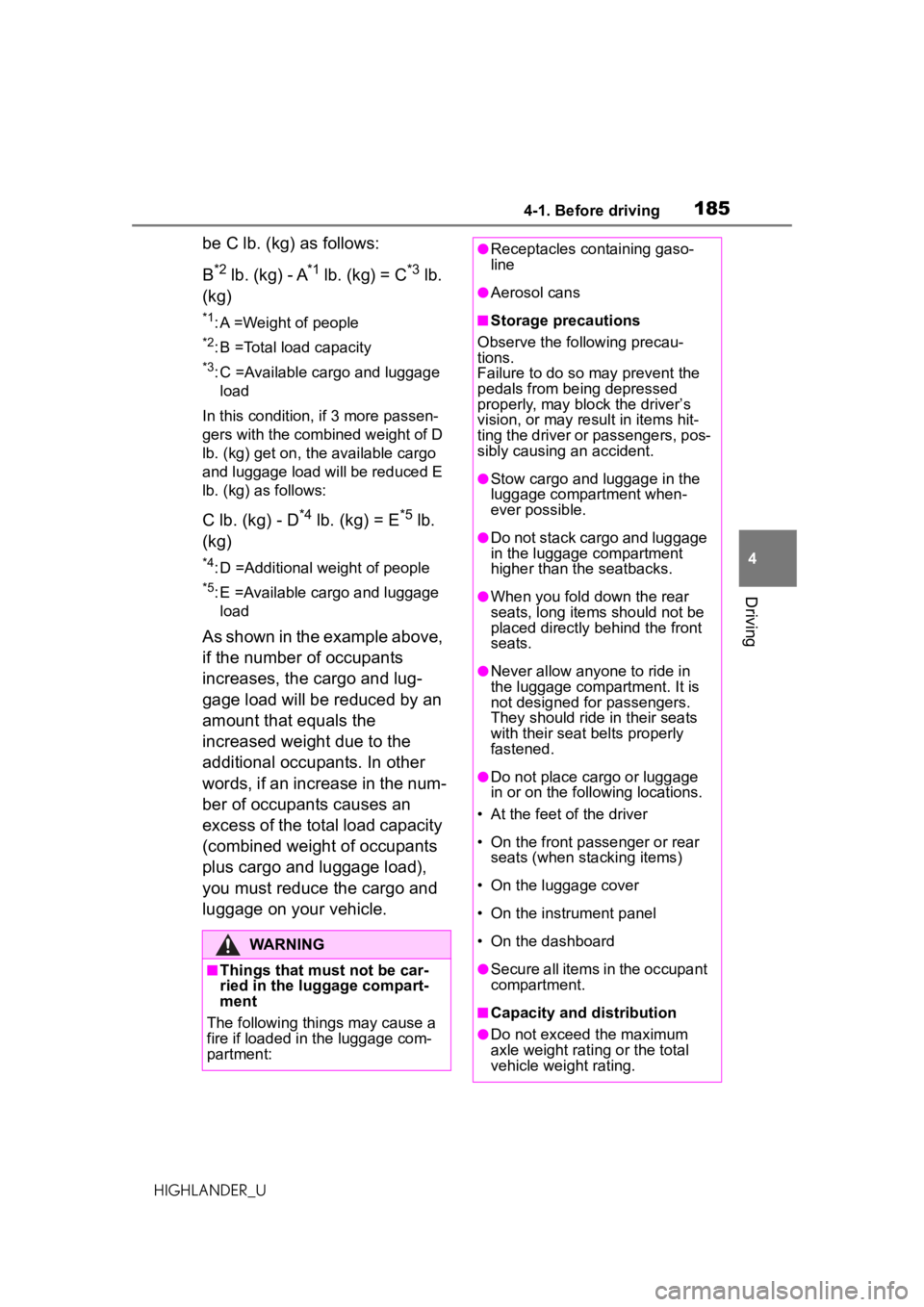
be C lb. (kg) as follows:
B
*2 lb. (kg) - A*1 lb. (kg) = C*3 lb.
(kg)
*1: A =Weight of people
*2: B =Total load capacity
*3: C =Available cargo and luggage load
In this condition, if 3 more passen-
gers with the combined weight of D
lb. (kg) get on, the available cargo
and luggage load will be reduced E
lb. (kg) as follows:
C lb. (kg) - D*4 lb. (kg) = E*5 lb.
(kg)
*4: D =Additional weight of people
*5: E =Available cargo and luggage load
As shown in the example above,
if the number of occupants
increases, the cargo and lug-
gage load will be reduced by an
amount that equals the
increased weight due to the
additional occupants. In other
words, if an increase in the num-
ber of occupants causes an
excess of the total load capacity
(combined weight of occupants
plus cargo and luggage load),
you must reduce the cargo and
luggage on your vehicle.
WARNING
■Things that must not be car-
ried in the luggage compart-
ment
The following things may cause a
fire if loaded in the luggage com-
partment:
●Receptacles containing gaso-
line
●Aerosol cans
■Storage precautions
Observe the following precau-
tions.
Failure to do so may prevent the
pedals from being depressed
properly, may block the driver’s
vision, or may result in items hit-
ting the driver or passengers, pos-
sibly causing an accident.
●Stow cargo and luggage in the
luggage compartment when-
ever possible.
●Do not stack cargo and luggage
in the luggage compartment
higher than the seatbacks.
●When you fold down the rear
seats, long items should not be
placed directly behind the front
seats.
●Never allow anyone to ride in
the luggage compartment. It is
not designed for passengers.
They should ride in their seats
with their seat belts properly
fastened.
●Do not place cargo or luggage
in or on the following locations.
• At the feet of the driver
• On the front passenger or rear seats (when stacking items)
• On the luggage cover
• On the instrument panel
• On the dashboard
●Secure all items in the occupant
compartment.
■Capacity and distribution
●Do not exceed the maximum
axle weight rati ng or the total
vehicle weight rating.
Page 187 of 560
1874-1. Before driving
HIGHLANDER_U
4
Driving
■Total load capacity and seating
capacity
These details are also described on
the tire and loading information
label. ( P.423)
Vehicle load limits
Vehicle load limits include
total load capacity, seating
capacity, trailer weight rat-
ing and cargo capacity.
Total load capacity (vehicle
capacity weight): P.492
Total load capacity means the
combined weight of occupants,
cargo and luggage.
Seating capacity: P.492
Seating capacity means the max-
imum number of occupants
whose estimated average weight
is 150 lb. (68 kg) per person.
TWR (Trailer Weight Rat-
ing): P.193, 492
TWR means the maximum gross
trailer weight (trailer weight plus
its cargo weight) that your vehicle
is able to tow.
Cargo capacity
Cargo capacity may increase or
decrease depending on the
weight and the number of occu-
pants.
WARNING
■Overloading the vehicle
Do not overload the vehicle.
It may not only cause damage to
the tires, but also degrade steer-
ing and braking ability, resulting in
an accident.