tow TOYOTA HIGHLANDER 2020 (in English) Repair Manual
[x] Cancel search | Manufacturer: TOYOTA, Model Year: 2020, Model line: HIGHLANDER, Model: TOYOTA HIGHLANDER 2020Pages: 560, PDF Size: 14.42 MB
Page 446 of 560
4467-2. Steps to take in an emergency
HIGHLANDER_U
The following may indicate a
problem with your transmission.
Contact your Toyota dealer or
commercial towing service
before towing.
The engine is running but the
vehicle does not move.
The vehicle makes an abnor-
mal sound.
WARNING
■While towing
●When towing using cables or
chains, avoid sudden starts, etc.
which place excessive stress on
the towing eyelets, cables or
chains. The towing eyelets,
cables or chains may become
damaged, broken debris may hit
people, and cause serious dam-
age.
●Do not turn the engine switch
off.
There is a possibility that the
steering wheel is locked and
cannot be operated.
NOTICE
■To prevent damage to the
vehicle when towing using a
wheel-lift type truck
●Do not tow the vehicle from the
rear when the engine switch is
off. The steering lock mecha-
nism is not strong enough to
hold the front wheels straight.
●When raising the vehicle,
ensure adequate ground clear-
ance for towing at the opposite
end of the raised vehicle. With-
out adequate clearance, the
vehicle could be damaged while
being towed.
■To prevent damage to the
vehicle when towing with a
sling-type truck
Do not tow with a sling-type truck,
either from the front or rear.
■To prevent damage to the
vehicle during emergency
towing
Do not secure cables or chains to
the suspension components.
■When towing a vehicle
equipped with a Stop & Start
system (if equipped)
If it is necessary to tow the vehicle
with all 4 wheels on the ground,
perform the following procedure
before towing the vehicle, in order
to protect the system.
Turn the engine switch off and
then start the engine or turn the
engine switch to ON.
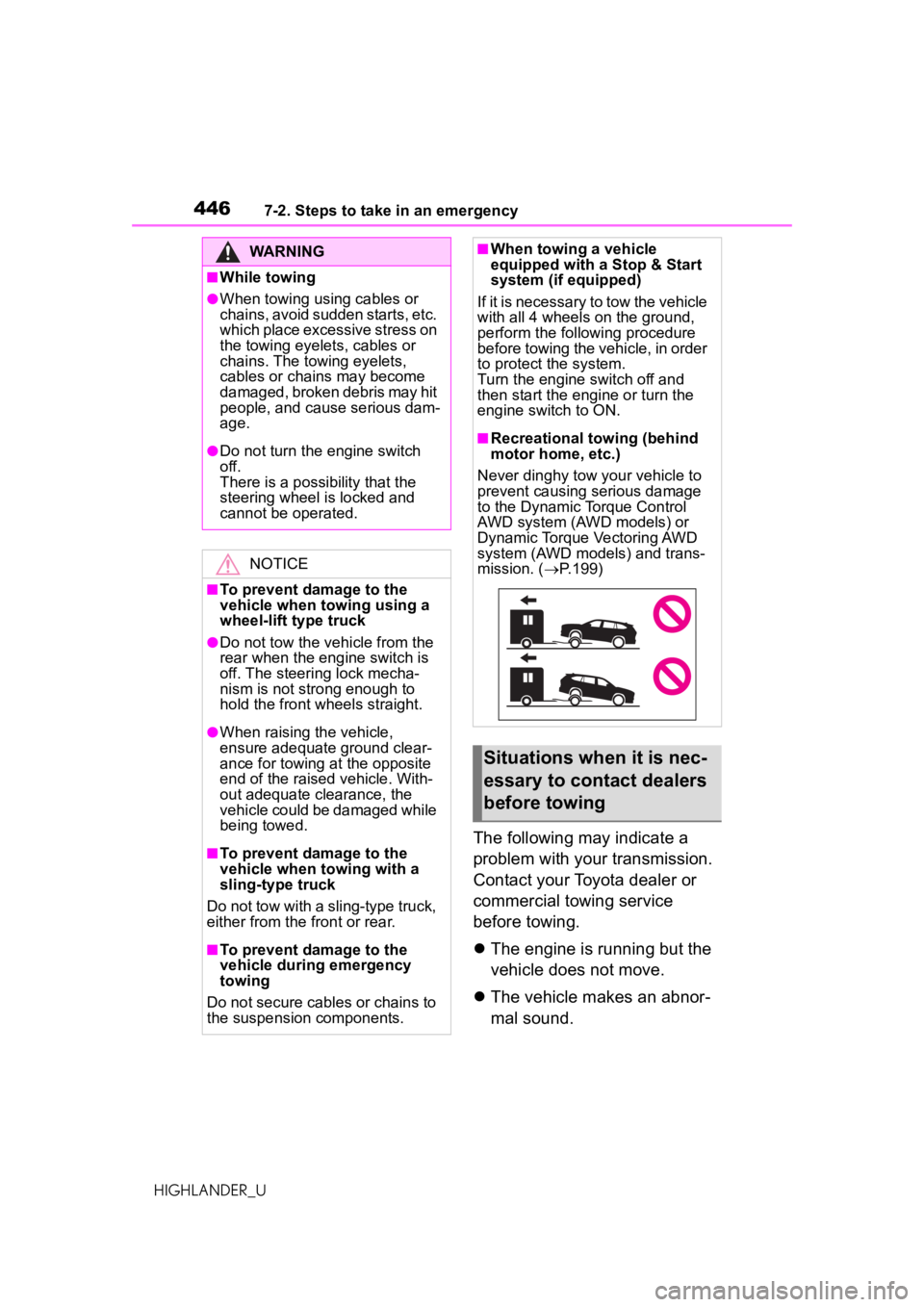
■Recreational towing (behind
motor home, etc.)
Never dinghy tow your vehicle to
prevent causing serious damage
to the Dynamic Torque Control
AWD system (AWD models) or
Dynamic Torque Vectoring AWD
system (AWD models) and trans-
mission. ( P.199)
Situations when it is nec-
essary to contact dealers
before towing
Page 447 of 560
4477-2. Steps to take in an emergency
HIGHLANDER_U
7
When trouble arises
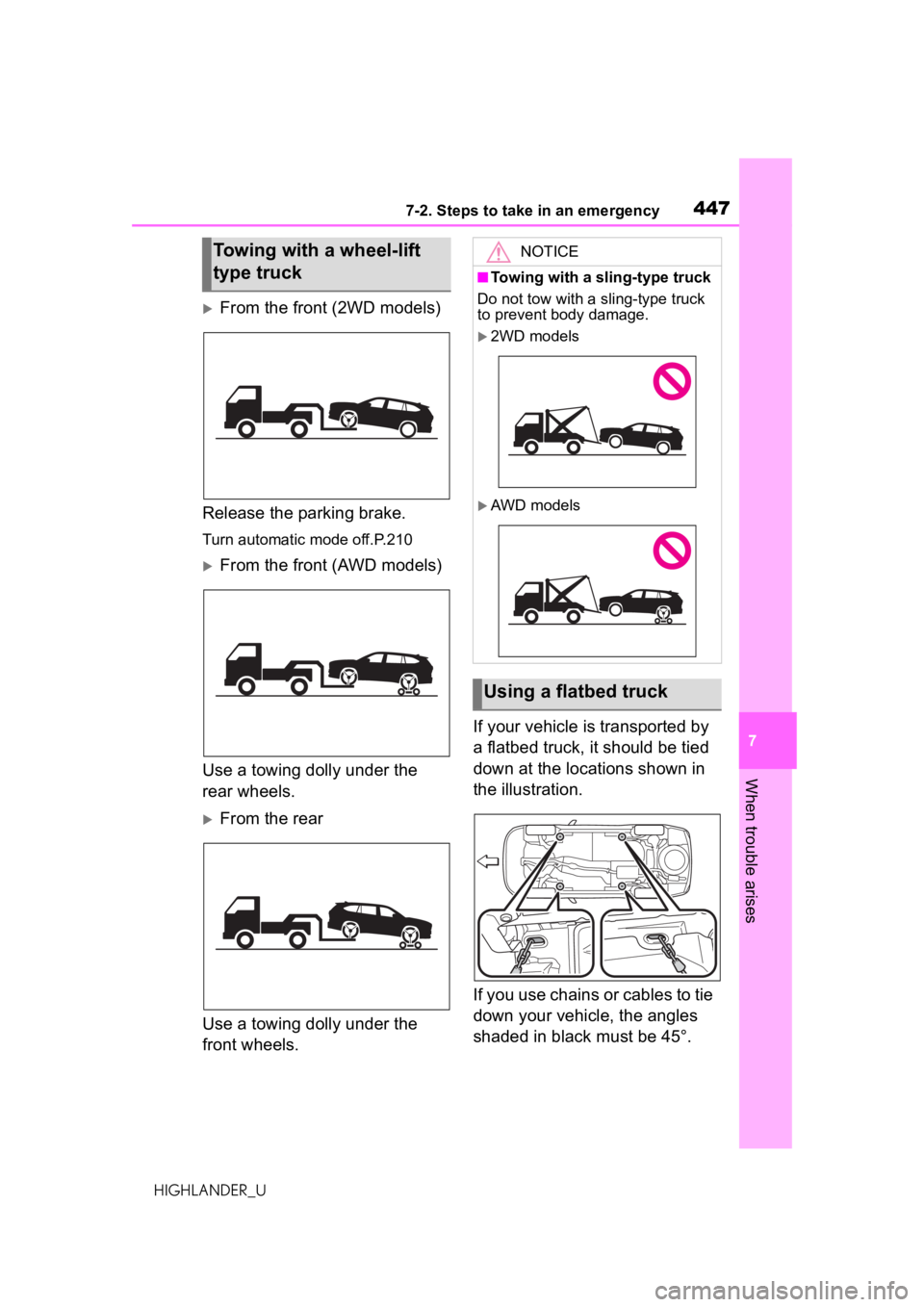
From the front (2WD models)
Release the parking brake.
Turn automatic mode off.P.210
From the front (AWD models)
Use a towing dolly under the
rear wheels.
From the rear
Use a towing dolly under the
front wheels. If your vehicle is transported by
a flatbed truck, it should be tied
down at the locations shown in
the illustration.
If you use chains or cables to tie
down your vehicle, the angles
shaded in black must be 45°.
Towing with a wheel-lift
type truckNOTICE
■Towing with a sling-type truck
Do not tow with a sling-type truck
to prevent body damage.
2WD models
AWD models
Using a flatbed truck
Page 448 of 560
4487-2. Steps to take in an emergency
HIGHLANDER_U
A driver must be in the vehicle to
steer and operate the brakes.
The vehicle’s wheels, drive train,
axles, steering and brakes must
be in good condition.
Fluid leaks under the vehicle
(Water dripping from the air
conditioning after use is nor-
mal.)
Flat-looking tires or uneven
tire wear
Engine coolant temperature
gauge needle continually
points higher than normal
Changes in exhaust sound
Excessive tire squeal when
cornering
Strange noises related to the
suspension system
Pinging or other noises
related to the engine
Engine missing, stumbling or
running roughly
Appreciable loss of power
Vehicle pulls heavily to one
NOTICE
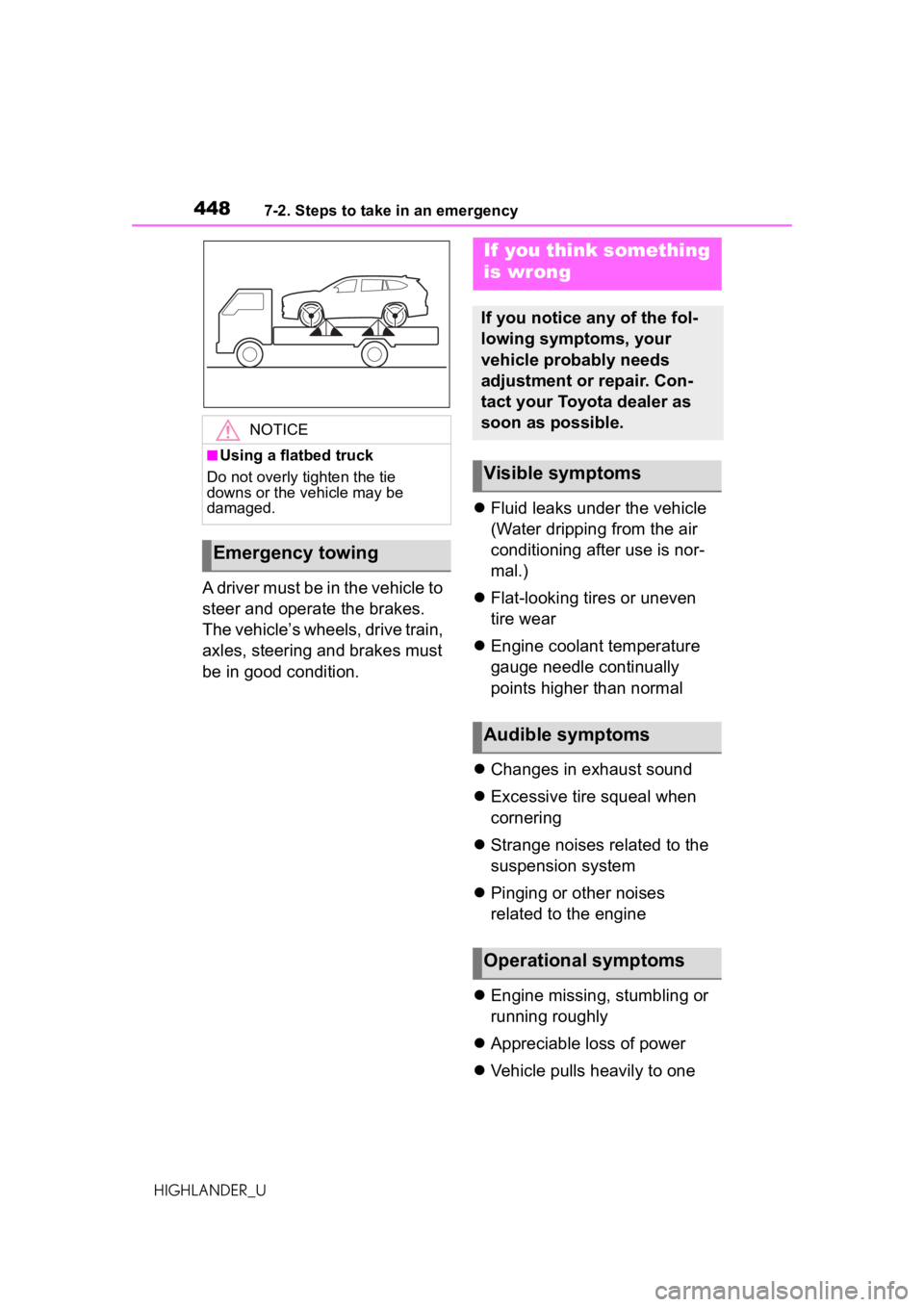
■Using a flatbed truck
Do not overly tighten the tie
downs or the vehicle may be
damaged.
Emergency towing
If you think something
is wrong
If you notice any of the fol-
lowing symptoms, your
vehicle probably needs
adjustment or repair. Con-
tact your Toyota dealer as
soon as possible.
Visible symptoms
Audible symptoms
Operational symptoms
Page 471 of 560
4717-2. Steps to take in an emergency
HIGHLANDER_U
7
When trouble arises
lock.
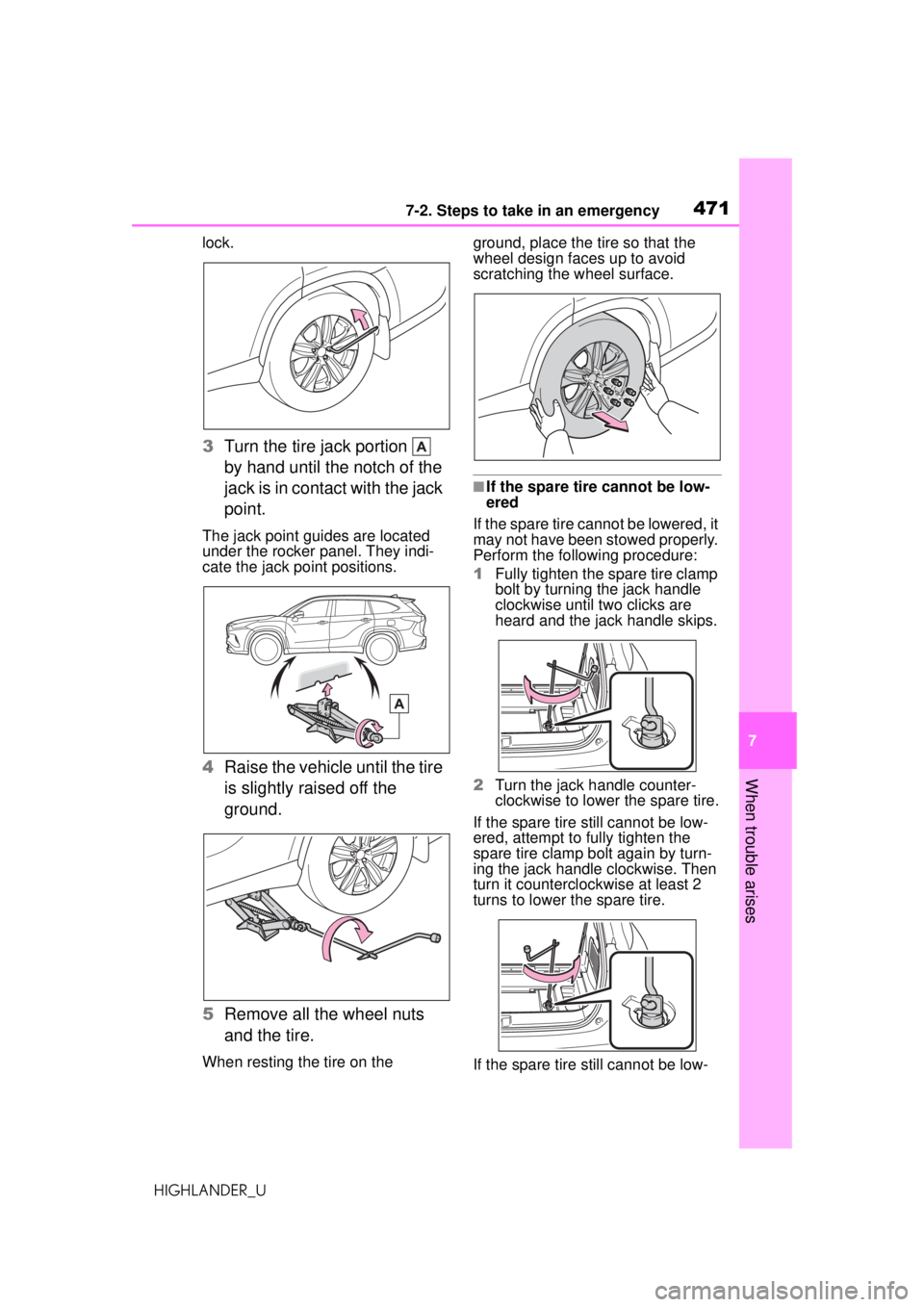
3 Turn the tire jack portion
by hand until the notch of the
jack is in contact with the jack
point.
The jack point guides are located
under the rocker panel. They indi-
cate the jack point positions.
4Raise the vehicle until the tire
is slightly raised off the
ground.
5 Remove all the wheel nuts
and the tire.
When resting the tire on the ground, place the tire so that the
wheel design faces up to avoid
scratching the wheel surface.
■If the spare tire cannot be low-
ered
If the spare tire cannot be lowered, it
may not have been stowed properly.
Perform the following procedure:
1 Fully tighten the spare tire clamp
bolt by turning the jack handle
clockwise until two clicks are
heard and the jack handle skips.
2 Turn the jack handle counter-
clockwise to lower the spare tire.
If the spare tire still cannot be low-
ered, attempt to fully tighten the
spare tire clamp bolt again by turn-
ing the jack handle clockwise. Then
turn it counterclockwise at least 2
turns to lower the spare tire.
If the spare tire still cannot be low-
Page 473 of 560
4737-2. Steps to take in an emergency
HIGHLANDER_U
7
When trouble arises
motion, causing the tire to come off.
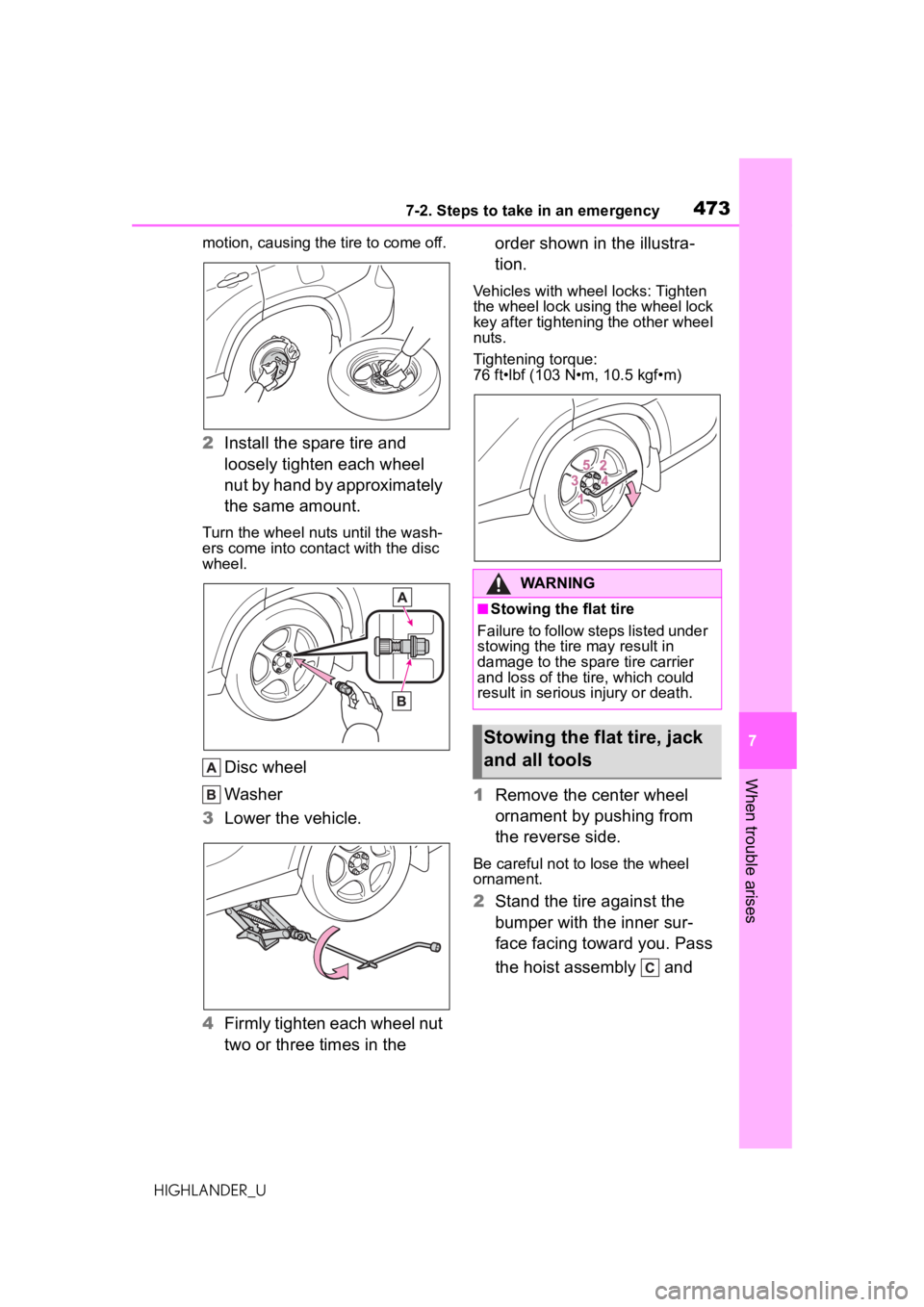
2Install the spare tire and
loosely tighten each wheel
nut by hand by approximately
the same amount.
Turn the wheel nuts until the wash-
ers come into contact with the disc
wheel.
Disc wheel
Washer
3 Lower the vehicle.
4 Firmly tighten each wheel nut
two or three times in the order shown in the illustra-
tion.
Vehicles with wheel locks: Tighten
the wheel lock using the wheel lock
key after tightening the other wheel
nuts.
Tightening torque:
76 ft•lbf (103 N•m, 10.5 kgf•m)
1
Remove the center wheel
ornament by pushing from
the reverse side.
Be careful not to lose the wheel
ornament.
2Stand the tire against the
bumper with the inner sur-
face facing toward you. Pass
the hoist assembly and
WARNING
■Stowing the flat tire
Failure to follow steps listed under
stowing the tire may result in
damage to the spare tire carrier
and loss of the tire, which could
result in serious injury or death.
Stowing the flat tire, jack
and all tools
Page 475 of 560
4757-2. Steps to take in an emergency
HIGHLANDER_U
7
When trouble arises
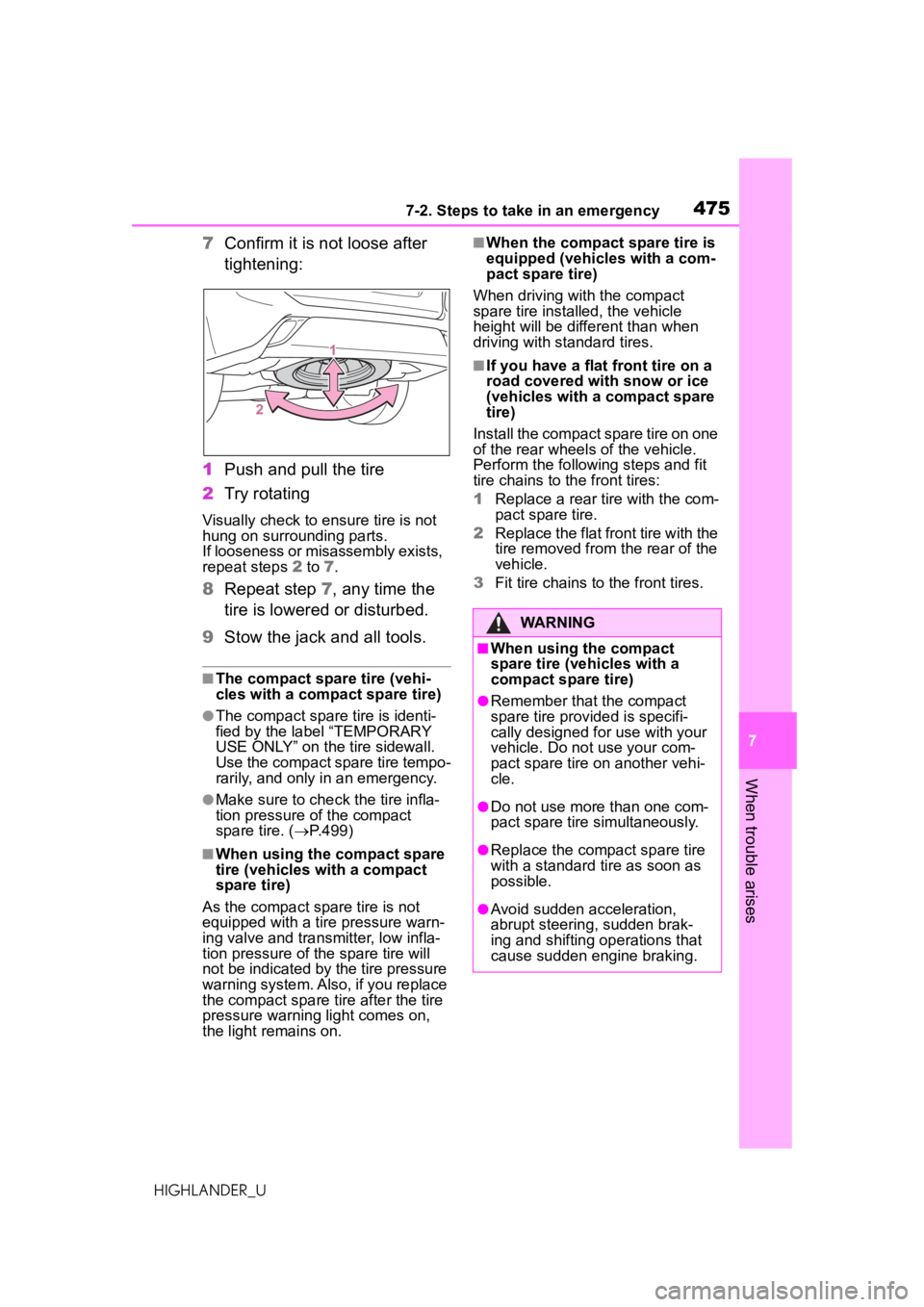
7 Confirm it is not loose after
tightening:
1 Push and pull the tire
2 Try rotating
Visually check to ensure tire is not
hung on surrounding parts.
If looseness or misassembly exists,
repeat steps 2 to 7 .
8Repeat step 7, any time the
tire is lowered or disturbed.
9 Stow the jack and all tools.
■The compact spare tire (vehi-
cles with a compact spare tire)
●The compact spare tire is identi-
fied by the label “TEMPORARY
USE ONLY” on the tire sidewall.
Use the compact spare tire tempo-
rarily, and only in an emergency.
●Make sure to che ck the tire infla-
tion pressure of the compact
spare tire. ( P.499)
■When using the compact spare
tire (vehicles with a compact
spare tire)
As the compact spare tire is not
equipped with a tire pressure warn-
ing valve and transmitter, low infla-
tion pressure of the spare tire will
not be indicated by the tire pressure
warning system. Also, if you replace
the compact spare tire after the tire
pressure warning light comes on,
the light remains on.
■When the compact spare tire is
equipped (vehicles with a com-
pact spare tire)
When driving with the compact
spare tire installed, the vehicle
height will be different than when
driving with standard tires.
■If you have a flat front tire on a
road covered with snow or ice
(vehicles with a compact spare
tire)
Install the compact spare tire on one
of the rear wheels of the vehicle.
Perform the following steps and fit
tire chains to the front tires:
1 Replace a rear tire with the com-
pact spare tire.
2 Replace the flat front tire with the
tire removed from the rear of the
vehicle.
3 Fit tire chains to the front tires.
WARNING
■When using the compact
spare tire (vehicles with a
compact spare tire)
●Remember that the compact
spare tire provided is specifi-
cally designed for use with your
vehicle. Do not use your com-
pact spare tire on another vehi-
cle.
●Do not use more than one com-
pact spare tire simultaneously.
●Replace the compact spare tire
with a standard tire as soon as
possible.
●Avoid sudden acceleration,
abrupt steering, sudden brak-
ing and shifting operations that
cause sudden engine braking.
Page 477 of 560
4777-2. Steps to take in an emergency
HIGHLANDER_U
7
When trouble arises
NOTICE
■Driving with tire chains and
the compact spare tire (vehi-
cles with a compact spare
tire)
Do not fit tire chains to the com-
pact spare tire.
Tire chains may damage the vehi-
cle body and adversely affect driv-
ing performance.
■When replacing the tires
When removing or fitting the
wheels, tires or t he tire pressure
warning valve and transmitter,
contact your Toyota dealer as the
tire pressure warning valve and
transmitter may be damaged if not
handled correctly.
■When stowing the flat tire
●Ensure that there is no object
caught between the tire and the
vehicle underbody.
●Securely tighten the spare tire
clamp bolt to hold the spare
wheel carrier by the hook.
●Stow the flat tire in the spare tire
location. Failure to do so may
cause damage to the spare tire
carrier. Proper storage reduces
the possibility of injury in a colli-
sion or during sudden braking.
●Have the flat tire repaired and
the spare tire replaced with it as
soon as possible.
■Proper storage of the spare
tire
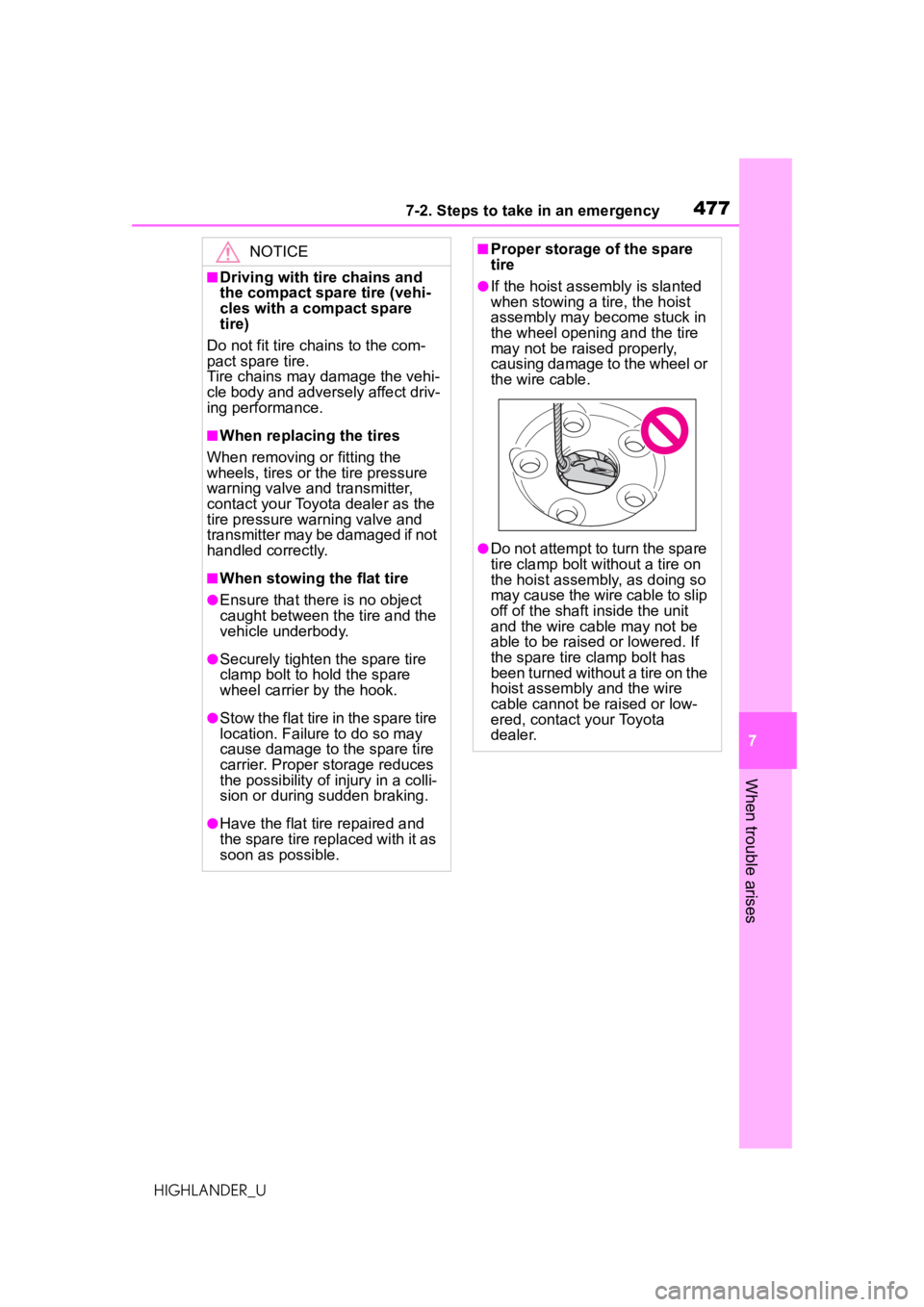
●If the hoist assembly is slanted
when stowing a tire, the hoist
assembly may become stuck in
the wheel opening and the tire
may not be raised properly,
causing damage to the wheel or
the wire cable.
●Do not attempt to turn the spare
tire clamp bolt without a tire on
the hoist assembly, as doing so
may cause the wire cable to slip
off of the shaft inside the unit
and the wire cable may not be
able to be raised or lowered. If
the spare tire clamp bolt has
been turned without a tire on the
hoist assembly and the wire
cable cannot be raised or low-
ered, contact your Toyota
dealer.
Page 489 of 560
4897-2. Steps to take in an emergency
HIGHLANDER_U
7
When trouble arises
1 Stop the engine. Shift the
shift lever to P and set the
parking brake.
2 Remove the mud, snow or
sand from around the front
wheels.
3 Place wood, stones or some
other material under the front
wheels to help provide trac-
tion.
4 Restart the engine.
5 Shift the shift lever to D or R
and release the parking
brake. Then, while exercising
caution, depress the acceler-
ator pedal.
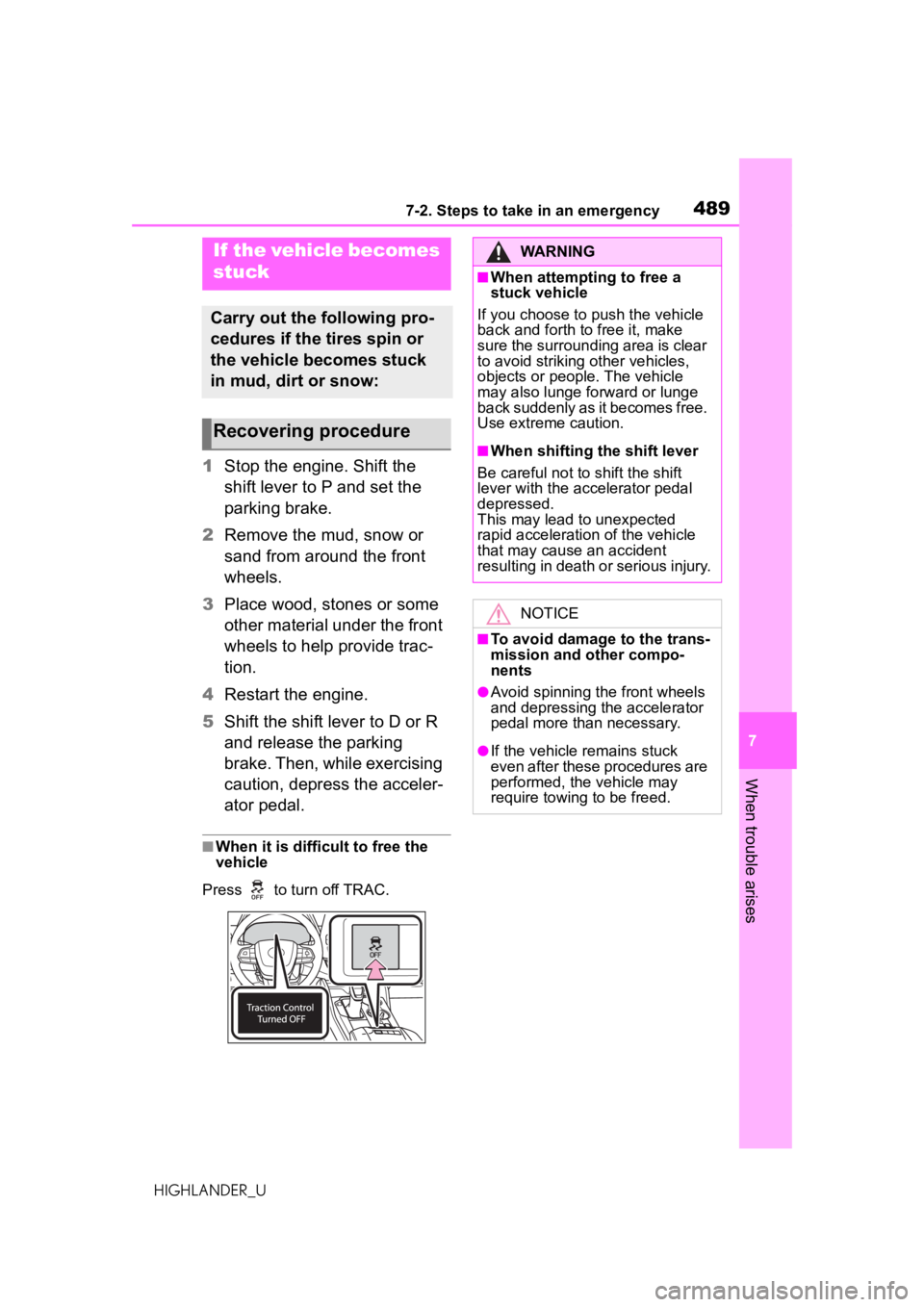
■When it is difficult to free the
vehicle
Press to turn off TRAC.
If the vehicle becomes
stuck
Carry out the following pro-
cedures if the tires spin or
the vehicle becomes stuck
in mud, dirt or snow:
Recovering procedure
WARNING
■When attempting to free a
stuck vehicle
If you choose to push the vehicle
back and forth to free it, make
sure the surrounding area is clear
to avoid striking other vehicles,
objects or people. The vehicle
may also lunge forward or lunge
back suddenly as it becomes free.
Use extreme caution.
■When shifting the shift lever
Be careful not to shift the shift
lever with the accelerator pedal
depressed.
This may lead to unexpected
rapid acceleration of the vehicle
that may cause an accident
resulting in death or serious injury.
NOTICE
■To avoid damage to the trans-
mission and other compo-
nents
●Avoid spinning the front wheels
and depressing the accelerator
pedal more than necessary.
●If the vehicle remains stuck
even after these procedures are
performed, the vehicle may
require towing to be freed.
Page 547 of 560

547Alphabetical Index
HIGHLANDER_U
Wheels and wheel ornaments ........................................... 388
Clock ................................... 79, 82
Coat hooks .............................. 376
Condenser .............................. 408
Console box ............................ 359
Consumption screen.............. 106
Conversation mirror ............... 378
Cooling system ...................... 407 Engine overheating .............. 487
Cruise control Dynamic radar cruise control with full-speed range .......... 254
Cup holders ............................ 360
Current fuel consumption . 84, 92
Curtain shield airbags ............. 32
Customizable features ........... 515
D
Daytime running light system214 Replacing light bulbs ............ 432
Defogger Outside rear view mirrors ... 329, 335, 339
Rear window ........ 329, 335, 339
Windshield............ 329, 335, 338
Differential Rear differential oil ............... 498
Digital Rearview Mirror .......... 152
Dimension ............................... 492
Dinghy towing ........................ 199
Display Dynamic radar cruise control with full-speed range .......... 254
Head-up display ................... 101
Intuitive parking assist .......... 276
LTA (Lane Tracing Assist) ..... 246
Multi-information display .. 82, 91
RCTA .................................... 284
Toyota Multi-operation touch 326
Warning message ................ 460 Distance until next engine oil
change .....................................81
Do-it-yourself maintenance ...395
Door courtesy lights...............355
Door lock Back door ............................. 119
Side doors ............................ 115
Smart key system .................131
Wireless remote control........ 113
Doors Automatic door locking and unlocking system ................ 118
Back door ............................. 119
Door glasses ........................164
Door lock .............................. 119
Open door warning buzzer . 116, 11 8
Outside rear view mirrors .....162
Rear door child-protectors .... 118
Downhill assist control system ............................................... 311
Drive distance .....................86, 95
Drive information ................86, 95
Driver’s seat position memory Driving position memory .......144
Memory recall function .........145
Drive-start control ..................178
Driving Break-in tips .........................178
Correct driving posture ...........23
Driving mode select switch ...306
Procedures ...........................177
Winter drive tips....................319
Driving information display83, 92
Driving mode select switch ...306
Driving position memory .......144 Memory recall function .........145
Driving range ................84, 92, 93
Driving support system informa- tion display........................85, 95
Page 548 of 560

548Alphabetical Index
HIGHLANDER_U
Dynamic radar cruise control with full-speed range ........... 254Warning message ................ 263
Dynamic Torque Control AWD system ................................... 314
Dynamic Torque Vectoring AWD system ................................... 314
E
Eco drive mode ...................... 306
Eco Driving Indicator . 84, 93, 104
Eco Driving Indicator Light84, 93
EDR (Event data recorder)......... 7
Elapsed time ....................... 86, 95
Electric Power Steering (EPS) ............................................... 313Warning light ........................ 452
Electronic key ......................... 112 Battery-saving function......... 132
If the electronic key does not operate properly ................. 481
Replacing the battery ........... 428
Electronic roof sunshade Jam protection function ........ 171
Operation ............................. 170
Emergency flashers ............... 442
Emergency, in case of If a warning buzzer sounds .. 450
If a warning light turns on ..... 450
If a warning message is dis-played................................. 460
If the battery is discharged ... 483
If the electronic key does not operate properly ................. 481
If the engine will not start ..... 478
If the fuel filler door cannot be opened ............................... 480
If the vehicle is trapped in rising water .................................. 443
If you have a flat tire ............. 464
If you lose your keys ............ 479 If you think something is wrong
...........................................448
If your vehicle becomes stuck ...........................................489
If your vehicle has to be stopped in an emergency .................442
If your vehicle ne eds to be towed
...........................................445
If your vehicle overheats ......487
Engine ACCESSORY mode .............203
Compartment........................404
Engine switch .......................200
Fuel pump shut off system ...449
Hood .....................................402
How to start the engine ........200
Identification number ............494
If the engine will not start......478
If your vehicle has to be stopped in an emergency .................442
Ignition switch (engine switch) ...........................................200
Overheating ..........................487
Tachometer.............................79
Engine coolant Capacity ...............................497
Checking ..............................407
Preparing and checking before winter ..................................319
Engine coolant temperature gauge .......................................79
Engine immobilizer system .....69
Engine oil Capacity ...............................495
Checking ..............................404
Preparing and checking before winter ..................................319
Warning light.........................451
Engine oil maintenance data .406
Engine switch .........................200 Auto power off function .........203