ECO mode TOYOTA HILUX 2017 (in English) Owner's Manual
[x] Cancel search | Manufacturer: TOYOTA, Model Year: 2017, Model line: HILUX, Model: TOYOTA HILUX 2017Pages: 720, PDF Size: 112.19 MB
Page 178 of 720
1783-2. Opening, closing and locking the doors
HILUX_OM_OM0K322E_(EE)
■Setting and canceling the functions
To switch between setting and canceling, follow the procedure
below.
Close all the doors and turn the engine switch to IGNITION ON
mode (vehicles with smart entry & start system) or the “ON” posi-
tion (vehicles without smart entry & start system). (Perform step
within 20 seconds.)
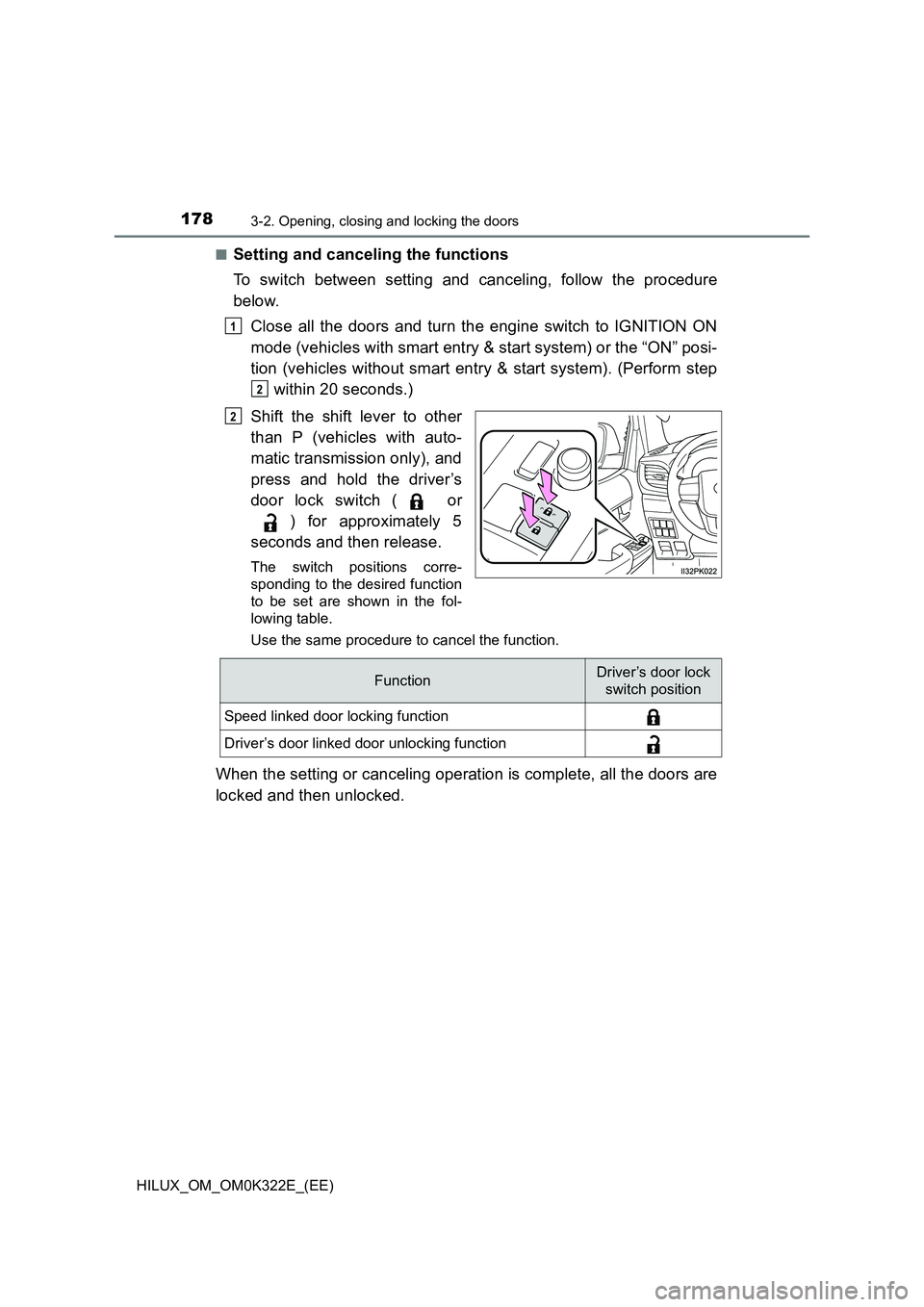
Shift the shift lever to other
than P (vehicles with auto-
matic transmission only), and
press and hold the driver’s
door lock switch ( or
) for approximately 5
seconds and then release.
The switch positions corre-
sponding to the desired function
to be set are shown in the fol-
lowing table.
Use the same procedure to cancel the function.
When the setting or canceling operation is complete, all the doors are
locked and then unlocked.
1
2
2
FunctionDriver’s door lock
switch position
Speed linked door locking function
Driver’s door linked door unlocking function
Page 186 of 720
1863-2. Opening, closing and locking the doors
HILUX_OM_OM0K322E_(EE)
■ Alarms and warning indicators
A combination of exterior and interior alarms as well as warning messages
shown on the multi-information display are used to prevent theft of the vehicle
and accidents resulting from erroneous operation. Take appropriate mea-
sures in response to any warning message on the multi-information display.
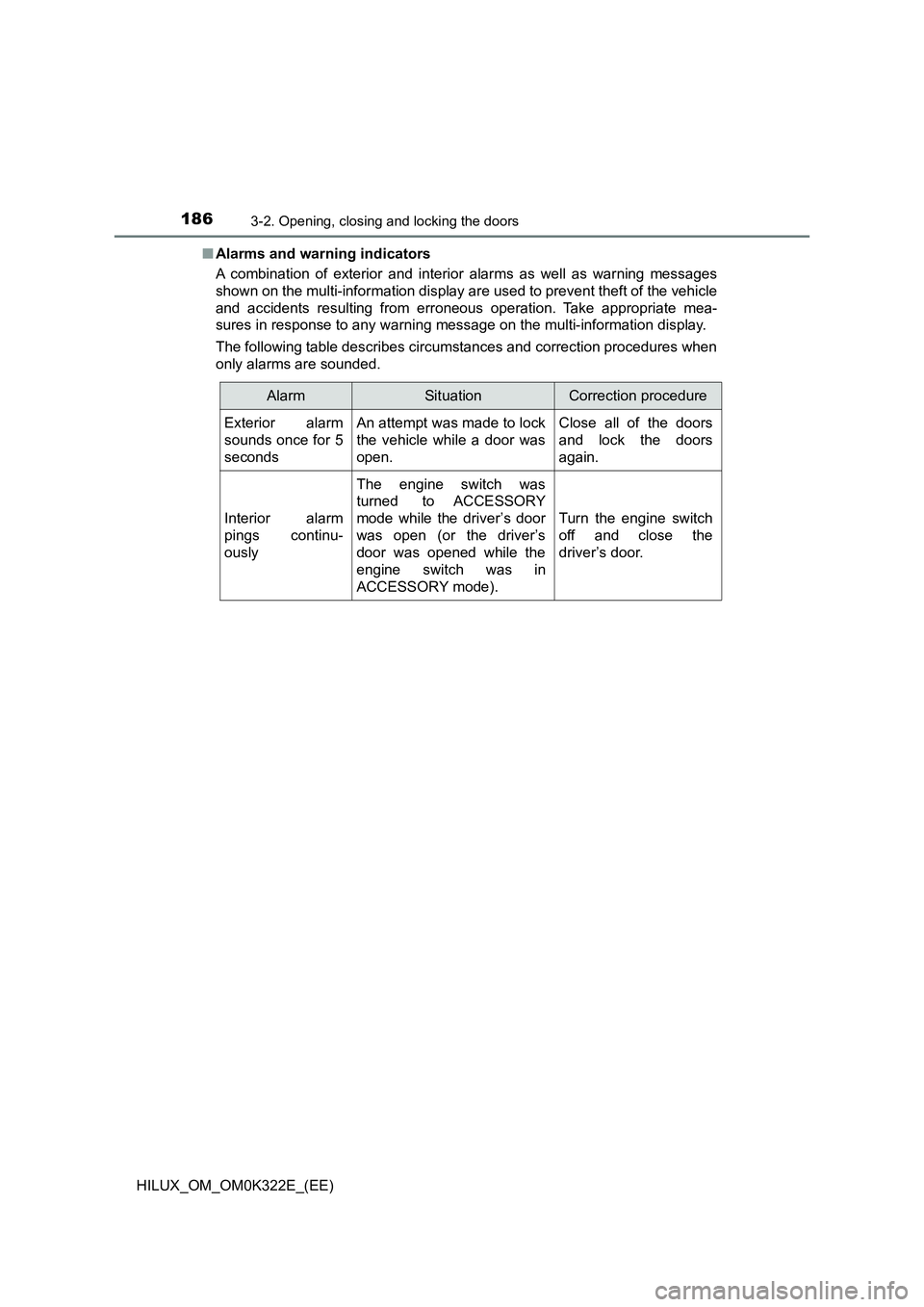
The following table describes circumstances and correction procedures when
only alarms are sounded.
AlarmSituationCorrection procedure
Exterior alarm
sounds once for 5
seconds
An attempt was made to lock
the vehicle while a door was
open.
Close all of the doors
and lock the doors
again.
Interior alarm
pings continu-
ously
The engine switch was
turned to ACCESSORY
mode while the driver’s door
was open (or the driver’s
door was opened while the
engine switch was in
ACCESSORY mode).
Turn the engine switch
off and close the
driver’s door.
Page 189 of 720
1893-2. Opening, closing and locking the doors
3
Operation of each component
HILUX_OM_OM0K322E_(EE)
■ If the smart entry & start system does not operate properly
● Locking and unlocking the doors: Use the mechanical key. (P. 644)
● Starting the engine: P. 645
■ Electronic key battery depletion
● The standard battery life is 1 to 2 years.
● If the battery becomes low, an alarm will sound in the cabin when the engine
stops.
● As the electronic key always receives radio waves, the battery will become
depleted even if the electronic key is not used. The following symptoms indi-
cate that the electronic key battery may be depleted. Replace the battery
when necessary. ( P. 575)
• The smart entry & start system or the wireless remote control does not
operate.
• The detection area becomes smaller.
• The LED indicator on the key surface does not turn on.
● To avoid serious deterioration, do not leave the electronic key within 1 m (3
ft.) of the following electrical appliances that produce a magnetic field:
•TVs
• Personal computers
• Cellular phones, cordless phones and battery chargers
• Recharging cellular phones or cordless phones
• Table lamps
• Induction cookers
■ If “KEY LEFT INSIDE VEHICLE”/“Key left inside vehicle” is shown on the
multi-information display (if equipped)
An attempt was made to lock the doors using the smart entry & start system
while the electronic key was still inside the vehicle, or an attempt was made
to lock either front door by opening a door and putting the inside lock button
into the lock position, then closing the door by pulling on the outside door
handle with the electronic key still inside the vehicle.
Retrieve the electronic key from the vehicle and lock the doors again.
■ Customization that can be configured at any authorized Toyota retailer
or Toyota authorized repairer, or any reliable repairer
Settings (e.g. smart entry & start system) can be changed.
(Customizable features: P. 695)
■ If the smart entry & start system has been deactivated in a customized
setting
● Locking and unlocking the doors:
Use the wireless remote control or mechanical key. ( P. 174, 644)
● Starting the engine and changing engine switch modes: P. 645
● Stopping the engine: P. 271
Page 233 of 720
2333-5. Opening and closing the windows
3
Operation of each component
HILUX_OM_OM0K322E_(EE)
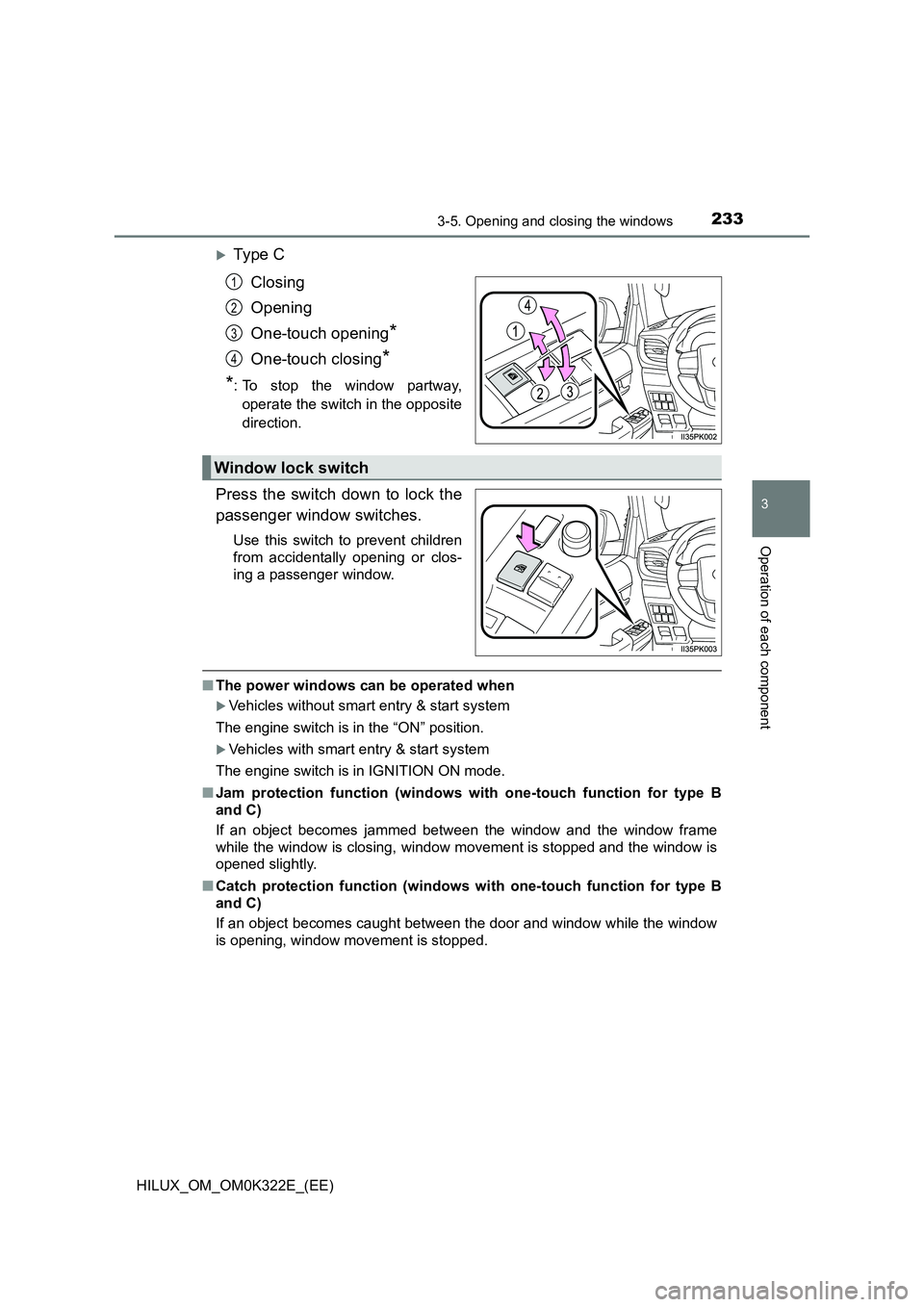
Ty pe C
Closing
Opening
One-touch opening*
One-touch closing*
*: To stop the window partway,
operate the switch in the opposite
direction.
Press the switch down to lock the
passenger window switches.
Use this switch to prevent children
from accidentally opening or clos-
ing a passenger window.
■ The power windows can be operated when
Vehicles without smart entry & start system
The engine switch is in the “ON” position.
Vehicles with smart entry & start system
The engine switch is in IGNITION ON mode.
■ Jam protection function (windows with one-touch function for type B
and C)
If an object becomes jammed between the window and the window frame
while the window is closing, window movement is stopped and the window is
opened slightly.
■ Catch protection function (windows with one-touch function for type B
and C)
If an object becomes caught between the door and window while the window
is opening, window movement is stopped.
1
2
3
4
Window lock switch
Page 234 of 720
2343-5. Opening and closing the windows
HILUX_OM_OM0K322E_(EE)
■ Operating the power windows after turning the engine off
Vehicles without smart entry & start system
The power windows can be operated for approximately 45 seconds even
after the engine switch is turned to the “ACC” or “LOCK” position. They can-
not, however, be operated once either front door is opened.
Vehicles with smart entry & start system
The power windows can be operated for approximately 45 seconds even
after the engine switch is turned to ACCESSORY mode or turned off. They
cannot, however, be operated once either front door is opened.
■ When the window cannot be opened or closed (windows with one-touch
function for type B and C)
When the jam protection function or catch protection function operates
unusually and the window cannot be opened or closed, perform the following
operations with the power window switch of that door.
● Stop the vehicle. With the engine switch in the “ON” position (vehicles with-
out smart entry & start system) or IGNITION ON mode (vehicles with smart
entry & start system), within 4 seconds of the jam protection function or
catch protection function activating, continually operate the power window
switch in the one-touch closing dire ction or one-touch opening direction so
that the window can be opened and closed.
● If the window cannot be opened and closed even when performing the
above operations, perform the following procedure for function initialization.
Turn the engine switch to the “ON” position (vehicles without smart entry
& start system) or IGNITION ON mode (vehicles with smart entry & start
system).
Pull and hold the power window switch in the one-touch closing direction
and completely close the window.
Release the power window switch for a moment, resume pulling the
switch in the one-touch closing direction, and hold it there for approxi-
mately 6 seconds or more.
Press and hold the power window switch in the one-touch opening direc-
tion. After the window is completely opened, continue holding the switch
for an additional 1 second or more.
Release the power window switch for a moment, resume pushing the
switch in the one-touch opening direction, and hold it there for approxi-
mately 4 seconds or more.
Pull and hold the power window switch in the one-touch closing direction
again. After the window is completely closed, continue holding the switch
for a further 1 second or more.
If you release the switch while the window is moving, start again from the
beginning.
If the window reverses and cannot be fully closed or opened, have the vehi-
cle inspected by any authorized Toyota retailer or Toyota authorized
repairer, or any reliable repairer.
1
2
3
4
5
6
Page 241 of 720
2414-1. Before driving
4
Driving
HILUX_OM_OM0K322E_(EE)
■When starting off on an uphill (vehicles with hill-start assist control sys-
tem)
The hill-start assist control will activate. ( P. 387)
■ Driving in the rain
● Drive carefully when it is raining, because visibility will be reduced, the win-
dows may become fogged-up, and the road will be slippery.
● Drive carefully when it starts to rain, because the road surface will be espe-
cially slippery.
● Refrain from high speeds when driving on an expressway in the rain,
because there may be a layer of water between the tires and the road sur-
face, preventing the steering and brakes from operating properly.
■ Engine speed while driving (automatic transmission)
In the following conditions, the engine speed may become high while driving.
This is due to automatic up-shifting c ontrol or down-shifting implementation to
meet driving conditions. It does not indicate sudden acceleration.
● The vehicle is judged to be driving uphill or downhill
● When the accelerator pedal is released
■ Restraining the engine output (Brake Override System)
● When the accelerator and brake pedals are depressed at the same time, the
engine output may be restrained.
● Vehicles without multi-information display: A warning light comes on while
the system is operating. ( P. 613)
● Vehicles with multi-information display: A warning message is displayed on
the multi-information display while the system is operating. ( P. 620)
■ Breaking in your new Toyota
To extend the life of the vehicle, observing the following precautions is recom-
mended:
● For the first 300 km (200 miles):
Avoid sudden stops.
● For the first 800 km (500 miles) (models for model code destination W*):
Do not tow a trailer. ( P. 253)
*: See “Checking your vehicle’s model” if you are not sure of which model
your vehicle is. ( P. 1 1 )
● For the first 1000 km (600 miles):
• Do not drive at extremely high speeds.
• Avoid sudden acceleration.
• Do not drive continuously in the low gears.
• Do not drive at a constant speed for extended periods.
• Do not drive slowly with the manual transmission in a high gear.
Page 242 of 720
2424-1. Before driving
HILUX_OM_OM0K322E_(EE)
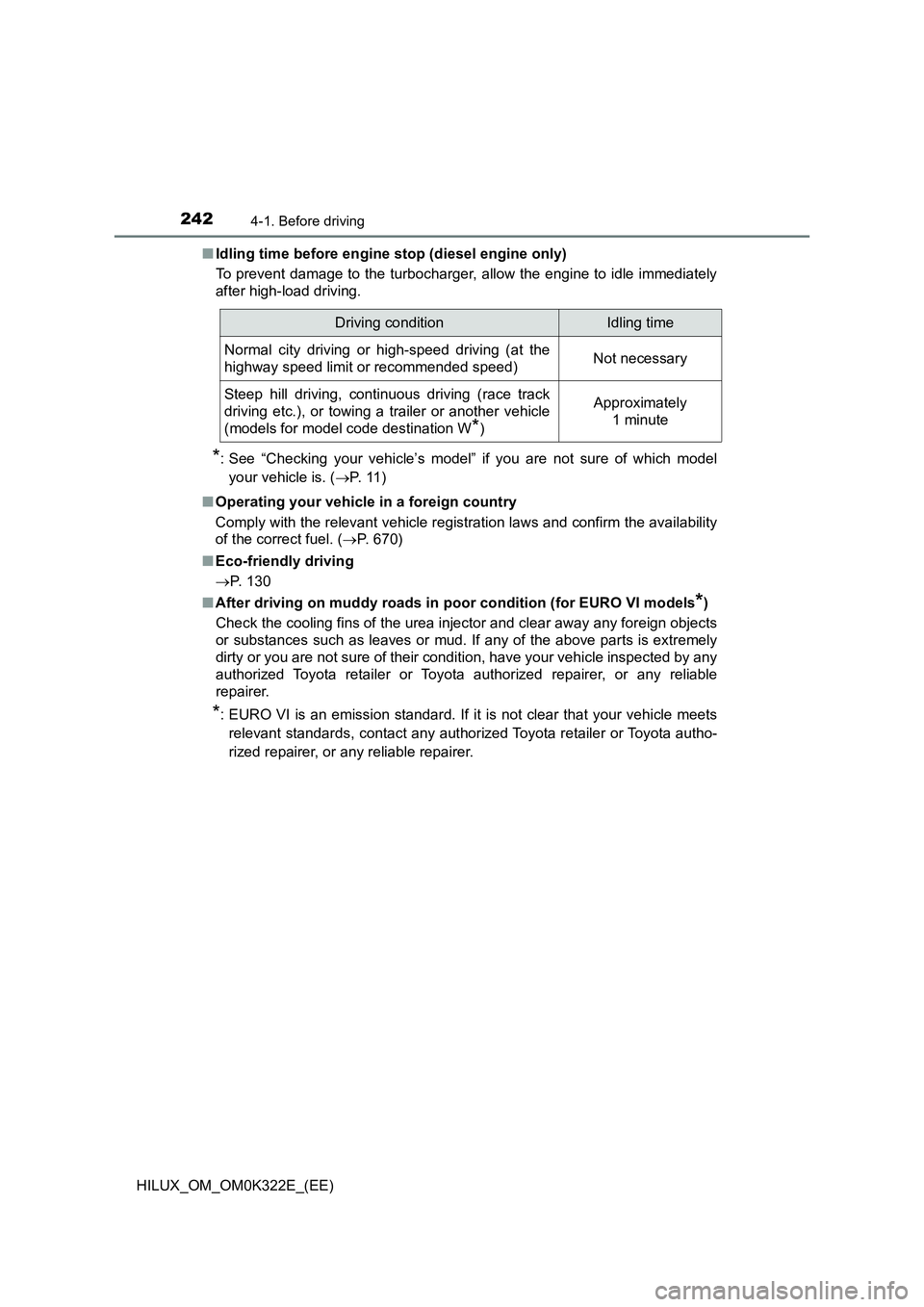
■ Idling time before engine stop (diesel engine only)
To prevent damage to the turbocharger, allow the engine to idle immediately
after high-load driving.
*: See “Checking your vehicle’s model” if you are not sure of which model
your vehicle is. ( P. 11 )
■ Operating your vehicle in a foreign country
Comply with the relevant vehicle registration laws and confirm the availability
of the correct fuel. ( P. 670)
■ Eco-friendly driving
P. 130
■ After driving on muddy roads in poor condition (for EURO VI models*)
Check the cooling fins of the urea injector and clear away any foreign objects
or substances such as leaves or mud. If any of the above parts is extremely
dirty or you are not sure of their condition, have your vehicle inspected by any
authorized Toyota retailer or Toyota authorized repairer, or any reliable
repairer.
*: EURO VI is an emission standard. If it is not clear that your vehicle meets
relevant standards, contact any authorized Toyota retailer or Toyota autho-
rized repairer, or any reliable repairer.
Driving conditionIdling time
Normal city driving or high-speed driving (at the
highway speed limit or recommended speed)Not necessary
Steep hill driving, continuous driving (race track
driving etc.), or towing a trailer or another vehicle
(models for model code destination W*)
Approximately
1 minute
Page 244 of 720
2444-1. Before driving
HILUX_OM_OM0K322E_(EE)
WARNING
Observe the following precautions.
Failure to do so may result in death or serious injury.
■ When driving the vehicle
● Use engine braking (downshift) to maintain a safe speed when driving
down a steep hill.
Using the brakes continuously may cause the brakes to overheat and lose
effectiveness. ( P. 2 7 8 )
● Do not adjust the positions of the steering wheel, the seat, or the inside or
outside rear view mirrors while driving.
Doing so may result in a loss of vehicle control.
● Always check that all passengers’ arms, heads or other parts of their body
are not outside the vehicle.
● Do not drive the vehicle off-road.
4WD models only: This is not a 4WD vehicle designed for off-road driving.
Proceed with all due caution if it becomes unavoidable to drive off-road.
● Do not drive across a river or through other bodies of water.
This may cause electric/electronic components to short circuit, damage
the engine or cause other serious damage to the vehicle.
● On vehicles with manual transmission, do not operate the clutch halfway
for a long period of time unless it is necessary. Doing so could not only
speed up clutch wear, but could also damage the clutch or even cause a
fatal accident such as vehicle fire.
■ When driving on slippery road surfaces
● Sudden braking, acceleration and steering may cause tire slippage and
reduce your ability to control the vehicle.
● Sudden acceleration, engine braking due to shifting, or changes in engine
speed could cause the vehicle to skid.
● After driving through a puddle, lightly depress the brake pedal to make
sure that the brakes are functioning properly. Wet brake pads may prevent
the brakes from functioning properly. If the brakes on only one side are wet
and not functioning properly, steering control may be affected.
Page 247 of 720
2474-1. Before driving
4
Driving
HILUX_OM_OM0K322E_(EE)
WARNING
Observe the following precautions.
Failure to do so may result in death or serious injury.
■ When the vehicle is parked
● Always apply the parking brake, shift the shift lever to P (vehicles with
automatic transmission only), stop the engine and lock the vehicle.
Do not leave the vehicle unattended while the engine is running.
If the vehicle is parked with the shift lever in P but the parking brake is not
set, the vehicle may start to move, possibly leading to an accident.
● Do not touch the exhaust pipes while the engine is running or immediately
after turning the engine off.
Doing so may cause burns.
■ When taking a nap in the vehicle
Always turn the engine off. Otherwise, if you accidentally move the shift
lever or depress the accelerator pedal, this could cause an accident or fire
due to engine overheating. Additionally, if the vehicle is parked in a poorly
ventilated area, exhaust gases may collect and enter the vehicle, leading to
death or a serious health hazard.
■ When braking
● When the brakes are wet, drive more cautiously.
Braking distance increases when the brakes are wet, and this may cause
one side of the vehicle to brake differently than the other side. Also, the
parking brake may not securely hold the vehicle.
● If the power brake assist function does not operate, do not follow other
vehicles closely and avoid hills or shar p turns that require braking. In this
case, braking is still possible, but the brake pedal should be depressed
more firmly than usual. Also, the braking distance will increase. Have your
brakes fixed immediately.
● Do not pump the brake pedal if the engine stalls.
Each push on the brake pedal uses up the reserve for the power-assisted
brakes.
● The brake system consists of 2 individual hydraulic systems: If one of the
systems fails, the other will still operate. In this case, the brake pedal
should be depressed more firmly than usual and the braking distance will
increase.
Have your brakes fixed immediately.
■ If the vehicle becomes stuck (4WD models)
Do not spin the wheels excessively when any of the tires is up in the air, or
the vehicle is stuck in sand, mud, etc. This may damage the driveline com-
ponents or propel the vehicle forward or backward, causing an accident.
Page 252 of 720
2524-1. Before driving
HILUX_OM_OM0K322E_(EE)
Trailer towing (except models for model
code destination W)
: See “Checking your vehicle’s model” if you are not sure of which model your vehicle is.
( P. 1 1 )
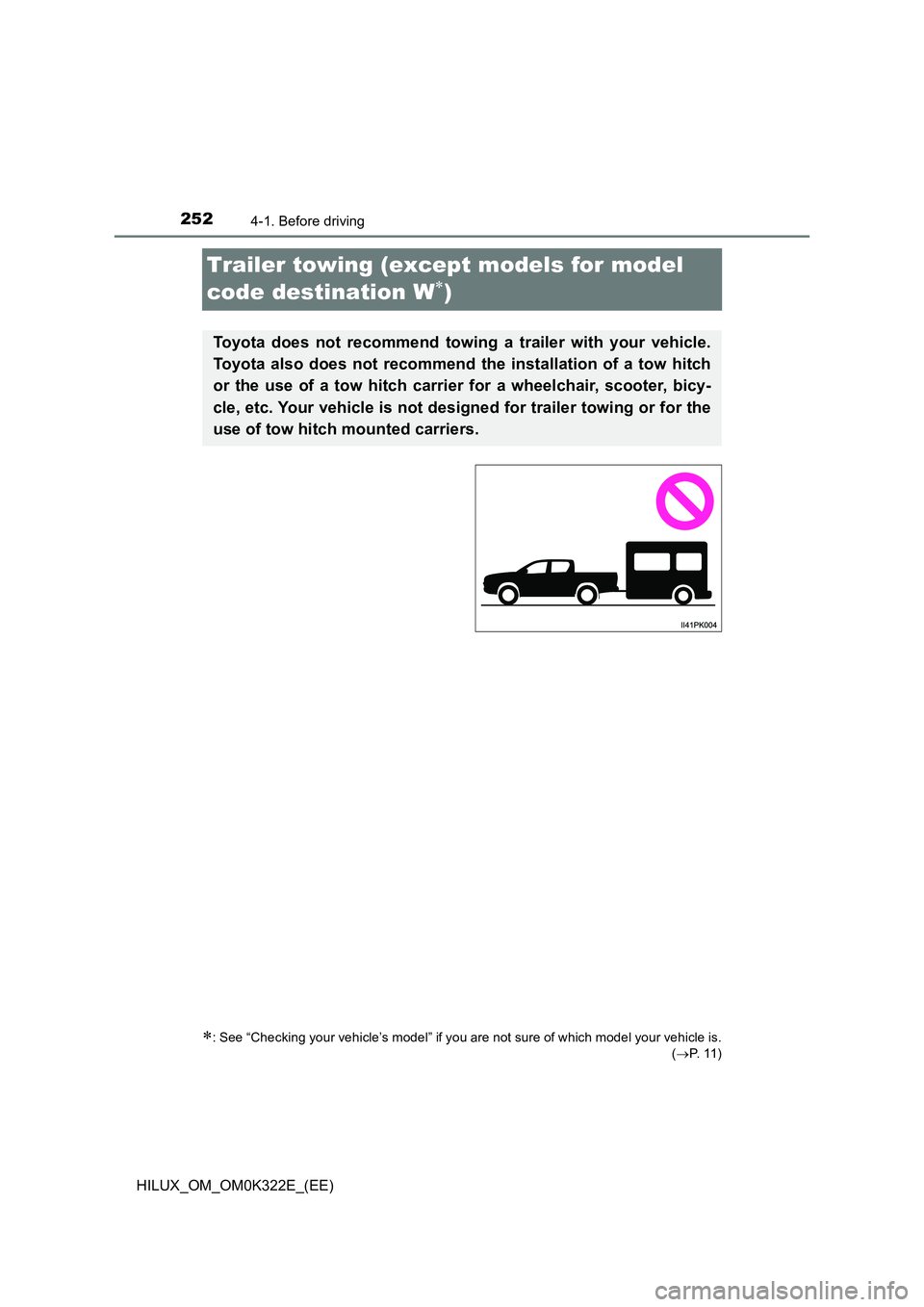
Toyota does not recommend towing a trailer with your vehicle.
Toyota also does not recommend the installation of a tow hitch
or the use of a tow hitch carrier for a wheelchair, scooter, bicy-
cle, etc. Your vehicle is not designed for trailer towing or for the
use of tow hitch mounted carriers.