control TOYOTA HILUX 2018 Manual PDF
[x] Cancel search | Manufacturer: TOYOTA, Model Year: 2018, Model line: HILUX, Model: TOYOTA HILUX 2018Pages: 708, PDF Size: 95.31 MB
Page 369 of 708
3694-5. Using the driving support systems
4
Driving
HILUX_OM_OM0K375E_(EE)
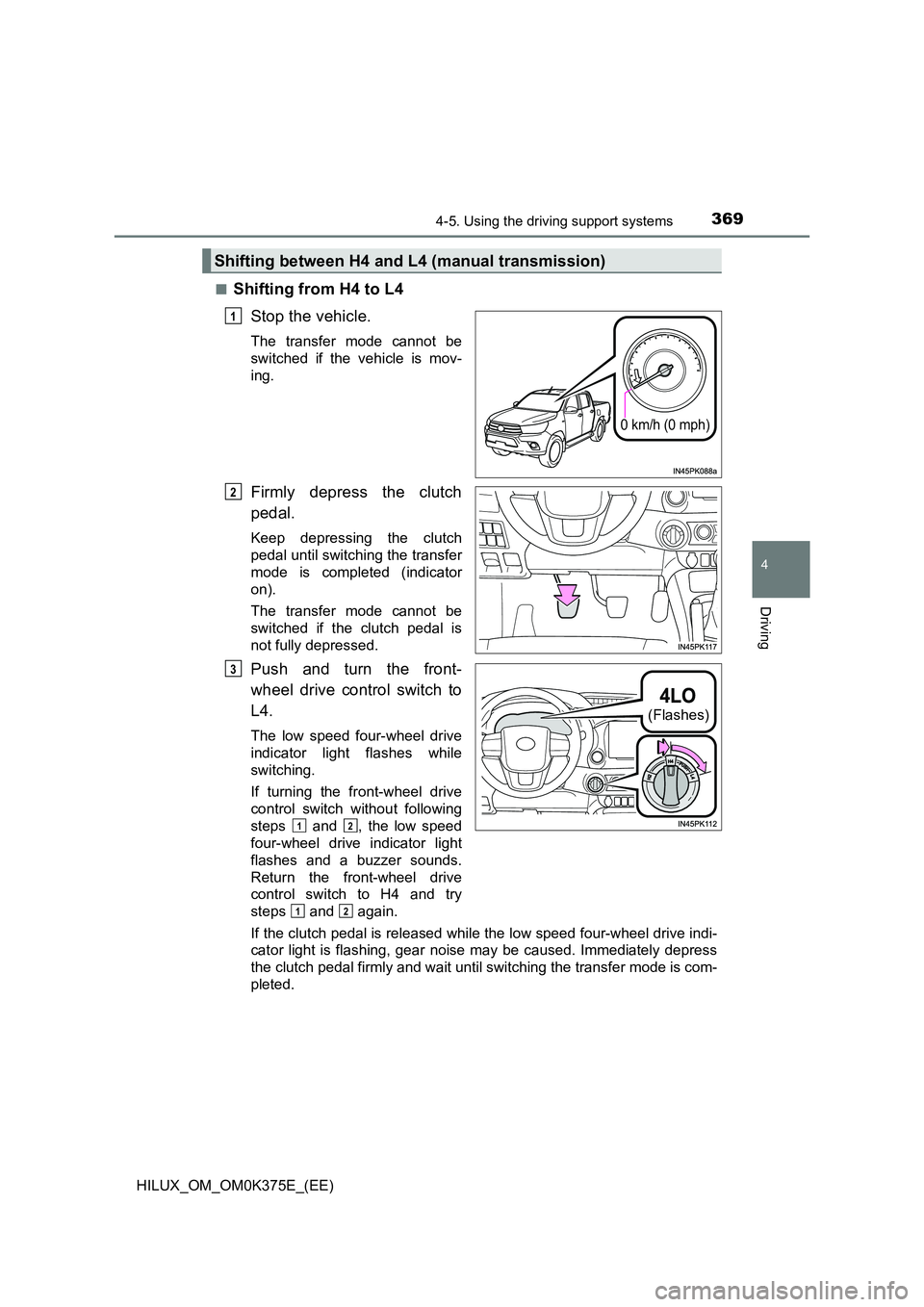
■Shifting from H4 to L4
Stop the vehicle.
The transfer mode cannot be
switched if the vehicle is mov-
ing.
Firmly depress the clutch
pedal.
Keep depressing the clutch
pedal until switching the transfer
mode is completed (indicator
on).
The transfer mode cannot be
switched if the clutch pedal is
not fully depressed.
Push and turn the front-
wheel drive control switch to
L4.
The low speed four-wheel drive
indicator light flashes while
switching.
If turning the front-wheel drive
control switch without following
steps and , the low speed
four-wheel drive indicator light
flashes and a buzzer sounds.
Return the front-wheel drive
control switch to H4 and try
steps and again.
If the clutch pedal is released while the low speed four-wheel drive indi-
cator light is flashing, gear noise may be caused. Immediately depress
the clutch pedal firmly and wait until switching the transfer mode is com-
pleted.
Shifting between H4 and L4 (manual transmission)
0 km/h (0 mph)
1
2
(Flashes)
3
12
12
Page 371 of 708
3714-5. Using the driving support systems
4
Driving
HILUX_OM_OM0K375E_(EE)
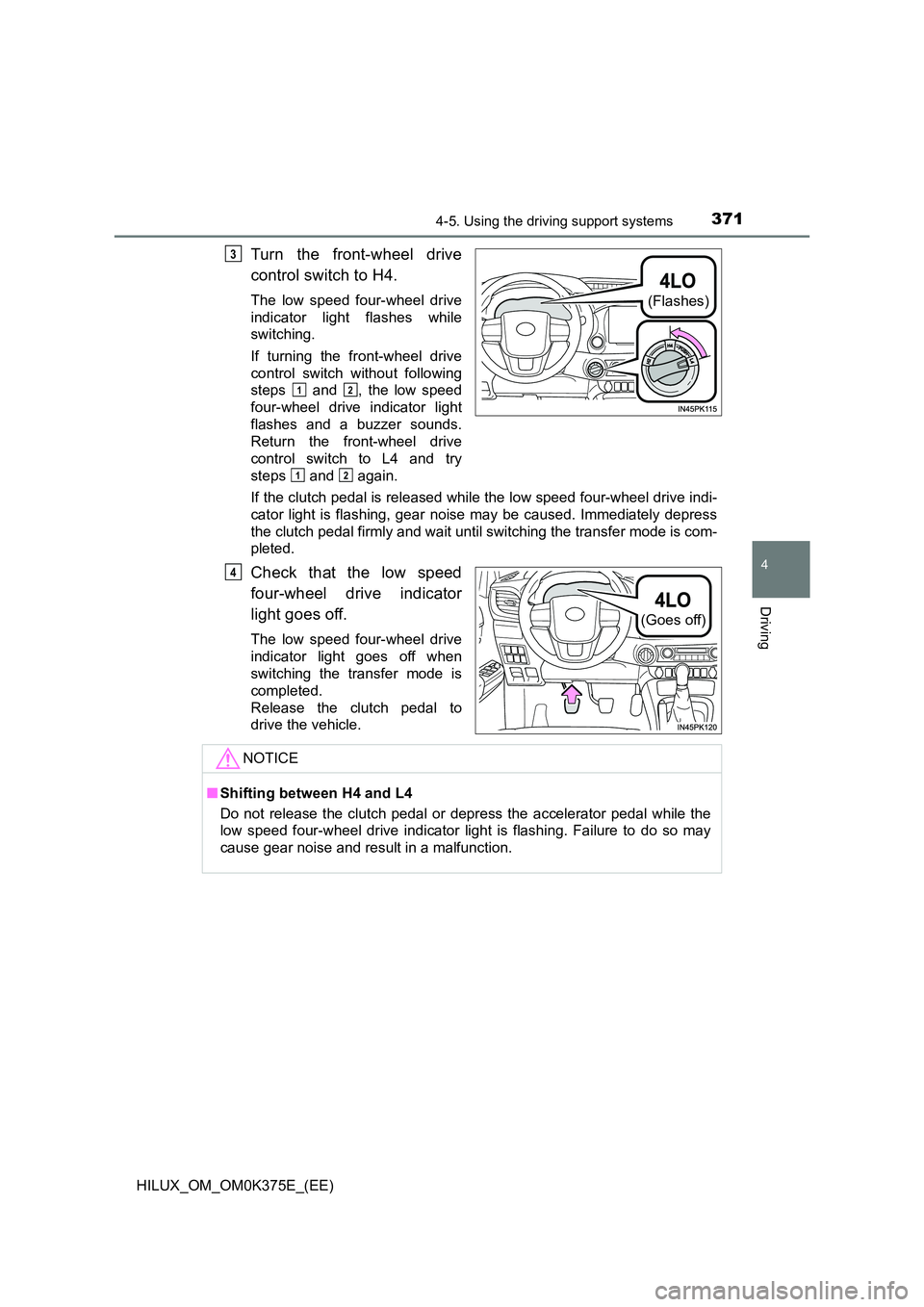
Turn the front-wheel drive
control switch to H4.
The low speed four-wheel drive
indicator light flashes while
switching.
If turning the front-wheel drive
control switch without following
steps and , the low speed
four-wheel drive indicator light
flashes and a buzzer sounds.
Return the front-wheel drive
control switch to L4 and try
steps and again.
If the clutch pedal is released while the low speed four-wheel drive indi-
cator light is flashing, gear noise may be caused. Immediately depress
the clutch pedal firmly and wait until switching the transfer mode is com-
pleted.
Check that the low speed
four-wheel drive indicator
light goes off.
The low speed four-wheel drive
indicator light goes off when
switching the transfer mode is
completed.
Release the clutch pedal to
drive the vehicle.
(Flashes)
3
12
12
(Goes off)
4
NOTICE
■ Shifting between H4 and L4
Do not release the clutch pedal or depress the accelerator pedal while the
low speed four-wheel drive indicator light is flashing. Failure to do so may
cause gear noise and result in a malfunction.
Page 372 of 708
3724-5. Using the driving support systems
HILUX_OM_OM0K375E_(EE)
■Four-wheel drive usage frequency (vehicles with A.D.D.)
You should drive in four-wheel drive for at least 16 km (10 miles) each month.
This will assure that the front drive components are lubricated.
■ Shifting between H2 and H4
If you have trouble shifting in cold w eather, reduce your speed or stop the
vehicle and reshift.
■ Shifting to L4 (vehicles with VSC)
VSC is automatically turned off.
■ When driving on dry paved surface roads and expressway
Use H2 position. If the vehicle is driven in H4 or L4 position for a long time, a
warning buzzer sounds, and the four-wheel drive indicator light flashes rap-
idly or a warning message is shown on the multi-information display. If the
warning message is shown on the multi-information display, follow the mes-
sage.
WARNING
■ While driving
● Never turn the front-wheel drive control switch from H2 to H4 if the wheels
are slipping. Stop the slipping or spinning before shifting.
● For normal driving on dry and hard surface roads, use H2 position. Driving
on dry and hard surface roads in H4 or L4 position may cause drive com-
ponent oil leakage, seizure, or other problems resulting in an accident.
Further, it may cause tire wear and increased fuel consumption.
● Avoid turning suddenly in H4 or L4 position. If you do turn suddenly, the
difference in turning speeds between the front and rear wheels may have
a similar effect to braking, thus making driving difficult.
Page 376 of 708
3764-5. Using the driving support systems
HILUX_OM_OM0K375E_(EE)
■Locking the rear differential
The following systems do not operate w hen the rear differential is locked.
It is normal operation for the ABS warning light, VSC OFF indicator (if
equipped) and “TRC OFF” indicator (if equipped) to be on or for “TRC
TURNED OFF”/“TRC turned off” to be displayed on the multi-information dis-
play (if equipped) at this time.
•ABS
• Brake assist (if equipped)
• VSC (if equipped)
• TRC/A-TRC (if equipped)
• Trailer Sway Control (if equipped)
• Hill-start assist control (if equipped)
• Downhill assist control (if equipped)
■ Unlocking the rear differential
If the rear differential lock indicator still flashes even after unlocking the rear
differential, check the safety of the surrounding area and slightly turn the
steering wheel in either direction while the vehicle is in motion.
■ Automatic system cancelation of the rear differential lock system
The rear differential lock is also unlocked in any of the following situations:
● The front-wheel drive control switch is turned to H2 or H4 (4WD models)
● The engine switch is turned to the “ACC” or “LOCK” position (vehicles with-
out smart entry & start system) or A CCESSORY or off (vehicles with smart
entry & start system)
■ After unlocking the rear differential
Check that the indicator goes off.
WARNING
■ To avoid an accident
Failure to observe the following precautions may result in an accident.
● Do not use the rear differential lock system except when wheel spinning
occurs in a ditch or on a slippery or rugged surface. Large steering effort
and careful cornering control will be required.
● Do not lock the rear differential until the wheels have stopped spinning.
Otherwise, the vehicle may move in an unexpected direction when the dif-
ferential lock is engaged, resulting in an accident. This may also lead to
possible damage to rear differential lock component parts.
● Do not drive over 8 km/h (5 mph) when the differential is locked.
● Do not keep driving with the rear differential lock switch on.
Page 378 of 708
3784-5. Using the driving support systems
HILUX_OM_OM0K375E_(EE)
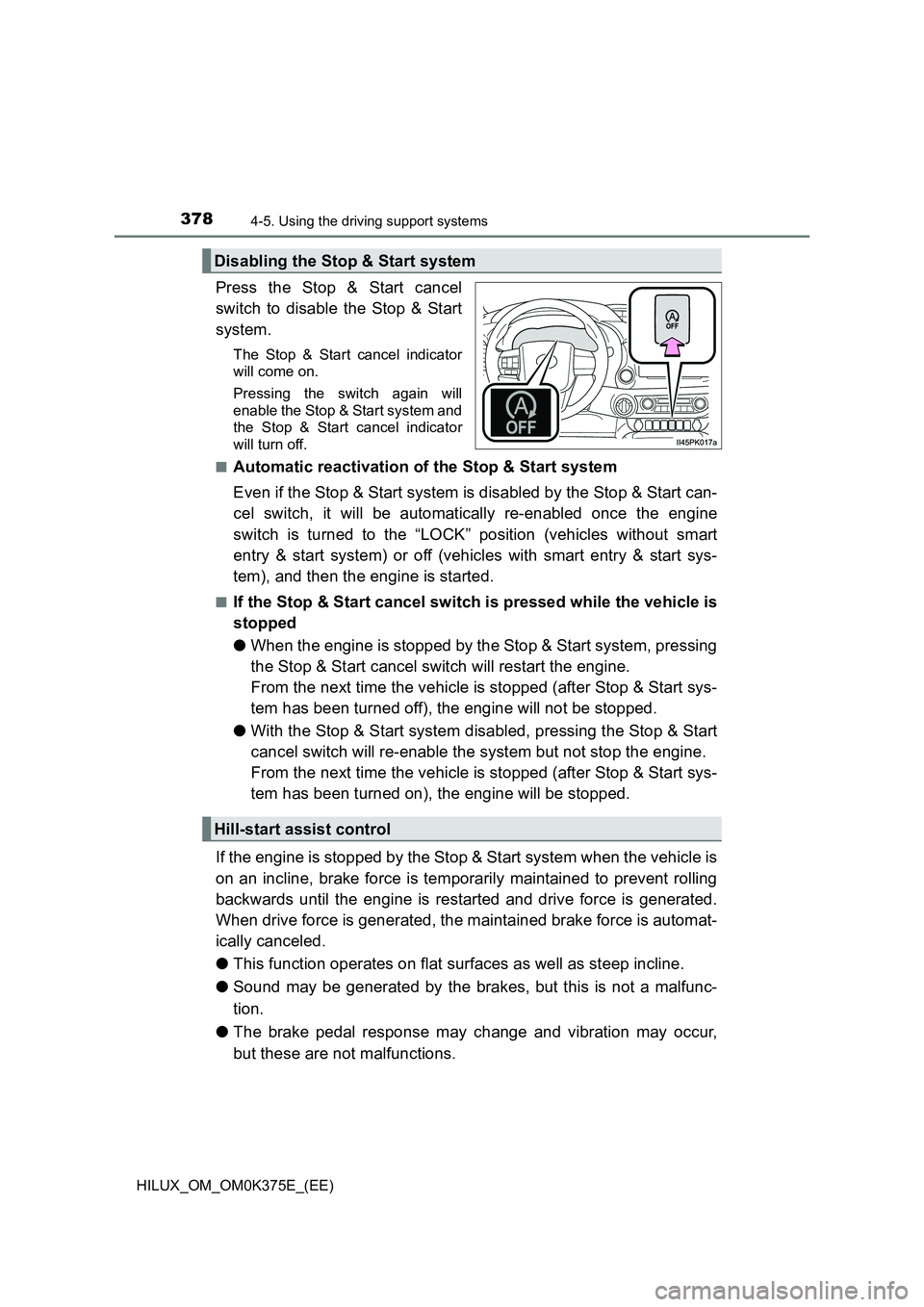
Press the Stop & Start cancel
switch to disable the Stop & Start
system.
The Stop & Start cancel indicator
will come on.
Pressing the switch again will
enable the Stop & Start system and
the Stop & Start cancel indicator
will turn off.
■Automatic reactivation of the Stop & Start system
Even if the Stop & Start system is disabled by the Stop & Start can-
cel switch, it will be automatically re-enabled once the engine
switch is turned to the “LOCK” position (vehicles without smart
entry & start system) or off (vehicles with smart entry & start sys-
tem), and then the engine is started.
■If the Stop & Start cancel switch is pressed while the vehicle is
stopped
● When the engine is stopped by the Stop & Start system, pressing
the Stop & Start cancel switch will restart the engine.
From the next time the vehicle is stopped (after Stop & Start sys-
tem has been turned off), the engine will not be stopped.
● With the Stop & Start system disabled, pressing the Stop & Start
cancel switch will re-enable the system but not stop the engine.
From the next time the vehicle is stopped (after Stop & Start sys-
tem has been turned on), the engine will be stopped.
If the engine is stopped by the Stop & Start system when the vehicle is
on an incline, brake force is temporarily maintained to prevent rolling
backwards until the engine is restarted and drive force is generated.
When drive force is generated, the maintained brake force is automat-
ically canceled.
● This function operates on flat surfaces as well as steep incline.
● Sound may be generated by the brakes, but this is not a malfunc-
tion.
● The brake pedal response may change and vibration may occur,
but these are not malfunctions.
Disabling the Stop & Start system
Hill-start assist control
Page 379 of 708
3794-5. Using the driving support systems
4
Driving
HILUX_OM_OM0K375E_(EE)
■Operating conditions
● The Stop & Start system is operational when all of the following conditions
are met:
• Vehicles with automatic transmission: The brake pedal is being
depressed firmly
• Vehicles with manual transmission: The clutch pedal is not being
depressed.
• The engine is adequately warmed up.
• The outside temperature is -5 C (23 F) or higher
• Vehicles with automatic transmission: The shift lever is in D or S, or P
after driving in D or S.
• Vehicles with manual transmission: The shift lever is in N.
• Vehicles with automatic air conditioning system: is off.
• The hood is closed. ( P. 380)
• The driver’s seat belt is fastened.
• The driver’s door is closed.
• The accelerator pedal is not being depressed.
● In the following situations, the engine may not be stopped by the Stop &
Start system. This is not a malfunction of the Stop & Start system.
• The air conditioning system is being used when the ambient temperature
is high or low.
• The battery is undergoing a periodic recharge.
• The battery is not sufficiently charged, such as if the vehicle has been
parked for a long time and the battery charge has decreased, the electric
load is large, the battery temperature is excessively low or the battery has
deteriorated.
• The brake booster vacuum is low.
• The vehicle is stopped on a steep incline.
• The steering wheel is being operated
• Due to traffic or other circumstances the vehicle is being stopped repeat-
edly.
• The vehicle is being driven in a high altitude area.
• Engine coolant temperature or tr ansmission fluid temperature is
extremely low or high.
• The battery fluid temperature is extremely low or high.
• For a while after the battery terminals have been disconnected and
reconnected.
• For a while after the battery has been replaced.
• The front-wheel drive control switch is in the L4 position or the rear differ-
ential is locked.
Page 382 of 708
3824-5. Using the driving support systems
HILUX_OM_OM0K375E_(EE)
■ If an odor comes from the air conditioning system while the engine is
stopped by the Stop & Start system
Vehicles with manual air conditioning system:
If the idling stop time is set to “Long”, change the setting to “Normal”. If an
odor occurs even when “Normal” is selected, press the Stop & Start cancel
switch to deactivate the Stop & Start system.
Vehicles with automatic air conditioning system:
Press the Stop & Start cancel switch to deactivate the Stop & Start system.
■ Changing the idling stop time with the air conditioning system on
The length of time the Stop & Start system will operate when the air condition-
ing system is on can be changed by performing the following operation. (The
length of time the Stop & Start system will operate when the air conditioning
system is off cannot be changed.)
Use the meter control switches to select while the vehicle is stopped
and press , and select and press .
Select “Normal” or “Long”, and then press .
■ The Stop & Start system protection function
● When an excessively loud sound is being projected by the audio system,
the audio system may be automatically cut off in order to reduce battery
consumption. If this occurs, turn the engine switch to the “LOCK” position
(vehicles without smart entry & start sy stem) or off (vehicles with smart entry
& start system), wait for 3 seconds or longer and then turn it to the “ACC” or
“ON” position (vehicles without smart entry & start system), or ACCES-
SORY mode or IGNITION ON mode (vehicles with smart entry & start sys-
tem) to re-enable the audio system.
● The audio system may not be activated when the battery terminals are dis-
connected and then reconnected. If this occurs, turn the engine switch to
the “LOCK” position (vehicles without smart entry & start system) or off
(vehicles with smart entry & start system), and then repeat the following
operation twice to activate the audio system normally.
• Turn the engine switch to the “ON” position (vehicles without smart entry
& start system), or IGNITION ON mode (vehicles with smart entry & start
system), and then to the “LOCK” position (vehicles without smart entry &
start system) or off (vehicles with smart entry & start system).
■ Replacing the battery
P. 642
1
2
Page 383 of 708
3834-5. Using the driving support systems
4
Driving
HILUX_OM_OM0K375E_(EE)
■ Displaying the Stop & Start system status
Operation status of the Stop & Start system can be displayed on the
(Drive information) screen of multi-information display. ( P. 144)
The display of “After Reset” can be reset.
● To reset the display, press of the meter control switches, press “<” or “>”
to select “Reset”, and then press and hold .
● To stop the reset procedure, press .
■ Multi-information display messages
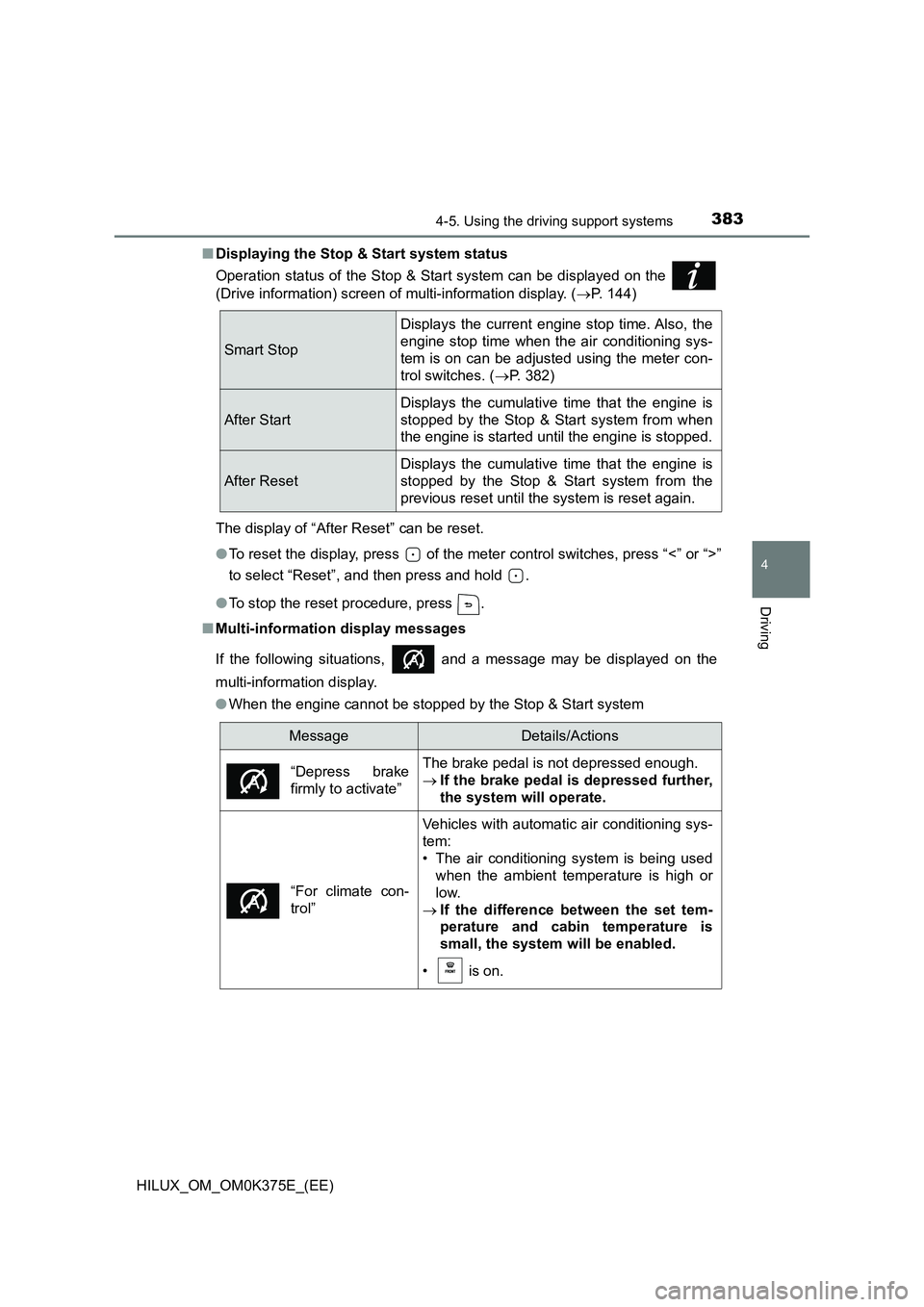
If the following situations, and a message may be displayed on the
multi-information display.
● When the engine cannot be stopped by the Stop & Start system
Smart Stop
Displays the current engine stop time. Also, the
engine stop time when t he air conditioning sys-
tem is on can be adjusted using the meter con-
trol switches. ( P. 382)
After Start
Displays the cumulative time that the engine is
stopped by the Stop & Start system from when
the engine is started until the engine is stopped.
After Reset
Displays the cumulative time that the engine is
stopped by the Stop & Start system from the
previous reset until the system is reset again.
MessageDetails/Actions
“Depress brake
firmly to activate”
The brake pedal is not depressed enough.
If the brake pedal is depressed further,
the system will operate.
“For climate con-
trol”
Vehicles with automatic air conditioning sys-
tem:
• The air conditioning system is being used
when the ambient temperature is high or
low.
If the difference between the set tem-
perature and cabin temperature is
small, the system will be enabled.
• is on.
Page 385 of 708
3854-5. Using the driving support systems
4
Driving
HILUX_OM_OM0K375E_(EE)
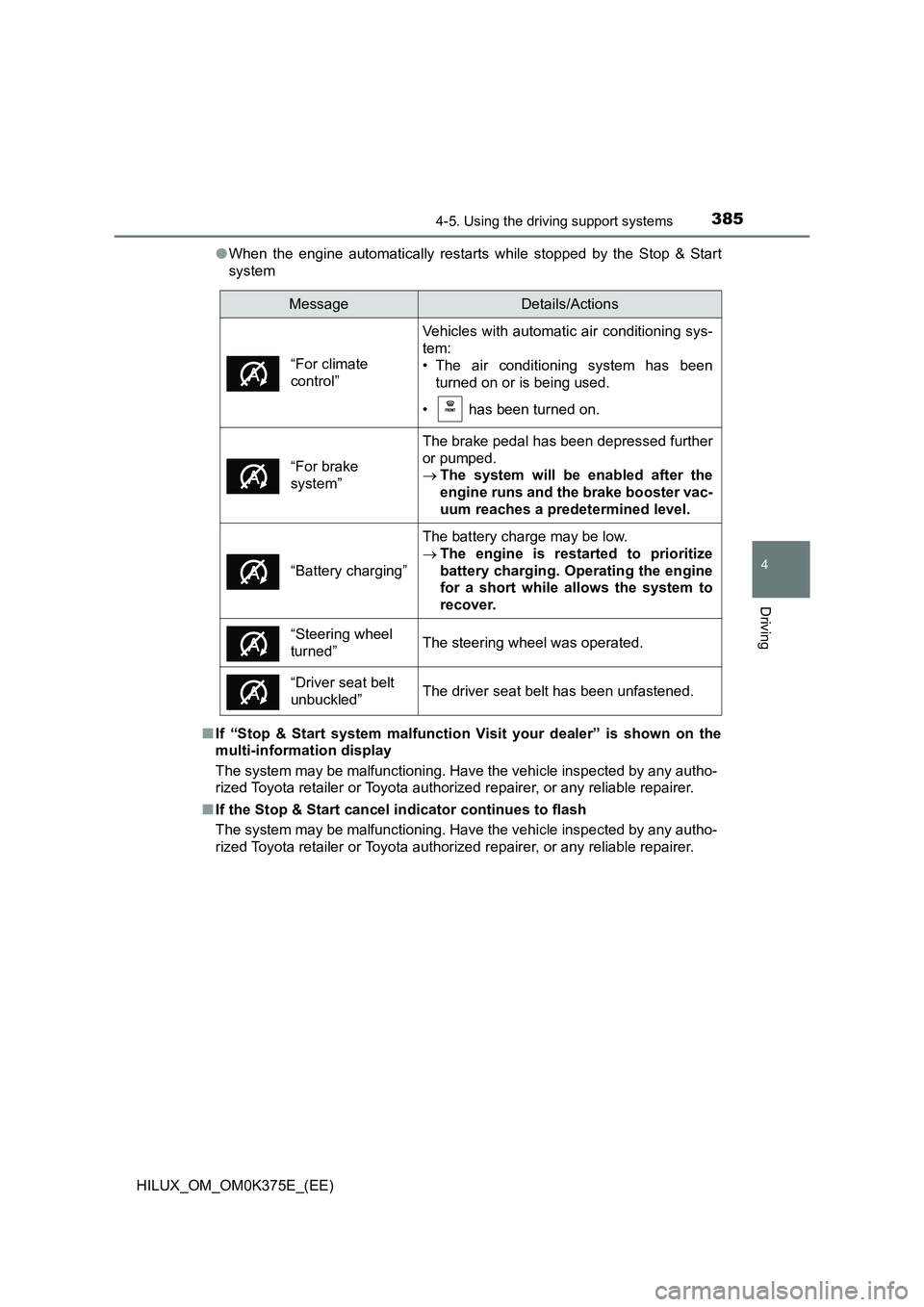
● When the engine automatically restarts while stopped by the Stop & Start
system
■ If “Stop & Start system malfunction Visit your dealer” is shown on the
multi-information display
The system may be malfunctioning. Have the vehicle inspected by any autho-
rized Toyota retailer or Toyota authorized repairer, or any reliable repairer.
■ If the Stop & Start cancel indicator continues to flash
The system may be malfunctioning. Have the vehicle inspected by any autho-
rized Toyota retailer or Toyota authorized repairer, or any reliable repairer.
MessageDetails/Actions
“For climate
control”
Vehicles with automatic air conditioning sys-
tem:
• The air conditioning system has been
turned on or is being used.
• has been turned on.
“For brake
system”
The brake pedal has been depressed further
or pumped.
The system will be enabled after the
engine runs and the brake booster vac-
uum reaches a predetermined level.
“Battery charging”
The battery charge may be low.
The engine is restarted to prioritize
battery charging. Operating the engine
for a short while allows the system to
recover.
“Steering wheel
turned”The steering wheel was operated.
“Driver seat belt
unbuckled”The driver seat belt has been unfastened.
Page 387 of 708
387
4
4-5. Using the driving support systems
Driving
HILUX_OM_OM0K375E_(EE)
Driving assist systems
◆ABS (Anti-lock Brake System)
Helps to prevent wheel lock when the brakes are applied suddenly, or if the
brakes are applied while driving on a slippery road surface
◆Brake assist (if equipped)
Generates an increased level of braking force after the brake pedal is
depressed when the system detects a panic stop situation
◆VSC (Vehicle Stability Control) (if equipped)
Helps the driver to control skidding when swerving suddenly or turning on
slippery road surfaces
◆TRC (Traction Control) for Pre Runner and H2 position on 4WD
models (if equipped)
Helps to maintain drive power and pr event the drive wheels from spinning
when starting the vehicle or accelerating on slippery roads
◆A-TRC (Active Traction Control) for H4 and L4 position on 4WD
models (if equipped)
Helps to maintain drive power and prevent the four wheels from spinning
when starting the vehicle or accelerating on slippery roads
◆Hill-start assist control (if equipped)
Helps to reduce the backward movement of the vehicle when starting on
an uphill
◆Emergency brake signal (if equipped)
When the brakes are applied suddenly, the emergency flashers automati-
cally flash to alert the vehicle behind.
To keep driving safety and performance, the following systems
operate automatically in response to various driving situations.
Be aware, however, that these systems are supplementary and
should not be relied upon too heavily when operating the vehi-
cle.