inflation pressure TOYOTA iQ EV 2013 Owners Manual (in English)
[x] Cancel search | Manufacturer: TOYOTA, Model Year: 2013, Model line: iQ EV, Model: TOYOTA iQ EV 2013Pages: 444, PDF Size: 7.34 MB
Page 4 of 444
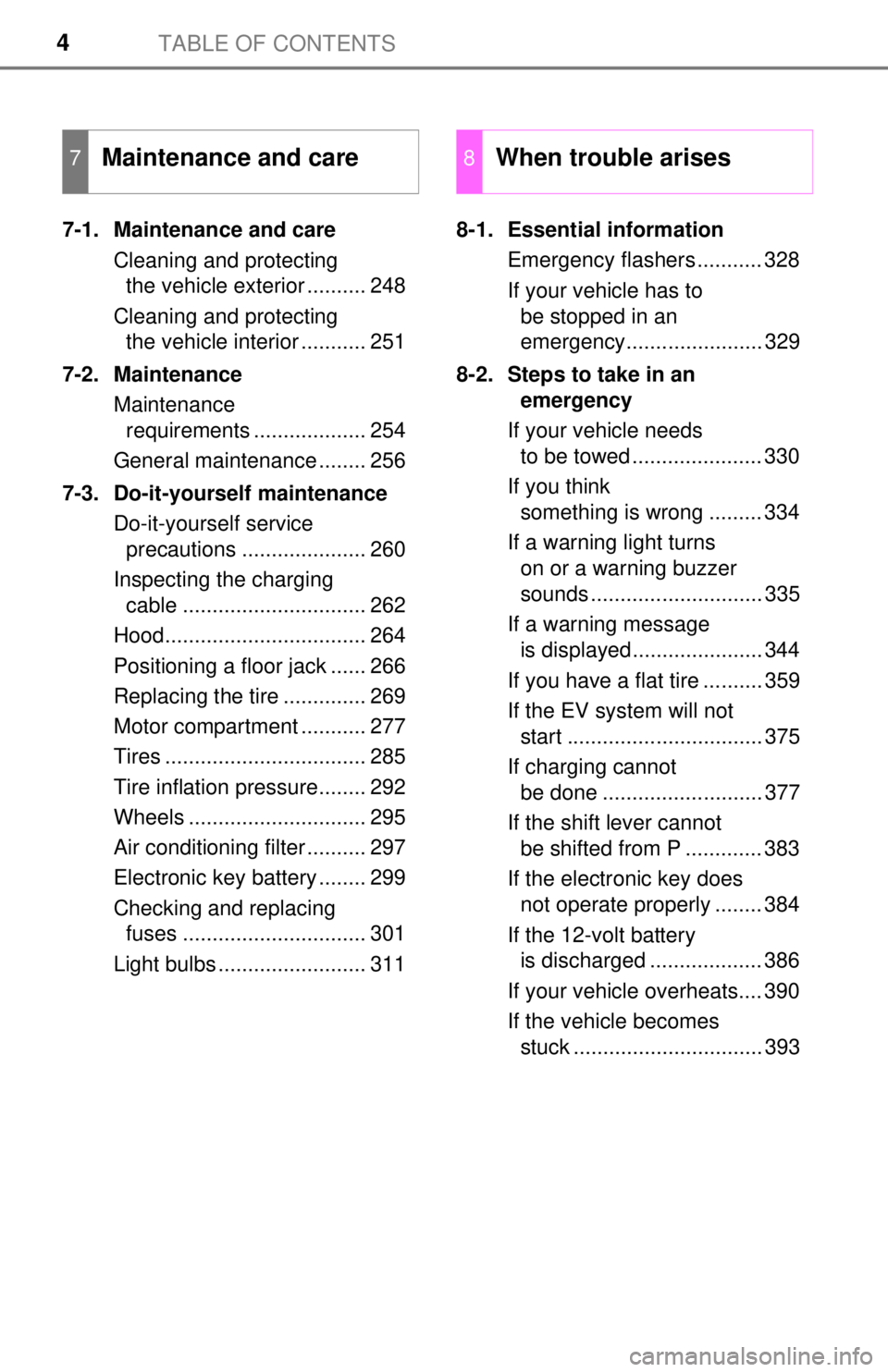
TABLE OF CONTENTS4
7-1. Maintenance and careCleaning and protecting the vehicle exterior .......... 248
Cleaning and protecting the vehicle interior ........... 251
7-2. Maintenance Maintenance requirements ................... 254
General maintenance ........ 256
7-3. Do-it-yourself maintenance Do-it-yourself service precautions ..................... 260
Inspecting the charging cable ............................... 262
Hood.................................. 264
Positioning a floor jack ...... 266
Replacing the tire .............. 269
Motor compartment ........... 277
Tires .................................. 285
Tire inflation pressure........ 292
Wheels .............................. 295
Air conditioning filter .......... 297
Electronic key battery ........ 299
Checking and replacing fuses ............................... 301
Light bulbs ......................... 311 8-1. Essential information
Emergency flashers ........... 328
If your vehicle has to be stopped in an
emergency....................... 329
8-2. Steps to take in an emergency
If your vehicle needs to be towed ...................... 330
If you think something is wrong ......... 334
If a warning light turns on or a warning buzzer
sounds ............................. 335
If a warning message is displayed...................... 344
If you have a flat tire .......... 359
If the EV system will not start ................................. 375
If charging cannot be done ........................... 377
If the shift lever cannot be shifted from P ............. 383
If the electronic key does not operate properly ........ 384
If the 12-volt battery is discharged ................... 386
If your vehicle overheats.... 390
If the vehicle becomes stuck ................................ 393
7Maintenance and care8When trouble arises
Page 13 of 444
13Pictorial index
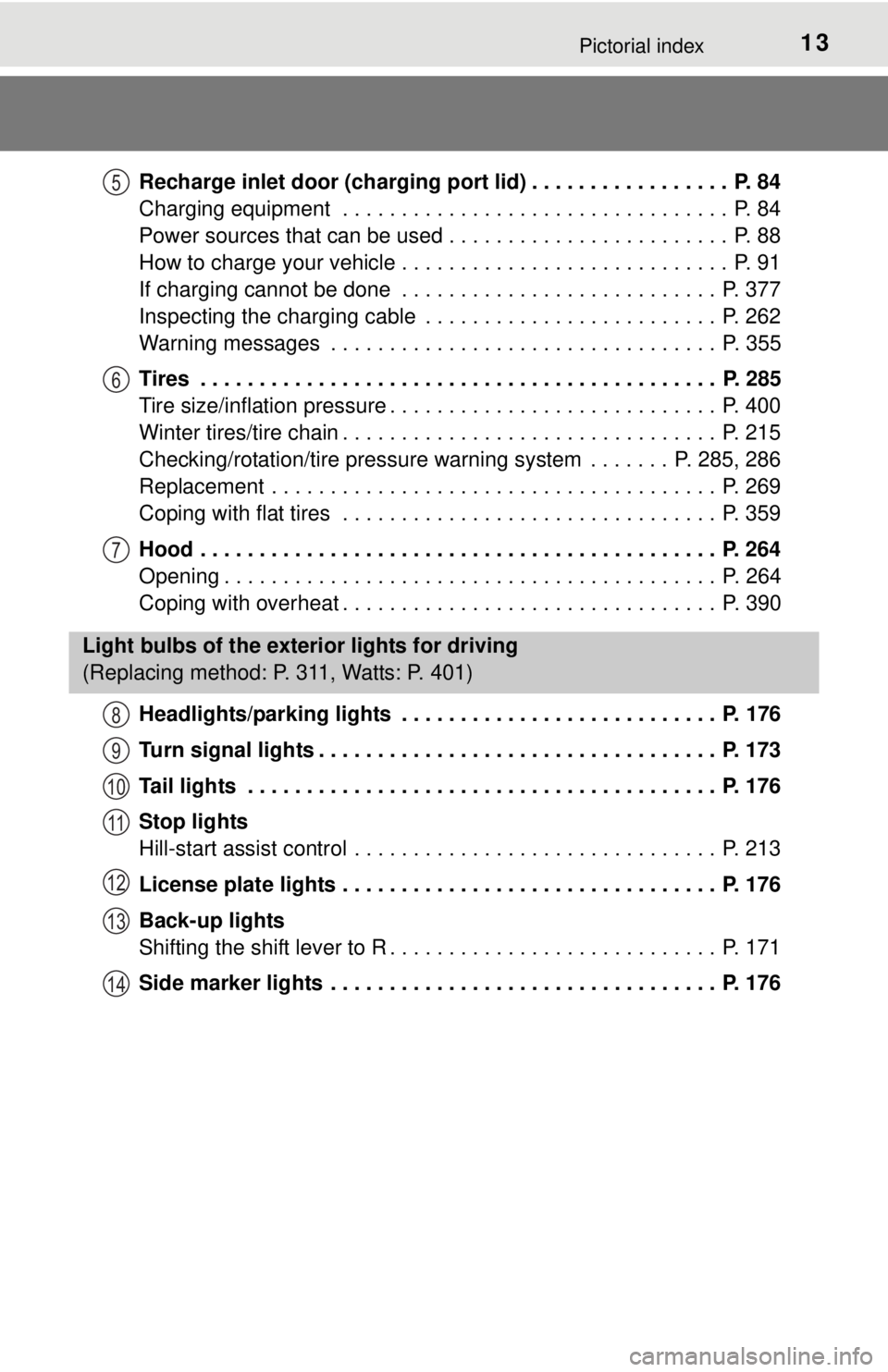
Recharge inlet door (charging port lid) . . . . . . . . . . . . . . . . . P. 84
Charging equipment . . . . . . . . . . . . . . . . . . . . . . . . . . . . . . . . . P. 84
Power sources that can be used . . . . . . . . . . . . . . . . . . . . . . . . P. 88
How to charge your vehicle . . . . . . . . . . . . . . . . . . . . . . . . . . . . P. 91
If charging cannot be done . . . . . . . . . . . . . . . . . . . . . . . . . . . P. 377
Inspecting the charging cable . . . . . . . . . . . . . . . . . . . . . . . . . P. 262
Warning messages . . . . . . . . . . . . . . . . . . . . . . . . . . . . . . . . . P. 355
Tires . . . . . . . . . . . . . . . . . . . . . . . . . . . . . . . . . . . . . . . . . . . . P. 285
Tire size/inflation pressure . . . . . . . . . . . . . . . . . . . . . . . . . . . . P. 400
Winter tires/tire chain . . . . . . . . . . . . . . . . . . . . . . . . . . . . . . . . P. 215
Checking/rotation/tire pressure warning system . . . . . . . P. 285, 286
Replacement . . . . . . . . . . . . . . . . . . . . . . . . . . . . . . . . . . . . . . P. 269
Coping with flat tires . . . . . . . . . . . . . . . . . . . . . . . . . . . . . . . . P. 359
Hood . . . . . . . . . . . . . . . . . . . . . . . . . . . . . . . . . . . . . . . . . . . . P. 264
Opening . . . . . . . . . . . . . . . . . . . . . . . . . . . . . . . . . . . . . . . . . . P. 264
Coping with overheat . . . . . . . . . . . . . . . . . . . . . . . . . . . . . . . . P. 390
Headlights/parking lights . . . . . . . . . . . . . . . . . . . . . . . . . . . P. 176
Turn signal lights . . . . . . . . . . . . . . . . . . . . . . . . . . . . . . . . . . P. 173
Tail lights . . . . . . . . . . . . . . . . . . . . . . . . . . . . . . . . . . . . . . . . P. 176
Stop lights
Hill-start assist control . . . . . . . . . . . . . . . . . . . . . . . . . . . . . . . P. 213
License plate lights . . . . . . . . . . . . . . . . . . . . . . . . . . . . . . . . P. 176
Back-up lights
Shifting the shift lever to R . . . . . . . . . . . . . . . . . . . . . . . . . . . . P. 171
Side marker lights . . . . . . . . . . . . . . . . . . . . . . . . . . . . . . . . . P. 1765
6
7
Light bulbs of the exterior lights for driving
(Replacing method: P. 311, Watts: P. 401)
8
9
10
11
12
13
14
Page 97 of 444
972-3. Driving the EV (Electric Vehicle)
2
EV system
■Air conditioning on/off
●Switch the air conditioning off when it is not needed. Doing so
can help control excessive elec tricity and power consumption.
In summer:
In high temperatures, use the re circulated air mode. Doing so will
help to reduce the burden on the air conditioning and reduce
power consumption as well.
In winter:
Excessive or unnecessary heating should be avoided. The use of
the seat heater ( P. 244) is effective to avoid excessive power
consumption.
● For efficiency, use the Remote Climate Control before departing
while the charging cable is connected. ( P. 228)
■Checking tire inflation pressure
Make sure to check the tire infl ation pressure frequently. Improper
tire inflation pressure can cause poor power consumption.
Also, as snow tires can cause large amounts of friction, their use on
dry roads will lead to p oor power consumption. Use tires that are
appropriate for the season.
■Luggage
Carrying heavy luggage can require excessive energy. Avoid leav-
ing unnecessary luggage in the vehicle.
Page 212 of 444
2125-5. Using the driving support systems
CAUTION
■The ABS does not operate effectively when
● The limits of tire gripping performance have been exceeded.
● The vehicle hydroplanes while driving at high speed on wet or slick roads.
■ Stopping distance when the ABS is operating may exceed that of nor-
mal conditions
The ABS is not designed to shorten the vehicle’s stopping distance. Always
maintain a safe distance from the vehicle in front of you, especially in the
following situations:
● When driving on dirt, gravel or snow-covered roads
● When driving with tire chains
● When driving over bumps in the road
● When driving over roads with potholes or uneven surfaces
■ TRAC may not operat e effectively when
Directional control and power may not be achievable while driving on slip-
pery road surfaces, even if the TRAC system is operating.
Do not drive the vehicle in conditions where stability and power may be lost.
■ When the VSC is activated
The slip indicator flashes. Always drive carefully. Reckless driving may
cause an accident. Exercise particular care when the indicator flashes.
■ Replacing tires
Make sure that all tires are of the specified size, brand, tread pattern and
total load capacity. In addition, make sure that the tires are inflated to the
recommended tire inflation pressure level.
The ABS, TRAC and VSC systems will not function correctly if different tires
are installed on the vehicle.
Contact your Scion dealer for further information when replacing tires or
wheels.
■ Handling of tires and the suspension
Using tires with any kind of problem or modifying the suspension will affect
the driving assist systems, and may cause a system to malfunction.
Page 247 of 444
247
7Maintenance and care
7-1. Maintenance and careCleaning and protecting the vehicle exterior .......... 248
Cleaning and protecting the vehicle interior ........... 251
7-2. Maintenance Maintenance requirements ................... 254
General maintenance ........ 256 7-3. Do-it-yourself maintenance
Do-it-yourself service precautions ..................... 260
Inspecting the charging cable ............................... 262
Hood ................................. 264
Positioning a floor jack ...... 266
Replacing the tire .............. 269
Motor compartment ........... 277
Tires .................................. 285
Tire inflation pressure ....... 292
Wheels .............................. 295
Air conditioning filter.......... 297
Electronic key battery........ 299
Checking and replacing fuses ............................... 301
Light bulbs......................... 311
Page 259 of 444

2597-2. Maintenance
7
Maintenance and care
Vehicle exterior
ItemsCheck points
Doors• Do the doors operate smoothly?
Hood• Does the hood lock system workproperly?
Fluid leaks
• There should not be any signs offluid leakage after the vehicle has
been parked.
Tires
• Is the tire inflation pressure cor-rect?
• The tires should not be dam- aged or excessively worn.
• Have the tires been rotated according to the maintenance
schedule?
• The wheel nuts should not be loose.
Charging equipment
ItemsCheck points
Charging cable
• Check that the electrical leakage
detection function operates prop-
erly. ( P. 262)
Page 260 of 444

2607-3. Do-it-yourself maintenance
Do-it-yourself ser vice precautions
If you perform maintenance by yourself, be sure to follow the
correct procedures as given in these sections.
ItemsParts and tools
12-volt battery condition (P. 281)
• Grease
• Conventional wrench
(for terminal clamp bolts)
Brake fluid level ( P. 279)
• FMVSS No.116 DOT 3 or SAE
J1703 brake fluid
• Rag or paper towel
• Funnel (used only for adding brake fluid)
Inverter coolant level ( P. 278)
•“To y o t a Super Long Life Coolant”
or a similar high quality ethylene
glycol-based non-silicate, non-
amine, non-nitrite and non-borate
coolant with long-life hybrid
organic acid technology. “Toyota
Super Long Life Coolant” is pre-
mixed with 50% coolant and 50%
deionized water.
• Funnel (used only for adding cool- ant)
Fuses (P. 301)• Fuse with same amperage rating
as original
Light bulbs (P. 311)
• Bulb with same number and watt-
age rating as original
• Flathead screwdriver
Radiator and condenser ( P. 279)
Tire inflation pressure ( P. 292)• Tire pressure gauge
• Compressed air source
Washer fluid(P. 283)
• Water or washer fluid containing
antifreeze (for winter use)
• Funnel (used only for adding water or washer fluid)
Page 286 of 444

2867-3. Do-it-yourself maintenance
Your vehicle is equipped with a tire pressure warning system that uses
tire pressure warning valves and tr ansmitters to detect low tire infla-
tion pressure before serious problems arise.
If the tire pressure drops below a predetermined level, the driver is
warned by a warning light. ( P. 338)
◆Installing tire pressure warning valves and transmitters
When replacing tires or wheels, tire pressure warning valves and
transmitters must also be installed.
When new tire pressure warning valves and transmitters are
installed, new ID codes must be registered in the tire pressure
warning computer and the tire pr essure warning system must be
initialized. Have tire pressure warning valve and transmitter ID
codes registered by your Scion dealer. ( P. 287)
◆Initializing the tire pressure warning system
The tire pressure warning system must be initialized when rotating
the tires on vehicles differing with front and rear tire inflation pres-
sures.
When the tire pressure warning system is initialized, the current tire
inflation pressure is set as the benchmark pressure.
■How to initialize the tire pressure warning system
Park the vehicle in a safe place and turn the power switch off.
Initialization cannot be performed while the vehicle is moving.
Adjust the tire inflation pressure to the specified cold tire inflation
pressure level. ( P. 400)
Make sure to adjust the tire pressu re to the specified cold tire infla-
tion pressure level. The tire pressure warning system will operate
based on this pressure level.
Turn the power switch to ON mode.
Tire pressure warning system
1
2
3
Page 288 of 444

2887-3. Do-it-yourself maintenance
■Tire life
Any tire over 6 years old must be checked by a qualified technician even
if it has seldom or never been used or damage is not obvious.
■Routine tire inflation pressure checks
The tire pressure warning system does not replace routine tire inflation
pressure checks. Make sure to check tire inflation pressure as part of
your routine of daily vehicle checks.
■Maximum load of tire
Check that the maximum load of the replacement tire is greater than 1/2
of the Gross Axle Weight Ratings (GAWR) of either the front axle or the
rear axle, whichever is greater.
■Tire types
●Summer tires
Summer tires are high-speed performance tires best suited to highway
driving under dry conditions. Since summer tires do not have the same
traction performance as snow tires, summer tires are inadequate for
driving on snow-covered or icy ro ads. For driving on snow-covered
roads or icy roads, the use of snow tires is recommended. When install-
ing snow tires, be sure to replace all four tires.
●All season tires
All season tires are designed to provide better traction in snow and to
be adequate for driving in most winter conditions as well as for use
year-round. All season tires, however, do not have adequate traction
performance compared with snow tires in heavy or loose snow. Also, all
season tires fall short in acceleration and handling performance com-
pared with summer tires in highway driving.
●Snow tires
For driving on snow-covered roads or icy roads, we recommend using
snow tires. If you need snow tires, select tires of the same size, con-
struction and load capacity as the or iginally installed tires. Since your
vehicle has radial tires as original equipment, make sure your snow
tires also have radial construction. Do not install studded tires without
first checking local regulations fo r possible restrictions. Snow tires
should be installed on all wheels. ( P. 215)
For the GAWR, see the Certification
Label. For the maximum load of the tire,
see the load limit at maximum cold tire
inflation pressure mentioned on the
sidewall of the tire. (
P. 402)
Page 289 of 444

2897-3. Do-it-yourself maintenance
7
Maintenance and care
■Initializing the tire pressure warning system
Initialize the system with the tire inflation pressure adjusted to the speci-
fied level.
■If the tread on snow tires wears down below 0.16 in. (4 mm)
The effectiveness of the tire s as snow tires is lost.
■If you press the tire pressure warning reset switch accidentally
If initialization is performed, adjust the tire inflation pressure to the speci-
fied level and initialize the tire pressure warning system again.
■When initialization of the tire pr essure warning system has failed
Initialization can be completed in a few minutes. However, in the following
cases, the settings have not been recorded and the system will not oper-
ate properly. If repeated attempts to record tire inflation pressure settings
are unsuccessful, have the vehicl e inspected by your Scion dealer.
●When operating the tire pressure wa rning reset switch, the tire pressure
warning light does not blink 3 times.
●After carrying out the initialization procedure, the tire pressure warning
light blinks for 1 minute then stays on after driving for about 20 minutes.
■Tire pressure warning system certification
FCC ID: PAXPMV107J
FCC ID: HYQ13BDE
NOTE:
This device complies with part 15 of the FCC Rules. Operation is subject
to the following two conditions: (1) This device may not cause harmful
interference, and (2) this device must accept any interference received,
including interference that may cause undesired operation.
FCC WARNING:
Changes or modifications not expressly approved by the party responsi-
ble for compliance could void the user ’s authority to operate the equip-
ment.