instrument TOYOTA iQ EV 2013 Owners Manual (in English)
[x] Cancel search | Manufacturer: TOYOTA, Model Year: 2013, Model line: iQ EV, Model: TOYOTA iQ EV 2013Pages: 444, PDF Size: 7.34 MB
Page 1 of 444

Pictorial indexSearch by illustration
1For safety
and securityMake sure to read through them
2EV systemEV (Electric Vehicle) system characteristics,
charge methods, etc.
3Instrument
clusterHow to read the gauges and meters, the variety of
warning lights and indicators, etc.
4Operation of
each componentOpening and closing the doors and windows,
adjustment before driving, etc.
5DrivingOperations and advices which are necessary for
driving
6Interior featuresUsage of the interior features, etc.
7Maintenance
and careCaring for your vehicle and maintenance
procedures
8When trouble
arisesWhat to do in case of malfunction or emergency
9Vehicle
specificationsVehicle specifications, customizable features, etc.
10For ownersReporting safety defects for U.S. owners
IndexSearch by symptom
Search alphabetically
Page 2 of 444
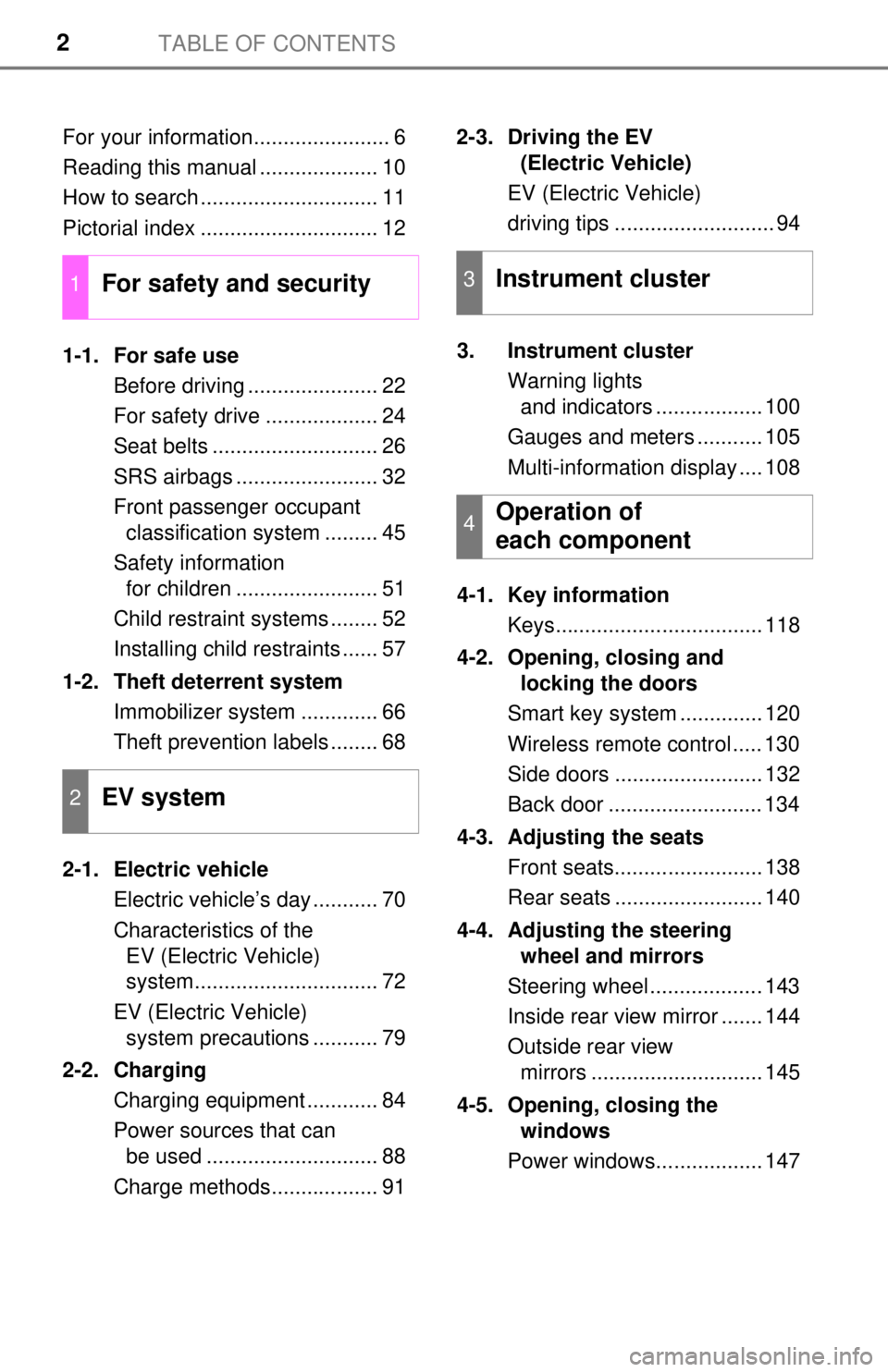
TABLE OF CONTENTS2
For your information....................... 6
Reading this manual .................... 10
How to search .............................. 11
Pictorial index .............................. 12
1-1. For safe useBefore driving ...................... 22
For safety drive ................... 24
Seat belts ............................ 26
SRS airbags ........................ 32
Front passenger occupant classification system ......... 45
Safety information for children ........................ 51
Child restraint systems ........ 52
Installing child restraints ...... 57
1-2. Theft deterrent system Immobilizer system ............. 66
Theft prevention labels ........ 68
2-1. Electric vehicle Electric vehicle’s day ........... 70
Characteristics of the EV (Electric Vehicle)
system............................... 72
EV (Electric Vehicle) system precautions ........... 79
2-2. Charging Charging equipment ............ 84
Power sources that can be used ............................. 88
Charge methods.................. 91 2-3. Driving the EV
(Electric Vehicle)
EV (Electric Vehicle)
driving tips ........................... 94
3. Instrument cluster Warning lights and indicators .................. 100
Gauges and meters ........... 105
Multi-information display .... 108
4-1. Key information Keys................................... 118
4-2. Opening, closing and locking the doors
Smart key system .............. 120
Wireless remote control ..... 130
Side doors ......................... 132
Back door .......................... 134
4-3. Adjusting the seats Front seats......................... 138
Rear seats ......................... 140
4-4. Adjusting the steering wheel and mirrors
Steering wheel ................... 143
Inside rear view mirror ....... 144
Outside rear view mirrors ............................. 145
4-5. Opening, closing the windows
Power windows.................. 147
1For safety and security
2EV system
3Instrument cluster
4Operation of
each component
Page 14 of 444

14Pictorial index
■Instrument panel
Power switch . . . . . . . . . . . . . . . . . . . . . . . . . . . . . . . . . . . . . P. 165
Starting the EV system/changing the modes . . . . . . . . . . P. 165, 166
Emergency stop of the EV system . . . . . . . . . . . . . . . . . . . . . . P. 329
When the EV system will not start . . . . . . . . . . . . . . . . . . . . . . P. 375
Warning messages . . . . . . . . . . . . . . . . . . . . . . . . . . . . . . . . . P. 350
Shift lever . . . . . . . . . . . . . . . . . . . . . . . . . . . . . . . . . . . . . . . . P. 171
Shifting the shift position . . . . . . . . . . . . . . . . . . . . . . . . . . . . . P. 171
Precautions against towing . . . . . . . . . . . . . . . . . . . . . . . . . . . P. 330
When the shift lever does not move. . . . . . . . . . . . . . . . . . . . . P. 383
Meters . . . . . . . . . . . . . . . . . . . . . . . . . . . . . . . . . . . . . . . . . . . P. 105
Reading the meters/
adjusting the instrument panel light . . . . . . . . . . . . . . . . . P. 105, 106
Warning lights/indicator . . . . . . . . . . . . . . . . . . . . . . . . . . . . . . P. 100
When the warning lights come on . . . . . . . . . . . . . . . . . . . . . . P. 3351
2
3
Page 16 of 444

16Pictorial index
■Switches
Outside rear view mirror switches . . . . . . . . . . . . . . . . . . . . P. 145
Odometer/trip meter display and
instrument panel light change knob . . . . . . . . . . . . . . . . . . P. 106
“DISP” knob . . . . . . . . . . . . . . . . . . . . . . . . . . . . . . . . . . . . . . P. 108
Window lock switch . . . . . . . . . . . . . . . . . . . . . . . . . . . . . . . . P. 147
Door lock switch . . . . . . . . . . . . . . . . . . . . . . . . . . . . . . . . . . P. 132
Power window switches . . . . . . . . . . . . . . . . . . . . . . . . . . . . P. 147
Tire pressure warning reset switch . . . . . . . . . . . . . . . . . . . P. 2861
2
3
4
5
6
7
Page 35 of 444
351-1. For safe use
1
For safety and security
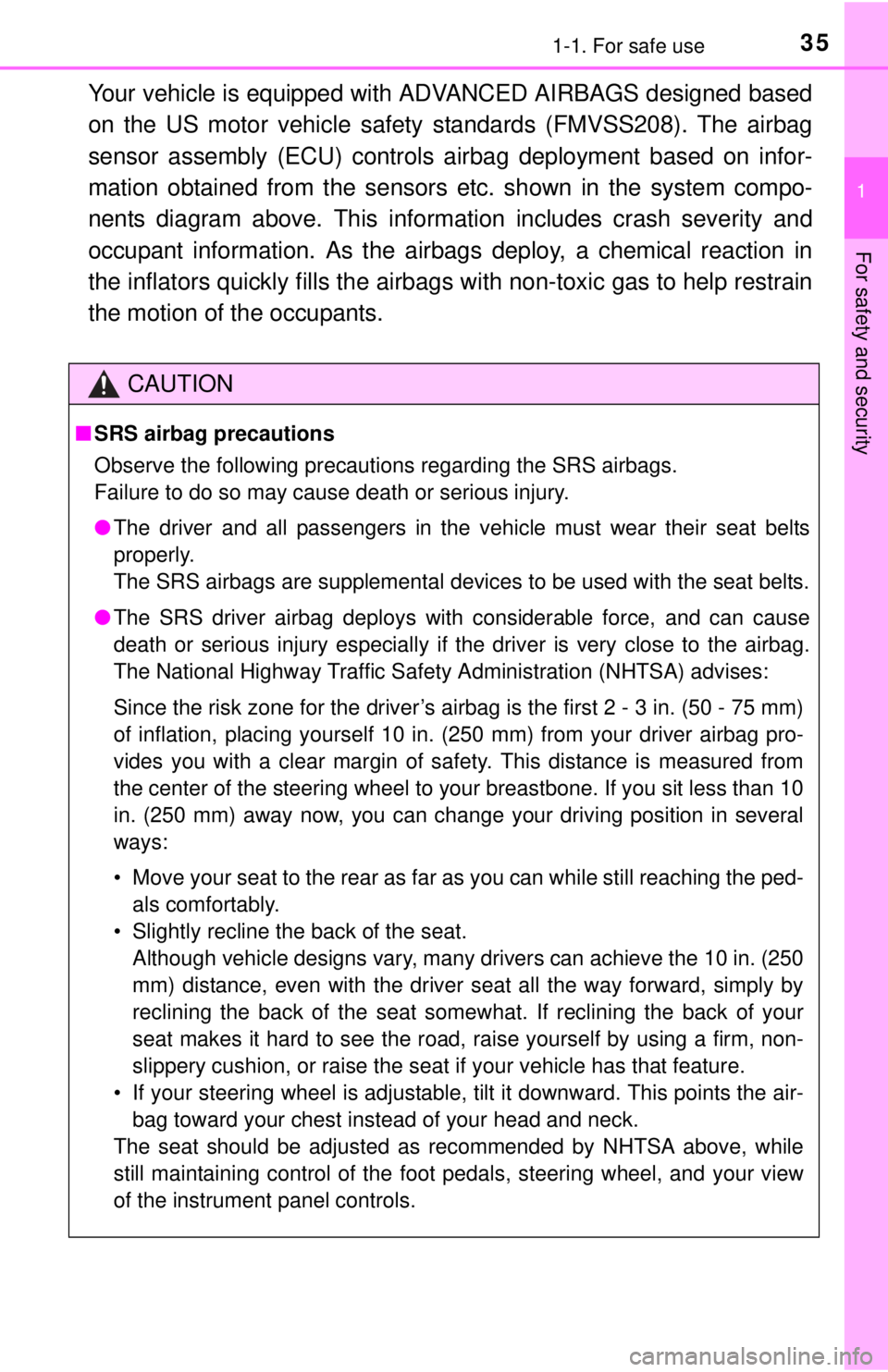
Your vehicle is equipped with ADVANCED AIRBAGS designed based
on the US motor vehicle safety standards (FMVSS208). The airbag
sensor assembly (ECU) controls airbag deployment based on infor-
mation obtained from the sensors et c. shown in the system compo-
nents diagram above. This informat ion includes crash severity and
occupant information. As the airbags deploy, a chemical reaction in
the inflators quickly fills the airbag s with non-toxic gas to help restrain
the motion of the occupants.
CAUTION
■ SRS airbag precautions
Observe the following precautions regarding the SRS airbags.
Failure to do so may cause death or serious injury.
● The driver and all passengers in the vehicle must wear their seat belts
properly.
The SRS airbags are supplemental devices to be used with the seat belts.
● The SRS driver airbag deploys with considerable force, and can cause
death or serious injury especially if the driver is very close to the airbag.
The National Highway Traffic Safety Administration (NHTSA) advises:
Since the risk zone for the driver’s airbag is the first 2 - 3 in. (50 - 75 mm)
of inflation, placing yourself 10 in. (250 mm) from your driver airbag pro-
vides you with a clear margin of safety. This distance is measured from
the center of the steering wheel to your breastbone. If you sit less than 10
in. (250 mm) away now, you can change your driving position in several
ways:
• Move your seat to the rear as far as you can while still reaching the ped- als comfortably.
• Slightly recline the back of the seat. Although vehicle designs vary, many drivers can achieve the 10 in. (250
mm) distance, even with the driver seat all the way forward, simply by
reclining the back of the seat somewhat. If reclining the back of your
seat makes it hard to see the road, raise yourself by using a firm, non-
slippery cushion, or raise the seat if your vehicle has that feature.
• If your steering wheel is adjustable, tilt it downward. This points the air- bag toward your chest instead of your head and neck.
The seat should be adjusted as recommended by NHTSA above, while
still maintaining control of the foot pedals, steering wheel, and your view
of the instrument panel controls.
Page 37 of 444

371-1. For safe use
1
For safety and security
CAUTION
■SRS airbag precautions
● Do not allow a child to stand in front of
the SRS front passenger airbag unit or
sit on the knees of a front passenger.
● Do not allow the front seat occupants to
hold items on their knees.
● Do not lean against the door, the roof
side rail or the front, side and rear pil-
lars.
● Do not allow anyone to kneel on the
passenger seat toward the door or put
their head or hands outside the vehicle.
● Do not allow anyone to kneel on the
rear seat toward the back door.
● Do not attach anything to or lean any-
thing against areas such as the dash-
board, steering wheel pad and lower
portion of the instrument panel.
These items can become projectiles
when the SRS driver, front passenger
and knee airbags deploy.
Page 39 of 444

391-1. For safe use
1
For safety and security
■If the SRS airbags deploy (inflate)
●Bruising and slight abrasions may result from contact with a deploying
(inflating) SRS airbag.
● A loud noise and white powder will be emitted.
● Parts of the airbag module (steering wheel hub, airbag cover and inflator) as
well as the front seats, parts of the front and rear pillars, roof side rails and
rear roof headlining, may be hot for several minutes. The airbag itself may
also be hot.
● The windshield may crack.
CAUTION
■Modification and disposal of SRS airbag system components
Do not dispose of your vehicle or per form any of the following modifications
without consulting your Scion dealer. The SRS airbags may malfunction or
deploy (inflate) accidentally, causing death or serious injury.
● Installation, removal, disassembly and repair of the SRS airbags
● Repairs, modifications, removal or replacement of the steering wheel,
instrument panel, dashboard, seats or seat upholstery, front, side and rear
pillars, roof side rails or roof headlining
● Repairs or modifications of the front fender, front and rear bumper, or side
or rear of the occupant compartment
● Installation of snow plows, winches, etc. to the front grille (bull bars or kan-
garoo bar etc.)
● Installation of racks etc. to the back door (strap racks, bicycle rack etc.)
● Modifications to the vehicle’s suspension system
● Installation of electronic devices such as mobile two-way radios and CD
players
● Modifications to your vehicle for a person with a physical disability
Page 44 of 444

441-1. For safe use
●The pad section of the steering wheel,
dashboard near the front passenger air-
bag or lower portion of the instrument
panel is scratched, cracked, or other-
wise damaged.
● The seat cushion surface is scratched,
cracked, or otherwise damaged.
● The surface of the seats with the side
airbag is scratched, cracked, or other-
wise damaged.
● The portion of the front pillars, rear pil-
lars or roof side rail garnishes (padding)
containing the curtain shield airbags
inside is scratched, cracked, or other-
wise damaged.
● The portion of the rear roof headlining or
rear pillars containing the rear window
curtain shield airbag inside is scratched,
cracked, or otherwise damaged.
Page 99 of 444

99
Instrument cluster3
3. Instrument clusterWarning lights and indicators ................. 100
Gauges and meters .......... 105
Multi-information display ... 108
Page 100 of 444

1003. Instrument cluster
War ning lights and indicators
◆Instrument cluster
The warning lights and indicators on the instrument cluster, cen-
ter panel and instrument panel inform the driver of the status of
the vehicle’s various systems.
For the purpose of explanation, the following illustration dis-
plays all warning lights a nd indicators illuminated.