light TOYOTA iQ EV 2013 Owners Manual (in English)
[x] Cancel search | Manufacturer: TOYOTA, Model Year: 2013, Model line: iQ EV, Model: TOYOTA iQ EV 2013Pages: 36, PDF Size: 2.62 MB
Page 6 of 36

61. EV system
Before charging, always check that:
●The parking brake is securely set.
●The shift lever is in P.
●The power switch is off.
●All light switches are turned off. (For example, the headlights, emer-
gency flashers, interior light, etc.)
When the traction battery is charged through charging stations, since
the connector shape and charging procedure may vary depending on
the type of chargers, follow the instructions or procedures provided in
the charger’s instruction manual.
Proceed to step for charging the battery at charging stations.
Prepare the charging cable.
Insert the charging cable’s plug
into the outlet of the external
power source.
Make sure to hold the body of the
plug and insert it firmly into the out-
let.
Important things to check before charging
How to normal charge
(how to quick charge [if equipped]:P. 1 0 )
4
1
2
Page 8 of 36

81. EV system
Remove the charging connec-
tor cap
*.
*: Some charging connectors at
charging stations do not have a
protective cap.
Insert the charging connector
into the normal charging inlet.
When inserting, make sure not to
press the latch release button.
Line up the guides, and then push
in the connector until a click is
heard.
Confirm that the charging indi-
cator is illuminated. (When the
charging timer function is in
use, the light will turn off sev-
eral seconds after illuminating.)
Pull the charging connector
towards you while pressing the
latch release button.
If the charging connector is discon-
nected during charging (while the
charging indicator is on), charging
will be interrupted.
6
Guide
7
8
After normal charging
1
Page 15 of 36
151. EV system
1
EV system
EV (Electric Vehicle) driving tips
■Driving in D position
The D position allows the most efficient driving.
■Route selection
●Repeated acceleration and deceleration due to traffic conges-
tion, long waits at traffic lights, and driving on steep inclines will
lead to poor power consumption. In order to avoid those situa-
tions as much as possible, check traffic reports before leaving. If
the vehicle is driven in traffic congestion, gently release the brake
pedal to allow the vehicle to move forward slightly, avoid overuse
of the accelerator pedal. Doing so can help minimize unneces-
sary energy consumption.
●Whenever the EV system is started, 3 different possible driving
ranges will be displayed on the multi-information display. If a dif-
ferent route is used for driving, select an appropriate driving
route by taking into account those estimated possible driving dis-
tances.
■When braking the vehicle
Make sure to operate the brakes gently and in good time. A greater
amount of electrical energy can be retained when slowing down.
Unlike the conventional vehicles, the energy consumption effi-
ciency of electric vehicles will decline if they continue driving on
highways or at high average speeds, causing the possible driv-
ing distance to reduce. Therefore, if the remaining charge of the
traction battery is low, avoid relying on the displayed possible
driving distance too much as well as driving on highways. Driv-
ing the vehicle at moderate speeds, the traction battery’s energy
consumption can be controlled.
The following driving tips will contribute to reduction in the bat-
tery consumption and increase in the driving range.
Page 18 of 36
181. EV system
When the traction batter y becomes low
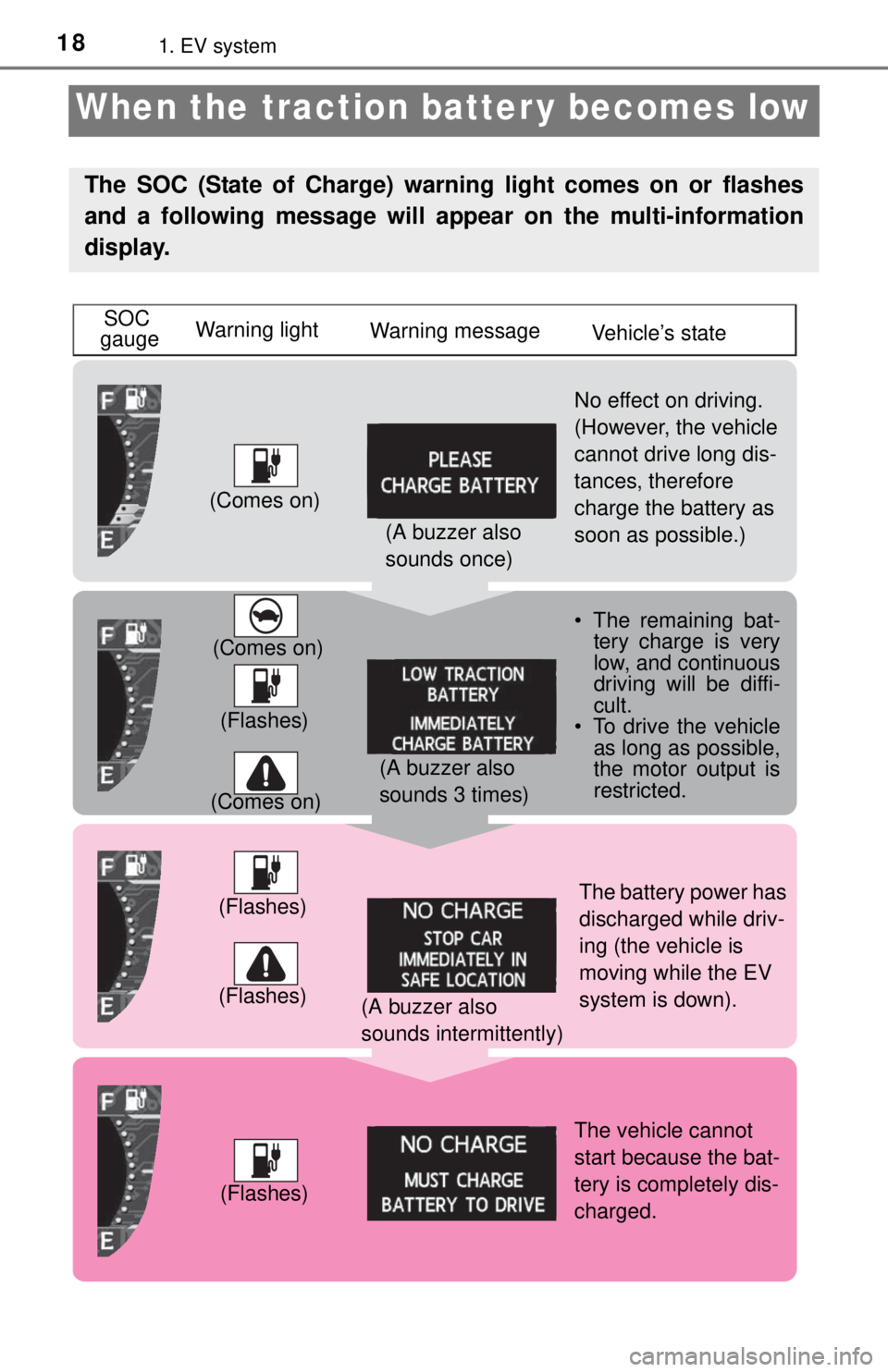
The SOC (State of Charge) warning light comes on or flashes
and a following message will appear on the multi-information
display.
SOC
gaugeWarning light
Warning message
Vehicle’s state
No effect on driving.
(However, the vehicle
cannot drive long dis-
tances, therefore
charge the battery as
soon as possible.)
• The remaining bat-
tery charge is very
low, and continuous
driving will be diffi-
cult.
• To drive the vehicle
as long as possible,
the motor output is
restricted.
The battery power has
discharged while driv-
ing (the vehicle is
moving while the EV
system is down).
The vehicle cannot
start because the bat-
tery is completely dis-
charged. (Comes on)
(Comes on)
(Comes on)
(Flashes)(Flashes)
(Flashes)
(Flashes)(A buzzer also
sounds once)
(A buzzer also
sounds 3 times)
(A buzzer also
sounds intermittently)