engine TOYOTA LAND CRUISER 2012 Owners Manual
[x] Cancel search | Manufacturer: TOYOTA, Model Year: 2012, Model line: LAND CRUISER, Model: TOYOTA LAND CRUISER 2012Pages: 692, PDF Size: 29.3 MB
Page 316 of 692
316 2-5. Driving information
L/C200_EE (OM60G38E)
NOTICE
To prevent the water damage
Take all necessary safety measures to ensure that water damage to the
engine or other components does not occur.
Water entering the engine air intake will cause severe engine damage.
Water entering the automatic transmission will cause deterioration in shift
quality, locking up of your transmission accompanied by vibration, and ulti-
mately damage.
Water can wash the grease from wheel bearings, causing rusting and pre-
mature failure, and may also enter the differentials, transmission and
transfer case, reducing the gear oil’s lubricating qualities.
When you drive through water
If driving through water, such as when crossing shallow streams, first check
the depth of the water and the bottom of the river bed for firmness. Drive
slowly and avoid deep water.
Inspection after off-road driving
Sand and mud that has accumulated in brake drums and around brake
discs may affect braking efficiency and may damage brake system compo-
nents.
Always perform a maintenance inspection after each day of off-road driv-
ing that has taken you through rough terrain, sand, mud, or water.
Page 319 of 692
319
2-5. Driving information
2
When driving
L/C200_EE (OM60G38E)
Winter driving tips
Carry out the necessary preparations and inspections before driving
the vehicle in winter. Always drive the vehicle in a manner appropri-
ate to the prevailing weather conditions.
Pre-winter preparations
Use fluids that are appropriate to the prevailing outside tem-
peratures.
• Engine oil
• Engine coolant
• Washer fluid
Have a service technician inspect the condition of the battery.
Have the vehicle fitted with four snow tires or purchase a set
of tire chains for the rear tires.
Ensure that all tires are the same size and brand, and that chains
match the size of the tires.
Page 322 of 692
322 2-5. Driving information
L/C200_EE (OM60G38E)
CAUTION
Driving with snow tires
Observe the following precautions to reduce the risk of accidents.
Failing to do so may result in a loss of vehicle control and cause death or
serious injury.
Use tires of the size specified for your vehicle.
Maintain the recommended level of tire inflation pressure.
Do not drive at speeds in excess of the speed limit or the speed limit spec-
ified for the snow tires being used.
Snow tires should be installed on all wheels.
Driving with tire chains
Observe the following precautions to reduce the risk of accidents.
Failing to do so may result in the vehicle being unable to be driven safely,
and may cause death or serious injury.
Do not drive in excess of the speed limit specified for the tire chains being
used or 50 km/h (30 mph), whichever is lower.
Avoid driving on bumpy road surfaces or over potholes.
Avoid sudden acceleration, abrupt steering, sudden braking and shifting
operations that cause sudden engine braking.
Slow down sufficiently before entering a curve to ensure that vehicle con-
trol is maintained.
When installing tire chains
Vehicles with the 4-Wheel AHC: Turn off the vehicle height control.
The vehicle height may change due to the automatic leveling function and
you may catch part of your body in the vehicle, resulting in an accident.
(P. 248)
Page 325 of 692
325 2-5. Driving information
2
When driving
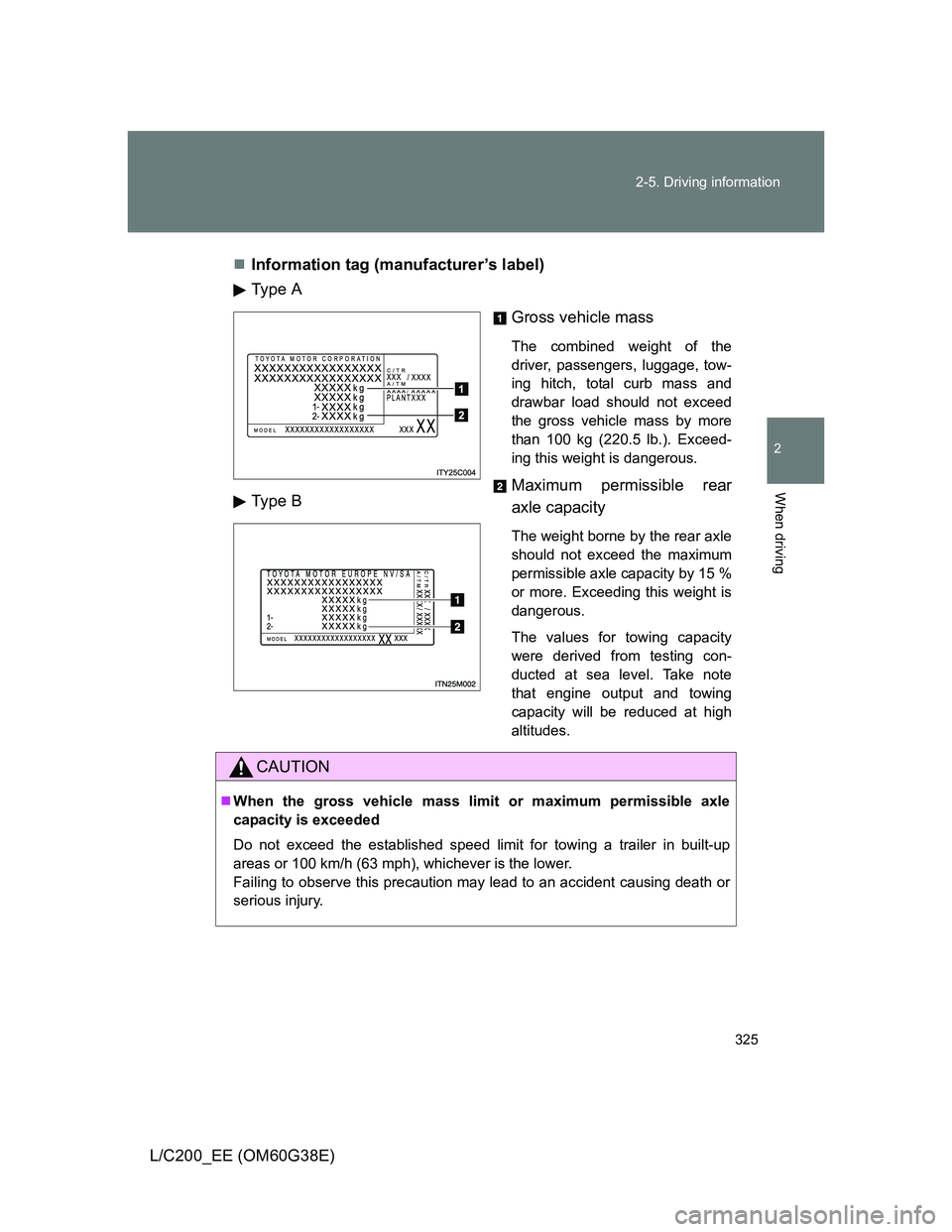
L/C200_EE (OM60G38E)Information tag (manufacturer’s label)
Type A
Gross vehicle mass
The combined weight of the
driver, passengers, luggage, tow-
ing hitch, total curb mass and
drawbar load should not exceed
the gross vehicle mass by more
than 100 kg (220.5 lb.). Exceed-
ing this weight is dangerous.
Maximum permissible rear
axle capacity
The weight borne by the rear axle
should not exceed the maximum
permissible axle capacity by 15 %
or more. Exceeding this weight is
dangerous.
The values for towing capacity
were derived from testing con-
ducted at sea level. Take note
that engine output and towing
capacity will be reduced at high
altitudes.
Type B
CAUTION
When the gross vehicle mass limit or maximum permissible axle
capacity is exceeded
Do not exceed the established speed limit for towing a trailer in built-up
areas or 100 km/h (63 mph), whichever is the lower.
Failing to observe this precaution may lead to an accident causing death or
serious injury.
Page 327 of 692
327 2-5. Driving information
2
When driving
L/C200_EE (OM60G38E)
Connecting and disconnecting a trailer (vehicles with 4-Wheel
AHC)
Stop your vehicle and a trailer in line and perform the following:
Connecting a trailer
Put the 4-Wheel AHC in the “LO” (low) mode.
Turn off the “ENGINE START STOP” switch or the 4-Wheel
AHC.
Connect a trailer.
Turn on the “ENGINE START STOP” switch or the 4-Wheel
AHC.
Select the “N” (normal) mode with the height select switch.
When a vehicle loaded with four occupants tows a trailer of about
1800 kg (4000 lb.) with more than about 180 kg (400 lb.) tongue
load, the normal mode may not be selected. However, there is no
problem to continue normal driving. Drive with sufficient care
because of large load.
Disconnecting a trailer
Put the 4-Wheel AHC in the “LO” (low) mode. (Make sure the
vehicle height is in the “LO” mode by pushing
“” on the
height select switch.)
Turn off the “ENGINE START STOP” switch or the 4-Wheel
AHC.
Set the supporting leg of a trailer on the ground and raise the
hitch by 100 mm (4 in.).
Turn on the “ENGINE START STOP” switch or the 4-Wheel
AHC.
STEP1
STEP2
STEP3
STEP4
STEP5
STEP1
STEP2
STEP3
STEP4
Page 332 of 692
332 2-5. Driving information
L/C200_EE (OM60G38E)Transmission information
To maintain engine braking efficiency, when using engine braking,
do not put the transmission in “D”.
Transmission shift range position must be in “5” in the “S” mode.
If the engine overheats...
Towing a loaded trailer up a long steep incline in temperatures
exceeding 30C (85F) may result in the engine overheating. If the
engine coolant temperature gauge indicates that the engine is
overheating, turn the air conditioning off immediately, leave the
road and stop the vehicle in a safe place. (P. 634)
When parking the vehicle
Always place wheel chocks under the wheels of both the vehicle
and trailer. Firmly set the parking brake and shift the shift lever to
“P”.
CAUTION
Follow all the precautions described in this section. Failure to do so could
cause an accident resulting in death or serious injury.
Trailer towing precautions
When towing, make sure that none of the weight limits are exceeded.
(P. 324)
Vehicle speed in towing
Observe the legal maximum speeds for trailer towing.
Before descending hills or long declines
Reduce speed and downshift. However, never downshift suddenly while
descending steep or long downhill grades.
Operation of the brake
Do not hold the brake pedal depressed often or for long periods.
Doing so may result in the brake overheating or reduce braking effects.
Page 349 of 692
349 3-1. Using the air conditioning system and defogger
3
Interior features
L/C200_EE (OM60G38E)
CAUTION
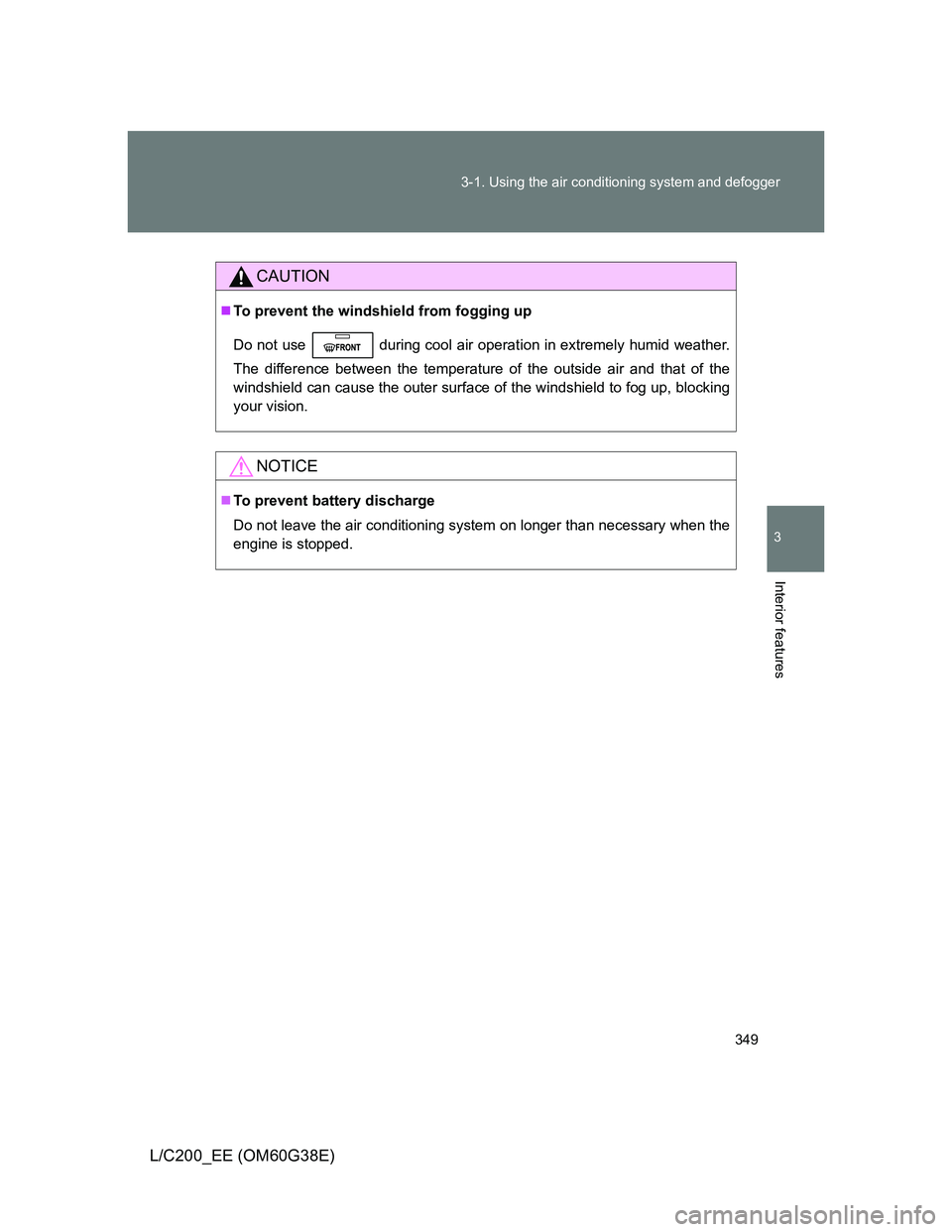
To prevent the windshield from fogging up
Do not use during cool air operation in extremely humid weather.
The difference between the temperature of the outside air and that of the
windshield can cause the outer surface of the windshield to fog up, blocking
your vision.
NOTICE
To prevent battery discharge
Do not leave the air conditioning system on longer than necessary when the
engine is stopped.
Page 353 of 692
353 3-1. Using the air conditioning system and defogger
3
Interior features
L/C200_EE (OM60G38E)
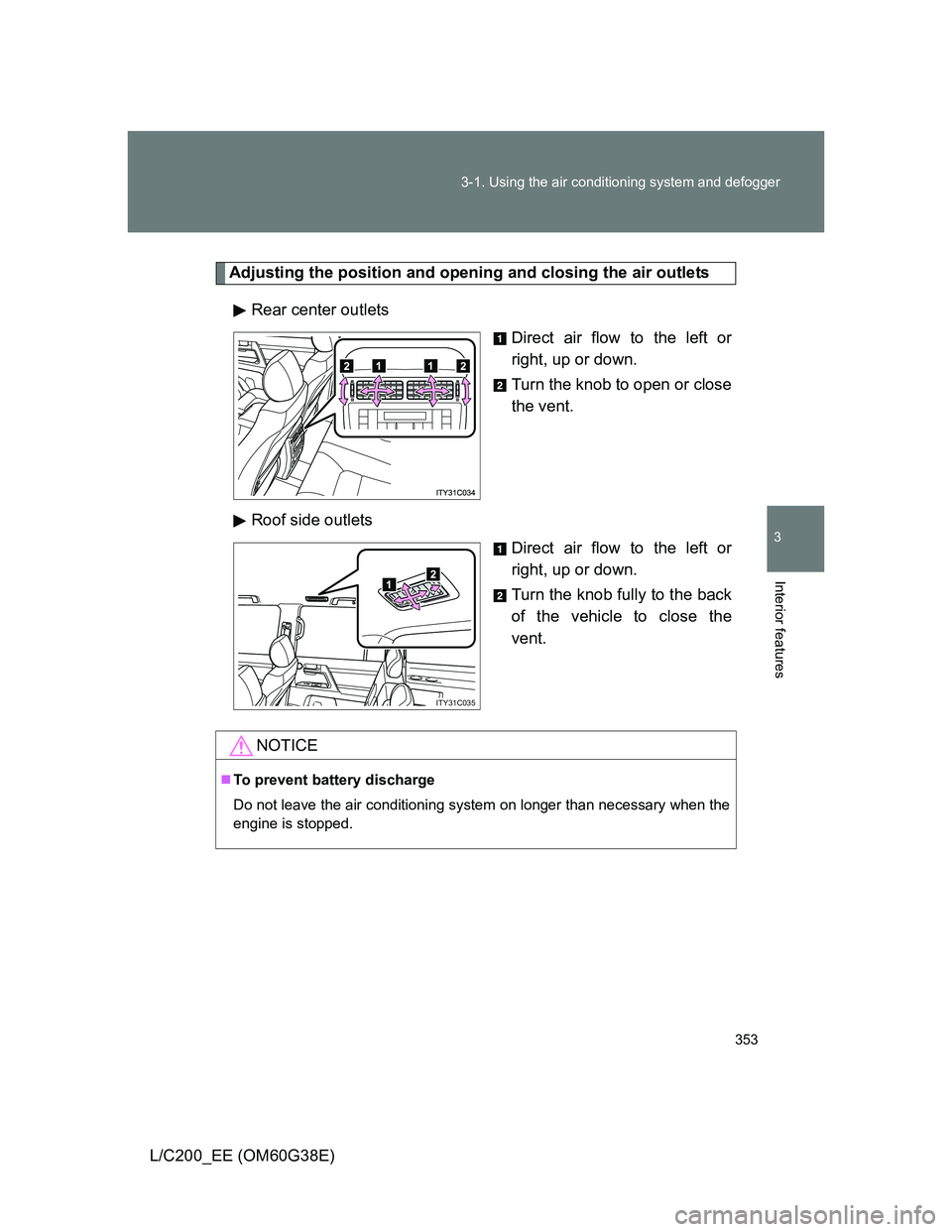
Adjusting the position and opening and closing the air outlets
Rear center outlets
Direct air flow to the left or
right, up or down.
Turn the knob to open or close
the vent.
Roof side outlets
Direct air flow to the left or
right, up or down.
Turn the knob fully to the back
of the vehicle to close the
vent.
ITY31C035
NOTICE
To prevent battery discharge
Do not leave the air conditioning system on longer than necessary when the
engine is stopped.
Page 354 of 692
354
3-1. Using the air conditioning system and defogger
L/C200_EE (OM60G38E)
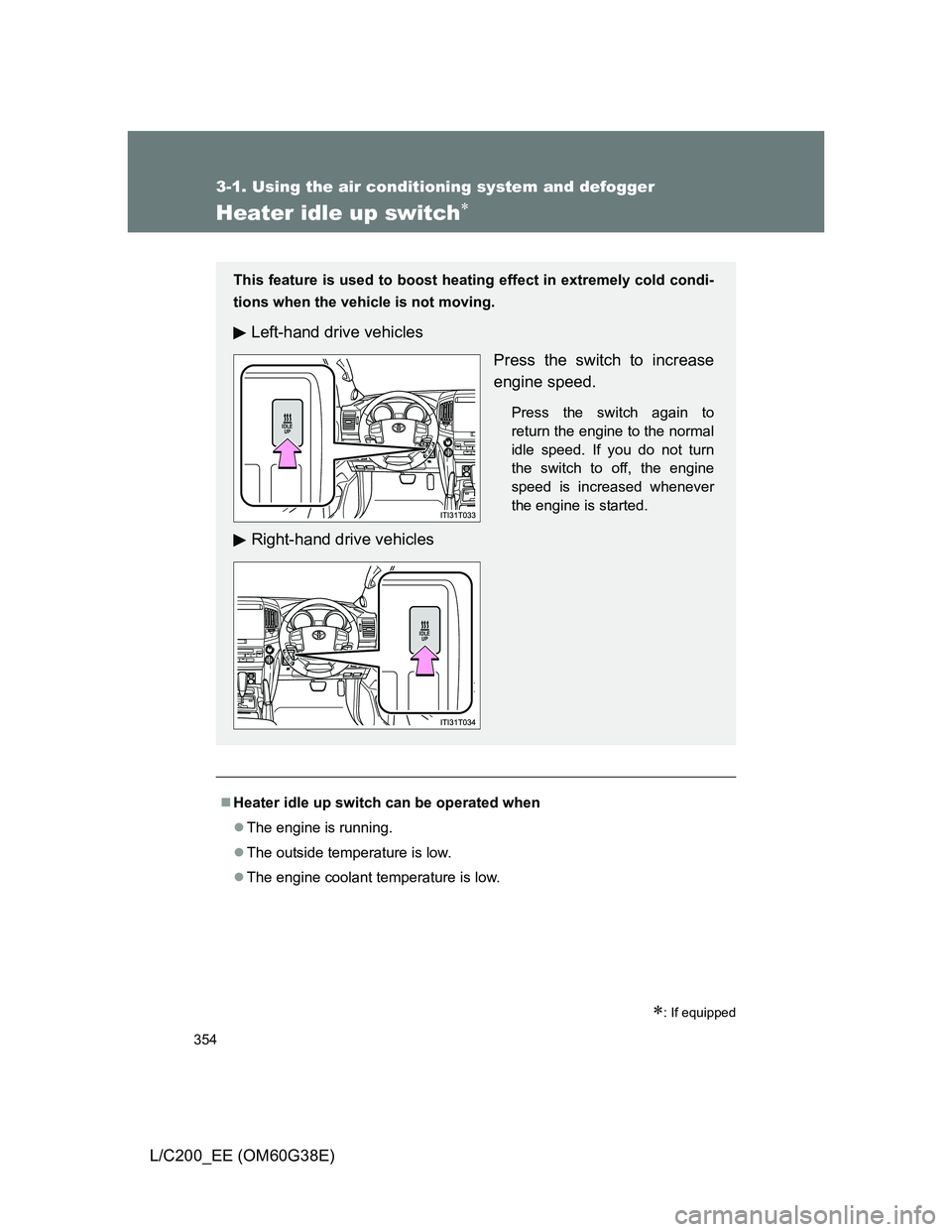
Heater idle up switch
: If equipped
Heater idle up switch can be operated when
The engine is running.
The outside temperature is low.
The engine coolant temperature is low.
This feature is used to boost heating effect in extremely cold condi-
tions when the vehicle is not moving.
Left-hand drive vehicles
Press the switch to increase
engine speed.
Press the switch again to
return the engine to the normal
idle speed. If you do not turn
the switch to off, the engine
speed is increased whenever
the engine is started.
Right-hand drive vehicles
IDLE
UP
IDLE
UP
Page 355 of 692
355
3-1. Using the air conditioning system and defogger
3
Interior features
L/C200_EE (OM60G38E)
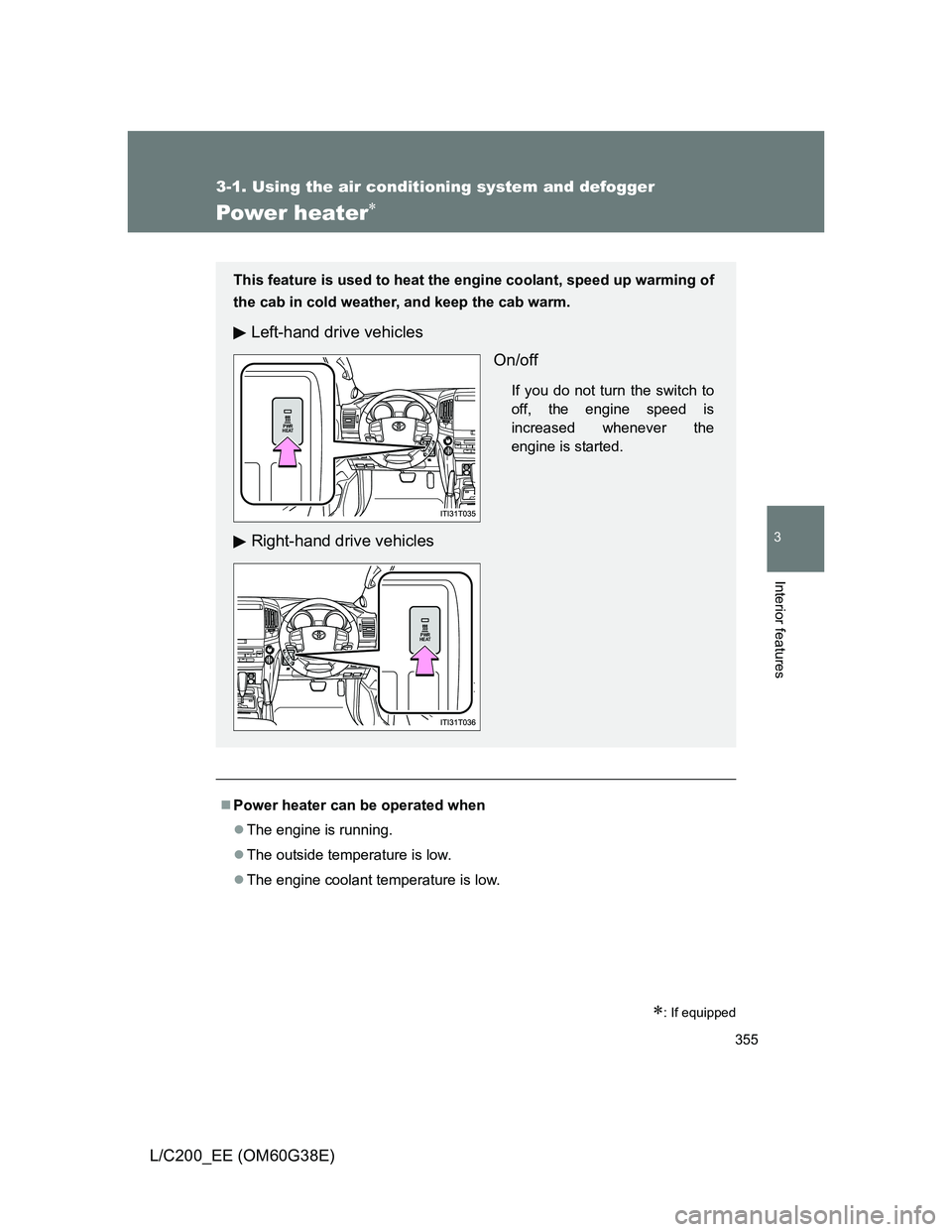
Power heater
: If equipped
Power heater can be operated when
The engine is running.
The outside temperature is low.
The engine coolant temperature is low.
This feature is used to heat the engine coolant, speed up warming of
the cab in cold weather, and keep the cab warm.
Left-hand drive vehicles
On/off
If you do not turn the switch to
off, the engine speed is
increased whenever the
engine is started.
Right-hand drive vehicles
PWR
HEAT
PWR
HEAT