lock TOYOTA LAND CRUISER 2012 Owners Manual
[x] Cancel search | Manufacturer: TOYOTA, Model Year: 2012, Model line: LAND CRUISER, Model: TOYOTA LAND CRUISER 2012Pages: 692, PDF Size: 29.3 MB
Page 561 of 692
561 4-3. Do-it-yourself maintenance
4
Maintenance and care
L/C200_EE (OM60G38E)
CAUTION
High-intensity discharge (HID) headlights
Contact any authorized Toyota dealer or repairer, or another duly qualified
and equipped professional before replacing high-intensity discharge head-
lights (including light bulbs).
Do not touch the high-intensity discharge headlight’s high voltage socket
when the headlights are turned on.
An extremely high voltage of 30000 V will be discharged and could result
in death or serious injury by electric shock.
Do not attempt to take apart or repair the low beam discharge headlight
bulbs, connectors, power supply circuits, or related components.
Doing so could result in electric shock and serious injury or death.
To prevent damage or fire
Make sure bulbs are fully seated and locked.
Page 566 of 692
566 5-1. Essential information
L/C200_EE (OM60G38E)
Emergency towing
If a tow truck is not available, in an emergency your vehicle may be
temporarily towed using a cable or chain secured to the towing
hook(s). This should only be attempted on hard, surfaced roads for
short distances at low speeds.
A driver must be in the vehicle to steer and operate the brakes. The
vehicle’s wheels, drive train, axles, steering and brakes must be in
good condition.
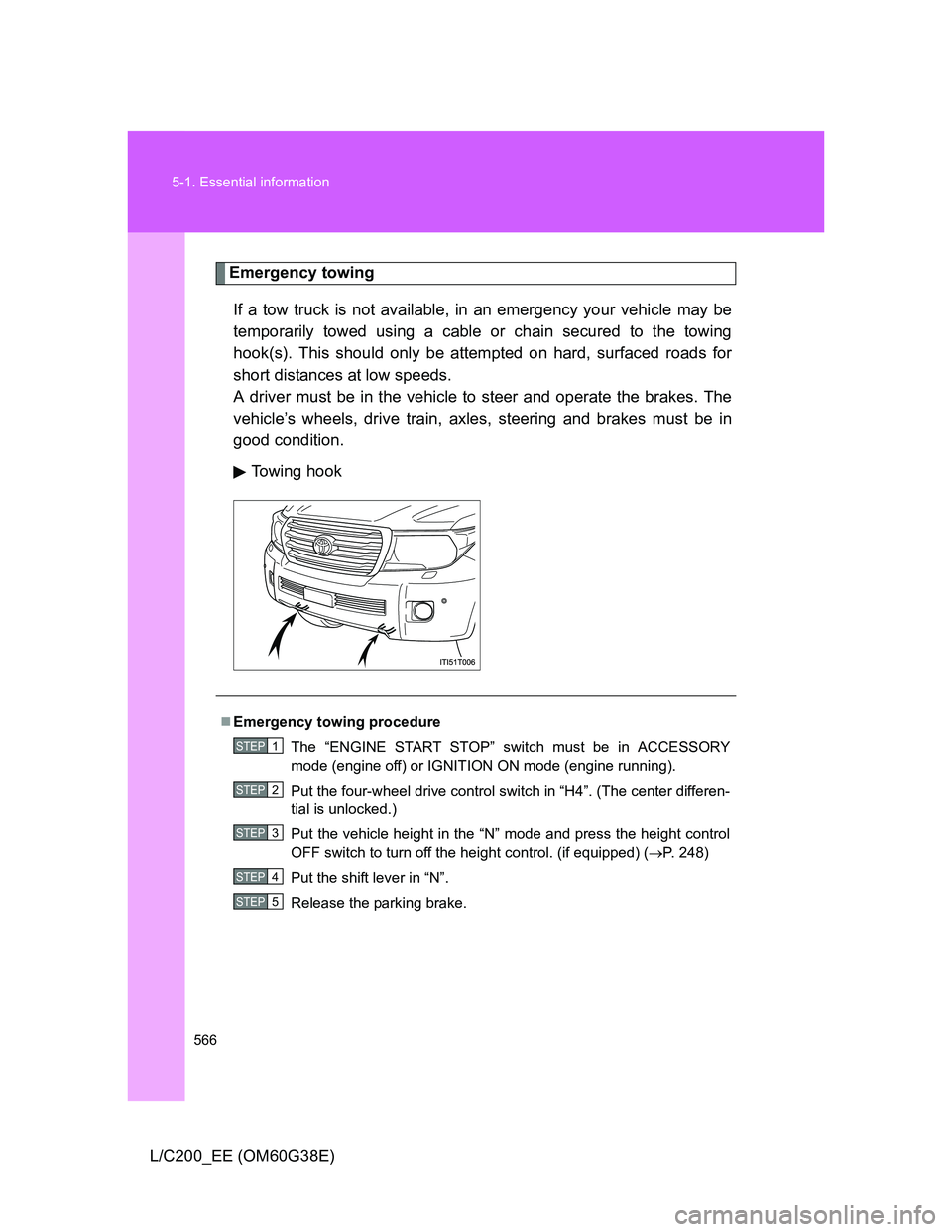
Towing hook
Emergency towing procedure
The “ENGINE START STOP” switch must be in ACCESSORY
mode (engine off) or IGNITION ON mode (engine running).
Put the four-wheel drive control switch in “H4”. (The center differen-
tial is unlocked.)
Put the vehicle height in the “N” mode and press the height control
OFF switch to turn off the height control. (if equipped) (P. 248)
Put the shift lever in “N”.
Release the parking brake.
STEP1
STEP2
STEP3
STEP4
STEP5
Page 569 of 692
5
569 5-1. Essential information
When trouble arises
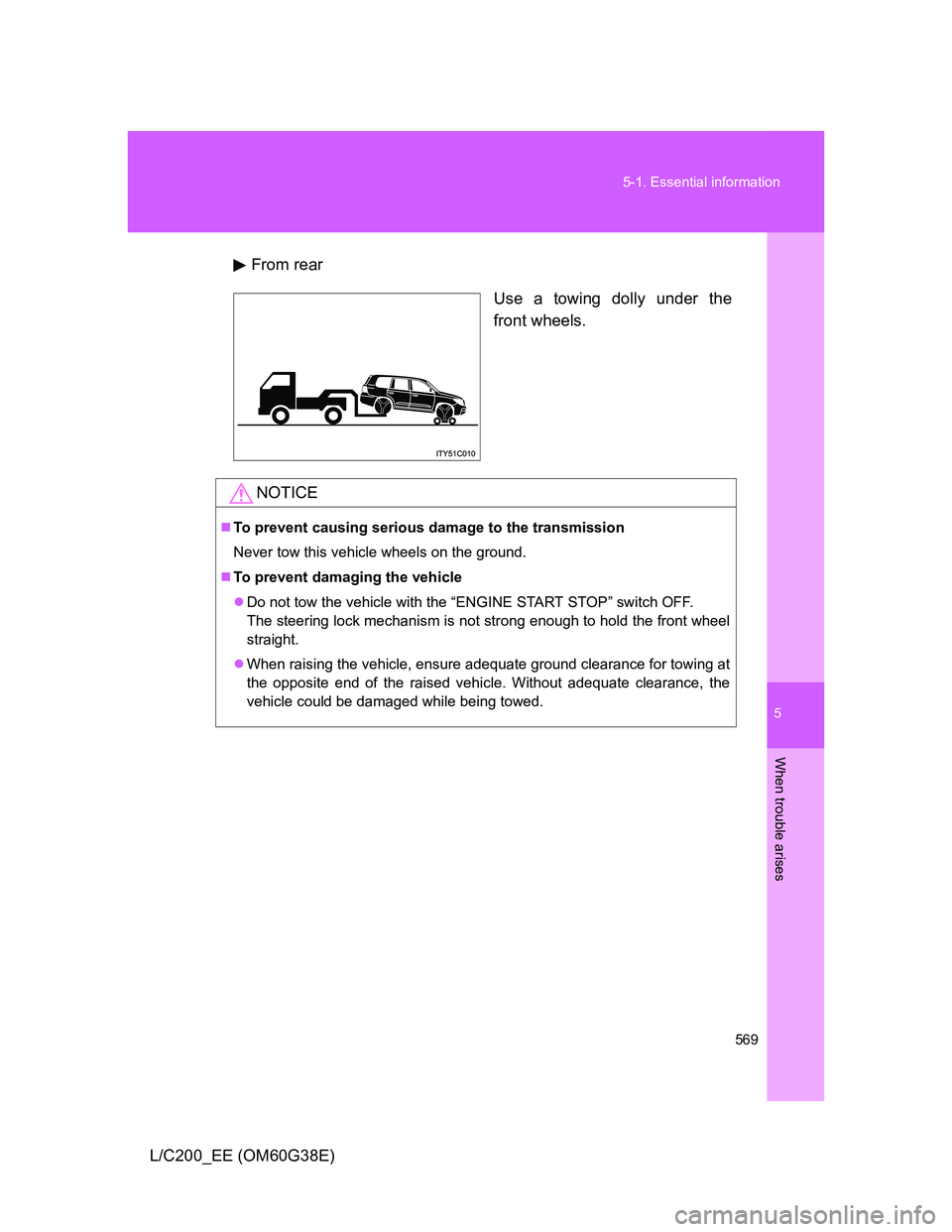
L/C200_EE (OM60G38E)From rear
Use a towing dolly under the
front wheels.
NOTICE
To prevent causing serious damage to the transmission
Never tow this vehicle wheels on the ground.
To prevent damaging the vehicle
Do not tow the vehicle with the “ENGINE START STOP” switch OFF.
The steering lock mechanism is not strong enough to hold the front wheel
straight.
When raising the vehicle, ensure adequate ground clearance for towing at
the opposite end of the raised vehicle. Without adequate clearance, the
vehicle could be damaged while being towed.
Page 578 of 692
578 5-2. Steps to take in an emergency
L/C200_EE (OM60G38E)
If the malfunction indicator lamp comes on while driving
For some models, the malfunction indicator lamp will come on if the fuel tank
becomes completely empty. If the fuel tank is empty, refuel the vehicle
immediately. The malfunction indicator lamp will go off after several trips.
If the malfunction indicator lamp does not go off, contact any authorized
Toyota dealer or repairer, or another duly qualified and equipped
professional.
If the low speed four-wheel drive indicator light or the center differen-
tial lock indicator light blinks
Take the specified steps. (P. 262)
If the brake system warning light or the malfunction indicator light also
comes on, or the low speed four-wheel drive indicator light or the center dif-
ferential lock indicator light continues to blink after taking the specified steps,
there may be a malfunction in the engine, the brake system or the four-
wheel drive system. In this case, you may not be able to transfer between
“H4” and “L4” modes, and the center differential lock may not be able to be
locked or unlocked. Have the vehicle inspected by any authorized Toyota
dealer or repairer, or another duly qualified and equipped professional,
immediately.
Front passenger detection sensor and passenger seat belt reminder
If luggage is placed on the front passenger seat, the front passenger
detection sensor may cause the warning light to flash, even if a passen-
ger is not sitting in the seat.
If a cushion is placed on the seat, the sensor may not detect a passen-
ger, and the warning light may not operate properly.
Page 580 of 692
580 5-2. Steps to take in an emergency
L/C200_EE (OM60G38E)
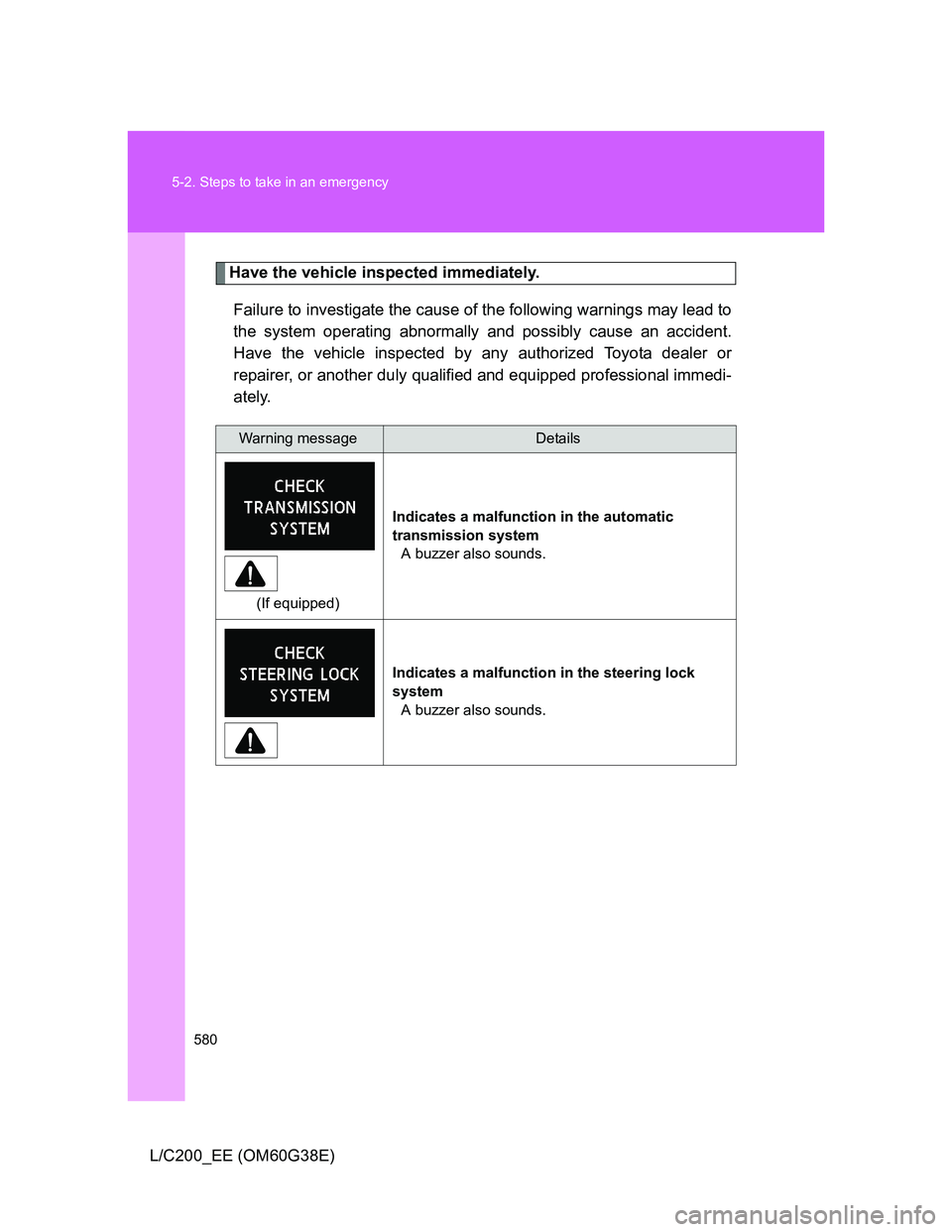
Have the vehicle inspected immediately.
Failure to investigate the cause of the following warnings may lead to
the system operating abnormally and possibly cause an accident.
Have the vehicle inspected by any authorized Toyota dealer or
repairer, or another duly qualified and equipped professional immedi-
ately.
Warning messageDetails
(If equipped)Indicates a malfunction in the automatic
transmission system
A buzzer also sounds.
Indicates a malfunction in the steering lock
system
A buzzer also sounds.
Page 592 of 692
592 5-2. Steps to take in an emergency
L/C200_EE (OM60G38E)
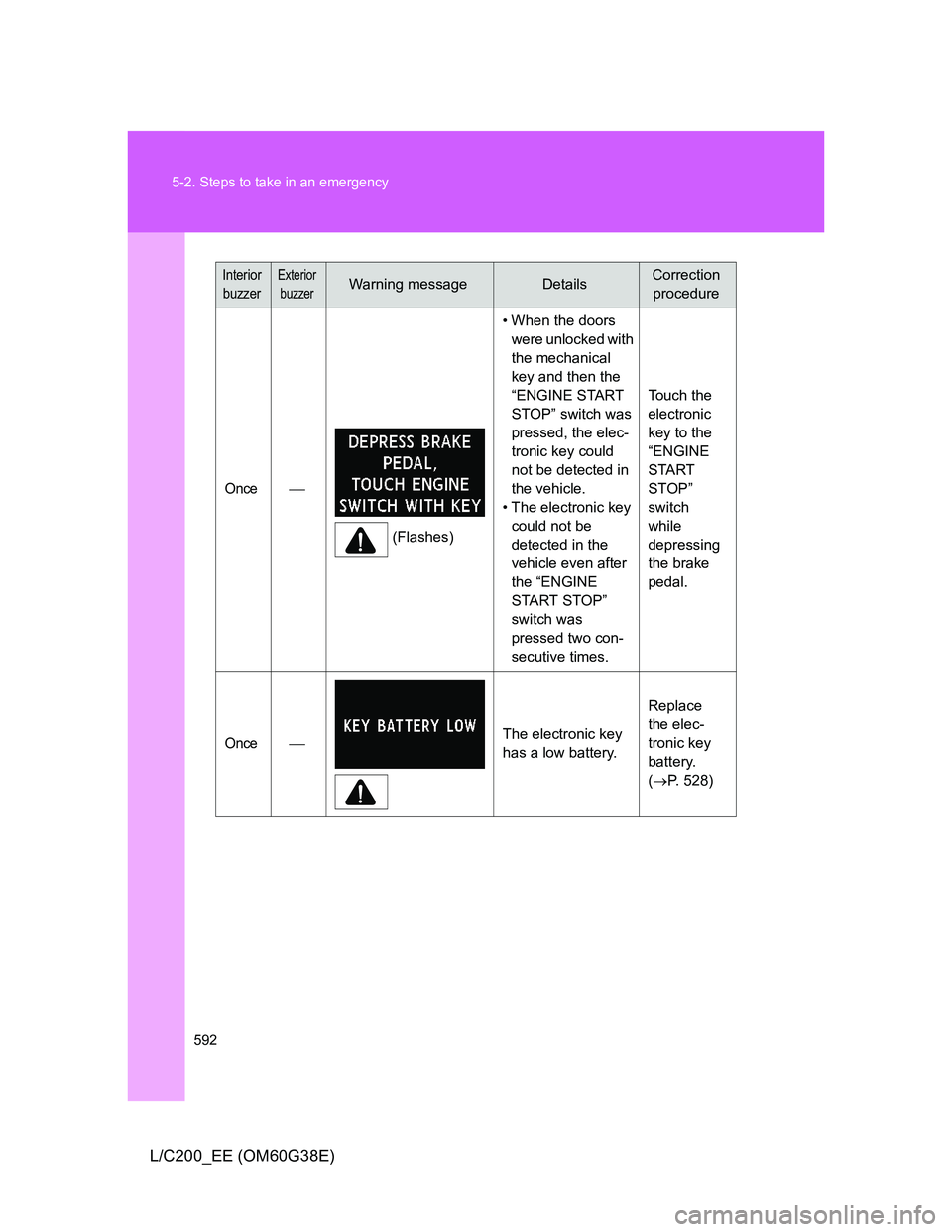
Interior
buzzerExterior
buzzerWarning messageDetailsCorrection
procedure
Once
(Flashes)• When the doors
were unlocked with
the mechanical
key and then the
“ENGINE START
STOP” switch was
pressed, the elec-
tronic key could
not be detected in
the vehicle.
• The electronic key
could not be
detected in the
vehicle even after
the “ENGINE
START STOP”
switch was
pressed two con-
secutive times. Touch the
electronic
key to the
“ENGINE
START
STOP”
switch
while
depressing
the brake
pedal.
OnceThe electronic key
has a low battery.Replace
the elec-
tronic key
battery.
(P. 528)
Page 593 of 692
5
593 5-2. Steps to take in an emergency
When trouble arises
L/C200_EE (OM60G38E)
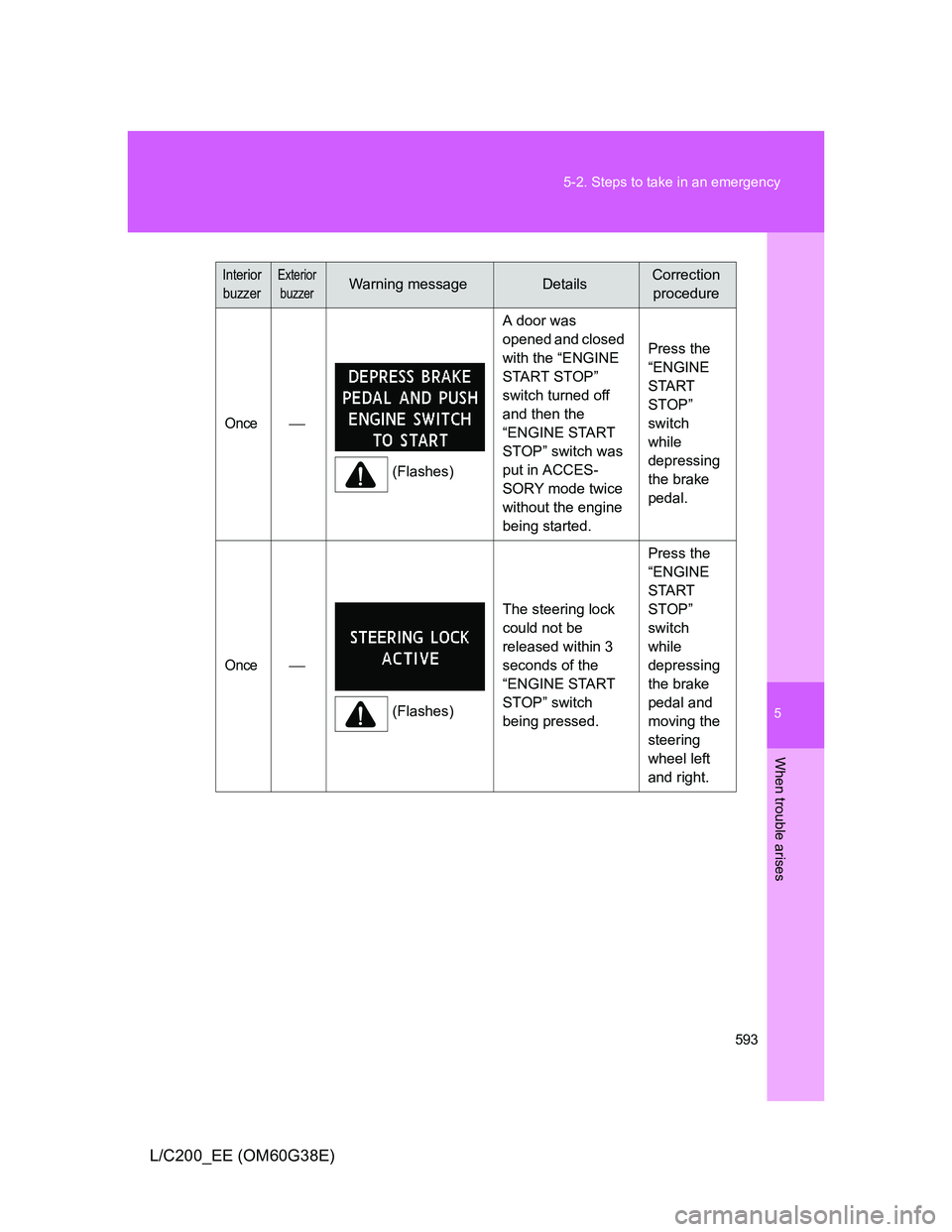
Interior
buzzerExterior
buzzerWarning messageDetailsCorrection
procedure
Once
(Flashes)A door was
opened and closed
with the “ENGINE
START STOP”
switch turned off
and then the
“ENGINE START
STOP” switch was
put in ACCES-
SORY mode twice
without the engine
being started.Press the
“ENGINE
START
STOP”
switch
while
depressing
the brake
pedal.
Once
(Flashes)The steering lock
could not be
released within 3
seconds of the
“ENGINE START
STOP” switch
being pressed. Press the
“ENGINE
START
STOP”
switch
while
depressing
the brake
pedal and
moving the
steering
wheel left
and right.
Page 613 of 692
5
613 5-2. Steps to take in an emergency
When trouble arises
L/C200_EE (OM60G38E)
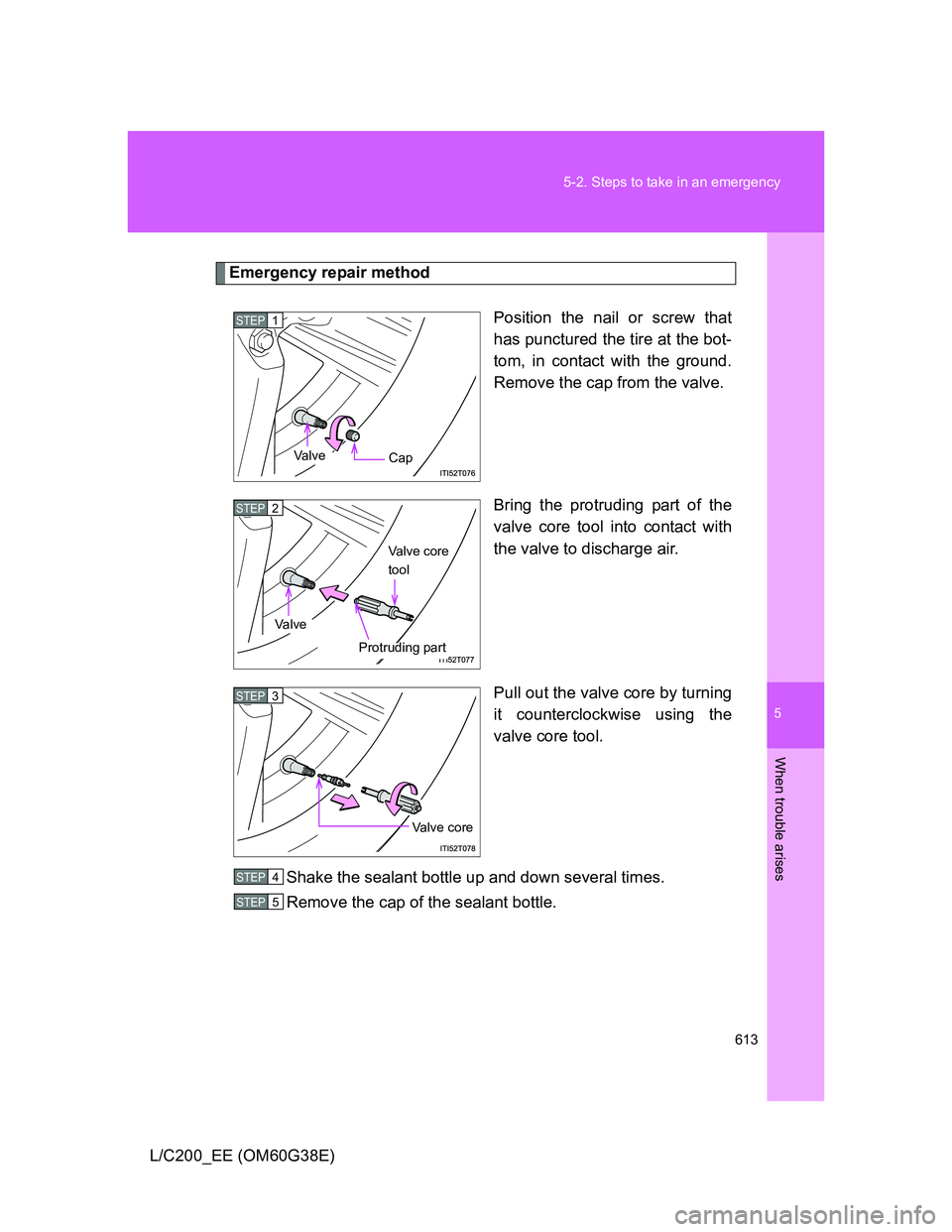
Emergency repair method
Position the nail or screw that
has punctured the tire at the bot-
tom, in contact with the ground.
Remove the cap from the valve.
Bring the protruding part of the
valve core tool into contact with
the valve to discharge air.
Pull out the valve core by turning
it counterclockwise using the
valve core tool.
Shake the sealant bottle up and down several times.
Remove the cap of the sealant bottle.
STEP1
CapVa l v e
STEP2
Va l v e c o r e
tool
Protruding part
Va l v e
STEP3
Va l v e c o r e
STEP4
STEP5
Page 615 of 692
5
615 5-2. Steps to take in an emergency
When trouble arises
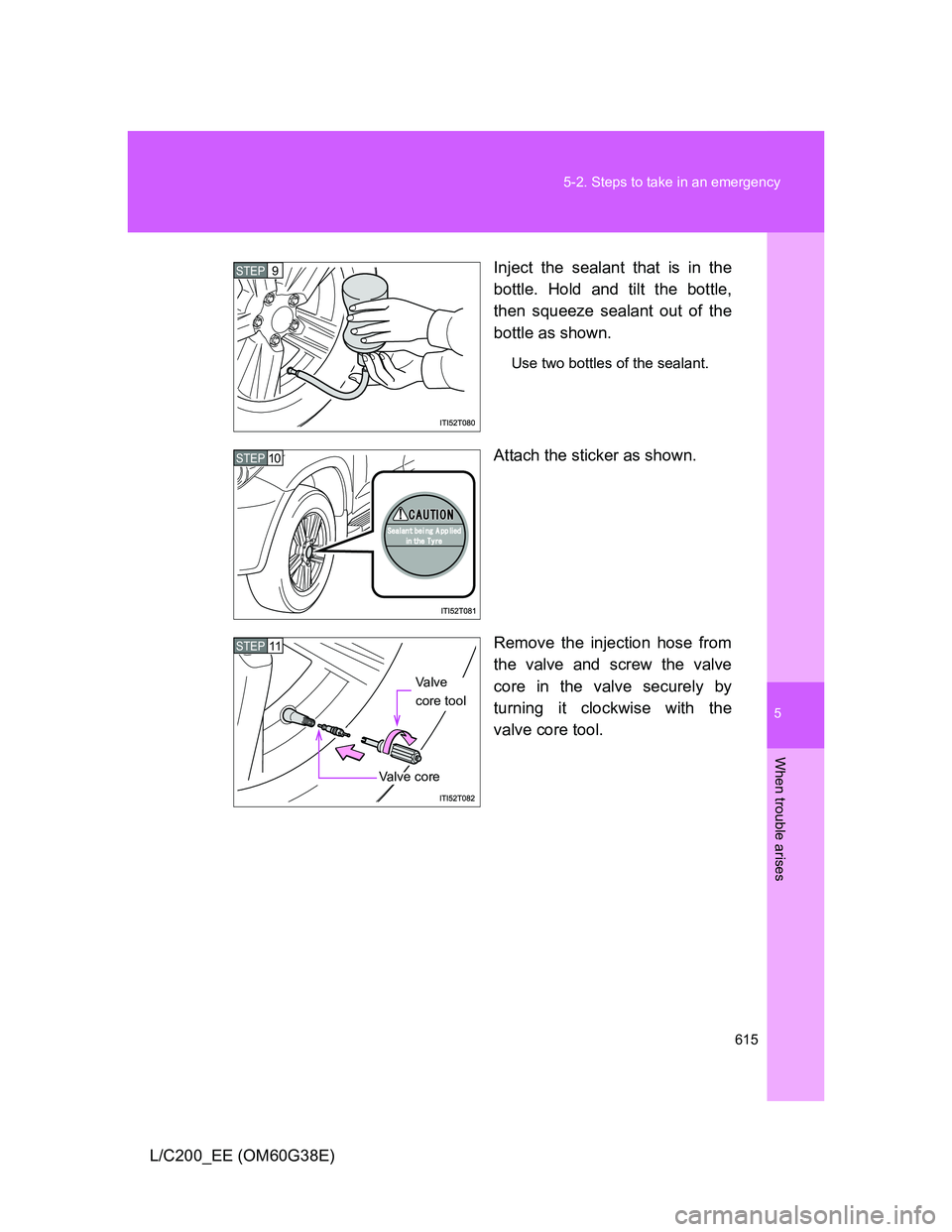
L/C200_EE (OM60G38E)Inject the sealant that is in the
bottle. Hold and tilt the bottle,
then squeeze sealant out of the
bottle as shown.
Use two bottles of the sealant.
Attach the sticker as shown.
Remove the injection hose from
the valve and screw the valve
core in the valve securely by
turning it clockwise with the
valve core tool.
STEP9
STEP10
STEP11
Va l v e
core tool
Va l v e c o r e
Page 623 of 692
5
623
5-2. Steps to take in an emergency
When trouble arises
L/C200_EE (OM60G38E)
If the engine will not start
If the engine still does not start after following the correct starting
procedure (P. 190) or releasing the steering lock (P. 192), confirm
the following points.
The engine will not start even when the starter motor oper-
ates normally
One of the following may be the cause of the problem.
There may not be sufficient fuel in the vehicle’s tank.
Gasoline engine: Refuel the vehicle.
Diesel engine: (P. 637)
The engine may be flooded. (gasoline engine)
Try to restart the engine once more following correct starting
procedures. (P. 190)
There may be a malfunction in the engine immobilizer system.
(P. 120)
The starter motor turns over slowly, the interior lights and
headlights are dim, or the horn does not sound or sounds at
a low volume
One of the following may be the cause of the problem.
The battery may be discharged. (P. 630)
The battery terminal connections may be loose or corroded.
The starter motor does not turn over
The engine starting system may be malfunctioning due to an
electrical problem such as an open circuit or a blown fuse. How-
ever, an interim measure is available to start the engine.
(P. 624)