parking brake TOYOTA MIRAI 2020 (in English) Owner's Guide
[x] Cancel search | Manufacturer: TOYOTA, Model Year: 2020, Model line: MIRAI, Model: TOYOTA MIRAI 2020Pages: 528, PDF Size: 11.98 MB
Page 299 of 528

2995-5. Using the driving support systems
5
Driving
MIRAI_OM_USA_OM62073U
WARNING
■The ABS does not operate effectively when
● The limits of tire gripping performance have been exceeded (suc h as
excessively worn tires on a snow covered road).
● The vehicle hydroplanes while driving at high speed on wet or s lick roads.
■ Stopping distance when the ABS is operating may exceed that of nor-
mal conditions
The ABS is not designed to shorten the vehicle’s stopping distance. Always
maintain a safe distance from the vehicle in front of you, espe cially in the
following situations:
● When driving on dirt, gravel or snow-covered roads
● When driving with tire chains
● When driving over bumps in the road
● When driving over roads with potholes or uneven surfaces
■ TRAC may not operate effectively when
Directional control and power may not be achievable while driving on slip-
pery road surfaces, even if the TRAC system is operating.
Drive the vehicle carefully in conditions where stability and p ower may be
lost.
■ Hill- start assist control does not operate effectively when
● Do not overly rely on the hill-start assist control. The hill-s tart assist control
may not operate effectively on steep inclines and roads covered with ice.
● Unlike the parking brake, hill-start assist control is not inte nded to hold the
vehicle stationary for an extended period of time. Do not attempt to use
hill-start assist control to hold the vehicle on an incline, as doing so may
lead to an accident.
■ When the TRAC, VSC and/or ABS is activated
The slip indicator flashes. Always drive carefully. Reckless dr iving may
cause an accident. Exercise particular care when the indicator flashes.
■ When the TRAC/VSC systems are turned off
Be especially careful and drive at a speed appropriate to the r oad condi-
tions. As these are the systems to help ensure vehicle stabilit y and driving
force, do not turn the TRAC/VSC systems off unless necessary.
Page 302 of 528
3025-6. Driving tips
MIRAI_OM_USA_OM62073U
Accelerate the vehicle slowly, keep a safe distance between you and
the vehicle ahead, and drive at a reduced speed suitable to roa d con-
ditions.
Park the vehicle and shift the shift position to P without sett ing the
parking brake. The parking brake may freeze up, preventing it f rom
being released. If the vehicle is parked without setting the pa rking
brake, make sure t o block the wheels.
Failure to do so may be dangerous because it may cause the vehi cle
to move unexpectedly, possi bly leading to an accident.
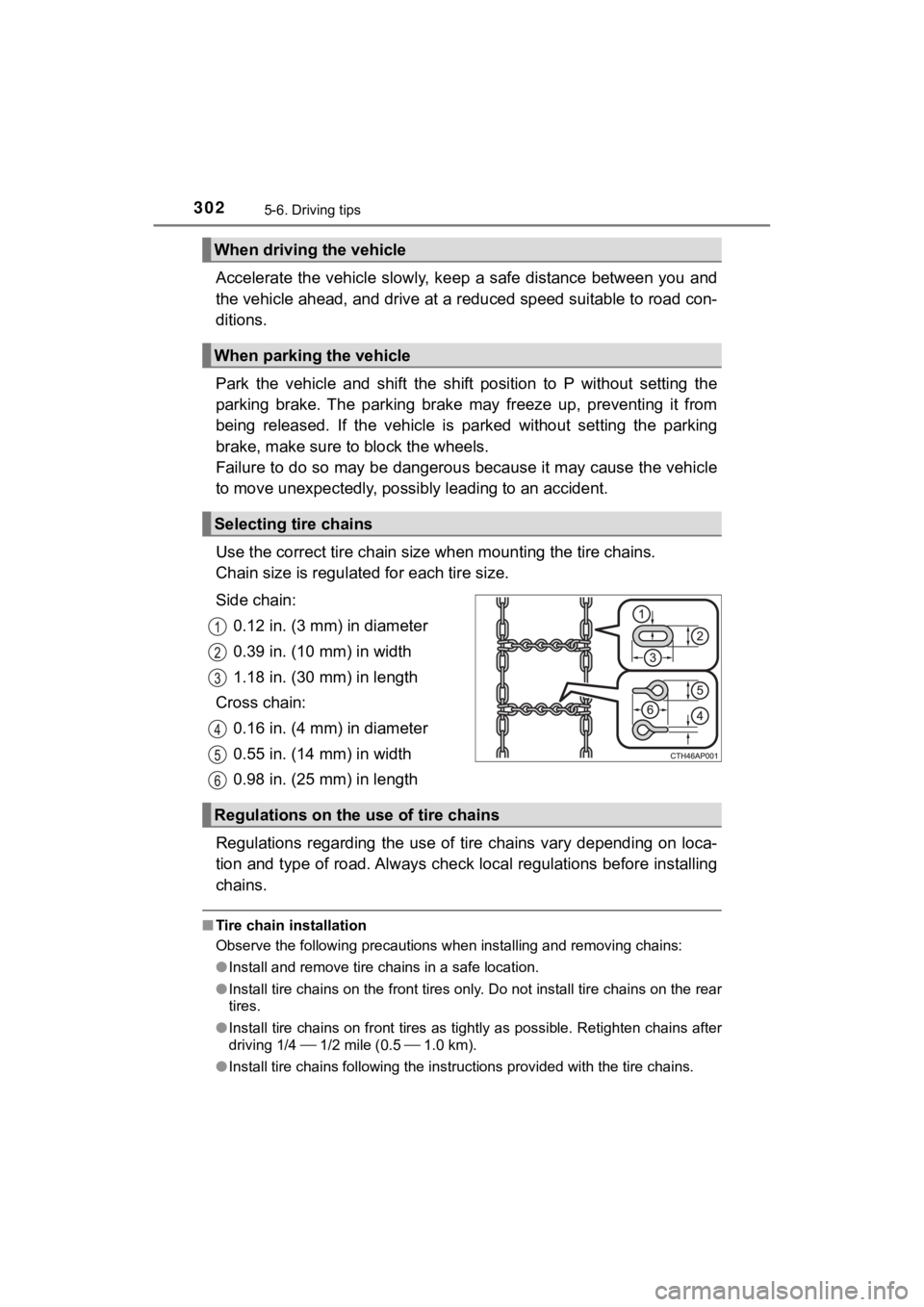
Use the correct tire chain size when mount ing the tire chains.
Chain size is regulate d for each tire size.
Side chain: 0.12 in. (3 mm) in diameter
0.39 in. (10 mm) in width
1.18 in. (30 mm) in length
Cross chain: 0.16 in. (4 mm) in diameter
0.55 in. (14 mm) in width
0.98 in. (25 mm) in length
Regulations regarding the use of tire chains vary depending on loca-
tion and type of road. Always chec k local regulations before installing
chains.
■ Tire chain installation
Observe the following precautions when installing and removing chains:
● Install and remove tire chains in a safe location.
● Install tire chains on the front tires only. Do not install tir e chains on the rear
tires.
● Install tire chains on front tires as tightly as possible. Reti ghten chains after
driving 1/4 1/2 mile (0.5 1.0 km).
● Install tire chains following the instructions provided with th e tire chains.
When driving the vehicle
When parking the vehicle
Selecting tire chains
Regulations on the use of tire chains
Page 362 of 528

3627-2. Maintenance
MIRAI_OM_USA_OM62073U
Vehicle interior
ItemsCheck points
Accelerator pedal
• The accelerator pedal shouldmove smoothly (without uneven
pedal effort or catching).
Transmission “Park” mechanism
• When parked on a slope and the
shift position is in P, is the vehicle
securely stopped?
Brake pedal
• Does the brake pedal movesmoothly?
• Does the brake pedal have appro-
priate clearance from the floor? (P. 470)
• Does the brake pedal have the
correct amount of free play? (P. 470)
Brakes
• The vehicle should not pull to one
side when the brakes are applied.
• The brakes should work effec-
tively.
• The brake pedal should not feel spongy.
• The brake pedal should not get too close to the floor when the
brakes are applied.
Head restraints• Do the head restraints move
smoothly and lock securely?
Indicators/buzzers• Do the indicators and buzzersfunction properly?
Lights • Do all the lights come on?
Parking brake
• Does the parking brake pedal move smoothly?
• When parked on a slope and the parking brake is on, is the vehicle
securely stopped?
Page 386 of 528
3867-3. Do-it-yourself maintenance
MIRAI_OM_USA_OM62073U
Replacing the tire
●Stop the vehicle on a hard, flat surface.
● Set the parking brake.
● Shift the shift position to P.
● Stop the fuel cell system.
When raising your vehicle with a jack, position the jack cor-
rectly. Improper placement may damage your vehicle or cause
injury.
If necessary tire replacement seem s difficult to perform, contact
your Toyota dealer.
Before jacking up the vehicle
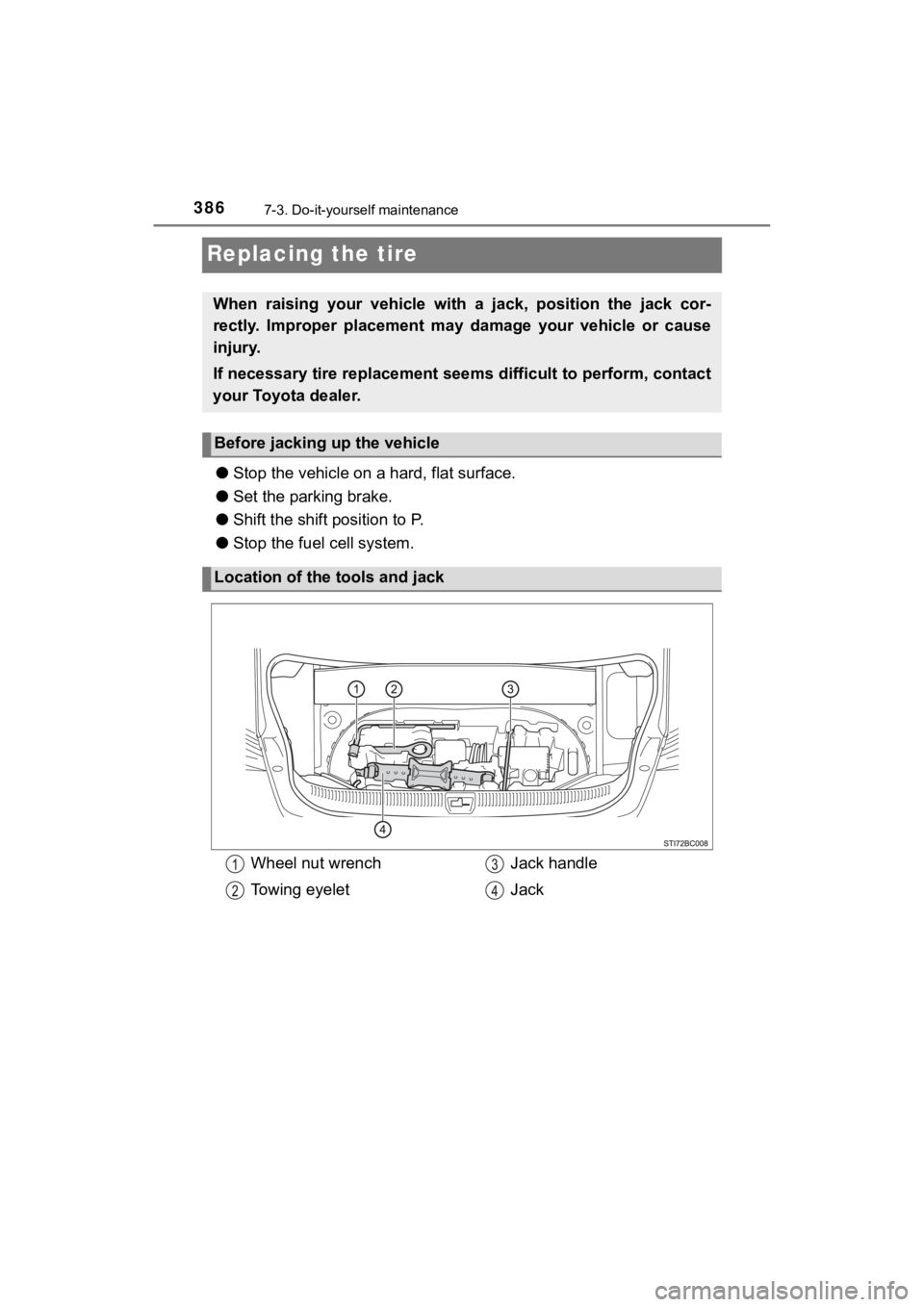
Location of the tools and jack
Wheel nut wrench
To w i n g e y e l e t Jack handle
Jack
Page 412 of 528

4128-2. Steps to take in an emergency
MIRAI_OM_USA_OM62073U
The following may indicate a problem with your transmission. Contact
your Toyota dealer or commercial towing service before towing.
● The fuel cell system warning message shows on the multi-informa -
tion display and the vehicle does not move.
● The vehicle makes an abnormal sound.
Do not tow with a sling-type truck
to prevent body damage.
Situations when it is necessary to contact dealers before towing
Towing with a sling-type truck
Towing with a wheel-lift type truck
From the frontFrom the rear
Release the parking brake. Us e a towing dolly under the
front wheels.
Page 414 of 528

4148-2. Steps to take in an emergency
MIRAI_OM_USA_OM62073U
Take out the towing eyelet. (P. 386,434)
Remove the eyelet cover usi ng a flathead screwdriver.
To protect the bodywork, place a rag between the screwdriver an d the
vehicle body as shown in the illustration.
Insert the towing eyelet into the
hole and tighten partially by
hand.
Tighten down the towing eyelet
securely using a wheel nut
wrench or hard metal bar.
Securely attach cables or c hains to the towing eyelet.
Take care not to damage the vehicle body.
Enter the vehicle being towed and start the fuel cell system.
If the fuel cell system does not start, turn the power switch to ON mode.
Turn off the Parking Support Brake function (for static objects) (if
equipped).: →P. 276
Shift the shift position to N and release the parking brake.
Emergency towing procedure
1
2
FrontRear
3
4
5
6
7
Page 415 of 528

4158-2. Steps to take in an emergency
MIRAI_OM_USA_OM62073U
8
When trouble arises
■While towing
If the fuel cell system is off, the power assist for the brakes and steering will
not function, making steering and braking more difficult.
■ Wheel nut wrench
Wheel nut wrench is installed in trunk. (P. 386 434)
■ Before transporting or towing in frozen areas
Operate the water release function. Otherwise, the fuel cell sy stem may
freeze and the vehicle may not be able to be started. ( P. 190)
WARNING
Observe the following precautions.
Failure to do so may result in death or serious injury.
■When towing the vehicle
■ While towing
● When towing using cables or chains, avoid sudden starts, etc., which
place excessive stress on the towing eyelets, cables or chains. The towing
eyelets, cables or chains may become damaged, broken debris may hit
people, and cause serious damage.
● Do not turn the power switch off.
This may lead to an accident as the front wheels will be locked by the
parking lock.
■ Installing towing eyelets to the vehicle
Make sure that towing eyelets are installed securely.
If not securely installed, towing eyelets may come loose during towing.
Be sure to transport the vehicle with the
front wheels raised or with all four wheels
raised off the ground. If the vehicle is
towed with the front wheels contacting
the ground, the drivetrain and related
parts may be damaged or electricity gen-
erated by the operation of the motor may
cause a fire to occur depending on the
nature of the damage or malfunction.
Page 419 of 528
4198-2. Steps to take in an emergency
MIRAI_OM_USA_OM62073U
8
When trouble arises
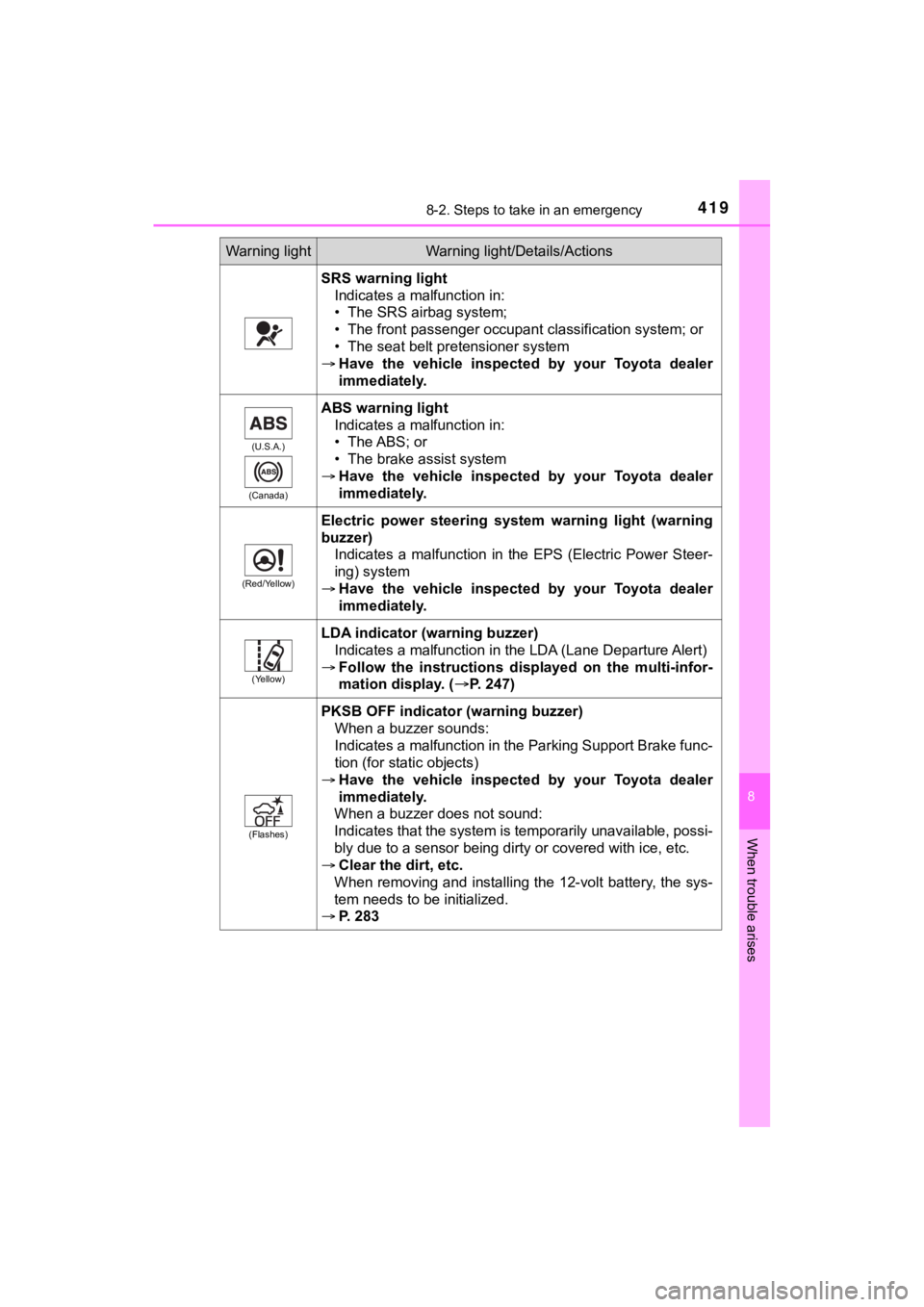
SRS warning lightIndicates a malfunction in:
• The SRS airbag system;
• The front passenger occupant classification system; or
• The seat belt pretensioner system
Have the vehicle inspected by your Toyota dealer
immediately.
(U.S.A.)
(Canada)
ABS warning light Indicates a malfunction in:
• The ABS; or
• The brake assist system
Have the vehicle inspected by your Toyota dealer
immediately.
(Red/Yellow)
Electric power steering system warning light (warning
buzzer)
Indicates a malfunction in the EPS (Electric Power Steer-
ing) system
Have the vehicle inspected by your Toyota dealer
immediately.
(Yellow)
LDA indicator (warning buzzer)
Indicates a malfunction in the LDA (Lane Departure Alert)
Follow the instructions dis played on the multi-infor-
mation display. (
P. 247)
(Flashes)
PKSB OFF indicator (warning buzzer) When a buzzer sounds:
Indicates a malfunction in the Parking Support Brake func-
tion (for static objects)
Have the vehicle inspected by your Toyota dealer
immediately.
When a buzzer does not sound:
Indicates that the system is temporarily unavailable, possi-
bly due to a sensor being dirty or covered with ice, etc.
Clear the dirt, etc.
When removing and installing the 12-volt battery, the sys-
tem needs to be initialized.
P. 283
Warning lightWarning light/Details/Actions
Page 420 of 528

4208-2. Steps to take in an emergency
MIRAI_OM_USA_OM62073U
(Flashes or
illuminates)
PCS warning light
When a buzzer sounds simultaneously:
Indicates a malfunction has occurred in the PCS (Pre-Col-
lision System).
Have the vehicle inspected by your Toyota dealer
immediately.
When a buzzer does not sound:
The PCS (Pre-Collision System) has become temporarily
unavailable, corrective action may be necessary.
Follow the instructions dis played on the multi-infor-
mation display. (
P. 224, 426)
If the PCS (Pre-Collision System) or VSC (Vehicle Stability
Control) system is disabled, the PCS warning light will illu-
minate.
P. 237
Slip indicator
Indicates a malfunction in:
• The VSC system;
• The TRAC system; or
• The hill-start assist control system
The light will flash when the ABS, VSC or TRAC
system is
operating.
Have the vehicle inspected by your Toyota dealer
immediately.
(U.S.A.)
(Canada)
Parking brake warning light (warning buzzer)*2
Parking brake has not been fully released
Operate the parking brake once again.
If the light turns off after the parking brake is fully release d,
the system is operating normally.
Open door warning light (warning buzzer)*3
Indicates that a door or the trunk is not fully closed
Check that all the doors and the trunk are closed.
Low fuel level warning light
Indicates that remaining fuel is approximately 2.4 lb.
(1.1 kg) or less
Refuel the vehicle.
Warning lightWarning light/Details/Actions
Page 421 of 528

4218-2. Steps to take in an emergency
MIRAI_OM_USA_OM62073U
8
When trouble arises
*1: Brake warning buzzer: When there is a malfunction that leads to a decline in the brak e effective-
ness, a buzzer sounds while at the same time a warning light co mes on.
*2: Parking brake engaged warning buzzer:
P. 200
*3: Open door warning buzzer:
A buzzer will sound if the vehicle reaches a speed of 3 mph (5 km/h) or
more with any door open.
Driver’s and front passenger’ s seat belt reminder light
(warning buzzer)
*4
Warns the driver and/or front passenger to fasten their
seat belts
Fasten the seat belt.
If the front passenger’s seat is occupied, the front
passenger’s seat belt also needs to be fastened to
make the warning light (warning buzzer) turn off.
Master warning light
A buzzer sounds and the warning light comes on and
flashes to indicate that the master warning system has
detected a malfunction.
P. 426
Tire pressure warning light
Indicates low tire pressure due to one of the following:
• Flat tire
• Natural causes
• The tire pressure warning system is malfunctioning
Immediately stop the veh icle in a safe place.
Handling method ( P. 4 2 3 )
Brake Override System/Drive-St art Control/Parking Sup-
port Brake function (for st atic objects) (if equipped)
*5
Indicates that:
• The Brake Override System is operating;
• The Brake Override System is malfunctioning (with
warning buzzer);
• The Drive-Start Control is operating (with warning buzzer);
• The Drive-Start Control is malfunctioning (with warning buzzer); or
• The Parking Support Brake function (for static objects)
(if equipped) is operating (with warning buzzer)
(P. 279)
Follow the instruction that are displayed on the multi-
information display.
Warning lightWarning light/Details/Actions