light TOYOTA MIRAI 2023 Owner's Manual
[x] Cancel search | Manufacturer: TOYOTA, Model Year: 2023, Model line: MIRAI, Model: TOYOTA MIRAI 2023Pages: 572, PDF Size: 17.71 MB
Page 49 of 572
491-1. For safe use
Owners Manual_USA_M62064_en
1
For safety and security
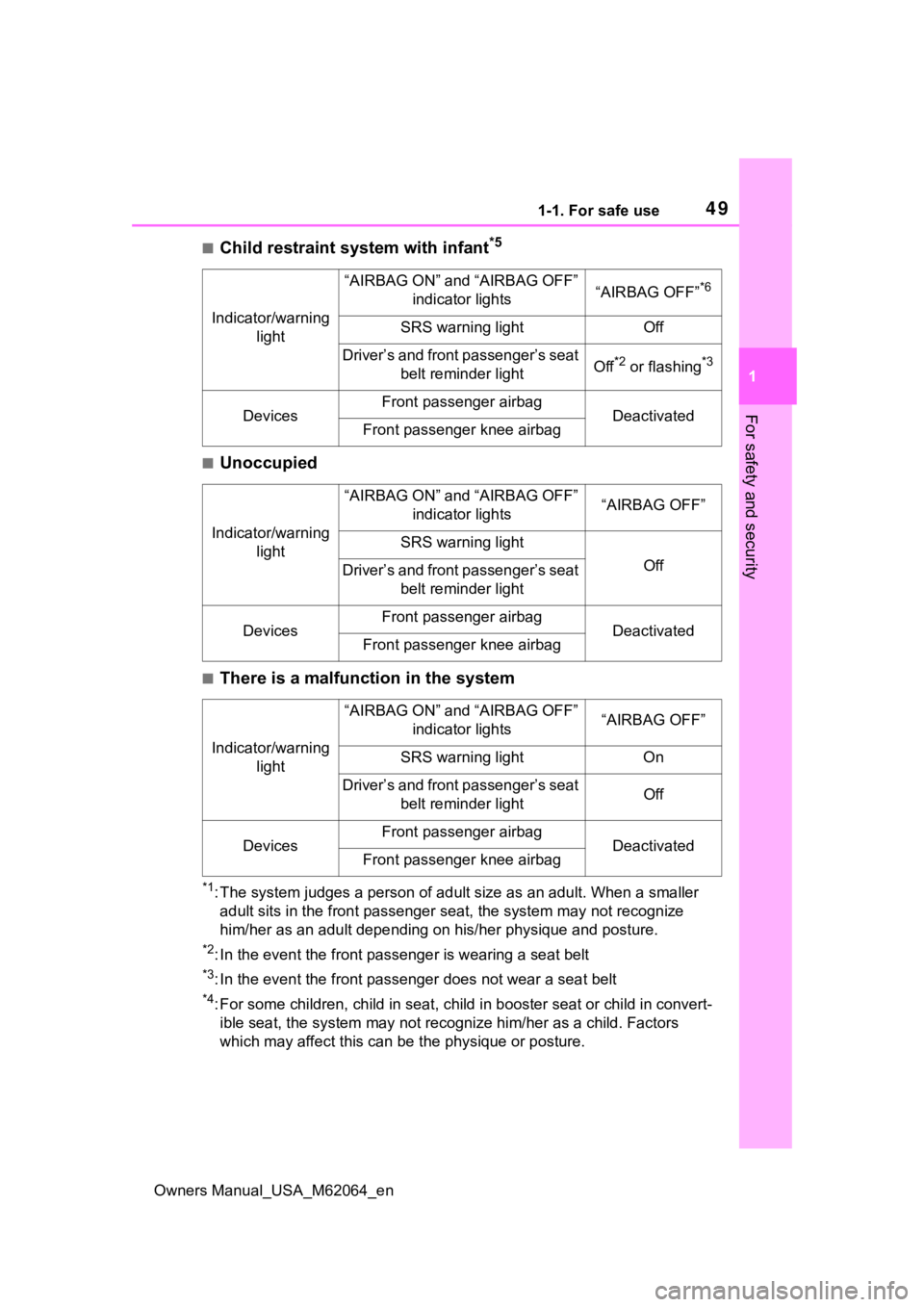
■Child restraint system with infant*5
■Unoccupied
■There is a malfunction in the system
*1: The system judges a person of adult size as an adult. When a smaller
adult sits in the front passenger seat, the system may not recognize
him/her as an adult depending on his/her physique and posture.
*2: In the event the front passenger is wearing a seat belt
*3: In the event the front passen ger does not wear a seat belt
*4: For some children, child in seat, child in booster seat or chi ld in convert-
ible seat, the system may not recognize him/her as a child. Fac tors
which may affect this can be the physique or posture.
Indicator/warning light
“AIRBAG ON” and “AIRBAG OFF” indicator lights“AIRBAG OFF”*6
SRS warning lightOff
Driver’s and front passenger’s seat belt reminder lightOff*2 or flashing*3
DevicesFront passenger airbagDeactivatedFront passenger knee airbag
Indicator/warning light
“AIRBAG ON” and “AIRBAG OFF” indicator lights“AIRBAG OFF”
SRS warning light
OffDriver’s and front passenger’s seat belt reminder light
DevicesFront passenger airbagDeactivatedFront passenger knee airbag
Indicator/warning light
“AIRBAG ON” and “AIRBAG OFF” indicator lights“AIRBAG OFF”
SRS warning lightOn
Driver’s and front passenger’s seat belt reminder lightOff
DevicesFront passenger airbagDeactivatedFront passenger knee airbag
Page 50 of 572

501-1. For safe use
Owners Manual_USA_M62064_en
*5: Never install a rear-facing child restraint system on the front passenger
seat. A forward-facing child restraint system should only be in stalled on
the front passenger sea t when it is unavoidable. ( P.54)
*6: In case the indicator light is not illuminated, consult this m anual on how
to install the child restr aint system properly. (P. 5 2 )
Page 55 of 572
551-2. Child safety
Owners Manual_USA_M62064_en
1
For safety and security
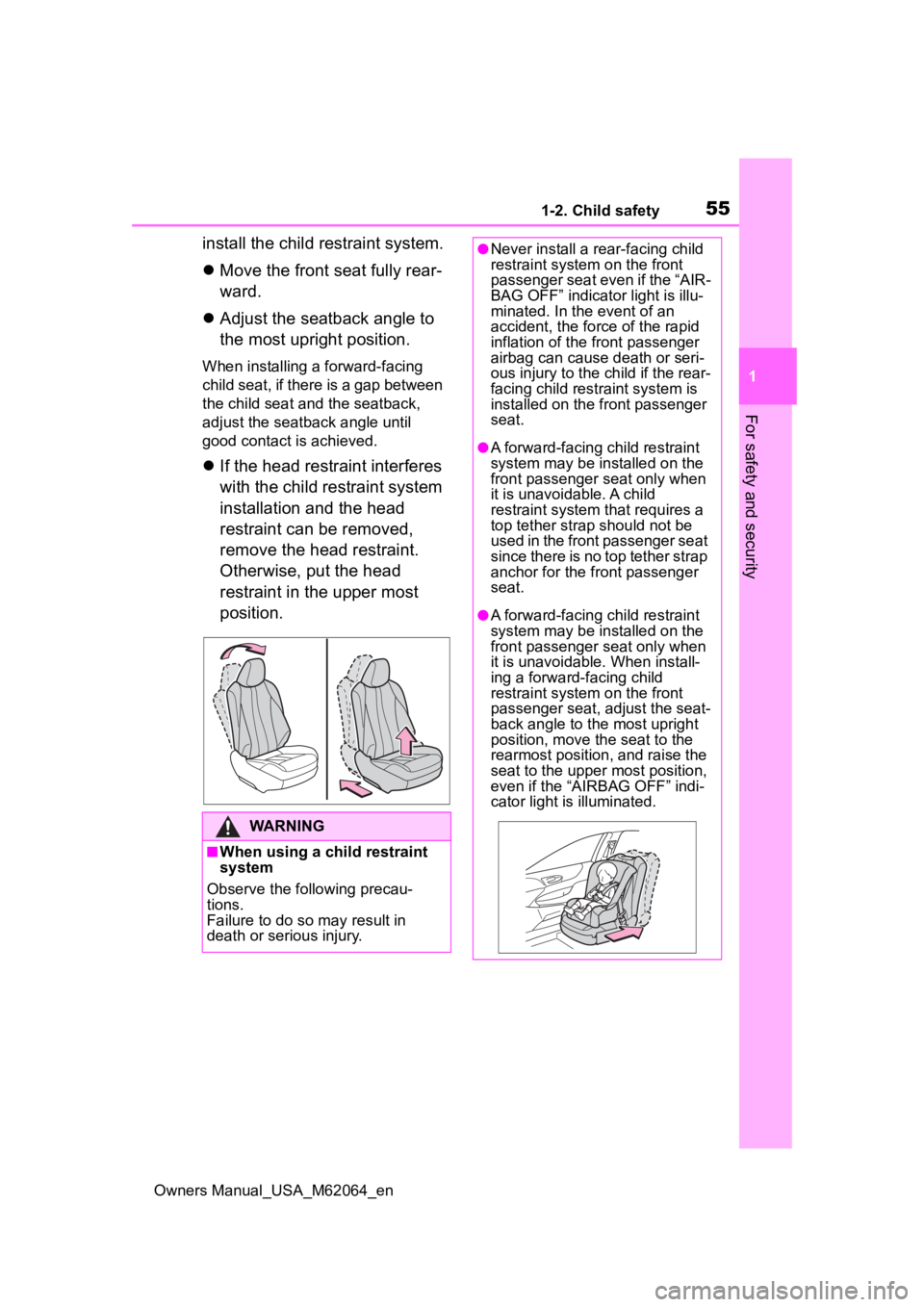
install the child restraint system.
Move the front seat fully rear-
ward.
Adjust the seatback angle to
the most upright position.
When installing a forward-facing
child seat, if there is a gap between
the child seat and the seatback,
adjust the seatback angle until
good contact is achieved.
If the head restraint interferes
with the child restraint system
installation and the head
restraint can be removed,
remove the head restraint.
Otherwise, put the head
restraint in the upper most
position.
WARNING
■When using a child restraint
system
Observe the following precau-
tions.
Failure to do so m ay result in
death or serious injury.
●Never install a rear-facing child
restraint system on the front
passenger seat even if the “AIR-
BAG OFF” indicator light is illu-
minated. In the event of an
accident, the force of the rapid
inflation of the front passenger
airbag can cause death or seri-
ous injury to the child if the rear-
facing child restraint system is
installed on the front passenger
seat.
●A forward-facing child restraint
system may be installed on the
front passenger seat only when
it is unavoidable. A child
restraint system that requires a
top tether strap should not be
used in the front passenger seat
since there is no top tether strap
anchor for the front passenger
seat.
●A forward-facing child restraint
system may be installed on the
front passenger seat only when
it is unavoidable. When install-
ing a forward-facing child
restraint system on the front
passenger seat, adjust the seat-
back angle to the most upright
position, move the seat to the
rearmost position, and raise the
seat to the upper most position,
even if the “AIRBAG OFF” indi-
cator light is illuminated.
Page 65 of 572
651-3. Emergency assistance
Owners Manual_USA_M62064_en
1
For safety and security
1-3.Emergency assistance
*: If equipped
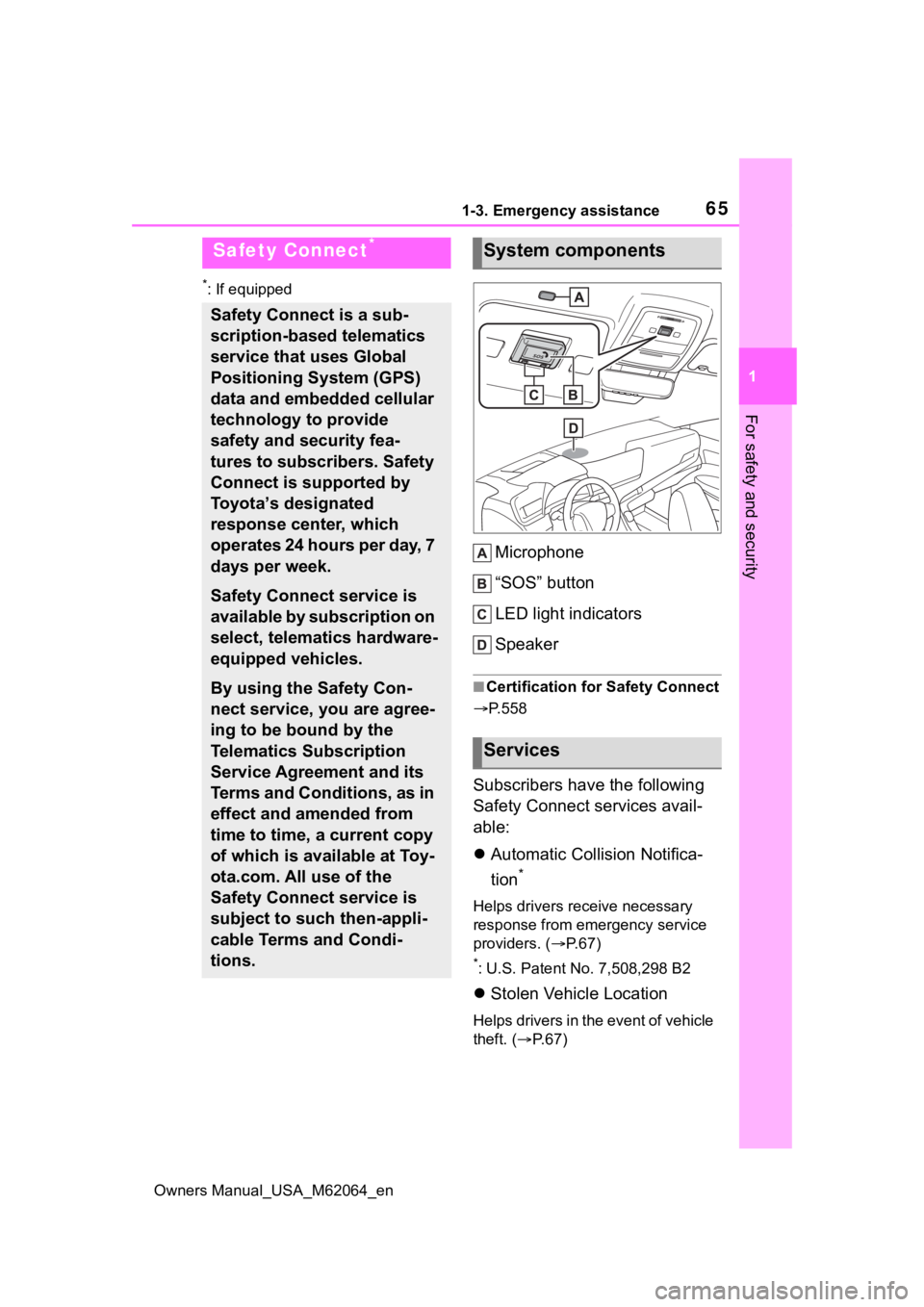
Microphone
“SOS” button
LED light indicators
Speaker
■Certification for Safety Connect
P.558
Subscribers have the following
Safety Connect services avail-
able:
Automatic Collision Notifica-
tion
*
Helps drivers receive necessary
response from emergency service
providers. ( P. 6 7 )
*: U.S. Patent No. 7,508,298 B2
Stolen Vehicle Location
Helps drivers in the event of vehicle
theft. ( P. 6 7 )
Safety Connect*
Safety Connect is a sub-
scription-based telematics
service that uses Global
Positioning System (GPS)
data and embedded cellular
technology to provide
safety and security fea-
tures to subscribers. Safety
Connect is supported by
Toyota’s designated
response center, which
operates 24 hours per day, 7
days per week.
Safety Connect service is
available by subscription on
select, telematics hardware-
equipped vehicles.
By using the Safety Con-
nect service, you are agree-
ing to be bound by the
Telematics Subscription
Service Agreement and its
Terms and Conditions, as in
effect and amended from
time to time, a current copy
of which is available at Toy-
ota.com. All use of the
Safety Connect service is
subject to such then-appli-
cable Terms and Condi-
tions.
System components
Services
Page 67 of 572
671-3. Emergency assistance
Owners Manual_USA_M62064_en
1
For safety and security
When the power switch is turned
to ON, the red indicator light
comes on for 2 seconds then
turns off. Afterward, the green
indicator light comes on, indicat-
ing that the service is active.
The following indicator light pat-
terns indicate specific system
usage conditions:
Green indicator light on =
Active service
Green indicator light flashing
= Safety Connect call in pro-
cess
Red indicator light (except at
vehicle start-up) = System
malfunction (contact your Toy-
ota dealer)
No indicator light (off) =
Safety Connect service not
active
■Automatic Collision Notifi-
cation
In case of either airbag deploy-
ment or severe rear-end colli-
sion, the system is designed to
automatically call the response
center. The responding agent
receives the vehicle’s location
and attempts to speak with the
vehicle occupants to assess the
level of emergency. If the occu- pants are unable to communi-
cate, the agent automatically
treats the call as an emergency,
contacts the nearest emer-
gency services provider to
describe the situation, and
requests that assistance be sent
to the location.
■Stolen Vehicle Location
If your vehicle is stolen, Safety
Connect can work with local
authorities to assist them in
locating and recovering the
vehicle. After filing a police
report, call the Safety Connect
response center at 1-800-331-
4331 in the United States, 1-
877-855-8377 in Puerto Rico or
1-888-869-6828 in Canada, and
follow the prompts for Safety
Connect to initiate this service.
In addition to assisting law
enforcement with recovery of a
stolen vehicle, Safety-Connect-
equipped vehicle location data
may, under certain circum-
stances, be shared with third
parties to locate your vehicle.
Further information is available
at Toyota.com.
■Emergency Assistance But-
ton (“SOS”)
In the event of an emergency on
the road, push the “SOS” button
to reach the Safety Connect
response center. The answer-
ing agent will determine your
vehicle’s location, assess the
emergency, and dispatch the
Safety Connect LED light
Indicators
Safety Connect services
Page 70 of 572
701-4. Theft deterrent system
Owners Manual_USA_M62064_en
1-4.Theft deterrent system
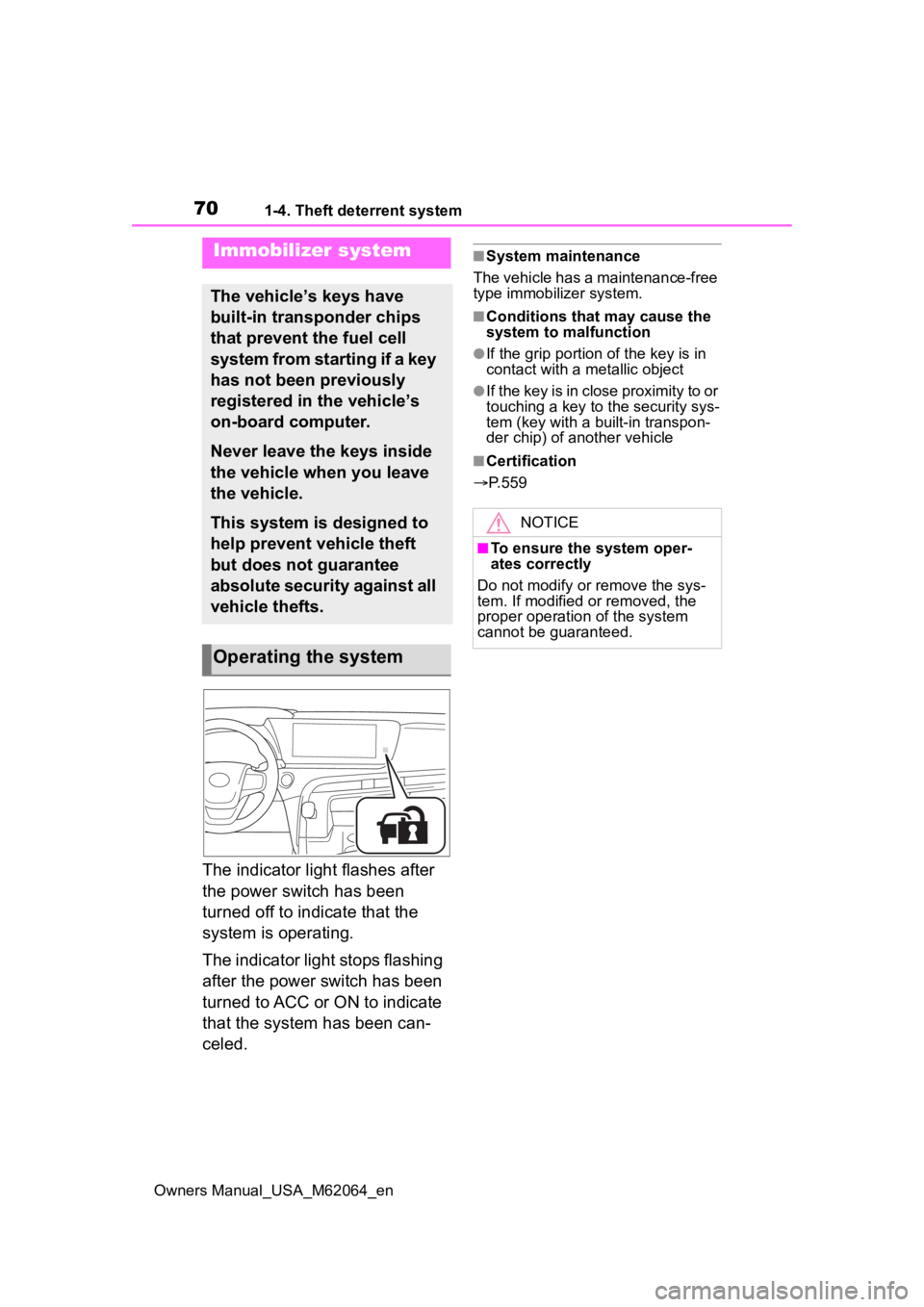
The indicator light flashes after
the power switch has been
turned off to indicate that the
system is operating.
The indicator light stops flashing
after the power switch has been
turned to ACC or ON to indicate
that the system has been can-
celed.
■System maintenance
The vehicle has a maintenance-free
type immobilizer system.
■Conditions that may cause the
system to malfunction
●If the grip portion of the key is in
contact with a metallic object
●If the key is in close proximity to or
touching a key to the security sys-
tem (key with a built-in transpon-
der chip) of another vehicle
■Certification
P.559
Immobilizer system
The vehicle’s keys have
built-in transponder chips
that prevent the fuel cell
system from starting if a key
has not been previously
registered in the vehicle’s
on-board computer.
Never leave the keys inside
the vehicle when you leave
the vehicle.
This system is designed to
help prevent vehicle theft
but does not guarantee
absolute security against all
vehicle thefts.
Operating the system
NOTICE
■To ensure the system oper-
ates correctly
Do not modify or remove the sys-
tem. If modified or removed, the
proper operation of the system
cannot be guaranteed.
Page 71 of 572
711-4. Theft deterrent system
Owners Manual_USA_M62064_en
1
For safety and security
■Items to check before lock-
ing the vehicle
To prevent unexpected trigger-
ing of the alarm and vehicle
theft, make sure of the following:
Nobody is in the vehicle.
The windows are closed
before the alarm is set.
No valuables or other per-
sonal items are left in the
vehicle.
■Setting
Close the doors, trunk and
hood, and lock all the doors
using the entry function or wire-
less remote control. The system
will be set automatically after 30
seconds.
Except for Canada: The alarm
can also be set using the
mechanical key.
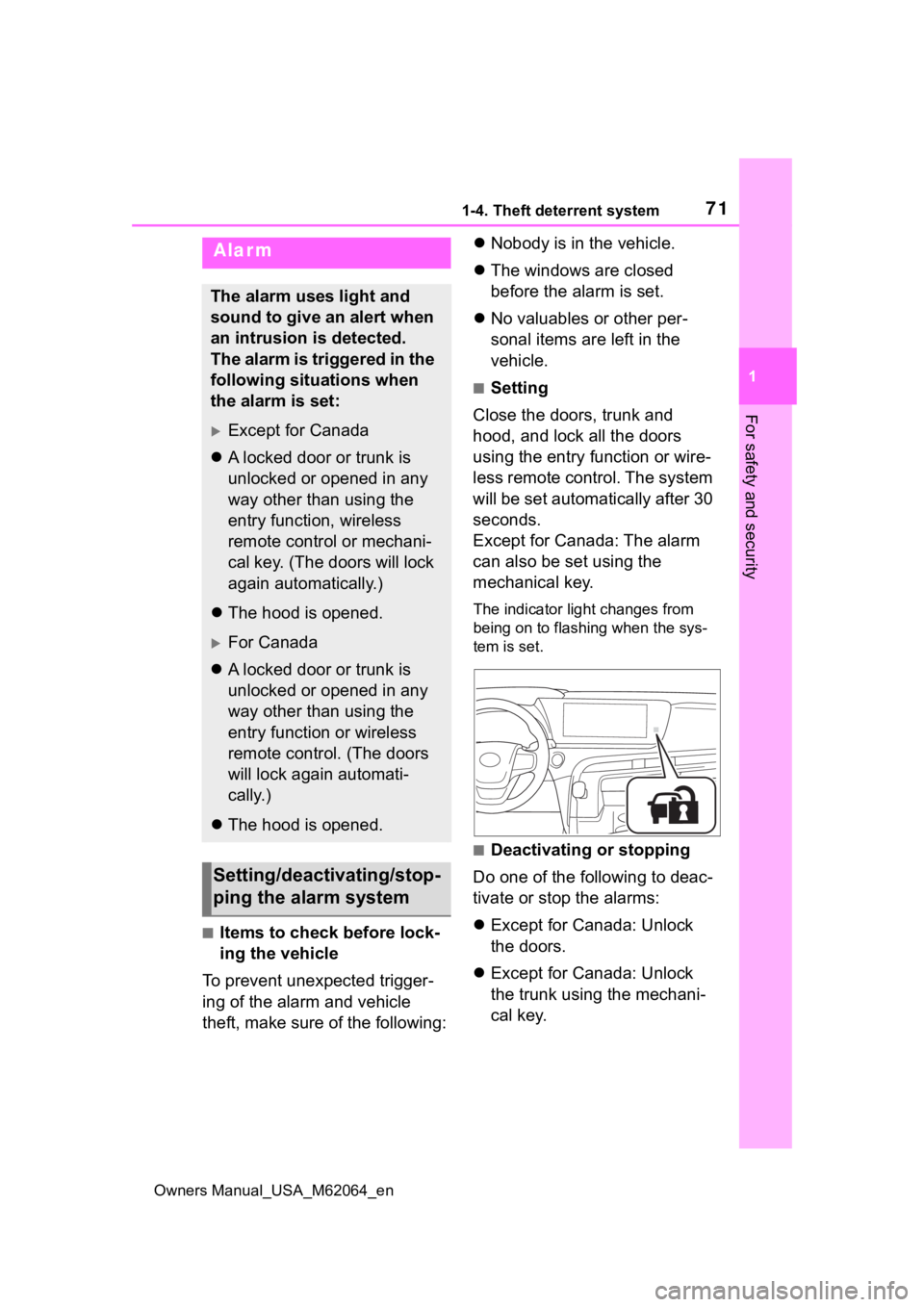
The indicator light changes from
being on to flashing when the sys-
tem is set.
■Deactivating or stopping
Do one of the following to deac-
tivate or stop the alarms:
Except for Canada: Unlock
the doors.
Except for Canada: Unlock
the trunk using the mechani-
cal key.
Alarm
The alarm uses light and
sound to give an alert when
an intrusion is detected.
The alarm is triggered in the
following situations when
the alarm is set:
Except for Canada
A locked door or trunk is
unlocked or opened in any
way other than using the
entry function, wireless
remote control or mechani-
cal key. (The doors will lock
again automatically.)
The hood is opened.
For Canada
A locked door or trunk is
unlocked or opened in any
way other than using the
entry function or wireless
remote control. (The doors
will lock again automati-
cally.)
The hood is opened.
Setting/deactivating/stop-
ping the alarm system
Page 83 of 572
832-1. Fuel cell electric vehicle
Owners Manual_USA_M62064_en
2
Fuel cell system
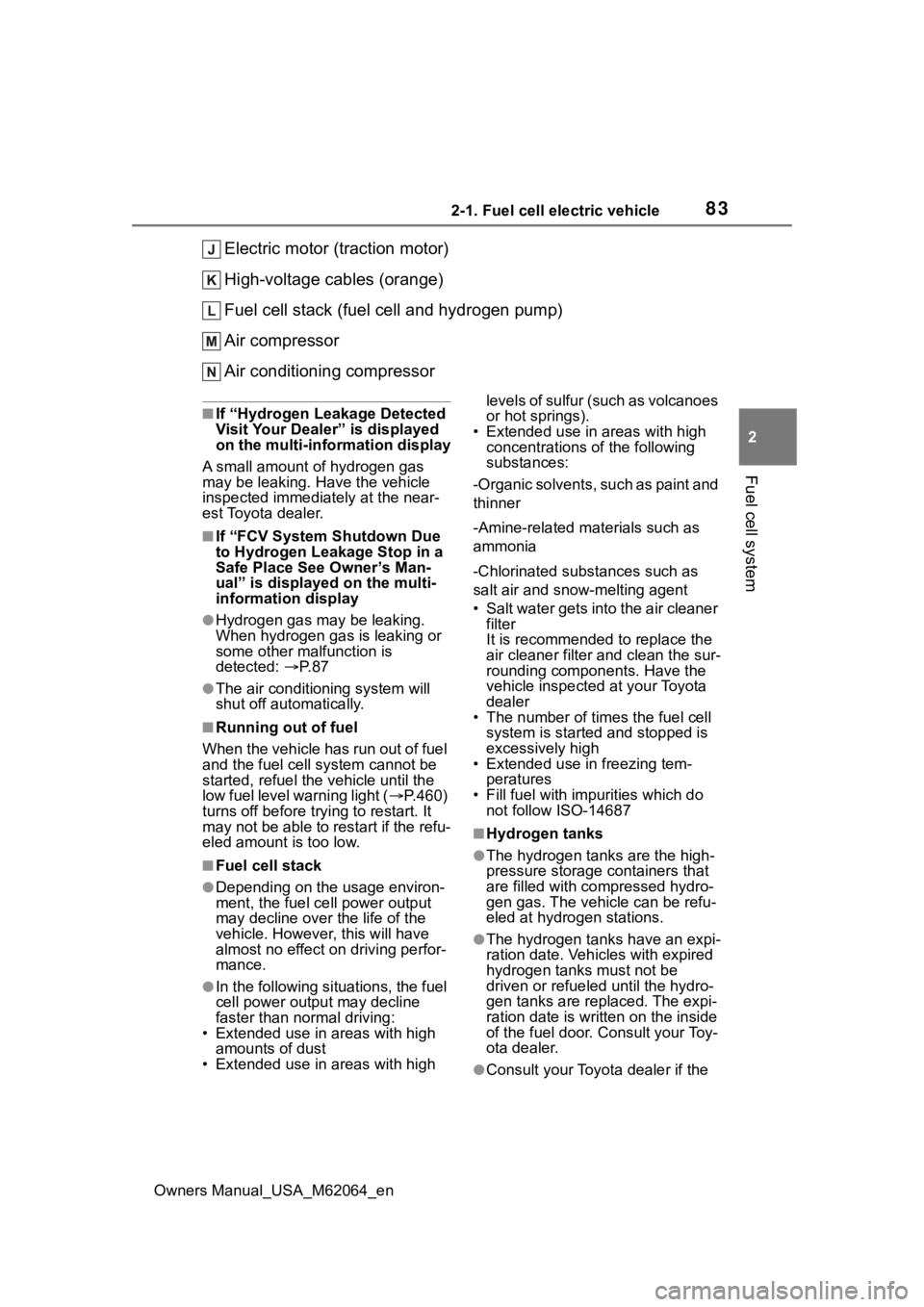
Electric motor (traction motor)
High-voltage cables (orange)
Fuel cell stack (fuel cell and hydrogen pump)
Air compressor
Air conditioning compressor
■If “Hydrogen Leakage Detected
Visit Your Dealer” is displayed
on the multi-information display
A small amount of hydrogen gas
may be leaking. Have the vehicle
inspected immediately at the near-
est Toyota dealer.
■If “FCV System Shutdown Due
to Hydrogen Leakage Stop in a
Safe Place See Owner’s Man-
ual” is displayed on the multi-
information display
●Hydrogen gas may be leaking.
When hydrogen gas is leaking or
some other malfunction is
detected: P. 8 7
●The air conditioning system will
shut off automatically.
■Running out of fuel
When the vehicle has run out of fuel
and the fuel cell system cannot be
started, refuel the vehicle until the
low fuel level warning light ( P.460)
turns off before try ing to restart. It
may not be able to restart if the refu-
eled amount is too low.
■Fuel cell stack
●Depending on the usage environ-
ment, the fuel ce ll power output
may decline over the life of the
vehicle. However, this will have
almost no effect on driving perfor-
mance.
●In the following situations, the fuel
cell power output may decline
faster than normal driving:
• Extended use in areas with high
amounts of dust
• Extended use in areas with high levels of sulfur (such as volcanoes
or hot springs).
• Extended use in areas with high concentrations o f the following
substances:
-Organic solvents, such as paint and
thinner
-Amine-related materials such as
ammonia
-Chlorinated substances such as
salt air and snow-melting agent
• Salt water gets into the air cleaner filter
It is recommended to replace the
air cleaner filter and clean the sur-
rounding components. Have the
vehicle inspected at your Toyota
dealer
• The number of times the fuel cell system is started and stopped is
excessively high
• Extended use in freezing tem- peratures
• Fill fuel with impurities which do not follow ISO-14687
■Hydrogen tanks
●The hydrogen tanks are the high-
pressure storage containers that
are filled with co mpressed hydro-
gen gas. The vehicle can be refu-
eled at hydrogen stations.
●The hydrogen tanks have an expi-
ration date. Vehicles with expired
hydrogen tanks must not be
driven or refueled until the hydro-
gen tanks are replaced. The expi-
ration date is written on the inside
of the fuel door. Consult your Toy-
ota dealer.
●Consult your Toyota dealer if the
Page 84 of 572

842-1. Fuel cell electric vehicle
Owners Manual_USA_M62064_enhydrogen tanks or valves need to
be disposed.
■Fuel cell stack coolant
●Fuel cell stack coolant uses a spe-
cifically-designed fluid with high
electrical insulation properties, in
order to safely cool the high-volt-
age fuel cell stack.
●Never add water or other coolants
to the fuel cell st
ack cooling sys-
tem, as they will cause permanent
damage.
●Consult your Toyota dealer for
replenishing or changing the fuel
cell stack coolant.
■Ion filter
●An ion filter is inst alled in the cool-
ant lines for the fuel cell stack, in
order to maintain the normal insu-
lation properties of the coolant.
●It is necessary to periodically
change the ion filter. ( P.466)
Contact your Toyota dealer for this
periodic maintenance.
■Tailpipe
●When the power switch is turned
off and the fuel cell system is
stopped ( P.182) after driving,
exhaust water is discharged. Be
careful when standing behind the
vehicle to avoid dripping or spray-
ing.
●It is possible to manually purge
the exhaust. Thi s may be desir-
able, for instance, before parking
in a garage. This is done by press-
ing the H
2O switch. ( P.196)
●On cold days, water vapor in the
exhaust may appe ar as a white
mist emitted from the tailpipe. This
is not a malfunction. A white mist
may be emitted from the vehicle
side depending on the wind direc-
tion. If it is a concern, consult with
a Toyota dealer.
●If the tailpipe is blocked, the fuel
cell system will stop.
●In the following state when cold, a white mist may be emitted. Water
vapor is being emitted as a sys-
tem protection and it is not a mal-
function.
• If several minutes have passed after opening the fuel lid, such as
refueling.
• Several hours have passed after the power switch was turned off.
■Hydrogen detectors
When the power switch is turned to
ON, the hydrogen detectors are
activated.
■Power output restriction
When the power output is restricted,
the vehicle may fa il to accelerate or
even decelerate, even though the
accelerator pedal is depressed. If a
safe driving speed cannot be main-
tained, stop the ve hicle in a safe
place away from the traffic. This
may be caused by the following con-
ditions:
●The coolant temperature may be
too high. This can be caused by
driving conditions such as
repeated sudden acceleration and
deceleration, continuous driving
on an incline, continuous driving
at high altitudes with a high load,
etc. In such situations, “FCV sys-
tem overheated Output power
reduced” is displayed on the multi-
information display, and the power
output is restricted. Once the cool-
ant returns to normal temperature,
the power output will retu rn to nor-
mal. ( P.464)
●The remaining fuel may be low.
After the low fuel level warning
light comes on, the output power
will be gradually restricted in order
to extend the possible driving dis-
tance. Once getting to this point,
the remaining driving distance
possible is short. Immediately refill
the vehicle with hydrogen.
●On cold days, the low fuel level
warning light comes on faster than
usual and the output power is
restricted.
Page 85 of 572
852-1. Fuel cell electric vehicle
Owners Manual_USA_M62064_en
2
Fuel cell system
■Electromagnetic waves (EMF)
●High-voltage parts and cables in
fuel cell electric vehicles have an
electromagnetic shielding configu-
ration, and therefore emit approxi-
mately the same amount of
electromagnetic waves as con-
ventional gasoli ne-powered vehi-
cles or home electronic
appliances.
●Your vehicle may cause sound
interference in so me third party-
produced radio parts.
■Starting the fuel cell system in
an extremely col d environment
When the tracti on battery is extremely cold (below approxi-
mately -22˚F [-30˚C]) under the
influence of outsi
de temperature, it
may not be possible to start the fuel
cell system. In this case, try to start
the fuel cell system again after the
temperature of the traction battery
increases due to the outside tem-
perature increase etc.
■Traction battery
The traction battery has a limited
service life. The lifespan of the trac-
tion battery can change according to
driving style and driving conditions.
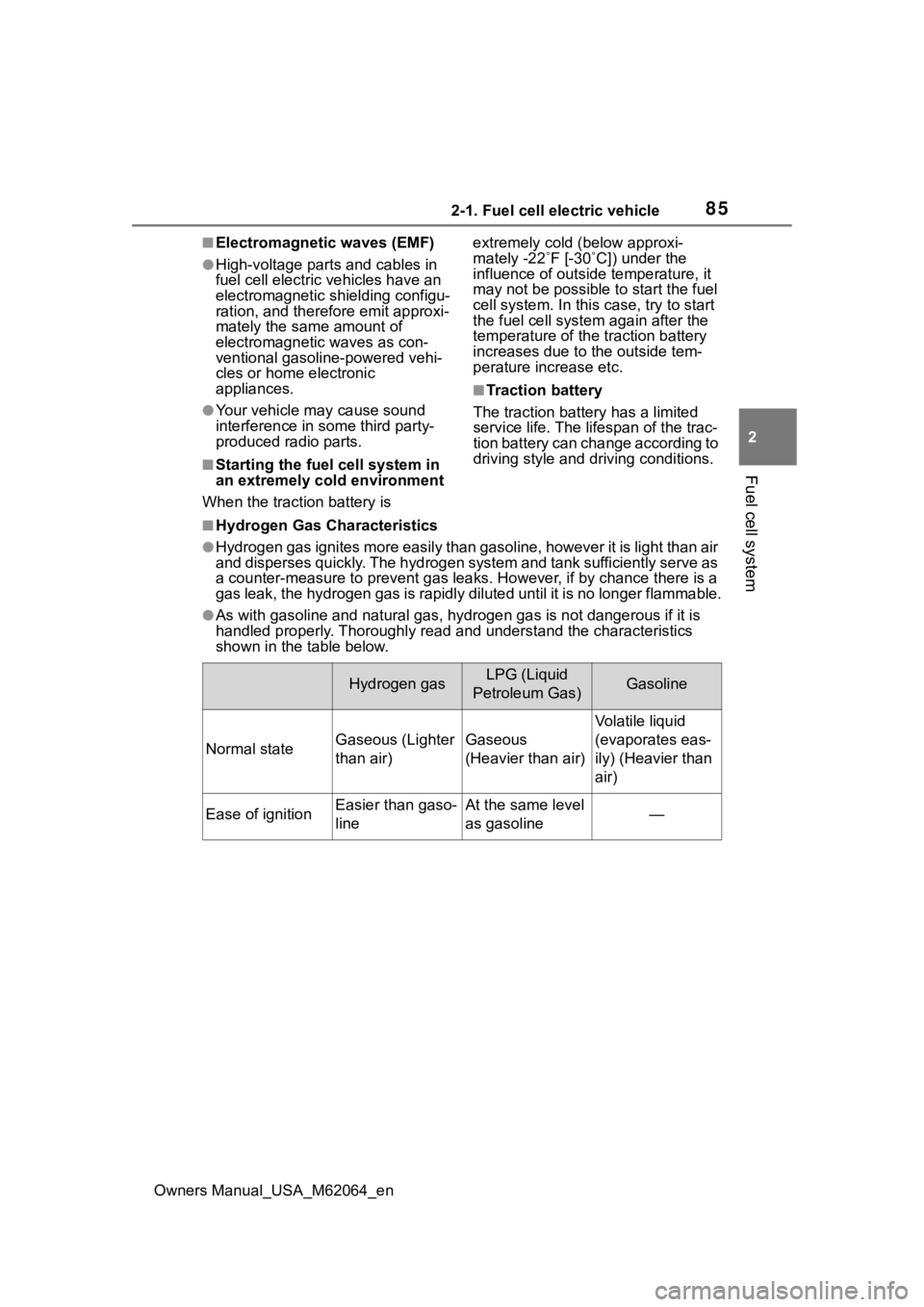
■Hydrogen Gas Characteristics
●Hydrogen gas ignites more easily than gasoline, however it is l ight than air
and disperses quickly. The hydrogen system and tank sufficientl y serve as
a counter-measure to prevent gas leaks. However, if by chance there is a
gas leak, the hydrogen gas is rapidly diluted until it is no lo nger flammable.
●As with gasoline and natural gas, hydrogen gas is not dangerous if it is
handled properly. Thoroughly rea d and understand the characteristics
shown in the table below.
Hydrogen gasLPG (Liquid
Petroleum Gas)Gasoline
Normal stateGaseous (Lighter
than air)Gaseous
(Heavier than air)
Volatile liquid
(evaporates eas-
ily) (Heavier than
air)
Ease of ignitionEasier than gaso-
lineAt the same level
as gasoline—