belt TOYOTA MIRAI 2023 Owners Manual
[x] Cancel search | Manufacturer: TOYOTA, Model Year: 2023, Model line: MIRAI, Model: TOYOTA MIRAI 2023Pages: 572, PDF Size: 17.71 MB
Page 1 of 572
1
2
3
4
5
6
7
8
9
10
Owners Manual_USA_M62064_en
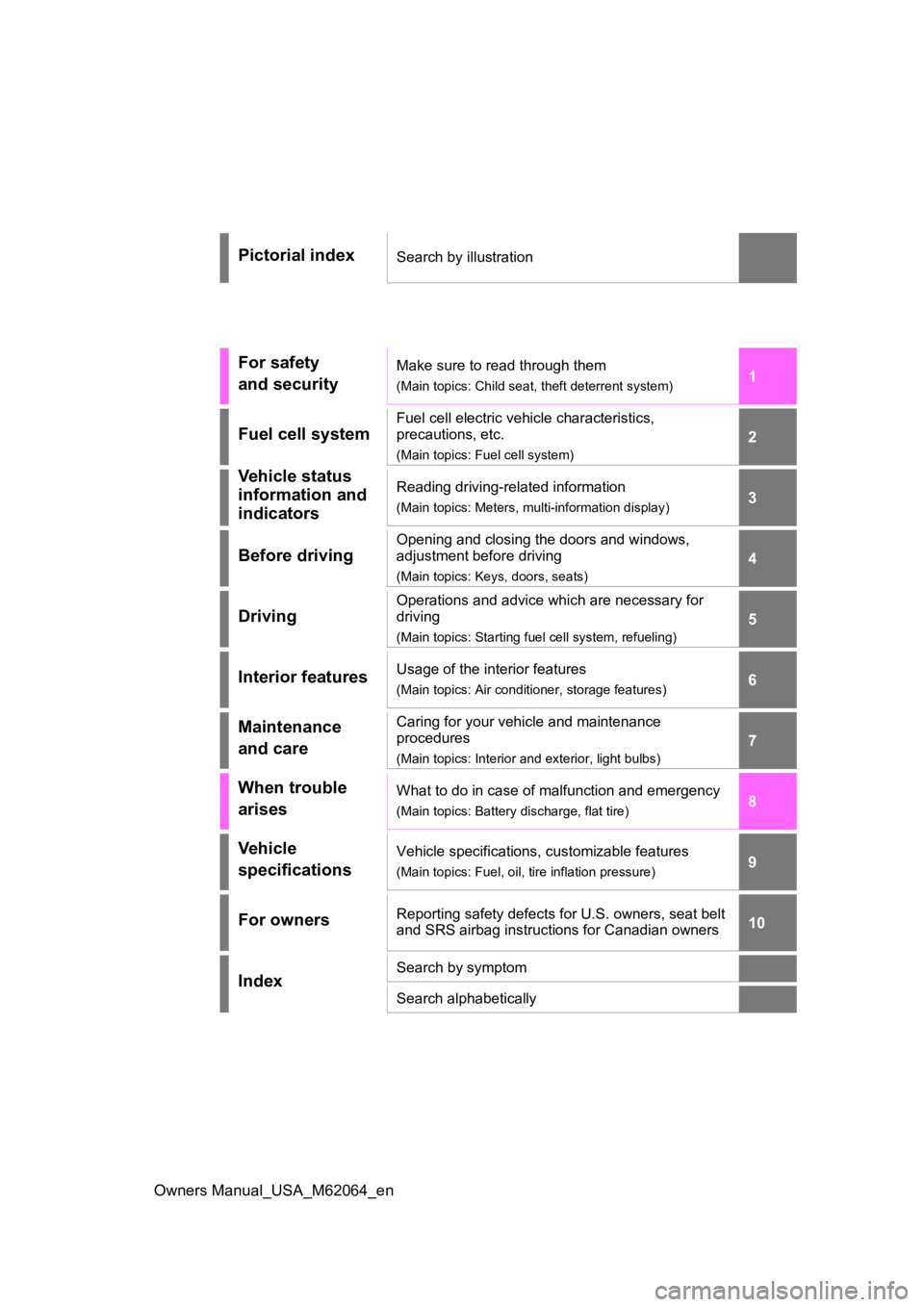
Pictorial indexSearch by illustration
For safety
and securityMake sure to read through them
(Main topics: Child seat, theft deterrent system)
Fuel cell system
Fuel cell electric vehicle characteristics,
precautions, etc.
(Main topics: Fuel cell system)
Vehicle status
information and
indicatorsReading driving-related information
(Main topics: Meters, multi-information display)
Before driving
Opening and closing the doors and windows,
adjustment before driving
(Main topics: Keys, doors, seats)
Driving
Operations and advice which are necessary for
driving
(Main topics: Starting f uel cell system, refueling)
Interior featuresUsage of the interior features
(Main topics: Air conditioner, storage features)
Maintenance
and careCaring for your vehicle and maintenance
procedures
(Main topics: Interior and exterior, light bulbs)
When trouble
arisesWhat to do in case of malfunction and emergency
(Main topics: Battery discharge, flat tire)
Vehicle
specificationsVehicle specifications, customizable features
(Main topics: Fuel, oil, tire inflation pressure)
For ownersReporting safety defects for U.S. owners, seat belt
and SRS airbag instructions for Canadian owners
IndexSearch by symptom
Search alphabetically
Page 2 of 572
2
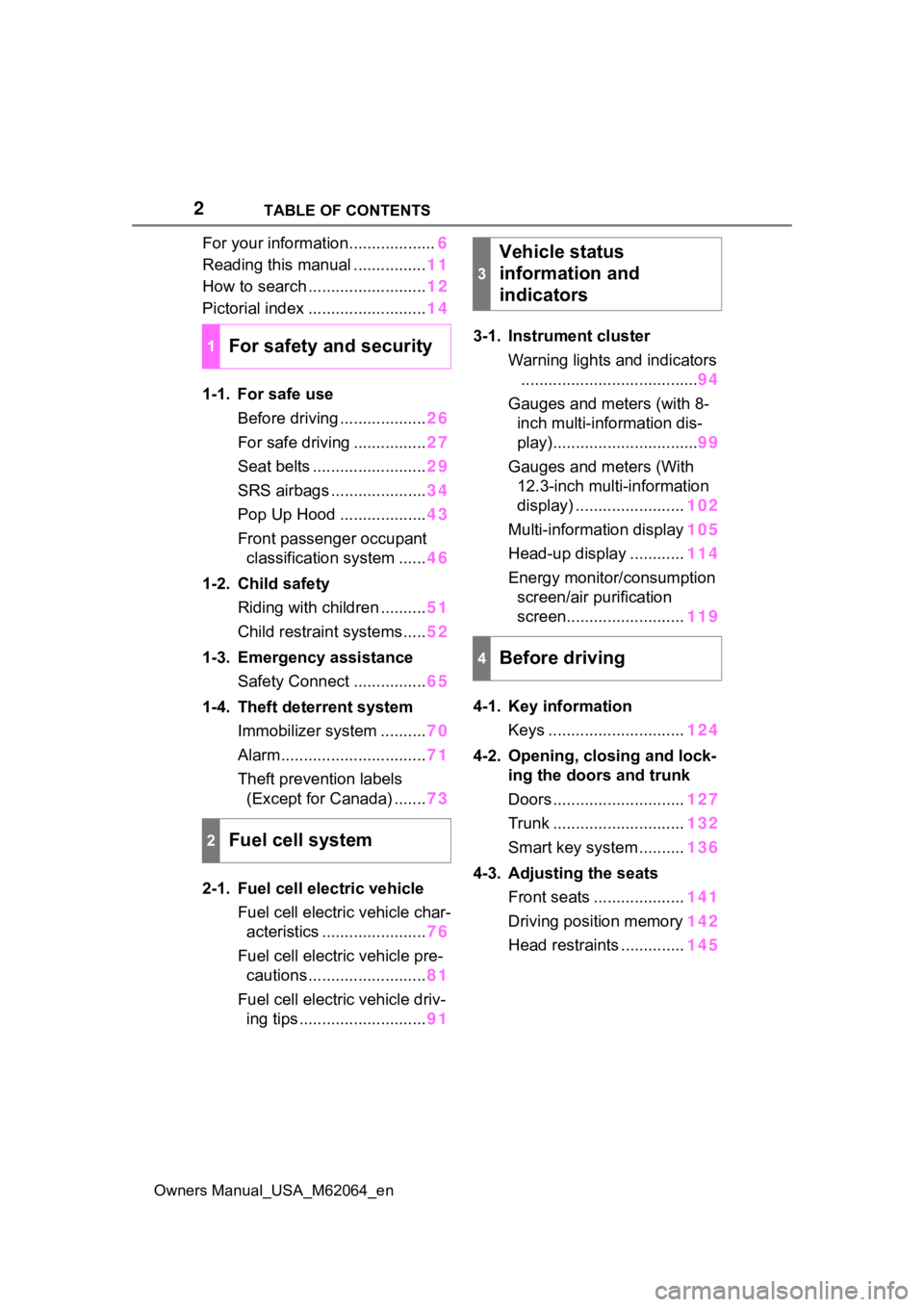
Owners Manual_USA_M62064_enTABLE OF CONTENTS
For your information...................
6
Reading this manual ................ 11
How to search .......................... 12
Pictorial index .......................... 14
1-1. For safe use Before driving ................... 26
For safe driving ................ 27
Seat belts ......................... 29
SRS airbags ..................... 34
Pop Up Hood ................... 43
Front passenger occupant classification system ...... 46
1-2. Child safety Riding with children .......... 51
Child restraint systems..... 52
1-3. Emergency assistance Safety Connect ................ 65
1-4. Theft deterrent system Immobilizer system .......... 70
Alarm................................ 71
Theft prevention labels (Except for Canada) ....... 73
2-1. Fuel cell electric vehicle Fuel cell electric vehicle char-acteristics ....................... 76
Fuel cell electric vehicle pre- cautions .......................... 81
Fuel cell electric vehicle driv- ing tips ............................ 913-1. Instrument cluster
Warning lights and indicators....................................... 94
Gauges and meters (with 8- inch multi-information dis-
play)................................ 99
Gauges and meters (With 12.3-inch multi-information
display) ........................ 102
Multi-information display 105
Head-up display ............ 114
Energy monitor/ consumption
screen/air purification
screen.......................... 119
4-1. Key information Keys .............................. 124
4-2. Opening, closing and lock- ing the doors and trunk
Doors ............................. 127
Trunk ............................. 132
Smart key system .......... 136
4-3. Adjusting the seats Front seats .................... 141
Driving position memory 142
Head restraints .............. 145
1For safety and security
2Fuel cell system
3
Vehicle status
information and
indicators
4Before driving
Page 5 of 572
5TABLE OF CONTENTS
Owners Manual_USA_M62064_en
1
2
3
4
5
6
8 7
9
10
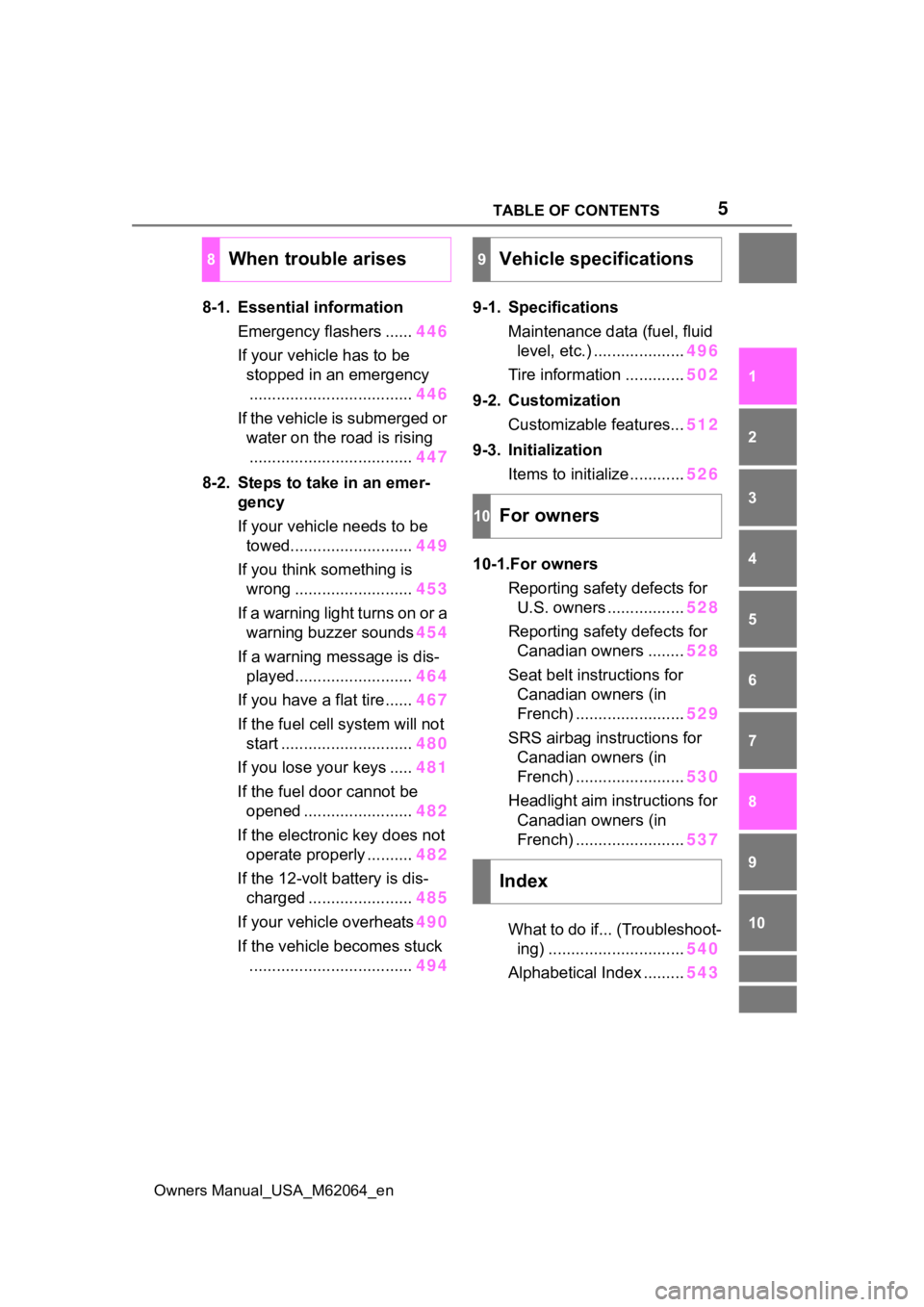
8-1. Essential information Emergency flashers ...... 446
If your vehicle has to be stopped in an emergency.................................... 446
If the vehicle is submerged or water on the road is rising.................................... 447
8-2. Steps to take in an emer- gency
If your vehicle needs to be towed........................... 449
If you think something is wrong .......................... 453
If a warning light turns on or a warning buzzer sounds 454
If a warning message is dis- played.......................... 464
If you have a flat tire...... 467
If the fuel cell system will not
start ............................. 480
If you lose your keys ..... 481
If the fuel door cannot be opened ........................ 482
If the electronic key does not operate properly .......... 482
If the 12-volt battery is dis- charged ....................... 485
If your vehicle overheats 490
If the vehicle becomes stuck .................................... 4949-1. Specifications
Maintenance data (fuel, fluid level, etc.) .................... 496
Tire information ............. 502
9-2. Customization Customizable features... 512
9-3. Initialization Items to initialize ............ 526
10-1.For owners Reporting safet y defects for
U.S. owners ................. 528
Reporting safet y defects for
Canadian owners ........ 528
Seat belt instructions for Canadian owners (in
French) ........................ 529
SRS airbag instructions for Canadian owners (in
French) ........................ 530
Headlight aim instructions for Canadian owners (in
French) ........................ 537
What to do if... (Troubleshoot- ing) .............................. 540
Alphabetical Index ......... 543
8When trouble arises9Vehicle specifications
10For owners
Index
Page 7 of 572

7
Owners Manual_USA_M62064_en
by installing non-genuine Toyota
products.
The installation of a mobile two-
way radio system in your vehicle
could affect electronic systems
such as:
Fuel cell system
Advanced Drive
Toyota Safety Sense 2.5 +
with Teammate
Toyota Safety Sense 2.5 +
Anti-lock brake system
Vehicle dynamics integrated
management
SRS airbag system
Seat belt pretensioner system
Be sure to check with your Toy-
ota dealer for precautionary
measures or special instructions
regarding installation of a mobile
two-way radio system.
High voltage parts and cables
on the fuel cell electric vehicles
emit approximately the same
amount of electromagnetic
waves as the conventional gas-
oline powered vehicles or home
electronic appliances despite of
their electromagnetic shielding.
Unwanted noise may occur in
the reception of the mobile two-
way radio. The vehicle is equipped with
sophisticated computers that will
record certain data, such as:
• Engine speed / Electric motor
speed (traction motor speed)
• Accelerator status
• Brake status
• Vehicle speed
• Operation status of the driving assist systems
• Images from the cameras
Your vehicle is equipped with cam-
eras. Contact your Toyota dealer for
the location of re cording cameras.
The recorded data varies
according to the vehicle grade
level and options with which it is
equipped.
These computers do not record
conversations or sounds, and
only record images outside of
the vehicle in certain situations.
Data Transmission
Your vehicle may transmit the data
recorded in these computers to
Toyota without notification to you.
Data usage
Toyota may use the data recorded
in this computer to diagnose mal-
functions, conduct research and
development, and improve quality.
Toyota will not disclose the
recorded data to a third party
except:
• With the consen t of the vehicle
owner or with the consent of the
lessee if the vehicle is leased
Installation of a mobile
two-way radio system
Vehicle data recording
Page 8 of 572
8
Owners Manual_USA_M62064_en• In response to an official request
by the police, a court of law or a
government agency
• For use by Toyota in a lawsuit
• For research purposes where the data is not tied to a specific vehi-
cle or vehicle owner
Recorded image information
can be erased by your Toyota
dealer.
The image recording function can
be disabled. However, if the func-
tion is disabled, data from when the
system operates will not be avail-
able.
To learn more about the vehi-
cle data collected, used and
shared by Toyota, please visit
www.toyota.com/privacyvts/
.
If your Toyota has Safety Con-
nect and if you have subscribed
to those services, please refer to
the Safety Connect Telematics
Subscription Service Agreement
for information on data collected
and its usage.
To learn more about the vehi-
cle data collected, used and
shared by Toyota, please visit
www.toyota.com/privacyvts/
.
When using Advanced Drive, refer to the subscription service
contract or “Toyota Teammate
Advanced Drive OWNER’S
MANUAL” for details about
recorded data and its use.
This vehicle is equipped with an
event data recorder (EDR). The
main purpose of an EDR is to
record, in certain crash or near
crash-like situations, such as an
air bag deployment or hitting a
road obstacle, data that will
assist in understanding how a
vehicle’s systems performed.
The EDR is designed to record
data related to vehicle dynamics
and safety systems for a short
period of time, typically 30 sec-
onds or less.
The EDR in this vehicle is
designed to record such data
as:
• How various systems in your
vehicle were operating;
• Whether or not the driver and passenger safety belts were
buckled/fastened;
• How far (if at all) the driver was depressing the accelera-
tor and/or brake pedal; and,
• How fast the vehicle was trav- eling.
These data can help provide a
better understanding of the cir-
cumstances in which crashes
and injuries occur.
Usage of data collected
through Safety Connect
(U.S.mainland only)
Advanced Drive data han-
dling
Event data recorder
Page 9 of 572

9
Owners Manual_USA_M62064_en
NOTE: EDR data are recorded
by your vehicle only if a non-triv-
ial crash situation occurs; no
data are recorded by the EDR
under normal driving conditions
and no personal data (e.g.,
name, gender, age, and crash
location) are recorded. How-
ever, other parties, such as law
enforcement, could combine the
EDR data with the type of per-
sonally identifying data rou-
tinely acquired during a crash
investigation.
To read data recorded by an
EDR, special equipment is
required, and access to the
vehicle or the EDR is needed. In
addition to the vehicle manufac-
turer, other parties, such as law
enforcement, that have the spe-
cial equipment, can read the
information if they have access
to the vehicle or the EDR.
Disclosure of the EDR data
Toyota will not disclose the data
recorded in an EDR to a third party
except when:
• An agreement from the vehicle’s
owner (or the less ee for a leased
vehicle) is obtained
• In response to an official request by the police, a court of law or a
government agency
• For use by Toyota in a lawsuit
However, if necessary, Toy-
ota may:
• Use the data for research on
vehicle safety performance • Disclose the data to a third party
for research pur poses without
disclosing information about the
specific vehicle or vehicle owner
The SRS airbag, seat belt pre-
tensioner devices and Pop Up
Hood system in your Toyota
contain explosive chemicals. If
the vehicle is scrapped with the
airbags, seat belt pretensioners
and Pop Up Hood micro gas
generators left as they are, this
may cause an accident such as
fire. Be sure to have the sys-
tems of the SRS airbag, seat
belt pretensioner and Pop Up
Hood micro gas generators
removed and disposed of by a
qualified service shop or by your
Toyota dealer before you scrap
your vehicle.
Special handling may apply, See
www.dtsc.ca.gov/
hazardouswaste/perchlorate.
Your vehicle has components
that may contain perchlorate.
These components may include
airbags, seat belt pretensioners,
Pop Up Hood system, wireless
remote control batteries, and the
batteries in the tire pressure
warning valve and transmitters.
Scrapping of your Toyota
Perchlorate Material
Page 22 of 572
22Pictorial index
Owners Manual_USA_M62064_en
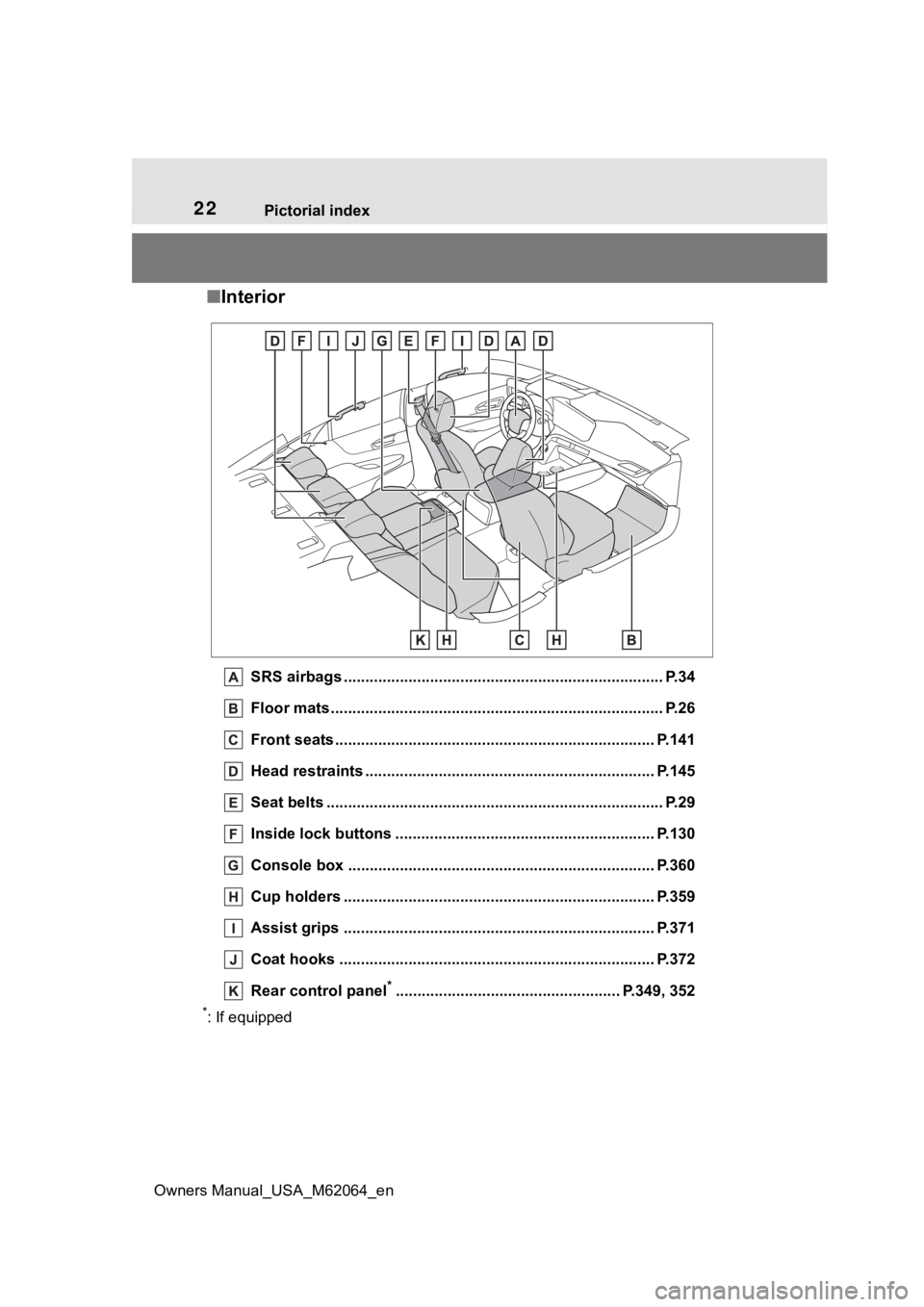
■ Interior
SRS airbags .................................................... ...................... P.34
Floor mats..................................................... ........................ P.26
Front seats .................................................... ...................... P.141
Head restraints ................................................ ................... P.145
Seat belts ..................................................... ......................... P.29
Inside lock buttons ............................................ ................ P.130
Console box ....................................................................... P.360
Cup holders .................................................... .................... P.359
Assist grips ................................................... ..................... P.371
Coat hooks ..................................................... .................... P.372
Rear control panel
*.................................................... P.349, 352
*: If equipped
Page 25 of 572
25
Owners Manual_USA_M62064_en
1
1
For safety and security
For safety and security
1-1. For safe useBefore driving ................. 26
For safe driving .............. 27
Seat belts ....................... 29
SRS airbags ................... 34
Pop Up Hood ................. 43
Front passenger occupant classification system .... 46
1-2. Child safety Riding with children ........ 51
Child restraint systems... 52
1-3. Emergency assistance Safety Connect .............. 65
1-4. Theft deterrent system Immobilizer sys tem ........70
Alarm.............................. 71
Theft prevention labels (Except for Canada) ..... 73
Page 27 of 572
271-1. For safe use
Owners Manual_USA_M62064_en
1
For safety and security
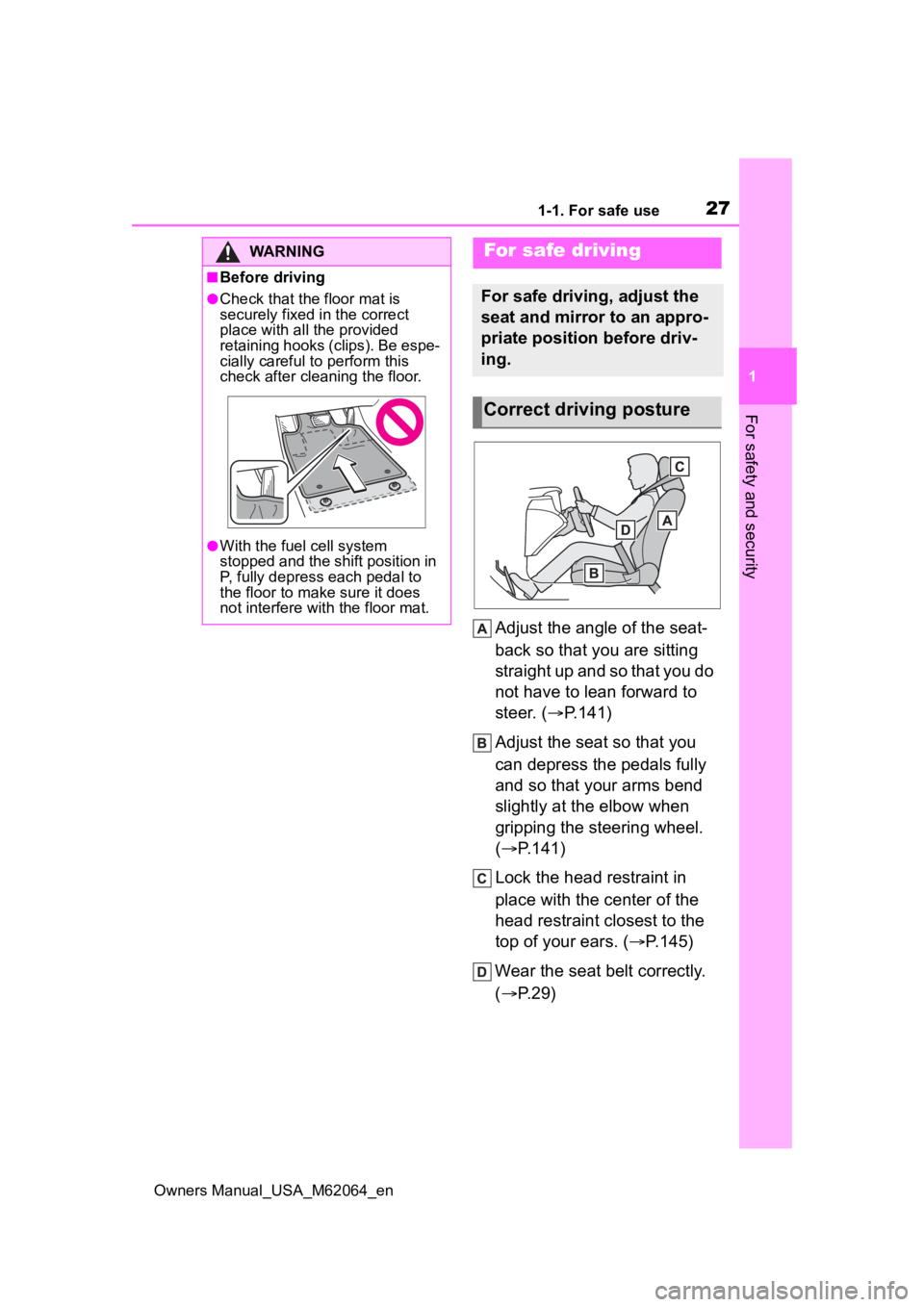
Adjust the angle of the seat-
back so that you are sitting
straight up and so that you do
not have to lean forward to
steer. ( P.141)
Adjust the seat so that you
can depress the pedals fully
and so that your arms bend
slightly at the elbow when
gripping the steering wheel.
( P.141)
Lock the head restraint in
place with the center of the
head restraint closest to the
top of your ears. ( P.145)
Wear the seat belt correctly.
( P.29)
WARNING
■Before driving
●Check that the floor mat is
securely fixed in the correct
place with all the provided
retaining hooks (clips). Be espe-
cially careful to perform this
check after cleaning the floor.
●With the fuel cell system
stopped and the shift position in
P, fully depress each pedal to
the floor to make sure it does
not interfere with the floor mat.
For safe driving
For safe driving, adjust the
seat and mirror to an appro-
priate position before driv-
ing.
Correct driving posture
Page 28 of 572
281-1. For safe use
Owners Manual_USA_M62064_en
Make sure that all occupants are
wearing their seat belts before
driving the vehicle. (P.29)
Use a child restraint system
appropriate for the child until the child becomes large enough to
properly wear the vehicle’s seat
belt. (
P.52)
Make sure that you can see
backward clearly by adjusting
the inside and outside rear view
mirrors properly. ( P.149, 150,
160)
WARNING
■For safe driving
Observe the following precau-
tions.
Failure to do so m ay result in
death or serious injury.
●Do not adjust the position of the
driver’s seat while driving.
Doing so could cause the driver
to lose control of the vehicle.
●Do not place a cushion between
the driver or passenger and the
seatback.
A cushion may prevent correct
posture from being achieved,
and reduce the effectiveness of
the seat belt and head restraint.
●Do not place anything under the
front seats.
Objects placed under the front
seats may become jammed in
the seat tracks and stop the
seat from locking in place. This
may lead to an accident and the
adjustment mechanism may
also be damaged.
●Always observe the legal speed
limit when driving on public
roads.
●When driving over long dis-
tances, take regular breaks
before you start to feel tired.
Also, if you feel tired or sleepy
while driving, do not force your-
self to continue driving and take
a break immediately.
Correct use of the seat
belts
Adjusting the mirrors