tow TOYOTA MIRAI 2023 Owners Manual
[x] Cancel search | Manufacturer: TOYOTA, Model Year: 2023, Model line: MIRAI, Model: TOYOTA MIRAI 2023Pages: 572, PDF Size: 17.71 MB
Page 3 of 572
3TABLE OF CONTENTS
Owners Manual_USA_M62064_en
1
2
3
4
5
6
8 7
9
10
4-4. Adjusting the steering wheel and mirrors
Steering wheel .............. 147
Inside rear view mirror .. 149
Digital Rear-view Mirror 150
Outside rear view mirrors .................................... 160
4-5. Opening, closing the win- dows
Power windows ............. 162
4-6. Favorite settings My Settings ................... 165
5-1. Before driving Driving the vehicle......... 169
Cargo and luggage ....... 175
Vehicle load limits ......... 178
Trailer towing................. 179
Dinghy towing ............... 179
5-2. Driving procedures Power switch ................. 180
Shift position ................. 185
Turn signal lever............ 190
Parking brake ................ 191
Brake Hold .................... 194
ASC (Active Sound Control) .................................... 196
Water release (H
2O switch)
.................................... 1965-3. Operating the lights and
wipers
Headlight switch ............ 198
AHB (Automatic High Beam) .................................... 200
Windshield wipers and washer ......................... 204
5-4. Refueling Opening the fuel door .... 210
5-5. Using the driving support systems
Toyota Safety Sense 2.5 +
.................................... 214
PCS (Pre-Collision System) .................................... 219
LTA (Lane Tracing Assist) .................................... 230
RSA (Road Sign Assist). 241
Dynamic radar cruise control with full-speed range ... 244
BSM (Blind Spot Monitor) .................................... 256
Intuitive parking assist ... 261
RCTA (Rear Cross Traffic Alert) ............................ 272
RCD (Rear Camera Detec- tion) ............................. 277
PKSB (Parking Support Brake) .......................... 281
Parking Support Brake func- tion (static obj ects front and
rear of the vehicle/static
objects around the vehicle) .................................... 286
Parking Support Brake func- tion (moving vehicle rear of
the vehicle) .................. 290
5Driving
Page 5 of 572
5TABLE OF CONTENTS
Owners Manual_USA_M62064_en
1
2
3
4
5
6
8 7
9
10
8-1. Essential information Emergency flashers ...... 446
If your vehicle has to be stopped in an emergency.................................... 446
If the vehicle is submerged or water on the road is rising.................................... 447
8-2. Steps to take in an emer- gency
If your vehicle needs to be towed........................... 449
If you think something is wrong .......................... 453
If a warning light turns on or a warning buzzer sounds 454
If a warning message is dis- played.......................... 464
If you have a flat tire...... 467
If the fuel cell system will not
start ............................. 480
If you lose your keys ..... 481
If the fuel door cannot be opened ........................ 482
If the electronic key does not operate properly .......... 482
If the 12-volt battery is dis- charged ....................... 485
If your vehicle overheats 490
If the vehicle becomes stuck .................................... 4949-1. Specifications
Maintenance data (fuel, fluid level, etc.) .................... 496
Tire information ............. 502
9-2. Customization Customizable features... 512
9-3. Initialization Items to initialize ............ 526
10-1.For owners Reporting safet y defects for
U.S. owners ................. 528
Reporting safet y defects for
Canadian owners ........ 528
Seat belt instructions for Canadian owners (in
French) ........................ 529
SRS airbag instructions for Canadian owners (in
French) ........................ 530
Headlight aim instructions for Canadian owners (in
French) ........................ 537
What to do if... (Troubleshoot- ing) .............................. 540
Alphabetical Index ......... 543
8When trouble arises9Vehicle specifications
10For owners
Index
Page 18 of 572
18Pictorial index
Owners Manual_USA_M62064_en
Warning messages ............................................... ............... P.464
Emergency flasher switch ....................................... .......... P.446
Audio system
*1
Air conditioning system*2................................................. P.340
Usage................................................................................... P.340
Air conditioning system ............................. ............... P.333, 340
Usage.......................................................... ................. P.333, 340
Rear window defogger ........................................... ...... P.335, 342
Trunk opener main switch ................................................. P.135
Shift lever.................................................... ........................ P.185
Changing the shift position.................................... ............... P.185
Precautions for towing .. ....................................... ................ P.449
Power switch ................................................... ................... P.180
Starting the fuel cell system/c hanging the modes ................P.180
Emergency stop of the fuel cell system ............................... P.446
When the fuel cell system will not start ....................... ......... P.480
Warning messages ............................................... ............... P.464
Tilt and telescopic st eering control switch
*2/tilt and telescopic
steering lock release lever
*2............................................. P.147
Adjustment ..................................................... ...................... P.147
Driving position memory
*2.................................................... P.142
Hood lock release lever ........................................ ............. P.406
*1: Refer to “MULTIMEDIA OWNER’S MANUAL”.
*2: If equipped
Page 31 of 572
311-1. For safe use
Owners Manual_USA_M62064_en
1
For safety and security
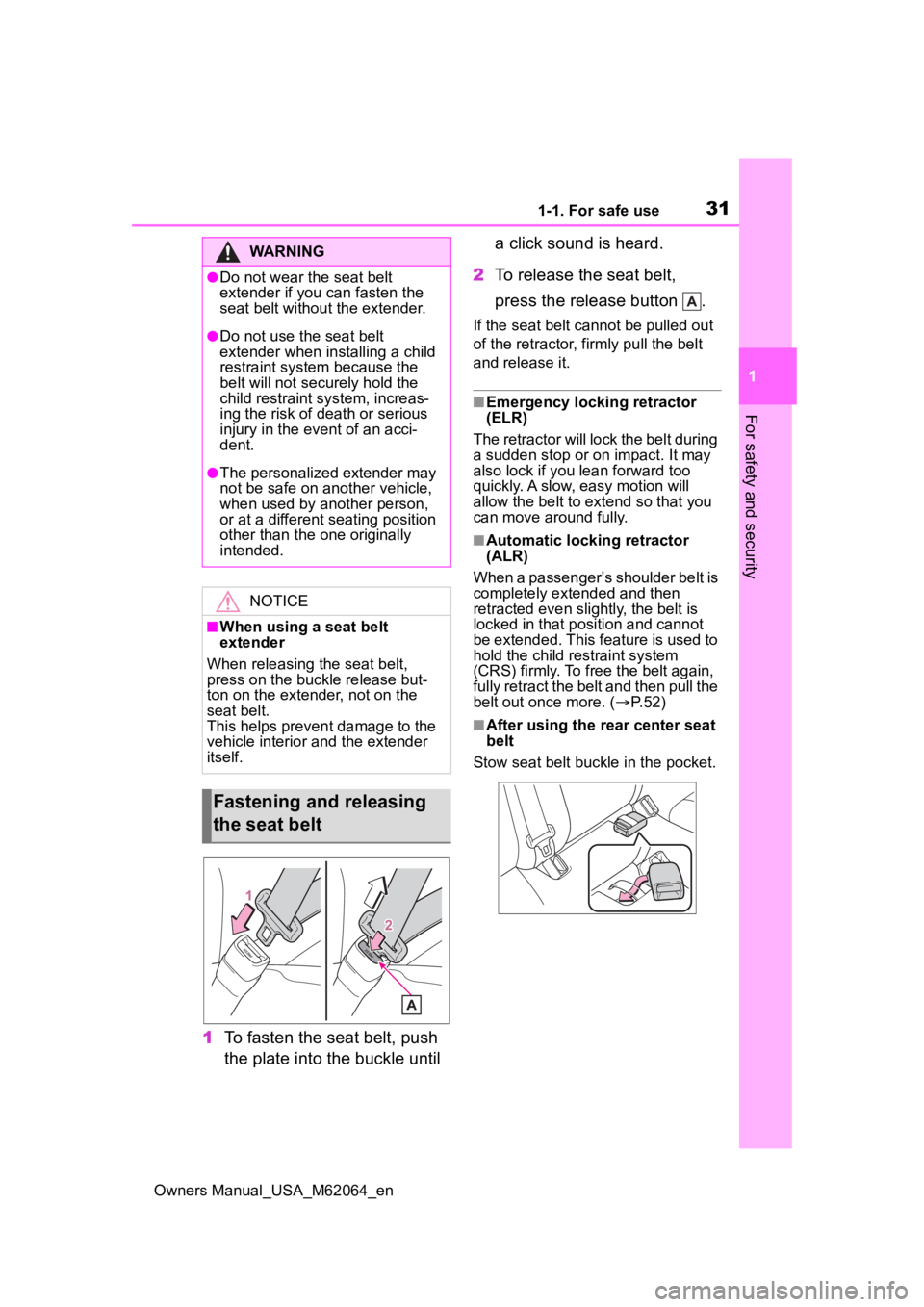
1 To fasten the seat belt, push
the plate into the buckle until a click sound is heard.
2 To release the seat belt,
press the release button .
If the seat belt cannot be pulled out
of the retractor, firmly pull the belt
and release it.
■Emergency locking retractor
(ELR)
The retractor will lock the belt during
a sudden stop or on impact. It may
also lock if you lean forward too
quickly. A slow, easy motion will
allow the belt to extend so that you
can move around fully.
■Automatic locking retractor
(ALR)
When a passenger’s shoulder belt is
completely extended and then
retracted even slightly, the belt is
locked in that position and cannot
be extended. This feature is used to
hold the child restraint system
(CRS) firmly. To free the belt again,
fully retract the belt and then pull the
belt out once more. ( P. 5 2 )
■After using the rear center seat
belt
Stow seat belt buckle in the pocket.
WARNING
●Do not wear the seat belt
extender if you can fasten the
seat belt without the extender.
●Do not use the seat belt
extender when installing a child
restraint system because the
belt will not securely hold the
child restraint system, increas-
ing the risk of death or serious
injury in the event of an acci-
dent.
●The personalized extender may
not be safe on another vehicle,
when used by another person,
or at a different seating position
other than the one originally
intended.
NOTICE
■When using a seat belt
extender
When releasing the seat belt,
press on the buckle release but-
ton on the extender, not on the
seat belt.
This helps prevent damage to the
vehicle interior and the extender
itself.
Fastening and releasing
the seat belt
Page 41 of 572
411-1. For safe use
Owners Manual_USA_M62064_en
1
For safety and security
WARNING
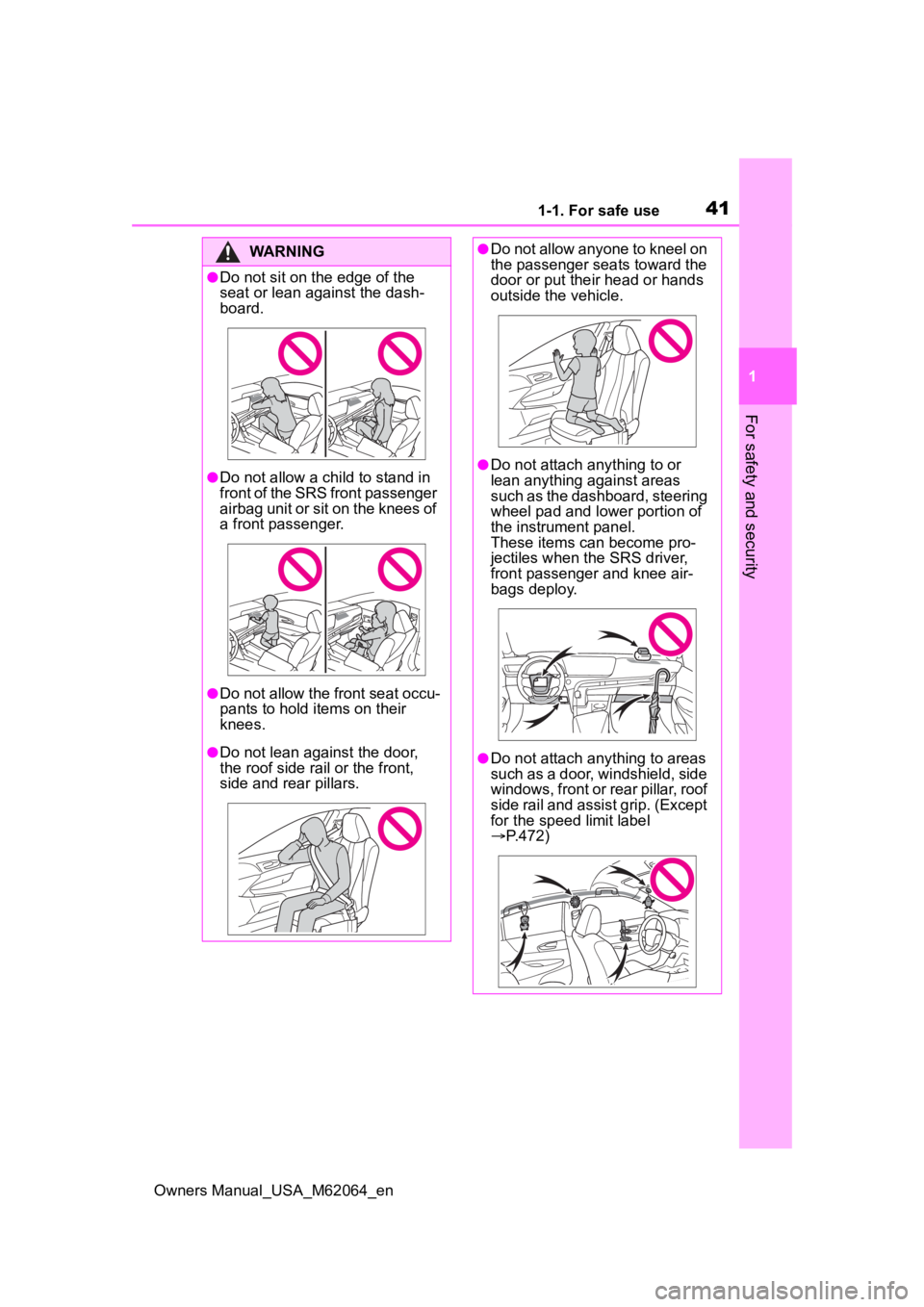
●Do not sit on the edge of the
seat or lean against the dash-
board.
●Do not allow a child to stand in
front of the SRS front passenger
airbag unit or sit on the knees of
a front passenger.
●Do not allow the front seat occu-
pants to hold items on their
knees.
●Do not lean against the door,
the roof side rail or the front,
side and rear pillars.
●Do not allow anyone to kneel on
the passenger seats toward the
door or put their head or hands
outside the vehicle.
●Do not attach anything to or
lean anything against areas
such as the dashboard, steering
wheel pad and lower portion of
the instrument panel.
These items can become pro-
jectiles when th e SRS driver,
front passenger and knee air-
bags deploy.
●Do not attach anything to areas
such as a door, windshield, side
windows, front or rear pillar, roof
side rail and assist grip. (Except
for the speed limit label
P.472)
Page 59 of 572
591-2. Child safety
Owners Manual_USA_M62064_en
1
For safety and security
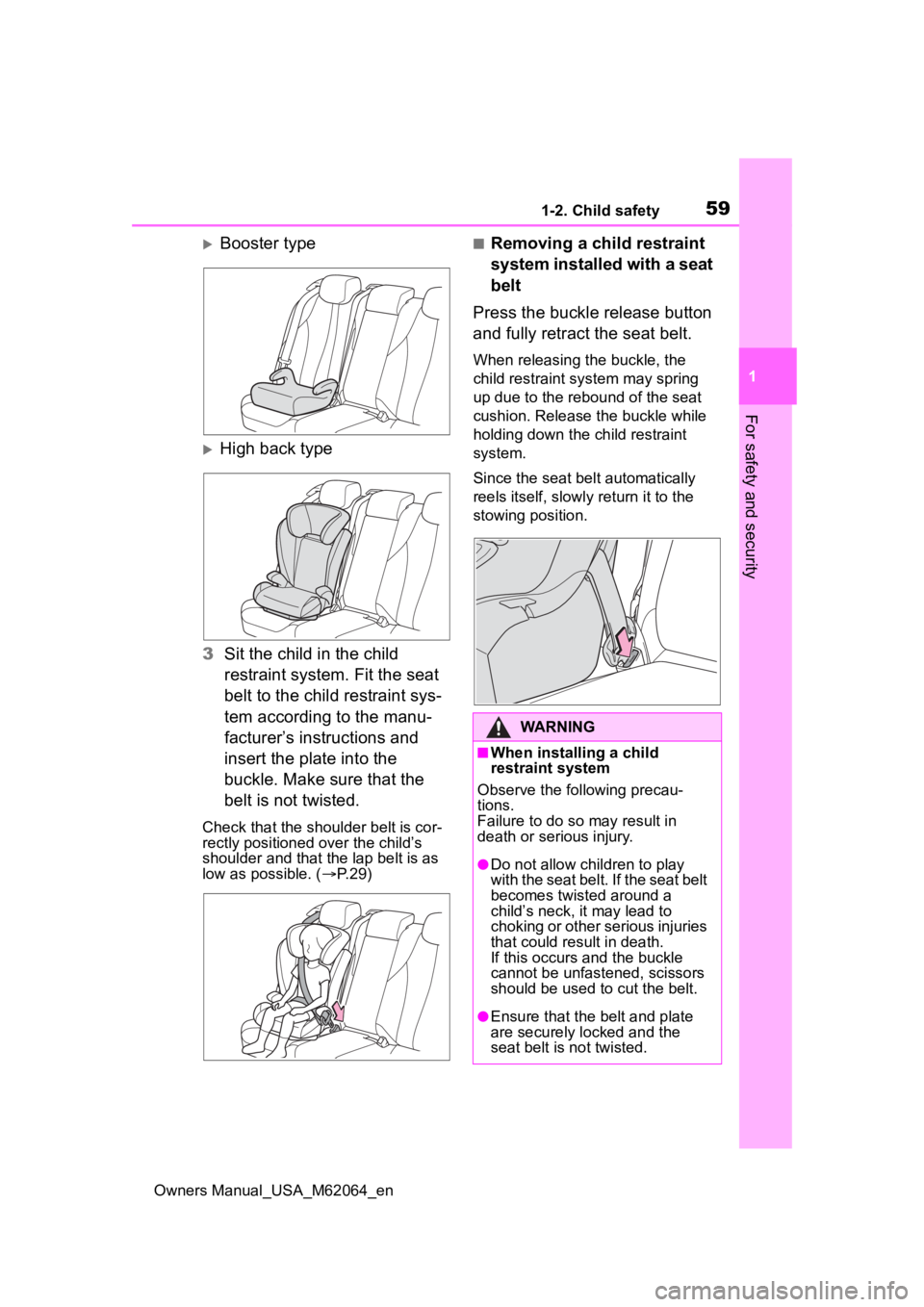
Booster type
High back type
3 Sit the child in the child
restraint system. Fit the seat
belt to the child restraint sys-
tem according to the manu-
facturer’s instructions and
insert the plate into the
buckle. Make sure that the
belt is not twisted.
Check that the shoulder belt is cor-
rectly positioned over the child’s
shoulder and that the lap belt is as
low as possible. ( P.29)
■Removing a child restraint
system installed with a seat
belt
Press the buckle release button
and fully retract the seat belt.
When releasing the buckle, the
child restraint system may spring
up due to the rebound of the seat
cushion. Release the buckle while
holding down the child restraint
system.
Since the seat belt automatically
reels itself, slowly return it to the
stowing position.
WARNING
■When installing a child
restraint system
Observe the following precau-
tions.
Failure to do so may result in
death or serious injury.
●Do not allow children to play
with the seat belt. If the seat belt
becomes twisted around a
child’s neck, it may lead to
choking or other serious injuries
that could result in death.
If this occurs and the buckle
cannot be unfastened, scissors
should be used to cut the belt.
●Ensure that the belt and plate
are securely locked and the
seat belt is not twisted.
Page 68 of 572
681-3. Emergency assistance
Owners Manual_USA_M62064_en
necessary assistance required.
If you accidentally press the “SOS”
button, tell the response-center
agent that you are not experiencing
an emergency.
■Enhanced Roadside Assis-
tance
Enhanced Roadside Assistance
adds GPS data to the already
included warranty-based Toyota
roadside service.
Subscribers can press the
“SOS” button to reach a Safety
Connect response-center agent,
who can help with a wide range
of needs, such as: towing, flat
tire, fuel delivery, etc. For a
description of the Roadside
Assistance services and their
limitations, please see the
Safety Connect Terms and Con-
ditions, which are available at
Toyota.com.
Important! Read this informa-
tion about exposure to radio fre-
quency signals before using
Safety Connect;
The Safety Connect system
installed in your vehicle is a low-
power radio transmitter and
receiver. It receives and also
sends out radio frequency (RF)
signals. In August 1996, the Federal
Communications Commission
(FCC) adopted RF exposure
guidelines with safety levels for
mobile wireless phones. Those
guidelines are consistent with
the safety standards previously
set by the following U.S. and
international standards bodies.
ANSI (American National
Standards Institute) C95.1
[1992]
NCRP (National Council on
Radiation Protection and
Measurement) Report 86
[1986]
ICNIRP (International Com-
mission on Non-Ionizing Radi-
ation Protection) [1996]
Those standards were based on
comprehensive and periodic
evaluations of the relevant sci-
entific literature. Over 120 scien-
tists, engineers, and physicians
from universities, and govern-
ment health agencies and
industries reviewed the avail-
able body of research to
develop the ANSI Standard
(C95.1).
The design of Safety Connect
complies with the FCC guide-
lines in addition to those stan-
dards.
Safety information for
Safety Connect
Page 88 of 572
882-1. Fuel cell electric vehicle
Owners Manual_USA_M62064_en
WARNING
■Road accident cautions
In the event of an accident,
observe the following precautions.
Failure to do so c an cause fire or
electric shocks, resulting in death
or serious injury.
●Stop the vehicle i n a safe place
to prevent subsequent acci-
dents. Shift the shift position to
P and apply the parking brake.
●Check for hydrogen gas leak-
age.
Hydrogen leaks will cause a
warning message to be shown
on the multi-information dis-
play. Larger leaks may also be
audible.
●If a large amount of hydrogen
gas leaking is noticed, turn off
the power switch, exit the vehi-
cle, and stay far away from it.
Display warning signs and keep
sources of fire away from the
vehicle. If possible, get assis-
tance. When the above is done,
immediately contact your Toyota
dealer.
●Do not touch the high-voltage
parts, cables (orange), or con-
nectors.
●If electric wires are exposed
inside or outside your vehicle,
an electric shock may occur.
Never touch exposed electric
wires.
●If a fluid leak occurs, do not
touch the fluid as it may be the
carbonate ester-based organic
electrolyte from t he traction bat-
tery. If it comes into contact with
your skin or eyes, wash it off
immediately with a large
amount of water, and seek
immediate medical attention.
●In case of a vehicle fire, the
hydrogen gas in the hydrogen
tanks is released angled down-
ward on both the right side of
the vehicle as well as the rear of
the vehicle, in order to reduce
damage to the hydrogen tanks.
Keep away from the vehicle and
do not stand on either the right
side or the rear of the vehicle.
●If a vehicle fire occurs, it can be
extinguished with a Class A, B,
or C fire extinguisher. If using
water, apply a large amount
from a hydrant.
●If your vehicle needs to be
towed, do so with the rear
wheels lifted. If the wheels are
touching the ground, the electric
motor (traction motor) may con-
tinue to generate electricity.
This may cause a fire.
■Traction battery
●Never resell, trans fer, or modify
the traction batte ry. To prevent
accidents, traction batteries that
have been removed from dis-
posed vehicle are collected
through Toyota dealers. Do not
dispose of the traction battery
yourself.
If the traction battery is not
properly collected, the following
may occur, resulting in death or
serious injury:
• The traction battery may be ille- gally disposed or dumped, and
it is hazardous to the environ-
ment. Additionally, someone
may touch a high-voltage part,
resulting in an electric shock.
Page 138 of 572
1384-2. Opening, closing and locking the doors and trunk
Owners Manual_USA_M62064_en
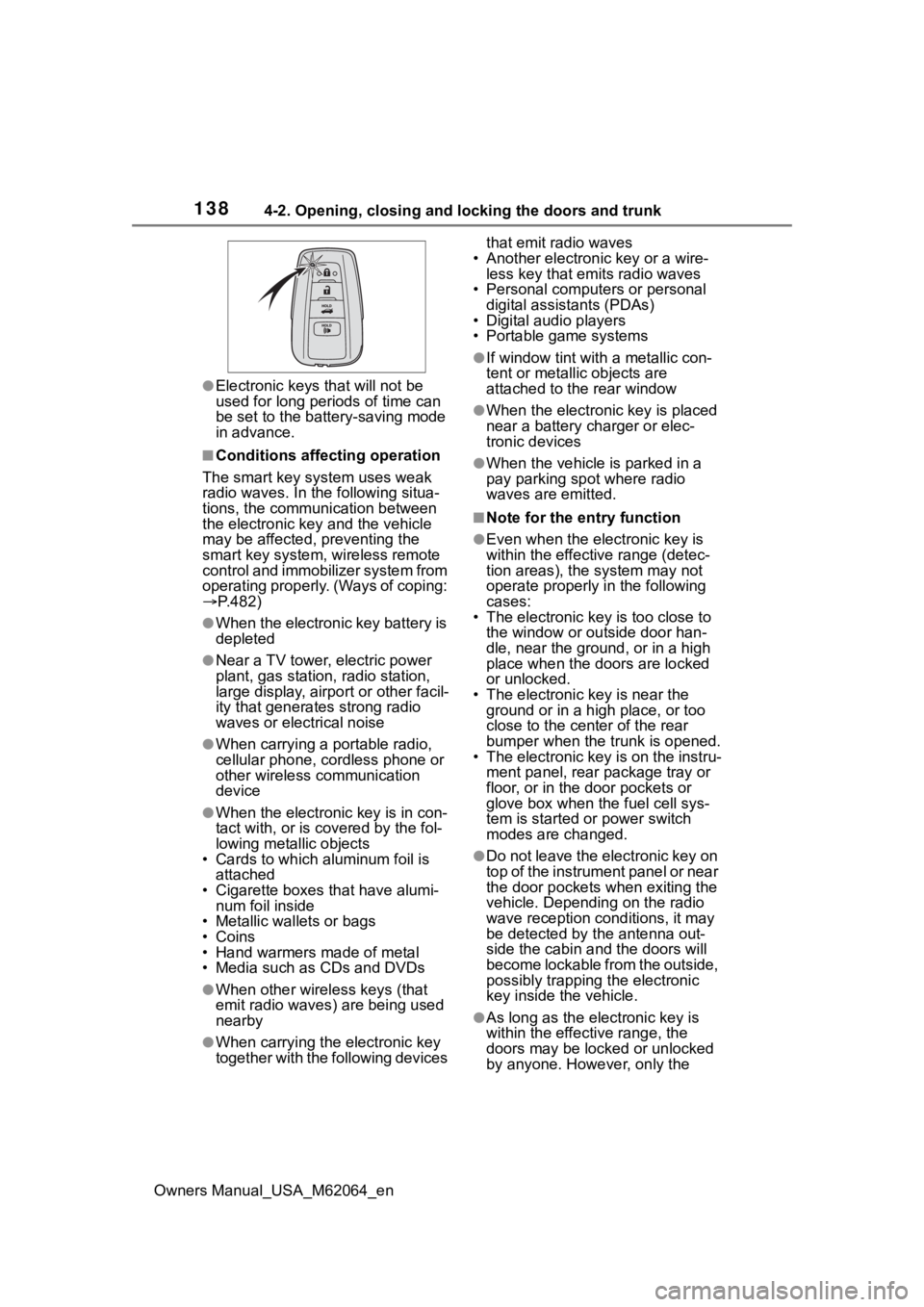
●Electronic keys that will not be
used for long periods of time can
be set to the battery-saving mode
in advance.
■Conditions affecting operation
The smart key system uses weak
radio waves. In the following situa-
tions, the communication between
the electronic key and the vehicle
may be affected, preventing the
smart key system, wireless remote
control and immobilizer system from
operating properly. (Ways of coping:
P.482)
●When the electronic key battery is
depleted
●Near a TV tower, electric power
plant, gas station , radio station,
large display, airpo rt or other facil-
ity that generates strong radio
waves or electrical noise
●When carrying a portable radio,
cellular phone, cordless phone or
other wireless communication
device
●When the electronic key is in con-
tact with, or is covered by the fol-
lowing metallic objects
• Cards to which al uminum foil is
attached
• Cigarette boxes that have alumi- num foil inside
• Metallic wallets or bags
• Coins
• Hand warmers made of metal
• Media such as CDs and DVDs
●When other wireless keys (that
emit radio waves) are being used
nearby
●When carrying the electronic key
together with the following devices that emit radio waves
• Another electronic key or a wire- less key that emits radio waves
• Personal computers or personal digital assistants (PDAs)
• Digital audio players
• Portable game systems
●If window tint wit h a metallic con-
tent or metallic objects are
attached to the rear window
●When the electronic key is placed
near a battery charger or elec-
tronic devices
●When the vehicle is parked in a
pay parking spot where radio
waves are emitted.
■Note for the entry function
●Even when the electronic key is
within the effective range (detec-
tion areas), the system may not
operate properly in the following
cases:
• The electronic key is too close to the window or outside door han-
dle, near the ground, or in a high
place when the doors are locked
or unlocked.
• The electronic key is near the ground or in a high place, or too
close to the center of the rear
bumper when the trunk is opened.
• The electronic key is on the instru- ment panel, rear package tray or
floor, or in the door pockets or
glove box when the fuel cell sys-
tem is started or power switch
modes are changed.
●Do not leave the electronic key on
top of the instrument panel or near
the door pockets when exiting the
vehicle. Depending on the radio
wave reception conditions, it may
be detected by the antenna out-
side the cabin and the doors will
become lockable from the outside,
possibly trapping the electronic
key inside the vehicle.
●As long as the electronic key is
within the effective range, the
doors may be locked or unlocked
by anyone. However, only the
Page 146 of 572
1464-3. Adjusting the seats
Owners Manual_USA_M62064_en
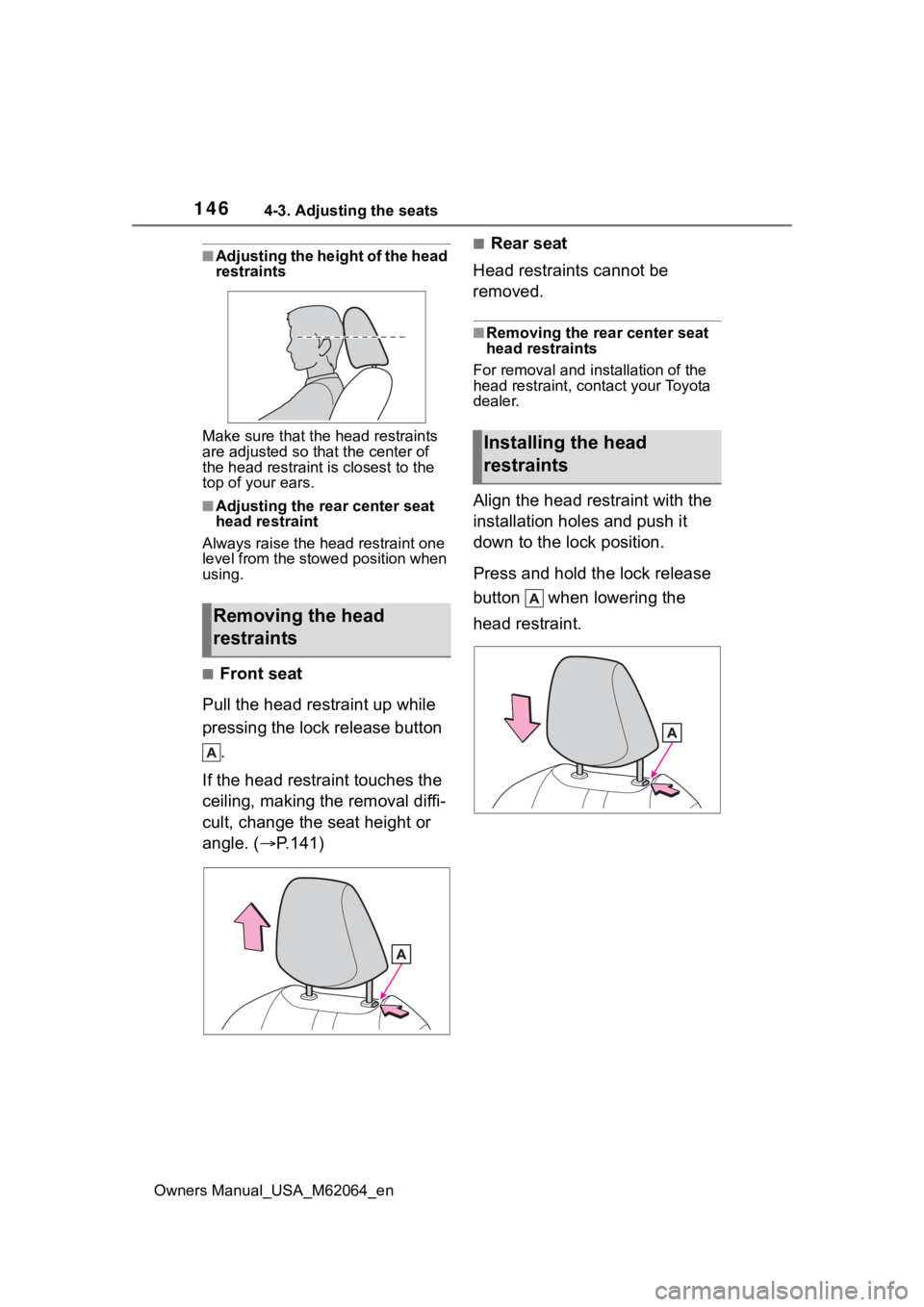
■Adjusting the height of the head
restraints
Make sure that the head restraints
are adjusted so that the center of
the head restraint is closest to the
top of your ears.
■Adjusting the rear center seat
head restraint
Always raise the head restraint one
level from the stowed position when
using.
■Front seat
Pull the head restraint up while
pressing the lock release button .
If the head restraint touches the
ceiling, making the removal diffi-
cult, change the seat height or
angle. ( P.141)
■Rear seat
Head restraints cannot be
removed.
■Removing the rear center seat
head restraints
For removal and installation of the
head restraint, contact your Toyota
dealer.
Align the head restraint with the
installation holes and push it
down to the lock position.
Press and hold the lock release
button when lowering the
head restraint.
Removing the head
restraints
Installing the head
restraints