phone TOYOTA PRIUS PLUG-IN 2012 Owners Manual
[x] Cancel search | Manufacturer: TOYOTA, Model Year: 2012, Model line: PRIUS PLUG-IN, Model: TOYOTA PRIUS PLUG-IN 2012Pages: 704, PDF Size: 19.59 MB
Page 18 of 704

19
PLUG-IN QG_U (OM47747U)
2. Plug-in Hybrid Applications
Plug-in Hybrid Applications is a service for plug-in hybrid vehicles.
These are added to the Safety Connect and Entune products.
The contents provide charge support, comfort support and drive sup-
port via the vehicle’s navigation system and the owner’s Smartphone.
Both of the following accounts are required for the services.
●Active Safety Connect account
●Active Toyota Entune account
Plug-in Hybrid Applications operation
The following functions can be used with the navigation system.
●Download of nearby charging stations to the map screen (Type A)
●View list of nearby charging stations and corresponding charging
station information (such as voltage supported) (Type B)
The function of Type B is a function added to Entune.
For details about the function, refer to http://www.toyota.com/entune/.
Page 40 of 704
11
PRIUS PHV_OM_OM47818U_(U)
A
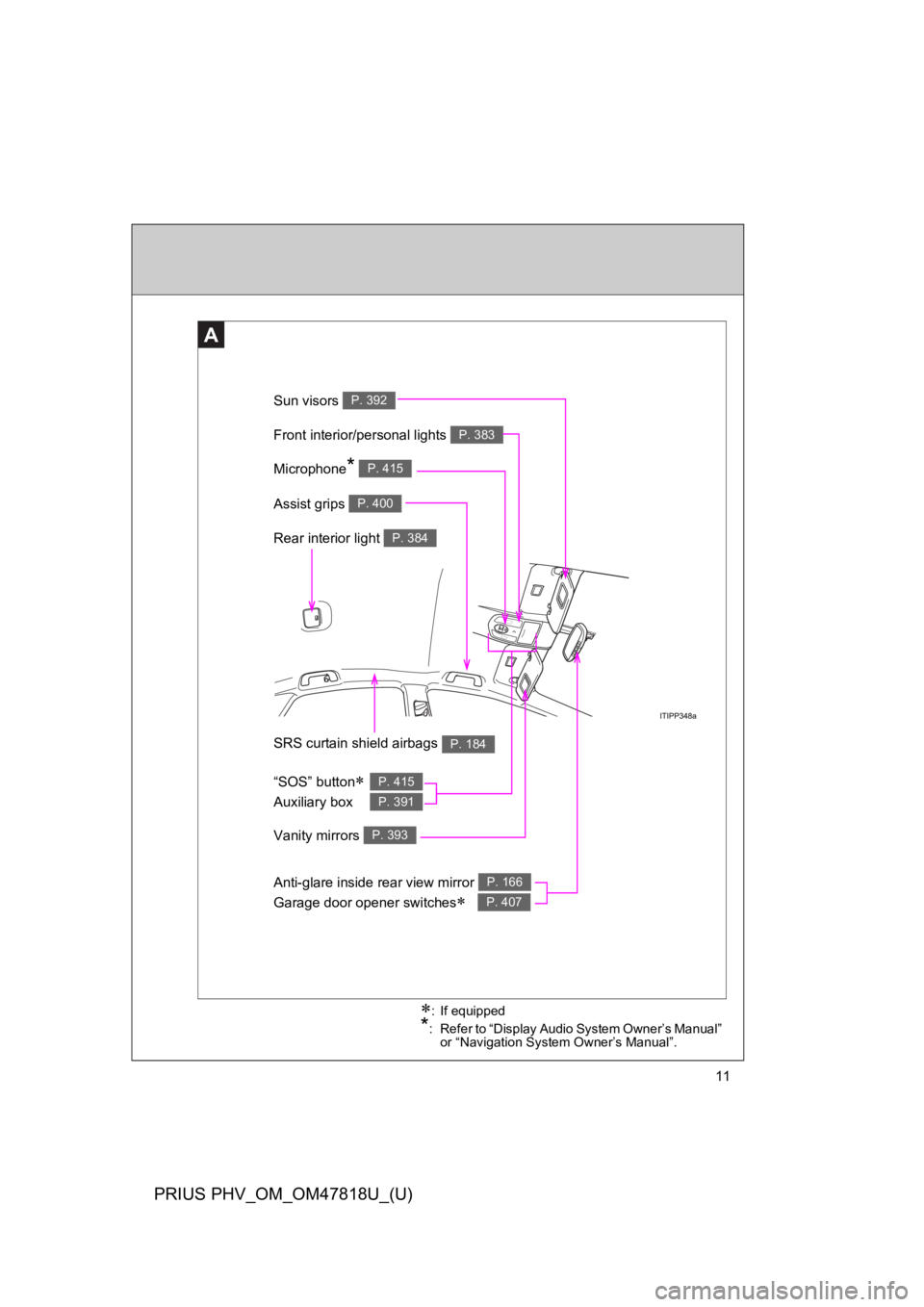
Anti-glare inside rear view mirror
Garage door opener switches∗
P. 166
P. 407
Sun visors P. 392
SRS curtain shield airbags P. 184
Rear interior light P. 384
Vanity mirrors P. 393
Front interior/personal lights P. 383
∗:If equipped
*:Refer to “Display Audio System Owner’s Manual” or “Navigation System Owner’s Manual”.
Microphone* P. 415
“SOS” button∗
Auxiliary box
P. 415
P. 391
Assist grips P. 400
Page 46 of 704

17
PRIUS PHV_OM_OM47818U_(U)
B
Telephone switches*1, 2
“DISP” button P. 267Audio remote
control switches*1, 2
Cruise control switch∗
Dynamic radar cruise control
switch∗
P. 308
P. 312
Vehicle-to-vehicle distance button∗ P. 312
Talk switch*1, 2
“TRIP” button P. 267, 273
Climate remote control switches P. 369
∗:If equipped
*1:Refer to “Navigation System Owner’s Manual”.
*2:Refer to “Display Audio System Owner’s Manual”.
Page 56 of 704

27
PRIUS PHV_OM_OM47818U_(U)
CAUTION
■General precautions while driving
Driving under the influence: Never drive your vehicle when under the influ-
ence of alcohol or drugs that have impaired your ability to operate your vehi-
cle. Alcohol and certain drugs delay reaction time, impair judgment and
reduce coordination, which could lead to an accident that could result in
death or serious injury.
Defensive driving: Always drive defensively. Anticipate mistakes that other
drivers or pedestrians might make and be ready to avoid accidents.
Driver distraction: Always give your full attention to driving. Anything that dis-
tracts the driver, such as adjusting controls, talking on a cellular phone or
reading can result in a collision with resulting death or serious injury to you,
your occupants or others.
■General precaution regarding children’s safety
Never leave children unattended in the vehicle, and never allow children to
have or use the key.
Children may be able to start the vehicle or shift the vehicle into neutral.
There is also a danger that children may injure themselves by playing with
the windows or other features of the vehicle. In addition, heat build-up or
extremely cold temperatures inside the vehicle can be fatal to children.
Page 97 of 704
70
1-1. Plug-in hybrid system
PRIUS PHV_OM_OM47818U_(U)
Plug-in Hybrid Applications
Plug-in Hybrid Applications operation
The following functions can be used with the navigation system.
●Download of nearby charging stations to the map screen (Type A)
●View list of nearby charging stations and corresponding charging
station information (such as voltage supported) (Type B)
The function of Type B is a function added to Entune.
For details about the function, refer to http://www.toyota.com/entune/.
Plug-in Hybrid Applications is a service for plug-in hybrid vehicles.
These are added to the Safety Connect and Entune products.
The contents provide charge support, comfort support and drive
support via the vehicle’s navigation system and the owner’s Smart-
phone.
Both of the following accounts are required for the services.
●Active Safety Connect account
●Active Toyota Entune account
For Safety Connect and Entune, refer to the following page.
Page 146 of 704

119
1-4. Opening, closing and locking the doors
1
Before driving
PRIUS PHV_OM_OM47818U_(U)
■Conditions affecting operation
The smart key system, wireless remote control and immobilizer system use
weak radio waves. In the following situations, the communication between
the electronic key and the vehicle may be affected, preventing the smart key
system, wireless remote control and immobilizer system from operating
properly. (Ways of coping: →P. 5 9 1 )
●When the electronic key battery is depleted
●Near a TV tower, electric power plant, gas station, radio station, large dis-
play, airport or other facility that generates strong radio waves or electri-
cal noise
●When carrying a portable radio, cellular phone, cordless phone or other
wireless communication devices
●When the electronic key is in contact with, or is covered by the following
metallic objects
•Cards to which aluminum foil is attached
•Cigarette boxes that have aluminum foil inside
•Metallic wallets or bags
•Coins
•Hand warmers made of metal
•Media such as CDs and DVDs
●When other wireless key (that emit radio waves) is being used nearby
●When carrying the electronic key together with the following devices that
emit radio waves
•Another vehicle’s electronic key or a wireless key that emits radio
waves
•Personal computers or personal digital assistants (PDAs)
•Digital audio players
•Portable game systems
●If window tint with a metallic content or metallic objects are attached to
the rear window
Page 150 of 704
123
1-4. Opening, closing and locking the doors
1
Before driving
PRIUS PHV_OM_OM47818U_(U)
■If the smart key system does not operate properly
●Locking and unlocking the doors: Use the mechanical key. (→P. 5 9 1 )
●Starting the hybri d system: →P. 5 9 2
■Electronic key battery depletion
●The standard battery life is 1 to 2 years.
●If the battery becomes low, an alarm will sound in the cabin when the
hybrid system stops. (→P. 1 1 4 )
●As the electronic key always receives radio waves, the battery will
become depleted even if the electronic key is not used. The following
symptoms indicate that the electronic key battery may be depleted.
Replace the battery when necessary. (→P. 4 9 3 )
•The smart key system or the wireless remote control does not operate.
•The detection area becomes smaller.
•The LED indicator on the key surface does not turn on.
●To a v o i d s e r i o u s d e t e r i o r a t i o n , d o n o t l e a v e t h e e l e c t r o n i c k e y w i t h i n 3 f t .
(1 m) of the following electrical appliances that produce a magnetic field:
•TVs
•Personal computers
•Cellular phones, cordless phones and battery chargers
•Charging cellular phones or cordless phones
•Induction cookers
•Table lamps
■When the electronic key battery is fully depleted
→P. 4 9 3
■Customization
Settings (e.g. smart key system) can be changed.
(Customizable features →P. 6 3 9 )
Page 440 of 704
415
3-5. Other interior features
PRIUS PHV_OM_OM47818U_(U)
3
Interior features
Safety Connect∗
∗: If equipped
Safety Connect is a subscription-based telematics service that uses
Global Positioning System (GPS) data and embedded cellular tech-
nology to provide safety and security features to subscribers. Safety
Connect is supported by Toyota’s designated response center,
which operates 24 hours per day, 7 days per week.
Safety Connect service is available by subscription on select,
telematics hardware-equipped vehicles.
By using the Safety Connect service, you are agreeing to be bound
by the Telematics Subscription Service Agreement and its Terms and
Conditions, as in effect and amended from time to time, a current
copy of which is available at Toyota.com. All use of the Safety Con-
nect service is subject to such then-applicable Terms and Condi-
tions.
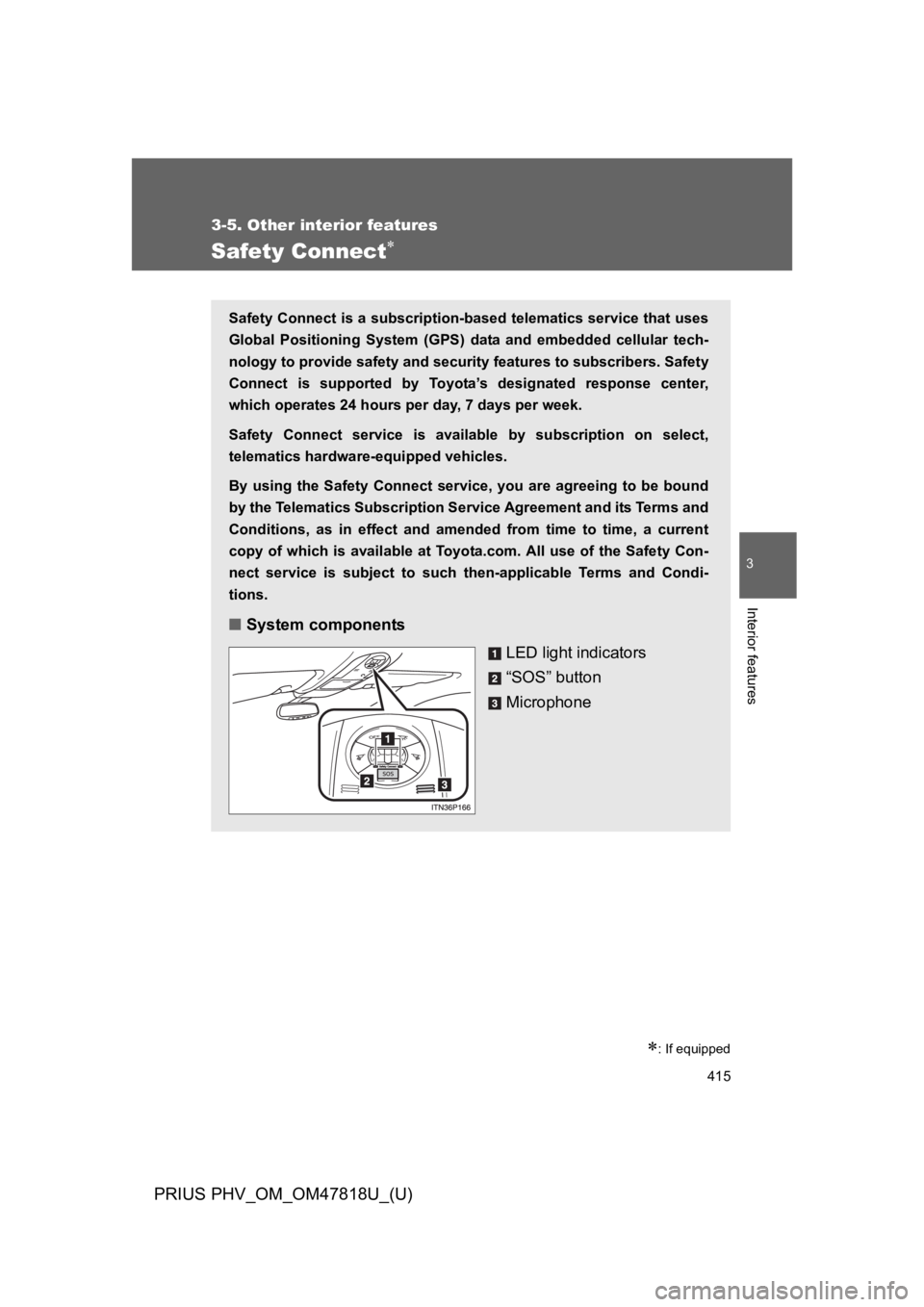
■System components
LED light indicators
“SOS” button
Microphone
Page 442 of 704
417
3-5. Other interior features
PRIUS PHV_OM_OM47818U_(U)
3
Interior features
■Safety Connect Services Information
●Phone calls using the vehicles Bluetooth® technology will not be possible
during Safety Connect.
●Safety Connect is available beginning Fall 2009 on select Toyota models.
Contact with the Safety Connect response center is dependent upon the
telematics device being in operative condition, cellular connection avail-
ability, and GPS satellite signal reception, which can limit the ability to
reach the response center or receive emergency service support. Enroll-
ment and Telematics Subscription Service Agreement required. A variety
of subscription terms is available; charges vary by subscription term
selected.
●Automatic Collision Notification, Emergency Assistance, Stolen Vehicle
Location, and Enhanced Roadside Assistance will function in the United
States, including Hawaii and Alask a, and in Canada. No Safety Connect
services will function outside of the United States in countries other than
Canada.
●Safety Connect services are not subject to section 255 of the Telecom-
munications Act and the device is not TTY compatible.
■Languages
The Safety Connect response center will offer support in multiple languages.
The Safety Connect system will offer voice prompts in English and Spanish.
Please indicate your language of choice when enrolling.
■When contacting the response center
Yo u m a y b e u n a b l e t o c o n t a c t t h e r e s p o n s e c e n t e r i f t h e n e t w o r k i s b u s y.
■Safety Connect backup battery depletion
An exclusive backup battery is built in to assist the Automatic Collision Noti-
fication, which is activated when impact above a certain level is applied to
the vehicle, or when the airbags operate. This battery is a primary battery,
and cannot be charged. The red LED indicator will flash to indicate that the
battery should be replaced.
The backup battery will need to be replaced if the Automatic Collision Notifi-
cation operates for 60 seconds or more. For replacement, consult your Toy-
ota dealer.
Page 445 of 704

420
3-5. Other interior features
PRIUS PHV_OM_OM47818U_(U)
Safety information for Safety Connect
Important! Read this information before using Safety Connect.
■Exposure to radio frequency signals
The Safety Connect system installed in your vehicle is a low-power
radio transmitter and receiver. It receives and also sends out radio
frequency (RF) signals.
In August 1996, the Federal Communications Commission (FCC)
adopted RF exposure guidelines with safety levels for mobile wire-
less phones. Those guidelines are consistent with the safety stan-
dards previously set by the following U.S. and international
standards bodies.
●ANSI (American National Standards Institute) C95.1 [1992]
●NCRP (National Council on Radiation Protection and Measure-
ment) Report 86 [1986]
●ICNIRP (International Commission on Non-Ionizing Radiation
Protection) [1996]
Those standards were based on comprehensive and periodic eval-
uations of the relevant scientific literature. Over 120 scientists,
engineers, and physicians from universities, and government
health agencies and industries reviewed the available body of
research to develop the ANSI Standard (C95.1).
The design of Safety Connect complies with the FCC guidelines in
addition to those standards.