warning TOYOTA PRIUS PRIME 2023 Owner's Guide
[x] Cancel search | Manufacturer: TOYOTA, Model Year: 2023, Model line: PRIUS PRIME, Model: TOYOTA PRIUS PRIME 2023Pages: 680, PDF Size: 14.97 MB
Page 52 of 680
521-2. Child safety
WARNING
●Toyota strongly urges the use of
a proper child restraint system
that conforms to the weight and
size of the child, installed on the
rear seat. According to accident
statistics, the child is safer when
properly restrained in the rear
seat than in the front seat.
●Holding a child in your or some-
one else’s arms is not a substi-
tute for a child restraint system.
In an accident, the child can be
crushed against the windshield
or between the holder and the
interior of the vehicle.
■Handling the child restraint
system
If the child restrain t system is not
properly fixed in place, the child or
other passengers may be seri-
ously injured or even killed in the
event of sudden braking, sudden
swerving, or an accident.
●If the vehicle were to receive a
strong impact from an accident,
etc., it is possible that the child
restraint system has damage
that is not readily visible. In
such cases, do not reuse the
restraint system.
●Make sure you have complied
with all installation instructions
provided with the child restraint
system manufacturer and that
the system is properly secured.
●Keep the child restraint system
properly secured on the seat
even if it is not in use. Do not
store the child restraint system
unsecured in the passenger
compartment.
●If it is necessary to detach the
child restraint system, remove it
from the vehicle or store it
securely in the luggage com-
partment.
Page 54 of 680
541-2. Child safety
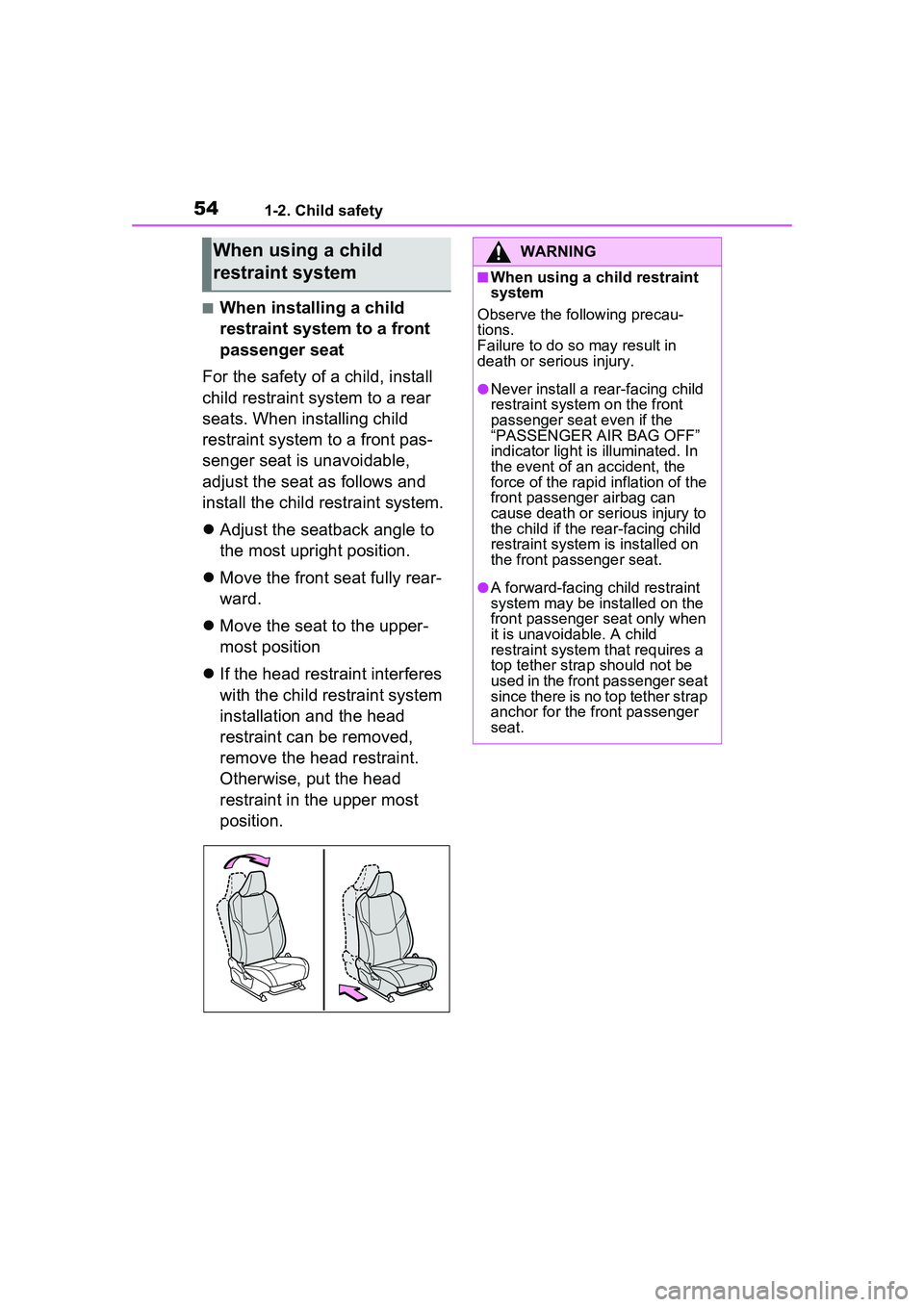
■When installing a child
restraint system to a front
passenger seat
For the safety of a child, install
child restraint system to a rear
seats. When installing child
restraint system to a front pas-
senger seat is unavoidable,
adjust the seat as follows and
install the child restraint system.
Adjust the seatback angle to
the most upright position.
Move the front seat fully rear-
ward.
Move the seat to the upper-
most position
If the head restraint interferes
with the child restraint system
installation and the head
restraint can be removed,
remove the head restraint.
Otherwise, put the head
restraint in the upper most
position.
When using a child
restraint systemWARNING
■When using a child restraint
system
Observe the following precau-
tions.
Failure to do so may result in
death or serious injury.
●Never install a re ar-facing child
restraint system on the front
passenger seat even if the
“PASSENGER AIR BAG OFF”
indicator light is illuminated. In
the event of an accident, the
force of the rapid inflation of the
front passenger airbag can
cause death or serious injury to
the child if the rear-facing child
restraint system is installed on
the front passenger seat.
●A forward-facing child restraint
system may be installed on the
front passenger seat only when
it is unavoidable. A child
restraint system that requires a
top tether strap should not be
used in the front passenger seat
since there is no top tether strap
anchor for the front passenger
seat.
Page 55 of 680
551-2. Child safety
1
For safety and security
A child restraint system for a
small child or baby must itself be
properly restrained on the seat
with the lap portion of the
lap/shoulder belt.
■Installing child restraint
system using a seat belt
(child restraint lock func-
tion belt)
Install the child restraint system
in accordance to the operation
WARNING
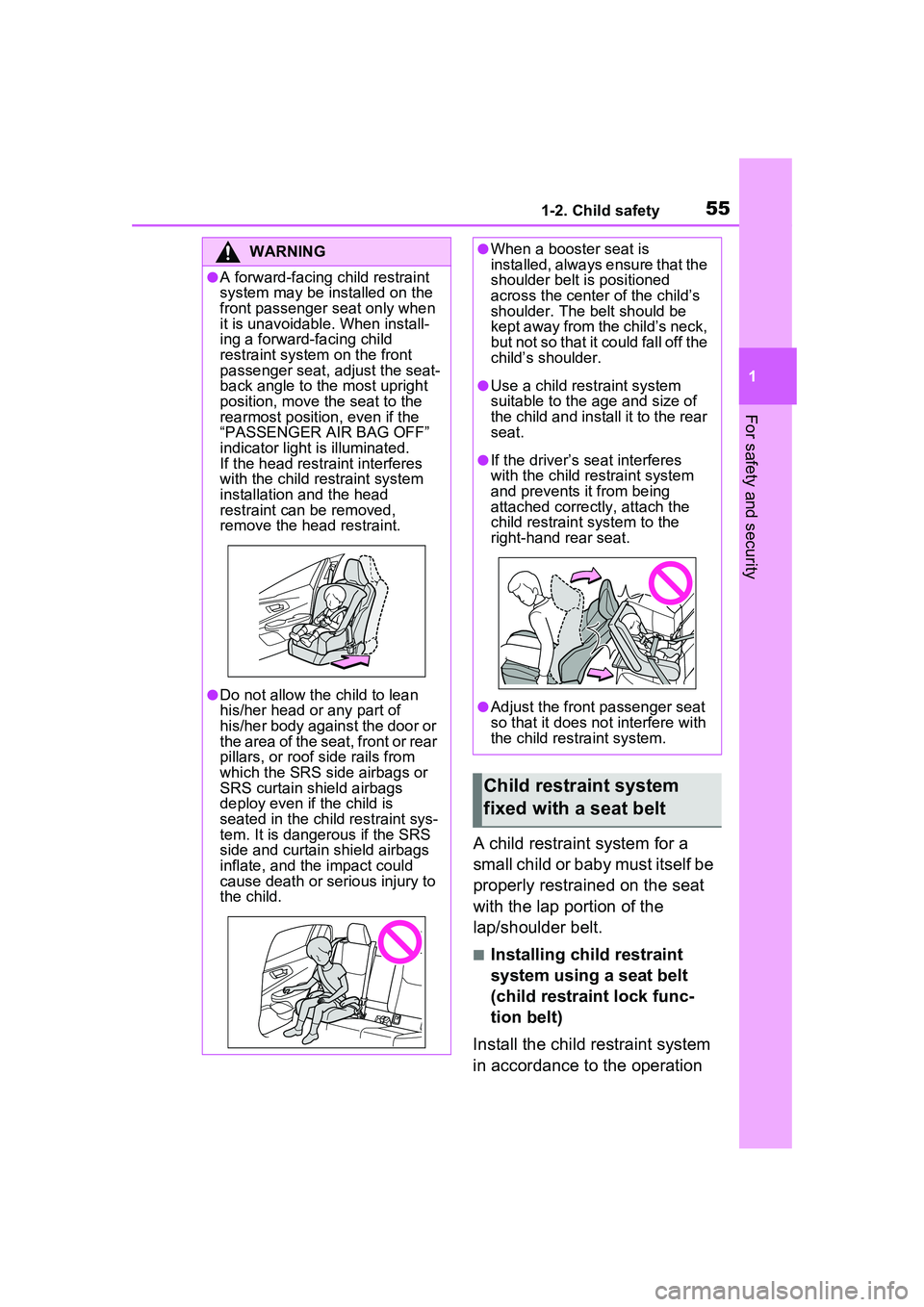
●A forward-facing child restraint
system may be installed on the
front passenger seat only when
it is unavoidable. When install-
ing a forward-facing child
restraint system on the front
passenger seat, adjust the seat-
back angle to the most upright
position, move the seat to the
rearmost position, even if the
“PASSENGER AIR BAG OFF”
indicator light is illuminated.
If the head restraint interferes
with the child restraint system
installation and the head
restraint can be removed,
remove the head restraint.
●Do not allow the child to lean
his/her head or any part of
his/her body against the door or
the area of the seat, front or rear
pillars, or roof side rails from
which the SRS side airbags or
SRS curtain shield airbags
deploy even if the child is
seated in the child restraint sys-
tem. It is dangerous if the SRS
side and curtain shield airbags
inflate, and the impact could
cause death or serious injury to
the child.
●When a booster seat is
installed, always ensure that the
shoulder belt is positioned
across the center of the child’s
shoulder. The belt should be
kept away from the child’s neck,
but not so that it could fall off the
child’s shoulder.
●Use a child restraint system
suitable to the age and size of
the child and install it to the rear
seat.
●If the driver’s seat interferes
with the child restraint system
and prevents it from being
attached correctly, attach the
child restraint system to the
right-hand rear seat.
●Adjust the front passenger seat
so that it does not interfere with
the child restraint system.
Child restraint system
fixed with a seat belt
Page 59 of 680
591-2. Child safety
1
For safety and security
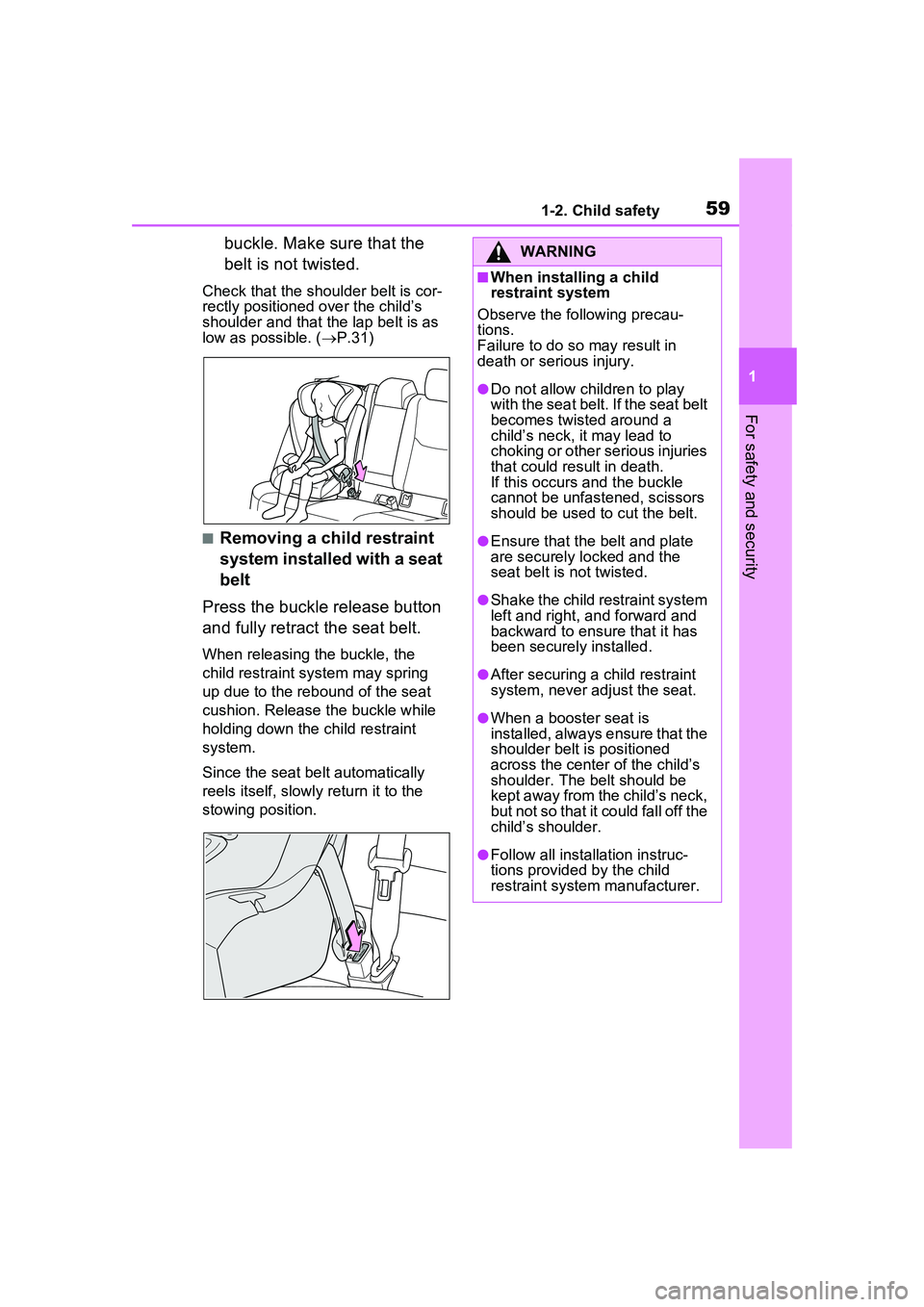
buckle. Make sure that the
belt is not twisted.
Check that the shoulder belt is cor-
rectly positioned over the child’s
shoulder and that the lap belt is as
low as possible. (P.31)
■Removing a child restraint
system installed with a seat
belt
Press the buckle release button
and fully retract the seat belt.
When releasing the buckle, the
child restraint system may spring
up due to the rebound of the seat
cushion. Release the buckle while
holding down the child restraint
system.
Since the seat belt automatically
reels itself, slowly return it to the
stowing position.
WARNING
■When installing a child
restraint system
Observe the following precau-
tions.
Failure to do so may result in
death or serious injury.
●Do not allow children to play
with the seat belt. If the seat belt
becomes twisted around a
child’s neck, it may lead to
choking or other serious injuries
that could result in death.
If this occurs and the buckle
cannot be unfastened, scissors
should be used to cut the belt.
●Ensure that the belt and plate
are securely locked and the
seat belt is not twisted.
●Shake the child restraint system
left and right, and forward and
backward to ensure that it has
been securely installed.
●After securing a child restraint
system, never adjust the seat.
●When a booster seat is
installed, always ensure that the
shoulder belt is positioned
across the center of the child’s
shoulder. The belt should be
kept away from the child’s neck,
but not so that it could fall off the
child’s shoulder.
●Follow all installation instruc-
tions provided by the child
restraint system manufacturer.
Page 60 of 680
601-2. Child safety
■Child restraint LATCH
anchors
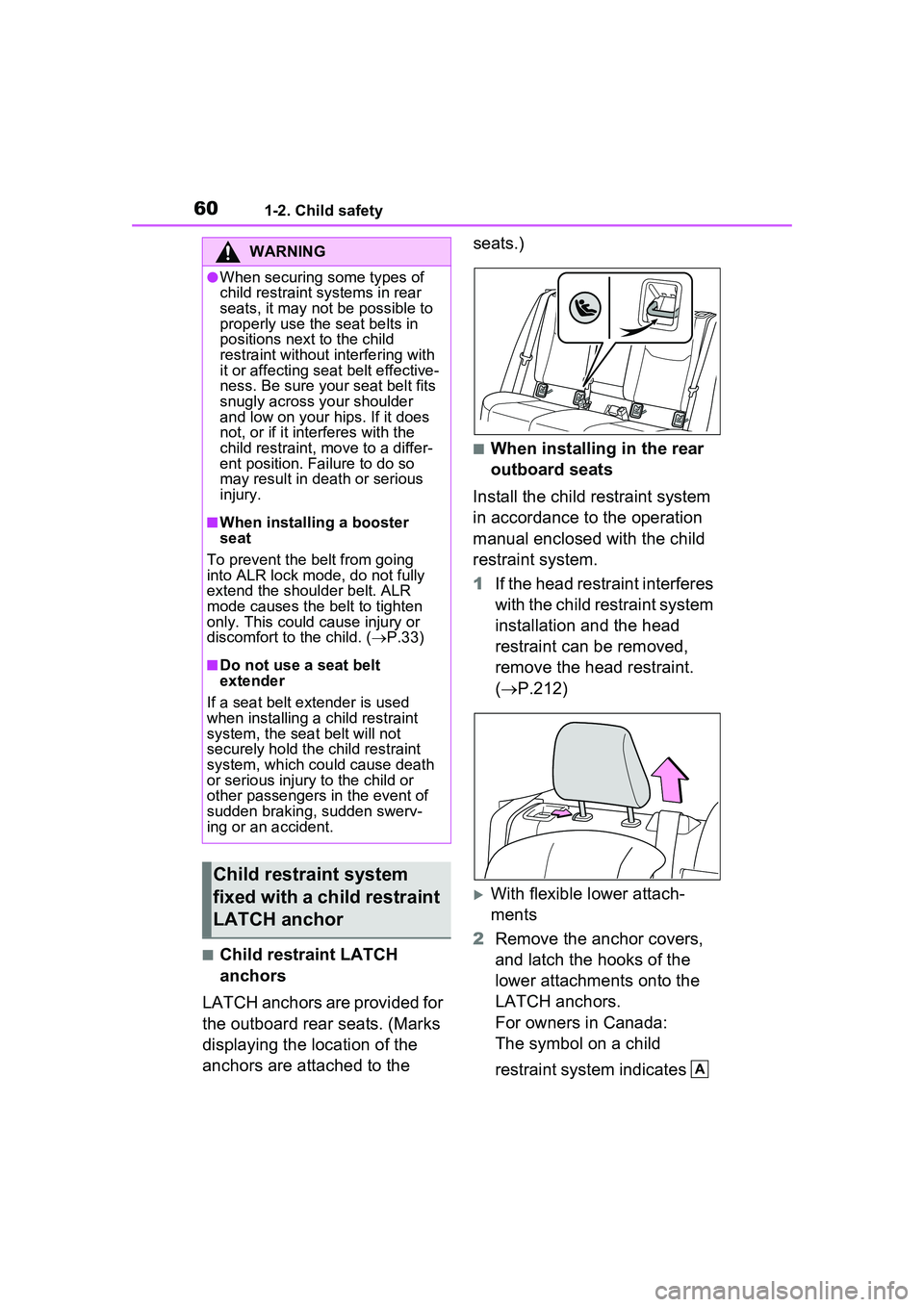
LATCH anchors are provided for
the outboard rear seats. (Marks
displaying the location of the
anchors are attached to the seats.)
■When installing in the rear
outboard seats
Install the child restraint system
in accordance to the operation
manual enclosed with the child
restraint system.
1 If the head restraint interferes
with the child restraint system
installation and the head
restraint can be removed,
remove the head restraint.
( P.212)
With flexible lower attach-
ments
2 Remove the anchor covers,
and latch the hooks of the
lower attachments onto the
LATCH anchors.
For owners in Canada:
The symbol on a child
restraint system indicates
WARNING
●When securing some types of
child restraint systems in rear
seats, it may not be possible to
properly use the seat belts in
positions next to the child
restraint without interfering with
it or affecting se at belt effective-
ness. Be sure your seat belt fits
snugly across your shoulder
and low on your hips. If it does
not, or if it interferes with the
child restraint, mo ve to a differ-
ent position. Failure to do so
may result in death or serious
injury.
■When installing a booster
seat
To prevent the belt from going
into ALR lock mode, do not fully
extend the shoulder belt. ALR
mode causes the belt to tighten
only. This could cause injury or
discomfort to the child. ( P.33)
■Do not use a seat belt
extender
If a seat belt extender is used
when installing a child restraint
system, the seat belt will not
securely hold th e child restraint
system, which could cause death
or serious injury to the child or
other passengers in the event of
sudden braking, sudden swerv-
ing or an accident.
Child restraint system
fixed with a child restraint
LATCH anchor
A
Page 62 of 680
621-2. Child safety
Child restraint systems with rigid
lower attachments cannot be
installed in the center seat. This
type of child restraint system
can only be installed in the out-
board seat.
■Laws and regulations pertain-
ing to anchors
The LATCH system conforms to
FMVSS225 or CMVSS210.2.
Child restraint systems conforming
to FMVSS213 or CMVSS213 speci-
fications can be used.
This vehicle is designed to conform
to SAE J1819.
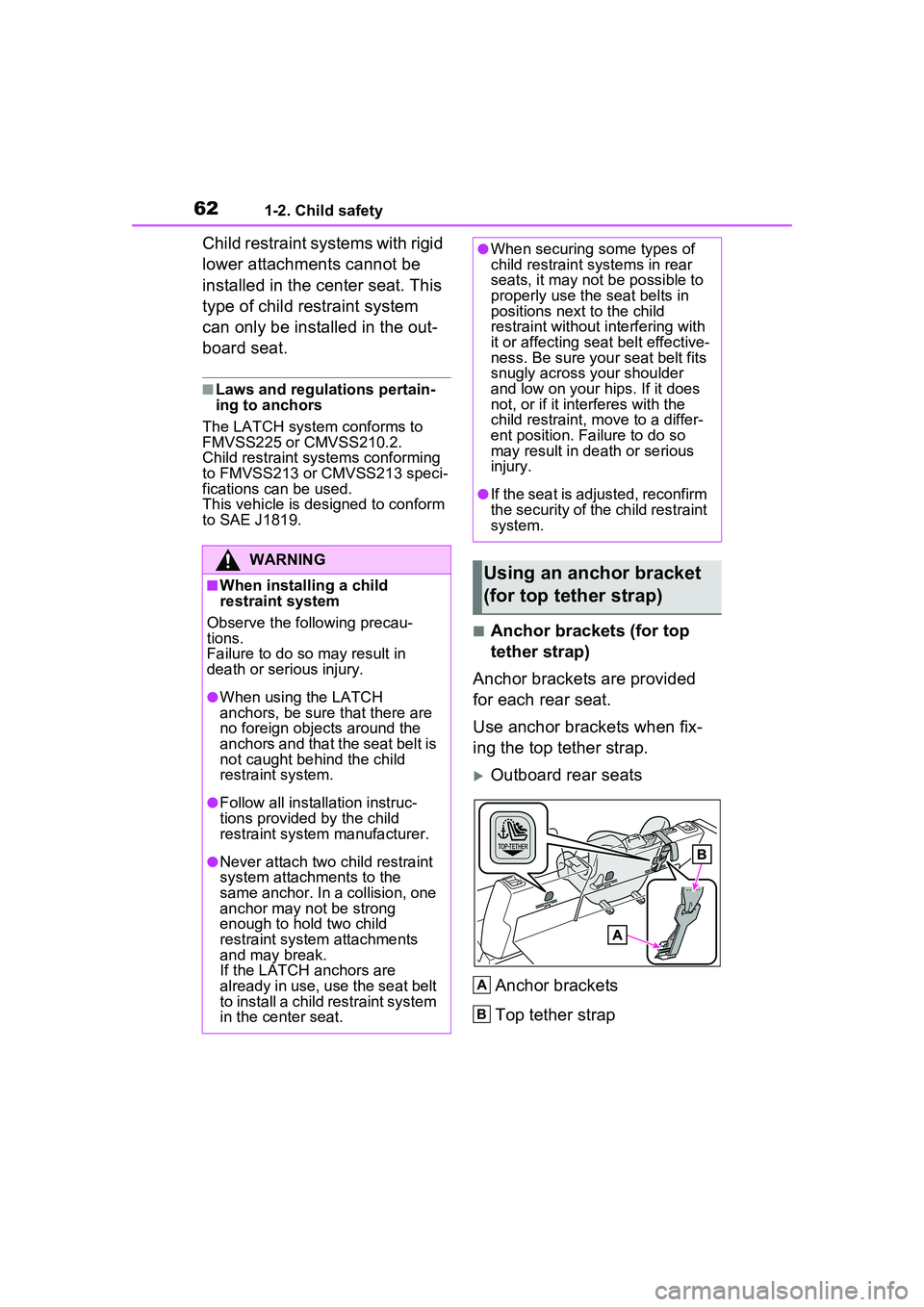
■Anchor brackets (for top
tether strap)
Anchor brackets are provided
for each rear seat.
Use anchor brackets when fix-
ing the top tether strap.
Outboard rear seats
Anchor brackets
Top tether strap
WARNING
■When installing a child
restraint system
Observe the following precau-
tions.
Failure to do so may result in
death or serious injury.
●When using the LATCH
anchors, be sure that there are
no foreign objects around the
anchors and that the seat belt is
not caught behind the child
restraint system.
●Follow all installation instruc-
tions provided by the child
restraint system manufacturer.
●Never attach two child restraint
system attachments to the
same anchor. In a collision, one
anchor may not be strong
enough to hold two child
restraint system attachments
and may break.
If the LATCH anchors are
already in use, use the seat belt
to install a child restraint system
in the center seat.
●When securing some types of
child restraint systems in rear
seats, it may not be possible to
properly use the seat belts in
positions next to the child
restraint without interfering with
it or affecting seat belt effective-
ness. Be sure your seat belt fits
snugly across your shoulder
and low on your hips. If it does
not, or if it interferes with the
child restraint, move to a differ-
ent position. Failure to do so
may result in death or serious
injury.
●If the seat is adjusted, reconfirm
the security of the child restraint
system.
Using an anchor bracket
(for top tether strap)
A
B
Page 64 of 680
641-2. Child safety
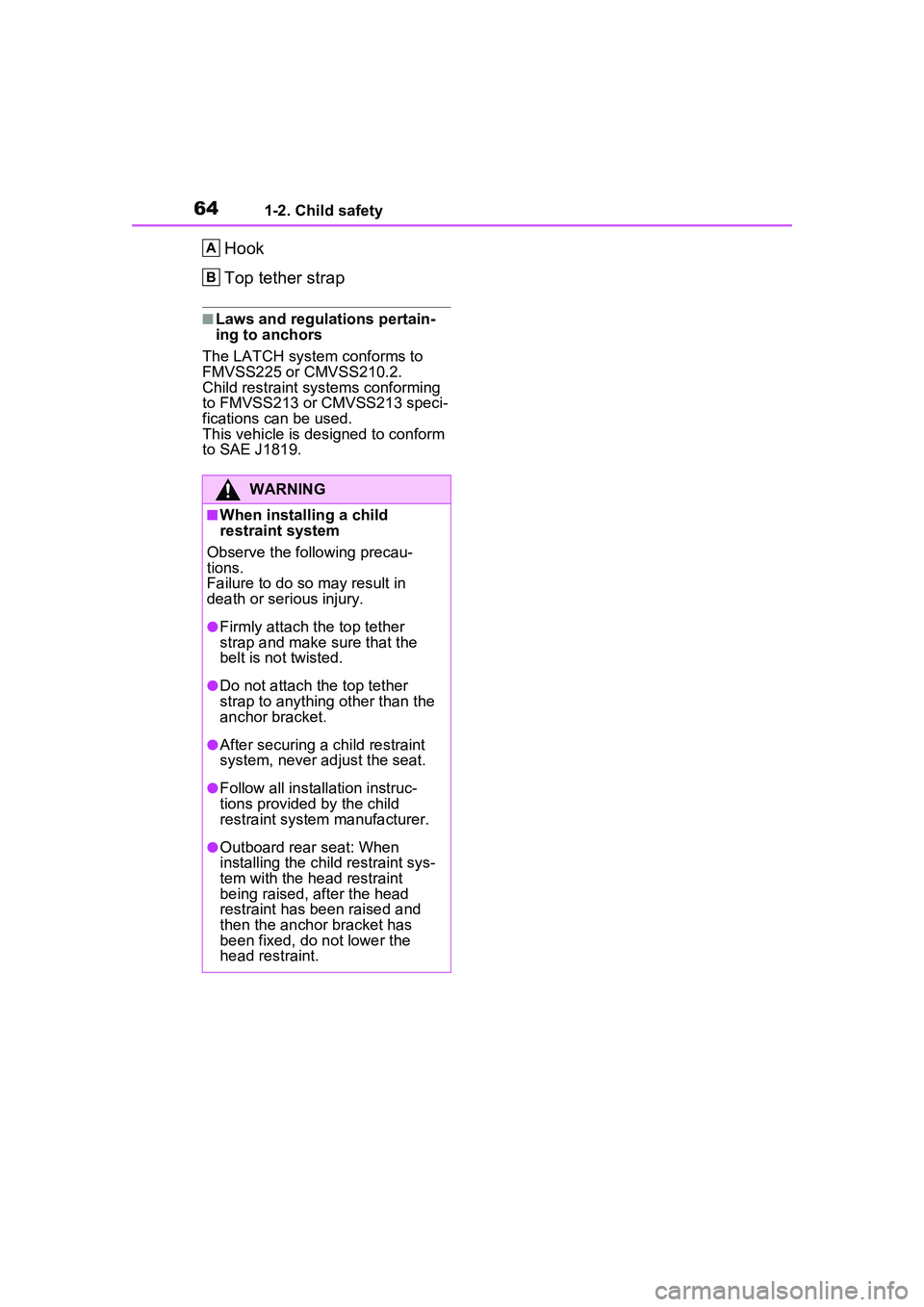
Hook
Top tether strap
■Laws and regulations pertain-
ing to anchors
The LATCH system conforms to
FMVSS225 or CMVSS210.2.
Child restraint systems conforming
to FMVSS213 or CMVSS213 speci-
fications can be used.
This vehicle is designed to conform
to SAE J1819.
WARNING
■When installing a child
restraint system
Observe the following precau-
tions.
Failure to do so may result in
death or serious injury.
●Firmly attach the top tether
strap and make sure that the
belt is not twisted.
●Do not attach the top tether
strap to anything other than the
anchor bracket.
●After securing a child restraint
system, never adjust the seat.
●Follow all installation instruc-
tions provided by the child
restraint system manufacturer.
●Outboard rear seat: When
installing the chil d restraint sys-
tem with the head restraint
being raised, after the head
restraint has been raised and
then the anchor bracket has
been fixed, do not lower the
head restraint.
A
B
Page 76 of 680
762-1. Plug-in hybrid system
from an external power source.
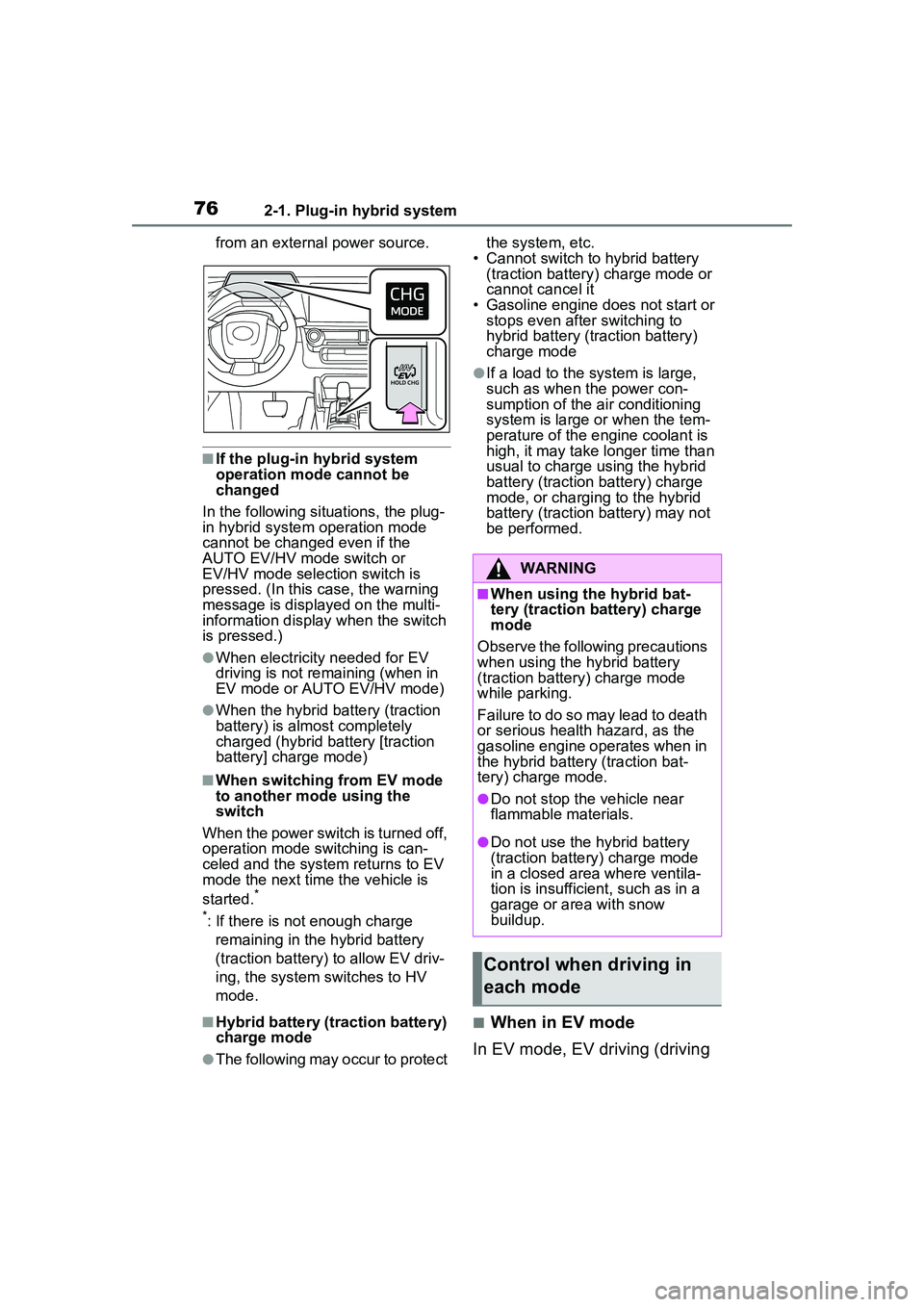
■If the plug-in hybrid system
operation mode cannot be
changed
In the following situations, the plug-
in hybrid system operation mode
cannot be changed even if the
AUTO EV/HV mode switch or
EV/HV mode selection switch is
pressed. (In this case, the warning
message is displayed on the multi-
information displa y when the switch
is pressed.)
●When electricity needed for EV
driving is not remaining (when in
EV mode or AUTO EV/HV mode)
●When the hybrid battery (traction
battery) is almost completely
charged (hybrid battery [traction
battery] charge mode)
■When switching from EV mode
to another mode using the
switch
When the power switch is turned off,
operation mode switching is can-
celed and the system returns to EV
mode the next time the vehicle is
started.
*
*
: If there is not enough charge remaining in the hybrid battery
(traction battery) to allow EV driv-
ing, the system switches to HV
mode.
■Hybrid battery (traction battery)
charge mode
●The following may occur to protect the system, etc.
• Cannot switch to hybrid battery (traction battery) charge mode or
cannot cancel it
• Gasoline engine does not start or stops even after switching to
hybrid battery (traction battery)
charge mode
●If a load to the system is large,
such as when the power con-
sumption of the air conditioning
system is large or when the tem-
perature of the engine coolant is
high, it may take longer time than
usual to charge using the hybrid
battery (traction battery) charge
mode, or charging to the hybrid
battery (traction battery) may not
be performed.
■When in EV mode
In EV mode, EV driving (driving
WARNING
■When using the hybrid bat-
tery (traction battery) charge
mode
Observe the following precautions
when using the hybrid battery
(traction battery) charge mode
while parking.
Failure to do so may lead to death
or serious health hazard, as the
gasoline engine operates when in
the hybrid battery (traction bat-
tery) charge mode.
●Do not stop the vehicle near
flammable materials.
●Do not use the hybrid battery
(traction battery) charge mode
in a closed area where ventila-
tion is insufficient, such as in a
garage or area with snow
buildup.
Control when driving in
each mode
Page 84 of 680
842-1. Plug-in hybrid system
■Running out of fuel
When the vehicle has run out of fuel
and the hybrid system cannot be
started, refuel th e vehicle with at
least enough gasoline to make the
low fuel level warning light ( P.562)
go off. If there is only a small
amount of fuel, the hybrid system
may not be able to start. (The stan-
dard amount of fuel is about 2.1 gal.
[8.0 L, 1.8 Imp.gal.], when the vehi-
cle is on a level surface. This value
may vary when the vehicle is on a
slope. Add extra fuel when the vehi-
cle is inclined.)
■Electromagnetic waves
●High voltage parts and cables on
the Plug-in Hybrid Electric Vehi-
cles incorporate electromagnetic
shielding, and therefore emit
approximately the same amount
of electromagnetic waves as con-
ventional gasoline powered vehi-
cles or home electronic
appliances.
●Your vehicle may cause sound
interference in some third party-
produced radio parts.
■Effect of magnetic forces
If objects that generate strong mag-
netic forces, such as large speak-
ers, are placed inside the luggage
compartment or installed nearby,
the generated magnetic forces may
negatively affect the hybrid system.
■Hybrid battery (traction battery)
(lithium-ion battery)
The hybrid battery (traction battery)
has a limited service life.
The hybrid battery (traction battery)
capacity (the ability to hold a
charge) reduces with time and use
in the same way as other recharge-
able batteries. The extent at which
capacity reduces changes drasti-
cally depending on the environment
(ambient temperature, etc.) and
usage conditions, such as how the
vehicle is driven and how the hybrid battery (traction battery) is charged.
This is a natural characteristic of
lithium-ion batteries, and is not a
malfunction. Also, even though the
EV driving range becomes shorter
when the hybrid battery (traction
battery) capacity reduces, vehicle
performance does not significantly
become worse.
In order to reduce the possibility of
the capacity reducing, follow the
directions listed on P.113, “Capacity
reduction of the hybrid battery (trac-
tion battery)”.
■Starting the hybrid system in an
extremely cold environment
When the hybrid battery (traction
battery) is extremely cold (below
approximately -22°F [-30°C]) under
the influence of the outside tem-
perature, it may not be possible to
start the hybrid system. In this case,
try to start the hybrid system again
after the temperature of the hybrid
battery increases due to the outside
temperature increase etc.
WARNING
■High voltage precautions
The vehicle has high voltage DC
and AC systems as well as a 12-
volt system. DC and AC high volt-
age is very dangerous and can
cause severe burns and electric
shock that may result in death or
serious injury.
●Never touch, disassemble,
remove or replace the high volt-
age parts, cables or their con-
nectors.
●The hybrid system will become
hot after starting as the system
uses high voltage. Be careful of
both the high voltage and the
high temperature, and always
obey the caution labels
attached to the vehicle.
Page 85 of 680
852-1. Plug-in hybrid system
2
Plug-in hybrid system
WARNING
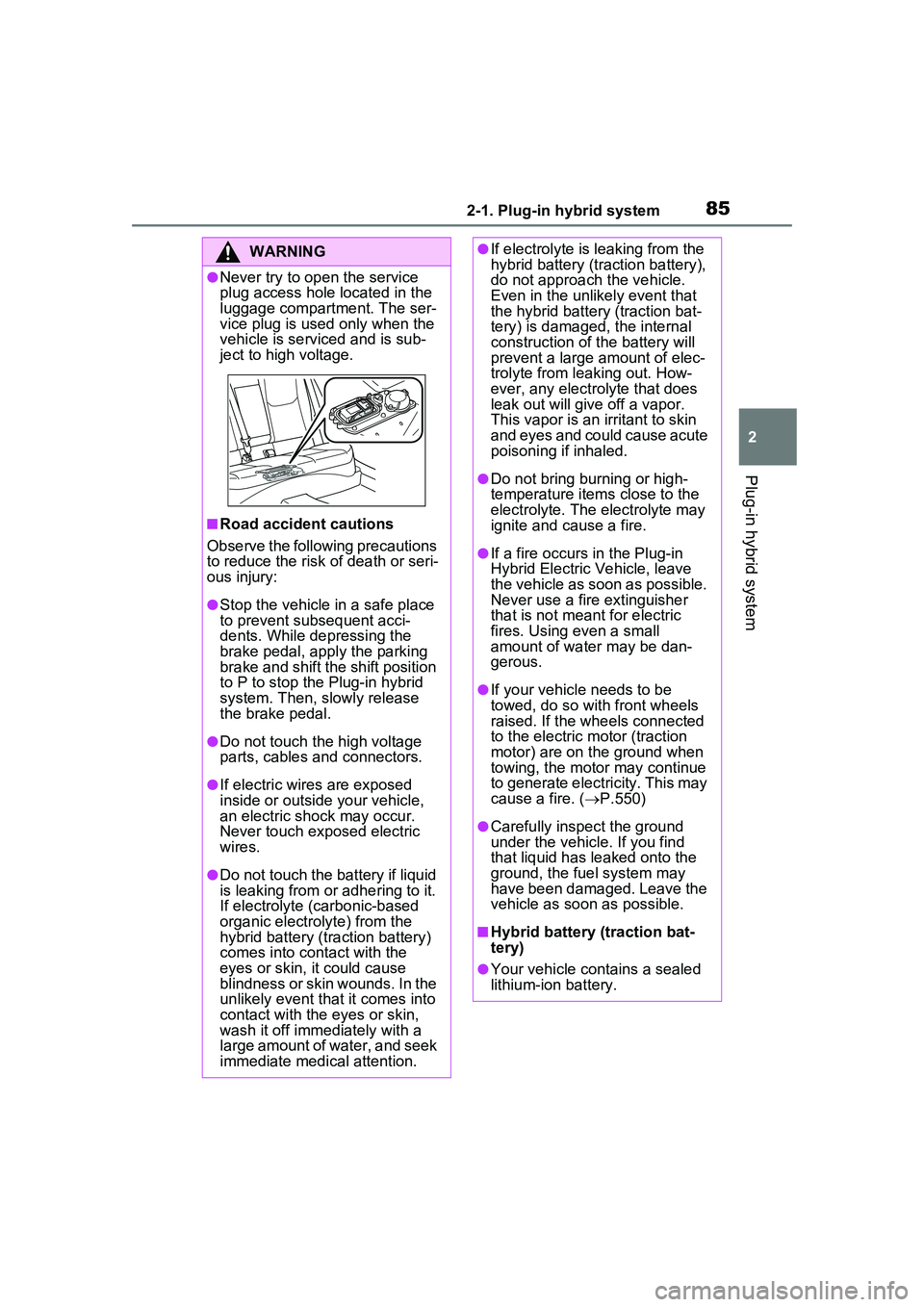
●Never try to open the service
plug access hole located in the
luggage compartment. The ser-
vice plug is used only when the
vehicle is serviced and is sub-
ject to high voltage.
■Road accident cautions
Observe the following precautions
to reduce the risk of death or seri-
ous injury:
●Stop the vehicle in a safe place
to prevent subsequent acci-
dents. While depressing the
brake pedal, apply the parking
brake and shift the shift position
to P to stop the Plug-in hybrid
system. Then, slowly release
the brake pedal.
●Do not touch the high voltage
parts, cables and connectors.
●If electric wires are exposed
inside or outside your vehicle,
an electric shock may occur.
Never touch exposed electric
wires.
●Do not touch the battery if liquid
is leaking from or adhering to it.
If electrolyte (carbonic-based
organic electrolyte) from the
hybrid battery (traction battery)
comes into contact with the
eyes or skin, it could cause
blindness or skin wounds. In the
unlikely event that it comes into
contact with the eyes or skin,
wash it off immediately with a
large amount of water, and seek
immediate medical attention.
●If electrolyte is leaking from the
hybrid battery (traction battery),
do not approach the vehicle.
Even in the unlikely event that
the hybrid battery (traction bat-
tery) is damaged, the internal
construction of the battery will
prevent a large amount of elec-
trolyte from leaking out. How-
ever, any electrolyte that does
leak out will give off a vapor.
This vapor is an irritant to skin
and eyes and could cause acute
poisoning if inhaled.
●Do not bring burning or high-
temperature items close to the
electrolyte. The electrolyte may
ignite and cause a fire.
●If a fire occurs in the Plug-in
Hybrid Electric Vehicle, leave
the vehicle as soon as possible.
Never use a fire extinguisher
that is not meant for electric
fires. Using even a small
amount of water may be dan-
gerous.
●If your vehicle needs to be
towed, do so with front wheels
raised. If the wheels connected
to the electric motor (traction
motor) are on the ground when
towing, the motor may continue
to generate electricity. This may
cause a fire. ( P.550)
●Carefully inspect the ground
under the vehicle. If you find
that liquid has leaked onto the
ground, the fuel system may
have been damaged. Leave the
vehicle as soon as possible.
■Hybrid battery (traction bat-
tery)
●Your vehicle contains a sealed
lithium-ion battery.