service TOYOTA PRIUS PRIME 2023 Owners Manual
[x] Cancel search | Manufacturer: TOYOTA, Model Year: 2023, Model line: PRIUS PRIME, Model: TOYOTA PRIUS PRIME 2023Pages: 680, PDF Size: 14.97 MB
Page 4 of 680
4TABLE OF CONTENTS
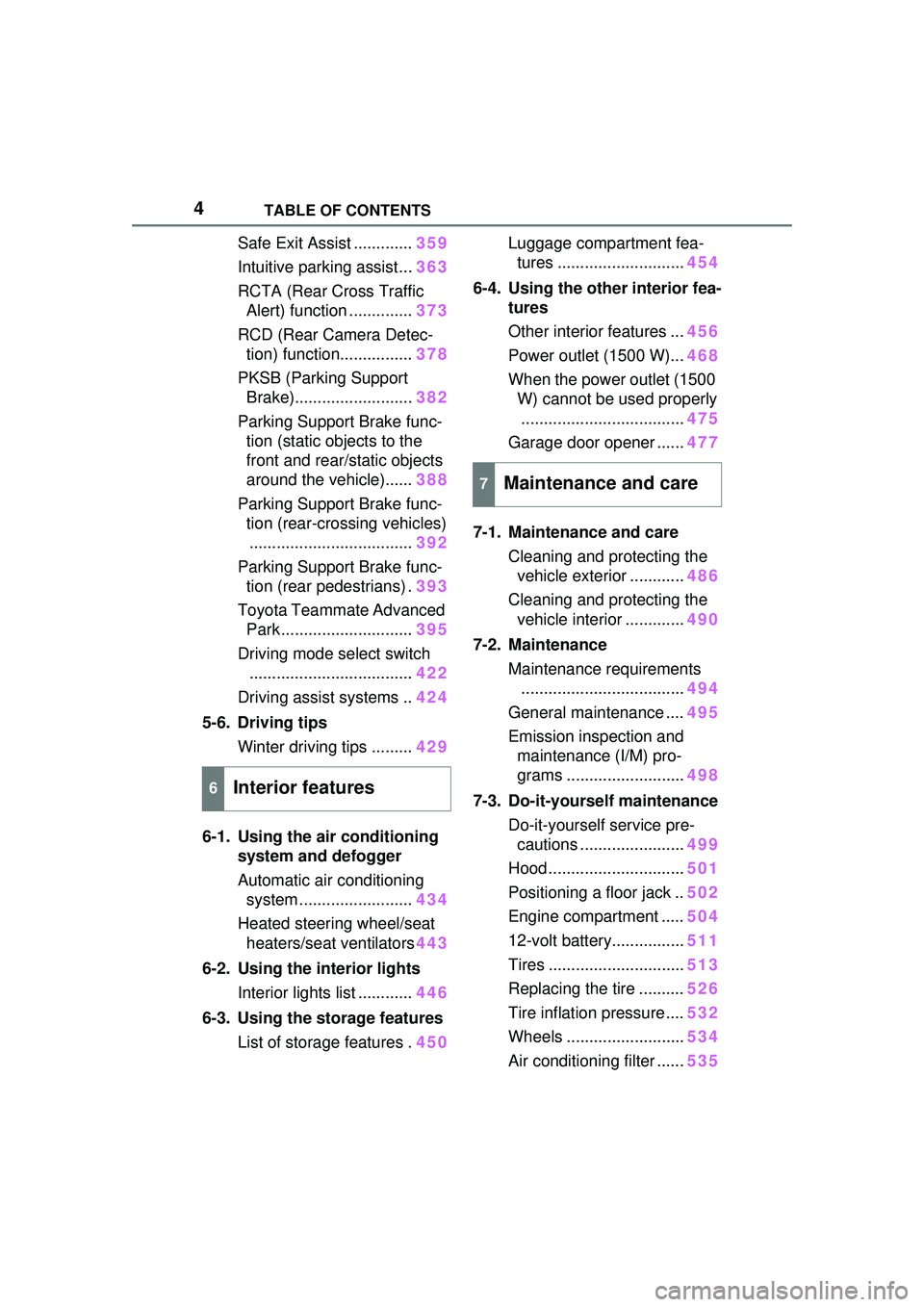
Safe Exit Assist .............359
Intuitive parking assist... 363
RCTA (Rear Cross Traffic Alert) function .............. 373
RCD (Rear Camera Detec- tion) function................ 378
PKSB (Parking Support Brake).......................... 382
Parking Support Brake func- tion (static objects to the
front and rear/static objects
around the vehicle)...... 388
Parking Support Brake func- tion (rear-crossing vehicles).................................... 392
Parking Support Brake func- tion (rear pedestrians) . 393
Toyota Teammate Advanced Park ............................. 395
Driving mode select switch .................................... 422
Driving assist systems .. 424
5-6. Driving tips Winter driving tips ......... 429
6-1. Using the air conditioning system and defogger
Automatic air conditioning system ......................... 434
Heated steering wheel/seat heaters/seat ventilators 443
6-2. Using the interior lights Interior lights list ............ 446
6-3. Using the storage features List of storage features . 450Luggage compartment fea-
tures ............................ 454
6-4. Using the other interior fea- tures
Other interior features ... 456
Power outlet (1500 W)... 468
When the power outlet (1500 W) cannot be used properly
.................................... 475
Garage door opener ...... 477
7-1. Maintenance and care Cleaning and protecting the vehicle exterior ............ 486
Cleaning and protecting the vehicle interior ............. 490
7-2. Maintenance Maintenance requirements.................................... 494
General maintenance .... 495
Emission inspection and maintenance (I/M) pro-
grams .......................... 498
7-3. Do-it-yourself maintenance Do-it-yourself service pre-cautions ....................... 499
Hood .............................. 501
Positioning a floor jack .. 502
Engine compartment ..... 504
12-volt battery................ 511
Tires .............................. 513
Replacing the tire .......... 526
Tire inflation pressure .... 532
Wheels .......................... 534
Air conditioning filter ...... 53
5
6Interior features
7Maintenance and care
Page 8 of 680
8
sor data
Image data (images from the
front, rear, vehicle periphery,
and driver monitor cameras)
*2
*2: The vehicle has multiple cam-
eras. For details on from which
cameras images are recorded,
contact your Toyota dealer.
Location information
These computers do not record
conversations, sounds, or
images of the inside of the vehi-
cle.
Also, personal information which
may be used to identify the
owner of the vehicle (name,
gender, age, etc.) is not
recorded.
■Usage of recorded data and
personal information by the
Toyota Safety Sense 3.0
The operating state of each sys-
tem, data from each sensor,
image data (images from the
front/rear cameras), and posi-
tion information is recorded by
the Toyota Safety Sense 3.0 in
the following situations. Toyota
obtains this information when
the vehicle is brought to the
dealership or when sent to the
Toyota servers.
In certain collisions or colli-
sion-like situations
When driving on roads with
certain traffic situations, such
as congestion, poor road sur-
faces, poor weather, etc.
When driving on certain
roads, such as roads which
were recently opened or
extended
After the hybrid system is
started, for a certain amount
of time
To learn more about the vehicle
data collected, used and shared
by Toyota, please visit
www.toyota.com/privacyvts/.
■Data provision and use pur-
pose by third parties
Data recorded by the computers
may be used for collision analy-
sis, malfunction diagnosis, auto-
mated driving, advanced safety
and map related technologies
(technology, product develop-
ment, product improvement,
etc.) and products and services
which use data (maps used for
automated driving and
advanced safety technologies,
driving condition analysis, analy-
sis of the driving environment,
such as road infrastructure, traf-
fic condition communication,
etc. Herein referred to as “indi-
vidual services”.)
Also, this data may be used for
customer support related to a
collision, collisi on analysis or
resolution.
In situations such as the follow-
ing, Toyota may disclose the
recorded data to a third party:
When the consent of the vehi-
Page 9 of 680
9
cle owner (or the lessee if the
vehicle is leased) has been
given
When officially requested by
the police, a court of law or a
government agency
When it is to be used by
Toyota in a lawsuit
When data is to be used
research purposes after pro-
cessing so that the data is not
tied to a specific vehicle or
vehicle owner
In addition to the above, Toyota
may disclose the data recorded
by the Toyota Safety Sense 3.0
to a third party in the following
situations:
When separate consent of the
vehicle owner (or the lessee if
the vehicle is leased) has
been given. This includes sit-
uations when the user sub-
scribes to an individual
service which is provided by a
second party and uses vehi-
cle recorded data, where the
provider has obtained the
user’s consent for providing
data to a third-party
When providing data to a
company involved in autono-
mous driving software, etc. for
the purpose of research and
development (technology,
product development, prod-
uct improvement, etc.) of
automated driving, advanced safety and map related tech-
nologies
When providing image data
and position information to a
company involved in map cre-
ation, etc. for the purpose of
research and development
map related technologies
When providing image data
and position information to a
local government for the pur-
pose of road maintenance,
etc.
When providing processed
image data and position infor-
mation to traffic condition
communication individual ser-
vices
When providing image data
from near a fire, or other area
that emergency services are
dispatched, to the fire depart-
ment of a local government
which has entered a separate
contract with Toyota
Image information recorded by the
vehicle can be erased by your
Toyota dealer.
The image recording function can
be disabled. However, if the function
is disabled, data from when systems
operate will not be available.
If you wish to stop the collection of
Toyota Safety Sense 3.0 data by the
Toyota servers for the purpose of
research and development and pro-
vision to individual services, contact
your Toyota dealer.
Page 10 of 680
10
If your Toyota has Safety Con-
nect and if you have subscribed
to those services, please refer to
the Safety Connect Telematics
Subscription Service Agreement
for information on data collected
and its usage.
To learn more about the vehi-
cle data collected, used and
shared by Toyota, please visit
www.toyota.com/privacyvts/
.
This vehicle is equipped with an
event data recorder (EDR). The
main purpose of an EDR is to
record, in certain crash or near
crash-like situations, such as an
air bag deployment or hitting a
road obstacle, data that will
assist in understanding how a
vehicle’s systems performed.
The EDR is designed to record
data related to vehicle dynamics
and safety systems for a short
period of time, typically 30 sec-
onds or less.
The EDR in this vehicle is
designed to record such data
as:
How various systems in your
vehicle were operating;
Whether or not the driver and
passenger safety belts were buckled/fastened;
How far (if at all) the driver
was depressing the accelera-
tor and/or brake pedal; and,
How fast the vehicle was trav-
eling.
These data can help provide a
better understanding of the cir-
cumstances in which crashes
and injuries occur.
NOTE: EDR data are recorded
by your vehicle only if a non-triv-
ial crash situation occurs; no
data are recorded by the EDR
under normal driving conditions
and no personal data (e.g.,
name, gender, age, and crash
location) are recorded. How-
ever, other parties, such as law
enforcement, could combine the
EDR data with the type of per-
sonally identifying data rou-
tinely acquired during a crash
investigation.
To read data recorded by an
EDR, special equipment is
required, and access to the
vehicle or the EDR is needed. In
addition to the vehicle manufac-
turer, other parties, such as law
enforcement, that have the spe-
cial equipment, can read the
information if they have access
to the vehicle or the EDR.
Disclosure of the EDR data
Toyota will not disclose the data
recorded in an EDR to a third party
except when:
Usage of data collected
through Safety Connect
(U.S.mainland only)
Event data recorder
Page 37 of 680
371-1. For safe use
1
For safety and security
bag sensor assembly (ECU) controls airbag deployment based on
information obtained from the sensors, etc., shown in the system
components diagram above. This information includes crash sever-
ity and occupant information. As the airbags deploy, a chemical
reaction in the inflators quickly fills the airbags with non-toxic gas to
help restrain the motion of the occupants.
■If the SRS airbags deploy
(inflate)
●Slight abrasions, burns, bruising,
etc., may be sustained from SRS
airbags, due to the extremely high
speed of deployment (inflation) by
hot gases.
●A loud noise and white powder will
be emitted.
●Parts of the airbag module (steer-
ing wheel hub, airbag cover and
inflator) as well as the parts
around the airbags may be hot for
several minutes. The airbag itself
may also be hot.
●The windshield may crack.
●The hybrid system will be stopped
and fuel supply to the engine will
be stopped. (P.87)
●The brakes and st op lights will be
controlled automatically.
( P.425)
●The interior lights will turn on auto-
matically. ( P.446)
●The emergency flashers will turn
on automatically. ( P.546)
●For Safety Connect subscribers, if
any of the following situations
occur, the system is designed to
send an emergency call to the
response center, notifying them of
the vehicle’s location (without
needing to push the “SOS” button)
and an agent will a ttempt to speak
with the occupants to ascertain
the level of emergency and assis-
tance required. If the occupants
are unable to communicate, the
agent automatically treats the call
as an emergency and helps to dis-
patch the necessary emergency services. (
P.65)
• When an SRS airbag has been deployed
• When a seat belt pretensioner has
operated
• When the vehicle has been involved in a severe rear-end colli-
sion
■The SRS airbags deploy in a
frontal impact when
●The following SRS airbags will
deploy in the event of an impact
that exceeds a threshold level
(level of force corresponding to an
approximately 12 - 18 mph [20 -
30 km/h] frontal collision with a
fixed wall that does not move or
deform):
• SRS front airbags
●The threshold level at which the
SRS airbags will deploy will be
higher than normal in the in the
following situations:
• When the vehicle collides with an
object, such as a parked vehicle
or sign pole, which moves or
deforms on impact
• If the vehicle is involved in an underride collision, such as a colli-
sion in which the front of the vehi-
cle underrides, or goes under, the
bed of a truck
●Depending on the type of collision,
only the following may deploy:
• Seat belt pretensioners
●The SRS airbags for the front pas-
senger’s seat will not deploy if
there is no passenger in the front
passenger seat. However, the
SRS airbags for the front passen-
ger’s seat may deploy, even if the
seat is unoccupied, if luggage is
put on the seat.
Page 65 of 680
651-3. Emergency assistance
1
For safety and security
1-3.Emergency assistance
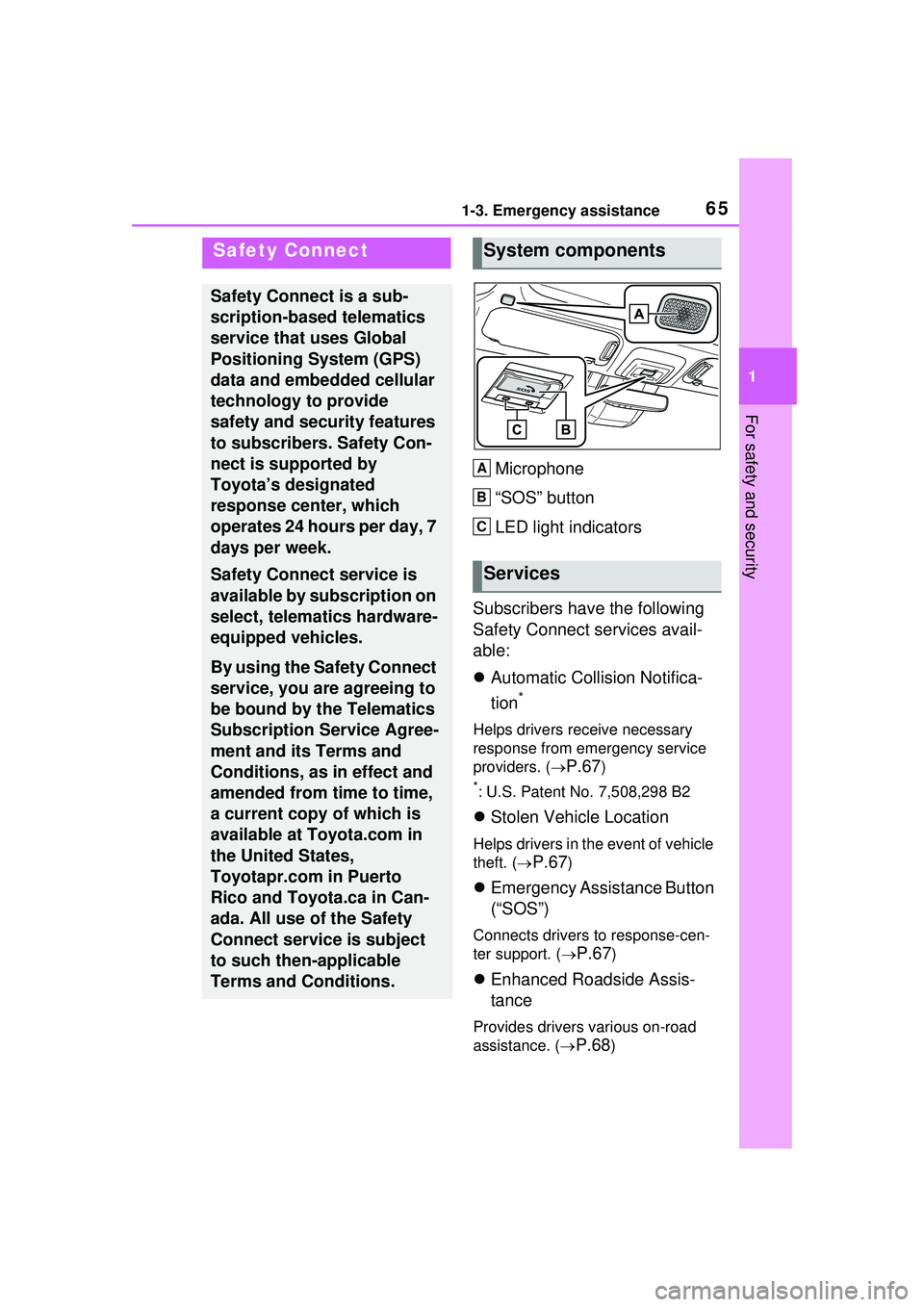
Microphone
“SOS” button
LED light indicators
Subscribers have the following
Safety Connect services avail-
able:
Automatic Collision Notifica-
tion
*
Helps drivers receive necessary
response from emergency service
providers. (
P.67)
*: U.S. Patent No. 7,508,298 B2
Stolen Vehicle Location
Helps drivers in the event of vehicle
theft. (
P.67)
Emergency Assistance Button
(“SOS”)
Connects drivers to response-cen-
ter support. (
P.67)
Enhanced Roadside Assis-
tance
Provides drivers various on-road
assistance. (
P.68)
Safety Connect
Safety Connect is a sub-
scription-based telematics
service that uses Global
Positioning System (GPS)
data and embedded cellular
technology to provide
safety and security features
to subscribers. Safety Con-
nect is supported by
Toyota’s designated
response center, which
operates 24 hours per day, 7
days per week.
Safety Connect service is
available by subscription on
select, telematics hardware-
equipped vehicles.
By using the Safety Connect
service, you are agreeing to
be bound by the Telematics
Subscription Service Agree-
ment and its Terms and
Conditions, as in effect and
amended from time to time,
a current copy of which is
available at Toyota.com in
the United States,
Toyotapr.com in Puerto
Rico and Toyota.ca in Can-
ada. All use of the Safety
Connect service is subject
to such then-applicable
Terms and Conditions.
System components
Services
A
B
C
Page 66 of 680
661-3. Emergency assistance
After you have signed the
Telematics Subscription Ser-
vice Agreement and are
enrolled, you can begin receiv-
ing services.
A variety of subscription terms
are available for purchase. Con-
tact your Toyota dealer, call the
following appropriate Customer
Experience Center or push the
“SOS” button in your vehicle for
further subscription details.
The United States
1-800-331-4331
Canada
1-888-869-6828
Puerto Rico
1-877-855-8377
■Safety Connect Services Infor-
mation
●Phone calls using the vehicle’s
Bluetooth® technology will not be
possible when Safety Connect is
active and in use.
●Safety Connect is available begin-
ning Fall 2009 on select Toyota
models (in the contiguous United
States only). Contact with the
Safety Connect response center
is dependent upon the telematics
device being in operative condi-
tion, cellular connection availabil-
ity, and GPS satellite signal
reception, which can limit the abil-
ity to reach the response center or
receive emergency service sup-
port. Enrollment and Telematics
Subscription Service Agreement
are required. A variety of subscrip-
tion terms are available; charges vary by subscripti
on term selected
and location.
●Automatic Collision Notification,
Emergency Assistance and Stolen
Vehicle Location are available in
the United States, including
Hawaii and Alaska, Puerto Rico
and Canada, and Enhanced
Roadside Assistance are avail-
able in the United States, Puerto
Rico and Canada.
●Automatic Collision Notification,
Emergency Assistance, Stolen
Vehicle and Enhanced Road
Assistance are not available in the
U.S. Virgin Islands.
For vehicles first sold in the U.S.
Virgin Islands, no Safety Connect
services will function in or outside
the U.S. Virgin Islands.
●Safety Connect services are not
subject to section 255 of the Tele-
communications Act and the
device is not TTY compatible.
■Languages
The Safety Connect response cen-
ter will offer support in multiple lan-
guages. The Safety Connect system
will offer voice prompts in English,
Spanish, and French. Please indi-
cate your language of choice when
enrolling.
■When contacting the response
center
You may be unable to contact the
response center if the network is
busy.
When the power switch is turned
to ON, the red indicator light
comes on for 2 seconds then
turns off. Afterward, the green
indicator light comes on, indicat-
ing that the service is active.
Subscription
Safety Connect LED light
Indicators
Page 67 of 680
671-3. Emergency assistance
1
For safety and security
The following indicator light pat-
terns indicate specific system
usage conditions:
Green indicator light on =
Active service
Green indicator light flashing
= Safety Connect call in pro-
cess
Red indicator light (except at
vehicle start-up) = System
malfunction (contact your
Toyota dealer)
No indicator light (off) =
Safety Connect service not
active
■Automatic Collision Notifi-
cation
In case of either airbag deploy-
ment or severe rear-end colli-
sion, the system is designed to
automatically call the response
center. The responding agent
receives the vehicle’s location
and attempts to speak with the
vehicle occupants to assess the
level of emergency. If the occu-
pants are unable to communi-
cate, the agent automatically
treats the call as an emergency,
contacts the nearest emer-
gency services provider to
describe the situation, and
requests that assistance be sent
to the location.
■Stolen Vehicle Location
If your vehicle is stolen, Safety
Connect can work with local
authorities to assist them in
locating and recovering the
vehicle. After filing a police
report, call the Customer Experi-
ence Center at 1-800-331-4331
in the United States, 1-877-855-
8377 in Puerto Rico or 1-888-
869-6828 in Canada, and follow
the prompts for Safety Connect
to initiate this service.
In addition to assisting law
enforcement with recovery of a
stolen vehicle, Safety-Connect-
equipped vehicle location data
may, under certain circum-
stances, be shared with third
parties to locate your vehicle.
Further information is available
at Toyota.com in the United
States, Toyotapr.com in Puerto
Rico and Toyota.ca in Canada.
■Emergency Assistance But-
ton (“SOS”)
In the event of an emergency on
the road, push the “SOS” button
to reach the Safety Connect
response center. The answering
agent will determine your vehi-
cle’s location, assess the emer-
gency, and dispatch the
necessary assistance required.
If you accidentally press the “SOS”
button, tell the response-center
agent that you are not experiencing
an emergency.
Safety Connect services
Page 68 of 680
681-3. Emergency assistance
■Enhanced Roadside Assis-
tance
Enhanced Roadside Assistance
adds GPS data to the already
included warranty-based Toyota
roadside service.
Subscribers can press the
“SOS” button to reach a Safety
Connect response-center agent,
who can help with a wide range
of needs, such as: towing, flat
tire, fuel delivery, etc. For a
description of the Enhanced
Roadside Assistance services
and their limitations, please see
the Safety Connect Terms and
Conditions, which are available
at Toyota.com in the United
States, Toyotapr.com in Puerto
Rico and Toyota.ca in Canada.
Important! Read this informa-
tion before using Safety Con-
nect.
■Exposure to radio fre-
quency signals
The Safety Connect system
installed in your vehicle is a low-
power radio transmitter and
receiver. It receives and also
sends out radio frequency (RF)
signals.
In August 1996, the Federal
Communications Commission
(FCC) adopted RF exposure
guidelines with safety levels for mobile wireless phones. Those
guidelines are consistent with
the safety standards previously
set by the following U.S. and
international standards bodies.
ANSI (American National
Standards Institute) C95.1
[1992]
NCRP (National Council on
Radiation Protection and
Measurement) Report 86
[1986]
ICNIRP (International Com-
mission on Non-Ionizing Radi-
ation Protection) [1996]
Those standards were based on
comprehensive and periodic
evaluations of the relevant sci-
entific literature. Over 120 scien-
tists, engineers, and physicians
from universities, and govern-
ment health agencies and
industries reviewed the avail-
able body of research to
develop the ANSI Standard
(C95.1).
The design of Safety Connect
complies with the FCC guide-
lines in addition to those stan-
dards.
■Free/Open Source Soft-
ware Information
This product contains
Free/Open Source Software
(FOSS). The license information
and/or the source code of such
FOSS can be found at the fol-
lowing URL.
Safety information for
Safety Connect
Page 83 of 680
832-1. Plug-in hybrid system
2
Plug-in hybrid system
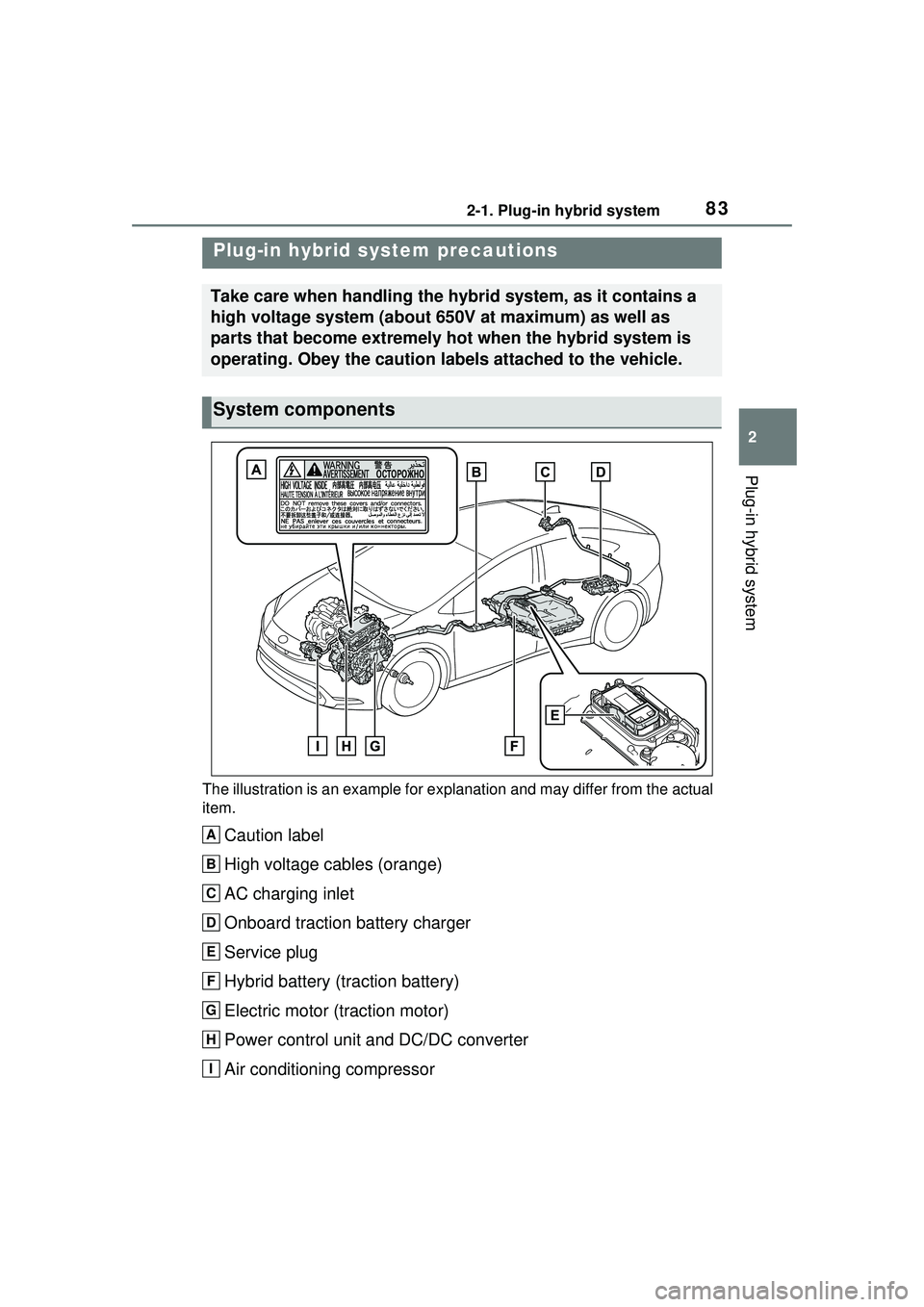
The illustration is an example for explanation and may differ from the actual
item.
Caution label
High voltage cables (orange)
AC charging inlet
Onboard traction battery charger
Service plug
Hybrid battery (traction battery)
Electric motor (traction motor)
Power control unit and DC/DC converter
Air conditioning compressor
Plug-in hybrid system precautions
Take care when handling the hybrid system, as it contains a
high voltage system (about 650V at maximum) as well as
parts that become extremely hot when the hybrid system is
operating. Obey the caution labels attached to the vehicle.
System components
A
B
C
D
E
F
G
H
I