replace TOYOTA PRIUS V 2013 Owners Manual (in English)
[x] Cancel search | Manufacturer: TOYOTA, Model Year: 2013, Model line: PRIUS V, Model: TOYOTA PRIUS V 2013Pages: 568, PDF Size: 10.58 MB
Page 9 of 568
9
PRIUS v_OM_OM47820U_(U)
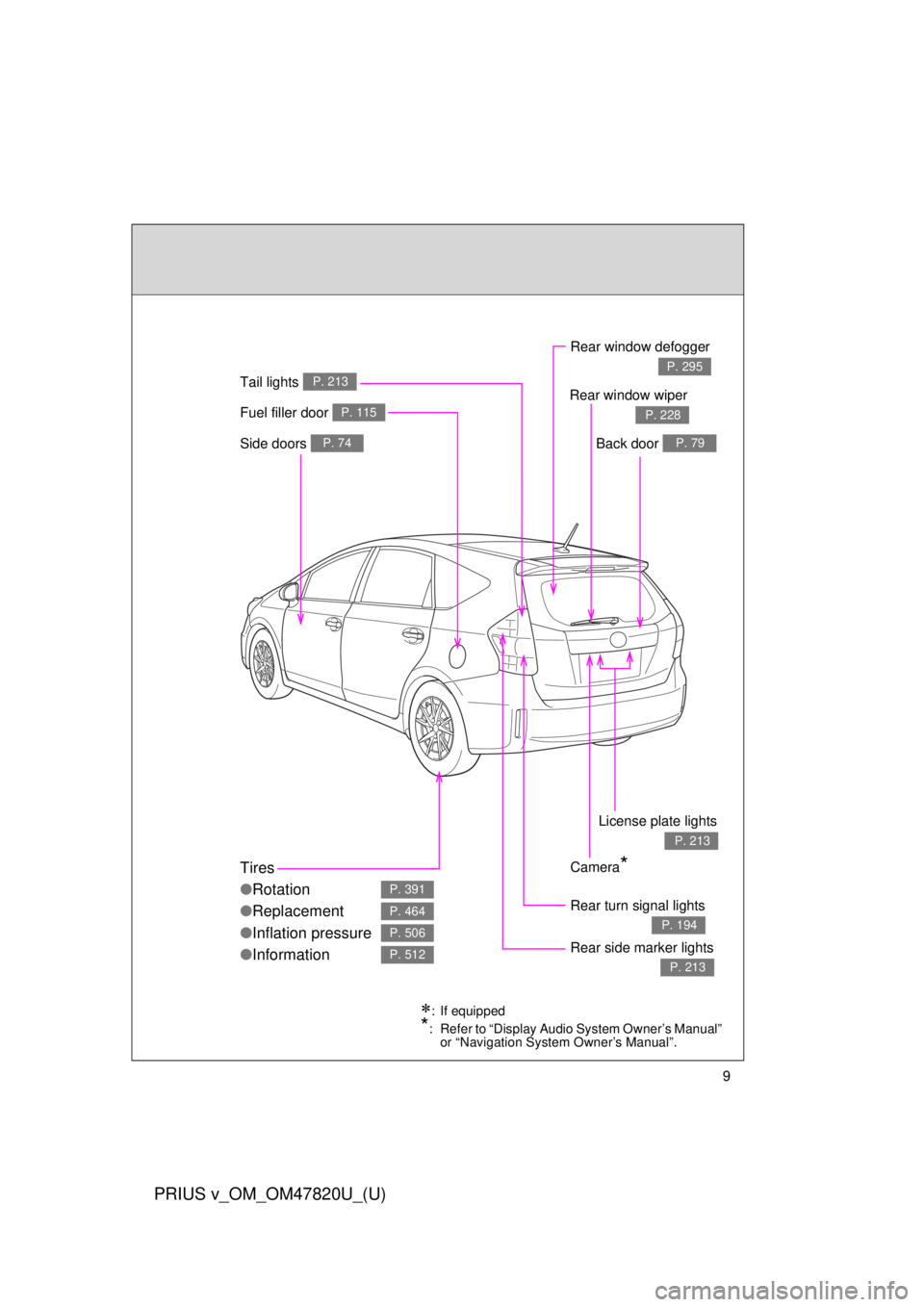
Fuel filler door P. 115
Rear turn signal lights
P. 194
Rear window defogger
P. 295
Tires
●Rotation
● Replacement
● Inflation pressure
● Information
P. 391
P. 464
P. 506
P. 512Rear side marker lights
P. 213
Tail lights P. 213
Camera*
Side doors P. 74Back door P. 79
Rear window wiper
P. 228
License plate lights
P. 213
: If equipped
*: Refer to “Display Audio System Owner’s Manual”
or “Navigation System Owner’s Manual”.
Page 20 of 568

20
PRIUS v_OM_OM47820U_(U)
For your information
Main Owner’s Manual
Please note that this manual applies to all models and explains all equip-
ment, including options. Therefore, you may find some explanations for
equipment not installed on your vehicle.
All specifications provided in this manual are current at the time of printing.
However, because of the Toyota policy of continual product improvement, we
reserve the right to make changes at any time without notice.
Depending on specifications, the vehicle shown in the illustrations may differ
from your vehicle in terms of color and equipment.
Noise from under vehicle after turning off the hybrid system
Approximately five hours after the hybrid system is turned off, you may hear
sound coming from under the vehicle for several minutes. This is the sound
of a fuel evaporation leakage check and, it does not indicate a malfunct\
ion.
Accessories, spare parts and modification of your Toyota
A wide variety of non-genuine spare parts and accessories for Toyota vehi-
cles are currently available in the market. You should know that Toyota does
not warrant these products and is not responsible for their performance,
repair, or replacement, or for any damage they may cause to, or adverse
effect they may have on, your Toyota vehicle.
This vehicle should not be modified with non-genuine Toyota products. Mod-
ification with non-genuine Toyota products could affect its performance,
safety or durability, and may even violate governmental regulations. In addi-
tion, damage or performance problems resulting from the modification may
not be covered under warranty.
Page 39 of 568
39
1-1. Hybrid system
1
Before driving
PRIUS v_OM_OM47820U_(U)
CAUTION
■
High voltage precautions
The vehicle has high voltage DC and AC systems as well as a 12-volt sys-
tem. DC and AC high voltage is very dangerous and can cause severe burns
and electric shock that may result in death or serious injury.
● Never touch, disassemble, remove or replace the high voltage parts,
cables or their connectors.
● The hybrid system will become hot after starting as the system uses high
voltage. Be careful of both the high voltage and the high temperature, and
always obey the caution labels attached to the vehicle.
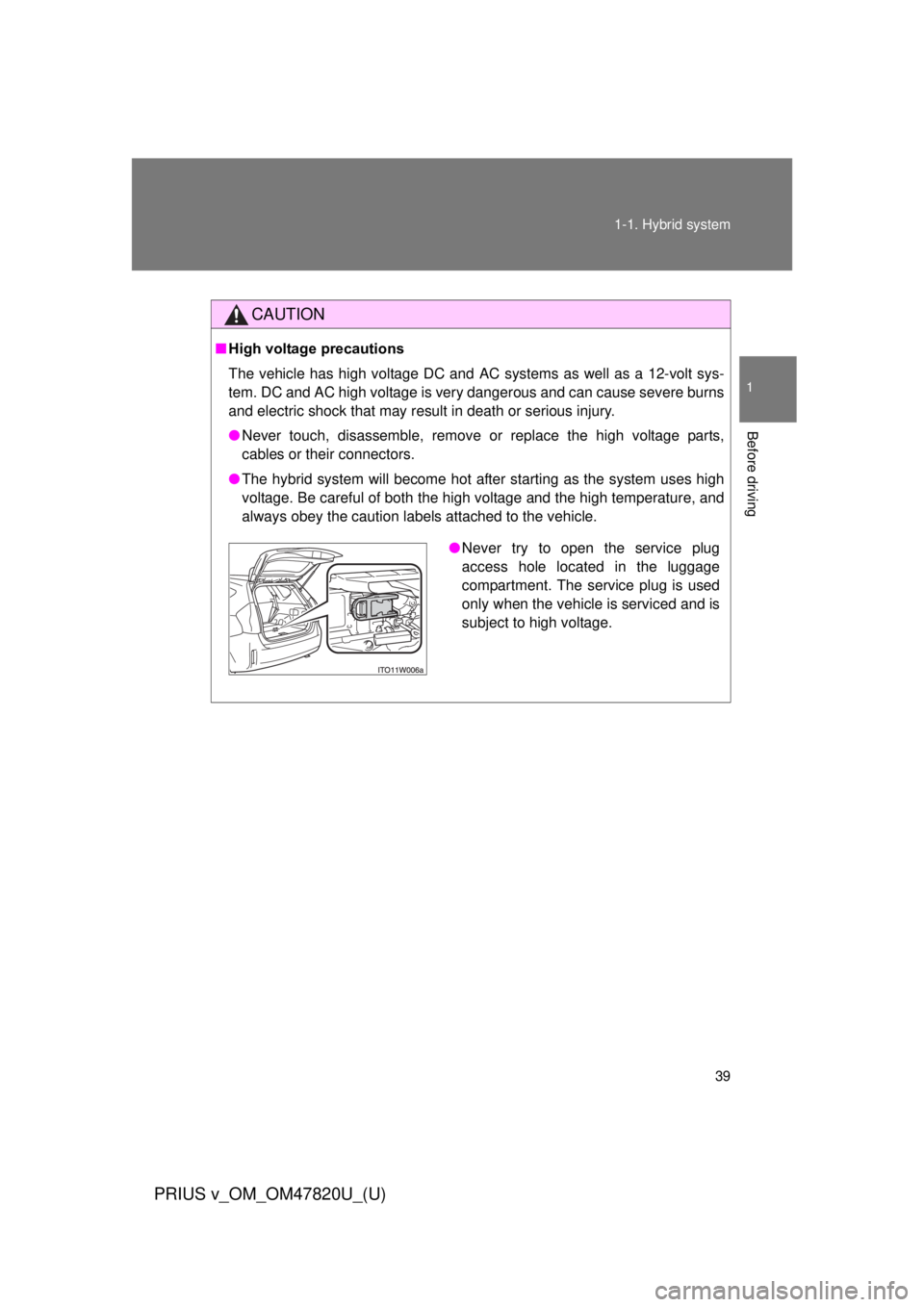
●Never try to open the service plug
access hole located in the luggage
compartment. The service plug is used
only when the vehicle is serviced and is
subject to high voltage.
Page 69 of 568
69
1-3. Opening, closing and locking the doors
1
Before driving
PRIUS v_OM_OM47820U_(U)
■
If the smart key system does not operate properly
● Locking and unlocking the doors: Use the mechanical key. ( P. 481)
● Starting the hybrid system: P. 482
■ Electronic key battery depletion
● The standard battery life is 1 to 2 years.
● As the electronic key always receives radio waves, the battery will
become depleted even if the electronic key is not used. The following
symptoms indicate that the electronic key battery may be depleted.
Replace the battery when necessary. ( P. 409)
• The smart key system or the wireless remote control does not operate.
• The detection area becomes smaller.
• The LED indicator on the key surface does not turn on.
● To avoid serious deterioration, do not leave the electronic key within 3 ft.
(1 m) of the following electrical appliances that produce a magnetic field:
•TVs
• Personal computers
• Cellular phones, cordless phones and battery chargers
• Recharging cellular phones or cordless phones
• Induction cookers
• Table lamps
■ When the electronic key battery is fully depleted
P. 409
■ Customization
Settings (e.g. smart key system) can be changed.
(Customizable features P. 527)
Page 85 of 568
85
1-4. Adjustable components (s
eats, mirrors, steering wheel)
1
Before driving
PRIUS v_OM_OM47820U_(U)
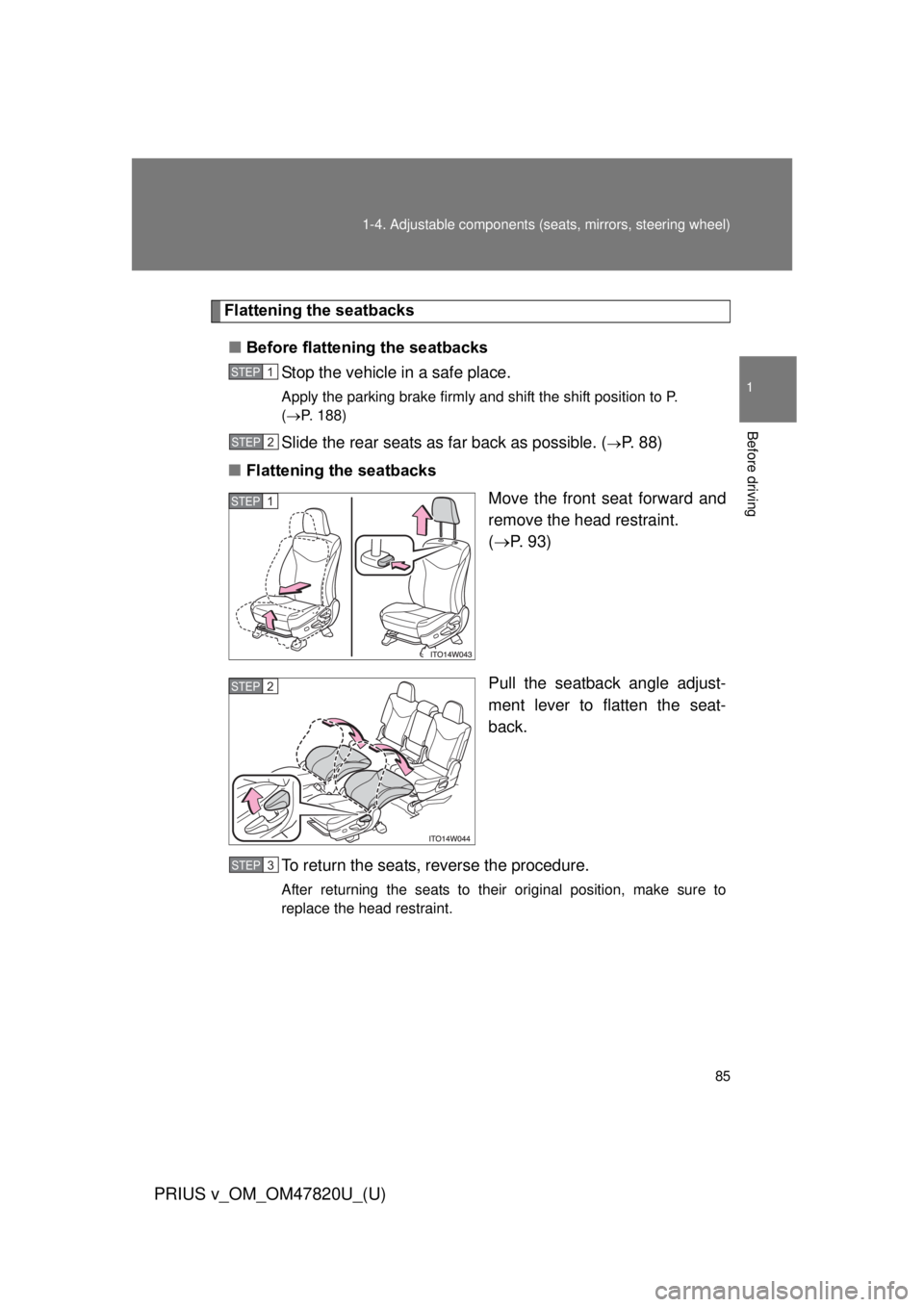
Flattening the seatbacks
■ Before flattening the seatbacks
Stop the vehicle in a safe place.
Apply the parking brake firmly and shift the shift position to P.
(P. 188)
Slide the rear seats as far back as possible. (P. 8 8 )
■ Flattening the seatbacks
Move the front seat forward and
remove the head restraint.
( P. 93)
Pull the seatback angle adjust-
ment lever to flatten the seat-
back.
To return the seats, reverse the procedure.
After returning the seats to their original position, make sure to
replace the head restraint.
STEP 1
STEP 2
STEP 1
STEP 2
STEP 3
Page 104 of 568

104 1-4. Adjustable components (seats, mirrors, steering wheel)
PRIUS v_OM_OM47820U_(U)
CAUTION
■When children are in the vehicle
Do not allow children to play with the seat belt. If the seat belt becomes
twisted around a child’s neck, it may lead to choking or other serious injuries
that could result in death.
If this occurs and the buckle cannot be unfastened, scissors should be used
to cut the belt.
■ Seat belt pretensioners
● Do not place anything, such as a cushion, on the front passenger’s seat.
Doing so will disperse the passenger’s weight, which prevents the sensor
from detecting the passenger’s weight properly. As a result, the seat belt
pretensioner for the front passenger’s seat may not activate in the event of
a collision.
● If the pretensioner has activated, the SRS warning light will come on. In
that case, the seat belt cannot be used again and must be replaced at
your Toyota dealer.
■ Adjustable shoulder anchor
Always make sure the shoulder belt is positioned across the center of your
shoulder. The belt should be kept away from your neck, but not falling off
your shoulder. Failure to do so could reduce the amount of protection in an
accident and cause death or serious injuries in the event of a sudden stop,
sudden swerve or accident. ( P. 98)
Page 105 of 568
105
1-4. Adjustable components (s
eats, mirrors, steering wheel)
1
Before driving
PRIUS v_OM_OM47820U_(U)
CAUTION
■Seat belt damage and wear
● Do not damage the seat belts by allowing the belt, plate, or buckle to be
jammed in the door.
● Inspect the seat belt system periodically. Check for cuts, fraying, and loose
parts. Do not use a damaged seat belt until it is replaced. Damaged seat
belts cannot protect an occupant from death or serious injury.
● Ensure that the belt and plate are locked and the belt is not twisted.
If the seat belt does not function correctly, immediately contact your Toyota
dealer.
● Replace the seat assembly, including the belts, if your vehicle has been
involved in a serious accident, even if there’s no obvious damage.
● Do not attempt to install, remove, modify, disassemble or dispose of the
seat belts. Have any necessary repairs carried out by your Toyota dealer.
Inappropriate handling of the pretensioner may prevent it from operating
properly, resulting in death or serious injury.
■ Using a seat belt comfort guide
Failure to observe the following precautions could reduce the effectiveness
of the seat belt in an accident, causing death or serious injury.
● Make sure the belt is not twisted and that it lies flat. The elastic cord must
be behind the belt and the guide must be on the front.
● To reduce the chance of injury in case of a sudden stop, sudden swerve or\
accident while driving, remove and store the comfort guide in its pocket
when it is not in use.
● Always make sure the shoulder belt is positioned across the center of the
shoulder. The belt should be kept away from the neck, and should not fall
off the shoulder.
Page 136 of 568
136 1-8. Safety information
PRIUS v_OM_OM47820U_(U)
CAUTION
■SRS airbag precautions
● Do not use seat accessories which cover the parts where the SRS side
airbags inflate as they may interfere with inflation of the airbags. Such
accessories may prevent the side airbags from activating correctly, disable
the system or cause the side airbags to inflate accidentally, resulting in
death or serious injury.
● Do not strike or apply significant levels of force to the area of the SRS air-
bag components.
Doing so can cause the SRS airbags to malfunction.
● Do not touch any of the component parts immediately after the SRS air-
bags have deployed (inflated) as they may be hot.
● If breathing becomes difficult after the SRS airbags have deployed, open a
door or window to allow fresh air in, or leave the vehicle if it is safe to do
so. Wash off any residue as soon as possible to prevent skin irritation.
● If the areas where the SRS airbags are stored, such as the steering wheel
pad and front and rear pillar garnishes, are damaged or cracked, have
them replaced by your Toyota dealer.
● Do not place anything, such as a cushion, on the front passenger’s seat.
Doing so will disperse the passenger’s weight, which prevents the sensor
from detecting the passenger’s weight properly. As a result, the SRS front
airbags for the front passenger may not deploy in the event of a collision.
Page 137 of 568
137
1-8. Safety information
1
Before driving
PRIUS v_OM_OM47820U_(U)
CAUTION
■
Modification and disposal of SRS airbag system components
Do not dispose of your vehicle or per form any of the following modifications
without consulting your Toyota dealer. The SRS airbags may malfunction or
deploy (inflate) accidentally, causing death or serious injury.
● Installation, removal, disassembly and repair of the SRS airbags
● Repairs, modifications, removal or replacement of the steering wheel,
instrument panel, dashboard, seats or seat upholstery, front, side and rear
pillars or roof side rails
● Repairs or modifications of the front fender, front bumper, or side of the
occupant compartment
● Installation of snow plows, winches, etc. to the front grille (bull bars or kan-
garoo bar etc.)
● Modifications to the vehicle’s suspension system
● Installation of electronic devices such as mobile two-way radios and CD
players
● Modifications to your vehicle for a person with a physical disability
Page 143 of 568
143
1-8. Safety information
1
Before driving
PRIUS v_OM_OM47820U_(U)
CAUTION
■
Front passenger occupant cl assification system precautions
● Do not recline the front passenger seatback so far that it touches a rear
seat. This may cause the “AIR BAG OFF” indicator light to be illuminated,
which indicates that the passenger’s airbags will not deploy in the event of
a severe accident. If the seatback touches the rear seat, return the seat-
back to a position where it does not touch the rear seat. Keep the front\
passenger seatback as upright as possible when the vehicle is moving.
Reclining the seatback excessively may lessen the effectiveness of the
seat belt system.
● If an adult sits in the front passenger seat, the “AIR BAG ON” indicator
light is illuminated. If the “AIR BAG OFF” indicator is illuminated, ask the
passenger to sit up straight, well back in the seat, feet on the floor, and
with the seat belt worn correctly. If the “AIR BAG OFF” indicator still
remains illuminated, either ask the passenger to move to the rear seat, or
if that is not possible, move the front passenger seat fully rearward.
● When it is unavoidable to install a forward-facing child restraint system on
the front passenger seat, install the child restraint system on the front pas-
senger seat in the proper order. ( P. 149)
● Do not modify or remove the front seats.
● Do not kick the front passenger seat or subject it to severe impact. Other-
wise, the SRS warning light may come on to indicate a malfunction of the
detection system. In this case, contact your Toyota dealer immediately.
● Child restraint systems installed on the rear seat should not contact the
front seatbacks.
● Do not use a seat accessory, such as a cushion and seat cover, that cov-
ers the seat cushion surface.
● Do not modify or replace the upholstery of the front seat.