replace TOYOTA PRIUS V 2013 (in English) Owner's Manual
[x] Cancel search | Manufacturer: TOYOTA, Model Year: 2013, Model line: PRIUS V, Model: TOYOTA PRIUS V 2013Pages: 568, PDF Size: 10.58 MB
Page 404 of 568
404
4-3. Do-it-yourself maintenance
PRIUS v_OM_OM47820U_(U)
Wheels
If a wheel is bent, cracked or heavily corroded, it should be
replaced. Otherwise, the tire may separate from the wheel or
cause a loss of handling control.
■Wheel selection
When replacing wheels, care should be taken to ensure that
they are equivalent to those removed in load capacity, diameter,
rim width and inset
*.
Replacement wheels are available at your Toyota dealer.
*: Conventionally referred to as “offset”.
Toyota does not recommend using the following:
● Wheels of different sizes or types
● Used wheels
● Bent wheels that have been straightened
■ Aluminum wheel precautions
●Use only Toyota wheel nuts and wrenches designed for use
with your aluminum wheels.
● When rotating, repairing or changing your tires, check that the
wheel nuts are still tight after driving 1000 miles (1600 km).
● Be careful not to damage the aluminum wheels when using
tire chains.
● Use only Toyota genuine balance weights or equivalent and a
plastic or rubber hammer when balancing your wheels.
Page 405 of 568
405
4-3. Do-it-yourself maintenance
PRIUS v_OM_OM47820U_(U)
4
Maintenance and care
■When replacing wheels
The wheels of your vehicle are equipped with tire pressure warning
valves and transmitters that allow the tire pressure warning system to
provide advance warning in the event of a loss in tire inflation pressure.
Whenever wheels are replaced, tire pressure warning valves and trans-
mitters must be installed. (
P. 392)
CAUTION
■When replacing wheels
●Do not use wheels that are a different size from those recommended in
the Owner’s Manual, as this may resu lt in a loss of handling control.
●Never use an inner tube in a leaking wheel which is designed for a
tubeless tire. Doing so may result in an accident, causing death or seri-
ous injury.
■When installing the wheel nuts
●Never use oil or grease on the wheel bolts or wheel nuts.
Oil and grease may cause the wheel nuts to be excessively tightened,
leading to bolt or disc wheel damage. In addition, the oil or grease can
cause the wheel nuts to loosen and the wheel may fall off, causing an
accident and resulting in death or serious injury. Remove any oil or
grease from the wheel bolts or wheel nuts.
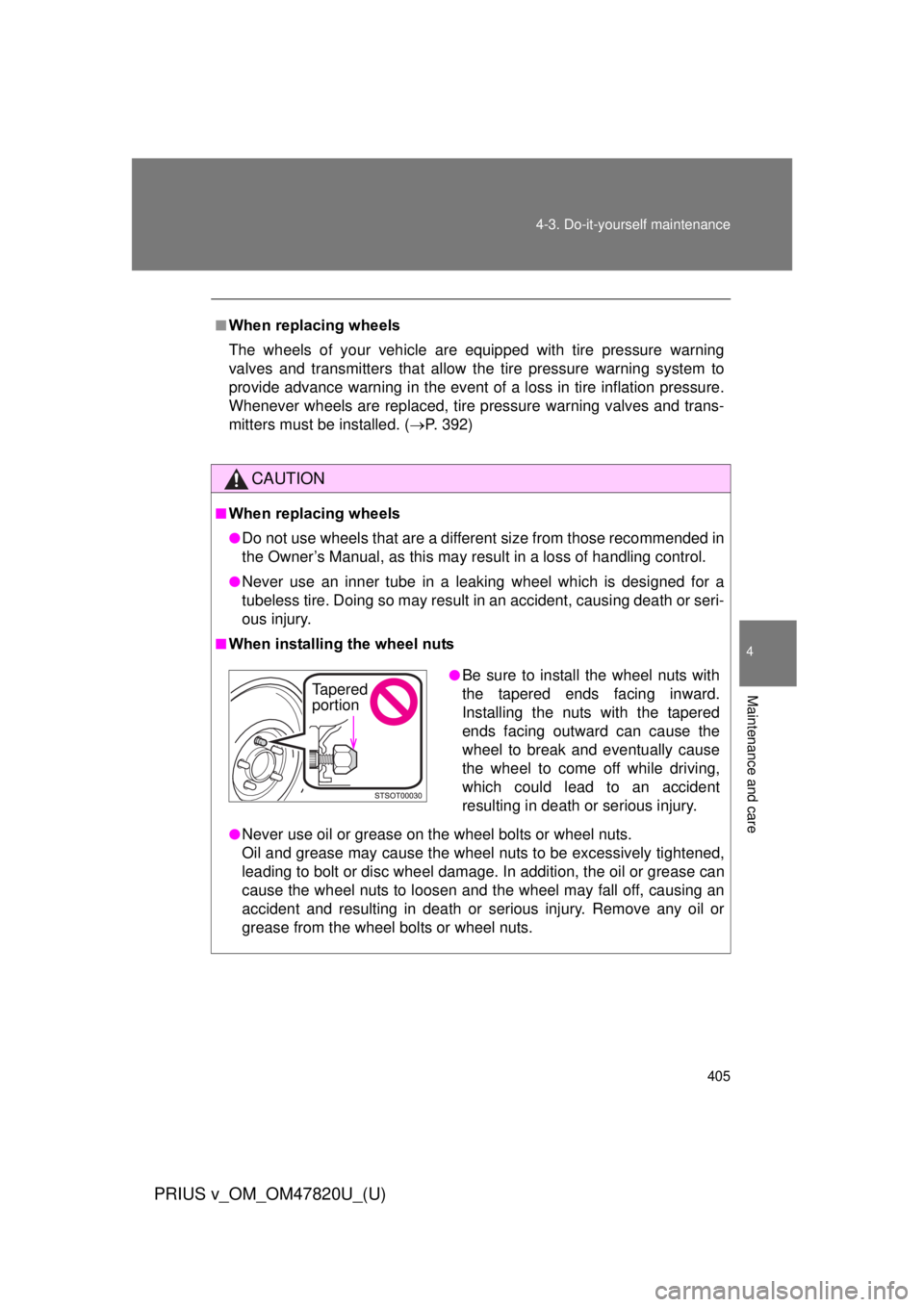
●Be sure to install the wheel nuts with
the tapered ends facing inward.
Installing the nuts with the tapered
ends facing outward can cause the
wheel to break and eventually cause
the wheel to come off while driving,
which could lead to an accident
resulting in death or serious injury.Tapered
portion
Page 406 of 568
406 4-3. Do-it-yourself maintenance
PRIUS v_OM_OM47820U_(U)
CAUTION
■Use of defective wheels prohibited
Do not use cracked or deformed wheels.
Doing so could cause the tire to leak air during driving, possibly causing
an accident.
NOTICE
■Replacing tire pressure warning valves and transmitters
●Because tire repair or replacement may affect the tire pressure warn-
ing valves and transmitters, make sure to have tires serviced by your
Toyota dealer or other qualified service shop. In addition, make sure to
purchase your tire pressure warning valves and transmitters at your
Toyota dealer.
●Ensure that only genuine Toyota wheels are used on your vehicle.
Tire pressure warning valves and transmitters may not work properly
with non-genuine wheels.
Page 408 of 568
408 4-3. Do-it-yourself maintenance
PRIUS v_OM_OM47820U_(U)
■Checking interval
Inspect and replace the air conditioning filter according to the maintenance
schedule. In dusty areas or areas with heavy traffic flow, early replacement
may be required. (For scheduled maintenance information, please refer to
the “Scheduled Maintenance Guide” or “Owner’s Manual Supplement”.)
■ If air flow from the vents decreases dramatically
The filter may be clogged. Check the filter and replace if necessary.
NOTICE
■To prevent damage to the system
When using the air conditioning system, make sure that a filter is always
installed.
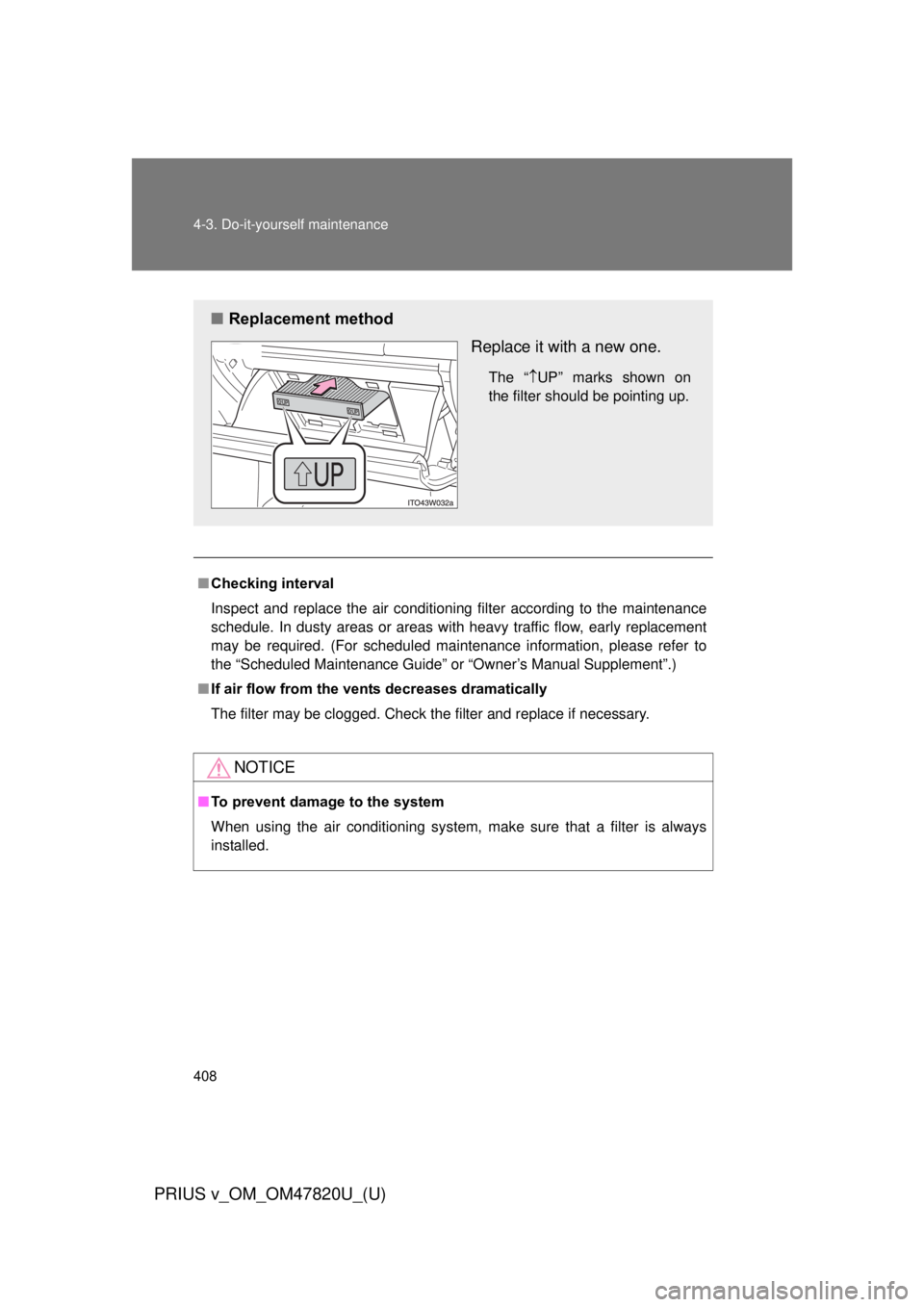
■ Replacement method
Replace it with a new one.
The “UP” marks shown on
the filter should be pointing up.
Page 409 of 568
409
4-3. Do-it-yourself maintenance
PRIUS v_OM_OM47820U_(U)
4
Maintenance and care
Electronic key batter y
Replace the battery with a new one if it is depleted.
■You will need the following items:
●Flathead screwdriver
● Lithium battery CR1632
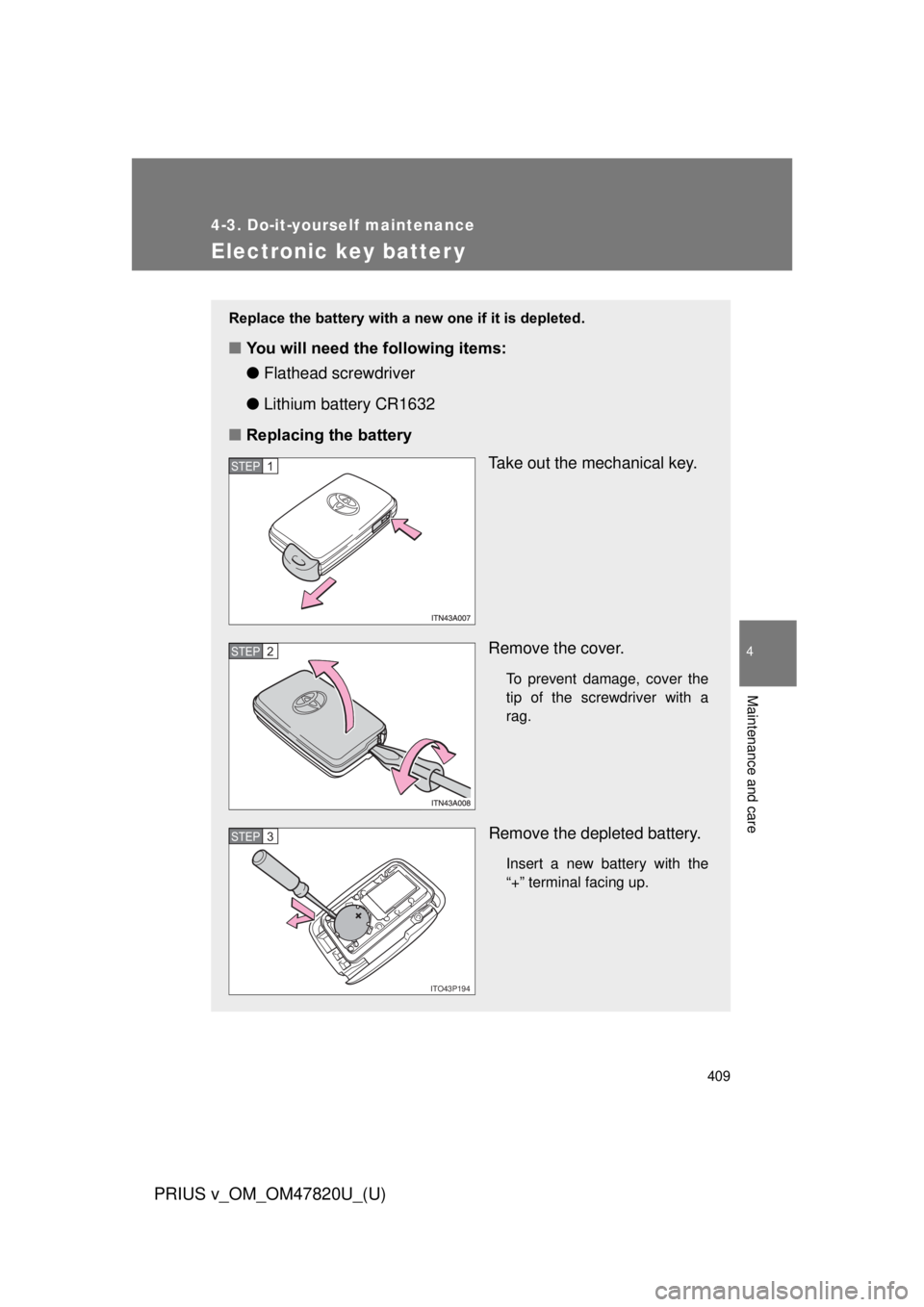
■ Replacing the battery
Take out the mechanical key.
Remove the cover.
To prevent damage, cover the
tip of the screwdriver with a
rag.
Remove the depleted battery.
Insert a new battery with the
“+” terminal facing up.
STEP 1
STEP 2
ITO43P194
STEP 3
Page 410 of 568
410 4-3. Do-it-yourself maintenance
PRIUS v_OM_OM47820U_(U)
■Use a CR1632 lithium battery
● Batteries can be purchased at your Toyota dealer, local electrical appli-
ance shops or camera stores.
● Replace only with the same or equivalent type recommended by the
manufacturer.
● Dispose of used batteries according to local laws.
■ If the electronic key battery is depleted
The following symptoms may occur:
● The smart key system and wireless remote control will not function prop-
erly.
● The operational range will be reduced.
CAUTION
■Removed battery and other parts
These parts are small and if swallowed by a child, they can cause choking.
Keep away from children. Failure to do so could result in death or serious
injury.
NOTICE
■For normal operation after replacing the battery
Observe the following precautions to prevent accidents:
● Always work with dry hands.
Moisture may cause the battery to rust.
● Do not touch or move any other component inside the remote control.
● Do not bend either of the battery terminals.
Page 411 of 568
411
4-3. Do-it-yourself maintenance
PRIUS v_OM_OM47820U_(U)
4
Maintenance and care
Checking and replacing fuses
If any of the electrical components do not operate, a fuse may have
blown. If this happens, check and replace the fuses as necessary.
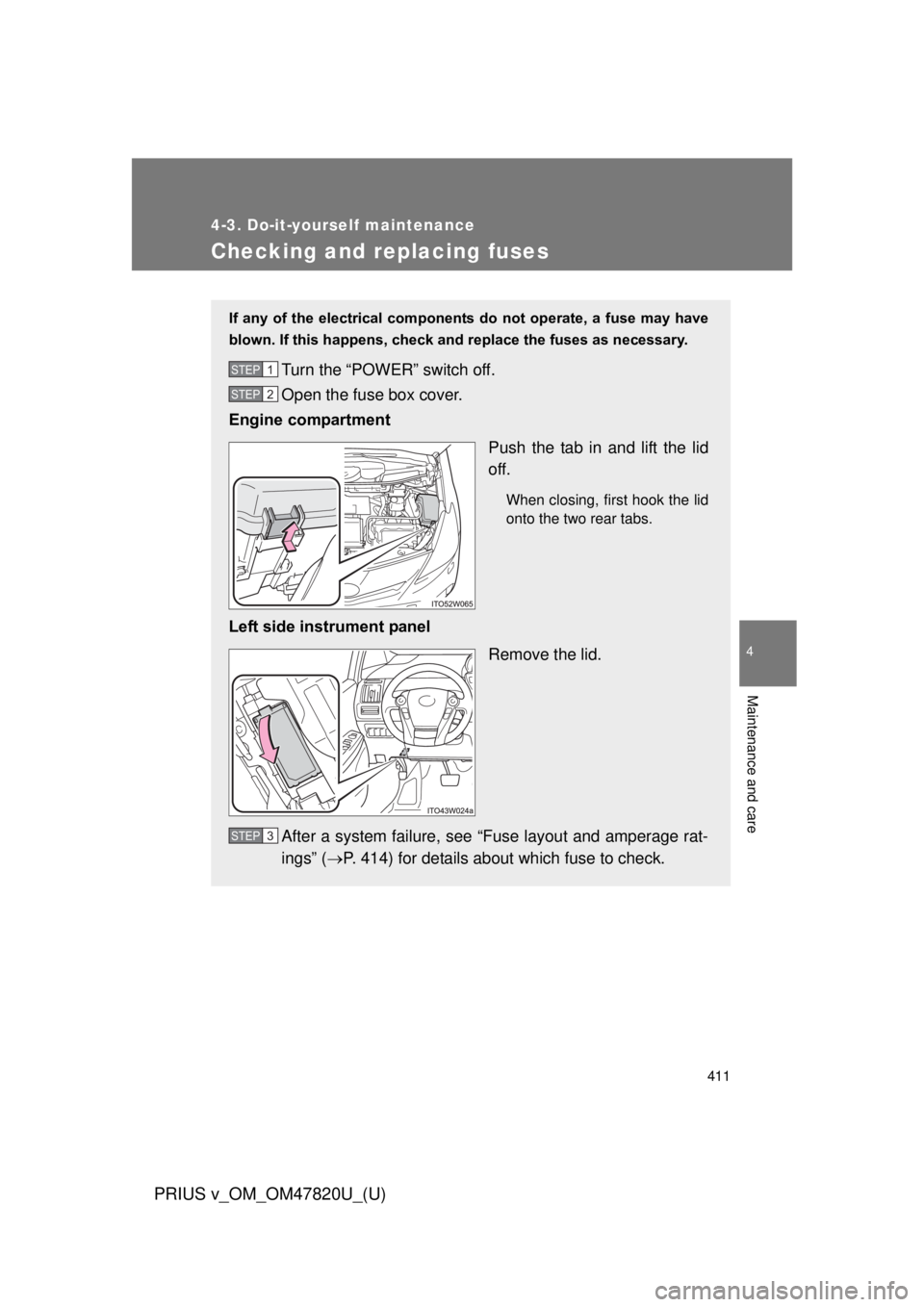
Turn the “POWER” switch off.
Open the fuse box cover.
Engine compartment
Push the tab in and lift the lid
off.
When closing, first hook the lid
onto the two rear tabs.
Left side instrument panelRemove the lid.
After a system failure, see “Fuse layout and amperage rat-
ings” ( P. 414) for details about which fuse to check.
STEP 1
STEP 2
STEP 3
Page 412 of 568
412 4-3. Do-it-yourself maintenance
PRIUS v_OM_OM47820U_(U)
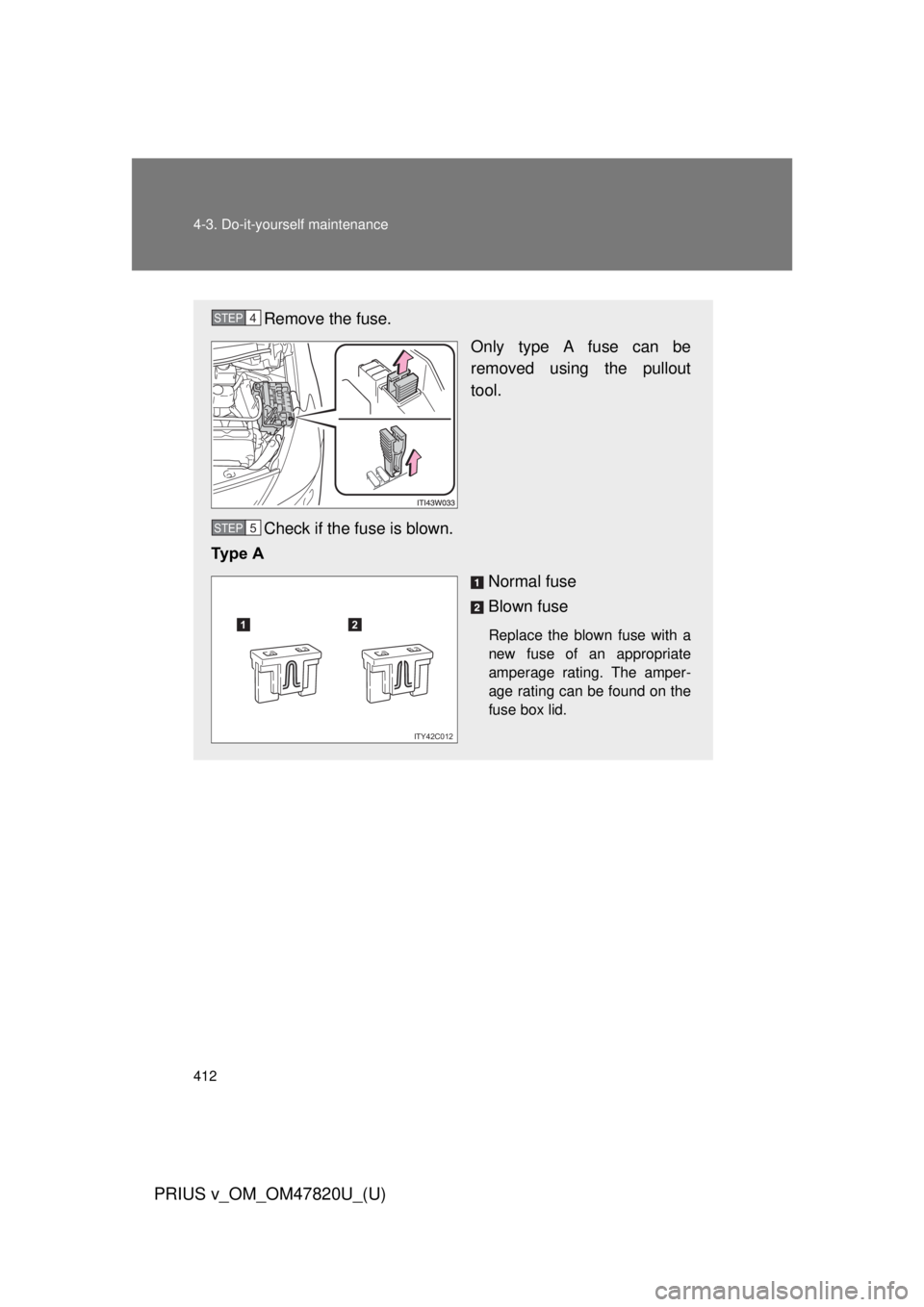
Remove the fuse.Only type A fuse can be
removed using the pullout
tool.
Check if the fuse is blown.
Ty p e A
Normal fuse
Blown fuse
Replace the blown fuse with a
new fuse of an appropriate
amperage rating. The amper-
age rating can be found on the
fuse box lid.
STEP 4
STEP 5
12
ITY42C012
Page 413 of 568
413
4-3. Do-it-yourself maintenance
PRIUS v_OM_OM47820U_(U)
4
Maintenance and care
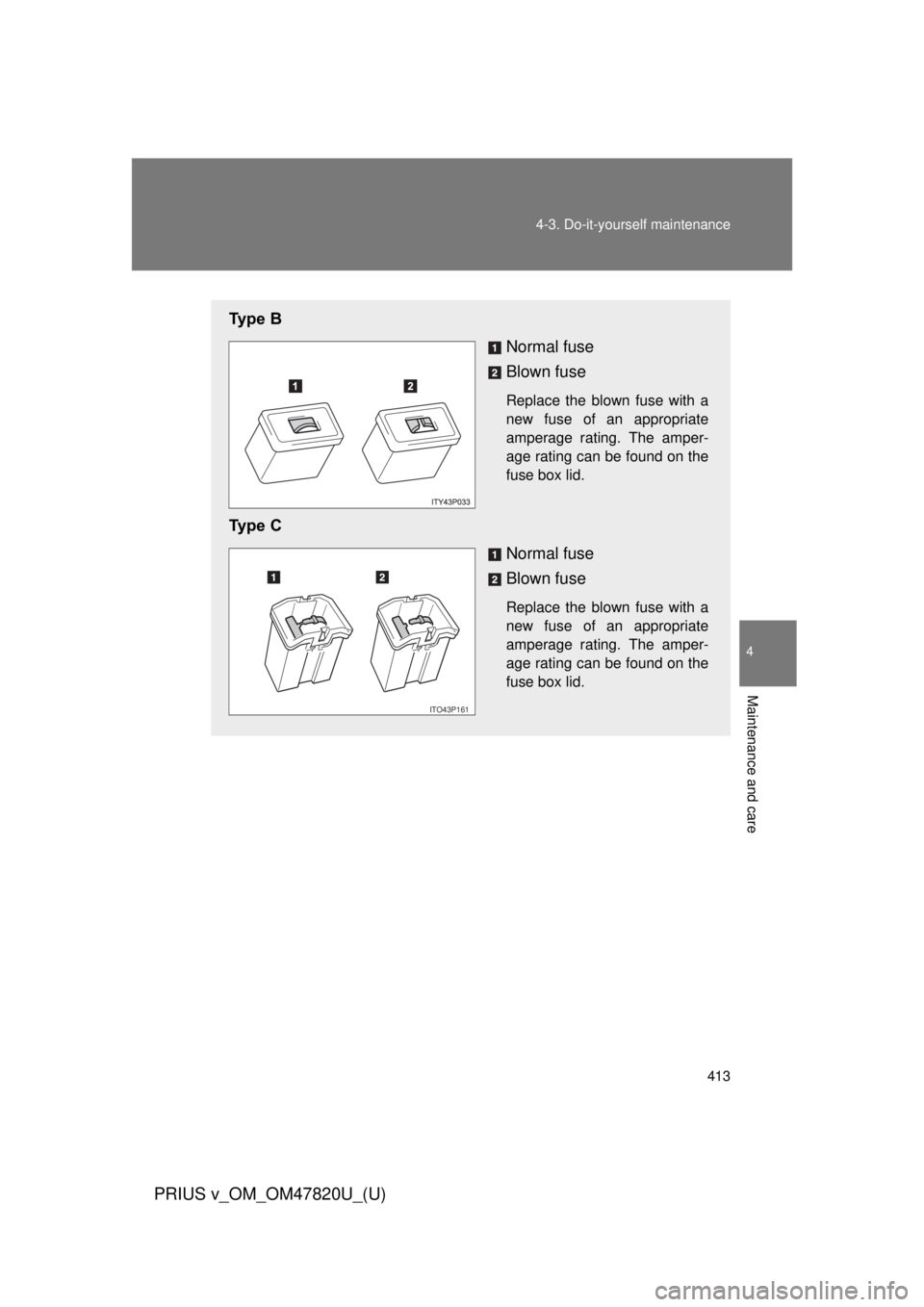
Ty p e B
Normal fuse
Blown fuse
Replace the blown fuse with a
new fuse of an appropriate
amperage rating. The amper-
age rating can be found on the
fuse box lid.
Ty p e CNormal fuse
Blown fuse
Replace the blown fuse with a
new fuse of an appropriate
amperage rating. The amper-
age rating can be found on the
fuse box lid.
ITO43P161
Page 420 of 568
420 4-3. Do-it-yourself maintenance
PRIUS v_OM_OM47820U_(U)
■After a fuse is replaced
● If the lights do not turn on even after the fuse has been replaced, a bulb
may need replacement. (P. 422)
● If the replaced fuse blows again, have the vehicle inspected by your
Toyota dealer.
■ If there is an overload in a circuit
The fuses are designed to blow, protecting the wiring harness from damage.
■ When replacing light bulbs
Toyota recommends that you use genuine Toyota products designed for this
vehicle. Because certain bulbs are connected to circuits designed to prevent
overload, non-genuine parts or parts not designed for this vehicle may be
unusable.
CAUTION
■To prevent system breakdowns and vehicle fire
Observe the following precautions.
Failure to do so may cause damage to the vehicle, and possibly a fire or
injury.
● Never use a fuse of a higher amperage rating than that indicated, or use
any other object in place of a fuse.
● Always use a genuine Toyota fuse or equivalent.
Never replace a fuse with a wire, even as a temporary fix.
● Do not modify the fuses or fuse boxes.
■ Fuse box near the power control unit
Never check or replace the fuses as there are high voltage parts and wiring
near the fuse box.
Doing so may cause electric shock, resulting in death or serious injury.