ignition TOYOTA PROACE 2017 Workshop Manual
[x] Cancel search | Manufacturer: TOYOTA, Model Year: 2017, Model line: PROACE, Model: TOYOTA PROACE 2017Pages: 516, PDF Size: 91.65 MB
Page 159 of 516
159
* Depending on the country of sale.
Heated windscreen and
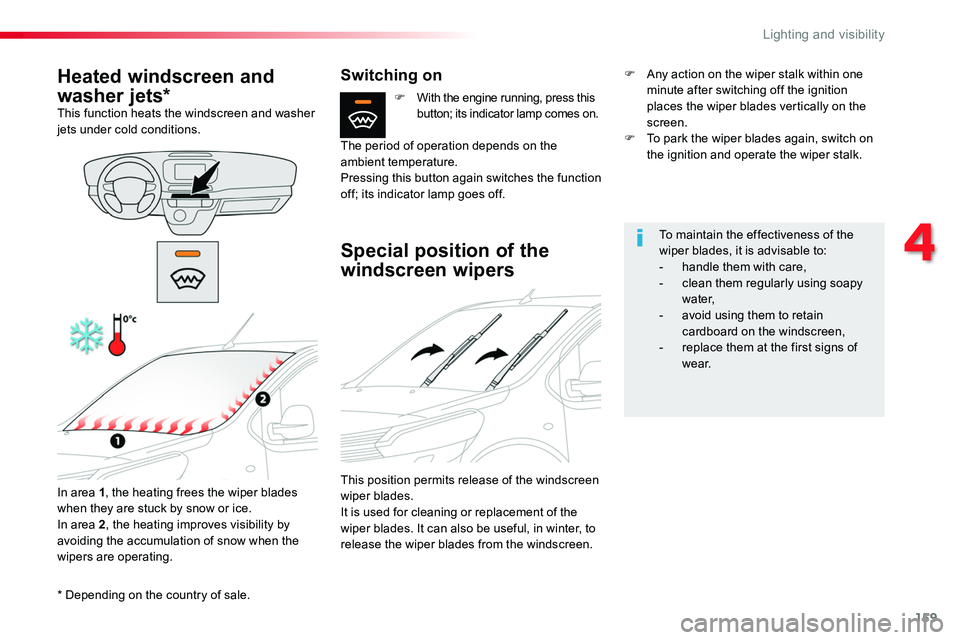
washer jets*This function heats the windscreen and washer jets under cold conditions.
In area 1, the heating frees the wiper blades when they are stuck by snow or ice.In area 2, the heating improves visibility by
avoiding the accumulation of snow when the wipers are operating.
Switching on
F With the engine running, press this button; its indicator lamp comes on.
The period of operation depends on the ambient temperature.Pressing this button again switches the function off; its indicator lamp goes off.
Special position of the
windscreen wipers
This position permits release of the windscreen wiper blades.It is used for cleaning or replacement of the wiper blades. It can also be useful, in winter, to release the wiper blades from the windscreen.
To maintain the effectiveness of the wiper blades, it is advisable to:- handle them with care,- clean them regularly using soapy water,- avoid using them to retain cardboard on the windscreen,- replace them at the first signs of w e a r.
F Any action on the wiper stalk within one minute after switching off the ignition places the wiper blades vertically on the screen.F To park the wiper blades again, switch on the ignition and operate the wiper stalk.
4
Lighting and visibility
Page 160 of 516
160
Automatic operation of
hazard warning lamps
Hazard warning lamps
When braking in an emergency, depending on the rate of deceleration, as well as when the ABS regulation is invoked or in the event of an impact, the hazard warning lamps come on automatically.They switch off automatically the first time you accelerate.F You can also switch them off by pressing the button.
Visual warning with all of the direction indicators flashing to alert other road users to a vehicle breakdown, towing or accident.
ER A - GLONASS
emergency call
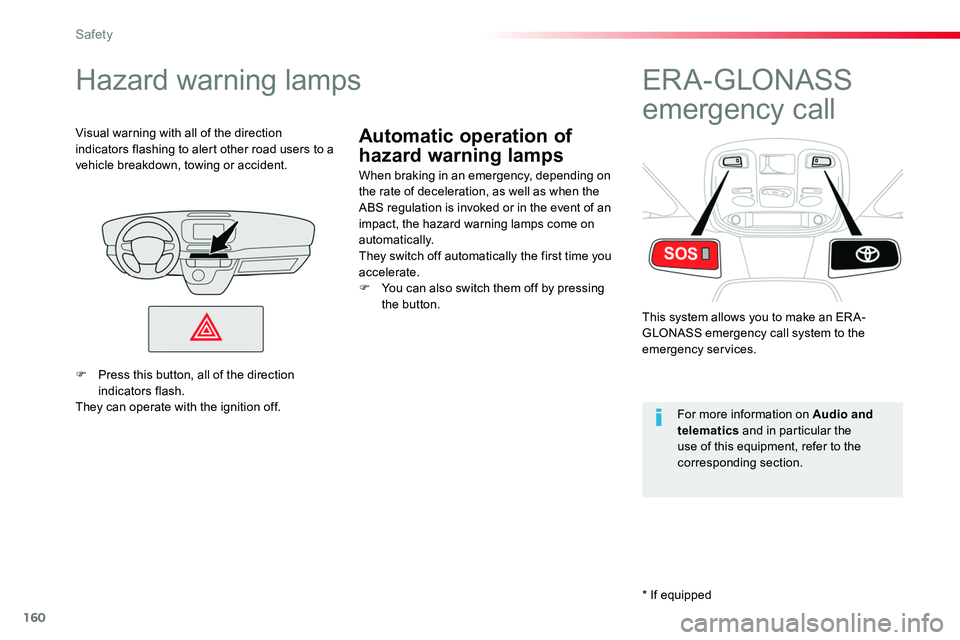
This system allows you to make an ER A-GLONASS emergency call system to the emergency services.
For more information on Audio and telematics and in particular the use of this equipment, refer to the corresponding section.
F Press this button, all of the direction indicators flash.They can operate with the ignition off.
* If equipped
Safety
Page 163 of 516
163
Dynamic stability control (DSC) and anti-slip regulation (ASR)
Activation
These systems are activated automatically each time the vehicle is started.As soon as they detect a problem of grip or trajectory, these systems act on the operation of the engine and brakes.
This is indicated by flashing of this warning lamp in the instrument panel.
Deactivation
In exceptional conditions (starting a vehicle which is bogged down, stuck in snow, on soft ground...), it may be advisable to deactivate the DSC system, so that the wheels can move freely and regain grip.But it is recommended that the system be reactivated as soon as possible.
Operating fault
Reactivation
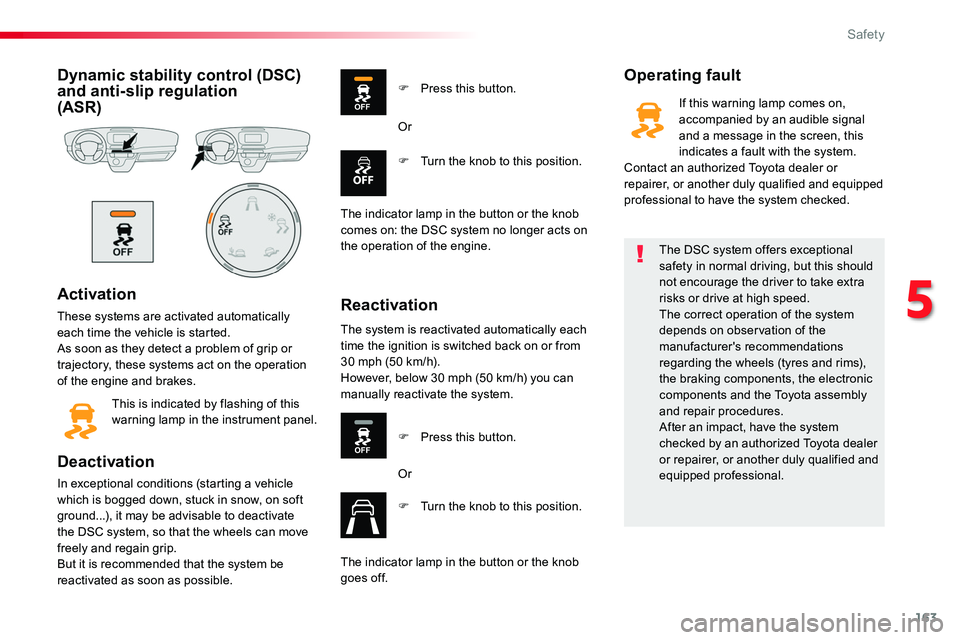
F Press this button.
F Turn the knob to this position.
Or
The indicator lamp in the button or the knob
comes on: the DSC system no longer acts on the operation of the engine.
The system is reactivated automatically each time the ignition is switched back on or from 30 mph (50 km/h).However, below 30 mph (50 km/h) you can manually reactivate the system.
F Press this button.
Or
F Turn the knob to this position.
The indicator lamp in the button or the knob goes off.
The DSC system offers exceptional safety in normal driving, but this should not encourage the driver to take extra risks or drive at high speed.The correct operation of the system depends on observation of the manufacturer's recommendations regarding the wheels (tyres and rims), the braking components, the electronic components and the Toyota assembly and repair procedures.After an impact, have the system checked by an authorized Toyota dealer or repairer, or another duly qualified and equipped professional.
If this warning lamp comes on, accompanied by an audible signal and a message in the screen, this indicates a fault with the system.Contact an authorized Toyota dealer or repairer, or another duly qualified and equipped professional to have the system checked.
5
Safety
Page 164 of 516
164
To y o t a Tr a c t i o n
Select
Special patented traction control system which improves traction on snow, mud and sand.This system, the operation of which has been optimised for each situation, allows you to manoeuvre in most conditions of poor grip (encountered during touring use).
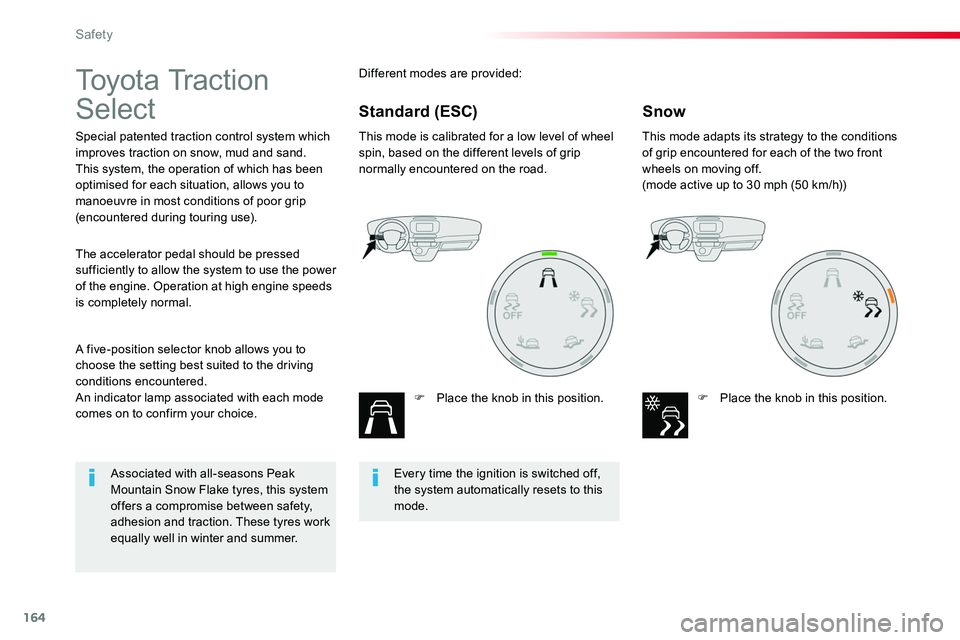
This mode is calibrated for a low level of wheel spin, based on the different levels of grip normally encountered on the road.
F Place the knob in this position.
This mode adapts its strategy to the conditions of grip encountered for each of the two front wheels on moving off.(mode active up to 30 mph (50 km/h))
F Place the knob in this position.
A five-position selector knob allows you to choose the setting best suited to the driving conditions encountered.An indicator lamp associated with each mode comes on to confirm your choice.
The accelerator pedal should be pressed sufficiently to allow the system to use the power of the engine. Operation at high engine speeds is completely normal.
Different modes are provided:
SnowStandard (ESC)
Every time the ignition is switched off, the system automatically resets to this mode.
Associated with all-seasons Peak Mountain Snow Flake tyres, this system offers a compromise between safety, adhesion and traction. These tyres work equally well in winter and summer.
Safety
Page 165 of 516
165
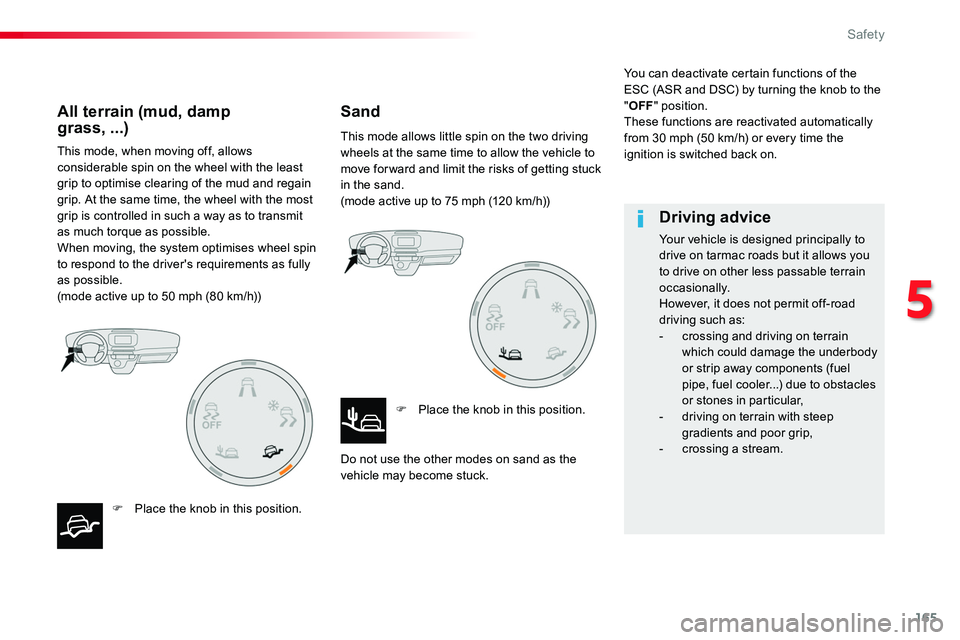
This mode, when moving off, allows considerable spin on the wheel with the least grip to optimise clearing of the mud and regain grip. At the same time, the wheel with the most grip is controlled in such a way as to transmit
as much torque as possible.When moving, the system optimises wheel spin to respond to the driver's requirements as fully as possible.(mode active up to 50 mph (80 km/h))
F Place the knob in this position.
This mode allows little spin on the two driving wheels at the same time to allow the vehicle to move for ward and limit the risks of getting stuck in the sand.(mode active up to 75 mph (120 km/h))
F Place the knob in this position.
Do not use the other modes on sand as the vehicle may become stuck.
You can deactivate certain functions of the ESC (ASR and DSC) by turning the knob to the "OFF" position.These functions are reactivated automatically from 30 mph (50 km/h) or every time the ignition is switched back on.
All terrain (mud, damp grass, ...)Sand
Driving advice
Your vehicle is designed principally to drive on tarmac roads but it allows you to drive on other less passable terrain occasionally.However, it does not permit off-road driving such as:- crossing and driving on terrain which could damage the underbody or strip away components (fuel pipe, fuel cooler...) due to obstacles or stones in particular,- driving on terrain with steep gradients and poor grip,- crossing a stream.
5
Safety
Page 166 of 516
166
Seat belts
Front seat beltsFastening
Unfastening
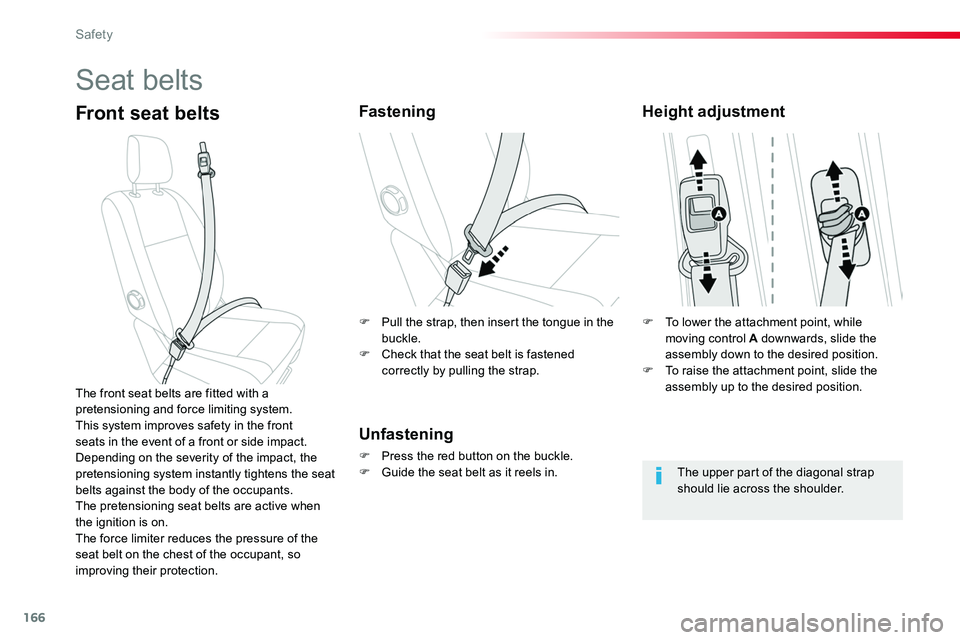
F Press the red button on the buckle.F Guide the seat belt as it reels in.
The front seat belts are fitted with a pretensioning and force limiting system.This system improves safety in the front seats in the event of a front or side impact. Depending on the severity of the impact, the pretensioning system instantly tightens the seat belts against the body of the occupants.The pretensioning seat belts are active when the ignition is on.The force limiter reduces the pressure of the seat belt on the chest of the occupant, so improving their protection.
Height adjustment
The upper part of the diagonal strap should lie across the shoulder.
F To lower the attachment point, while moving control A downwards, slide the assembly down to the desired position.F To raise the attachment point, slide the assembly up to the desired position.
F Pull the strap, then insert the tongue in the buckle.F Check that the seat belt is fastened correctly by pulling the strap.
Safety
Page 168 of 516
168
Seat belt warning lamps
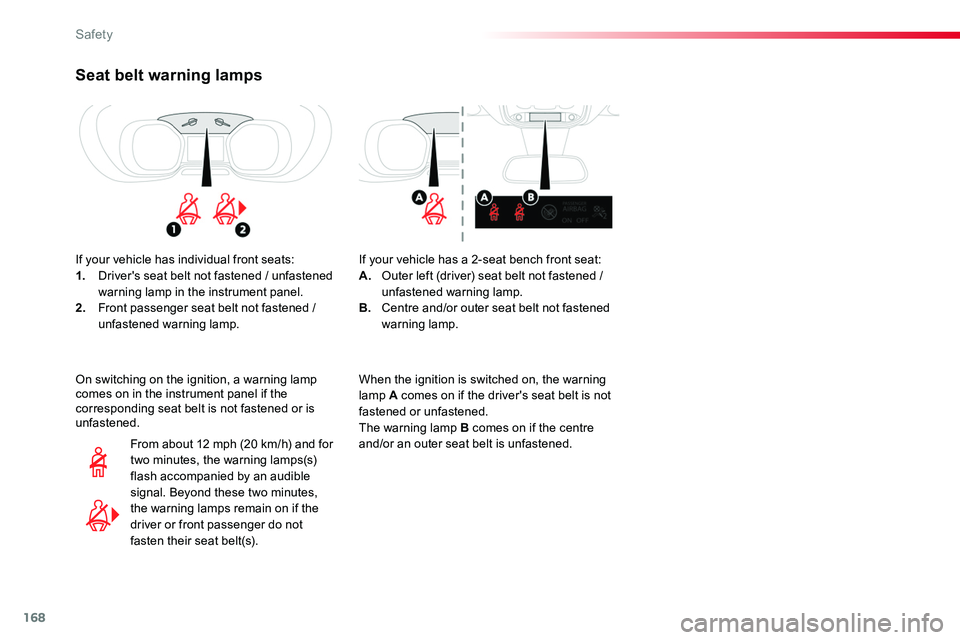
If your vehicle has individual front seats:1. Driver's seat belt not fastened / unfastened warning lamp in the instrument panel.2. Front passenger seat belt not fastened / unfastened warning lamp.
From about 12 mph (20 km/h) and for two minutes, the warning lamps(s) flash accompanied by an audible signal. Beyond these two minutes, the warning lamps remain on if the driver or front passenger do not fasten their seat belt(s).
On switching on the ignition, a warning lamp comes on in the instrument panel if the corresponding seat belt is not fastened or is unfastened.
If your vehicle has a 2-seat bench front seat:A. Outer left (driver) seat belt not fastened / unfastened warning lamp.B. Centre and/or outer seat belt not fastened warning lamp.
When the ignition is switched on, the warning lamp A comes on if the driver's seat belt is not fastened or unfastened.The warning lamp B comes on if the centre and/or an outer seat belt is unfastened.
Safety
Page 170 of 516
170
Airbags
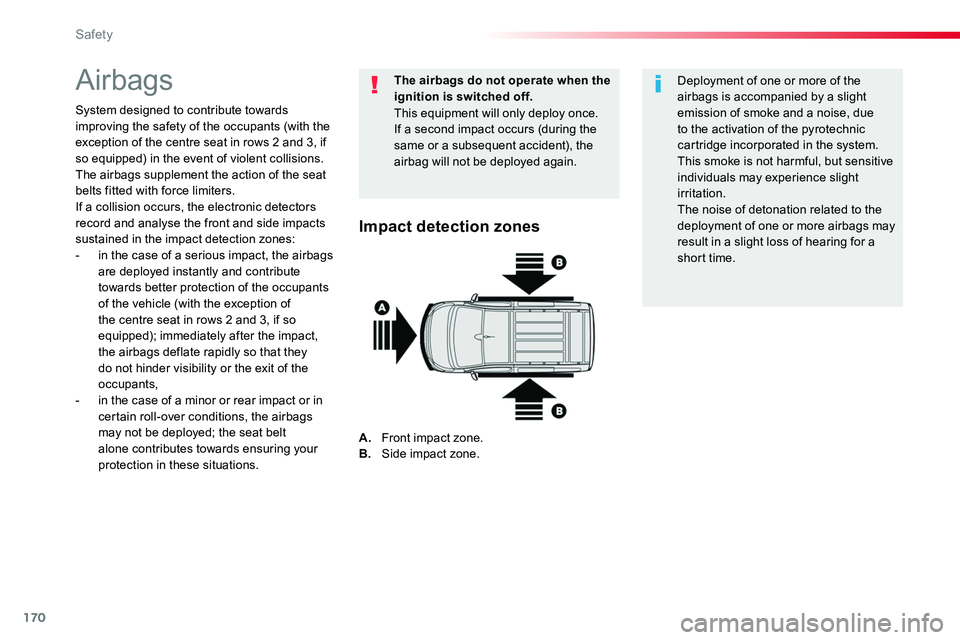
System designed to contribute towards improving the safety of the occupants (with the exception of the centre seat in rows 2 and 3, if so equipped) in the event of violent collisions. The airbags supplement the action of the seat belts fitted with force limiters.If a collision occurs, the electronic detectors record and analyse the front and side impacts sustained in the impact detection zones:- in the case of a serious impact, the airbags are deployed instantly and contribute towards better protection of the occupants of the vehicle (with the exception of the centre seat in rows 2 and 3, if so equipped); immediately after the impact, the airbags deflate rapidly so that they do not hinder visibility or the exit of the occupants,- in the case of a minor or rear impact or in certain roll-over conditions, the airbags may not be deployed; the seat belt alone contributes towards ensuring your protection in these situations.
The airbags do not operate when the ignition is switched off.
This equipment will only deploy once. If a second impact occurs (during the same or a subsequent accident), the airbag will not be deployed again.
Deployment of one or more of the airbags is accompanied by a slight emission of smoke and a noise, due to the activation of the pyrotechnic cartridge incorporated in the system.This smoke is not harmful, but sensitive individuals may experience slight irritation.The noise of detonation related to the
deployment of one or more airbags may result in a slight loss of hearing for a short time.
Impact detection zones
A. Front impact zone.B. Side impact zone.
Safety
Page 172 of 516
172
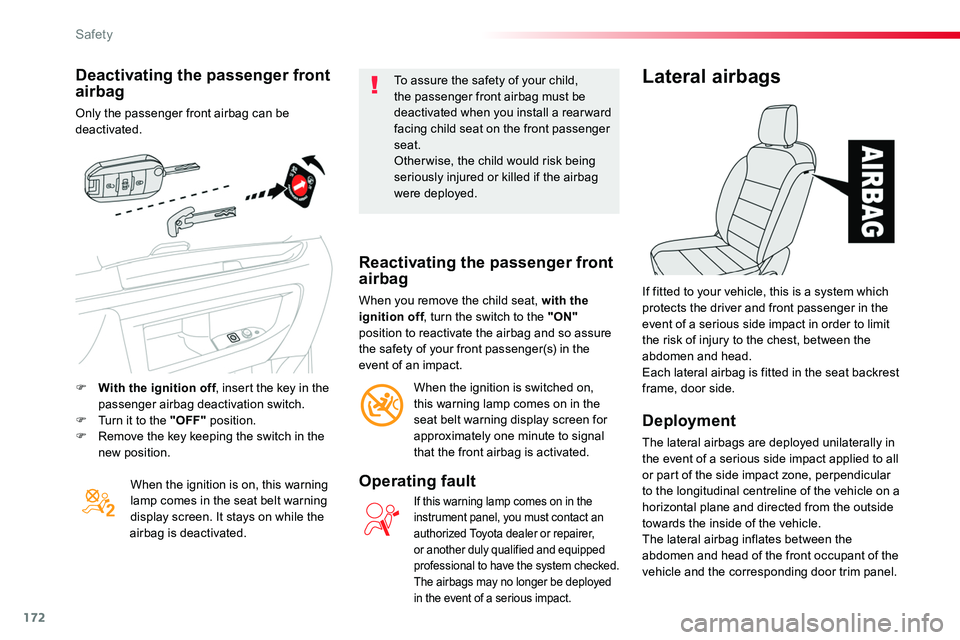
Deactivating the passenger front airbag
Only the passenger front airbag can be deactivated.
When the ignition is on, this warning lamp comes in the seat belt warning display screen. It stays on while the airbag is deactivated.
To assure the safety of your child, the passenger front airbag must be deactivated when you install a rear ward facing child seat on the front passenger seat.Otherwise, the child would risk being seriously injured or killed if the airbag were deployed.
Reactivating the passenger front airbag
When you remove the child seat, with the ignition off, turn the switch to the "ON" position to reactivate the airbag and so assure the safety of your front passenger(s) in the event of an impact.
When the ignition is switched on, this warning lamp comes on in the seat belt warning display screen for approximately one minute to signal that the front airbag is activated.
Operating fault
If this warning lamp comes on in the instrument panel, you must contact an
authorized Toyota dealer or repairer, or another duly qualified and equipped professional to have the system checked. The airbags may no longer be deployed in the event of a serious impact.
Lateral airbags
Deployment
The lateral airbags are deployed unilaterally in the event of a serious side impact applied to all or part of the side impact zone, perpendicular to the longitudinal centreline of the vehicle on a horizontal plane and directed from the outside towards the inside of the vehicle.
The lateral airbag inflates between the abdomen and head of the front occupant of the vehicle and the corresponding door trim panel.
If fitted to your vehicle, this is a system which protects the driver and front passenger in the event of a serious side impact in order to limit the risk of injury to the chest, between the abdomen and head.Each lateral airbag is fitted in the seat backrest frame, door side.F With the ignition off, insert the key in the passenger airbag deactivation switch.F Turn it to the "OFF" position.F Remove the key keeping the switch in the new position.
Safety
Page 194 of 516
194
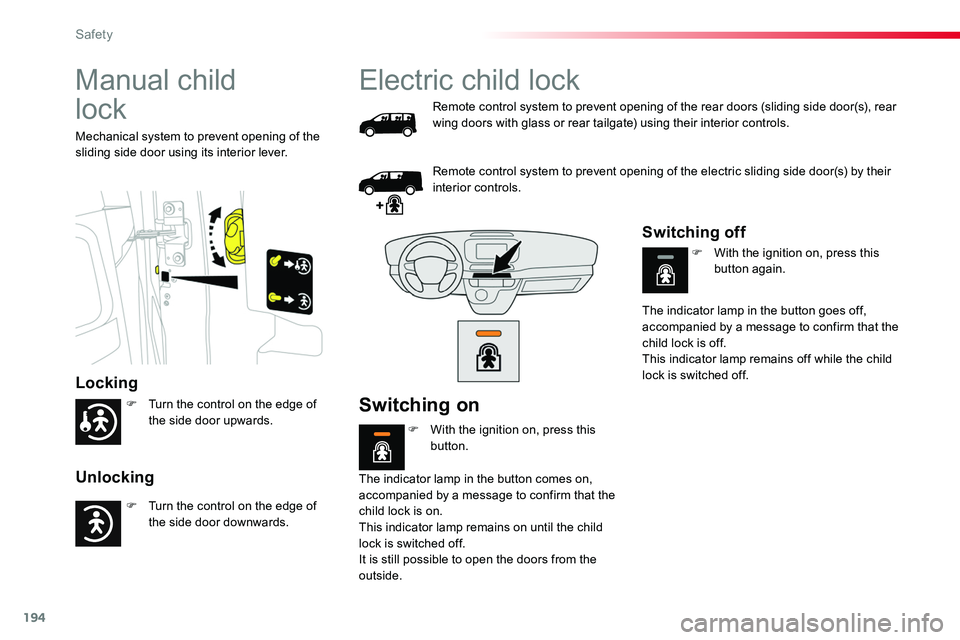
Manual child
lock
Locking
Unlocking
Mechanical system to prevent opening of the sliding side door using its interior lever.
Electric child lock
Remote control system to prevent opening of the rear doors (sliding side door(s), rear wing doors with glass or rear tailgate) using their interior controls.
The indicator lamp in the button comes on, accompanied by a message to confirm that the child lock is on.This indicator lamp remains on until the child lock is switched off.It is still possible to open the doors from the outside.
The indicator lamp in the button goes off, accompanied by a message to confirm that the child lock is off.This indicator lamp remains off while the child lock is switched off.
Switching on
F With the ignition on, press this button.
F With the ignition on, press this button again.
Switching off
F Turn the control on the edge of the side door upwards.
F Turn the control on the edge of the side door downwards.
Remote control system to prevent opening of the electric sliding side door(s) by their interior controls.
Safety