parking brake TOYOTA PROACE 2019 (in English) User Guide
[x] Cancel search | Manufacturer: TOYOTA, Model Year: 2019, Model line: PROACE, Model: TOYOTA PROACE 2019Pages: 516, PDF Size: 90.91 MB
Page 206 of 516
206
Hill start assist control (HAC)
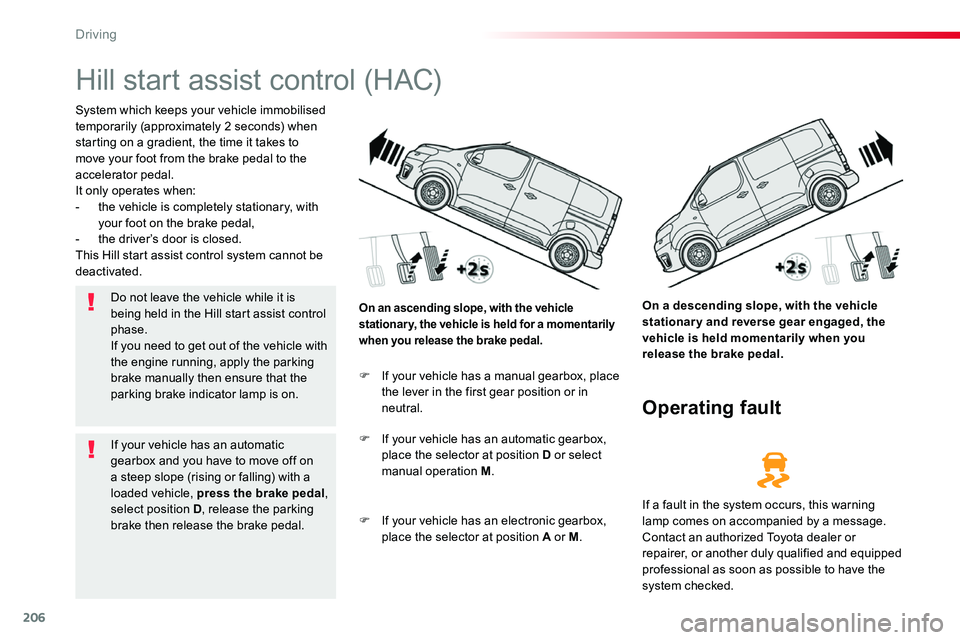
System which keeps your vehicle immobilised temporarily (approximately 2 seconds) when starting on a gradient, the time it takes to move your foot from the brake pedal to the accelerator pedal.It only operates when:- the vehicle is completely stationary, with your foot on the brake pedal,- the driver’s door is closed.This Hill start assist control system cannot be deactivated.
On a descending slope, with the vehicle stationary and reverse gear engaged, the vehicle is held momentarily when you release the brake pedal.
On an ascending slope, with the vehicle stationary, the vehicle is held for a momentarily when you release the brake pedal.
Operating fault
F If your vehicle has a manual gearbox, place the lever in the first gear position or in neutral.
F If your vehicle has an automatic gearbox, place the selector at position D or select manual operation M.
F If your vehicle has an electronic gearbox,
place the selector at position A or M.
If a fault in the system occurs, this warning lamp comes on accompanied by a message. Contact an authorized Toyota dealer or repairer, or another duly qualified and equipped professional as soon as possible to have the
system checked.
Do not leave the vehicle while it is being held in the Hill start assist control phase.If you need to get out of the vehicle with the engine running, apply the parking brake manually then ensure that the parking brake indicator lamp is on.
If your vehicle has an automatic gearbox and you have to move off on a steep slope (rising or falling) with a loaded vehicle, press the brake pedal, select position D, release the parking brake then release the brake pedal.
Driving
Page 209 of 516
209
Automatic gearbox
Six speed automatic gearbox which offers a choice between the comfort of automatic operation or manual gear changing.Two driving modes are offered:- automatic operation for electronic management of the gears by the gearbox,- manual operation for sequential changing of the gears by the driver.
Gear selector
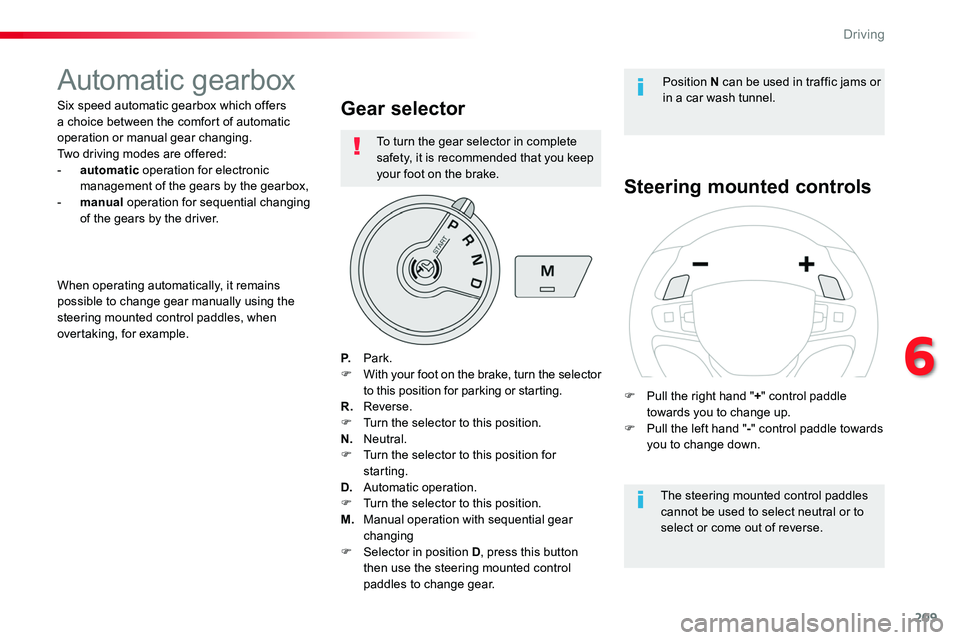
P. Park.F With your foot on the brake, turn the selector to this position for parking or starting.R. Reverse.F Turn the selector to this position.N. Neutral.F Turn the selector to this position for starting.D. Automatic operation.F Turn the selector to this position.
M. Manual operation with sequential gear changingF Selector in position D, press this button then use the steering mounted control paddles to change gear.
Steering mounted controls
The steering mounted control paddles cannot be used to select neutral or to select or come out of reverse.
When operating automatically, it remains possible to change gear manually using the steering mounted control paddles, when overtaking, for example.
Position N can be used in traffic jams or in a car wash tunnel.
F Pull the right hand "+" control paddle towards you to change up.F Pull the left hand "-" control paddle towards you to change down.
To turn the gear selector in complete safety, it is recommended that you keep your foot on the brake.
6
Driving
Page 210 of 516
210
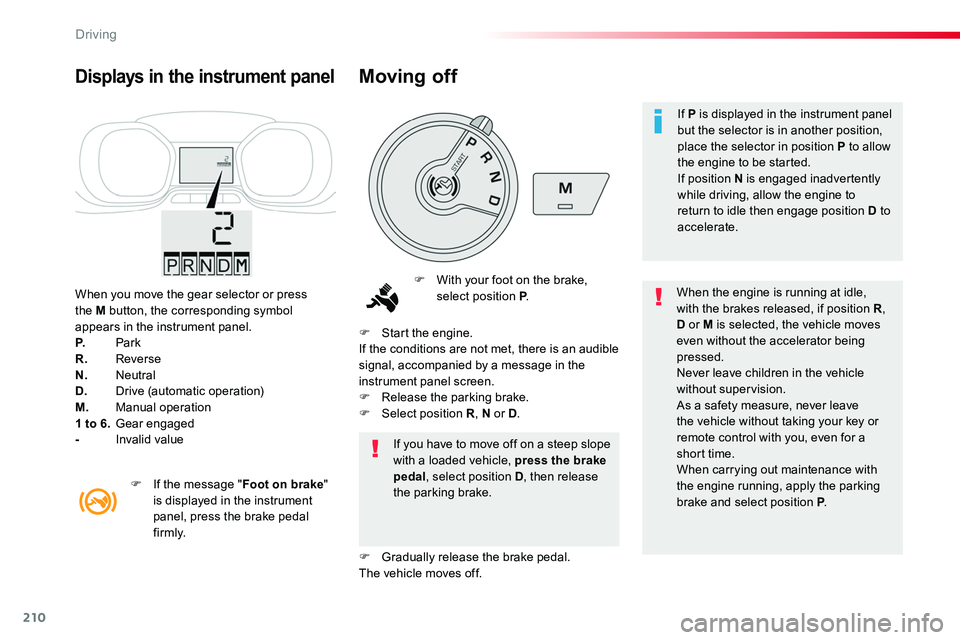
When you move the gear selector or press the M button, the corresponding symbol appears in the instrument panel.P. ParkR. ReverseN. NeutralD. Drive (automatic operation)M. Manual operation1 to 6. Gear engaged- Invalid value
Displays in the instrument panel
F With your foot on the brake, select position P.When the engine is running at idle, with the brakes released, if position R, D or M is selected, the vehicle moves even without the accelerator being pressed.Never leave children in the vehicle without supervision.As a safety measure, never leave the vehicle without taking your key or remote control with you, even for a short time.When carrying out maintenance with the engine running, apply the parking brake and select position P.
If you have to move off on a steep slope with a loaded vehicle, press the brake pedal, select position D, then release the parking brake.
F Start the engine.If the conditions are not met, there is an audible signal, accompanied by a message in the instrument panel screen.F Release the parking brake.F Select position R, N or D.
F Gradually release the brake pedal.The vehicle moves off.
F If the message "Foot on brake" is displayed in the instrument panel, press the brake pedal f i r m l y.
Moving off
If P is displayed in the instrument panel but the selector is in another position, place the selector in position P to allow the engine to be started.If position N is engaged inadvertently while driving, allow the engine to return to idle then engage position D to accelerate.
Driving
Page 211 of 516
211
Automatic operation
Never select position N while the vehicle is moving.Never select position P or R unless the vehicle is completely stationary.
Creep function (moving
without using the accelerator)This function provides great flexibility in manoeuvring the vehicle at low speed (when parking, in traffic jams, …).With the engine at idle, parking brake released and position D, M or R selected, the vehicle moves as soon as you take your foot off the brake pedal (even without pressing the accelerator).
As a safety measure (children on board), never leave the vehicle with the engine running and the doors closed.
The gearbox then operates in auto-adaptive mode, without any intervention on the part of the driver. It continuously selects the most suitable gear according to the style of driving, the profile of the road and the load in the vehicle.For maximum acceleration, without touching the selector press the accelerator pedal down fully (kick-down). The gearbox changes down
automatically or maintains the gear selected until the maximum engine speed is reached.On braking, the gearbox changes down automatically to provide effective engine braking.If you release the accelerator sharply, the gearbox will not change to a higher gear, for safety reasons.
F Select position D for automatic changing of the six gears.
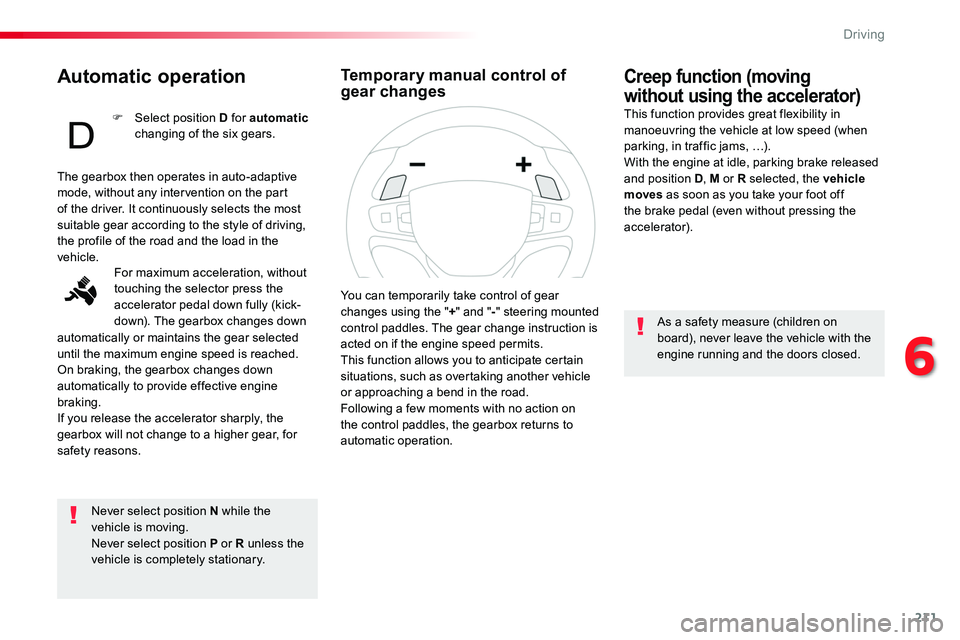
You can temporarily take control of gear changes using the "+" and "-" steering mounted control paddles. The gear change instruction is acted on if the engine speed permits.This function allows you to anticipate certain situations, such as overtaking another vehicle or approaching a bend in the road.Following a few moments with no action on the control paddles, the gearbox returns to automatic operation.
Temporary manual control of gear changes
6
Driving
Page 213 of 516
213
When the ignition is on, a message appears in the instrument panel screen to indicate a gearbox fault.
Operating fault
In this case, the gearbox switches to back-up mode and is locked in 3rd gear. You may feel
a substantial knock when changing from P to R and from N to R. This will not cause any damage to the gearbox.Do not exceed 60 mph (100 km/h), local speed restrictions permitting.Have it checked by an authorized Toyota dealer or repairer, or another duly qualified and equipped professional.
You risk damaging the gearbox:- if you press the accelerator and brake pedals at the same time (braking or acceleration must be done only with the right foot),- if you force the selector from position P to another position when the battery is flat.
To reduce fuel consumption when stationary for long periods with the engine running (traffic jam...), position the selector at N and apply the parking brake.
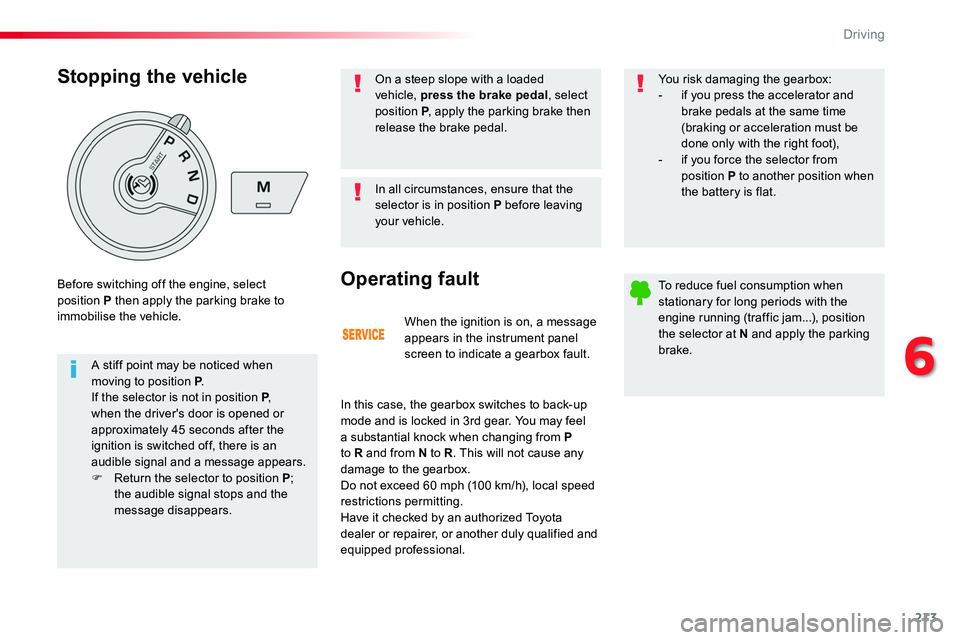
Stopping the vehicle
A stiff point may be noticed when moving to position P.If the selector is not in position P, when the driver's door is opened or
approximately 45 seconds after the ignition is switched off, there is an audible signal and a message appears.F Return the selector to position P; the audible signal stops and the message disappears.
Before switching off the engine, select position P then apply the parking brake to immobilise the vehicle.
In all circumstances, ensure that the selector is in position P before leaving your vehicle.
On a steep slope with a loaded vehicle, press the brake pedal, select position P, apply the parking brake then release the brake pedal.
6
Driving
Page 215 of 516
215
Automatic operation
F After starting the engine, select position A for automatic gear changes
The gearbox operates in auto-active mode, without any action on the part of the driver. It continuously selects the most suitable gear for:- the style of driving,- the profile of the road.
AUTO and the gear engaged are displayed in the instrument panel.
For optimum acceleration, for example when overtaking another
vehicle, press the accelerator pedal firmly past the point of resistance.
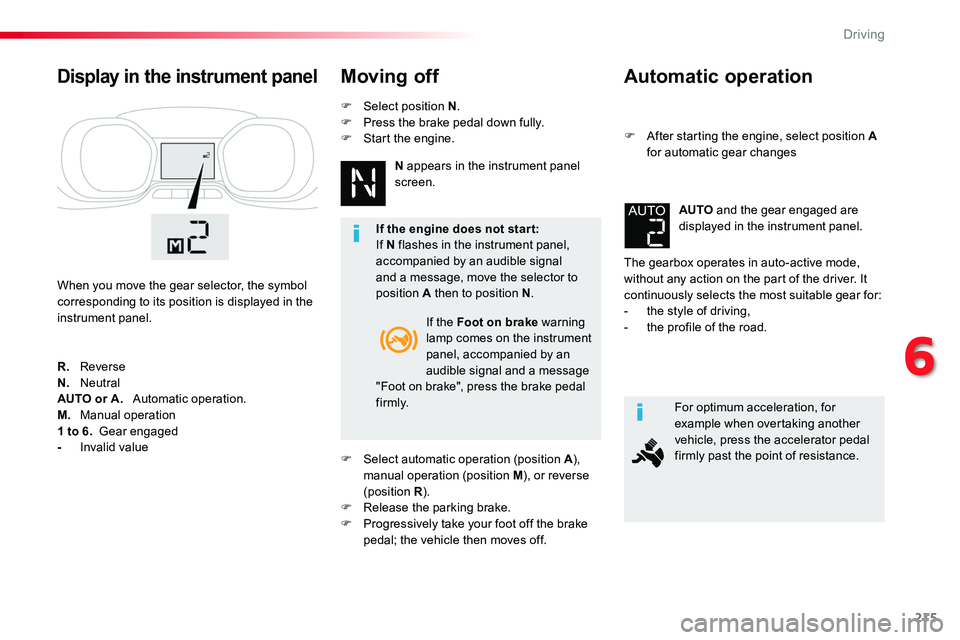
Display in the instrument panel
When you move the gear selector, the symbol corresponding to its position is displayed in the instrument panel.
Moving off
If the Foot on brake warning lamp comes on the instrument panel, accompanied by an audible signal and a message "Foot on brake", press the brake pedal f i r m l y.
R. ReverseN. NeutralAUTO or A. Automatic operation.M. Manual operation
1 to 6. Gear engaged- Invalid value
If the engine does not star t:If N flashes in the instrument panel, accompanied by an audible signal and a message, move the selector to position A then to position N.
F Select automatic operation (position A), manual operation (position M), or reverse (position R).F Release the parking brake.F Progressively take your foot off the brake
pedal; the vehicle then moves off.
N appears in the instrument panel screen.
F Select position N.F Press the brake pedal down fully.F Start the engine.
6
Driving
Page 217 of 516
217
With the ignition on, the flashing of A or AUTO, accompanied by an audible signal and a message, indicates a malfunction of the gearbox.
Operating fault
Have it checked by an authorized Toyota dealer or repairer, or another duly qualified and equipped professional.
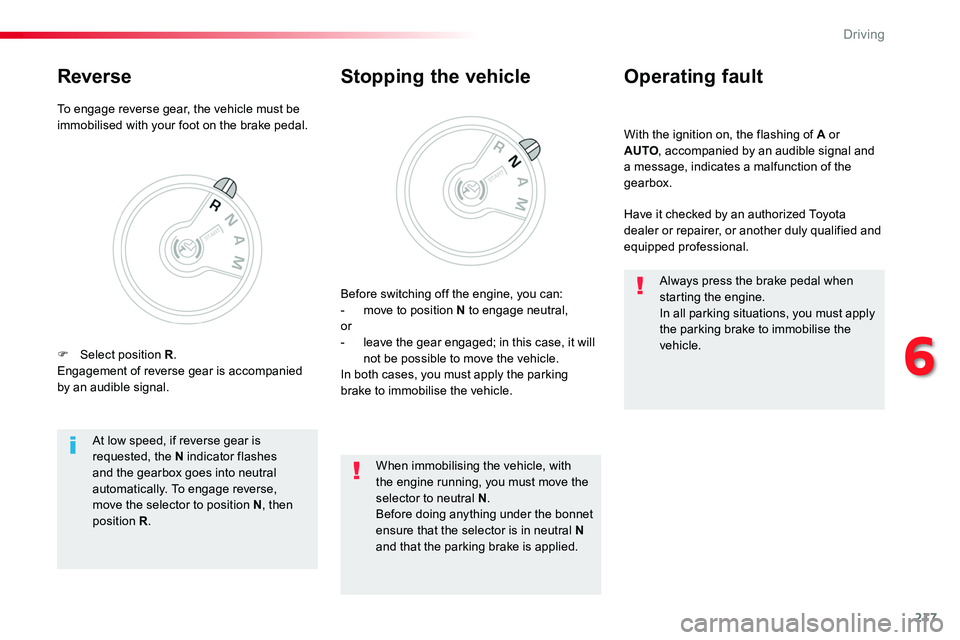
Stopping the vehicle
Before switching off the engine, you can:- move to position N to engage neutral,or- leave the gear engaged; in this case, it will not be possible to move the vehicle.In both cases, you must apply the parking brake to immobilise the vehicle.
At low speed, if reverse gear is requested, the N indicator flashes and the gearbox goes into neutral automatically. To engage reverse, move the selector to position N, then position R.
When immobilising the vehicle, with the engine running, you must move the selector to neutral N.Before doing anything under the bonnet ensure that the selector is in neutral N
and that the parking brake is applied.
Always press the brake pedal when starting the engine.In all parking situations, you must apply the parking brake to immobilise the vehicle.
To engage reverse gear, the vehicle must be immobilised with your foot on the brake pedal.
Reverse
F Select position R.Engagement of reverse gear is accompanied by an audible signal.
6
Driving
Page 218 of 516
218
Stop & StartGoing into engine
STOP mode
If your vehicle has a manual gearbox, its speed must be below 12 mph (20 km/h) or stationary (depending on engine); the "ECO" indicator lamp comes on in the instrument panel and the engine goes into standby automatically when you place the gear lever in
neutral and you release the clutch pedal.
For your comfort, during parking manoeuvres, STOP mode is not available for a few seconds after coming out of reverse gear.Stop & Start does not affect the functionality of the vehicle, such as for example, braking, power steering...A slight delay between the vehicle stopping and the engine cutting out may be noticed.
If your vehicle is fitted with Stop & Start, a time counter calculates the time spent in
STOP mode during a journey.It resets to zero every time the ignition is switched on.
Stop & Start time counter
The Stop & Start system puts the engine temporarily into standby - STOP mode - during stops in the traffic (red lights, traffic jams, or other...). The engine restarts automatically - START mode - as soon as you want to move off. The restart takes place instantly, quickly and silently.Per fect for urban use, the Stop & Start system reduces fuel consumption and exhaust emissions as well as the noise level when stationary.
If your vehicle has an automatic gearbox and the vehicle is stationary, the "ECO" indicator lamp comes on and the engine goes into standby automatically when you press the brake pedal or place the gear selector in position N.
If your vehicle has an electronic gearbox and the vehicle's speed is below 5 mph (8 km/h), the "ECO" indicator lamp comes on and the engine goes into standby automatically when you press the brake pedal or place the gear selector in position N.
(minutes / seconds or hours / minutes)
Never refuel with the engine in STOP mode; you must switch off the ignition with the button.
Driving
Page 219 of 516
219
Going into engine
START mode
START mode is invoked automatically in certain temporary conditions (examples: battery charge, engine temperature, braking assistance, air conditioning setting) to assure correct operation of the system and mainly when:- you open the driver's door,
- you open a sliding side door,- you unfasten the driver's seat belt,- the speed of the vehicle exceeds 15 mph (25 km/h) or 2 mph (3 km/h) (depending on the engine) with a manual gearbox,- the speed of the vehicle exceeds 2 mph (3 km/h) with an automatic gearbox,
Special cases: START invoked automatically
In this case the "ECO" warning lamp flashes for a few seconds, then goes off.
This operation is perfectly normal.
If your vehicle has a manual gearbox, the "ECO" indicator lamp goes off in the instrument panel and the engine restarts automatically when you fully depress the clutch pedal.
If your vehicle has an automatic gearbox, the "ECO" lamp goes off in the instrument panel and the engine restarts automatically when:- you release the brake pedal with the gear selector in position D or M,- you are in position N with the brake pedal released and you move the gear selector to position D or M,- you engage reverse.
If your vehicle has an electronic gearbox, the "ECO" lamp goes off in the instrument panel and the engine restarts automatically when:- you release the brake pedal with the gear selector in position A or M,- you are in position N with the brake pedal released and you move the gear selector to position A or M,- you enegage reverse.
Special cases: STOP mode not available
STOP mode is not invoked in certain temporary conditions (examples: battery charge, engine temperature, braking assistance, ambient temperature) to assure correct operation of the system and mainly when:- the vehicle is on a steep slope (rising or falling),
- the driver's door is open,- a sliding side door is open,- the driver's seat belt is not fastened,- the vehicle has not exceeded 6 mph (10 km/h) since the last engine start by the driver,- the electric parking brake is applied or being applied,- the engine is needed to maintain a comfortable temperature in the passenger compartment,- demisting is active.
In this case, the "ECO" warning lamp flashes for a few seconds then goes off.
This operation is perfectly normal.
6
Driving
Page 268 of 516
268
Snow chains
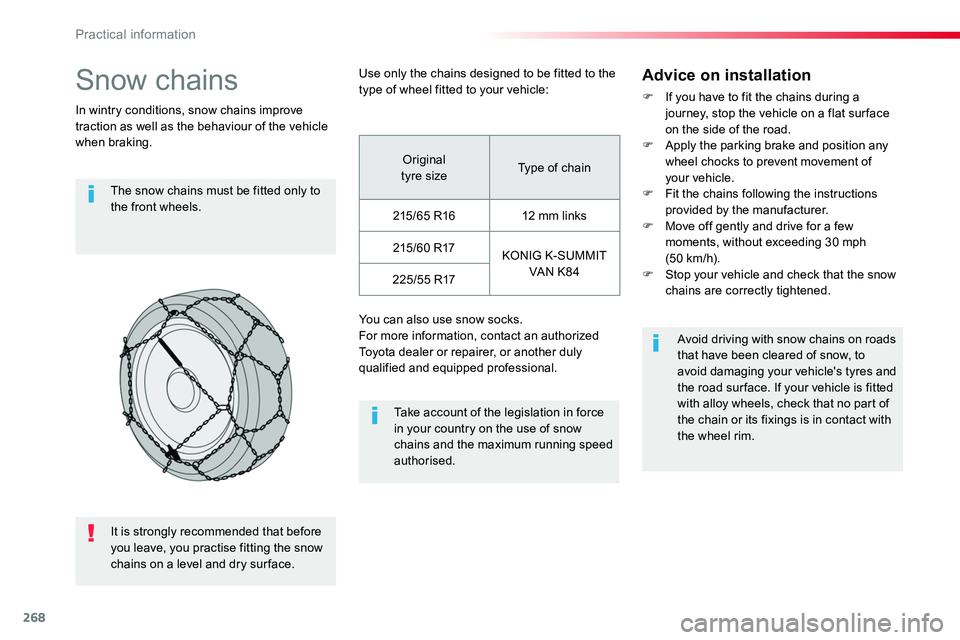
In wintry conditions, snow chains improve traction as well as the behaviour of the vehicle when braking.
The snow chains must be fitted only to the front wheels.
Take account of the legislation in force in your country on the use of snow chains and the maximum running speed authorised.
Avoid driving with snow chains on roads that have been cleared of snow, to avoid damaging your vehicle's tyres and the road sur face. If your vehicle is fitted with alloy wheels, check that no part of the chain or its fixings is in contact with
the wheel rim.
Use only the chains designed to be fitted to the type of wheel fitted to your vehicle:
You can also use snow socks.For more information, contact an authorized Toyota dealer or repairer, or another duly qualified and equipped professional.
Advice on installation
F If you have to fit the chains during a journey, stop the vehicle on a flat sur face on the side of the road.F Apply the parking brake and position any wheel chocks to prevent movement of your vehicle.F Fit the chains following the instructions provided by the manufacturer.F Move off gently and drive for a few moments, without exceeding 30 mph (50 km/h).F Stop your vehicle and check that the snow chains are correctly tightened.
Original tyre sizeType of chain
215/65 R1612 mm links
215/60 R17KONIG K-SUMMIT VAN K84225/55 R17
It is strongly recommended that before
you leave, you practise fitting the snow chains on a level and dry sur face.
Practical information