check engine light TOYOTA RAV4 1996 Service Repair Manual
[x] Cancel search | Manufacturer: TOYOTA, Model Year: 1996, Model line: RAV4, Model: TOYOTA RAV4 1996Pages: 1632, PDF Size: 41.64 MB
Page 1 of 1632
1999-2000 BRAKES
Anti-Lock - RAV4
DESCRIPTION
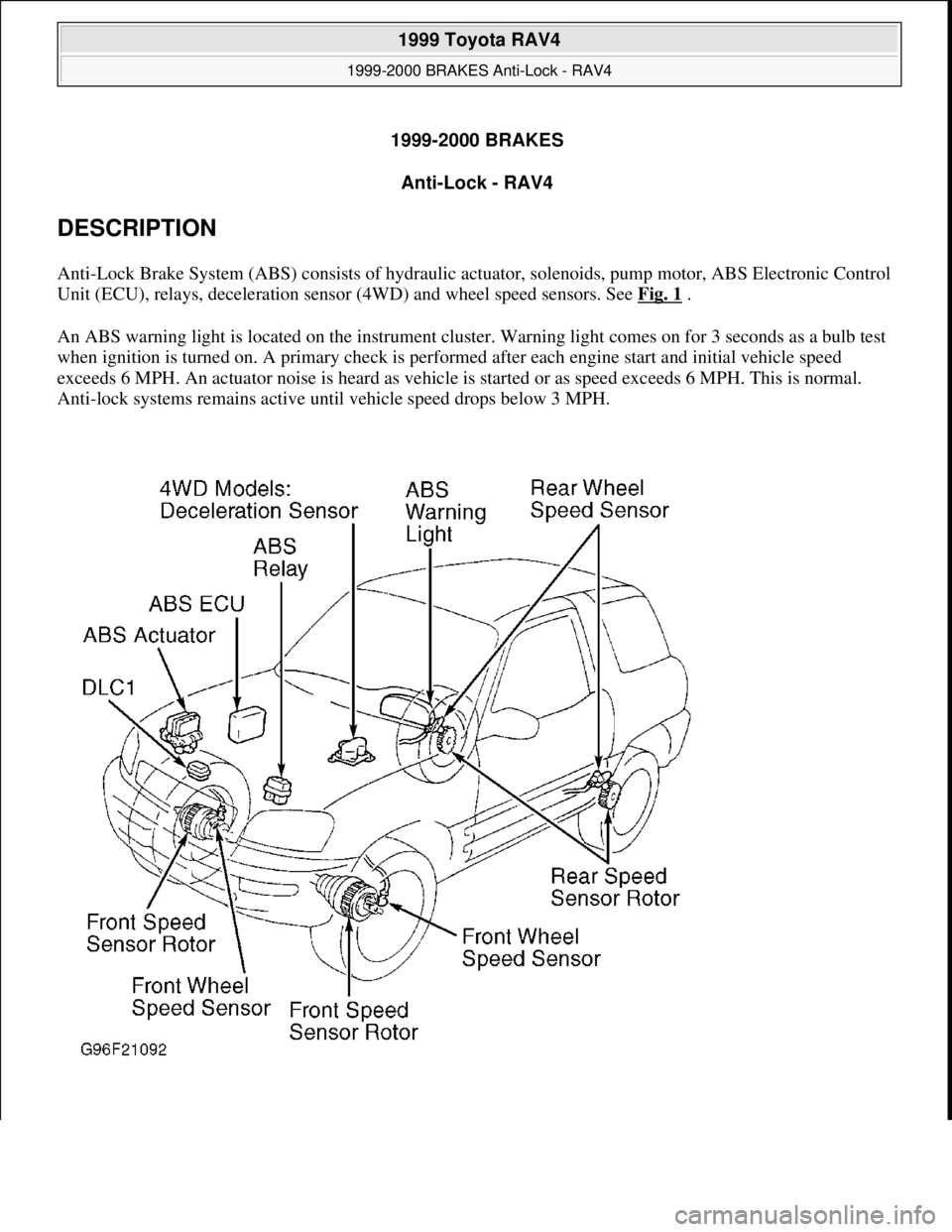
Anti-Lock Brake System (ABS) consists of hydraulic actuator, solenoids, pump motor, ABS Electronic Control
Unit (ECU), relays, deceleration sensor (4WD) and wheel speed sensors. See Fig. 1
.
An ABS warning light is located on the instrument cluster. Warning light comes on for 3 seconds as a bulb test
when ignition is turned on. A primary check is performed after each engine start and initial vehicle speed
exceeds 6 MPH. An actuator noise is heard as vehicle is started or as speed exceeds 6 MPH. This is normal.
Anti-lock systems remains active until vehicle speed drops below 3 MPH.
1999 Toyota RAV4
1999-2000 BRAKES Anti-Lock - RAV4
1999 Toyota RAV4
1999-2000 BRAKES Anti-Lock - RAV4
Microsoft
Sunday, November 22, 2009 10:06:17 AMPage 1 © 2005 Mitchell Repair Information Company, LLC.
Microsoft
Sunday, November 22, 2009 10:06:21 AMPage 1 © 2005 Mitchell Repair Information Company, LLC.
Page 3 of 1632
If cause of faulty operation cannot be located with basic diagnosis, ABS electronic control system must be
checked. See DIAGNOSIS & TESTING
.
When ignition is turned on, ABS warning light should come on, then go out after 3 seconds. If ABS warning
light does not operate as specified, go to ABS WARNING LIGHT under DIAGNOSIS & TESTING
.
DIAGNOSIS & TESTING
RETRIEVING DIAGNOSTIC TROUBLE CODES
ABS Warning Light Diagnostics
1. Ensure battery voltage is 12 volts. Turn ignition switch to ON position. ABS warning light should
illuminate, then go out after 3 seconds. If ABS warning light does not illuminate, check fuse, bulb, and
wiring harness. See ABS WARNING LIGHT
.
2. Remove short pin from DLC1. DLC1 is located in engine compartment, on left side of engine. See Fig.
2 . Using a jumper wire, jumper DLC1 terminals Tc and E1 . If a malfunction is detected, ABS warning
light will begin to flash a 2-digit Diagnostic Trouble Code (DTC). First number of blinks will equal first
digit in DTC. After a 1.5-second pause, second number of blinks will equal second digit in DTC.
3. If 2 or more DTCs are stored, there will be a 2.5-second pause between each DTC. After all DTCs are
flashed, there will be a 4 second pause and all DTCs will repeat. If ABS system is functioning properly,
ABS warning light will blink 2 times per second. For code definitions, see DTC DEFINITIONS
. For
DTC diagnosis, see DIAGNOSTIC TESTS
.
4. After replacing or repairing components, clear DTCs. If battery cables were disconnected during repairs,
all DTCs will be erased. If battery cables were not disconnected during repairs, see CLEARING DTCS
.
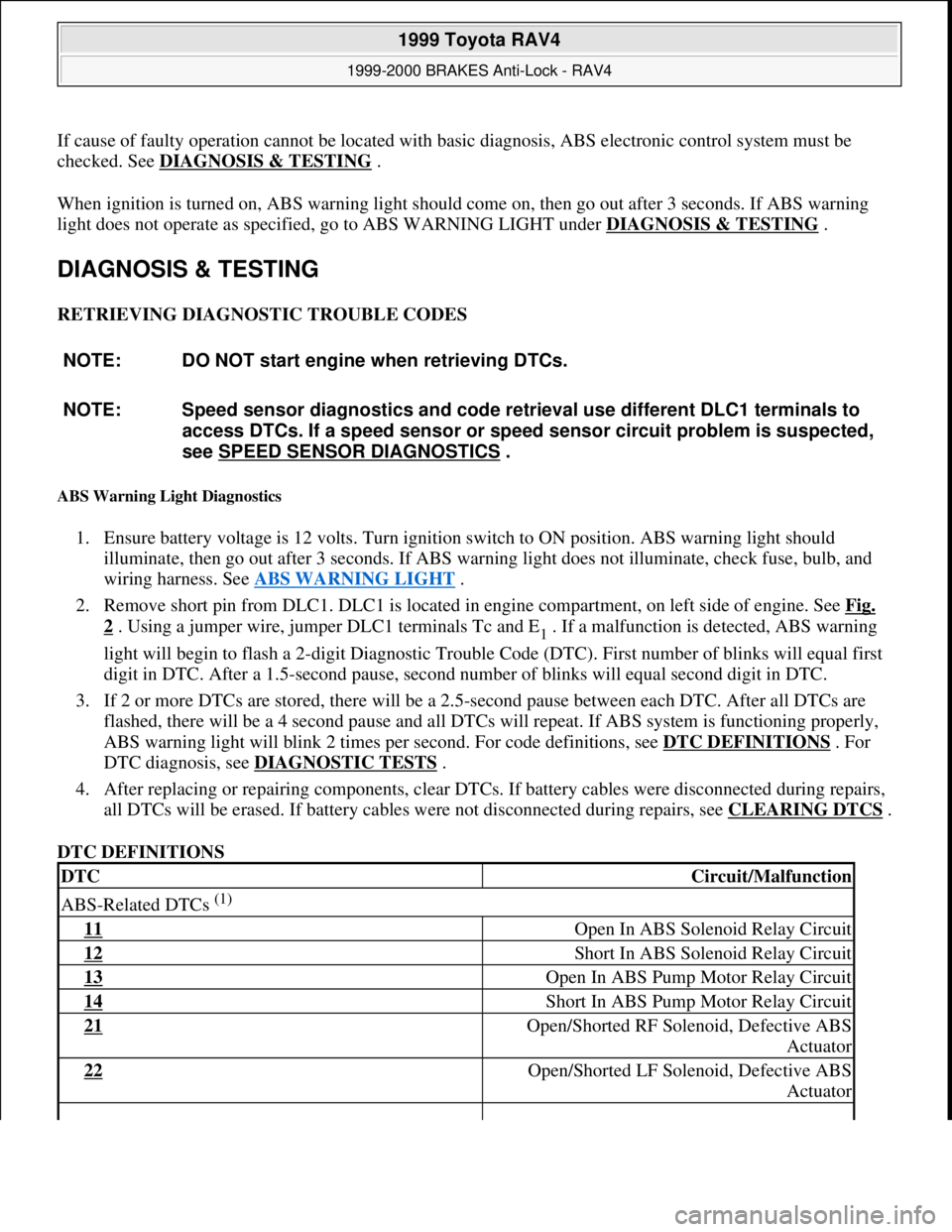
DTC DEFINITIONS NOTE: DO NOT start engine when retrieving DTCs.
NOTE: Speed sensor diagnostics and code retrieval use different DLC1 terminals to
access DTCs. If a speed sensor or speed sensor circuit problem is suspected,
see SPEED SENSOR DIAGNOSTICS
.
DTCCircuit/Malfunction
ABS-Related DTCs (1)
11 Open In ABS Solenoid Relay Circuit
12 Short In ABS Solenoid Relay Circuit
13 Open In ABS Pump Motor Relay Circuit
14 Short In ABS Pump Motor Relay Circuit
21 Open/Shorted RF Solenoid, Defective ABS
Actuator
22 Open/Shorted LF Solenoid, Defective ABS
Actuator
1999 Toyota RAV4
1999-2000 BRAKES Anti-Lock - RAV4
Microsoft
Sunday, November 22, 2009 10:06:17 AMPage 3 © 2005 Mitchell Repair Information Company, LLC.
Page 5 of 1632
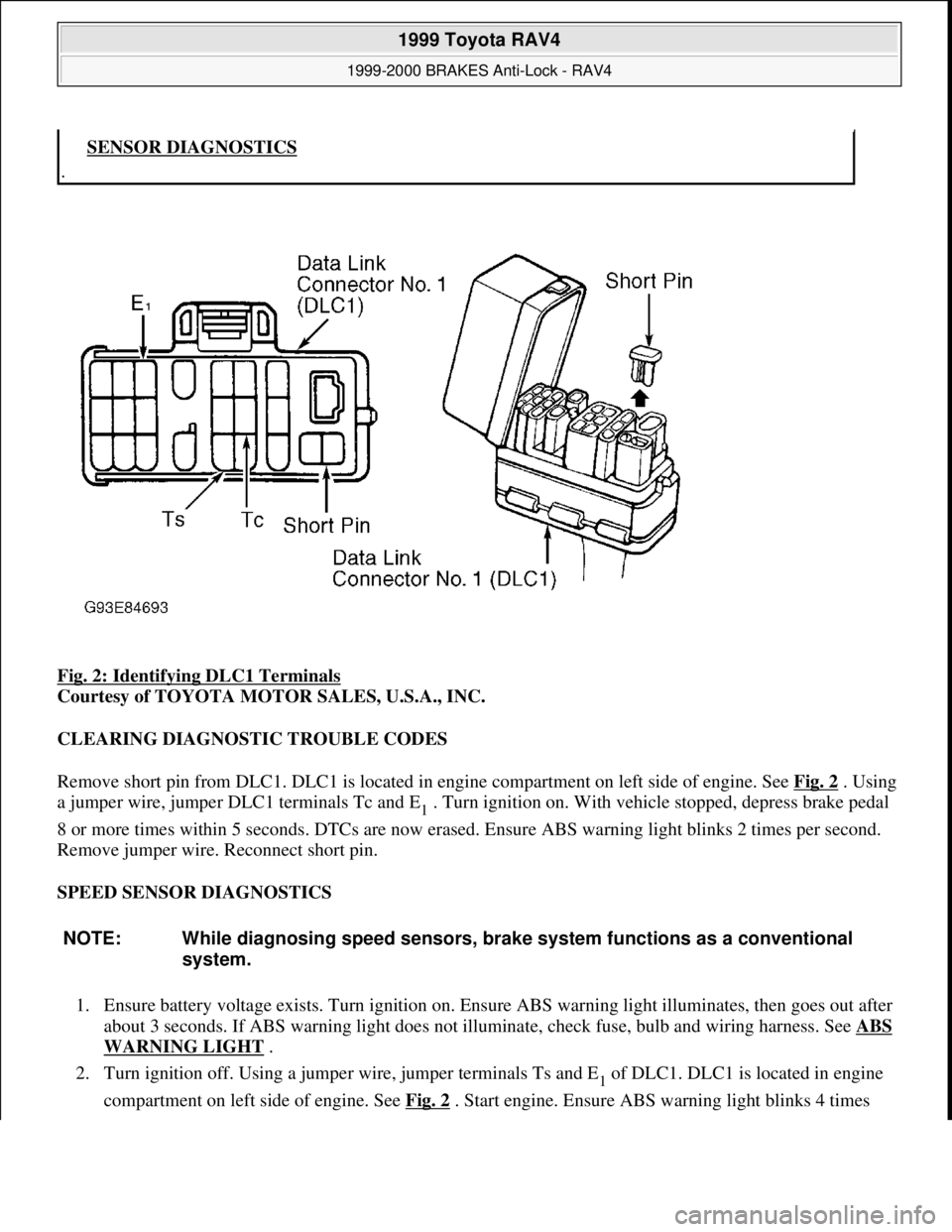
Fig. 2: Identifying DLC1 Terminals
Courtesy of TOYOTA MOTOR SALES, U.S.A., INC.
CLEARING DIAGNOSTIC TROUBLE CODES
Remove short pin from DLC1. DLC1 is located in engine compartment on left side of engine. See Fig. 2
. Using
a jumper wire, jumper DLC1 terminals Tc and E
1 . Turn ignition on. With vehicle stopped, depress brake pedal
8 or more times within 5 seconds. DTCs are now erased. Ensure ABS warning light blinks 2 times per second.
Remove jumper wire. Reconnect short pin.
SPEED SENSOR DIAGNOSTICS
1. Ensure battery voltage exists. Turn ignition on. Ensure ABS warning light illuminates, then goes out after
about 3 seconds. If ABS warning light does not illuminate, check fuse, bulb and wiring harness. See ABS
WARNING LIGHT .
2. Turn ignition off. Using a jumper wire, jumper terminals Ts and E
1 of DLC1. DLC1 is located in engine
compartment on left side of en
gine. See Fig. 2. Start engine. Ensure ABS warning light blinks 4 times
.SENSOR DIAGNOSTICS
NOTE: While diagnosing speed sensors, brake system functions as a conventional
system.
1999 Toyota RAV4
1999-2000 BRAKES Anti-Lock - RAV4
Microsoft
Sunday, November 22, 2009 10:06:17 AMPage 5 © 2005 Mitchell Repair Information Company, LLC.
Page 7 of 1632
Turn ignition on. Measure voltage between terminals Tc and E1of DLC1. If voltage is 10-14 volts, circuit is
okay. If ABS warning light does not blink even after terminals are connected, malfunction may exist in ABS
ECU. If voltage is not 10-14 volts, check for open or short circuit in wiring harness between ABS actuator and
DLC1, or between ground and DLC1. See WIRING DIAGRAMS
. Repair as necessary. If wiring harness is
okay, replace ABS ECU.
TS TERMINAL
Circuit Description
Sensor check circuit detects abnormalities in speed sensor signal which cannot be detected when checking for
DTCs. Connecting terminals Ts and E
1 of DLC1 in engine compartment starts DTC check. See Fig. 2 .
Diagnostic Procedure
Turn ignition on. Measure voltage between terminals Ts and E1 of DLC1. If voltage is 10-14 volts, circuit is
okay. If ABS warning light does not blink even after terminals are connected, malfunction may exist in ABS
ECU. If voltage is not 10-14 volts, check for open or short circuit in wiring harness between ABS ECU and
DLC1, or between ground and DLC1. See WIRING DIAGRAMS
. Repair as necessary. If wiring harness is
okay, replace ABS ECU.
ABS ECU PIN VOLTAGES
ABS circuits and harness can be tested by backprobing ABS ECU connectors and comparing measured voltages
with ABS ECU standard values chart. See Fig. 3
.
1999 Toyota RAV4
1999-2000 BRAKES Anti-Lock - RAV4
Microsoft
Sunday, November 22, 2009 10:06:17 AMPage 7 © 2005 Mitchell Repair Information Company, LLC.
Page 10 of 1632
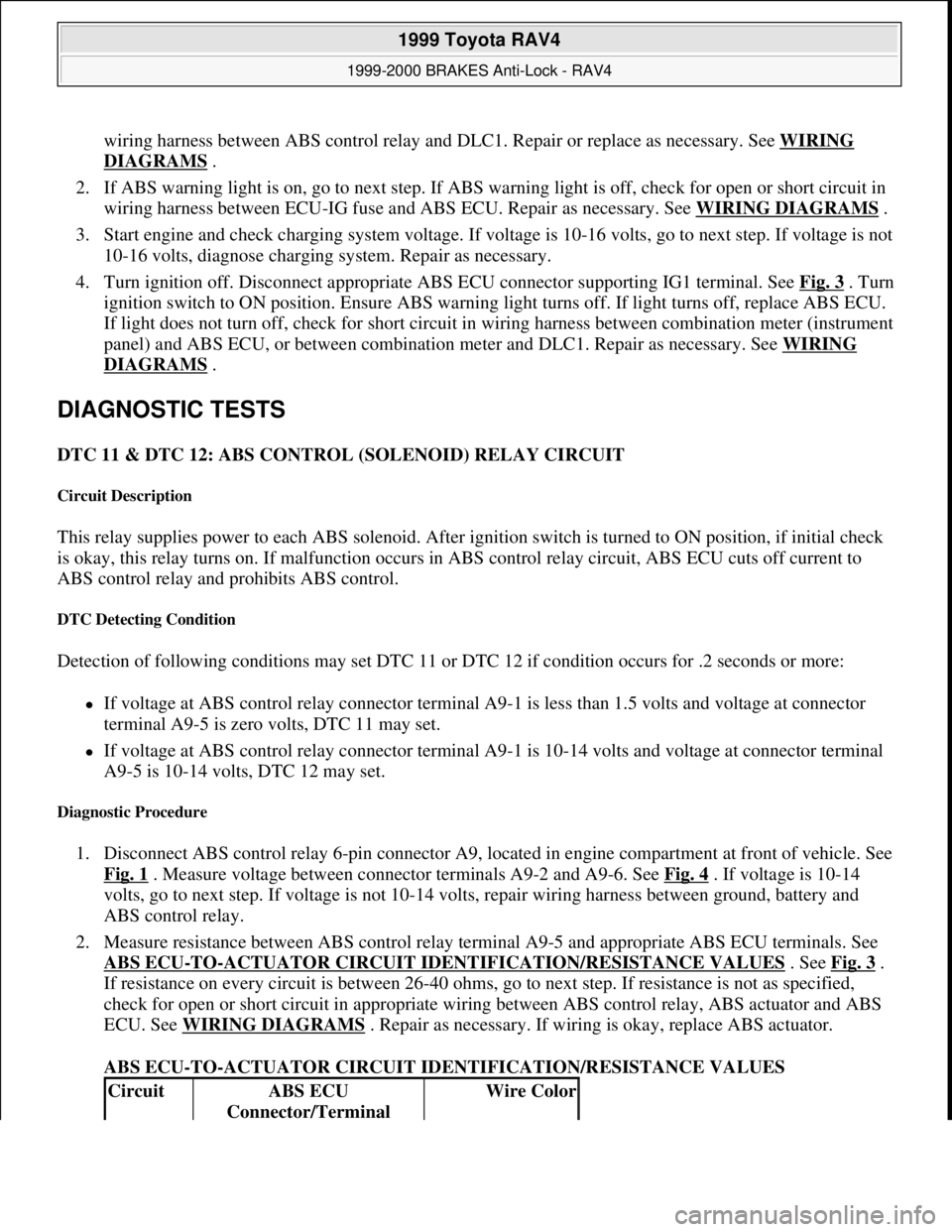
wiring harness between ABS control relay and DLC1. Repair or replace as necessary. See WIRING
DIAGRAMS .
2. If ABS warning light is on, go to next step. If ABS warning light is off, check for open or short circuit in
wiring harness between ECU-IG fuse and ABS ECU. Repair as necessary. See WIRING DIAGRAMS
.
3. Start engine and check charging system voltage. If voltage is 10-16 volts, go to next step. If voltage is not
10-16 volts, diagnose charging system. Repair as necessary.
4. Turn ignition off. Disconnect appropriate ABS ECU connector supporting IG1 terminal. See Fig. 3
. Turn
ignition switch to ON position. Ensure ABS warning light turns off. If light turns off, replace ABS ECU.
If light does not turn off, check for short circuit in wiring harness between combination meter (instrument
panel) and ABS ECU, or between combination meter and DLC1. Repair as necessary. See WIRING
DIAGRAMS .
DIAGNOSTIC TESTS
DTC 11 & DTC 12: ABS CONTROL (SOLENOID) RELAY CIRCUIT
Circuit Description
This relay supplies power to each ABS solenoid. After ignition switch is turned to ON position, if initial check
is okay, this relay turns on. If malfunction occurs in ABS control relay circuit, ABS ECU cuts off current to
ABS control relay and prohibits ABS control.
DTC Detecting Condition
Detection of following conditions may set DTC 11 or DTC 12 if condition occurs for .2 seconds or more:
If voltage at ABS control relay connector terminal A9-1 is less than 1.5 volts and voltage at connector
terminal A9-5 is zero volts, DTC 11 may set.
If voltage at ABS control relay connector terminal A9-1 is 10-14 volts and voltage at connector terminal
A9-5 is 10-14 volts, DTC 12 may set.
Diagnostic Procedure
1. Disconnect ABS control relay 6-pin connector A9, located in engine compartment at front of vehicle. See
Fig. 1
. Measure voltage between connector terminals A9-2 and A9-6. See Fig. 4 . If voltage is 10-14
volts, go to next step. If voltage is not 10-14 volts, repair wiring harness between ground, battery and
ABS control relay.
2. Measure resistance between ABS control relay terminal A9-5 and appropriate ABS ECU terminals. See
ABS ECU
-TO-ACTUATOR CIRCUIT IDENTIFICATION/RESISTANCE VALUES . See Fig. 3 .
If resistance on every circuit is between 26-40 ohms, go to next step. If resistance is not as specified,
check for open or short circuit in appropriate wiring between ABS control relay, ABS actuator and ABS
ECU. See WIRING DIAGRAMS
. Repair as necessary. If wiring is okay, replace ABS actuator.
ABS ECU-TO-ACTUATOR CIRCUIT IDENTIFICATION/RESISTANCE VALUES
CircuitABS ECU
Connector/TerminalWire Color
1999 Toyota RAV4
1999-2000 BRAKES Anti-Lock - RAV4
Microsoft
Sunday, November 22, 2009 10:06:17 AMPage 10 © 2005 Mitchell Repair Information Company, LLC.
Page 26 of 1632
1. Check charging system voltage. Ensure 10-14 volts is present. If charging system voltage is okay, go to
next step. If charging system voltage is not okay, check and repair charging system.
2. Turn ignition switch to ON position. Ensure ABS warning light comes on, then goes out after 3 seconds.
If ABS warning light does not illuminate, check fuse, bulb, and wiring harness. See ABS WARNING
LIGHT under DIAGNOSIS & TESTING. Turn ignition off.
3. Using a jumper wire, jumper terminals Ts and E
1 of DLC1. DLC1 is located in engine compartment on
left side of engine. See Fig. 2
. Ensure ABS warning light blinks 4 times per second. If ABS light does
not blink, go to ABS WARNING LIGHT
under DIAGNOSIS & TESTING. If ABS warning light
blinks, go to next step.
4. Using a floor jack, slowly jack up rear of vehicle. On vehicles with 215/70R16 tires, raise vehicle to a
height of 25.59-27.95" (650-710 mm). On vehicles with 235/60R16 tires, raise vehicle to a height of
26.38-28.74" (670-730 mm). If ABS warning light illuminates at specified height, check deceleration
sensor installation. If installation is okay, replace deceleration sensor. Lower vehicle.
5. Using a floor jack, slowly jack up front of vehicle. On vehicles with 215/70R16 tires, raise vehicle to a
height of 21.20-23.56" (550-610 mm). On vehicles with 235/60R16 tires, raise vehicle to a height of
22.44-24.80" (570-630 mm). If ABS warning light illuminates at specified height, check deceleration
sensor installation. If installation is okay, replace deceleration sensor. Lower vehicle.
6. Drive vehicle straight ahead at speed of 13 MPH or more. Lightly depress brake pedal. Ensure ABS
warning light pattern is normal (light blinks 4 times per second).
7. While driving vehicle straight ahead at speed of 13 MPH or more, moderately depress brake pedal.
Ensure ABS warning light illuminates in a solid pattern (light does not blink) while braking.
8. While driving vehicle straight ahead at speed of 13 MPH or more, firmly depress brake pedal. Ensure
ABS warning light illumination pattern changes from a solid pattern (light does not blink) to a normal
pattern (light blinks 4 times per second), then back to a solid pattern while braking.
9. If ABS warning light does not illuminate as described in steps 6 -8 , check deceleration sensor
installation. If installation is okay, replace deceleration sensor. Stop vehicle and turn ignition off. Remove
jumper wire from DLC1.
REMOVAL & INSTALLATION
ACTUATOR
Removal & Installation
Turn ignition off. Disconnect brakelines attached to actuator. Remove power steering hose retaining bracket
bolt and power steering reservoir. Disconnect actuator electrical connectors. Remove bolts, nuts and washers.
Remove actuator assembly. Remove actuator from actuator bracket. Remove cushions and holders from NOTE: When measuring vehicle height in following steps, measure at center of
lower body of vehicle.
WARNING:Hydraulic system may be under high pressure. Use caution when opening
hydraulic system.
1999 Toyota RAV4
1999-2000 BRAKES Anti-Lock - RAV4
Microsoft
Sunday, November 22, 2009 10:06:17 AMPage 26 © 2005 Mitchell Repair Information Company, LLC.
Page 31 of 1632
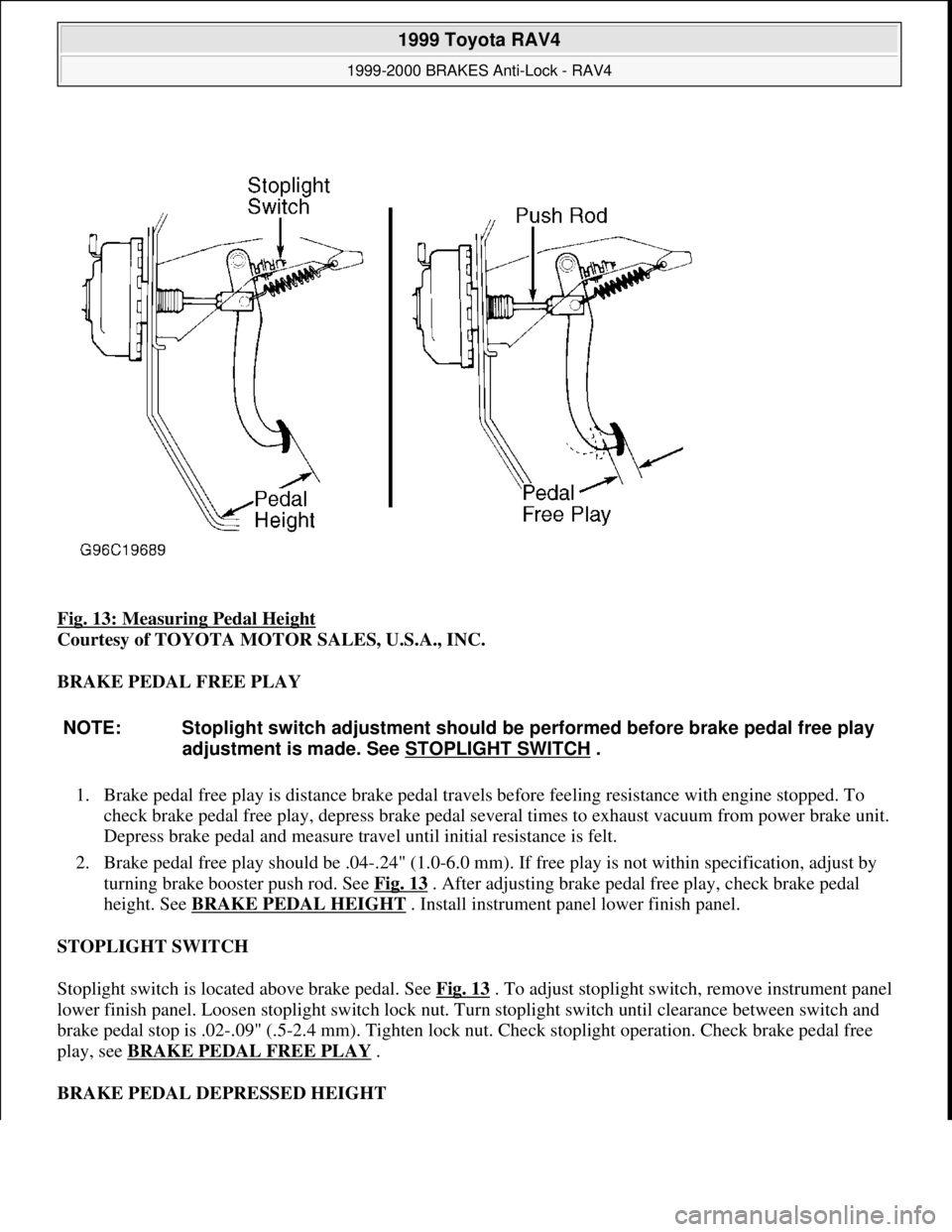
Fig. 13: Measuring Pedal Height
Courtesy of TOYOTA MOTOR SALES, U.S.A., INC.
BRAKE PEDAL FREE PLAY
1. Brake pedal free play is distance brake pedal travels before feeling resistance with engine stopped. To
check brake pedal free play, depress brake pedal several times to exhaust vacuum from power brake unit.
Depress brake pedal and measure travel until initial resistance is felt.
2. Brake pedal free play should be .04-.24" (1.0-6.0 mm). If free play is not within specification, adjust by
turning brake booster push rod. See Fig. 13
. After adjusting brake pedal free play, check brake pedal
height. See BRAKE PEDAL HEIGHT
. Install instrument panel lower finish panel.
STOPLIGHT SWITCH
Stoplight switch is located above brake pedal. See Fig. 13
. To adjust stoplight switch, remove instrument panel
lower finish panel. Loosen stoplight switch lock nut. Turn stoplight switch until clearance between switch and
brake pedal stop is .02-.09" (.5-2.4 mm). Tighten lock nut. Check stoplight operation. Check brake pedal free
play, see BRAKE PEDAL FREE PLAY .
BRAKE PEDAL DEPRESSED HEIGHT
NOTE: Stoplight switch adjustment should be performed before brake pedal free play
adjustment is made. See STOPLIGHT SWITCH
.
1999 Toyota RAV4
1999-2000 BRAKES Anti-Lock - RAV4
Microsoft
Sunday, November 22, 2009 10:06:17 AMPage 31 © 2005 Mitchell Repair Information Company, LLC.
Page 137 of 1632
exceeds .0079" (.200 mm).
2. Install torque converter on transmission. To ensure torque converter is fully seated, torque converter
depth should be checked. Using straightedge and caliper, measure torque converter depth from torque
converter bolt lug on torque converter to the surface on transmission. See Fig. 1
.
3. Torque converter depth should be more than .707" (17.95 mm). If torque converter depth is less than
specified, check for improperly seated torque converter.
4. To install, reverse removal procedure. Tighten all bolts/nuts to specification. See TORQUE
SPECIFICATIONS When installing torque converter bolts, apply Loctite to torque converter bolt
threads before installing. Ensure the Green torque converter bolt is installed first before installing the
remaining torque converter bolts.
5. Once engine and transmission are installed, adjust all cables and fill with ATF. See appropriate
TRANSMISSION SERVICING article.
Removal (Tacoma 4WD)
1. Disconnect negative battery cable. Remove transmission oil dipstick. Disconnect throttle valve cable from
throttle body.
2. Raise and support vehicle. Remove lower engine cover. Remove fan shroud from radiator. Remove rear
console box, located between the seats. Remove screws from front console, located near transfer case and
transmission shift levers.
3. Remove front console with transfer case shift lever knob. Disconnect electrical connectors for removal of
transmission shift lever assembly. Disconnect shift linkage at transmission shift lever assembly. Remove
transmission shift lever assembly.
4. Remove snap ring and transfer case shift lever from transfer case. Remove transmission oil dipstick tube
and "O" ring. Place reference marks on drive shaft flanges for reassembly reference. Remove drive shafts.
5. Remove exhaust pipes as necessary for access to transmission and transfer case. Disconnect speedometer
cable and necessary electrical connectors for transmission and transfer case removal. Remove
transmission oil cooler pipes and brackets as necessary.
6. Remove starter and stabilizer bar. Remove torque converter cover from front of transmission. Remove
torque converter bolts. Front differential assembly rear mount must be removed for transmission removal.
Rear mount is located on front differential assembly, just behind the drive shaft flange.
7. Support front differential assembly with jack. Remove front differential assembly rear mount-to-
crossmember nut. Slightly raise front differential assembly. Remove the 2 front differential assembly rear
mount bolts.
8. Support transmission with transmission jack. Remove transmission mount-to-transmission crossmember
bolts. Remove transmission crossmember, located below transmission and transfer case. Remove
transmission-to-cylinder block bolts. Lower transmission with transfer case from vehicle.
Installation
1. Before installing transmission, use dial indicator to check drive plate runout. Drive plate runout should be
checked right next to the starter ring gear on the drive plate. Replace drive plate if runout
exceeds .0079" (.200 mm).
2. Install torque converter on transmission. To ensure torque converter is full
y seated, torque converter
1998 Toyota Avalon XLS
TRANSMISSION SERVICING - A/T 1997-98 TRANSMISSION SERVICING Toyota - Transmission Removal &
Installation
Helpmelearn
November-03-08 10:30:29 AMPage 25 © 2005 Mitchell Repair Information Company, LLC.
Page 161 of 1632
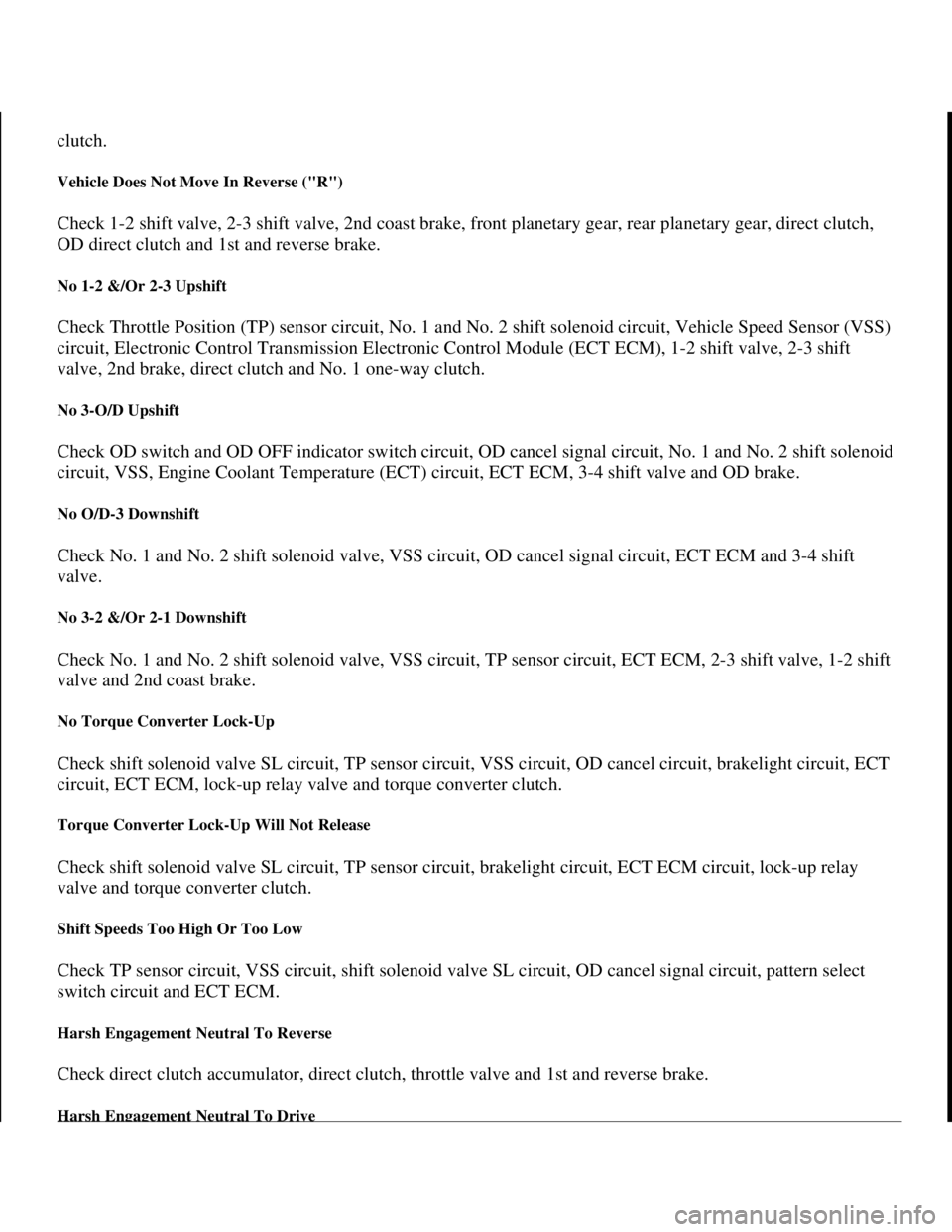
clutch.
Vehicle Does Not Move In Reverse ("R")
Check 1-2 shift valve, 2-3 shift valve, 2nd coast brake, front planetary gear, rear planetary gear, direct clutch,
OD direct clutch and 1st and reverse brake.
No 1-2 &/Or 2-3 Upshift
Check Throttle Position (TP) sensor circuit, No. 1 and No. 2 shift solenoid circuit, Vehicle Speed Sensor (VSS)
circuit, Electronic Control Transmission Electronic Control Module (ECT ECM), 1-2 shift valve, 2-3 shift
valve, 2nd brake, direct clutch and No. 1 one-way clutch.
No 3-O/D Upshift
Check OD switch and OD OFF indicator switch circuit, OD cancel signal circuit, No. 1 and No. 2 shift solenoid
circuit, VSS, Engine Coolant Temperature (ECT) circuit, ECT ECM, 3-4 shift valve and OD brake.
No O/D-3 Downshift
Check No. 1 and No. 2 shift solenoid valve, VSS circuit, OD cancel signal circuit, ECT ECM and 3-4 shift
valve.
No 3-2 &/Or 2-1 Downshift
Check No. 1 and No. 2 shift solenoid valve, VSS circuit, TP sensor circuit, ECT ECM, 2-3 shift valve, 1-2 shift
valve and 2nd coast brake.
No Torque Converter Lock-Up
Check shift solenoid valve SL circuit, TP sensor circuit, VSS circuit, OD cancel circuit, brakelight circuit, ECT
circuit, ECT ECM, lock-up relay valve and torque converter clutch.
Torque Converter Lock-Up Will Not Release
Check shift solenoid valve SL circuit, TP sensor circuit, brakelight circuit, ECT ECM circuit, lock-up relay
valve and torque converter clutch.
Shift Speeds Too High Or Too Low
Check TP sensor circuit, VSS circuit, shift solenoid valve SL circuit, OD cancel signal circuit, pattern select
switch circuit and ECT ECM.
Harsh Engagement Neutral To Reverse
Check direct clutch accumulator, direct clutch, throttle valve and 1st and reverse brake.
Harsh Engagement Neutral To Drive
1998 Toyota Avalon XLS
1997-99 AUTOMATIC TRANSMISSIONS Toyota A-540E, A-540H & A-541E Overhaul
Helpmelearn
November-03-08 10:28:16 AMPage 7 © 2005 Mitchell Repair Information Company, LLC.
Page 165 of 1632
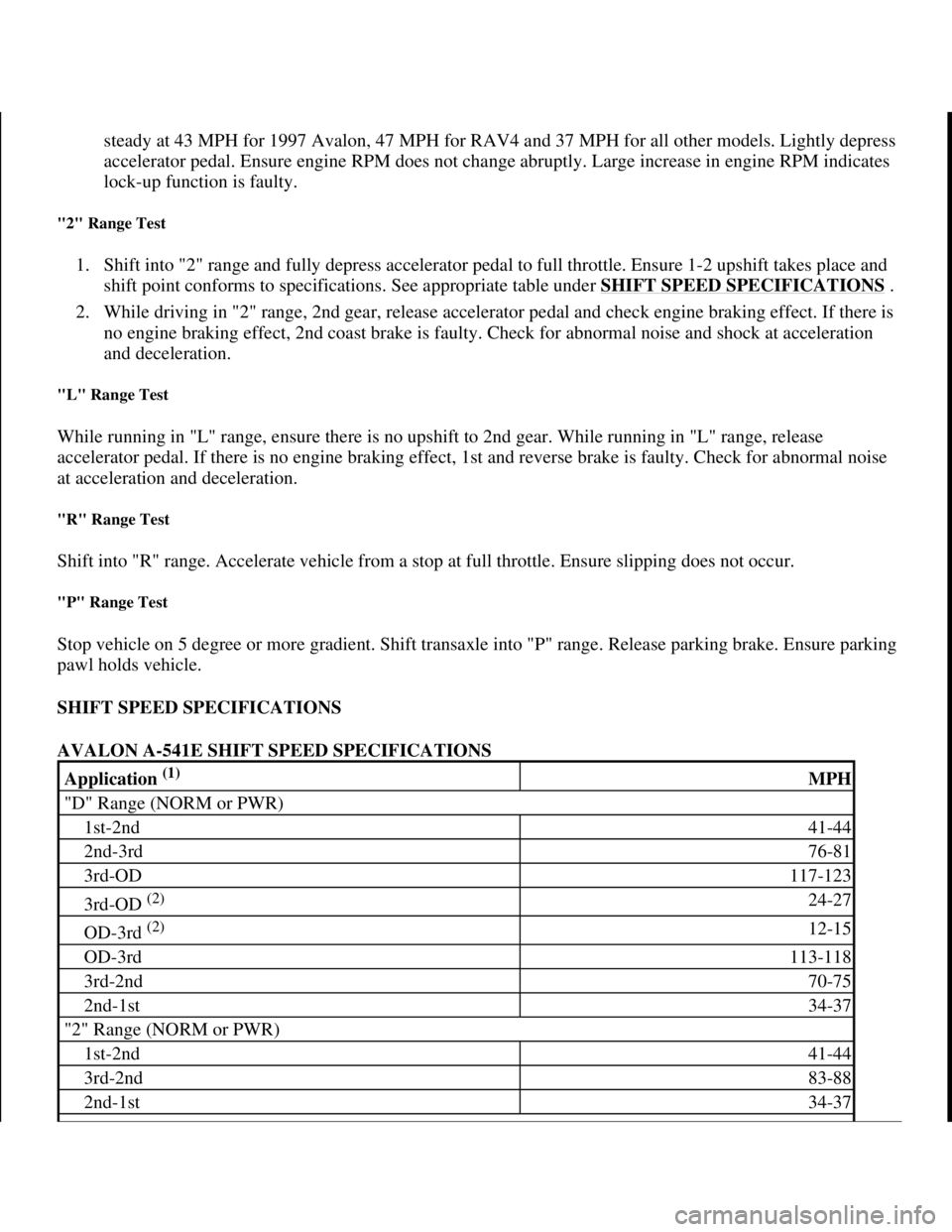
steady at 43 MPH for 1997 Avalon, 47 MPH for RAV4 and 37 MPH for all other models. Lightly depress
accelerator pedal. Ensure engine RPM does not change abruptly. Large increase in engine RPM indicates
lock-up function is faulty.
"2" Range Test
1. Shift into "2" range and fully depress accelerator pedal to full throttle. Ensure 1-2 upshift takes place and
shift point conforms to specifications. See appropriate table under SHIFT SPEED SPECIFICATIONS
.
2. While driving in "2" range, 2nd gear, release accelerator pedal and check engine braking effect. If there is
no engine braking effect, 2nd coast brake is faulty. Check for abnormal noise and shock at acceleration
and deceleration.
"L" Range Test
While running in "L" range, ensure there is no upshift to 2nd gear. While running in "L" range, release
accelerator pedal. If there is no engine braking effect, 1st and reverse brake is faulty. Check for abnormal noise
at acceleration and deceleration.
"R" Range Test
Shift into "R" range. Accelerate vehicle from a stop at full throttle. Ensure slipping does not occur.
"P" Range Test
Stop vehicle on 5 degree or more gradient. Shift transaxle into "P" range. Release parking brake. Ensure parking
pawl holds vehicle.
SHIFT SPEED SPECIFICATIONS
AVALON A-541E SHIFT SPEED SPECIFICATIONS
Application (1)MPH
"D" Range (NORM or PWR)
1st-2nd41-44
2nd-3rd76-81
3rd-OD117-123
3rd-OD (2)24-27
OD-3rd (2)12-15
OD-3rd113-118
3rd-2nd70-75
2nd-1st34-37
"2" Range (NORM or PWR)
1st-2nd41-44
3rd-2nd83-88
2nd-1st34-37
1998 Toyota Avalon XLS
1997-99 AUTOMATIC TRANSMISSIONS Toyota A-540E, A-540H & A-541E Overhaul
Helpmelearn
November-03-08 10:28:17 AMPage 11 © 2005 Mitchell Repair Information Company, LLC.