check engine light TOYOTA RAV4 1996 Service User Guide
[x] Cancel search | Manufacturer: TOYOTA, Model Year: 1996, Model line: RAV4, Model: TOYOTA RAV4 1996Pages: 1632, PDF Size: 41.64 MB
Page 269 of 1632
step 2). If throttle valve is not fully open, adjust throttle linkage or cable so throttle valve is fully open and
then go to step 2).
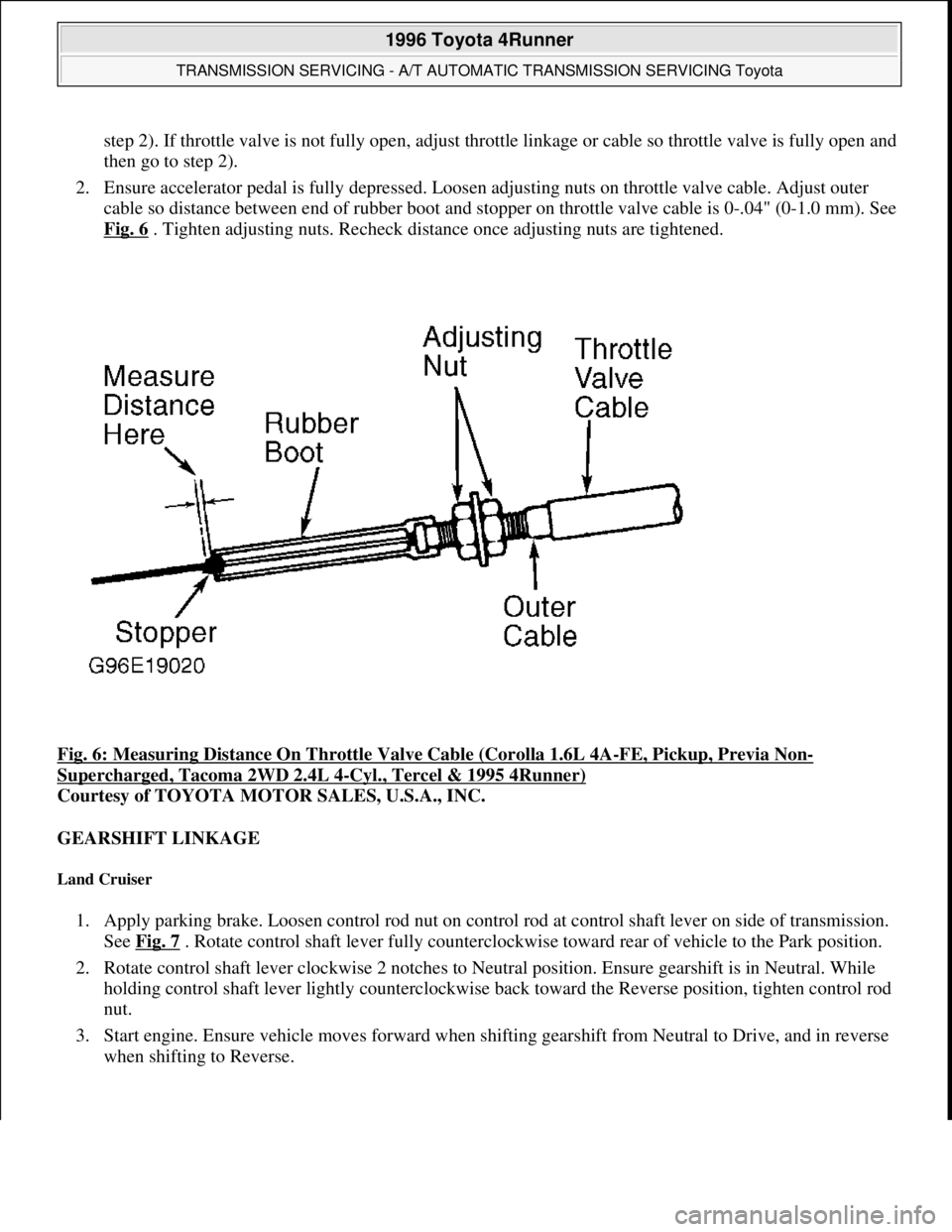
2. Ensure accelerator pedal is fully depressed. Loosen adjusting nuts on throttle valve cable. Adjust outer
cable so distance between end of rubber boot and stopper on throttle valve cable is 0-.04" (0-1.0 mm). See
Fig. 6
. Tighten adjusting nuts. Recheck distance once adjusting nuts are tightened.
Fig. 6: Measuring Distance On Throttle Valve Cable (Corolla 1.6L 4A
-FE, Pickup, Previa Non-
Supercharged, Tacoma 2WD 2.4L 4-Cyl., Tercel & 1995 4Runner)
Courtesy of TOYOTA MOTOR SALES, U.S.A., INC.
GEARSHIFT LINKAGE
Land Cruiser
1. Apply parking brake. Loosen control rod nut on control rod at control shaft lever on side of transmission.
See Fig. 7
. Rotate control shaft lever fully counterclockwise toward rear of vehicle to the Park position.
2. Rotate control shaft lever clockwise 2 notches to Neutral position. Ensure gearshift is in Neutral. While
holding control shaft lever lightly counterclockwise back toward the Reverse position, tighten control rod
nut.
3. Start engine. Ensure vehicle moves forward when shifting gearshift from Neutral to Drive, and in reverse
when shiftin
g to Reverse.
1996 Toyota 4Runner
TRANSMISSION SERVICING - A/T AUTOMATIC TRANSMISSION SERVICING Toyota
Microsoft
Tuesday, August 18, 2009 7:18:46 PMPage 13 © 2005 Mitchell Repair Information Company, LLC.
Page 344 of 1632
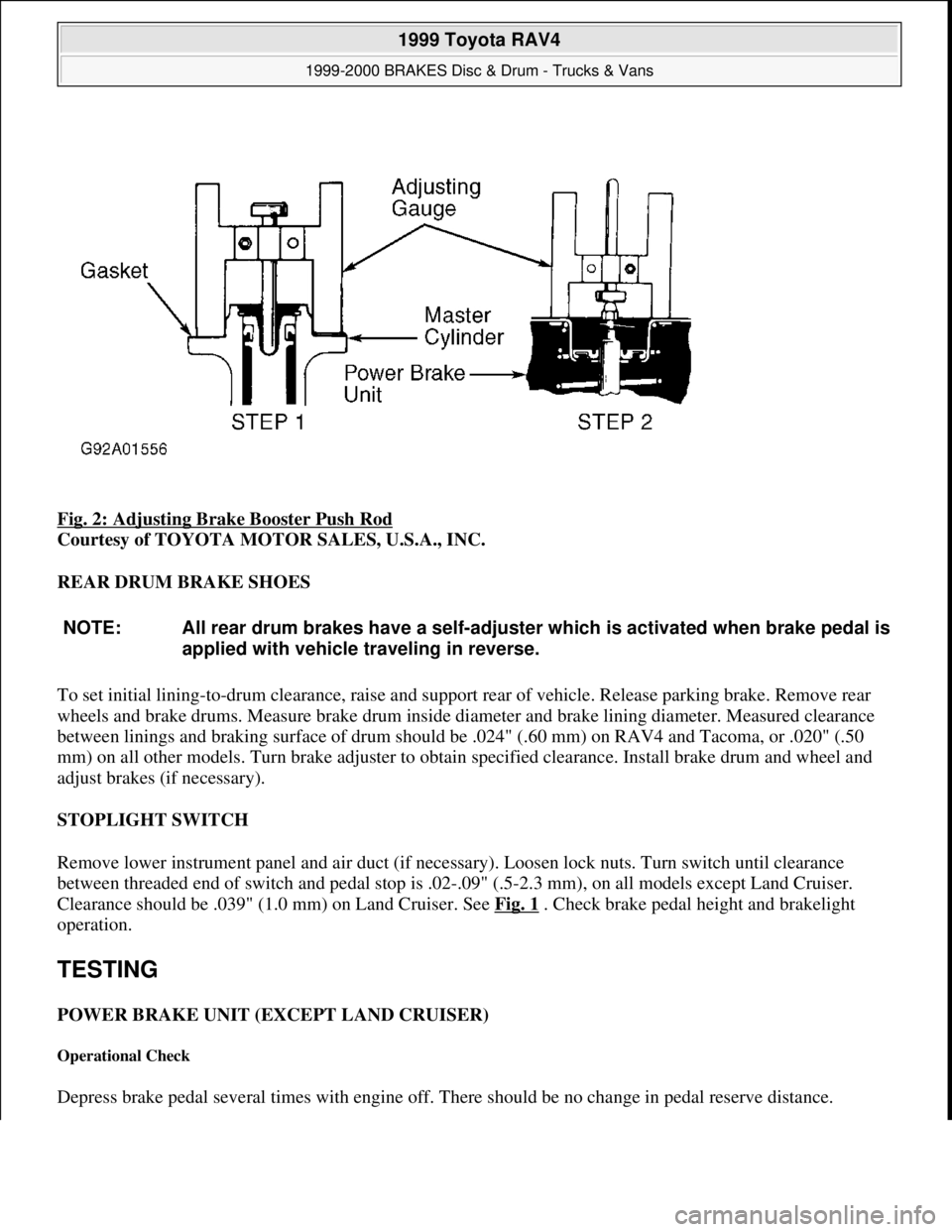
Fig. 2: Adjusting Brake Booster Push Rod
Courtesy of TOYOTA MOTOR SALES, U.S.A., INC.
REAR DRUM BRAKE SHOES
To set initial lining-to-drum clearance, raise and support rear of vehicle. Release parking brake. Remove rear
wheels and brake drums. Measure brake drum inside diameter and brake lining diameter. Measured clearance
between linings and braking surface of drum should be .024" (.60 mm) on RAV4 and Tacoma, or .020" (.50
mm) on all other models. Turn brake adjuster to obtain specified clearance. Install brake drum and wheel and
adjust brakes (if necessary).
STOPLIGHT SWITCH
Remove lower instrument panel and air duct (if necessary). Loosen lock nuts. Turn switch until clearance
between threaded end of switch and pedal stop is .02-.09" (.5-2.3 mm), on all models except Land Cruiser.
Clearance should be .039" (1.0 mm) on Land Cruiser. See Fig. 1
. Check brake pedal height and brakelight
operation.
TESTING
POWER BRAKE UNIT (EXCEPT LAND CRUISER)
Operational Check
Depress brake pedal several times with engine off. There should be no change in pedal reserve distance.
NOTE: All rear drum brakes have a self-adjuster which is activated when brake pedal is
applied with vehicle traveling in reverse.
1999 Toyota RAV4
1999-2000 BRAKES Disc & Drum - Trucks & Vans
Microsoft
Sunday, November 22, 2009 10:07:28 AMPage 5 © 2005 Mitchell Repair Information Company, LLC.
Page 345 of 1632
Depress brake pedal and start engine. If pedal goes down slightly, operation is normal.
Air Tightness Check
1. Start engine and run for 1-2 minutes, then turn engine off. Depress brake pedal several times slowly. If
pedal goes down farthest on first time, but gradually rises after second or third time, power brake unit is
airtight.
2. With engine stopped, depress brake pedal several times using normal pressure. Pedal should be low when
first depressed. On consecutive applications, pedal height should gradually rise. If pedal height does not
increase, check for air leaks.
LOAD-SENSING PROPORTIONING VALVE (LSPV) & BY-PASS VALVE (BPV)
Tacoma & Tundra
1. For testing purposes, rear axle is loaded to a specified weight. Set total rear axle weight to specified
amount. See LSPV REAR AXLE TEST WEIGHT
table.
2. Attach pressure gauge set to front caliper and rear wheel cylinder or caliper. Bleed air from system. See
BLEEDING BRAKE SYSTEM
. Depress brake pedal until front pressure is as specified. See LSPV
PRESSURE SPECIFICATIONS table. Wait 2 seconds and record rear pressure reading.
LSPV REAR AXLE TEST WEIGHT
LSPV PRESSURE SPECIFICATIONS NOTE: DO NOT depress brake pedal more than once or release pedal while
setting pressure on front gauge.
ApplicationLbs. (kg)
Tacoma
2WD1543 (700)
4WD1874 (850)
Tundra
V6
Engine
(5UZ-
FE)2205 (1000)
V8
Engine
(2UZ-
FE)2315 (1050)
4Runner2033 (922)
Application
Front Pressure - psi
(kg/cm
2 )
Rear Pressure - psi
(kg/cm
2 )
Tacoma
1999 Toyota RAV4
1999-2000 BRAKES Disc & Drum - Trucks & Vans
Microsoft
Sunday, November 22, 2009 10:07:28 AMPage 6 © 2005 Mitchell Repair Information Company, LLC.
Page 407 of 1632
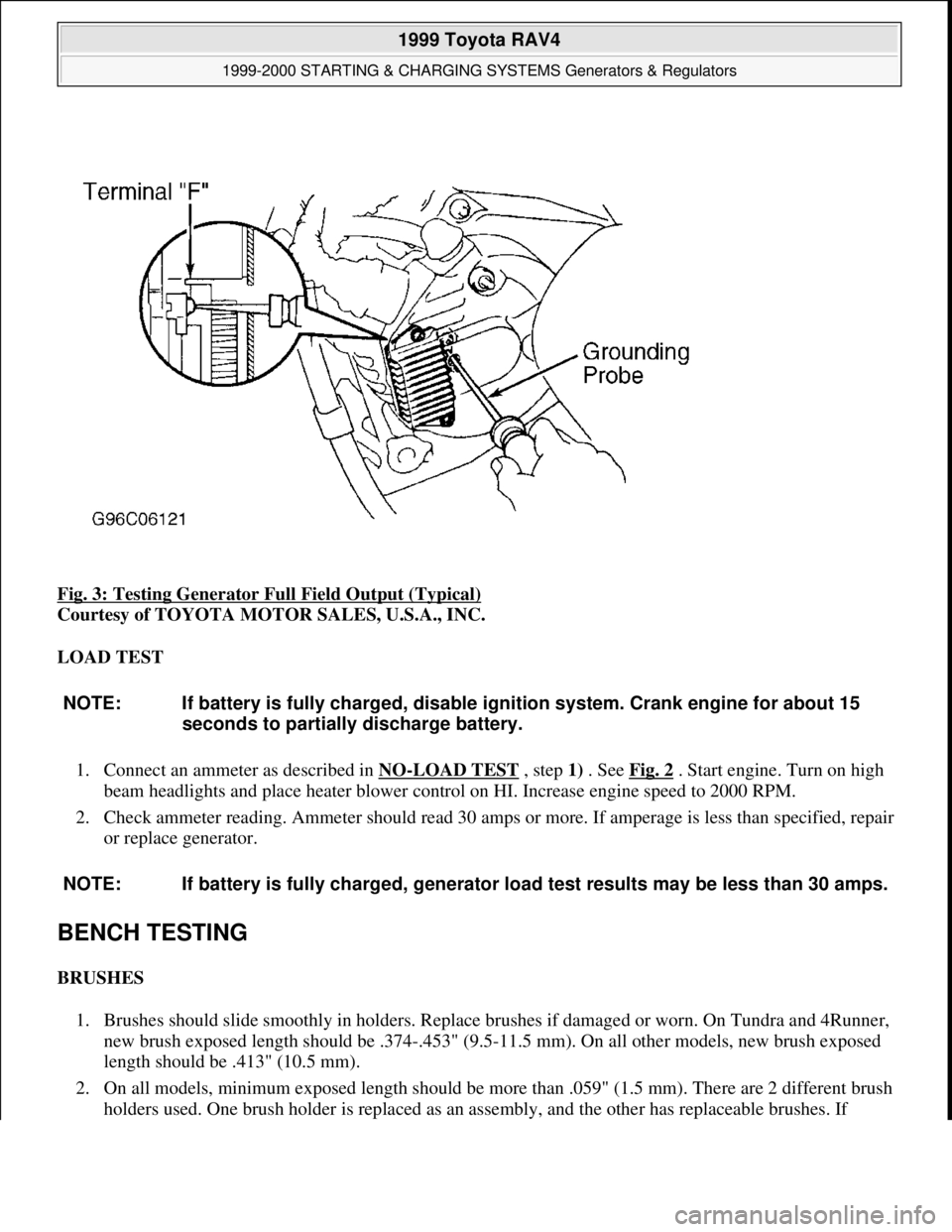
Fig. 3: Testing Generator Full Field Output (Typical)
Courtesy of TOYOTA MOTOR SALES, U.S.A., INC.
LOAD TEST
1. Connect an ammeter as described in NO
-LOAD TEST , step 1) . See Fig. 2 . Start engine. Turn on high
beam headlights and place heater blower control on HI. Increase engine speed to 2000 RPM.
2. Check ammeter reading. Ammeter should read 30 amps or more. If amperage is less than specified, repair
or replace generator.
BENCH TESTING
BRUSHES
1. Brushes should slide smoothly in holders. Replace brushes if damaged or worn. On Tundra and 4Runner,
new brush exposed length should be .374-.453" (9.5-11.5 mm). On all other models, new brush exposed
length should be .413" (10.5 mm).
2. On all models, minimum exposed length should be more than .059" (1.5 mm). There are 2 different brush
holders used. One brush holder is replaced as an assembl
y, and the other has replaceable brushes. If
NOTE: If battery is fully charged, disable ignition system. Crank engine for about 15
seconds to partially discharge battery.
NOTE: If battery is fully charged, generator load test results may be less than 30 amps.
1999 Toyota RAV4
1999-2000 STARTING & CHARGING SYSTEMS Generators & Regulators
Microsoft
Sunday, November 22, 2009 10:13:07 AMPage 6 © 2005 Mitchell Repair Information Company, LLC.
Page 530 of 1632
M/T models, depress and release clutch pedal. On all models, if CRUISE control indicator light comes on when
switch is in OFF position and goes off when switch is in ON position, circuit for that switch being activated is
okay. Go to next step. If CRUISE control indicator does not function as indicated, see SYMPTOM
DIAGNOSIS and perform appropriate test(s).
Vehicle Speed Sensor
1. Raise vehicle and support vehicle with drive wheels off ground. Start engine and slowly depress
accelerator pedal until vehicle speed is 25 MPH or more. Turn cruise ON-OFF switch to ON position. If
CRUISE control indicator light flashes on and off every .25 second, go to next step. If CRUISE control
indicator light does not flash on and off every .25 second, see SYMPTOM DIAGNOSIS
and perform
appropriate test(s).
2. Slow vehicle speed to 25 MPH or less. If CRUISE control indicator light comes on and stays on, vehicle
speed sensor circuit is okay. Go to next step. If CRUISE control indicator light does not come on, see
SYMPTOM DIAGNOSIS
and perform appropriate test(s).
3. Cruise control function test is now complete. No problems are indicated at this time. If cruise control
system still does not function properly and no trouble codes are present, see SYMPTOM DIAGNOSIS
and perform appropriate test(s). Problem may also be intermittent.
SYMPTOM DIAGNOSIS
Symptom diagnosis should only be performed if no Diagnostic Trouble Codes (DTCs) are present. If symptom
is unknown, perform CRUISE CONTROL FUNCTION TEST
to identify problem area. Identify symptom
and perform appropriate test. Perform tests in order listed.
SET Not Occurring Or CANCEL Occurring (No DTCs Present)
Check the following components and/or circuits:
Perform CRUISE CONTROL SWITCH CIRCUIT test under SYSTEM TESTS.
Perform DTC 21: VEHICLE SPEED SENSOR CIRCUIT test under DIAGNOSTIC TESTS.
Perform STOPLIGHT SWITCH CIRCUIT test under SYSTEM TESTS.
Perform PARK/NEUTRAL POSITION SWITCH CIRCUIT test under SYSTEM TESTS.
Perform CLUTCH SWITCH CIRCUIT test under SYSTEM TESTS.
Perform DTC 11 OR DTC 15: ACTUATOR MOTOR CIRCUIT test under DIAGNOSTIC TESTS.
Check actuator control cable adjustment. See ADJUSTMENTS .
Replace cruise control ECU with a known-good ECU and retest. If symptom is no longer present, replace
ECU.
SET Not Occurring Or CANCEL Occurring (DTC Is Not Output)
Check the following components and/or circuits:
Perform CRUISE CONTROL ECU POWER SOURCE CIRCUIT test under SYSTEM TESTS.
Replace cruise control ECU with a known-good ECU and retest. If symptom is no longer present, replace
1999 Toyota RAV4
1999 ACCESSORIES & EQUIPMENT Cruise Control Systems - RAV4
Microsoft
Sunday, November 22, 2009 10:52:01 AMPage 6 © 2005 Mitchell Repair Information Company, LLC.
Page 535 of 1632
1. Check stoplight operation. If stoplight operation is okay, go to next step. If stoplights DO NOT operate
correctly, check and repair stoplight system as necessary. See WIRING DIAGRAMS
.
2. Perform CANCEL SWITCHES test under CRUISE CONTROL FUNCTION TEST
under TROUBLE
SHOOTING. If stoplight input signal is not as specified, go to next step. If stoplight input signal is as
specified, no problem is indicated at this time. Fault may be intermittent. If sent here from SYMPTOM
DIAGNOSIS, perform next test listed.
3. Remove cruise control ECU with connector attached. See Fig. 1
. Turn ignition switch to ON position.
Backprobing cruise control ECU connector, measure voltage between ground and cruise control ECU
connector terminal No. 2 (Green/White wire). With brake pedal depressed, battery voltage should exist.
With brake pedal released, voltage should be less than one volt. If voltage is not as specified, go to next
step. If voltage is as specified, no problem is indicated at this time. Fault may be intermittent. If sent here
from SYMPTOM DIAGNOSIS, perform next test listed.
4. Check for open circuit in wiring harness and connectors between cruise control ECU and stoplight switch.
Repair as necessary and retest system. If wiring harness and connectors are okay, replace cruise control
ECU and retest system.
IDLE SIGNAL CIRCUIT
1. Remove cruise control ECU with connector attached. Disconnect Engine Control Module (ECM) 16-pin
connector. ECM is located behind bottom center of instrument panel, in front of console. Turn ignition
switch to ON position. Backprobing connector, measure voltage between ground and cruise control ECU
connector terminal No. 13 (Blue wire).
2. With throttle valve fully open, battery voltage should exist. With throttle valve fully closed, voltage
should be less than 2 volts. If voltage is not as specified, go to next step. If voltage is as specified, no
problem is indicated at this time. Fault may be intermittent. If sent here from SYMPTOM DIAGNOSIS,
perform next test listed.
3. Check wiring harness and connectors between ECM and TP sensor. Repair as necessary and retest
system. If wiring harness and connectors are okay, go to next step.
4. Disconnect TP sensor 3-pin Black connector. Measure resistance between TP sensor connector terminals
No. 2 (Brown wire) and No. 3 (Blue/Red wire). Resistance should be 2000-10,200 ohms with throttle
valve fully opened, and 200-6300 ohms with throttle valve fully closed. If resistance is as specified, go to
next step. If resistance is not as specified, replace TP sensor and retest system.
5. Check wiring harness and connectors between cruise control ECU and TP sensor, and between TP sensor
and ground. Repair as necessary and retest system. If wiring harness and connectors are okay, replace
cruise control ECU and retest system.
ELECTRONICALLY CONTROLLED TRANSMISSION (ECT) CIRCUIT
1. Start engine and bring to operating temperature. Drive vehicle and ensure overdrive operation is turned on
and off when overdrive ON-OFF switch is operated. If overdrive switch is okay, go to next step. If
overdrive switch is not okay, see appropriate ELECTRONIC CONTROLS article in AUTOMATIC NOTE: Ensure Throttle Position (TP) sensor circuit is operating as designed, and no
fault codes are present for TP sensor circuit. See appropriate ON-VEHICLE
ADJUSTMENTS article in ENGINE PERFORMANCE.
1999 Toyota RAV4
1999 ACCESSORIES & EQUIPMENT Cruise Control Systems - RAV4
Microsoft
Sunday, November 22, 2009 10:52:01 AMPage 11 © 2005 Mitchell Repair Information Company, LLC.
Page 537 of 1632
FUNCTION TEST under TROUBLE SHOOTING. If clutch switch input signal is not as specified, go to
next step. If clutch switch input signal is as specified, no problem is indicated at this time. Fault may be
intermittent. If sent here from SYMPTOM DIAGNOSIS, perform next test listed.
3. Remove cruise control ECU with connector attached. See Fig. 1
. Turn ignition switch to ON position.
Using voltmeter positive lead, backprobe cruise control ECU connector terminal No. 3 (Blue/Black wire)
with negative lead to ground. With clutch pedal depressed, battery voltage should exist. With clutch pedal
released, voltage should be less than one volt. If voltage is not as specified, go to next step. If voltage is
as specified, no problem is indicated at this time. Fault may be intermittent. If sent here from SYMPTOM
DIAGNOSIS, perform next test listed.
4. Check wiring harness and connectors between cruise control ECU and TURN & GAUGE fuses in
instrument panel junction block. Repair as necessary. If wiring harness and connectors are okay, replace
cruise control ECU and retest system.
CRUISE CONTROL ECU POWER SOURCE CIRCUIT
1. Locate ECU-IG (10-amp) fuse in instrument panel junction block. See Fig. 1
. Remove ECU-IG fuse and
ensure fuse continuity. If fuse is okay, go to next step. If fuse is not okay, check for short between cruise
control ECU connector terminal No. 9 (Black/Yellow wire) and ECU-IG fuse.
2. Remove cruise control ECU with connector attached. See Fig. 1
. Turn ignition switch to ON position.
Using voltmeter, backprobe between cruise control ECU connector terminals No. 9 (Black/Yellow wire)
and No. 16 (White/Black wire). If battery voltage is not present, go to next step. If battery voltage is
present, no problem is indicated at this time. Fault may be intermittent. If sent here from SYMPTOM
DIAGNOSIS, perform next test listed.
3. Turn ignition switch to OFF position. Backprobing connector, measure resistance between ground and
terminal No. 16 (White/Black wire) at cruise control ECU connector. If resistance is less than one ohm,
check wiring harness or connector between cruise control ECU connector and battery. Repair as
necessary and retest system. If resistance is one ohm or more, repair wiring harness or connector between
cruise control ECU connector terminal No. 16 (White/Black wire) and ground. Retest system.
CRUISE CONTROL INDICATOR LIGHT CIRCUIT
1. Turn ignition switch to ON position. Backprobing connector, measure voltage between ground and
terminal No. 4 (Green/Red wire) at cruise control ECU connector. With cruise control switch in OFF
position, battery voltage should be present. With cruise control switch in ON position, voltage should be
less than 1.2 volts.
2. If voltage is as specified, no problem is indicated at this time. Fault may be intermittent. If sent here from
SYMPTOM DIAGNOSIS, perform next test listed. If voltage is not as specified, check instrument
cluster. See appropriate INSTRUMENT PANELS article. Repair as necessary. If instrument cluster is
okay, replace cruise control ECU and retest system.
DIAGNOSTIC CIRCUIT
1. Locate Data Link Connector (DLC) No. 1 in right side of engine compartment, near shock tower.
Connect voltmeter positive lead to terminal Tc and negative lead to terminal E1. See Fig. 2
. Turn
ignition switch to ON position. If battery voltage is not present, go to next step. If battery voltage is
present, no problem is indicated at this time. Fault ma
y be intermittent. If sent here from SYMPTOM
1999 Toyota RAV4
1999 ACCESSORIES & EQUIPMENT Cruise Control Systems - RAV4
Microsoft
Sunday, November 22, 2009 10:52:01 AMPage 13 © 2005 Mitchell Repair Information Company, LLC.
Page 540 of 1632
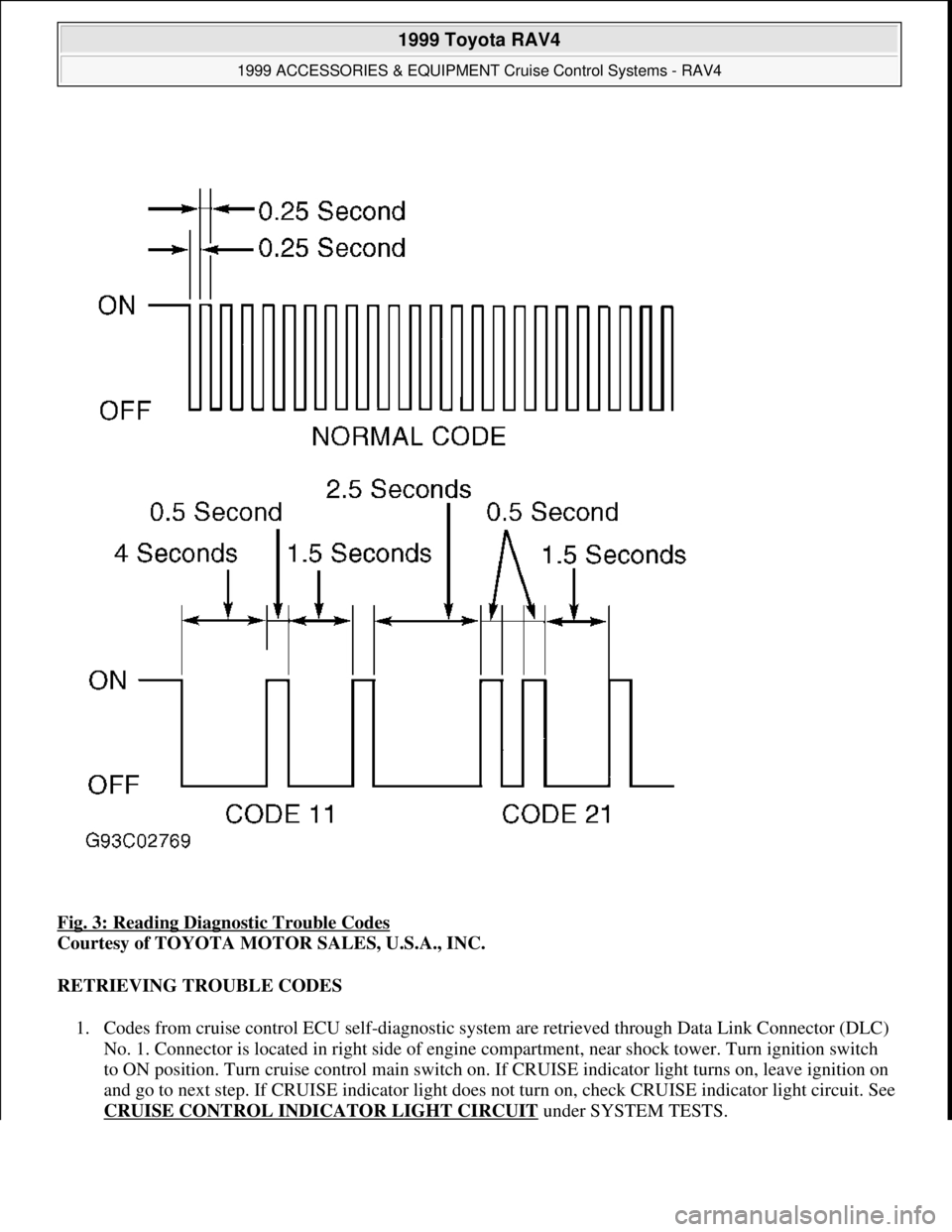
Fig. 3: Reading Diagnostic Trouble Codes
Courtesy of TOYOTA MOTOR SALES, U.S.A., INC.
RETRIEVING TROUBLE CODES
1. Codes from cruise control ECU self-diagnostic system are retrieved through Data Link Connector (DLC)
No. 1. Connector is located in right side of engine compartment, near shock tower. Turn ignition switch
to ON position. Turn cruise control main switch on. If CRUISE indicator light turns on, leave ignition on
and go to next step. If CRUISE indicator light does not turn on, check CRUISE indicator light circuit. See
CRUISE CONTROL INDICATOR LIGHT CIRCUIT
under SYSTEM TESTS.
1999 Toyota RAV4
1999 ACCESSORIES & EQUIPMENT Cruise Control Systems - RAV4
Microsoft
Sunday, November 22, 2009 10:52:01 AMPage 16 © 2005 Mitchell Repair Information Company, LLC.
Page 704 of 1632
Inspection
1. Inspect cylinder head warpage at cylinder block, exhaust manifold and intake manifold surfaces. Replace
cylinder head if warpage exceeds specification. See CYLINDER HEAD
table under ENGINE
SPECIFICATIONS.
2. Inspect cylinder block deck surface for warpage. Replace cylinder block if deck surface warpage exceeds
specification. See CYLINDER BLOCK
table under ENGINE SPECIFICATIONS.
3. Inspect intake and exhaust manifold machined surfaces for warpage. Replace component if warpage
exceeds .0118" (.300 mm). Inspect camshaft and components. See CAMSHAFT
.
4. Measure valve lifter diameter and bore diameter. Ensure oil clearance is within specification. Replace
components if not within specification. See VALVE LIFTERS
table under ENGINE
SPECIFICATIONS.
Installation
1. Apply adhesive to 2 or 3 threads of oil pressure switch, and install switch. Install NEW insulator at
bottom of fuel injector and NEW grommet on top of fuel injector. Coat NEW "O" rings with gasoline and
install on fuel injector.
2. Install 2 spacers on cylinder head. Install fuel injectors on cylinder head. Install fuel delivery pipe on fuel
injectors. Using twisting motion, push fuel injectors into fuel delivery pipe.
3. Install and slightly tighten fuel delivery pipe-to-cylinder head bolts. Ensure all fuel injectors rotate
smoothly. If fuel injector fails to rotate smoothly, check for improperly installed or damaged "O" rings.
4. Position electrical connector on fuel injector facing toward top of engine. Tighten fuel delivery pipe-to-
cylinder head bolts to specification. See TORQUE SPECIFICATIONS
.
5. Using NEW gasket, install intake manifold. Install and tighten bolts/nuts to specification. See TORQUE
SPECIFICATIONS . Install air tube on side of intake manifold.
6. Install adjusting shims and valve lifters in original location on cylinder head (if removed). Ensure valve
lifters rotate smoothly in cylinder head.
7. Install NEW gasket for cylinder head on cylinder block. Ensure all holes in gasket align with holes in
cylinder block.
8. Install cylinder head. Coat threads and bolt-to-cylinder contact surfaces on cylinder head bolts with
engine oil. Install and tighten cylinder head bolts in several steps, to specification in sequence. See Fig.
15 . See TORQUE SPECIFICATIONS .
9. If removed, install spark plug tubes. Install camshafts using proper procedure. See CAMSHAFT
. Install
No. 3 timing belt cover. Install and tighten bolts to specification. See TORQUE SPECIFICATIONS
.
10. To install remaining components, reverse removal procedure. If camshaft or cylinder head components
are serviced, adjust valve clearance. See VALVE CLEARANCE ADJUSTMENT
under
ADJUSTMENTS.
11. Before installing gasket and valve cover, apply sealant at front and rear valve cover areas on cylinder
head. See Fig. 6
. Using NEW gasket, install valve cover.
12. Install grommets in original location with marking on grommet aligned in designated area. See Fig. 7
.
Install and tighten valve cover nuts to specification. See TORQUE SPECIFICATIONS
.
13. Install VSV for EGR. Connect ground cable to intake manifold with bolt. Connect knock sensor
connector. Connect power steerin
g idle-up air hoses to air tube. On A/T models, connect A/T throttle
1999 Toyota RAV4
1999-2000 ENGINES 2.0L 4-Cylinder
Microsoft
Sunday, November 22, 2009 10:22:26 AMPage 21 © 2005 Mitchell Repair Information Company, LLC.
Page 769 of 1632
1. Install NEW insulator at bottom of fuel injector and NEW grommet on top of fuel injector. Coat NEW
"O" rings with gasoline and install on fuel injector.
2. Install 2 spacers on cylinder head. Install fuel injectors on cylinder head. Install fuel delivery pipe on fuel
injectors. Using twisting motion, push fuel injectors into fuel delivery pipe.
3. Install and slightly tighten fuel delivery pipe-to-cylinder head bolts. Ensure all fuel injectors rotate
smoothly. If fuel injector fails to rotate smoothly, check for improperly installed or damaged "O" rings.
4. Position electrical connector on fuel injector facing toward top of engine. Tighten fuel delivery pipe-to-
cylinder head bolts to specification. See TORQUE SPECIFICATIONS
.
5. Using NEW gasket, install intake manifold. Install and tighten bolts/nuts to specification. See TORQUE
SPECIFICATIONS . Install air tube on side of intake manifold.
6. Install adjusting shims and valve lifters in original location on cylinder head (if removed). Ensure valve
lifters rotate smoothly in cylinder head.
7. Install NEW gasket for cylinder head on cylinder block. Ensure all holes in gasket align with holes in
cylinder block.
8. Install cylinder head. Coat threads and bolt-to-cylinder contact surfaces on cylinder head bolts with
engine oil. Install and tighten cylinder head bolts to specification in sequence. See Fig. 15
. See
TORQUE SPECIFICATIONS
.
9. Install camshafts using proper procedure. See CAMSHAFTS. Install No. 3 timing belt cover. Install and
tighten bolts to specification. See TORQUE SPECIFICATIONS
.
10. To install remaining components, reverse removal procedure. If camshaft or cylinder head components
are serviced, adjust valve clearance. See VALVE CLEARANCE ADJUSTMENT
under
ADJUSTMENTS.
11. Before installing gasket and valve cover, apply sealant at front and rear valve cover areas on cylinder
head. See Fig. 4
. Using NEW gasket, install valve cover.
12. Install grommets in original location with marking on grommet aligned in designated area. See Fig. 5
.
Install and tighten valve cover nuts to specification. See TORQUE SPECIFICATIONS
.
13. Install NEW throttle body gasket with protruding area on gasket facing toward bottom of throttle body.
On throttle bodies using 4 mounting bolts, ensure longer bolts are installed in 2 lower bolt holes.
14. Install NEW "O" ring on coolant by-pass pipe and NEW gasket on water pump cover before installing
coolant by-pass pipe. Apply soapy water solution on "O" ring before installing coolant by-pass pipe. Use
NEW gasket when installing catalytic converter on exhaust manifold.
15. Use NEW gasket and NEW nuts when installing front exhaust pipe on front catalytic converter. Ensure
all bolts/nuts are loosely installed on front exhaust pipe before tightening to specification. See TORQUE
SPECIFICATIONS .
16. Install NEW "O" ring on distributor. Coat "O" ring with engine oil. Rotate crankshaft clockwise, as
viewed from timing belt end of engine, so cylinder No. 1 is at TDC on compression stroke and timing
mark on crankshaft pulley aligns with "0" mark on timing belt cover. Cylinder No. 1 is front cylinder at
timing belt end of engine.
17. Ensure slot area on intake camshaft is positioned vertically. Rotate drive coupling on distributor so cutout
aligns with alignment mark on distributor housing. See Fig. 16
.
18. Install distributor so center of flange on distributor is aligned with bolt hole on cylinder head. Install
distributor hol
d-down bolt. Adjust control cables and ignition timing. Fill cooling system.
1997 Toyota RAV4
2.0L 4-CYL 1997-98 ENGINES Toyota 2.0L 4-Cylinder
Microsoft
Sunday, November 22, 2009 10:23:31 AMPage 21 © 2005 Mitchell Repair Information Company, LLC.