fuse diagram TOYOTA RAV4 1996 Service Repair Manual
[x] Cancel search | Manufacturer: TOYOTA, Model Year: 1996, Model line: RAV4, Model: TOYOTA RAV4 1996Pages: 1632, PDF Size: 41.64 MB
Page 6 of 1632
per second. If ABS light does not blink, go to ABS WARNING LIGHT. If ABS warning light blinks,
go to next step.
3. Drive vehicle straight ahead above 28 MPH for several seconds. Stop vehicle. Jumper terminals Tc and
E
1 of DLC1. See Fig. 2 . If all sensors are okay, a normal DTC is displayed (ABS warning light blinks 2
times a second). If a malfunction is detected, ABS warning light will begin to flash a 2-digit DTC. First
number of blinks will equal first digit in a DTC. After a 1.5-second pause, second number of blinks will
equal second digit in a DTC.
4. If 2 or more DTCs are stored, there will be a 2.5-second pause between each DTC. After all DTCs are
flashed, there will be a 4 second pause and all DTCs will repeat.
5. Record DTCs. Turn ignition off. Repair as necessary. See DTC DEFINITIONS
. Remove jumper wire
from DLC1. Clear DTCs. See CLEARING DTCS
.
ABS WARNING LIGHT
Circuit Description
If ABS ECU detects a system malfunction, ABS ECU illuminates ABS warning light while at the same time
prohibiting ABS control. At this time, ABS ECU records a DTC in memory. After removing short pin from
DLC1, connecting terminals Tc and E
1 of DLC1 causes ABS warning light to blink and output a DTC. See Fig.
2 .
Diagnostic Procedure
1. If ABS warning light stays on, go to step 3 . If ABS warning light does not illuminate, check fuse, light
bulb and wiring. Repair or replace as necessary. If bulb is okay, diagnose combination meter (instrument
panel). See appropriate INSTRUMENT PANELS article in ACCESSORIES & EQUIPMENT. If no
problems were found, go to next step.
2. Check ABS control relay. See SOLENOID RELAY SECTION
under ABS CONTROL RELAY under
COMPONENT TESTS. Replace as necessary. If ABS control relay is okay, go to next step.
3. Retrieve DTCs. See RETRIEVING DTCS
under DIAGNOSIS & TESTING. If DTC is present, perform
appropriate test under DIAGNOSTIC TESTS. If DTC is not present, and ABS warning light goes off
when short pin is removed, go to next step. If ABS warning light does not turn off, check for short circuit
in wiring harness between ABS warning light, DLC1 and ABS ECU. Repair as necessary. See WIRING
DIAGRAMS .
4. Check ABS control relay. See SOLENOID RELAY SECTION
under ABS CONTROL RELAY under
COMPONENT TESTS. Replace relay as necessary. If relay is okay, check for short circuit in wiring
harness between DLC1 and ABS control relay. Repair as necessary. See WIRING DIAGRAMS
.
TC TERMINAL
Circuit Description
Connecting terminals Tc and E1 of DLC1 causes ABS warning light to blink and output a DTC. See Fig. 2 .
Diagnostic Procedure
1999 Toyota RAV4
1999-2000 BRAKES Anti-Lock - RAV4
Microsoft
Sunday, November 22, 2009 10:06:17 AMPage 6 © 2005 Mitchell Repair Information Company, LLC.
Page 10 of 1632
wiring harness between ABS control relay and DLC1. Repair or replace as necessary. See WIRING
DIAGRAMS .
2. If ABS warning light is on, go to next step. If ABS warning light is off, check for open or short circuit in
wiring harness between ECU-IG fuse and ABS ECU. Repair as necessary. See WIRING DIAGRAMS
.
3. Start engine and check charging system voltage. If voltage is 10-16 volts, go to next step. If voltage is not
10-16 volts, diagnose charging system. Repair as necessary.
4. Turn ignition off. Disconnect appropriate ABS ECU connector supporting IG1 terminal. See Fig. 3
. Turn
ignition switch to ON position. Ensure ABS warning light turns off. If light turns off, replace ABS ECU.
If light does not turn off, check for short circuit in wiring harness between combination meter (instrument
panel) and ABS ECU, or between combination meter and DLC1. Repair as necessary. See WIRING
DIAGRAMS .
DIAGNOSTIC TESTS
DTC 11 & DTC 12: ABS CONTROL (SOLENOID) RELAY CIRCUIT
Circuit Description
This relay supplies power to each ABS solenoid. After ignition switch is turned to ON position, if initial check
is okay, this relay turns on. If malfunction occurs in ABS control relay circuit, ABS ECU cuts off current to
ABS control relay and prohibits ABS control.
DTC Detecting Condition
Detection of following conditions may set DTC 11 or DTC 12 if condition occurs for .2 seconds or more:
If voltage at ABS control relay connector terminal A9-1 is less than 1.5 volts and voltage at connector
terminal A9-5 is zero volts, DTC 11 may set.
If voltage at ABS control relay connector terminal A9-1 is 10-14 volts and voltage at connector terminal
A9-5 is 10-14 volts, DTC 12 may set.
Diagnostic Procedure
1. Disconnect ABS control relay 6-pin connector A9, located in engine compartment at front of vehicle. See
Fig. 1
. Measure voltage between connector terminals A9-2 and A9-6. See Fig. 4 . If voltage is 10-14
volts, go to next step. If voltage is not 10-14 volts, repair wiring harness between ground, battery and
ABS control relay.
2. Measure resistance between ABS control relay terminal A9-5 and appropriate ABS ECU terminals. See
ABS ECU
-TO-ACTUATOR CIRCUIT IDENTIFICATION/RESISTANCE VALUES . See Fig. 3 .
If resistance on every circuit is between 26-40 ohms, go to next step. If resistance is not as specified,
check for open or short circuit in appropriate wiring between ABS control relay, ABS actuator and ABS
ECU. See WIRING DIAGRAMS
. Repair as necessary. If wiring is okay, replace ABS actuator.
ABS ECU-TO-ACTUATOR CIRCUIT IDENTIFICATION/RESISTANCE VALUES
CircuitABS ECU
Connector/TerminalWire Color
1999 Toyota RAV4
1999-2000 BRAKES Anti-Lock - RAV4
Microsoft
Sunday, November 22, 2009 10:06:17 AMPage 10 © 2005 Mitchell Repair Information Company, LLC.
Page 17 of 1632
DTC Detecting Condition
Detection of the following condition may set DTC 41:
At vehicle speed of about 2 MPH or more, if voltage at ABS ECU terminal IG1 is less than 9.5 volts for
10 seconds or more, DTC 41 may set.
Diagnostic Procedure
1. Check charging system voltage. If voltage is 10-14 volts, system is okay. Go to next step. If voltage is not
10-14 volts, repair charging system. Ensure system fuses are okay.
2. Turn ignition off. Remove ABS ECU. Do not disconnect electrical connectors. Turn ignition switch to
ON position. Measure voltage between terminals IG1 and GND at ABS ECU harness connector. See Fig.
3 . If voltage is 10-14 volts, turn ignition off. Condition may be intermittent. Check ABS ECU connectors
for poor connection or damage. Repair as necessary. If connectors are okay, replace ABS ECU. If voltage
is not as specified, go to next step.
3. Measure resistance between ground and GND terminals at ABS ECU harness connector. See Fig. 3
. If
resistance is one ohm or less, go to next step. If resistance is more than one ohm, repair ground circuit
wiring. See WIRING DIAGRAMS
.
4. Remove ECU-IG fuse from instrument panel junction block. If fuse is blown, check for short circuit in all
wiring harnesses and components connected to ECU-IG fuse (ECM, A/C, cruise control, deceleration
sensor, combination meter, sun roof, shift lock, transmission pattern select switch). See WIRING
DIAGRAMS . Repair as necessary. If fuse is not blown, check for open circuit in wiring harness between
battery and ABS ECU. Repair as necessary.
DTC 43 & DTC 45: DECELERATION SENSOR MALFUNCTION (4WD MODELS ONLY)
DTC Detecting Conditions
Detection of the following conditions may set DTCs 43 or 45:
On 2-door models, if output voltage from deceleration sensor does not change for 16 consecutive times or
more when vehicle speed is decreased from 19 MPH to zero MPH, DTC 43 will set.
On 4-door models, after battery cables are connected, if input from deceleration sensor does not change at
one cycle (zero MPH to 19 MPH or more, then back to zero) for 16 consecutive times, DTC 43 will set.
When brake pedal is not depressed at vehicle speed of 3 MPH or more, and forward and backward force
(force of more than 0.4 "G") is detected for 30 seconds or more, DTC 43 will set.
On 2-door models, at vehicle speed of 19 MPH or more, if deceleration sensor output and vehicle
acceleration from wheel speed remains abnormally different for one minute or more, DTC 45 will set.
Diagnostic Procedure
1. Check deceleration sensor. See DECELERATION SENSOR CHECK under COMPONENT TESTS.
Replace sensor as necessary. If sensor is okay, go to next step.
2. Check for open or short circuit in wiring harness between deceleration sensor and ABS ECU. See
WIRING DIAGRAMS
. Repair as necessary. If wiring harness is okay, replace ABS ECU.
1999 Toyota RAV4
1999-2000 BRAKES Anti-Lock - RAV4
Microsoft
Sunday, November 22, 2009 10:06:17 AMPage 17 © 2005 Mitchell Repair Information Company, LLC.
Page 89 of 1632
4. Recheck SRS-B fuse. If fuse is blown, check harness between SRS-B fuse and AIR BAG warning light.
If fuse is okay, check for intermittent fault. See AIR BAG WARNING LIGHT INTERMITTENT
.
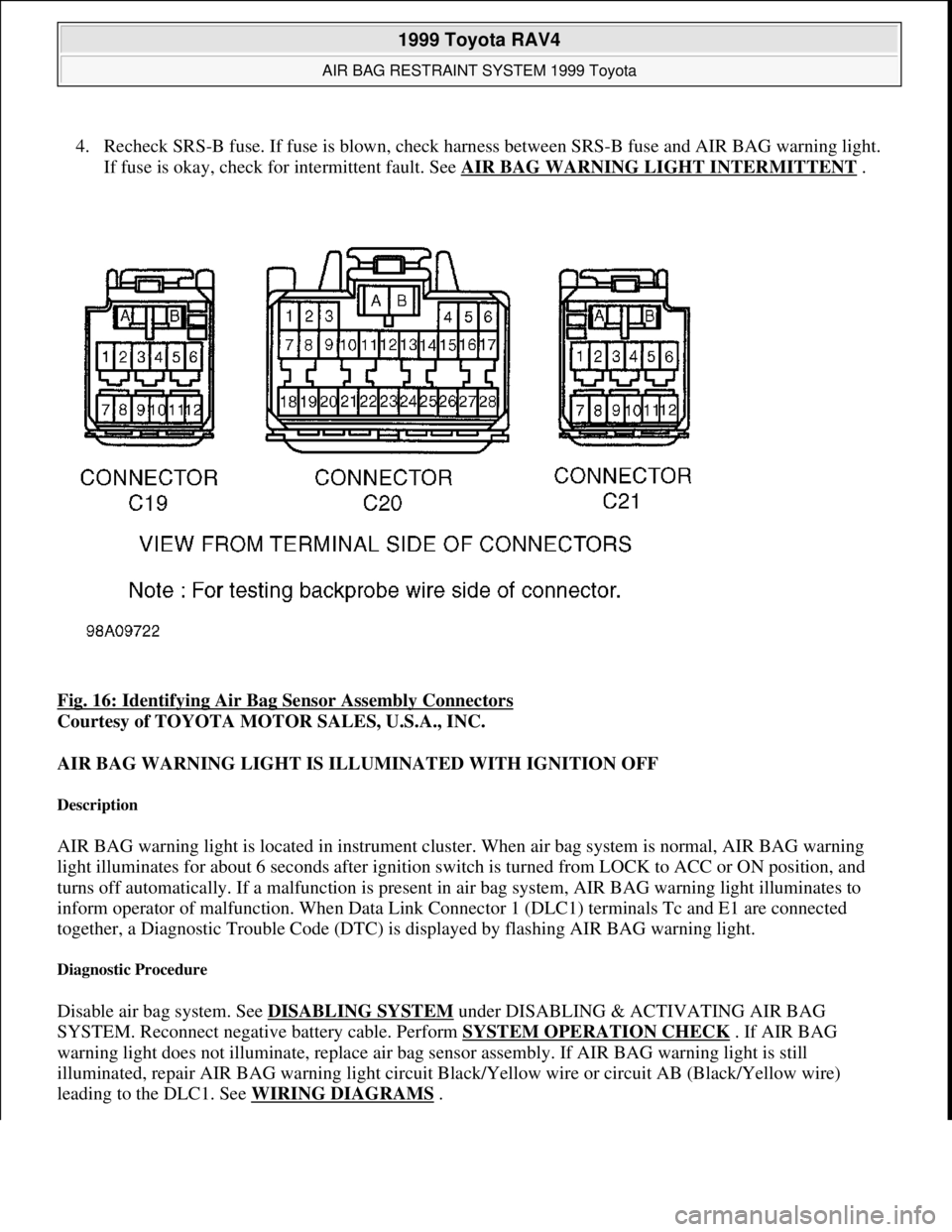
Fig. 16: Identifying Air Bag Sensor Assembly Connectors
Courtesy of TOYOTA MOTOR SALES, U.S.A., INC.
AIR BAG WARNING LIGHT IS ILLUMINATED WITH IGNITION OFF
Description
AIR BAG warning light is located in instrument cluster. When air bag system is normal, AIR BAG warning
light illuminates for about 6 seconds after ignition switch is turned from LOCK to ACC or ON position, and
turns off automatically. If a malfunction is present in air bag system, AIR BAG warning light illuminates to
inform operator of malfunction. When Data Link Connector 1 (DLC1) terminals Tc and E1 are connected
together, a Diagnostic Trouble Code (DTC) is displayed by flashing AIR BAG warning light.
Diagnostic Procedure
Disable air bag system. See DISABLING SYSTEM under DISABLING & ACTIVATING AIR BAG
SYSTEM. Reconnect negative battery cable. Perform SYSTEM OPERATION CHECK
. If AIR BAG
warning light does not illuminate, replace air bag sensor assembly. If AIR BAG warning light is still
illuminated, repair AIR BAG warning light circuit Black/Yellow wire or circuit AB (Black/Yellow wire)
leadin
g to the DLC1. See WIRING DIAGRAMS.
1999 Toyota RAV4
AIR BAG RESTRAINT SYSTEM 1999 Toyota
Microsoft
Sunday, November 22, 2009 10:33:23 AMPage 26 © 2005 Mitchell Repair Information Company, LLC.
Page 541 of 1632
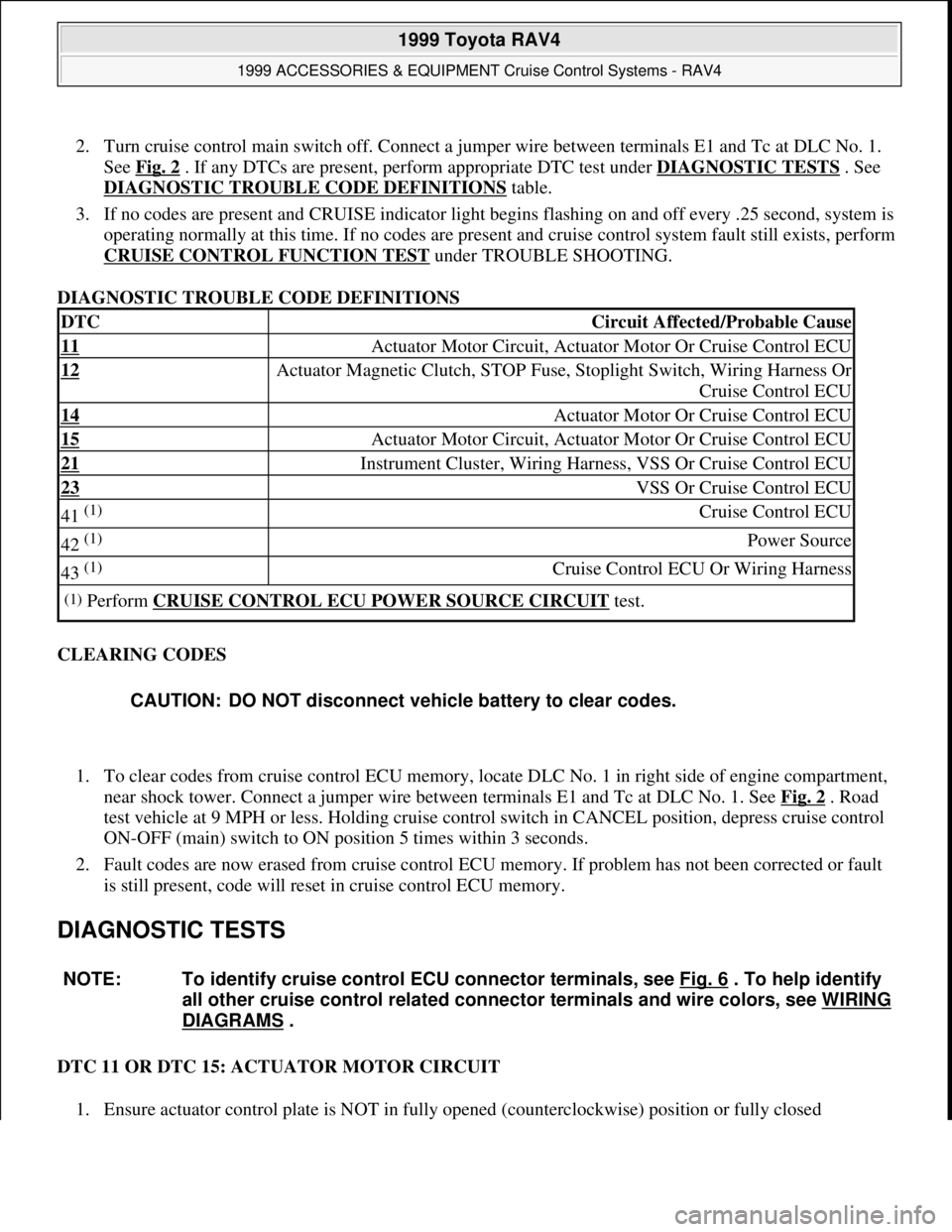
2. Turn cruise control main switch off. Connect a jumper wire between terminals E1 and Tc at DLC No. 1.
See Fig. 2
. If any DTCs are present, perform appropriate DTC test under DIAGNOSTIC TESTS . See
DIAGNOSTIC TROUBLE CODE DEFINITIONS
table.
3. If no codes are present and CRUISE indicator light begins flashing on and off every .25 second, system is
operating normally at this time. If no codes are present and cruise control system fault still exists, perform
CRUISE CONTROL FUNCTION TEST
under TROUBLE SHOOTING.
DIAGNOSTIC TROUBLE CODE DEFINITIONS
CLEARING CODES
1. To clear codes from cruise control ECU memory, locate DLC No. 1 in right side of engine compartment,
near shock tower. Connect a jumper wire between terminals E1 and Tc at DLC No. 1. See Fig. 2
. Road
test vehicle at 9 MPH or less. Holding cruise control switch in CANCEL position, depress cruise control
ON-OFF (main) switch to ON position 5 times within 3 seconds.
2. Fault codes are now erased from cruise control ECU memory. If problem has not been corrected or fault
is still present, code will reset in cruise control ECU memory.
DIAGNOSTIC TESTS
DTC 11 OR DTC 15: ACTUATOR MOTOR CIRCUIT
1. Ensure actuator control plate is NOT in full
y opened (counterclockwise) position or fully closed
DTCCircuit Affected/Probable Cause
11 Actuator Motor Circuit, Actuator Motor Or Cruise Control ECU
12 Actuator Magnetic Clutch, STOP Fuse, Stoplight Switch, Wiring Harness Or
Cruise Control ECU
14 Actuator Motor Or Cruise Control ECU
15 Actuator Motor Circuit, Actuator Motor Or Cruise Control ECU
21 Instrument Cluster, Wiring Harness, VSS Or Cruise Control ECU
23 VSS Or Cruise Control ECU
41 (1) Cruise Control ECU
42 (1) Power Source
43 (1) Cruise Control ECU Or Wiring Harness
(1)Perform CRUISE CONTROL ECU POWER SOURCE CIRCUIT test.
CAUTION: DO NOT disconnect vehicle battery to clear codes.
NOTE: To identify cruise control ECU connector terminals, see Fig. 6
. To help identify
all other cruise control related connector terminals and wire colors, see WIRING
DIAGRAMS .
1999 Toyota RAV4
1999 ACCESSORIES & EQUIPMENT Cruise Control Systems - RAV4
Microsoft
Sunday, November 22, 2009 10:52:01 AMPage 17 © 2005 Mitchell Repair Information Company, LLC.
Page 550 of 1632
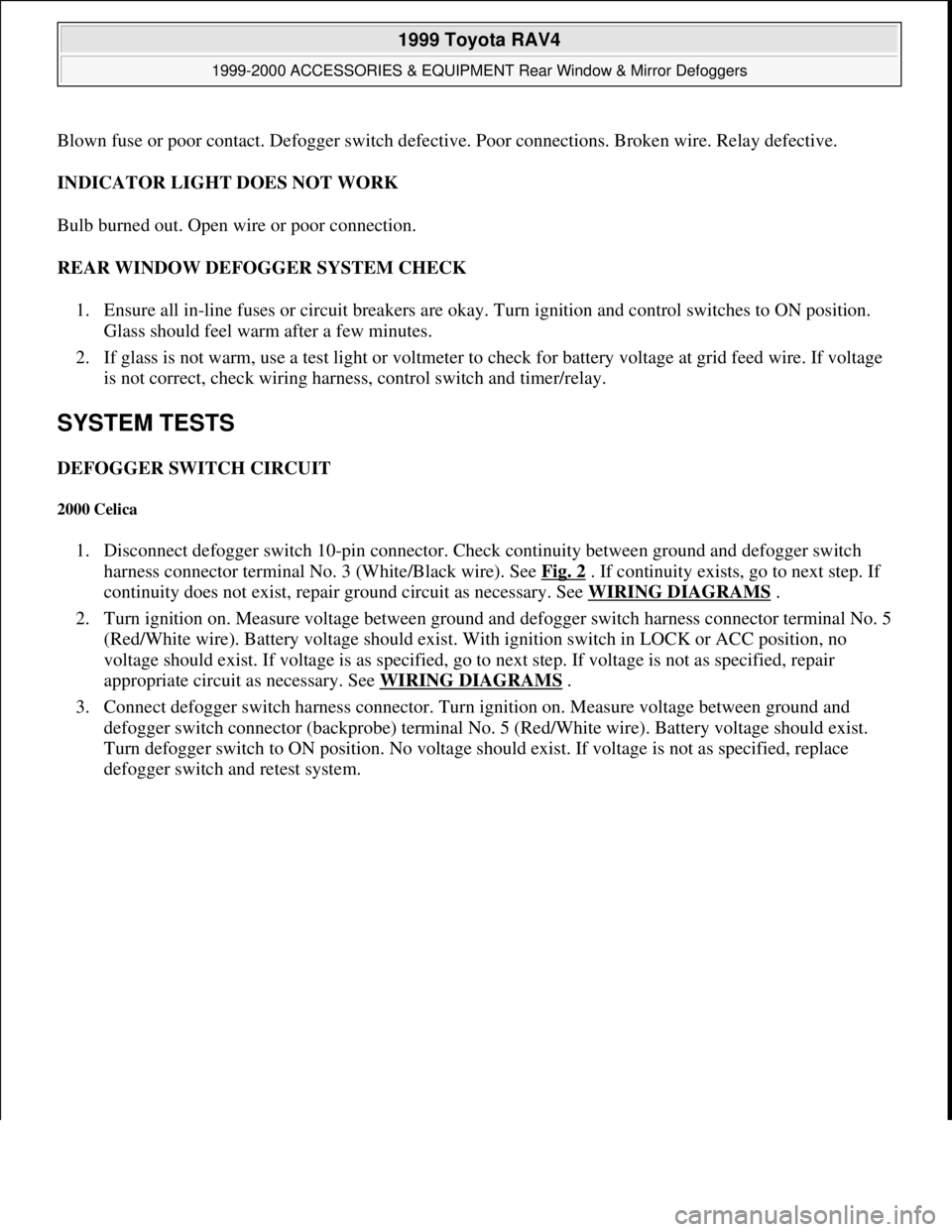
Blown fuse or poor contact. Defogger switch defective. Poor connections. Broken wire. Relay defective.
INDICATOR LIGHT DOES NOT WORK
Bulb burned out. Open wire or poor connection.
REAR WINDOW DEFOGGER SYSTEM CHECK
1. Ensure all in-line fuses or circuit breakers are okay. Turn ignition and control switches to ON position.
Glass should feel warm after a few minutes.
2. If glass is not warm, use a test light or voltmeter to check for battery voltage at grid feed wire. If voltage
is not correct, check wiring harness, control switch and timer/relay.
SYSTEM TESTS
DEFOGGER SWITCH CIRCUIT
2000 Celica
1. Disconnect defogger switch 10-pin connector. Check continuity between ground and defogger switch
harness connector terminal No. 3 (White/Black wire). See Fig. 2
. If continuity exists, go to next step. If
continuity does not exist, repair ground circuit as necessary. See WIRING DIAGRAMS
.
2. Turn ignition on. Measure voltage between ground and defogger switch harness connector terminal No. 5
(Red/White wire). Battery voltage should exist. With ignition switch in LOCK or ACC position, no
voltage should exist. If voltage is as specified, go to next step. If voltage is not as specified, repair
appropriate circuit as necessary. See WIRING DIAGRAMS
.
3. Connect defogger switch harness connector. Turn ignition on. Measure voltage between ground and
defogger switch connector (backprobe) terminal No. 5 (Red/White wire). Battery voltage should exist.
Turn defogger switch to ON position. No voltage should exist. If voltage is not as specified, replace
defo
gger switch and retest system.
1999 Toyota RAV4
1999-2000 ACCESSORIES & EQUIPMENT Rear Window & Mirror Defoggers
Microsoft
Sunday, November 22, 2009 10:55:10 AMPage 2 © 2005 Mitchell Repair Information Company, LLC.
Page 852 of 1632
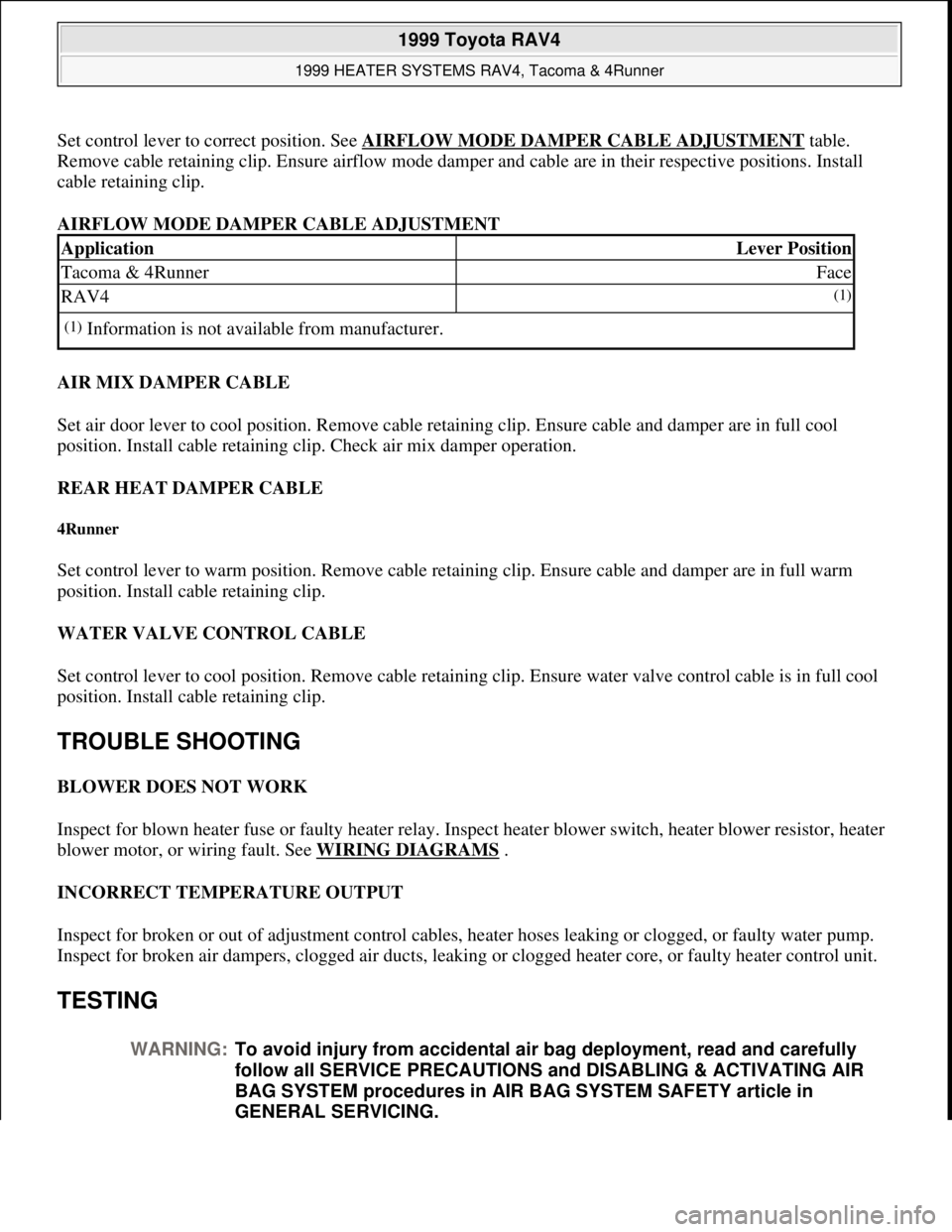
Set control lever to correct position. See AIRFLOW MODE DAMPER CABLE ADJUSTMENTtable.
Remove cable retaining clip. Ensure airflow mode damper and cable are in their respective positions. Install
cable retaining clip.
AIRFLOW MODE DAMPER CABLE ADJUSTMENT
AIR MIX DAMPER CABLE
Set air door lever to cool position. Remove cable retaining clip. Ensure cable and damper are in full cool
position. Install cable retaining clip. Check air mix damper operation.
REAR HEAT DAMPER CABLE
4Runner
Set control lever to warm position. Remove cable retaining clip. Ensure cable and damper are in full warm
position. Install cable retaining clip.
WATER VALVE CONTROL CABLE
Set control lever to cool position. Remove cable retaining clip. Ensure water valve control cable is in full cool
position. Install cable retaining clip.
TROUBLE SHOOTING
BLOWER DOES NOT WORK
Inspect for blown heater fuse or faulty heater relay. Inspect heater blower switch, heater blower resistor, heater
blower motor, or wiring fault. See WIRING DIAGRAMS
.
INCORRECT TEMPERATURE OUTPUT
Inspect for broken or out of adjustment control cables, heater hoses leaking or clogged, or faulty water pump.
Inspect for broken air dampers, clogged air ducts, leaking or clogged heater core, or faulty heater control unit.
TESTING
ApplicationLever Position
Tacoma & 4RunnerFace
RAV4(1)
(1)Information is not available from manufacturer.
WARNING:To avoid injury from accidental air bag deployment, read and carefully
follow all SERVICE PRECAUTIONS and DISABLING & ACTIVATING AIR
BAG SYSTEM procedures in AIR BAG SYSTEM SAFETY article in
GENERAL SERVICING.
1999 Toyota RAV4
1999 HEATER SYSTEMS RAV4, Tacoma & 4Runner
Microsoft
Sunday, November 22, 2009 10:30:50 AMPage 2 © 2005 Mitchell Repair Information Company, LLC.
Page 910 of 1632
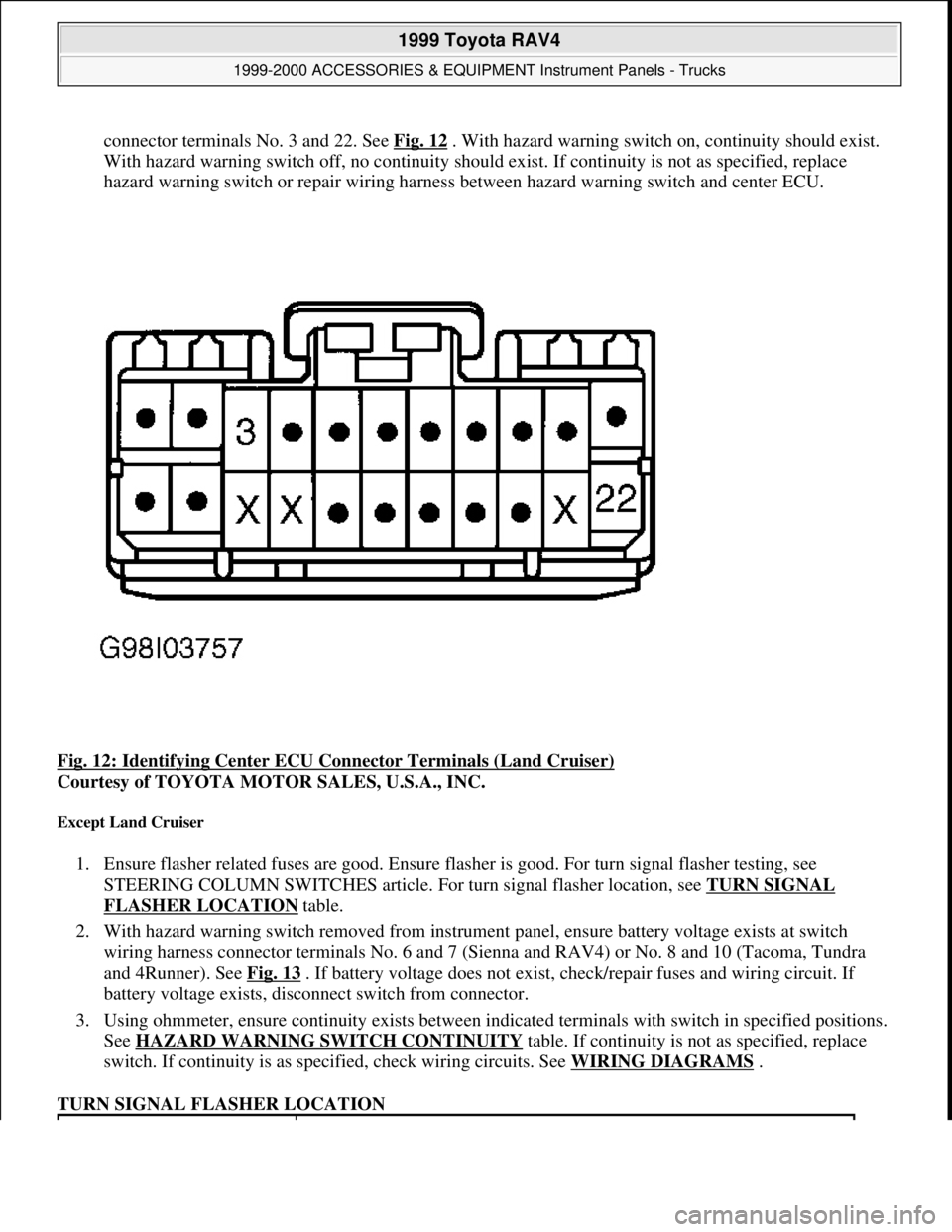
connector terminals No. 3 and 22. See Fig. 12. With hazard warning switch on, continuity should exist.
With hazard warning switch off, no continuity should exist. If continuity is not as specified, replace
hazard warning switch or repair wiring harness between hazard warning switch and center ECU.
Fig. 12: Identifying Center ECU Connector Terminals (Land Cruiser)
Courtesy of TOYOTA MOTOR SALES, U.S.A., INC.
Except Land Cruiser
1. Ensure flasher related fuses are good. Ensure flasher is good. For turn signal flasher testing, see
STEERING COLUMN SWITCHES article. For turn signal flasher location, see TURN SIGNAL
FLASHER LOCATION table.
2. With hazard warning switch removed from instrument panel, ensure battery voltage exists at switch
wiring harness connector terminals No. 6 and 7 (Sienna and RAV4) or No. 8 and 10 (Tacoma, Tundra
and 4Runner). See Fig. 13
. If battery voltage does not exist, check/repair fuses and wiring circuit. If
battery voltage exists, disconnect switch from connector.
3. Using ohmmeter, ensure continuity exists between indicated terminals with switch in specified positions.
See HAZARD WARNING SWITCH CONTINUITY
table. If continuity is not as specified, replace
switch. If continuity is as specified, check wiring circuits. See WIRING DIAGRAMS
.
TURN SIGNAL FLASHER LOCATION
1999 Toyota RAV4
1999-2000 ACCESSORIES & EQUIPMENT Instrument Panels - Trucks
Microsoft
Sunday, November 22, 2009 10:54:10 AMPage 20 © 2005 Mitchell Repair Information Company, LLC.
Page 1005 of 1632
1999-2000 ACCESSORIES & EQUIPMENT
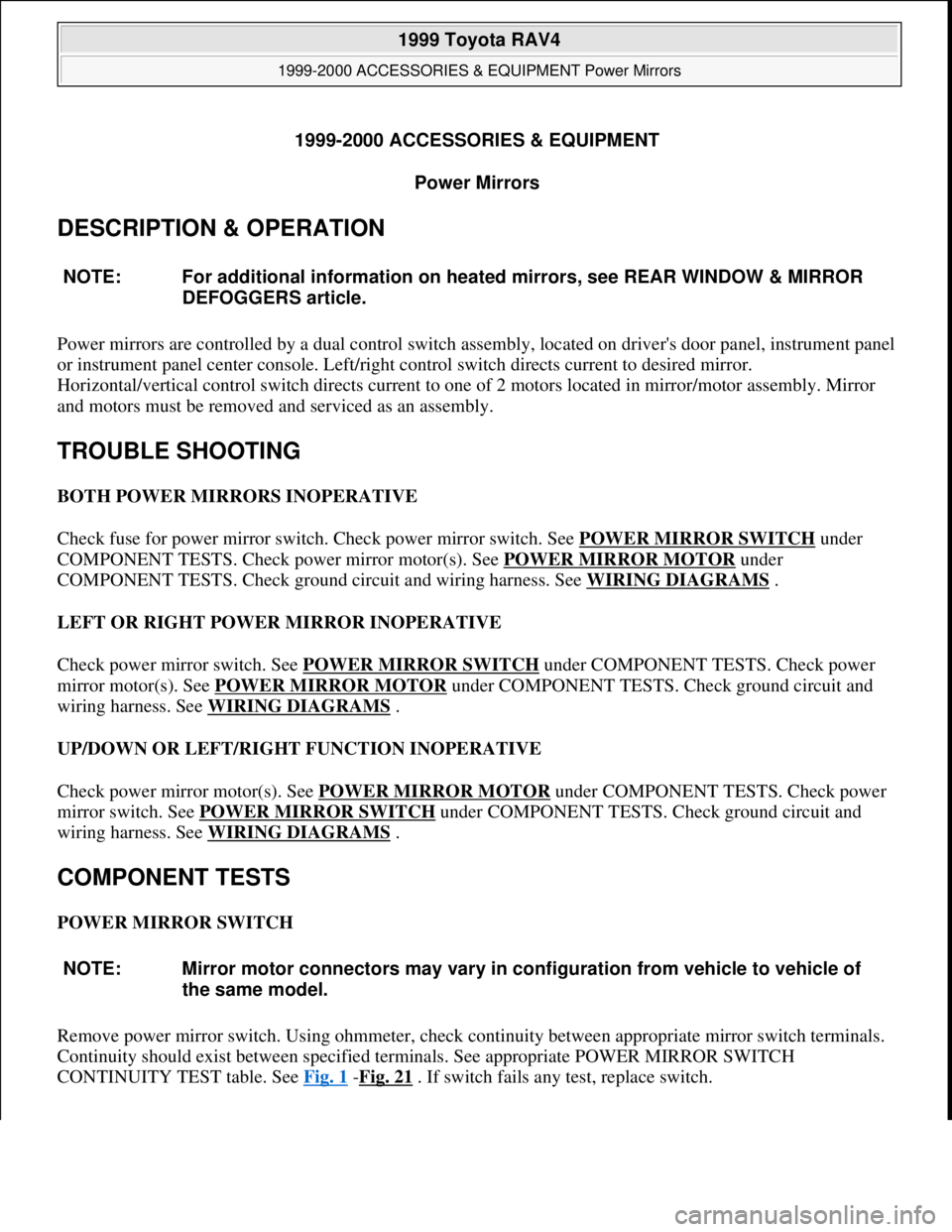
Power Mirrors
DESCRIPTION & OPERATION
Power mirrors are controlled by a dual control switch assembly, located on driver's door panel, instrument panel
or instrument panel center console. Left/right control switch directs current to desired mirror.
Horizontal/vertical control switch directs current to one of 2 motors located in mirror/motor assembly. Mirror
and motors must be removed and serviced as an assembly.
TROUBLE SHOOTING
BOTH POWER MIRRORS INOPERATIVE
Check fuse for power mirror switch. Check power mirror switch. See POWER MIRROR SWITCH
under
COMPONENT TESTS. Check power mirror motor(s). See POWER MIRROR MOTOR
under
COMPONENT TESTS. Check ground circuit and wiring harness. See WIRING DIAGRAMS
.
LEFT OR RIGHT POWER MIRROR INOPERATIVE
Check power mirror switch. See POWER MIRROR SWITCH
under COMPONENT TESTS. Check power
mirror motor(s). See POWER MIRROR MOTOR
under COMPONENT TESTS. Check ground circuit and
wiring harness. See WIRING DIAGRAMS
.
UP/DOWN OR LEFT/RIGHT FUNCTION INOPERATIVE
Check power mirror motor(s). See POWER MIRROR MOTOR
under COMPONENT TESTS. Check power
mirror switch. See POWER MIRROR SWITCH
under COMPONENT TESTS. Check ground circuit and
wiring harness. See WIRING DIAGRAMS
.
COMPONENT TESTS
POWER MIRROR SWITCH
Remove power mirror switch. Using ohmmeter, check continuity between appropriate mirror switch terminals.
Continuity should exist between specified terminals. See appropriate POWER MIRROR SWITCH
CONTINUITY TEST table. See Fig. 1
-Fig. 21. If switch fails any test, replace switch. NOTE: For additional information on heated mirrors, see REAR WINDOW & MIRROR
DEFOGGERS article.
NOTE: Mirror motor connectors may vary in configuration from vehicle to vehicle of
the same model.
1999 Toyota RAV4
1999-2000 ACCESSORIES & EQUIPMENT Power Mirrors
1999 Toyota RAV4
1999-2000 ACCESSORIES & EQUIPMENT Power Mirrors
Microsoft
Sunday, November 22, 2009 10:55:57 AMPage 1 © 2005 Mitchell Repair Information Company, LLC.
Microsoft
Sunday, November 22, 2009 10:56:02 AMPage 1 © 2005 Mitchell Repair Information Company, LLC.
Page 1506 of 1632
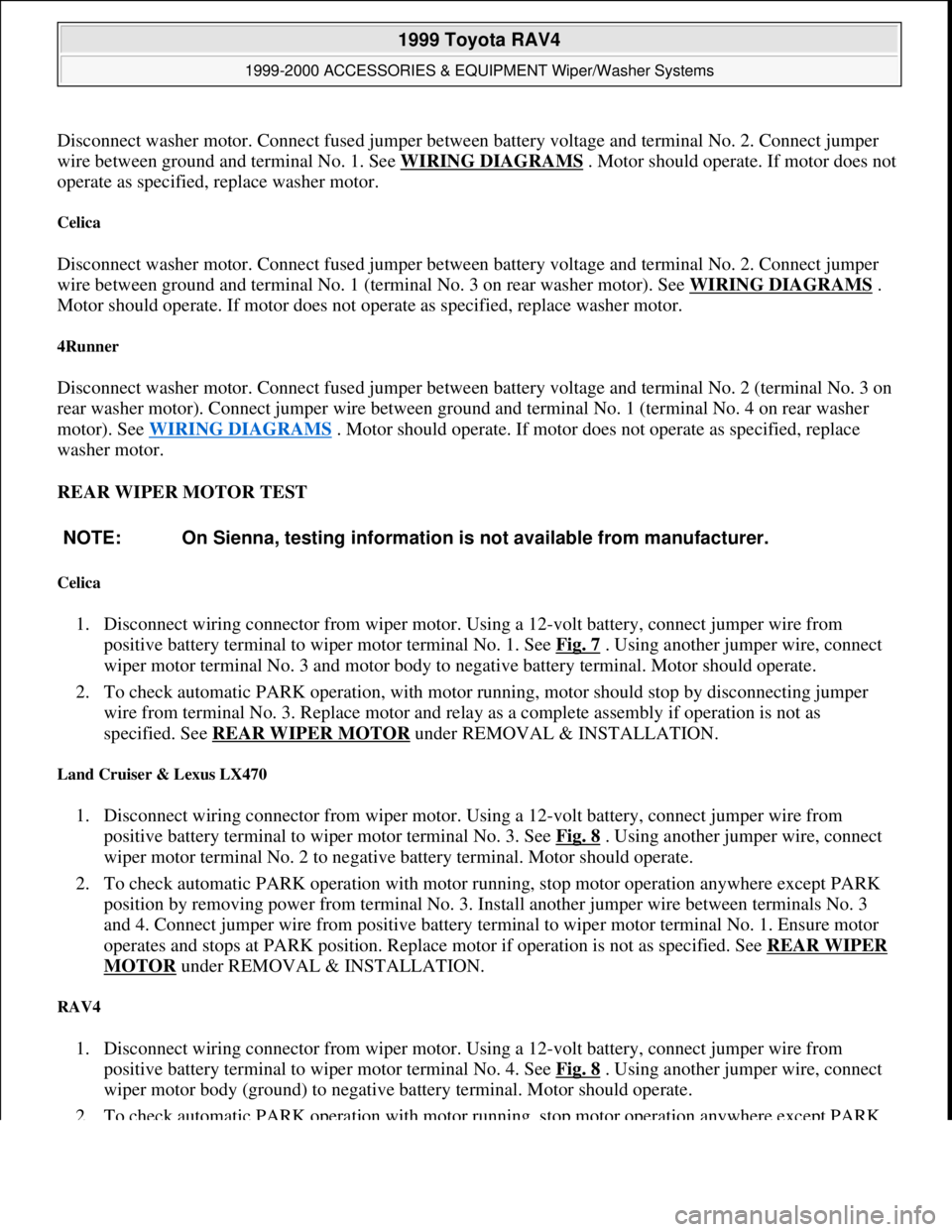
Disconnect washer motor. Connect fused jumper between battery voltage and terminal No. 2. Connect jumper
wire between ground and terminal No. 1. See WIRING DIAGRAMS
. Motor should operate. If motor does not
operate as specified, replace washer motor.
Celica
Disconnect washer motor. Connect fused jumper between battery voltage and terminal No. 2. Connect jumper
wire between ground and terminal No. 1 (terminal No. 3 on rear washer motor). See WIRING DIAGRAMS
.
Motor should operate. If motor does not operate as specified, replace washer motor.
4Runner
Disconnect washer motor. Connect fused jumper between battery voltage and terminal No. 2 (terminal No. 3 on
rear washer motor). Connect jumper wire between ground and terminal No. 1 (terminal No. 4 on rear washer
motor). See WIRING DIAGRAMS
. Motor should operate. If motor does not operate as specified, replace
washer motor.
REAR WIPER MOTOR TEST
Celica
1. Disconnect wiring connector from wiper motor. Using a 12-volt battery, connect jumper wire from
positive battery terminal to wiper motor terminal No. 1. See Fig. 7
. Using another jumper wire, connect
wiper motor terminal No. 3 and motor body to negative battery terminal. Motor should operate.
2. To check automatic PARK operation, with motor running, motor should stop by disconnecting jumper
wire from terminal No. 3. Replace motor and relay as a complete assembly if operation is not as
specified. See REAR WIPER MOTOR
under REMOVAL & INSTALLATION.
Land Cruiser & Lexus LX470
1. Disconnect wiring connector from wiper motor. Using a 12-volt battery, connect jumper wire from
positive battery terminal to wiper motor terminal No. 3. See Fig. 8
. Using another jumper wire, connect
wiper motor terminal No. 2 to negative battery terminal. Motor should operate.
2. To check automatic PARK operation with motor running, stop motor operation anywhere except PARK
position by removing power from terminal No. 3. Install another jumper wire between terminals No. 3
and 4. Connect jumper wire from positive battery terminal to wiper motor terminal No. 1. Ensure motor
operates and stops at PARK position. Replace motor if operation is not as specified. See REAR WIPER
MOTOR under REMOVAL & INSTALLATION.
RAV4
1. Disconnect wiring connector from wiper motor. Using a 12-volt battery, connect jumper wire from
positive battery terminal to wiper motor terminal No. 4. See Fig. 8
. Using another jumper wire, connect
wiper motor body (ground) to negative battery terminal. Motor should operate.
2. To check automatic PARK operation with motor runnin
g, stop motor operation anywhere except PARK NOTE: On Sienna, testing information is not available from manufacturer.
1999 Toyota RAV4
1999-2000 ACCESSORIES & EQUIPMENT Wiper/Washer Systems
Microsoft
Sunday, November 22, 2009 11:01:20 AMPage 11 © 2005 Mitchell Repair Information Company, LLC.