instrument cluster TOYOTA RAV4 1996 Service Repair Manual
[x] Cancel search | Manufacturer: TOYOTA, Model Year: 1996, Model line: RAV4, Model: TOYOTA RAV4 1996Pages: 1632, PDF Size: 41.64 MB
Page 1 of 1632
1999-2000 BRAKES
Anti-Lock - RAV4
DESCRIPTION
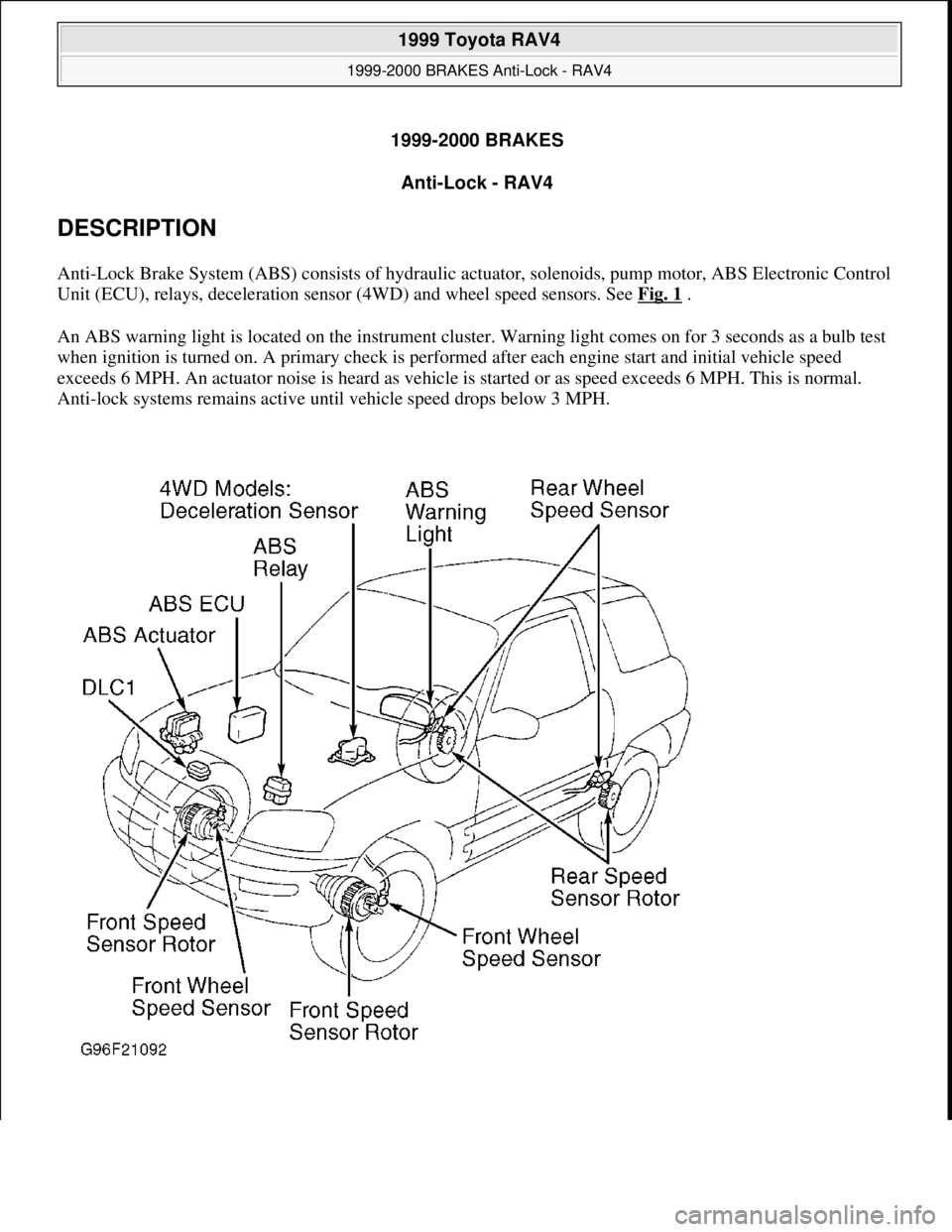
Anti-Lock Brake System (ABS) consists of hydraulic actuator, solenoids, pump motor, ABS Electronic Control
Unit (ECU), relays, deceleration sensor (4WD) and wheel speed sensors. See Fig. 1
.
An ABS warning light is located on the instrument cluster. Warning light comes on for 3 seconds as a bulb test
when ignition is turned on. A primary check is performed after each engine start and initial vehicle speed
exceeds 6 MPH. An actuator noise is heard as vehicle is started or as speed exceeds 6 MPH. This is normal.
Anti-lock systems remains active until vehicle speed drops below 3 MPH.
1999 Toyota RAV4
1999-2000 BRAKES Anti-Lock - RAV4
1999 Toyota RAV4
1999-2000 BRAKES Anti-Lock - RAV4
Microsoft
Sunday, November 22, 2009 10:06:17 AMPage 1 © 2005 Mitchell Repair Information Company, LLC.
Microsoft
Sunday, November 22, 2009 10:06:21 AMPage 1 © 2005 Mitchell Repair Information Company, LLC.
Page 37 of 1632
The air bag sensor, which deploys air bags, contains a back-up power supply, safing sensor and diagnostic code
memory. Spiral cable (clockspring) maintains a complete circuit to the steering wheel pad.
SYSTEM OPERATION CHECK
Turn ignition switch to ACC or ON position. Air bag warning light in instrument cluster should come on for
about 6 seconds and then go out. If light does not respond as specified, SRS is malfunctioning and needs repair.
See DIAGNOSIS
.
SERVICE PRECAUTIONS
Observe the following precautions when working on SRS:
Before servicing any SRS or steering column component, disable SRS. See DISABLING &
ACTIVATING AIR BAG SYSTEM . Failure to disable system could result in accidental air bag
deployment and personal injury.
When diagnosing SRS, always check for diagnostic codes before disconnecting battery.
After ignition switch is turned to LOCK position and negative battery cable is disconnected, wait at least
90 seconds before working on SRS. SRS is equipped with a back-up power source that may allow air bag
to deploy within 90 seconds of disconnecting negative battery cable.
In a minor collision in which air bags do not deploy, steering wheel pad must be inspected.
NEVER use air bag parts from another vehicle. Replace air bag parts with new parts.
Air bag sensor assembly contains mercury. After replacement, DO NOT destroy the old part. When
scrapping vehicle or replacing air bag sensor assembly, remove air bag sensor assembly and dispose of as
toxic waste.
Never disassemble or repair system components. Replace cracked, dented or otherwise damaged system
components.
Remove air bag sensor if shocks are likely to be applied to the sensor during repairs.
When diagnosing electrical circuits, use a Digital Volt/Ohmmeter (DVOM) with high impedance (10,000
ohms minimum).
Information labels are attached to air bag components. Follow all notices on labels.
After servicing SRS, check air bag warning light to ensure system is functioning properly. See SYSTEM
OPERATION CHECK .
Always wear safety glasses when servicing or handling an air bag.
When placing a live air bag on a bench or other surface, always face air bag and trim cover up, away from
surface. This will reduce motion of module if accidentally deployed.
After deployment, air bag surface may contain deposits of sodium hydroxide which irritates skin. During
clean-up, always wear safety glasses, rubber gloves and long-sleeved shirt. After clean-up, wash hands
using mild soap and water.
When carrying a live air bag module, trim cover must be pointed away from your body to minimize
injury in case of accidental deployment.
If SRS is not fully functional for any reason, vehicle should not be driven until system is repaired and
a
gain becomes operational. DO NOTremove bulbs, modules, sensors or other components or in any way
1996 Toyota 4Runner
AIR BAG RESTRAINT SYSTEM 1996 ACCESSORIES/SAFETY EQUIPMENT Toyota Air Bag Restraint System
Microsoft
Tuesday, August 18, 2009 7:33:32 PMPage 3 © 2005 Mitchell Repair Information Company, LLC.
Page 80 of 1632
INSTRUMENT PANEL
Removal & Installation
1. Before proceeding, see SERVICE PRECAUTIONS . Turn ignition switch to LOCK position.
Disconnect negative battery cable. Wait at least 90 seconds.
2. Access and disconnect right and left seat belt pretensioner connectors. See SEAT BELT
PRETENSIONERS . Remove front door scuff plates and cowl side trim boards. See Fig. 13 . Remove
steering wheel. See STEERING WHEEL
. Remove steering column covers and cluster finish panel.
Remove instrument cluster. Remove hood lock release lever.
3. Remove lower finish panel and instrument panel lower insert. Remove No. 2 heater-to-register duct.
Remove steering column assembly. See STEERING COLUMN
. Remove 2 screws and center cluster
finish panel. Pull off heater control knobs and pry off heater control name plate. Pry off cluster instrument
panel, then remove 3 screws from heater control assembly. Disconnect connectors and remove cluster
instrument panel.
4. Disconnect control cables and remove heater control assembly. Remove radio assembly. Remove console
box. Tape tip of screwdriver and remove lower center cluster finish panel. Disconnect connectors.
Remove stereo opening cover. Remove glove box assembly. Remove side trim cover. Disconnect
remaining connectors and remove bolts, then remove instrument panel.
5. To install, reverse removal procedure. Tighten fasteners to specification. See TORQUE
SPECIFICATIONS . Check AIR BAG warning light to ensure system is functioning properly. See
SYSTEM OPERATION CHECK
.
1999 Toyota RAV4
AIR BAG RESTRAINT SYSTEM 1999 Toyota
Microsoft
Sunday, November 22, 2009 10:33:22 AMPage 17 © 2005 Mitchell Repair Information Company, LLC.
Page 88 of 1632
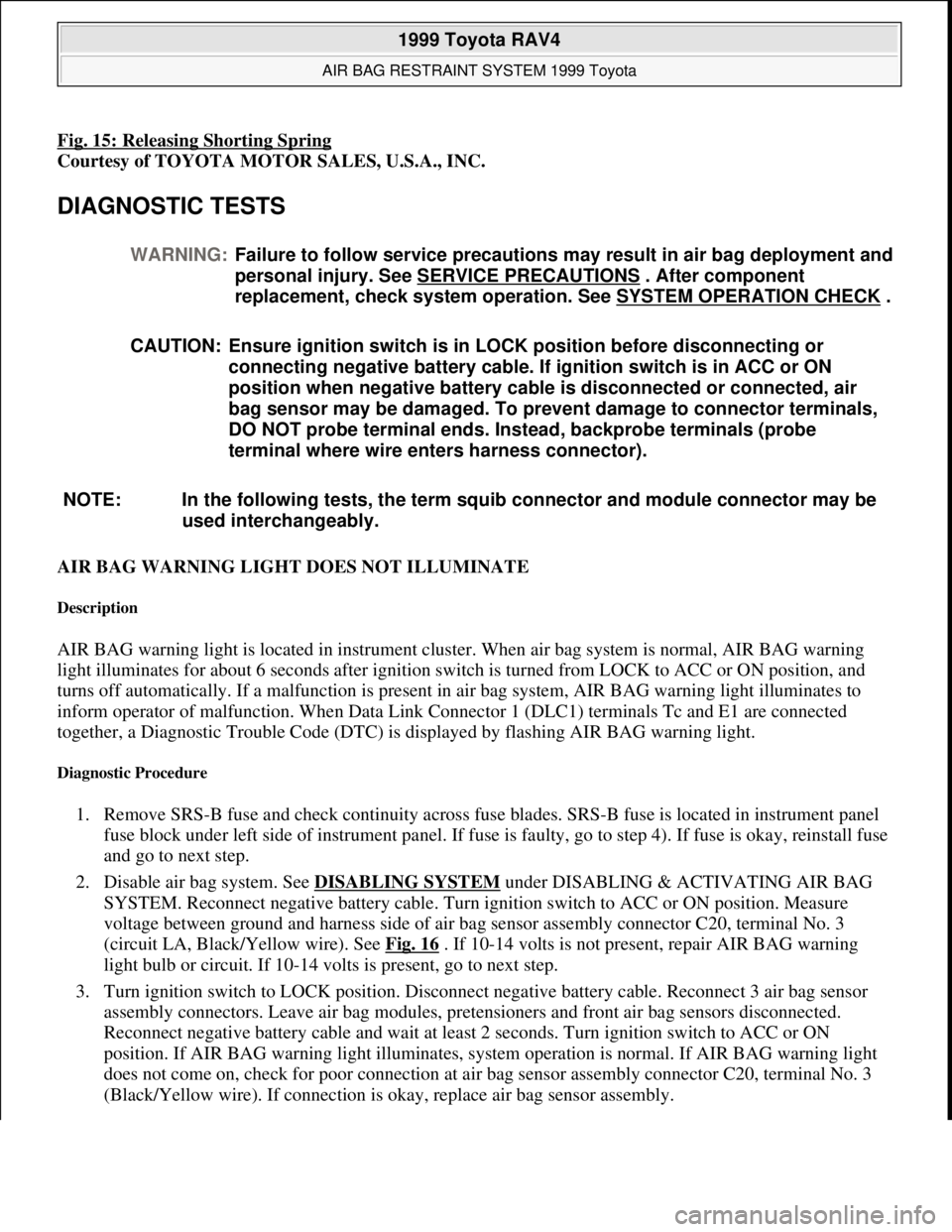
Fig. 15: Releasing Shorting Spring
Courtesy of TOYOTA MOTOR SALES, U.S.A., INC.
DIAGNOSTIC TESTS
AIR BAG WARNING LIGHT DOES NOT ILLUMINATE
Description
AIR BAG warning light is located in instrument cluster. When air bag system is normal, AIR BAG warning
light illuminates for about 6 seconds after ignition switch is turned from LOCK to ACC or ON position, and
turns off automatically. If a malfunction is present in air bag system, AIR BAG warning light illuminates to
inform operator of malfunction. When Data Link Connector 1 (DLC1) terminals Tc and E1 are connected
together, a Diagnostic Trouble Code (DTC) is displayed by flashing AIR BAG warning light.
Diagnostic Procedure
1. Remove SRS-B fuse and check continuity across fuse blades. SRS-B fuse is located in instrument panel
fuse block under left side of instrument panel. If fuse is faulty, go to step 4). If fuse is okay, reinstall fuse
and go to next step.
2. Disable air bag system. See DISABLING SYSTEM
under DISABLING & ACTIVATING AIR BAG
SYSTEM. Reconnect negative battery cable. Turn ignition switch to ACC or ON position. Measure
voltage between ground and harness side of air bag sensor assembly connector C20, terminal No. 3
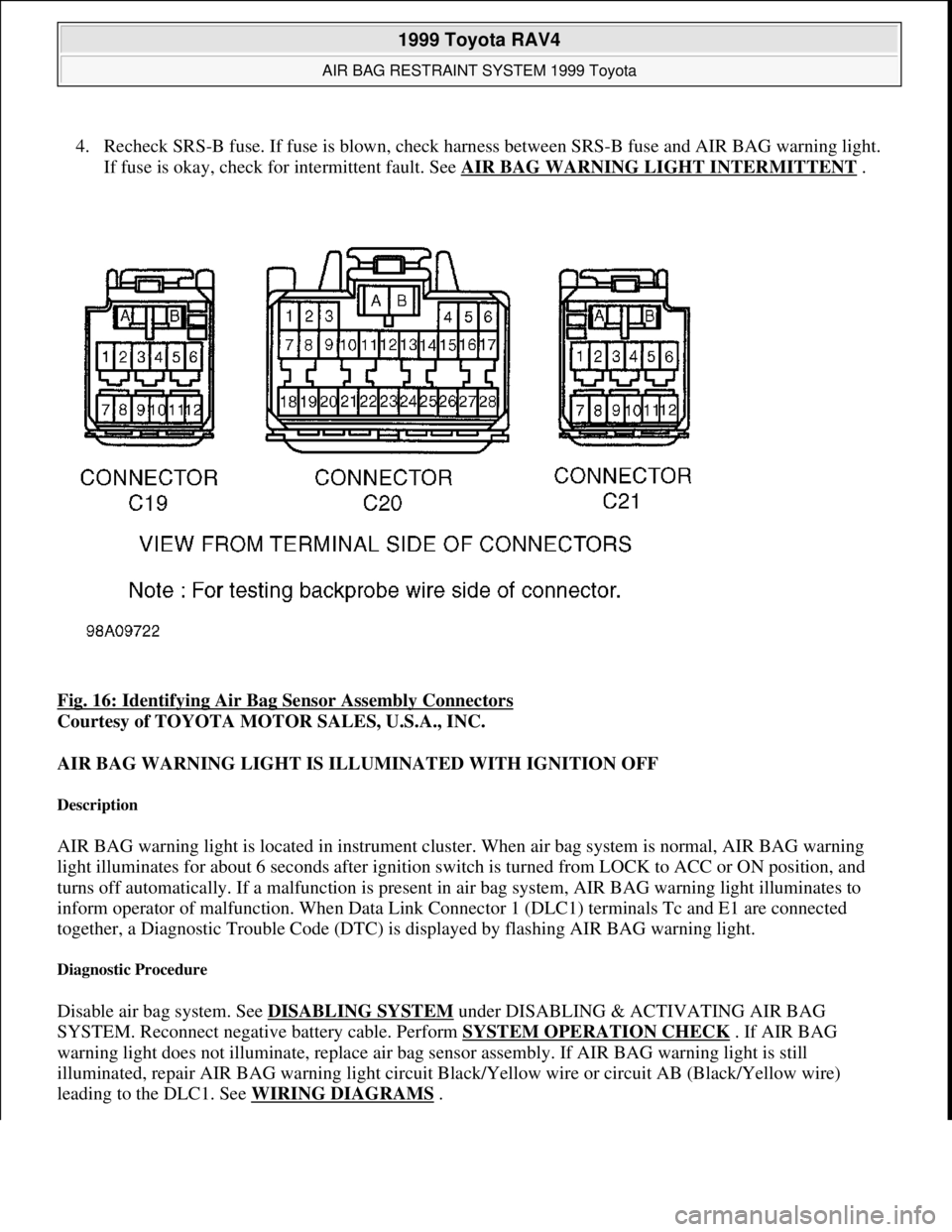
(circuit LA, Black/Yellow wire). See Fig. 16
. If 10-14 volts is not present, repair AIR BAG warning
light bulb or circuit. If 10-14 volts is present, go to next step.
3. Turn ignition switch to LOCK position. Disconnect negative battery cable. Reconnect 3 air bag sensor
assembly connectors. Leave air bag modules, pretensioners and front air bag sensors disconnected.
Reconnect negative battery cable and wait at least 2 seconds. Turn ignition switch to ACC or ON
position. If AIR BAG warning light illuminates, system operation is normal. If AIR BAG warning light
does not come on, check for poor connection at air bag sensor assembly connector C20, terminal No. 3
(Black/Yellow wire). If connection is oka
y, replace air bag sensor assembly. WARNING:Failure to follow service precautions may result in air bag deployment and
personal injury. See SERVICE PRECAUTIONS
. After component
replacement, check system operation. See SYSTEM OPERATION CHECK
.
CAUTION: Ensure ignition switch is in LOCK position before disconnecting or
connecting negative battery cable. If ignition switch is in ACC or ON
position when negative battery cable is disconnected or connected, air
bag sensor may be damaged. To prevent damage to connector terminals,
DO NOT probe terminal ends. Instead, backprobe terminals (probe
terminal where wire enters harness connector).
NOTE: In the following tests, the term squib connector and module connector may be
used interchangeably.
1999 Toyota RAV4
AIR BAG RESTRAINT SYSTEM 1999 Toyota
Microsoft
Sunday, November 22, 2009 10:33:23 AMPage 25 © 2005 Mitchell Repair Information Company, LLC.
Page 89 of 1632
4. Recheck SRS-B fuse. If fuse is blown, check harness between SRS-B fuse and AIR BAG warning light.
If fuse is okay, check for intermittent fault. See AIR BAG WARNING LIGHT INTERMITTENT
.
Fig. 16: Identifying Air Bag Sensor Assembly Connectors
Courtesy of TOYOTA MOTOR SALES, U.S.A., INC.
AIR BAG WARNING LIGHT IS ILLUMINATED WITH IGNITION OFF
Description
AIR BAG warning light is located in instrument cluster. When air bag system is normal, AIR BAG warning
light illuminates for about 6 seconds after ignition switch is turned from LOCK to ACC or ON position, and
turns off automatically. If a malfunction is present in air bag system, AIR BAG warning light illuminates to
inform operator of malfunction. When Data Link Connector 1 (DLC1) terminals Tc and E1 are connected
together, a Diagnostic Trouble Code (DTC) is displayed by flashing AIR BAG warning light.
Diagnostic Procedure
Disable air bag system. See DISABLING SYSTEM under DISABLING & ACTIVATING AIR BAG
SYSTEM. Reconnect negative battery cable. Perform SYSTEM OPERATION CHECK
. If AIR BAG
warning light does not illuminate, replace air bag sensor assembly. If AIR BAG warning light is still
illuminated, repair AIR BAG warning light circuit Black/Yellow wire or circuit AB (Black/Yellow wire)
leadin
g to the DLC1. See WIRING DIAGRAMS.
1999 Toyota RAV4
AIR BAG RESTRAINT SYSTEM 1999 Toyota
Microsoft
Sunday, November 22, 2009 10:33:23 AMPage 26 © 2005 Mitchell Repair Information Company, LLC.
Page 527 of 1632
OPERATION
Cruise control system functions can be performed from cruise control switch, located on lever on right side of
steering column. Pressing cruise ON-OFF (main) switch at end of lever turns system on. CRUISE indicator
light in instrument cluster comes on when desired cruising speed is set. To set desired speed, move control lever
downward in SET/COAST direction and release it. Desired speed should be maintained. Press cruise ON-OFF
(main) switch again to turn cruise control system off.
Cancel set speed by moving cruise control lever in CANCEL direction, pressing brake pedal, or pressing clutch
pedal (M/T) or placing shift lever in Neutral (A/T). If vehicle speed drops to less than 25 MPH, set speed will
automatically cancel. If vehicle speed decreases 10 MPH less than set speed, set speed will also cancel. If cruise
control ECU detects a system malfunction, set speed will automatically cancel and CRUISE indicator light will
flash several times.
Moving cruise control lever in RES/ACC (resume/accelerate) direction allows vehicle to return to speed set
before cancellation. Holding cruise control lever in RES/ACC (resume/accelerate) direction gradually increases
vehicle speed. Holding cruise control lever in SET/COAST direction gradually decreases vehicle speed.
ACTUATOR
Actuator consists of a motor, safety magnetic clutch, position sensor, pulley and a cable connected to engine
throttle valve. When actuator receives a signal from cruise control ECU, it engages safety magnetic clutch and
activates motor. Motor causes pulley and cable to move, which will open or close engine throttle valve.
When motor rotates forward, pulley also rotates (via safety magnetic clutch, gears and drive shaft). A cable
connected to engine throttle valve and opens valve accordingly. When motor rotates in a reverse direction,
pulley and cable also rotate in a reverse direction and engine throttle valve closes.
CRUISE CONTROL SWITCH
ON-OFF (Main Switch)
Cruise ON-OFF switch is power switch for cruise control system. When ignition is turned off, cruise ON-OFF
switch is also turned off. The switch remains off even when ignition is turned on again.
SET/COAST Position
When cruise control switch is moved to SET/COAST position with cruise ON-OFF switch turned to ON
position and vehicle speed greater than 25 MPH, cruise control ECU stores vehicle speed and maintains that
speed via actuator.
When cruise control switch is moved to SET/COAST position while in cruise control mode, actuator motor is
energized to close engine throttle valve. Vehicle decelerates until switch is released. From then on, cruise
control ECU stores new vehicle speed and maintains that speed.
RES/ACC Position
1999 Toyota RAV4
1999 ACCESSORIES & EQUIPMENT Cruise Control Systems - RAV4
Microsoft
Sunday, November 22, 2009 10:52:01 AMPage 3 © 2005 Mitchell Repair Information Company, LLC.
Page 528 of 1632
If cruise control operation is canceled by any canceling switch, vehicle set speed can be resumed and controlled
at the previously set speed by moving cruise control switch to RES/ACC (resume/accelerate) position. Set
speed, however, cannot be resumed if vehicle speed drops to less than 25 MPH, which clears cruise control
ECU set speed stored.
When cruise control switch is moved to RES/ACC (resume/accelerate) position while in cruise control mode,
actuator motor is energized to open engine throttle valve. Vehicle accelerates until switch is released. From then
on, cruise control ECU stores new vehicle speed and maintains that speed.
Cancel Position
When cruise control switch is moved to CANCEL position, a cancellation signal is sent to cruise control ECU
disabling cruise control operation. Previous vehicle set speed is stored in cruise control ECU memory.
CRUISE CONTROL ELECTRONIC CONTROL UNIT (ECU)
Cruise control Electronic Control Unit (ECU) constantly monitors and compares set speed with actual vehicle
speed from input sensors. When vehicle speed is greater than set speed, cruise control ECU activates actuator
motor to close engine throttle valve, reducing vehicle speed. When vehicle speed drops to less than set speed,
cruise control ECU activates actuator motor to open engine throttle valve, increasing vehicle speed.
Cruise control ECU includes a self-diagnostic function. If cruise control system is canceled by any condition
other than driver operation, cruise control ECU assumes a malfunction has occurred and may set a
corresponding trouble code.
VEHICLE SPEED SENSOR
Vehicle speed sensor is mounted on transaxle. Vehicle speed sensor rotor shaft is driven by a gear on transaxle
output shaft. For each shaft rotation, vehicle speed sensor sends a 4-pulse signal to instrument cluster and cruise
control ECU. Cruise control ECU calculates vehicle speed from this pulse signal.
SELF-DIAGNOSTIC SYSTEM
When vehicle is in cruise control mode, system will cancel due to a malfunction in actuator, vehicle speed
sensor or other cruise circuit. When cruise control functions are canceled due to a malfunction, CRUISE
indicator light will blink, indicating a trouble code is stored in cruise control ECU memory. See DIAGNOSTIC
TROUBLE CODE DEFINITIONS table under SELF-DIAGNOSTIC SYSTEM.
If a fault or symptom is present, but no trouble codes were set, a system function test can be performed. See
CRUISE CONTROL FUNCTION TEST
under TROUBLE SHOOTING.
Before proceeding with cruise control system self-diagnostic system, ensure basic inspection of system
connectors and wiring harnesses has been performed. If no faults were found during basic inspection, proceed
with self-diagnostic system.
NOTE: Intermittent failures may cause CRUISE indicator light to flicker or come on.
Light will go out after fault goes away. Fault may or may not be present at time
1999 Toyota RAV4
1999 ACCESSORIES & EQUIPMENT Cruise Control Systems - RAV4
Microsoft
Sunday, November 22, 2009 10:52:01 AMPage 4 © 2005 Mitchell Repair Information Company, LLC.
Page 537 of 1632
FUNCTION TEST under TROUBLE SHOOTING. If clutch switch input signal is not as specified, go to
next step. If clutch switch input signal is as specified, no problem is indicated at this time. Fault may be
intermittent. If sent here from SYMPTOM DIAGNOSIS, perform next test listed.
3. Remove cruise control ECU with connector attached. See Fig. 1
. Turn ignition switch to ON position.
Using voltmeter positive lead, backprobe cruise control ECU connector terminal No. 3 (Blue/Black wire)
with negative lead to ground. With clutch pedal depressed, battery voltage should exist. With clutch pedal
released, voltage should be less than one volt. If voltage is not as specified, go to next step. If voltage is
as specified, no problem is indicated at this time. Fault may be intermittent. If sent here from SYMPTOM
DIAGNOSIS, perform next test listed.
4. Check wiring harness and connectors between cruise control ECU and TURN & GAUGE fuses in
instrument panel junction block. Repair as necessary. If wiring harness and connectors are okay, replace
cruise control ECU and retest system.
CRUISE CONTROL ECU POWER SOURCE CIRCUIT
1. Locate ECU-IG (10-amp) fuse in instrument panel junction block. See Fig. 1
. Remove ECU-IG fuse and
ensure fuse continuity. If fuse is okay, go to next step. If fuse is not okay, check for short between cruise
control ECU connector terminal No. 9 (Black/Yellow wire) and ECU-IG fuse.
2. Remove cruise control ECU with connector attached. See Fig. 1
. Turn ignition switch to ON position.
Using voltmeter, backprobe between cruise control ECU connector terminals No. 9 (Black/Yellow wire)
and No. 16 (White/Black wire). If battery voltage is not present, go to next step. If battery voltage is
present, no problem is indicated at this time. Fault may be intermittent. If sent here from SYMPTOM
DIAGNOSIS, perform next test listed.
3. Turn ignition switch to OFF position. Backprobing connector, measure resistance between ground and
terminal No. 16 (White/Black wire) at cruise control ECU connector. If resistance is less than one ohm,
check wiring harness or connector between cruise control ECU connector and battery. Repair as
necessary and retest system. If resistance is one ohm or more, repair wiring harness or connector between
cruise control ECU connector terminal No. 16 (White/Black wire) and ground. Retest system.
CRUISE CONTROL INDICATOR LIGHT CIRCUIT
1. Turn ignition switch to ON position. Backprobing connector, measure voltage between ground and
terminal No. 4 (Green/Red wire) at cruise control ECU connector. With cruise control switch in OFF
position, battery voltage should be present. With cruise control switch in ON position, voltage should be
less than 1.2 volts.
2. If voltage is as specified, no problem is indicated at this time. Fault may be intermittent. If sent here from
SYMPTOM DIAGNOSIS, perform next test listed. If voltage is not as specified, check instrument
cluster. See appropriate INSTRUMENT PANELS article. Repair as necessary. If instrument cluster is
okay, replace cruise control ECU and retest system.
DIAGNOSTIC CIRCUIT
1. Locate Data Link Connector (DLC) No. 1 in right side of engine compartment, near shock tower.
Connect voltmeter positive lead to terminal Tc and negative lead to terminal E1. See Fig. 2
. Turn
ignition switch to ON position. If battery voltage is not present, go to next step. If battery voltage is
present, no problem is indicated at this time. Fault ma
y be intermittent. If sent here from SYMPTOM
1999 Toyota RAV4
1999 ACCESSORIES & EQUIPMENT Cruise Control Systems - RAV4
Microsoft
Sunday, November 22, 2009 10:52:01 AMPage 13 © 2005 Mitchell Repair Information Company, LLC.
Page 541 of 1632
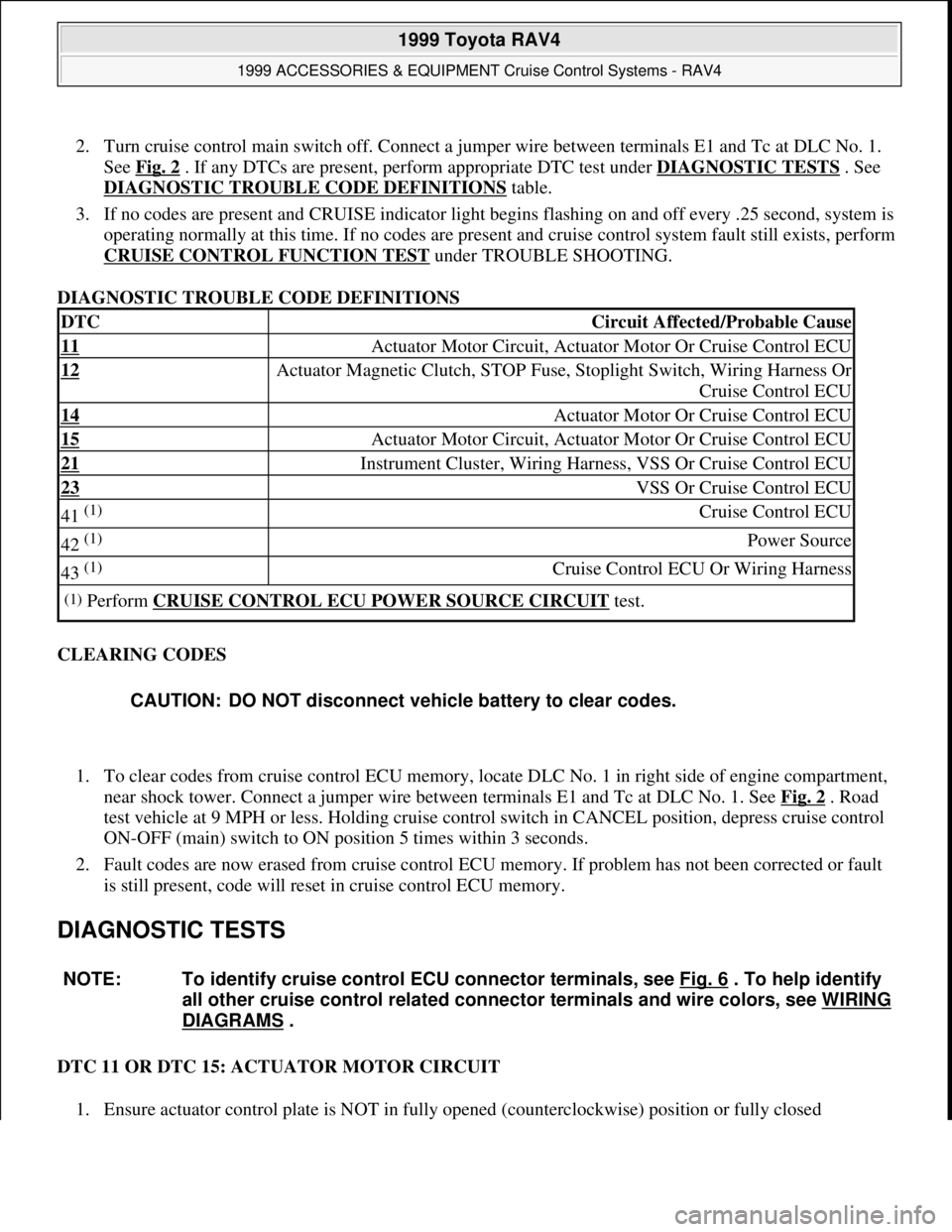
2. Turn cruise control main switch off. Connect a jumper wire between terminals E1 and Tc at DLC No. 1.
See Fig. 2
. If any DTCs are present, perform appropriate DTC test under DIAGNOSTIC TESTS . See
DIAGNOSTIC TROUBLE CODE DEFINITIONS
table.
3. If no codes are present and CRUISE indicator light begins flashing on and off every .25 second, system is
operating normally at this time. If no codes are present and cruise control system fault still exists, perform
CRUISE CONTROL FUNCTION TEST
under TROUBLE SHOOTING.
DIAGNOSTIC TROUBLE CODE DEFINITIONS
CLEARING CODES
1. To clear codes from cruise control ECU memory, locate DLC No. 1 in right side of engine compartment,
near shock tower. Connect a jumper wire between terminals E1 and Tc at DLC No. 1. See Fig. 2
. Road
test vehicle at 9 MPH or less. Holding cruise control switch in CANCEL position, depress cruise control
ON-OFF (main) switch to ON position 5 times within 3 seconds.
2. Fault codes are now erased from cruise control ECU memory. If problem has not been corrected or fault
is still present, code will reset in cruise control ECU memory.
DIAGNOSTIC TESTS
DTC 11 OR DTC 15: ACTUATOR MOTOR CIRCUIT
1. Ensure actuator control plate is NOT in full
y opened (counterclockwise) position or fully closed
DTCCircuit Affected/Probable Cause
11 Actuator Motor Circuit, Actuator Motor Or Cruise Control ECU
12 Actuator Magnetic Clutch, STOP Fuse, Stoplight Switch, Wiring Harness Or
Cruise Control ECU
14 Actuator Motor Or Cruise Control ECU
15 Actuator Motor Circuit, Actuator Motor Or Cruise Control ECU
21 Instrument Cluster, Wiring Harness, VSS Or Cruise Control ECU
23 VSS Or Cruise Control ECU
41 (1) Cruise Control ECU
42 (1) Power Source
43 (1) Cruise Control ECU Or Wiring Harness
(1)Perform CRUISE CONTROL ECU POWER SOURCE CIRCUIT test.
CAUTION: DO NOT disconnect vehicle battery to clear codes.
NOTE: To identify cruise control ECU connector terminals, see Fig. 6
. To help identify
all other cruise control related connector terminals and wire colors, see WIRING
DIAGRAMS .
1999 Toyota RAV4
1999 ACCESSORIES & EQUIPMENT Cruise Control Systems - RAV4
Microsoft
Sunday, November 22, 2009 10:52:01 AMPage 17 © 2005 Mitchell Repair Information Company, LLC.
Page 544 of 1632
1. Perform VEHICLE SPEED SENSOR test under CRUISE CONTROL FUNCTION TEST under
TROUBLE SHOOTING. If speed sensor input signals are not as specified, go to next step. If speed
sensor input signals are as specified, replace cruise control ECU and retest system.
2. Check speedometer circuit. See appropriate INSTRUMENT PANELS article. If speedometer circuit is
okay, go to next step. If speedometer circuit is not okay, repair wiring harness, connector or instrument
cluster as necessary. Retest system.
3. Check wiring harness and connectors between cruise control ECU, vehicle speed sensor and instrument
cluster. Repair as necessary and retest system. If wiring harness and connectors are okay, go to next step.
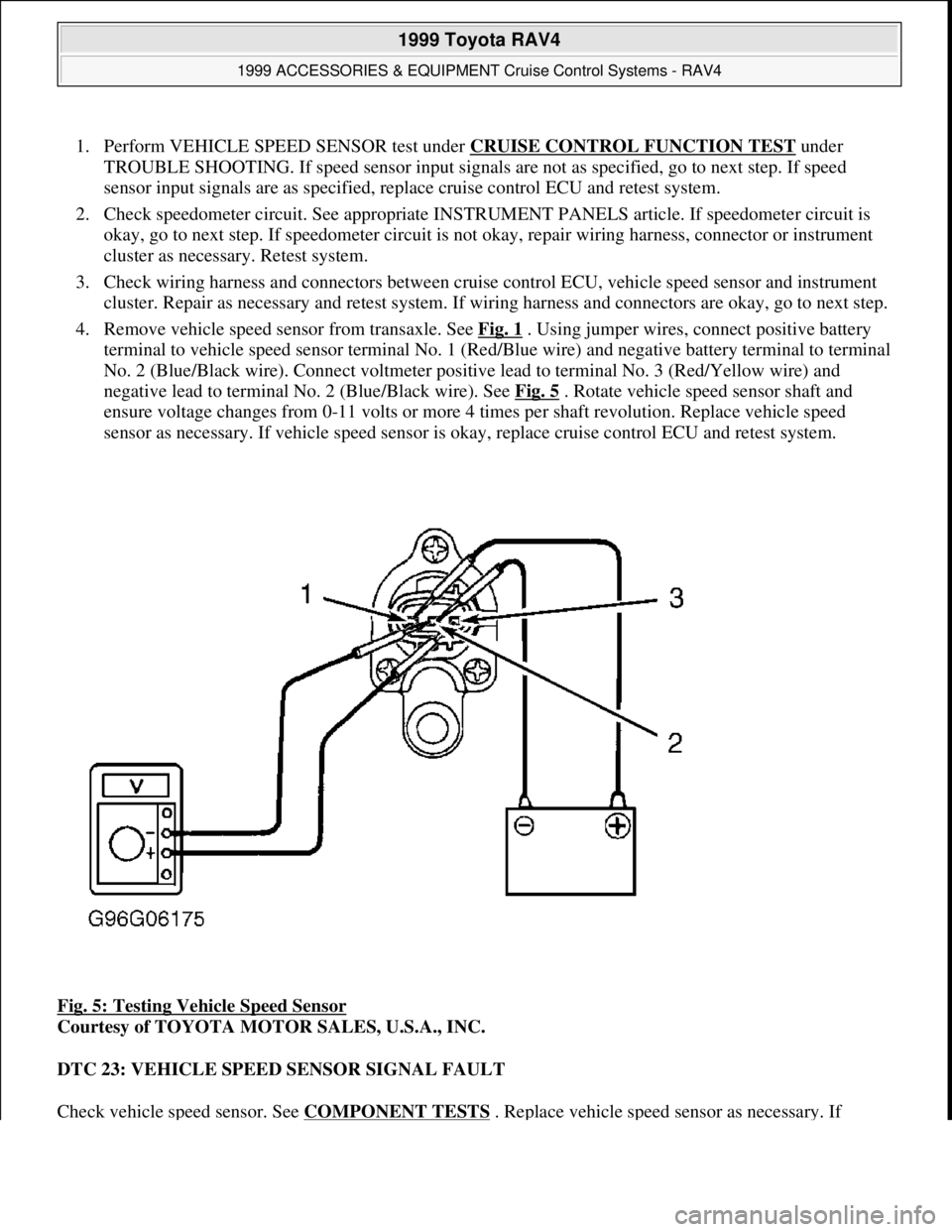
4. Remove vehicle speed sensor from transaxle. See Fig. 1
. Using jumper wires, connect positive battery
terminal to vehicle speed sensor terminal No. 1 (Red/Blue wire) and negative battery terminal to terminal
No. 2 (Blue/Black wire). Connect voltmeter positive lead to terminal No. 3 (Red/Yellow wire) and
negative lead to terminal No. 2 (Blue/Black wire). See Fig. 5
. Rotate vehicle speed sensor shaft and
ensure voltage changes from 0-11 volts or more 4 times per shaft revolution. Replace vehicle speed
sensor as necessary. If vehicle speed sensor is okay, replace cruise control ECU and retest system.
Fig. 5: Testing Vehicle Speed Sensor
Courtesy of TOYOTA MOTOR SALES, U.S.A., INC.
DTC 23: VEHICLE SPEED SENSOR SIGNAL FAULT
Check vehicle speed sensor. See COMPONENT TESTS
. Replace vehicle speed sensor as necessary. If
1999 Toyota RAV4
1999 ACCESSORIES & EQUIPMENT Cruise Control Systems - RAV4
Microsoft
Sunday, November 22, 2009 10:52:01 AMPage 20 © 2005 Mitchell Repair Information Company, LLC.