stop start TOYOTA RAV4 1996 Service Repair Manual
[x] Cancel search | Manufacturer: TOYOTA, Model Year: 1996, Model line: RAV4, Model: TOYOTA RAV4 1996Pages: 1632, PDF Size: 41.64 MB
Page 5 of 1632
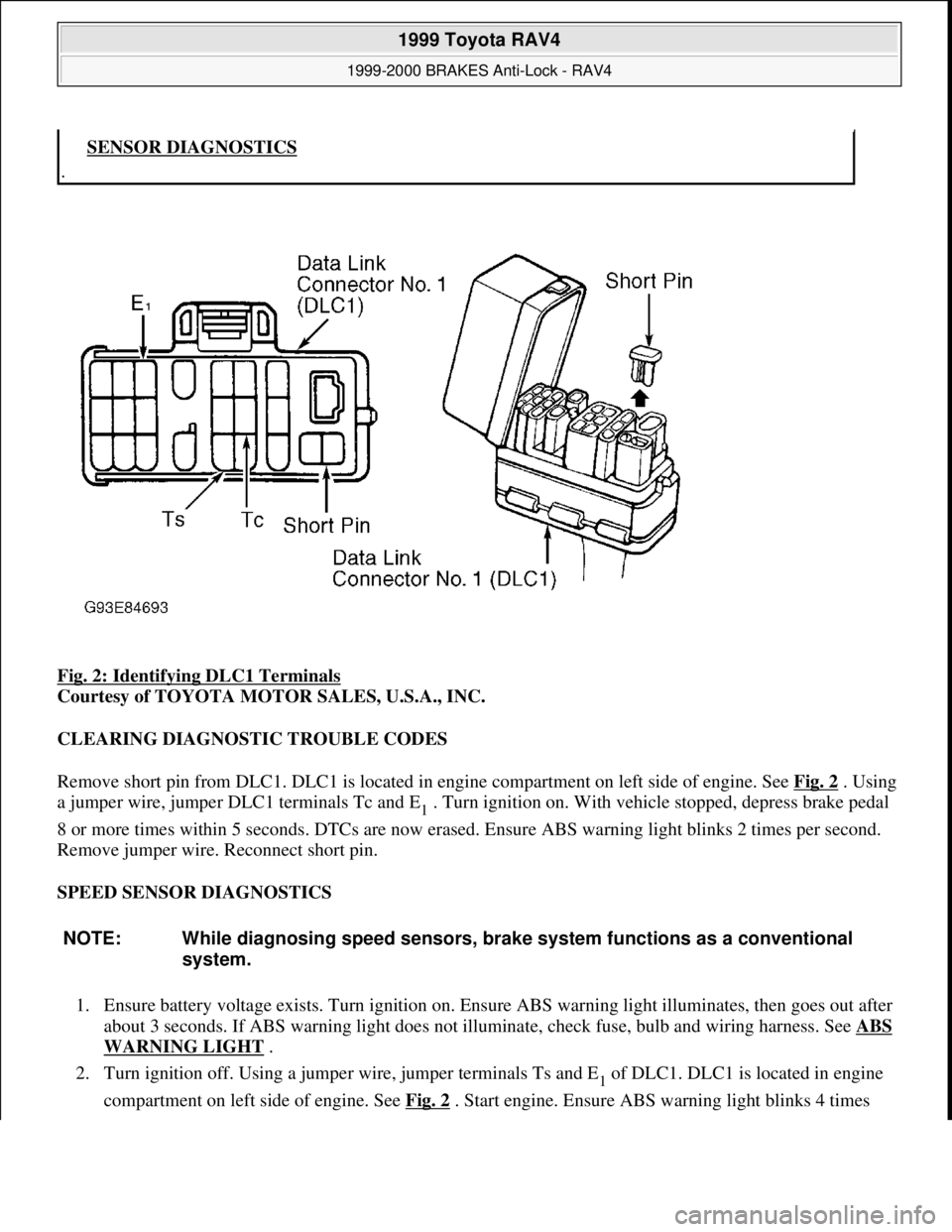
Fig. 2: Identifying DLC1 Terminals
Courtesy of TOYOTA MOTOR SALES, U.S.A., INC.
CLEARING DIAGNOSTIC TROUBLE CODES
Remove short pin from DLC1. DLC1 is located in engine compartment on left side of engine. See Fig. 2
. Using
a jumper wire, jumper DLC1 terminals Tc and E
1 . Turn ignition on. With vehicle stopped, depress brake pedal
8 or more times within 5 seconds. DTCs are now erased. Ensure ABS warning light blinks 2 times per second.
Remove jumper wire. Reconnect short pin.
SPEED SENSOR DIAGNOSTICS
1. Ensure battery voltage exists. Turn ignition on. Ensure ABS warning light illuminates, then goes out after
about 3 seconds. If ABS warning light does not illuminate, check fuse, bulb and wiring harness. See ABS
WARNING LIGHT .
2. Turn ignition off. Using a jumper wire, jumper terminals Ts and E
1 of DLC1. DLC1 is located in engine
compartment on left side of en
gine. See Fig. 2. Start engine. Ensure ABS warning light blinks 4 times
.SENSOR DIAGNOSTICS
NOTE: While diagnosing speed sensors, brake system functions as a conventional
system.
1999 Toyota RAV4
1999-2000 BRAKES Anti-Lock - RAV4
Microsoft
Sunday, November 22, 2009 10:06:17 AMPage 5 © 2005 Mitchell Repair Information Company, LLC.
Page 23 of 1632
battery.
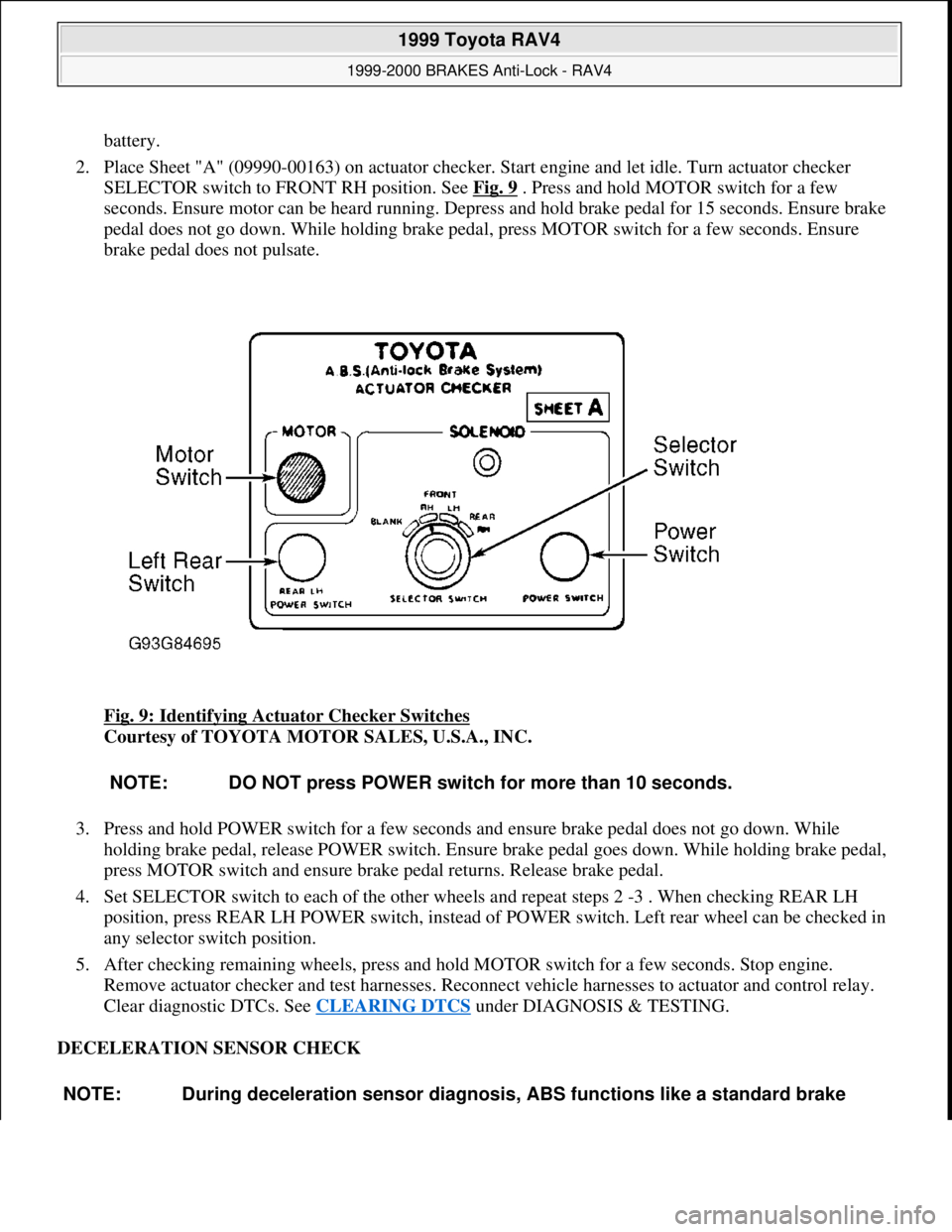
2. Place Sheet "A" (09990-00163) on actuator checker. Start engine and let idle. Turn actuator checker
SELECTOR switch to FRONT RH position. See Fig. 9
. Press and hold MOTOR switch for a few
seconds. Ensure motor can be heard running. Depress and hold brake pedal for 15 seconds. Ensure brake
pedal does not go down. While holding brake pedal, press MOTOR switch for a few seconds. Ensure
brake pedal does not pulsate.
Fig. 9: Identifying Actuator Checker Switches
Courtesy of TOYOTA MOTOR SALES, U.S.A., INC.
3. Press and hold POWER switch for a few seconds and ensure brake pedal does not go down. While
holding brake pedal, release POWER switch. Ensure brake pedal goes down. While holding brake pedal,
press MOTOR switch and ensure brake pedal returns. Release brake pedal.
4. Set SELECTOR switch to each of the other wheels and repeat steps 2 -3 . When checking REAR LH
position, press REAR LH POWER switch, instead of POWER switch. Left rear wheel can be checked in
any selector switch position.
5. After checking remaining wheels, press and hold MOTOR switch for a few seconds. Stop engine.
Remove actuator checker and test harnesses. Reconnect vehicle harnesses to actuator and control relay.
Clear diagnostic DTCs. See CLEARING DTCS
under DIAGNOSIS & TESTING.
DECELERATION SENSOR CHECK
NOTE: DO NOT press POWER switch for more than 10 seconds.
NOTE: During deceleration sensor diagnosis, ABS functions like a standard brake
1999 Toyota RAV4
1999-2000 BRAKES Anti-Lock - RAV4
Microsoft
Sunday, November 22, 2009 10:06:17 AMPage 23 © 2005 Mitchell Repair Information Company, LLC.
Page 164 of 1632
1. If shift lever is actuated with engine idling, a time lag will be noted before shock can be felt. This test is
used for checking condition of OD direct clutch, forward clutch, direct clutch, and 1st and reverse brake.
2. Apply parking brake. Start engine. On RAV4, ensure idle speed is 700-800 RPM. On all other models,
ensure idle speed is 650-750 RPM. Shift transaxle from "N" into "D" range. Use a stop watch to measure
elapsed time between shifting of lever until shock is felt. Standard time lag is less than 1.2 seconds.
3. Repeat procedure outlined in step 2) to measure time lag for "N" to "R". Standard lag time is less than 1.5
seconds.
4. If "N" to "D" time lag is longer than specification, line pressure is too low, forward clutch may be worn,
or OD one-way clutch is not operating properly.
5. If "N" to "R" time lag is longer than specified, direct clutch may be worn, 1st and reverse brake may be
worn, line pressure is too low or OD one-way clutch is not operating properly.
ROAD TEST
"D" Range Test In NORM & PWR Pattern Ranges
1. Shift into "D" range. Hold accelerator pedal constant at full throttle. Place shift mode button in NORM or
PWR position. Check 1-2, 2-3, and 3-OD lock-up and upshift points. See appropriate table under SHIFT
SPEED SPECIFICATIONS .
zIf no 1-2 upshift occurs, check 1-2 shift valve or solenoid.
zIf no 2-3 upshift occurs, check 2-3 shift valve or solenoid.
zIf no 3-OD upshift occurs, check 3-OD shift valve.
zIf all shift points are incorrect, check throttle valve, 1-2 shift valve, 2-3 shift valve and 3-OD shift
valve.
zIf all lock-up points are incorrect, check lock-up relay valve or shift solenoid valve SL.
2. Use procedure outlined in step 1) to check for shock and slip between 1-2, 2-3, and 3-OD upshifts. If
shock is harsh, line pressure may be too high. Check accumulator or check ball.
3. Run vehicle in "D" range lock-up or overdrive gear. Check for abnormal noise and vibration.
4. While running in "D" range, confirm correct kickdown vehicle speed limits for 2-1, 3-2, OD-3 shift
points. Check for abnormal shock and slip at kickdown.
5. Check loc
k-up function. Drive vehicle in OD gear of "D" range with lock-up on. Hold vehicle speed NOTE: Perform test at normal operating fluid temperature of 122-176°F (50-80°C).
NOTE: There is no overdrive upshift when coolant temperature is below 140°F
(60°C). There is no lock-up when vehicle speed is 6 MPH less than the set
cruise control speed.
NOTE: Check for cause of abnormal noise and vibration must be made with
extreme care as problem could be due to an unbalanced drive shaft,
differential, tire, torque converter, etc.
1998 Toyota Avalon XLS
1997-99 AUTOMATIC TRANSMISSIONS Toyota A-540E, A-540H & A-541E Overhaul
Helpmelearn
November-03-08 10:28:17 AMPage 10 © 2005 Mitchell Repair Information Company, LLC.
Page 269 of 1632
step 2). If throttle valve is not fully open, adjust throttle linkage or cable so throttle valve is fully open and
then go to step 2).
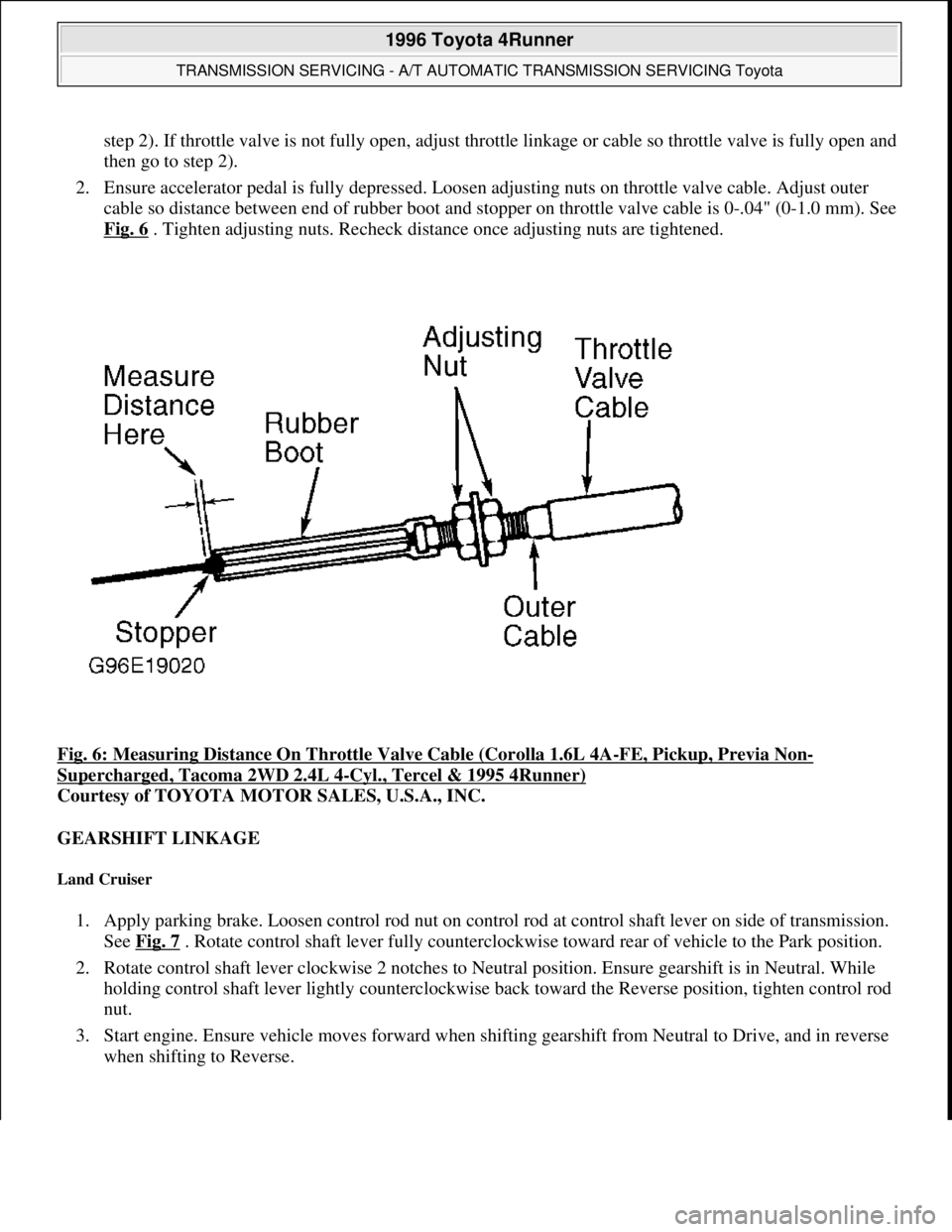
2. Ensure accelerator pedal is fully depressed. Loosen adjusting nuts on throttle valve cable. Adjust outer
cable so distance between end of rubber boot and stopper on throttle valve cable is 0-.04" (0-1.0 mm). See
Fig. 6
. Tighten adjusting nuts. Recheck distance once adjusting nuts are tightened.
Fig. 6: Measuring Distance On Throttle Valve Cable (Corolla 1.6L 4A
-FE, Pickup, Previa Non-
Supercharged, Tacoma 2WD 2.4L 4-Cyl., Tercel & 1995 4Runner)
Courtesy of TOYOTA MOTOR SALES, U.S.A., INC.
GEARSHIFT LINKAGE
Land Cruiser
1. Apply parking brake. Loosen control rod nut on control rod at control shaft lever on side of transmission.
See Fig. 7
. Rotate control shaft lever fully counterclockwise toward rear of vehicle to the Park position.
2. Rotate control shaft lever clockwise 2 notches to Neutral position. Ensure gearshift is in Neutral. While
holding control shaft lever lightly counterclockwise back toward the Reverse position, tighten control rod
nut.
3. Start engine. Ensure vehicle moves forward when shifting gearshift from Neutral to Drive, and in reverse
when shiftin
g to Reverse.
1996 Toyota 4Runner
TRANSMISSION SERVICING - A/T AUTOMATIC TRANSMISSION SERVICING Toyota
Microsoft
Tuesday, August 18, 2009 7:18:46 PMPage 13 © 2005 Mitchell Repair Information Company, LLC.
Page 345 of 1632
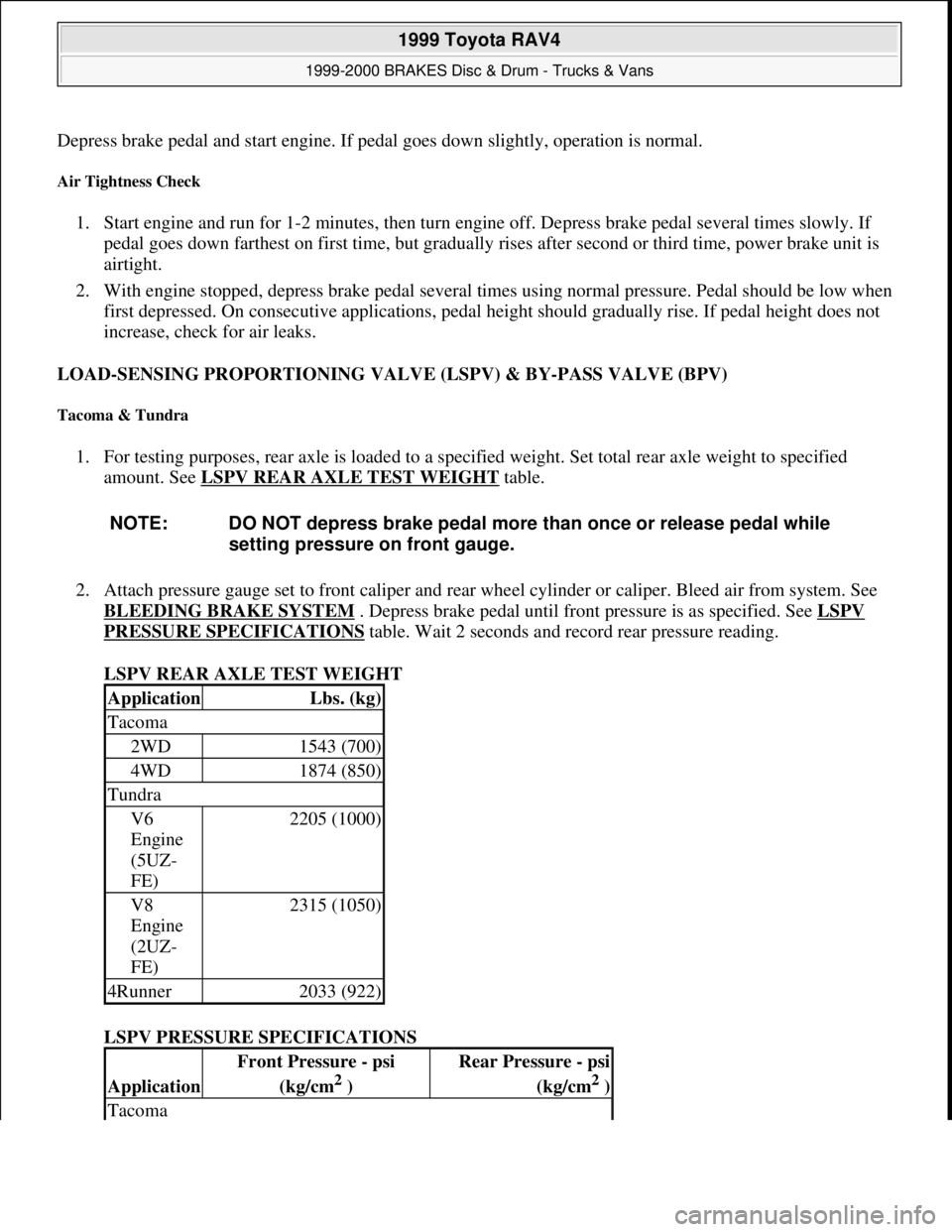
Depress brake pedal and start engine. If pedal goes down slightly, operation is normal.
Air Tightness Check
1. Start engine and run for 1-2 minutes, then turn engine off. Depress brake pedal several times slowly. If
pedal goes down farthest on first time, but gradually rises after second or third time, power brake unit is
airtight.
2. With engine stopped, depress brake pedal several times using normal pressure. Pedal should be low when
first depressed. On consecutive applications, pedal height should gradually rise. If pedal height does not
increase, check for air leaks.
LOAD-SENSING PROPORTIONING VALVE (LSPV) & BY-PASS VALVE (BPV)
Tacoma & Tundra
1. For testing purposes, rear axle is loaded to a specified weight. Set total rear axle weight to specified
amount. See LSPV REAR AXLE TEST WEIGHT
table.
2. Attach pressure gauge set to front caliper and rear wheel cylinder or caliper. Bleed air from system. See
BLEEDING BRAKE SYSTEM
. Depress brake pedal until front pressure is as specified. See LSPV
PRESSURE SPECIFICATIONS table. Wait 2 seconds and record rear pressure reading.
LSPV REAR AXLE TEST WEIGHT
LSPV PRESSURE SPECIFICATIONS NOTE: DO NOT depress brake pedal more than once or release pedal while
setting pressure on front gauge.
ApplicationLbs. (kg)
Tacoma
2WD1543 (700)
4WD1874 (850)
Tundra
V6
Engine
(5UZ-
FE)2205 (1000)
V8
Engine
(2UZ-
FE)2315 (1050)
4Runner2033 (922)
Application
Front Pressure - psi
(kg/cm
2 )
Rear Pressure - psi
(kg/cm
2 )
Tacoma
1999 Toyota RAV4
1999-2000 BRAKES Disc & Drum - Trucks & Vans
Microsoft
Sunday, November 22, 2009 10:07:28 AMPage 6 © 2005 Mitchell Repair Information Company, LLC.
Page 386 of 1632
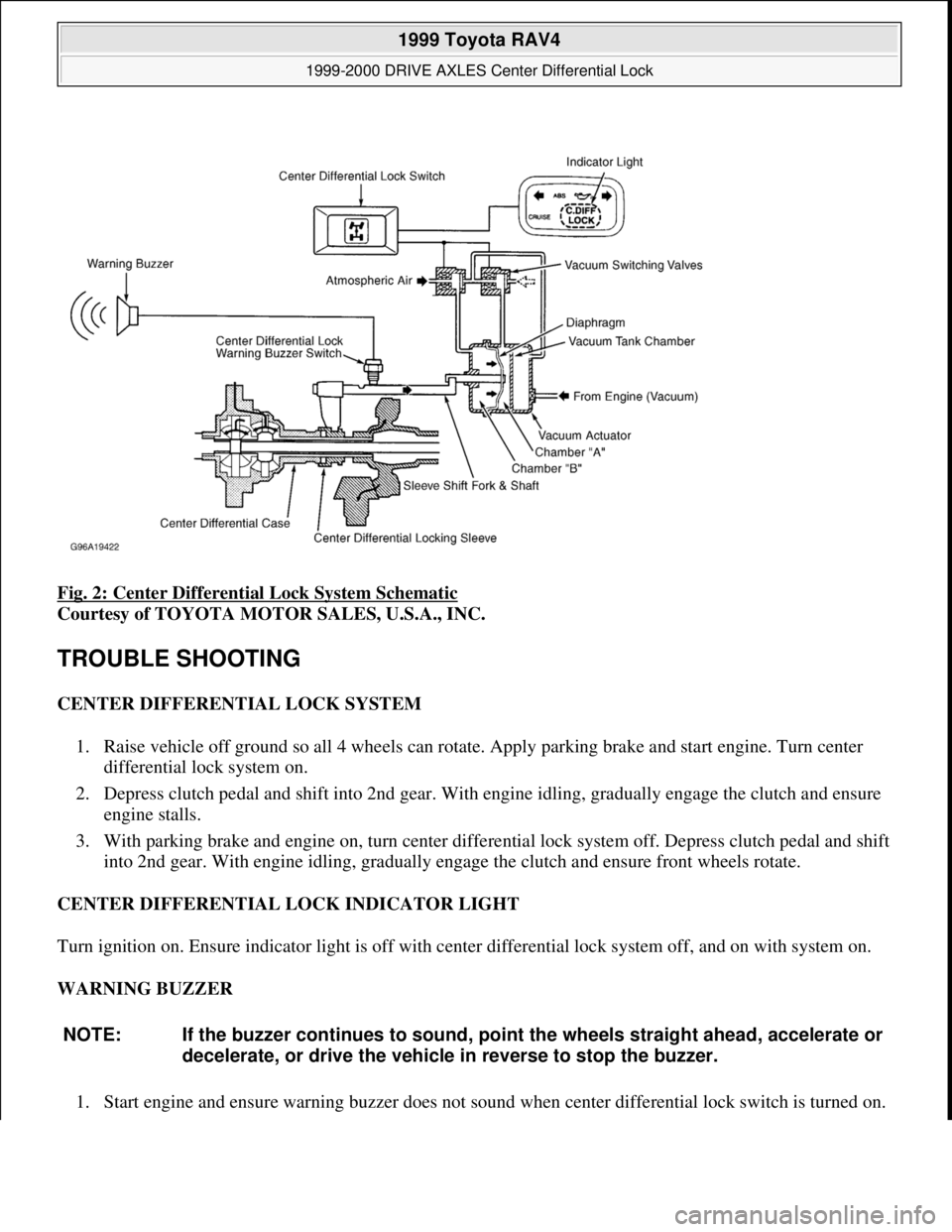
Fig. 2: Center Differential Lock System Schematic
Courtesy of TOYOTA MOTOR SALES, U.S.A., INC.
TROUBLE SHOOTING
CENTER DIFFERENTIAL LOCK SYSTEM
1. Raise vehicle off ground so all 4 wheels can rotate. Apply parking brake and start engine. Turn center
differential lock system on.
2. Depress clutch pedal and shift into 2nd gear. With engine idling, gradually engage the clutch and ensure
engine stalls.
3. With parking brake and engine on, turn center differential lock system off. Depress clutch pedal and shift
into 2nd gear. With engine idling, gradually engage the clutch and ensure front wheels rotate.
CENTER DIFFERENTIAL LOCK INDICATOR LIGHT
Turn ignition on. Ensure indicator light is off with center differential lock system off, and on with system on.
WARNING BUZZER
1. Start en
gine and ensure warning buzzer does not sound when center differential lock switch is turned on.
NOTE: If the buzzer continues to sound, point the wheels straight ahead, accelerate or
decelerate, or drive the vehicle in reverse to stop the buzzer.
1999 Toyota RAV4
1999-2000 DRIVE AXLES Center Differential Lock
Microsoft
Sunday, November 22, 2009 10:08:59 AMPage 3 © 2005 Mitchell Repair Information Company, LLC.
Page 471 of 1632
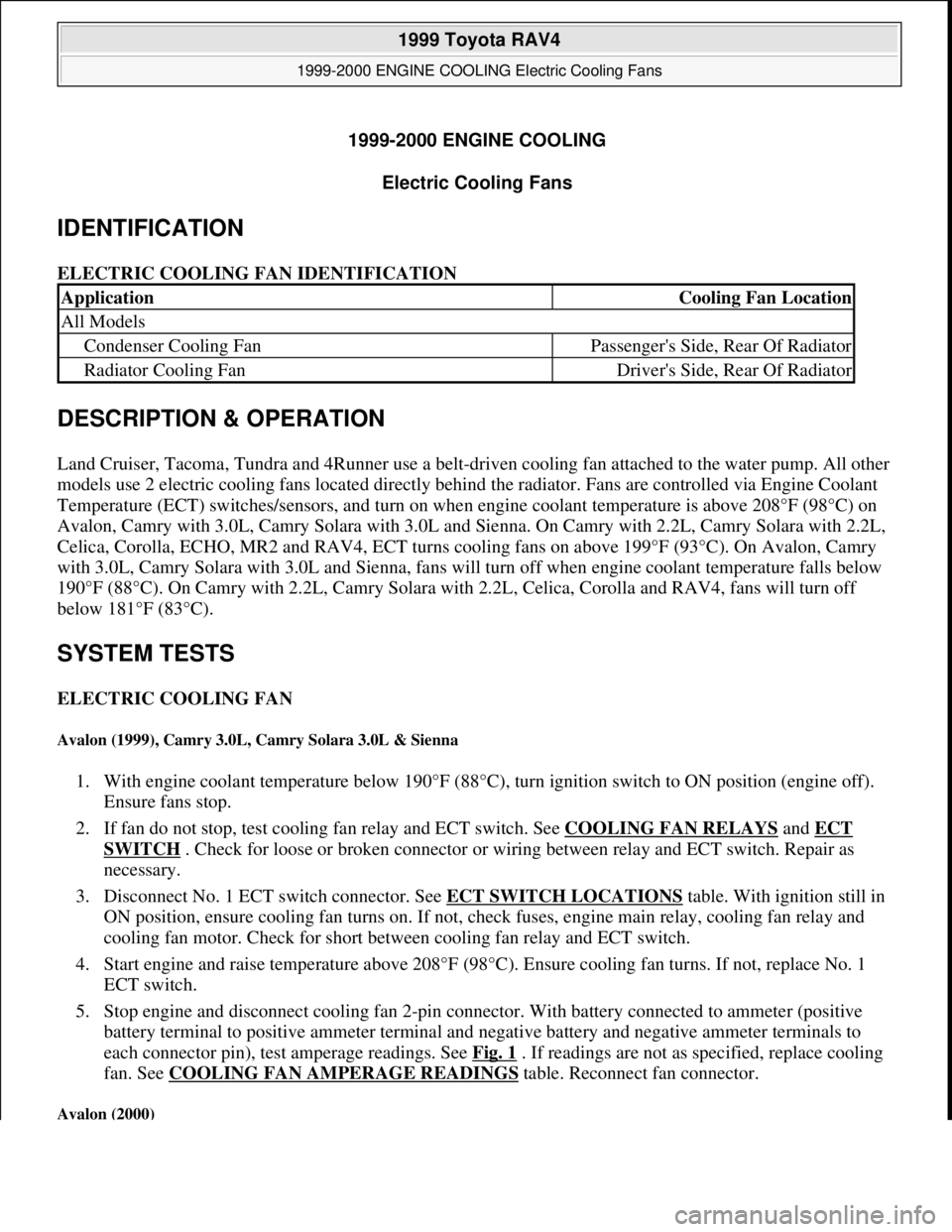
1999-2000 ENGINE COOLING
Electric Cooling Fans
IDENTIFICATION
ELECTRIC COOLING FAN IDENTIFICATION
DESCRIPTION & OPERATION
Land Cruiser, Tacoma, Tundra and 4Runner use a belt-driven cooling fan attached to the water pump. All other
models use 2 electric cooling fans located directly behind the radiator. Fans are controlled via Engine Coolant
Temperature (ECT) switches/sensors, and turn on when engine coolant temperature is above 208°F (98°C) on
Avalon, Camry with 3.0L, Camry Solara with 3.0L and Sienna. On Camry with 2.2L, Camry Solara with 2.2L,
Celica, Corolla, ECHO, MR2 and RAV4, ECT turns cooling fans on above 199°F (93°C). On Avalon, Camry
with 3.0L, Camry Solara with 3.0L and Sienna, fans will turn off when engine coolant temperature falls below
190°F (88°C). On Camry with 2.2L, Camry Solara with 2.2L, Celica, Corolla and RAV4, fans will turn off
below 181°F (83°C).
SYSTEM TESTS
ELECTRIC COOLING FAN
Avalon (1999), Camry 3.0L, Camry Solara 3.0L & Sienna
1. With engine coolant temperature below 190°F (88°C), turn ignition switch to ON position (engine off).
Ensure fans stop.
2. If fan do not stop, test cooling fan relay and ECT switch. See COOLING FAN RELAYS
and ECT
SWITCH . Check for loose or broken connector or wiring between relay and ECT switch. Repair as
necessary.
3. Disconnect No. 1 ECT switch connector. See ECT SWITCH LOCATIONS
table. With ignition still in
ON position, ensure cooling fan turns on. If not, check fuses, engine main relay, cooling fan relay and
cooling fan motor. Check for short between cooling fan relay and ECT switch.
4. Start engine and raise temperature above 208°F (98°C). Ensure cooling fan turns. If not, replace No. 1
ECT switch.
5. Stop engine and disconnect cooling fan 2-pin connector. With battery connected to ammeter (positive
battery terminal to positive ammeter terminal and negative battery and negative ammeter terminals to
each connector pin), test amperage readings. See Fig. 1
. If readings are not as specified, replace cooling
fan. See COOLING FAN AMPERAGE READINGS
table. Reconnect fan connector.
Avalon (2000)
ApplicationCooling Fan Location
All Models
Condenser Cooling FanPassenger's Side, Rear Of Radiator
Radiator Cooling FanDriver's Side, Rear Of Radiator
1999 Toyota RAV4
1999-2000 ENGINE COOLING Electric Cooling Fans
1999 Toyota RAV4
1999-2000 ENGINE COOLING Electric Cooling Fans
Microsoft
Sunday, November 22, 2009 10:21:41 AMPage 1 © 2005 Mitchell Repair Information Company, LLC.
Microsoft
Sunday, November 22, 2009 10:21:45 AMPage 1 © 2005 Mitchell Repair Information Company, LLC.
Page 474 of 1632
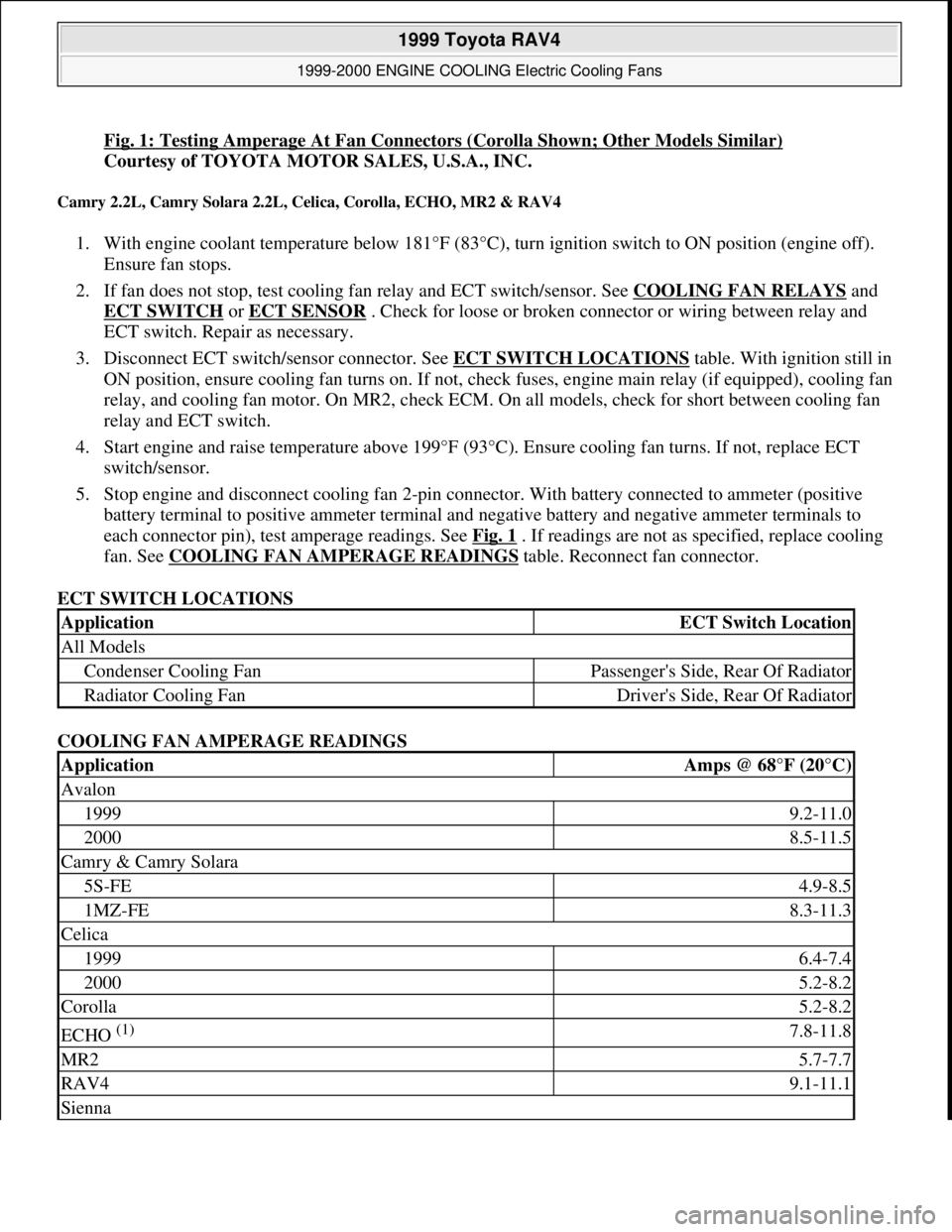
Fig. 1: Testing Amperage At Fan Connectors (Corolla Shown; Other Models Similar)
Courtesy of TOYOTA MOTOR SALES, U.S.A., INC.
Camry 2.2L, Camry Solara 2.2L, Celica, Corolla, ECHO, MR2 & RAV4
1. With engine coolant temperature below 181°F (83°C), turn ignition switch to ON position (engine off).
Ensure fan stops.
2. If fan does not stop, test cooling fan relay and ECT switch/sensor. See COOLING FAN RELAYS
and
ECT SWITCH
or ECT SENSOR . Check for loose or broken connector or wiring between relay and
ECT switch. Repair as necessary.
3. Disconnect ECT switch/sensor connector. See ECT SWITCH LOCATIONS
table. With ignition still in
ON position, ensure cooling fan turns on. If not, check fuses, engine main relay (if equipped), cooling fan
relay, and cooling fan motor. On MR2, check ECM. On all models, check for short between cooling fan
relay and ECT switch.
4. Start engine and raise temperature above 199°F (93°C). Ensure cooling fan turns. If not, replace ECT
switch/sensor.
5. Stop engine and disconnect cooling fan 2-pin connector. With battery connected to ammeter (positive
battery terminal to positive ammeter terminal and negative battery and negative ammeter terminals to
each connector pin), test amperage readings. See Fig. 1
. If readings are not as specified, replace cooling
fan. See COOLING FAN AMPERAGE READINGS
table. Reconnect fan connector.
ECT SWITCH LOCATIONS
COOLING FAN AMPERAGE READINGS
ApplicationECT Switch Location
All Models
Condenser Cooling FanPassenger's Side, Rear Of Radiator
Radiator Cooling FanDriver's Side, Rear Of Radiator
ApplicationAmps @ 68°F (20°C)
Avalon
19999.2-11.0
20008.5-11.5
Camry & Camry Solara
5S-FE4.9-8.5
1MZ-FE8.3-11.3
Celica
19996.4-7.4
20005.2-8.2
Corolla5.2-8.2
ECHO (1) 7.8-11.8
MR25.7-7.7
RAV49.1-11.1
Sienna
1999 Toyota RAV4
1999-2000 ENGINE COOLING Electric Cooling Fans
Microsoft
Sunday, November 22, 2009 10:21:41 AMPage 4 © 2005 Mitchell Repair Information Company, LLC.
Page 530 of 1632
M/T models, depress and release clutch pedal. On all models, if CRUISE control indicator light comes on when
switch is in OFF position and goes off when switch is in ON position, circuit for that switch being activated is
okay. Go to next step. If CRUISE control indicator does not function as indicated, see SYMPTOM
DIAGNOSIS and perform appropriate test(s).
Vehicle Speed Sensor
1. Raise vehicle and support vehicle with drive wheels off ground. Start engine and slowly depress
accelerator pedal until vehicle speed is 25 MPH or more. Turn cruise ON-OFF switch to ON position. If
CRUISE control indicator light flashes on and off every .25 second, go to next step. If CRUISE control
indicator light does not flash on and off every .25 second, see SYMPTOM DIAGNOSIS
and perform
appropriate test(s).
2. Slow vehicle speed to 25 MPH or less. If CRUISE control indicator light comes on and stays on, vehicle
speed sensor circuit is okay. Go to next step. If CRUISE control indicator light does not come on, see
SYMPTOM DIAGNOSIS
and perform appropriate test(s).
3. Cruise control function test is now complete. No problems are indicated at this time. If cruise control
system still does not function properly and no trouble codes are present, see SYMPTOM DIAGNOSIS
and perform appropriate test(s). Problem may also be intermittent.
SYMPTOM DIAGNOSIS
Symptom diagnosis should only be performed if no Diagnostic Trouble Codes (DTCs) are present. If symptom
is unknown, perform CRUISE CONTROL FUNCTION TEST
to identify problem area. Identify symptom
and perform appropriate test. Perform tests in order listed.
SET Not Occurring Or CANCEL Occurring (No DTCs Present)
Check the following components and/or circuits:
Perform CRUISE CONTROL SWITCH CIRCUIT test under SYSTEM TESTS.
Perform DTC 21: VEHICLE SPEED SENSOR CIRCUIT test under DIAGNOSTIC TESTS.
Perform STOPLIGHT SWITCH CIRCUIT test under SYSTEM TESTS.
Perform PARK/NEUTRAL POSITION SWITCH CIRCUIT test under SYSTEM TESTS.
Perform CLUTCH SWITCH CIRCUIT test under SYSTEM TESTS.
Perform DTC 11 OR DTC 15: ACTUATOR MOTOR CIRCUIT test under DIAGNOSTIC TESTS.
Check actuator control cable adjustment. See ADJUSTMENTS .
Replace cruise control ECU with a known-good ECU and retest. If symptom is no longer present, replace
ECU.
SET Not Occurring Or CANCEL Occurring (DTC Is Not Output)
Check the following components and/or circuits:
Perform CRUISE CONTROL ECU POWER SOURCE CIRCUIT test under SYSTEM TESTS.
Replace cruise control ECU with a known-good ECU and retest. If symptom is no longer present, replace
1999 Toyota RAV4
1999 ACCESSORIES & EQUIPMENT Cruise Control Systems - RAV4
Microsoft
Sunday, November 22, 2009 10:52:01 AMPage 6 © 2005 Mitchell Repair Information Company, LLC.
Page 535 of 1632
1. Check stoplight operation. If stoplight operation is okay, go to next step. If stoplights DO NOT operate
correctly, check and repair stoplight system as necessary. See WIRING DIAGRAMS
.
2. Perform CANCEL SWITCHES test under CRUISE CONTROL FUNCTION TEST
under TROUBLE
SHOOTING. If stoplight input signal is not as specified, go to next step. If stoplight input signal is as
specified, no problem is indicated at this time. Fault may be intermittent. If sent here from SYMPTOM
DIAGNOSIS, perform next test listed.
3. Remove cruise control ECU with connector attached. See Fig. 1
. Turn ignition switch to ON position.
Backprobing cruise control ECU connector, measure voltage between ground and cruise control ECU
connector terminal No. 2 (Green/White wire). With brake pedal depressed, battery voltage should exist.
With brake pedal released, voltage should be less than one volt. If voltage is not as specified, go to next
step. If voltage is as specified, no problem is indicated at this time. Fault may be intermittent. If sent here
from SYMPTOM DIAGNOSIS, perform next test listed.
4. Check for open circuit in wiring harness and connectors between cruise control ECU and stoplight switch.
Repair as necessary and retest system. If wiring harness and connectors are okay, replace cruise control
ECU and retest system.
IDLE SIGNAL CIRCUIT
1. Remove cruise control ECU with connector attached. Disconnect Engine Control Module (ECM) 16-pin
connector. ECM is located behind bottom center of instrument panel, in front of console. Turn ignition
switch to ON position. Backprobing connector, measure voltage between ground and cruise control ECU
connector terminal No. 13 (Blue wire).
2. With throttle valve fully open, battery voltage should exist. With throttle valve fully closed, voltage
should be less than 2 volts. If voltage is not as specified, go to next step. If voltage is as specified, no
problem is indicated at this time. Fault may be intermittent. If sent here from SYMPTOM DIAGNOSIS,
perform next test listed.
3. Check wiring harness and connectors between ECM and TP sensor. Repair as necessary and retest
system. If wiring harness and connectors are okay, go to next step.
4. Disconnect TP sensor 3-pin Black connector. Measure resistance between TP sensor connector terminals
No. 2 (Brown wire) and No. 3 (Blue/Red wire). Resistance should be 2000-10,200 ohms with throttle
valve fully opened, and 200-6300 ohms with throttle valve fully closed. If resistance is as specified, go to
next step. If resistance is not as specified, replace TP sensor and retest system.
5. Check wiring harness and connectors between cruise control ECU and TP sensor, and between TP sensor
and ground. Repair as necessary and retest system. If wiring harness and connectors are okay, replace
cruise control ECU and retest system.
ELECTRONICALLY CONTROLLED TRANSMISSION (ECT) CIRCUIT
1. Start engine and bring to operating temperature. Drive vehicle and ensure overdrive operation is turned on
and off when overdrive ON-OFF switch is operated. If overdrive switch is okay, go to next step. If
overdrive switch is not okay, see appropriate ELECTRONIC CONTROLS article in AUTOMATIC NOTE: Ensure Throttle Position (TP) sensor circuit is operating as designed, and no
fault codes are present for TP sensor circuit. See appropriate ON-VEHICLE
ADJUSTMENTS article in ENGINE PERFORMANCE.
1999 Toyota RAV4
1999 ACCESSORIES & EQUIPMENT Cruise Control Systems - RAV4
Microsoft
Sunday, November 22, 2009 10:52:01 AMPage 11 © 2005 Mitchell Repair Information Company, LLC.