engine oil TOYOTA RAV4 2006 Service Repair Manual
[x] Cancel search | Manufacturer: TOYOTA, Model Year: 2006, Model line: RAV4, Model: TOYOTA RAV4 2006Pages: 2000, PDF Size: 45.84 MB
Page 883 of 2000
2GR-FE LUBRICATION – OIL PUMPLU–23
LU
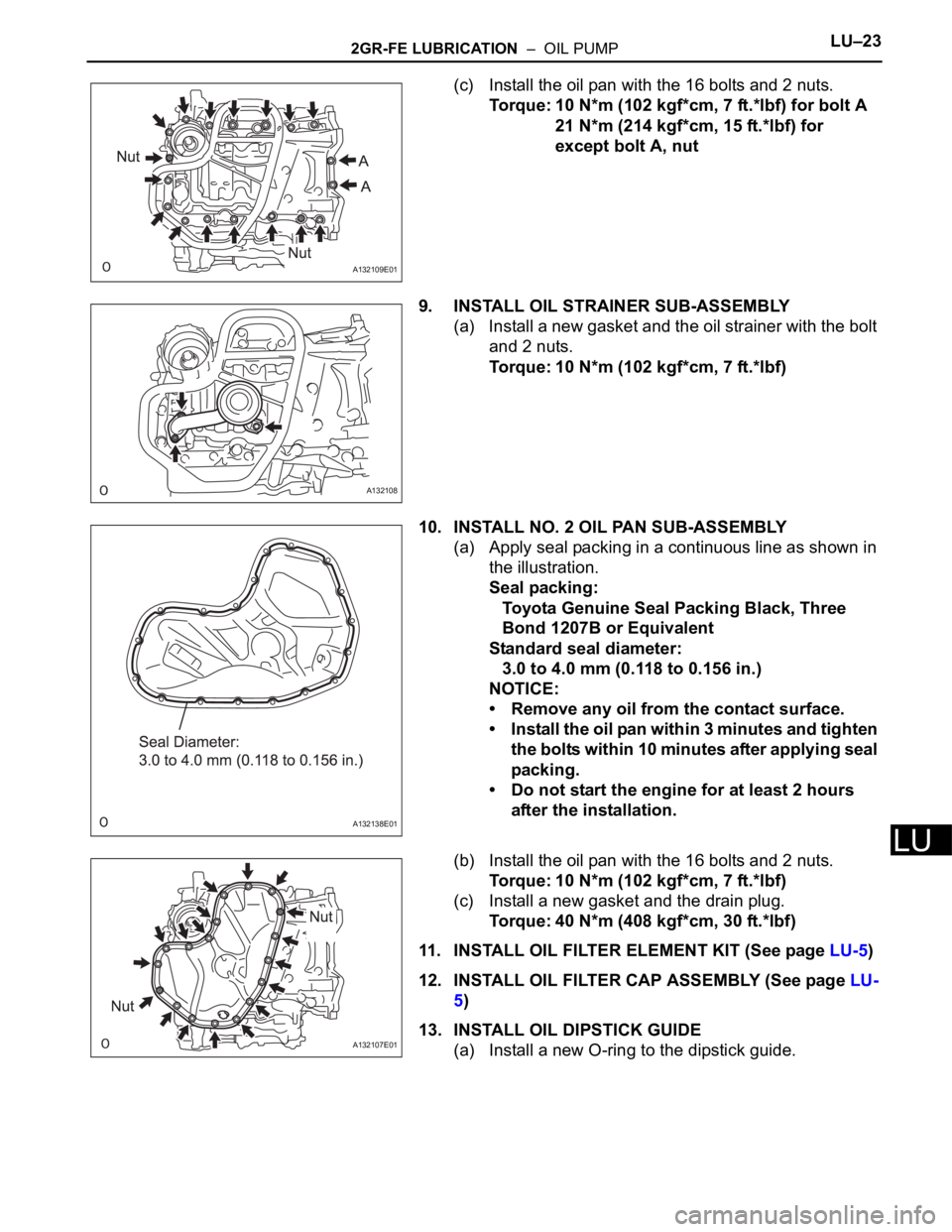
(c) Install the oil pan with the 16 bolts and 2 nuts.
Torque: 10 N*m (102 kgf*cm, 7 ft.*lbf) for bolt A
21 N*m (214 kgf*cm, 15 ft.*lbf) for
except bolt A, nut
9. INSTALL OIL STRAINER SUB-ASSEMBLY
(a) Install a new gasket and the oil strainer with the bolt
and 2 nuts.
Torque: 10 N*m (102 kgf*cm, 7 ft.*lbf)
10. INSTALL NO. 2 OIL PAN SUB-ASSEMBLY
(a) Apply seal packing in a continuous line as shown in
the illustration.
Seal packing:
Toyota Genuine Seal Packing Black, Three
Bond 1207B or Equivalent
Standard seal diameter:
3.0 to 4.0 mm (0.118 to 0.156 in.)
NOTICE:
• Remove any oil from the contact surface.
• Install the oil pan within 3 minutes and tighten
the bolts within 10 minutes after applying seal
packing.
• Do not start the engine for at least 2 hours
after the installation.
(b) Install the oil pan with the 16 bolts and 2 nuts.
Torque: 10 N*m (102 kgf*cm, 7 ft.*lbf)
(c) Install a new gasket and the drain plug.
Torque: 40 N*m (408 kgf*cm, 30 ft.*lbf)
11. INSTALL OIL FILTER ELEMENT KIT (See page LU-5)
12. INSTALL OIL FILTER CAP ASSEMBLY (See page LU-
5)
13. INSTALL OIL DIPSTICK GUIDE
(a) Install a new O-ring to the dipstick guide.
A132109E01
A132108
A132138E01
A132107E01
Page 884 of 2000
LU–242GR-FE LUBRICATION – OIL PUMP
LU
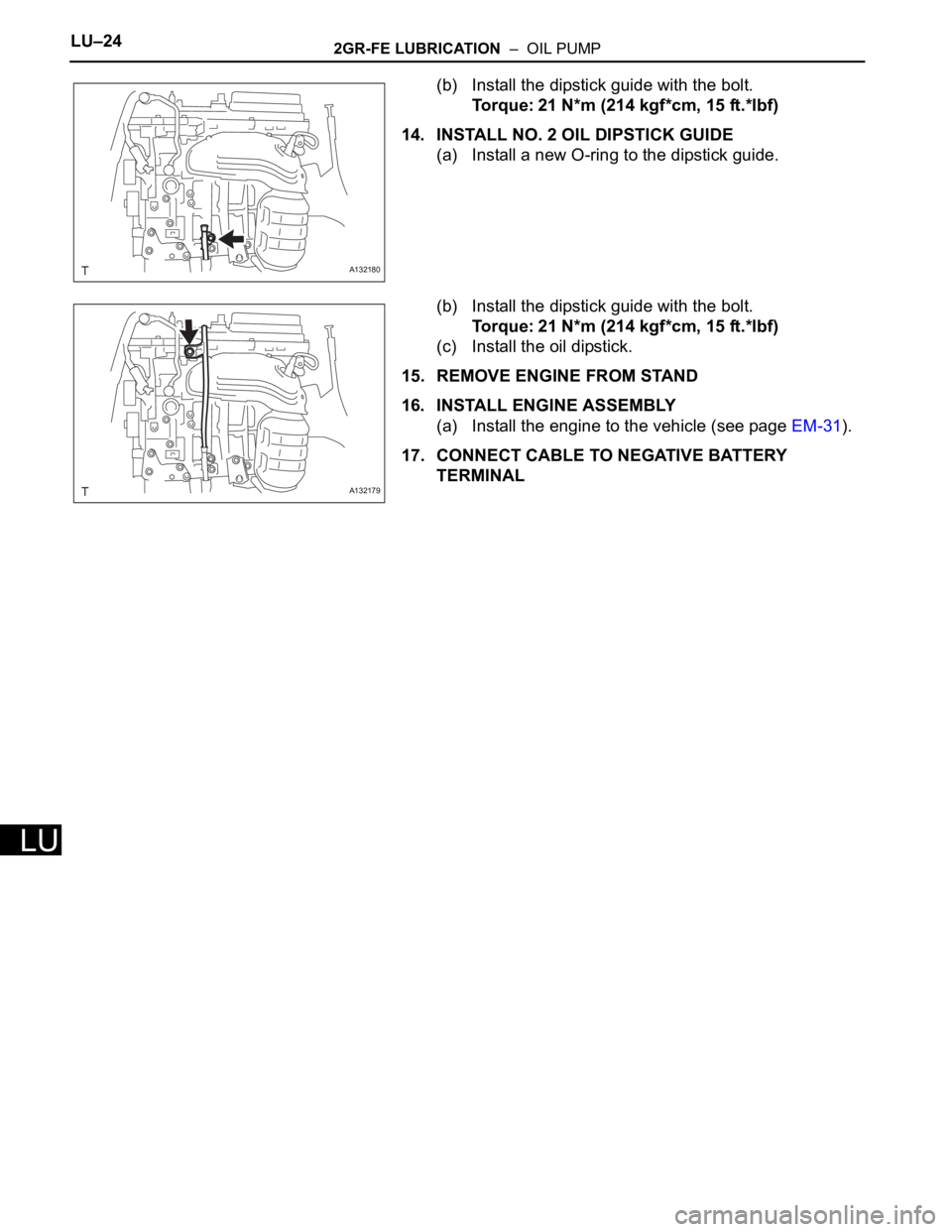
(b) Install the dipstick guide with the bolt.
Torque: 21 N*m (214 kgf*cm, 15 ft.*lbf)
14. INSTALL NO. 2 OIL DIPSTICK GUIDE
(a) Install a new O-ring to the dipstick guide.
(b) Install the dipstick guide with the bolt.
Torque: 21 N*m (214 kgf*cm, 15 ft.*lbf)
(c) Install the oil dipstick.
15. REMOVE ENGINE FROM STAND
16. INSTALL ENGINE ASSEMBLY
(a) Install the engine to the vehicle (see page EM-31).
17. CONNECT CABLE TO NEGATIVE BATTERY
TERMINAL
A132180
A132179
Page 885 of 2000
2AZ-FE IGNITION – IGNITION SYSTEMIG–5
IG
ON-VEHICLE INSPECTION
1. CHECK IGNITION COIL ASSEMBLY AND PERFORM
SPARK TEST
NOTICE:
In this section, the terms "cold" and "hot" refer to
the temperature of the coils. "Cold" means
approximately -10 to 50
C (14 to 122F). "Hot" means
approximately 50 to 100
C (122 to 212F).
(a) Check the DTCs.
NOTICE:
If a DTC is present, perform troubleshooting in
accordance with the procedure for that DTC.
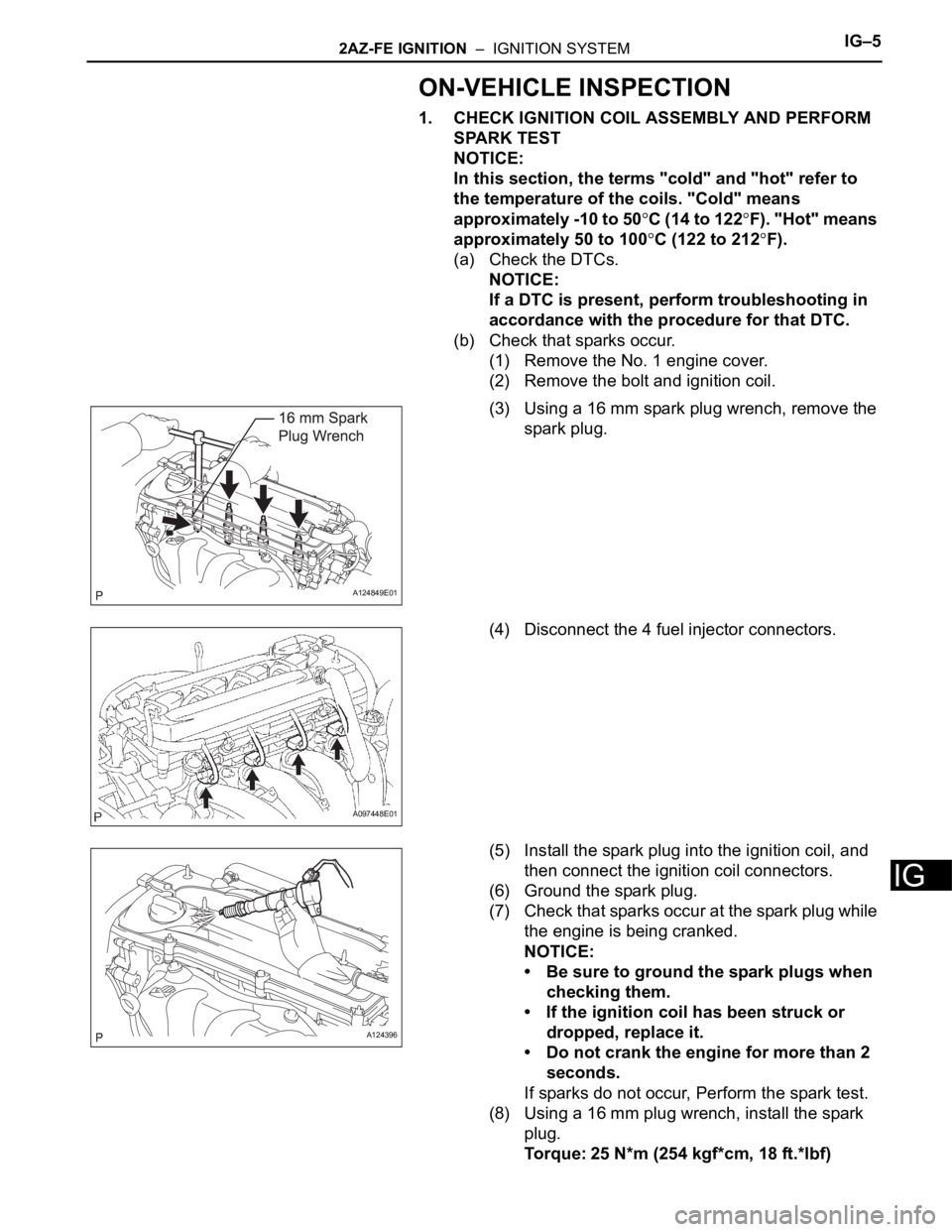
(b) Check that sparks occur.
(1) Remove the No. 1 engine cover.
(2) Remove the bolt and ignition coil.
(3) Using a 16 mm spark plug wrench, remove the
spark plug.
(4) Disconnect the 4 fuel injector connectors.
(5) Install the spark plug into the ignition coil, and
then connect the ignition coil connectors.
(6) Ground the spark plug.
(7) Check that sparks occur at the spark plug while
the engine is being cranked.
NOTICE:
• Be sure to ground the spark plugs when
checking them.
• If the ignition coil has been struck or
dropped, replace it.
• Do not crank the engine for more than 2
seconds.
If sparks do not occur, Perform the spark test.
(8) Using a 16 mm plug wrench, install the spark
plug.
Torque: 25 N*m (254 kgf*cm, 18 ft.*lbf)
A124849E01
A097448E01
A124396
Page 886 of 2000
IG–62AZ-FE IGNITION – IGNITION SYSTEM
IG
(9) Install the ignition coil with the bolt.
Torque: 9.0 N*m (92 kgf*cm, 80 in.*lbf)
(10) Connect the 4 fuel injector connectors.
(11) Install the No. 1 engine cover.
(c) Spark test flow chart.
(1) Check that the ignition coil connector is
securely connected.
Result
(2) Perform the spark test on each ignition coil.
1. Replace the ignition coil with a normal one.
2. Perform the spark test again.
Result
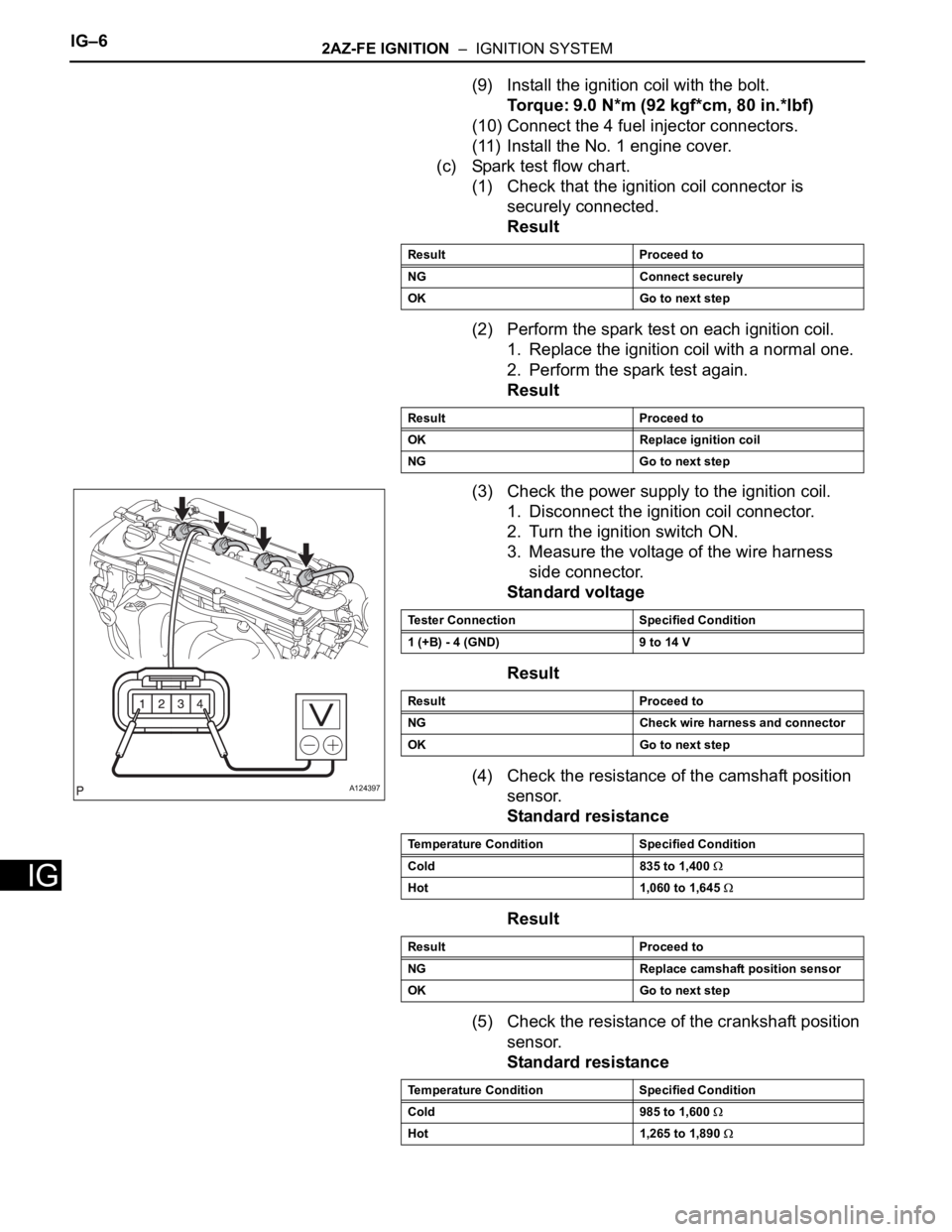
(3) Check the power supply to the ignition coil.
1. Disconnect the ignition coil connector.
2. Turn the ignition switch ON.
3. Measure the voltage of the wire harness
side connector.
Standard voltage
Result
(4) Check the resistance of the camshaft position
sensor.
Standard resistance
Result
(5) Check the resistance of the crankshaft position
sensor.
Standard resistance
Result Proceed to
NG Connect securely
OK Go to next step
Result Proceed to
OK Replace ignition coil
NG Go to next step
A124397
Tester Connection Specified Condition
1 (+B) - 4 (GND) 9 to 14 V
Result Proceed to
NG Check wire harness and connector
OK Go to next step
Temperature Condition Specified Condition
Cold 835 to 1,400
Hot 1,060 to 1,645
Result Proceed to
NG Replace camshaft position sensor
OK Go to next step
Temperature Condition Specified Condition
Cold 985 to 1,600
Hot 1,265 to 1,890
Page 887 of 2000
2AZ-FE IGNITION – IGNITION SYSTEMIG–7
IG
Result
(6) Check the IGT signal from the ECM.
Result
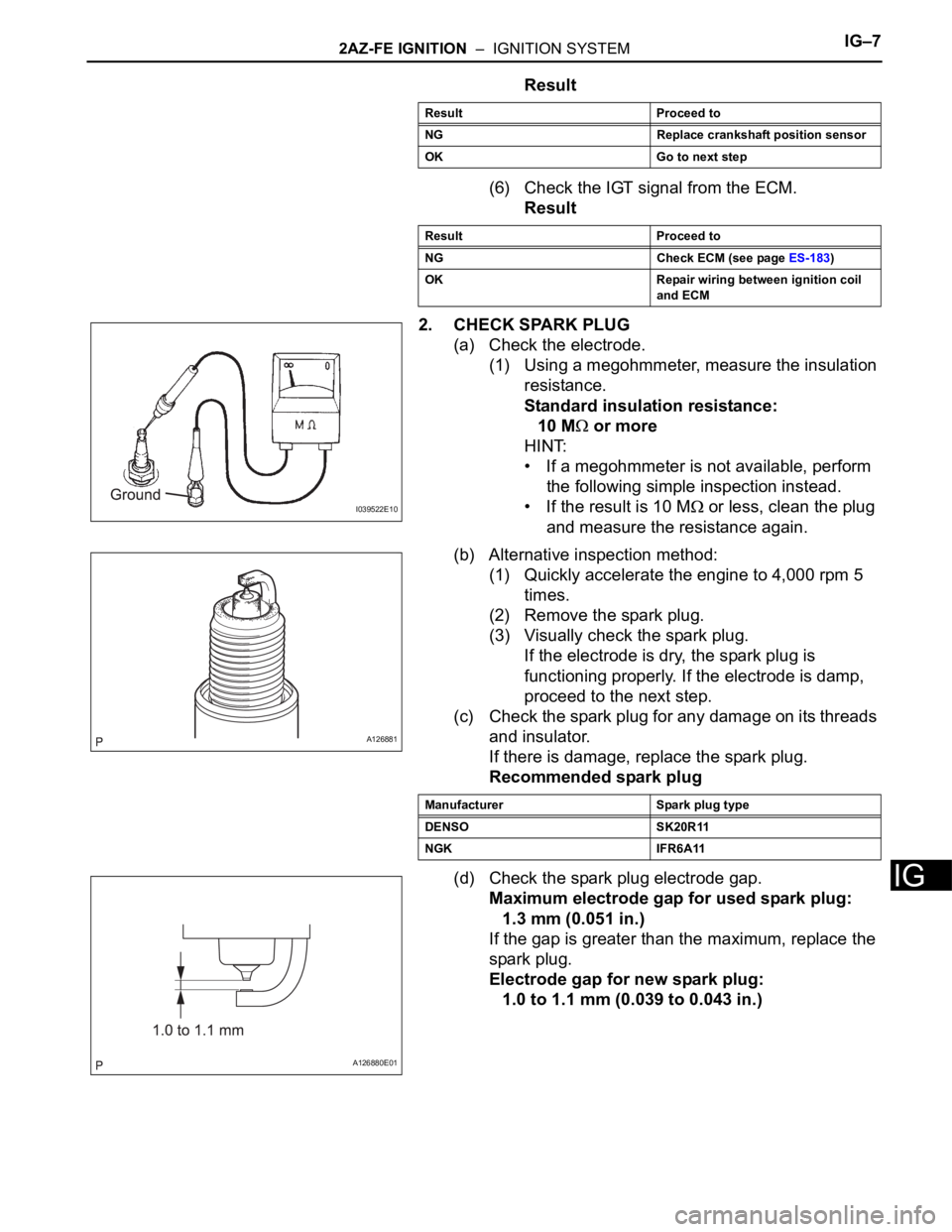
2. CHECK SPARK PLUG
(a) Check the electrode.
(1) Using a megohmmeter, measure the insulation
resistance.
Standard insulation resistance:
10 M
or more
HINT:
• If a megohmmeter is not available, perform
the following simple inspection instead.
• If the result is 10 M
or less, clean the plug
and measure the resistance again.
(b) Alternative inspection method:
(1) Quickly accelerate the engine to 4,000 rpm 5
times.
(2) Remove the spark plug.
(3) Visually check the spark plug.
If the electrode is dry, the spark plug is
functioning properly. If the electrode is damp,
proceed to the next step.
(c) Check the spark plug for any damage on its threads
and insulator.
If there is damage, replace the spark plug.
Recommended spark plug
(d) Check the spark plug electrode gap.
Maximum electrode gap for used spark plug:
1.3 mm (0.051 in.)
If the gap is greater than the maximum, replace the
spark plug.
Electrode gap for new spark plug:
1.0 to 1.1 mm (0.039 to 0.043 in.)
Result Proceed to
NG Replace crankshaft position sensor
OK Go to next step
Result Proceed to
NG Check ECM (see page ES-183)
OK Repair wiring between ignition coil
and ECM
I039522E10
A126881
Manufacturer Spark plug type
DENSO SK20R11
NGK IFR6A11
A126880E01
Page 895 of 2000
2GR-FE IGNITION – IGNITION SYSTEMIG–5
IG
ON-VEHICLE INSPECTION
1. CHECK IGNITION COIL ASSEMBLY AND PERFORM
SPARK TEST
NOTICE:
In this section, the terms "Cold" and "Hot" refer to
the temperature of the sensor. "Cold" means
approximately -10 to 50
C (14 to 122F). "Hot" means
approximately 50 to 100
C (122 to 212F).
(a) Check the DTCs.
NOTICE:
If a DTC is present, perform troubleshooting in
accordance with the procedure for that DTC.
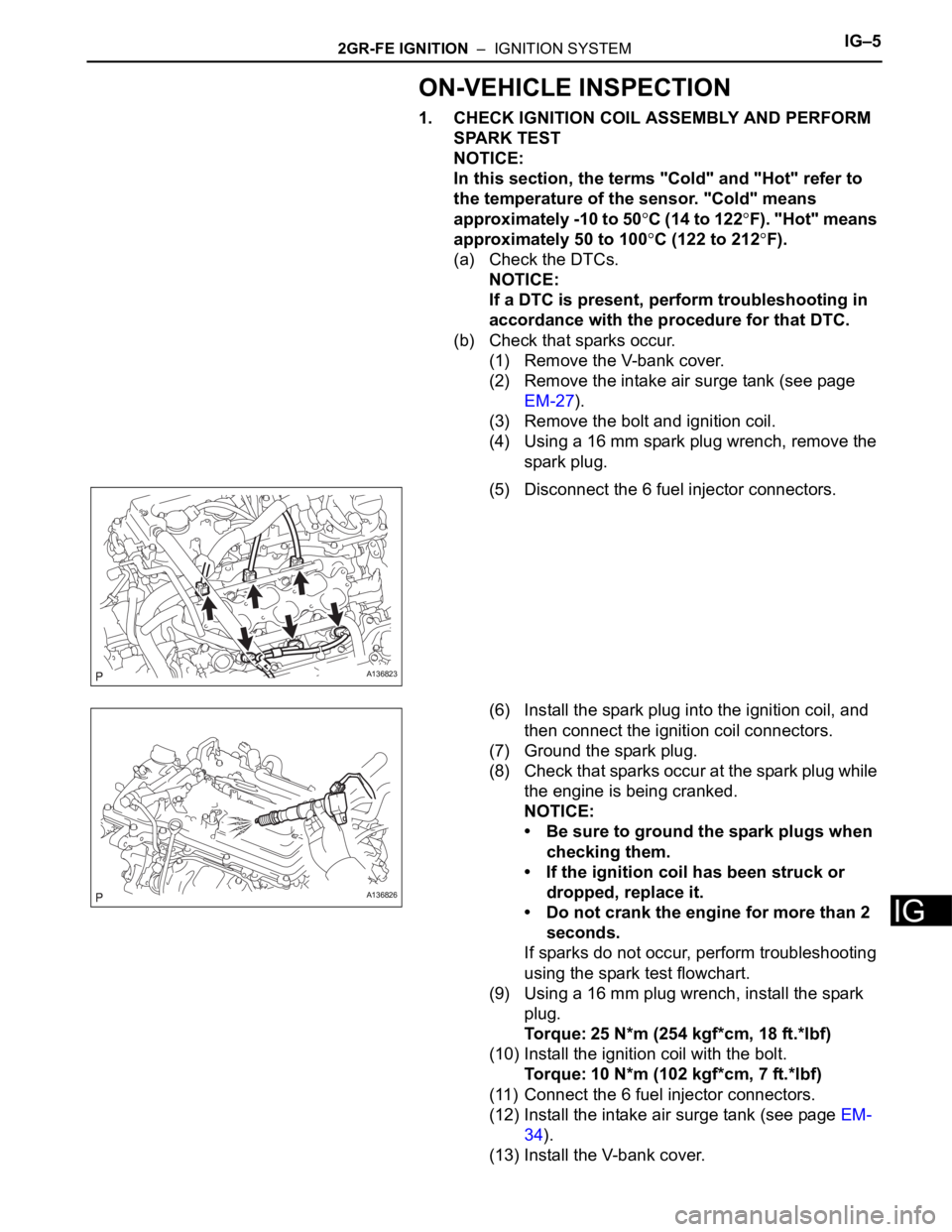
(b) Check that sparks occur.
(1) Remove the V-bank cover.
(2) Remove the intake air surge tank (see page
EM-27).
(3) Remove the bolt and ignition coil.
(4) Using a 16 mm spark plug wrench, remove the
spark plug.
(5) Disconnect the 6 fuel injector connectors.
(6) Install the spark plug into the ignition coil, and
then connect the ignition coil connectors.
(7) Ground the spark plug.
(8) Check that sparks occur at the spark plug while
the engine is being cranked.
NOTICE:
• Be sure to ground the spark plugs when
checking them.
• If the ignition coil has been struck or
dropped, replace it.
• Do not crank the engine for more than 2
seconds.
If sparks do not occur, perform troubleshooting
using the spark test flowchart.
(9) Using a 16 mm plug wrench, install the spark
plug.
Torque: 25 N*m (254 kgf*cm, 18 ft.*lbf)
(10) Install the ignition coil with the bolt.
Torque: 10 N*m (102 kgf*cm, 7 ft.*lbf)
(11) Connect the 6 fuel injector connectors.
(12) Install the intake air surge tank (see page EM-
34).
(13) Install the V-bank cover.
A136823
A136826
Page 897 of 2000
2GR-FE IGNITION – IGNITION SYSTEMIG–7
IG
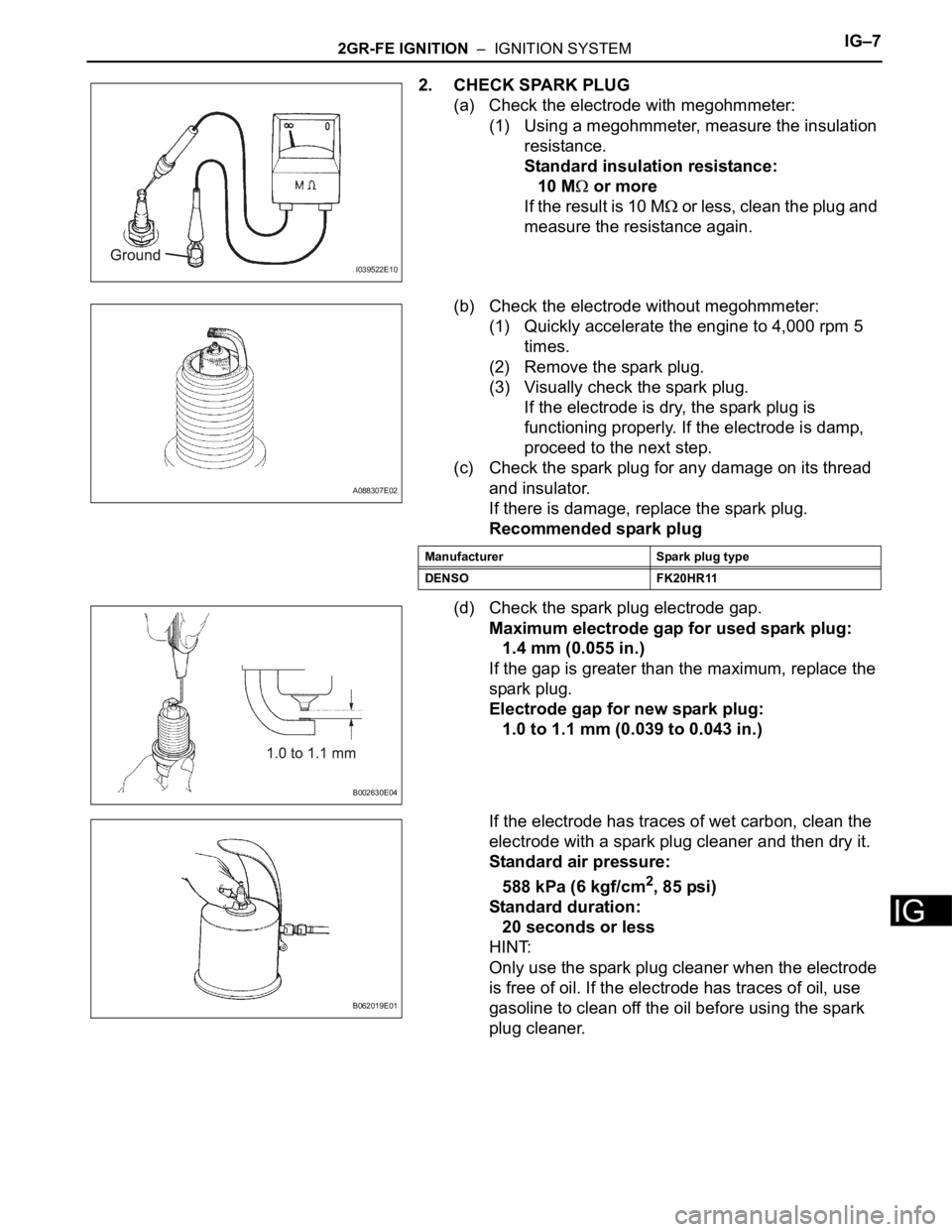
2. CHECK SPARK PLUG
(a) Check the electrode with megohmmeter:
(1) Using a megohmmeter, measure the insulation
resistance.
Standard insulation resistance:
10 M
or more
If the result is 10 M
or less, clean the plug and
measure the resistance again.
(b) Check the electrode without megohmmeter:
(1) Quickly accelerate the engine to 4,000 rpm 5
times.
(2) Remove the spark plug.
(3) Visually check the spark plug.
If the electrode is dry, the spark plug is
functioning properly. If the electrode is damp,
proceed to the next step.
(c) Check the spark plug for any damage on its thread
and insulator.
If there is damage, replace the spark plug.
Recommended spark plug
(d) Check the spark plug electrode gap.
Maximum electrode gap for used spark plug:
1.4 mm (0.055 in.)
If the gap is greater than the maximum, replace the
spark plug.
Electrode gap for new spark plug:
1.0 to 1.1 mm (0.039 to 0.043 in.)
If the electrode has traces of wet carbon, clean the
electrode with a spark plug cleaner and then dry it.
Standard air pressure:
588 kPa (6 kgf/cm
2, 85 psi)
Standard duration:
20 seconds or less
HINT:
Only use the spark plug cleaner when the electrode
is free of oil. If the electrode has traces of oil, use
gasoline to clean off the oil before using the spark
plug cleaner.
I039522E10
A088307E02
Manufacturer Spark plug type
DENSO FK20HR11
B002630E04
B062019E01
Page 954 of 2000

AX–20U140F AUTOMATIC TRANSAXLE – AUTOMATIC TRANSAXLE SYSTEM
AX
(g) Depress the accelerator pedal as much as possible
with your right foot. Quickly read the highest line
pressure reading when the engine speed reaches
stall speed.
(h) Perform the measure line pressure test again with
the shift lever on R.
Specified line pressure:
Evaluation:
Condition Shift Lever on D Shift Lever on R
Idling 372 to 412 kPa
(3.8 to 4.2 kgf/cm
2, 54 to 60 psi)672 to 742 kPa
(6.9 to 7.6 kgf/cm2, 97 to 108 psi)
Stall 931 to 1,031 kPa
(9.5 to 10.5 kgf/cm
2, 135 to 150 psi)1,768 to 1,968 kPa
(18.0 to 20.0 kgf/cm2, 256 to 285 psi)
Problem Possible Cause
Measured values at all positions are higher than specified • Shift solenoid valve SLT defective
• Regulator valve defective
Measured values at all positions are lower than specified • Shift solenoid valve SLT defective
• Regulator valve defective
• Oil pump defective
• U/D (underdrive) direct clutch defective
Pressure is low when shift lever is on D only • D position circuit fluid leak
• Forward clutch defective
Pressure is low when shift lever is on R only • R position circuit fluid leak
• Direct clutch defective
• 1st and reverse brake defective
Page 961 of 2000

U140F AUTOMATIC TRANSAXLE – AUTOMATIC TRANSAXLE SYSTEMAX–27
AX
Vehicle does not move with shift lever on R1. Front and rear planetary gearAX-155
2. U/D planetary gearAX-155
3. C2 direct clutchAX-155
4. C3 U/D brakeAX-155
5. B2 1st and reverse brakeAX-155
No up-shift (1st -> 2nd)1. Valve body assemblyAX-118
2. F1 No. 1 one-way clutchAX-155
3. B1 2nd brakeAX-155
No up-shift (2nd -> 3rd)1. Valve body assemblyAX-118
2. C2 direct clutchAX-155
No up-shift (3rd -> O/D)1. 3-4 shift valveAX-155
2. C3 U/D clutchAX-155
No down-shift (O/D -> 3rd) 3-4 shift valveAX-155
No down-shift (3rd -> 2nd) Valve body assemblyAX-118
No down-shift (2nd -> 1st) Valve body assemblyAX-118
No lock-up or no lock-up off1. Lock-up relay valveAX-155
2. Torque converter clutchAX-153
Harsh engagement (N -> D)1. C1 accumulatorAX-155
2. Valve body assemblyAX-118
3. C1 forward clutchAX-155
4. F2 U/D one-way clutchAX-155
5. F1 No. 1 one-way clutchAX-155
Harsh engagement (N -> R)1. Valve body assemblyAX-118
2. C2 direct clutchAX-155
3. B2 1st and reverse brakeAX-155
Harsh engagement (Lock-up)1. Lock-up relay valveAX-155
2. Torque converter clutchAX-153
Harsh engagement (2nd -> 3rd) Valve body assemblyAX-118
Harsh engagement (3rd -> O/D) Valve body assemblyAX-118
Harsh engagement (O/D -> 3rd) Valve body assemblyAX-118
Slip or shudder (forward position, after warm-up)1. Oil strainerAX-118
2. Torque converter clutchAX-153
3. C1 forward clutchAX-155
4. C2 direct clutchAX-155
5. C3 U/D brakeAX-155
6. F1 No. 1 one-way clutchAX-155
7. F2 U/D one-way clutchAX-155
Slip or shudder (shift lever on R)1. Oil strainerAX-118
2. C2 direct clutchAX-155
3. B2 1st and reverse brakeAX-155
Slip or shudder (1st) F1 No. 1 one-way clutchAX-155
Slip or shudder (2nd)1. F2 U/D one-way clutchAX-155
2. B1 2nd brakeAX-155
Slip or shudder (3rd) C2 direct clutchAX-155
Slip or shudder (O/D) C3 U/D clutchAX-155
No engine braking (1st to 3rd/shift lever on D) B3 U/D brakeAX-155
No engine braking (1st/shift lever on L) B2 1st and reverse brakeAX-155
No engine braking (2nd/shift lever on 2) B1 2nd brakeAX-155 Symptom Suspected area See page
Page 976 of 2000
AX–144U140F AUTOMATIC TRANSAXLE – DIFFERENTIAL OIL SEAL
AX
REPLACEMENT
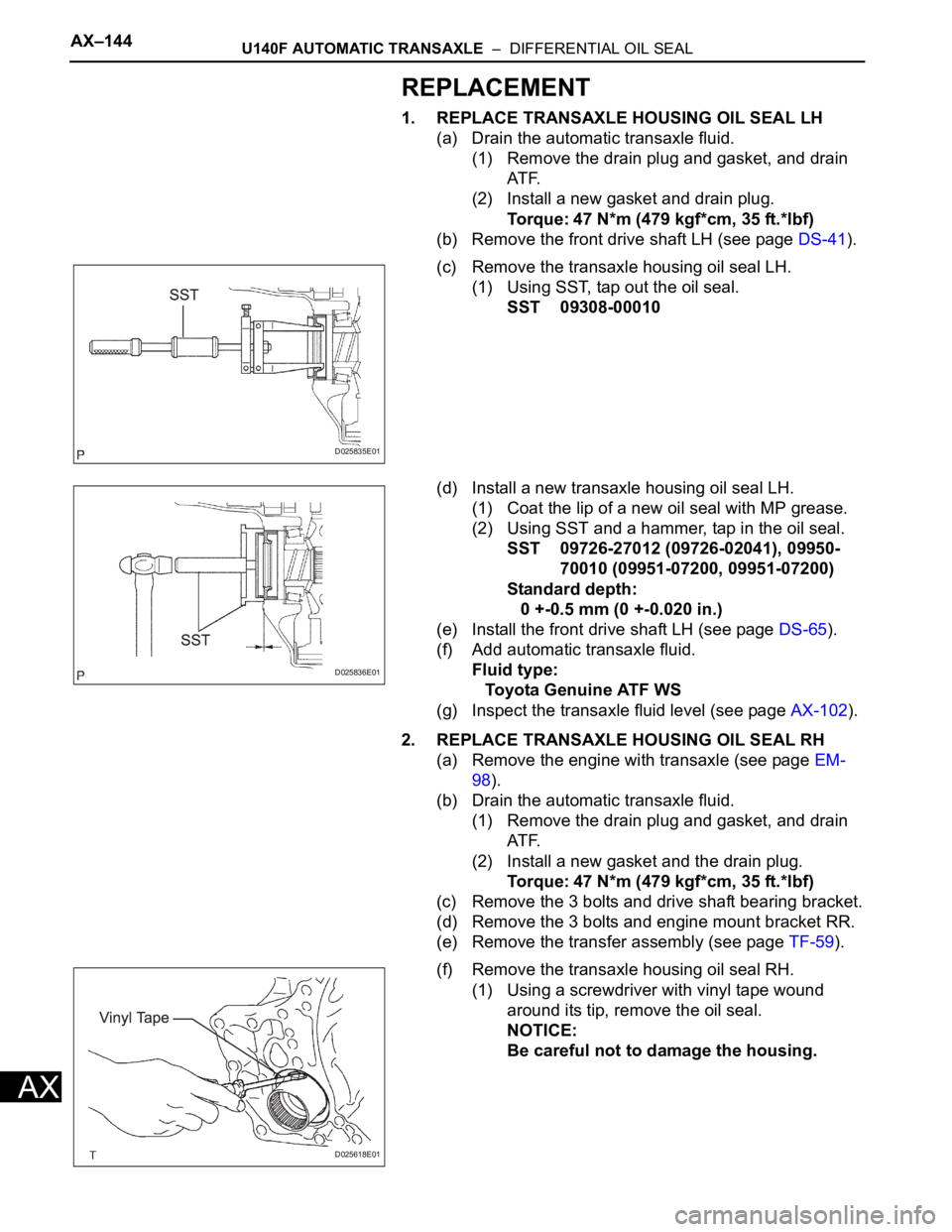
1. REPLACE TRANSAXLE HOUSING OIL SEAL LH
(a) Drain the automatic transaxle fluid.
(1) Remove the drain plug and gasket, and drain
AT F.
(2) Install a new gasket and drain plug.
Torque: 47 N*m (479 kgf*cm, 35 ft.*lbf)
(b) Remove the front drive shaft LH (see page DS-41).
(c) Remove the transaxle housing oil seal LH.
(1) Using SST, tap out the oil seal.
SST 09308-00010
(d) Install a new transaxle housing oil seal LH.
(1) Coat the lip of a new oil seal with MP grease.
(2) Using SST and a hammer, tap in the oil seal.
SST 09726-27012 (09726-02041), 09950-
70010 (09951-07200, 09951-07200)
Standard depth:
0 +-0.5 mm (0 +-0.020 in.)
(e) Install the front drive shaft LH (see page DS-65).
(f) Add automatic transaxle fluid.
Fluid type:
Toyota Genuine ATF WS
(g) Inspect the transaxle fluid level (see page AX-102).
2. REPLACE TRANSAXLE HOUSING OIL SEAL RH
(a) Remove the engine with transaxle (see page EM-
98).
(b) Drain the automatic transaxle fluid.
(1) Remove the drain plug and gasket, and drain
AT F.
(2) Install a new gasket and the drain plug.
Torque: 47 N*m (479 kgf*cm, 35 ft.*lbf)
(c) Remove the 3 bolts and drive shaft bearing bracket.
(d) Remove the 3 bolts and engine mount bracket RR.
(e) Remove the transfer assembly (see page TF-59).
(f) Remove the transaxle housing oil seal RH.
(1) Using a screwdriver with vinyl tape wound
around its tip, remove the oil seal.
NOTICE:
Be careful not to damage the housing.
D025835E01
D025836E01
D025618E01