current TOYOTA RAV4 2006 Service Owner's Manual
[x] Cancel search | Manufacturer: TOYOTA, Model Year: 2006, Model line: RAV4, Model: TOYOTA RAV4 2006Pages: 2000, PDF Size: 45.84 MB
Page 497 of 2000

2AZ-FE ENGINE CONTROL SYSTEM – SFI SYSTEMES–43
ES
KNOCK FB VAL Feedback value of knocking -
ACCEL POS #1Absolute Accelerator Pedal Position (APP)
No.1-
ACCEL POS #2 Absolute APP No. 2 -
THROTTLE POS Throttle sensor positioning -
THROTTLE POS Throttle position -
THROTTLE POS #2 Throttle sensor positioning #2 -
THROTTLE MOT Throttle motor -
O2S B1 S2 Heated oxygen sensor outputPerforming INJ VOL or A/F CONTROL
function of ACTIVE TEST enables technician
to check output voltage of sensor
AFS B1 S1 A/F sensor outputPerforming INJ VOL or A/F CONTROL
function of ACTIVE TEST enables technician
to check output voltage of sensor
TOTAL FT #1 Total fuel trim -
SHORT FT #1 Short-term fuel trimShort-term fuel compensation used to
maintain air-fuel ratio at stoichiometric air-fuel
ratio
LONG FT #1 Long-term fuel trimOverall fuel compensation carried out in long-
term to compensate a continual deviation of
short-term fuel trim from central valve
FUEL SYS #1 Fuel system status• OL (Open Loop): Has not yet satisfied
conditions to go closed loop
• CL (Closed Loop): Using A/F sensor as
feedback for fuel control
• OL DRIVE: Open loop due to driving
conditions (fuel enrichment)
• OL FAULT: Open loop due to detected
system fault
• CL FAULT: Closed loop but A/F sensor,
which used for fuel control malfunctioning
O2FT B1 S2 Fuel trim at heated oxygen sensor -
AF FT B1 S1 Fuel trim at A/F sensor -
AFS B1 S1 A/F sensor current -
CAT TEMP B1S1 Estimated catalyst temperature (sensor 1) -
CAT TEMP B1S2 Estimated catalyst temperature (sensor 2) -
S O2S B1S2Sub heated oxygen sensor impedance
(sensor 2)-
INI COOL TEMP Engine coolant temperature at engine start -
INI INTAKE TEMP Intake air temperature at engine start -
INJ VOL Injection volume -
STARTER SIG Starter switch (STSW) signal -
PS SW Power steering signal -
PS SIGNAL Power steering signal (history)Signal status usually ON until ignition switch
turned OFF
CTP SW Closed throttle position switch -
A/C SIGNAL A/C signal -
PNP SW (NSW) Park/Neutral Position (PNP) switch signal -
ELECT LOAD SIG Electrical load signal -
STOP LIGHT SW Stop light switch -
BATTERY VOLTAGE Battery voltage -
ATM PRESSURE Atmosphere pressure -
EVAP (Purge) VSV EVAP Purge VSV -
FUEL PUMP/SPD Fuel pump/speed status -LABEL
(Intelligent Tester Display)Measurement Item Diagnostic Note
Page 508 of 2000
SEAT – FRONT POWER SEAT CONTROL SYSTEMSE–3
SE
PROBLEM SYMPTOMS TABLE
HINT:
Use the table below to help determine the cause of the
problem symptom. The potential causes of the symptoms are
listed in order of probability in the "Suspected Area" column
of the table. Check each symptom by checking the suspected
areas in the order they are listed. Replace parts as
necessary.
Front power seat control system
ON-VEHICLE INSPECTION
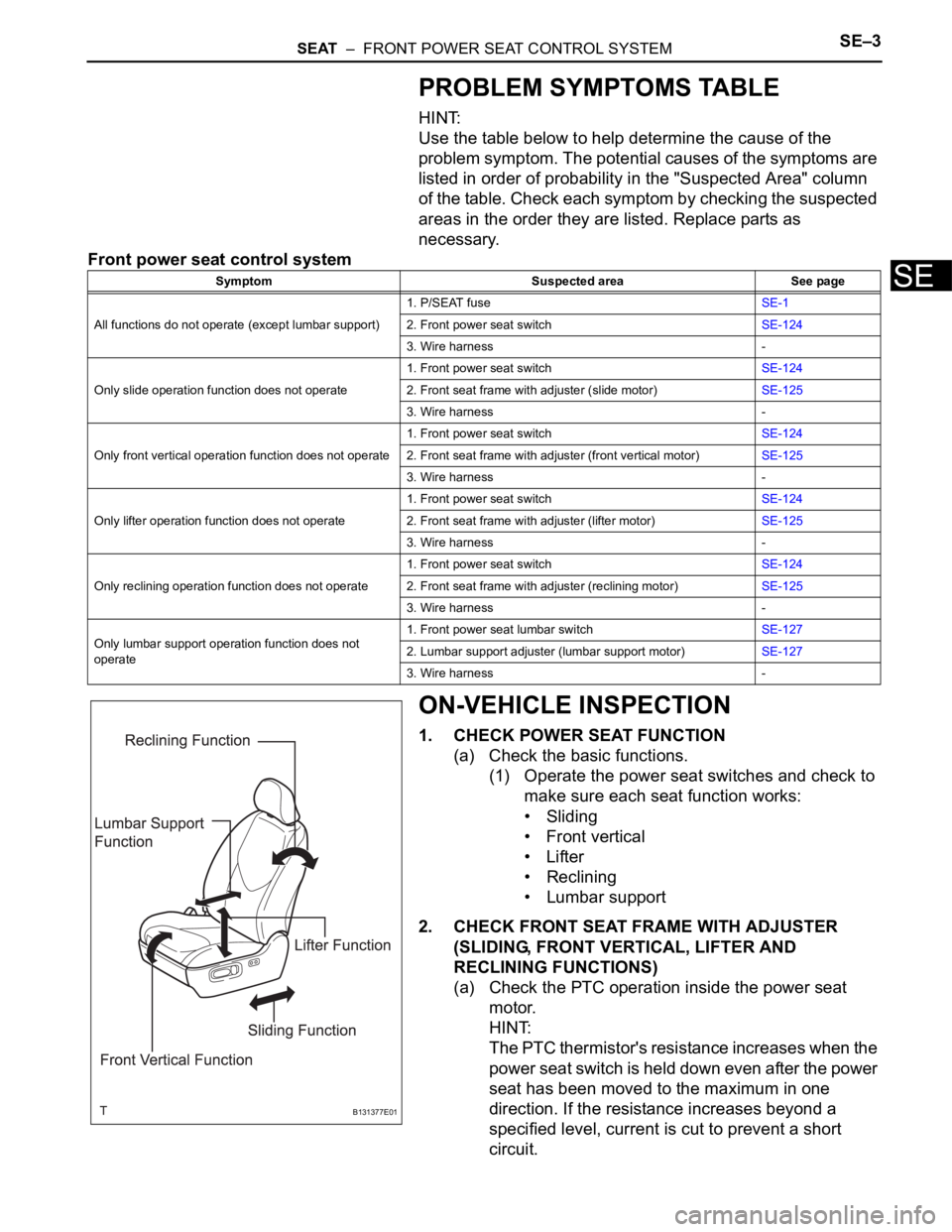
1. CHECK POWER SEAT FUNCTION
(a) Check the basic functions.
(1) Operate the power seat switches and check to
make sure each seat function works:
• Sliding
•Front vertical
•Lifter
• Reclining
• Lumbar support
2. CHECK FRONT SEAT FRAME WITH ADJUSTER
(SLIDING, FRONT VERTICAL, LIFTER AND
RECLINING FUNCTIONS)
(a) Check the PTC operation inside the power seat
motor.
HINT:
The PTC thermistor's resistance increases when the
power seat switch is held down even after the power
seat has been moved to the maximum in one
direction. If the resistance increases beyond a
specified level, current is cut to prevent a short
circuit.
Symptom Suspected area See page
All functions do not operate (except lumbar support)1. P/SEAT fuseSE-1
2. Front power seat switchSE-124
3. Wire harness -
Only slide operation function does not operate1. Front power seat switchSE-124
2. Front seat frame with adjuster (slide motor)SE-125
3. Wire harness -
Only front vertical operation function does not operate1. Front power seat switchSE-124
2. Front seat frame with adjuster (front vertical motor)SE-125
3. Wire harness -
Only lifter operation function does not operate1. Front power seat switchSE-124
2. Front seat frame with adjuster (lifter motor)SE-125
3. Wire harness -
Only reclining operation function does not operate1. Front power seat switchSE-124
2. Front seat frame with adjuster (reclining motor)SE-125
3. Wire harness -
Only lumbar support operation function does not
operate1. Front power seat lumbar switchSE-127
2. Lumbar support adjuster (lumbar support motor)SE-127
3. Wire harness -
B131377E01
Page 509 of 2000

SE–4SEAT – FRONT POWER SEAT CONTROL SYSTEM
SE
NOTICE:
• The inspection should be performed with the
seat installed in the vehicle.
• Perform the 4 steps below for the full range of
motion for each power seat function.
(1) Choose a power seat function. Operate the
power seat switch and move the seat as much
as possible in one direction. Keep the seat in
that position for approximately 60 seconds.
(2) Operate the power seat switch again and
continue to try to move the seat in the same
direction as in the previous step. Measure the
amount of time elapsed before current is
automatically cut (the sound of the motor has
stopped).
Standard:
4 to 90 seconds
(3) After current has been cut, release the power
seat switch and wait for approximately 60
seconds.
(4) Operate the same power seat switch and move
the seat in the opposite direction. Check that
the motor operates.
3. CHECK LUMBAR SUPPORT ADJUSTER ASSEMBLY
(a) Check the PTC operation inside the power seat
motor.
NOTICE:
The inspection should be performed with the
seat installed in the vehicle.
(1) Operate the lumbar support switch and move
the lumbar support to either the foremost or
rearmost position. Keep the seat in that
position for approximately 60 seconds.
(2) Operate the lumbar support switch again and
continue to try to move the lumbar support in
the same direction as in the previous step.
Measure the amount of time elapsed before
current is automatically cut (the sound of the
motor has stopped).
Standard:
4 to 90 seconds
(3) After current has been cut, release the lumbar
support switch and wait for approximately 60
seconds.
(4) Operate the lumbar support switch and move
the seat in the opposite direction. Check that
the motor operates.
Page 548 of 2000

ES–242GR-FE ENGINE CONTROL SYSTEM – SFI SYSTEM
ES
(b) If the test value is between the minimum and
maximum test limits, the component is functioning
normally. If not, the component is malfunctioning.
The test value is usually not near the test limits. If
the test value is on the borderline of the test limits,
the component is likely to malfunction in the near
future.
HINT:
The monitor result might on rare occasions be
PASS even if the malfunction indicator lamp (MIL) is
illuminated. This indicates the system malfunctioned
on a previous driving cycle. This might be caused by
an intermittent problem.
4. MONITOR RESULT INFORMATION
If you use a generic scan tool, multiply the test value by
the scaling value listed below.
A/F Sensor (Bank 1 Sensor 1)
A/F Sensor (Bank 2 Sensor 1)
HO2 Sensor (Bank 1 Sensor 2)
HO2 Sensor (Bank 2 Sensor 2)
Catalyst (Bank 1)
Catalyst (Bank 2)
EVAP
Monitor ID Test ID Scaling Unit Description
$01 $8E Multiply by 0.001 V A/F sensor deterioration level
$01 $91 Multiply by 0.004 mA A/F sensor current
Monitor ID Test ID Scaling Unit Description
$05 $8E Multiply by 0.001 V A/F sensor deterioration level
$05 $91 Multiply by 0.004 mA A/F sensor current
Monitor ID Test ID Scaling Unit Description
$02 $07 Multiply by 0.001 V Minimum sensor voltage
$02 $08 Multiply by 0.001 V Maximum sensor voltage
$02 $8F Multiply by 0.0003 g Maximum oxygen storage capacity
Monitor ID Test ID Scaling Unit Description
$06 $07 Multiply by 0.001 V Minimum sensor voltage
$06 $08 Multiply by 0.001 V Maximum sensor voltage
$06 $8F Multiply by 0.0003 g Maximum oxygen storage capacity
Monitor ID Test ID Scaling Unit Description
$21 $A9 Multiply by 0.0003 No dimension Oxygen storage capacity of catalyst
Monitor ID Test ID Scaling Unit Description
$22 $A9 Multiply by 0.0003 No dimension Oxygen storage capacity of catalyst
Monitor ID Test ID Scaling Unit Description
$3D $C9 Multiply by 0.001 kPa Test value for small leak (P0456)
$3D $CA Multiply by 0.001 kPa Test value for gross leak (P0455)
$3D $CB Multiply by 0.001 kPa Test value for leak detection pump stuck OFF (P2401)
$3D $CD Multiply by 0.001 kPa Test value for leak detection pump stuck ON (P2402)
$3D $CE Multiply by 0.001 kPa Test value for vent valve stuck OFF (P2420)
$3D $CF Multiply by 0.001 kPa Test value for vent valve stuck ON (P2419)
$3D $D0 Multiply by 0.001 kPa Test value for reference orifice low flow (P043E)
Page 549 of 2000

2GR-FE ENGINE CONTROL SYSTEM – SFI SYSTEMES–25
ES
Rear Oxygen Sensor Heater
Misfire
$3D $D1 Multiply by 0.001 kPa Test value for reference orifice high flow (P043F)
$3D $D4 Multiply by 0.001 kPa Test value for purge VSV stuck closed (P0441)
$3D $D5 Multiply by 0.001 kPa Test value for purge VSV stuck open (P0441)
$3D $D7 Multiply by 0.001 kPa Test value for purge flow insufficient (P0441)
Monitor ID Test ID Scaling Unit Description
$42 $91 Multiply by 0.001 Ohm Oxygen sensor heater resistance bank 1 sensor 2
$46 $91 Multiply by 0.001 Ohm Oxygen sensor heater resistance bank 2 sensor 2
Monitor ID Test ID Scaling Unit Description
$A1 $0B Multiply by 1 TimeExponential Weighted Moving Average (EWMA) misfire for all
cylinders:
EWMA = Total misfire counts for last driving cycle * 0.1 + Last
EWMA * 0.9
Misfire counts for last 10 driving cycles - Total
$A1 $0C Multiply by 1 TimeIgnition switch ON: Total misfire counts for last driving cycle
Engine running: Total misfire counts for current driving cycle
Misfire counts for last or current driving cycle - all cylinders
$A2 $0B Multiply by 1 TimeExponential Weighted Moving Average (EWMA) misfire for
cylinder 1:
EWMA = Total misfire counts for last driving cycle * 0.1 + Last
EWMA * 0.9
Misfire counts for last 10 driving cycles - Total
$A2 $0C Multiply by 1 TimeIgnition switch ON: Total misfire counts for last driving cycle
Engine running: Total misfire counts for current driving cycle
Misfire counts for last or current driving cycle - cylinder 1
$A3 $0B Multiply by 1 TimeExponential Weighted Moving Average (EWMA) misfire for
cylinder 2:
EWMA = Total misfire counts for last driving cycle * 0.1 + Last
EWMA * 0.9
Misfire counts for last 10 driving cycles - Total
$A3 $0C Multiply by 1 TimeIgnition switch ON: Total misfire counts for last driving cycle
Engine running: Total misfire counts for current driving cycle
Misfire counts for last or current driving cycle - cylinder 2
$A4 $0B Multiply by 1 TimeExponential Weighted Moving Average (EWMA) misfire for
cylinder 3:
EWMA = Total misfire counts for last driving cycle * 0.1 + Last
EWMA * 0.9
Misfire counts for last 10 driving cycles - Total
$A4 $0C Multiply by 1 TimeIgnition switch ON: Total misfire counts for last driving cycle
Engine running: Total misfire counts for current driving cycle
Misfire counts for last or current driving cycle - cylinder 3
$A5 $0B Multiply by 1 TimeExponential Weighted Moving Average (EWMA) misfire for
cylinder 4:
EWMA = Total misfire counts for last driving cycle * 0.1 + Last
EWMA * 0.9
Misfire counts for last 10 driving cycles - Total
$A5 $0C Multiply by 1 TimeIgnition switch ON: Total misfire counts for last driving cycle
Engine running: Total misfire counts for current driving cycle
Misfire counts for last or current driving cycle - cylinder 4
$A6 $0B Multiply by 1 TimeExponential Weighted Moving Average (EWMA) misfire for
cylinder 5:
EWMA = Total misfire counts for last driving cycle * 0.1 + Last
EWMA * 0.9
Misfire counts for last 10 driving cycles - Total
$A6 $0C Multiply by 1 TimeIgnition switch ON: Total misfire counts for last driving cycle
Engine running: Total misfire counts for current driving cycle
Misfire counts for last or current driving cycle - cylinder 5 Monitor ID Test ID Scaling Unit Description
Page 550 of 2000

ES–262GR-FE ENGINE CONTROL SYSTEM – SFI SYSTEM
ES
$A7 $0B Multiply by 1 TimeExponential Weighted Moving Average (EWMA) misfire for
cylinder 6:
EWMA = Total misfire counts for last driving cycle * 0.1 + Last
EWMA * 0.9
Misfire counts for last 10 driving cycles - Total
$A7 $0C Multiply by 1 TimeIgnition switch ON: Total misfire counts for last driving cycle
Engine running: Total misfire counts for current driving cycle
Misfire counts for last or current driving cycle - cylinder 6 Monitor ID Test ID Scaling Unit Description
Page 561 of 2000
2GR-FE ENGINE CONTROL SYSTEM – SFI SYSTEMES–37
ES
HINT:
*: The ECM terminal voltage is constant regardless
of the output voltage from the sensor.
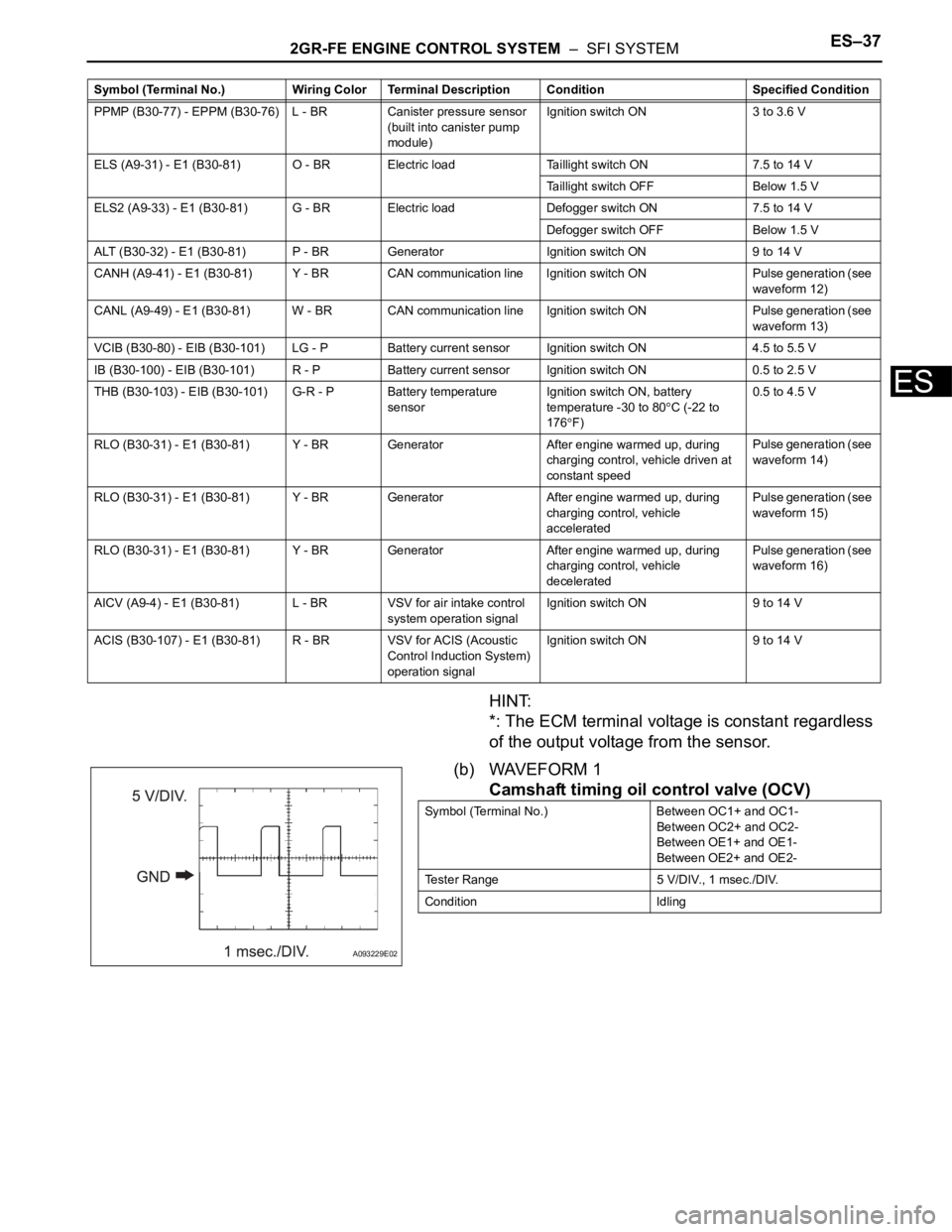
(b) WAVEFORM 1
Camshaft timing oil control valve (OCV)
PPMP (B30-77) - EPPM (B30-76) L - BR Canister pressure sensor
(built into canister pump
module)Ignition switch ON 3 to 3.6 V
ELS (A9-31) - E1 (B30-81) O - BR Electric load Taillight switch ON7.5 to 14 V
Taillight switch OFF Below 1.5 V
ELS2 (A9-33) - E1 (B30-81) G - BR Electric load Defogger switch ON7.5 to 14 V
Defogger switch OFF Below 1.5 V
ALT (B30-32) - E1 (B30-81) P - BR Generator Ignition switch ON 9 to 14 V
CANH (A9-41) - E1 (B30-81) Y - BR CAN communication line Ignition switch ON Pulse generation (see
waveform 12)
CANL (A9-49) - E1 (B30-81) W - BR CAN communication line Ignition switch ON Pulse generation (see
waveform 13)
VCIB (B30-80) - EIB (B30-101) LG - P Battery current sensor Ignition switch ON 4.5 to 5.5 V
IB (B30-100) - EIB (B30-101) R - P Battery current sensor Ignition switch ON 0.5 to 2.5 V
THB (B30-103) - EIB (B30-101) G-R - P Battery temperature
sensorIgnition switch ON, battery
temperature -30 to 80
C (-22 to
176
F)0.5 to 4.5 V
RLO (B30-31) - E1 (B30-81) Y - BR Generator After engine warmed up, during
charging control, vehicle driven at
constant speedPulse generation (see
waveform 14)
RLO (B30-31) - E1 (B30-81) Y - BR Generator After engine warmed up, during
charging control, vehicle
acceleratedPulse generation (see
waveform 15)
RLO (B30-31) - E1 (B30-81) Y - BR Generator After engine warmed up, during
charging control, vehicle
deceleratedPulse generation (see
waveform 16)
AICV (A9-4) - E1 (B30-81) L - BR VSV for air intake control
system operation signalIgnition switch ON 9 to 14 V
ACIS (B30-107) - E1 (B30-81) R - BR VSV for ACIS (Acoustic
Control Induction System)
operation signalIgnition switch ON 9 to 14 V Symbol (Terminal No.) Wiring Color Terminal Description Condition Specified Condition
A093229E02
Symbol (Terminal No.) Between OC1+ and OC1-
Between OC2+ and OC2-
Between OE1+ and OE1-
Between OE2+ and OE2-
Tester Range 5 V/DIV., 1 msec./DIV.
Condition Idling
Page 569 of 2000
2GR-FE ENGINE CONTROL SYSTEM – SFI SYSTEMES–45
ES
DTC CHECK / CLEAR
NOTICE:
When the diagnosis system is changed from normal
mode to check mode or vice versa, all DTCs and freeze
frame data recorded in normal mode are erased. Before
changing modes, always check and make a note of any
DTCs and freeze frame data.
HINT:
• DTCs which are stored in the ECM can be displayed on
the intelligent tester. The intelligent tester can display
current and pending DTCs.
• Some DTCs are not set if the ECM does not detect the
same malfunction again during a second consecutive
driving cycle. However, such malfunctions, detected on
only one occasion, are stored as pending DTCs.
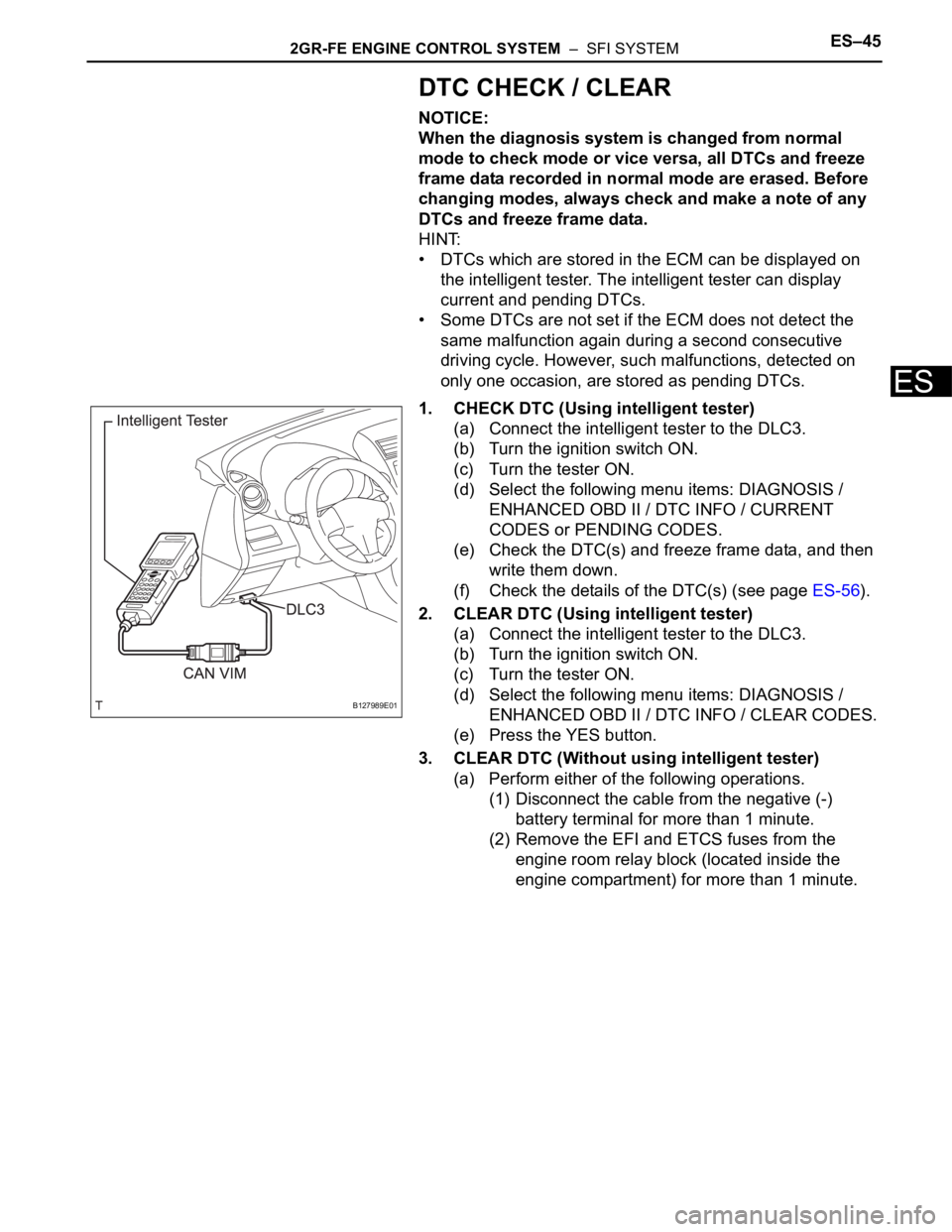
1. CHECK DTC (Using intelligent tester)
(a) Connect the intelligent tester to the DLC3.
(b) Turn the ignition switch ON.
(c) Turn the tester ON.
(d) Select the following menu items: DIAGNOSIS /
ENHANCED OBD II / DTC INFO / CURRENT
CODES or PENDING CODES.
(e) Check the DTC(s) and freeze frame data, and then
write them down.
(f) Check the details of the DTC(s) (see page ES-56).
2. CLEAR DTC (Using intelligent tester)
(a) Connect the intelligent tester to the DLC3.
(b) Turn the ignition switch ON.
(c) Turn the tester ON.
(d) Select the following menu items: DIAGNOSIS /
ENHANCED OBD II / DTC INFO / CLEAR CODES.
(e) Press the YES button.
3. CLEAR DTC (Without using intelligent tester)
(a) Perform either of the following operations.
(1) Disconnect the cable from the negative (-)
battery terminal for more than 1 minute.
(2) Remove the EFI and ETCS fuses from the
engine room relay block (located inside the
engine compartment) for more than 1 minute.
B127989E01
Page 571 of 2000

2GR-FE ENGINE CONTROL SYSTEM – SFI SYSTEMES–47
ES
KNOCK FB VAL Feedback value of knocking -
ACCEL POS #1Absolute Accelerator Pedal Position (APP)
No.1-
ACCEL POS #2 Absolute APP No. 2 -
THROTTLE POS Throttle sensor positioning -
THROTTLE POS Throttle position -
THROTTLE POS #2 Throttle sensor positioning #2 -
THROTTLE MOT Throttle motor -
O2S B1 S2
O2S B2 S2Heated oxygen sensor outputPerforming INJ VOL or A/F CONTROL
function of ACTIVE TEST enables technician
to check output voltage of sensor
AFS B1 S1
AFS B2 S1A/F sensor outputPerforming INJ VOL or A/F CONTROL
function of ACTIVE TEST enables technician
to check output voltage of sensor
TOTAL FT #1
TOTAL FT #2Total fuel trim -
SHORT FT #1
SHORT FT #2Short-term fuel trimShort-term fuel compensation used to
maintain air-fuel ratio at stoichiometric air-fuel
ratio
LONG FT #1
LONG FT #2Long-term fuel trimOverall fuel compensation carried out in long-
term to compensate a continual deviation of
short-term fuel trim from central valve
O2FT B1 S2
O2FT B2 S2Fuel trim at heated oxygen sensor -
AF FT B1 S1
AF FT B2 S1Fuel trim at A/F sensor-
AFS B1 S1
AFS B2 S1A/F sensor current-
CAT TEMP B1S1
CAT TEMP B2S1Estimated catalyst temperature (sensor 1)-
CAT TEMP B1S2
CAT TEMP B2S2Estimated catalyst temperature (sensor 2)-
S O2S B1S2
S O2S B2S2Sub heated oxygen sensor impedance
(sensor 2)-
INI COOL TEMP Engine coolant temperature at engine start -
INI INTAKE TEMP Intake air temperature at engine start -
INJ VOL Injection volume -
STARTER SIG Starter switch (STSW) signal -
PS SW Power steering signal -
PS SIGNAL Power steering signal (history)Signal status usually ON until ignition switch
turned OFF
CTP SW Closed throttle position switch -
A/C SIGNAL A/C signal -
PNP SW (NSW) Park/Neutral Position (PNP) switch signal -
ELECT LOAD SIG Electrical load signal -
STOP LIGHT SW Stop light switch -
BATTERY VOLTAGE Battery voltage -
ATM PRESSURE Atmosphere pressure -
FUEL PMP SP CTL Fuel pump speed control status -
ACIS VSVVSV for Acoustic Control Induction System
(ACIS)-
EVAP (Purge) VSV EVAP Purge VSV -
FUEL PUMP/SPD Fuel pump/speed status -LABEL
(Intelligent Tester Display)Measurement Item Diagnostic Note
Page 901 of 2000
2AZ-FE STARTING – STARTERST–9
ST
INSPECTION
1. INSPECT STARTER ASSEMBLY
NOTICE:
These tests must be performed within 3 to 5 seconds
to avoid burning out the coil.
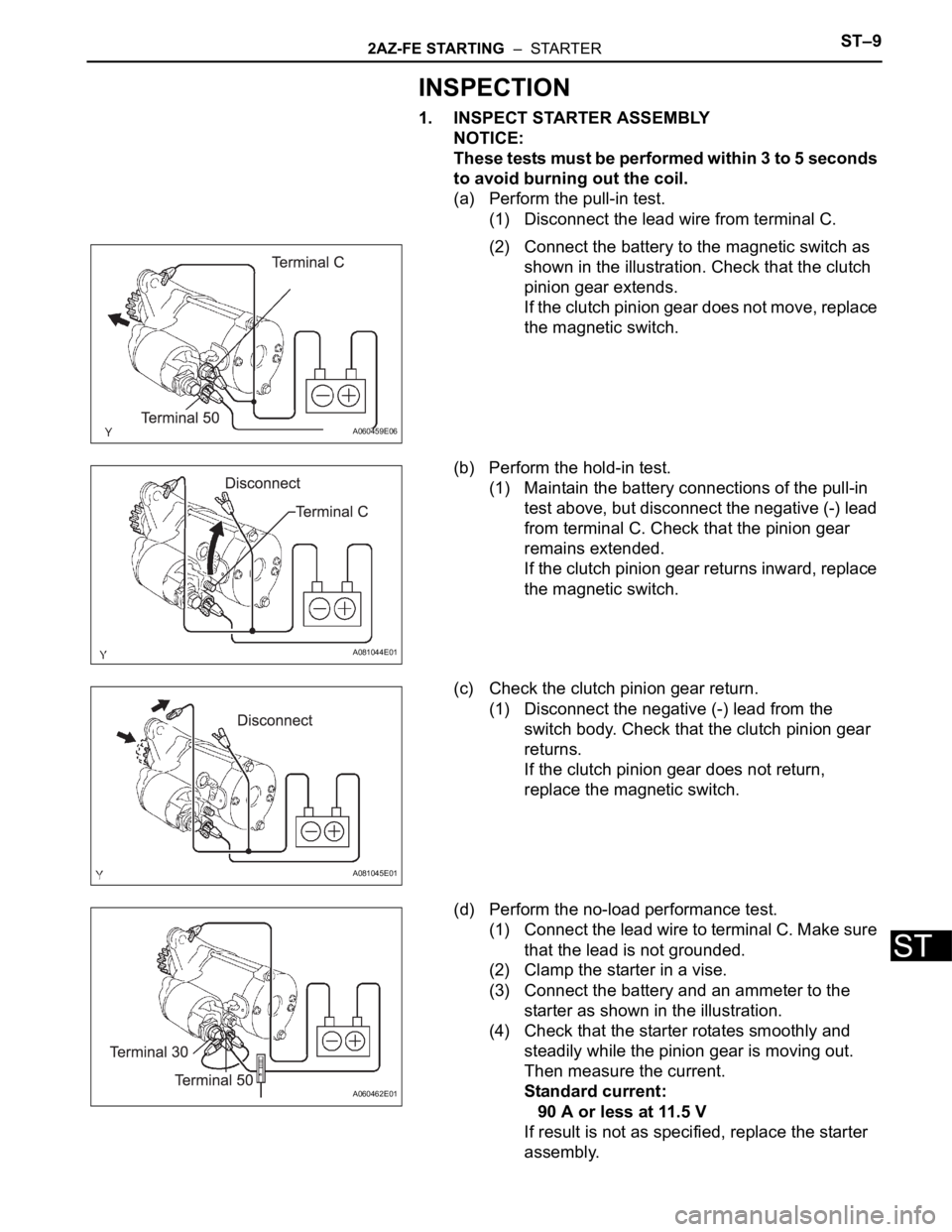
(a) Perform the pull-in test.
(1) Disconnect the lead wire from terminal C.
(2) Connect the battery to the magnetic switch as
shown in the illustration. Check that the clutch
pinion gear extends.
If the clutch pinion gear does not move, replace
the magnetic switch.
(b) Perform the hold-in test.
(1) Maintain the battery connections of the pull-in
test above, but disconnect the negative (-) lead
from terminal C. Check that the pinion gear
remains extended.
If the clutch pinion gear returns inward, replace
the magnetic switch.
(c) Check the clutch pinion gear return.
(1) Disconnect the negative (-) lead from the
switch body. Check that the clutch pinion gear
returns.
If the clutch pinion gear does not return,
replace the magnetic switch.
(d) Perform the no-load performance test.
(1) Connect the lead wire to terminal C. Make sure
that the lead is not grounded.
(2) Clamp the starter in a vise.
(3) Connect the battery and an ammeter to the
starter as shown in the illustration.
(4) Check that the starter rotates smoothly and
steadily while the pinion gear is moving out.
Then measure the current.
Standard current:
90 A or less at 11.5 V
If result is not as specified, replace the starter
assembly.
A060459E06
A081044E01
A081045E01
A060462E01