current TOYOTA RAV4 2006 Service Workshop Manual
[x] Cancel search | Manufacturer: TOYOTA, Model Year: 2006, Model line: RAV4, Model: TOYOTA RAV4 2006Pages: 2000, PDF Size: 45.84 MB
Page 1704 of 2000
SUPPLEMENTAL RESTRAINT SYSTEM – AIRBAG SYSTEMRS–55
RS
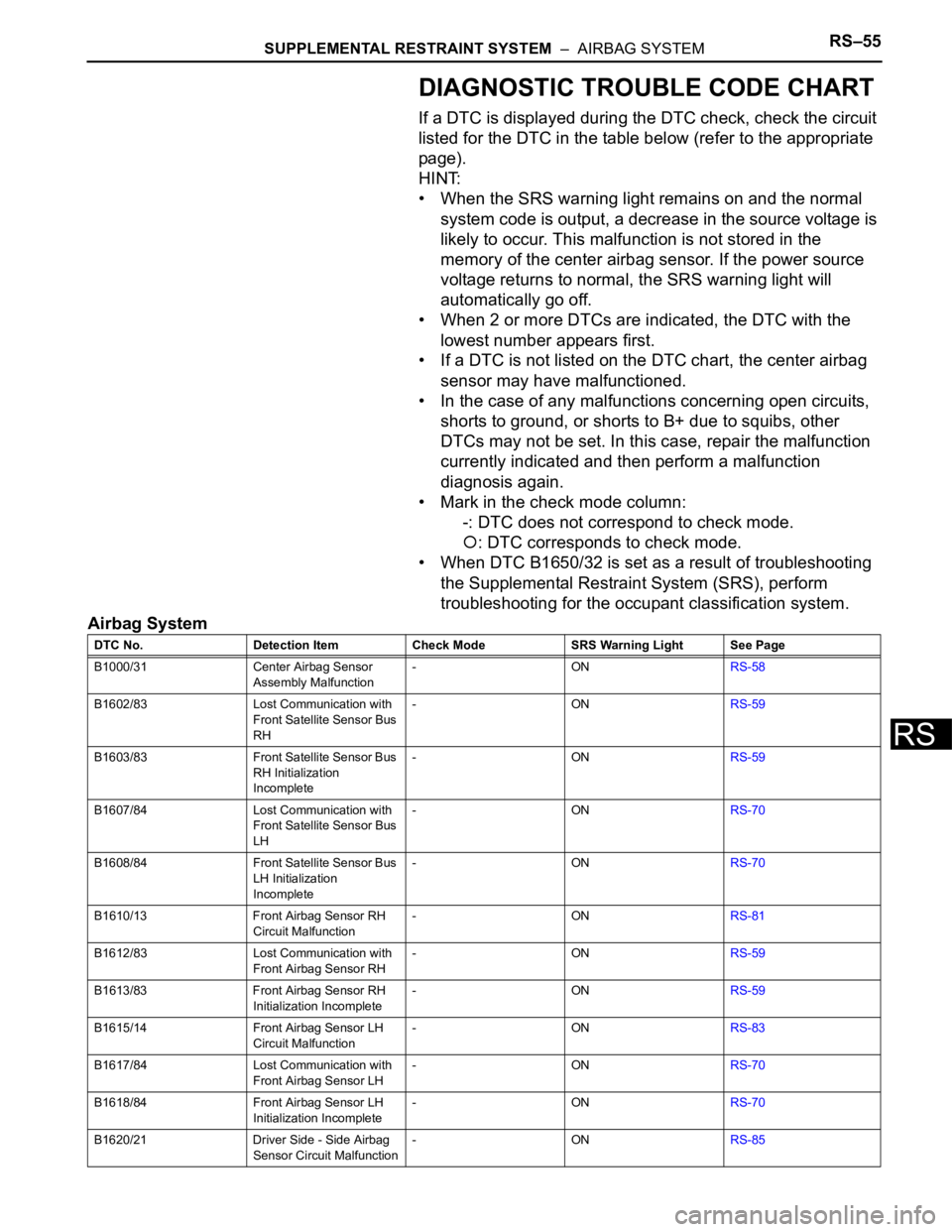
DIAGNOSTIC TROUBLE CODE CHART
If a DTC is displayed during the DTC check, check the circuit
listed for the DTC in the table below (refer to the appropriate
page).
HINT:
• When the SRS warning light remains on and the normal
system code is output, a decrease in the source voltage is
likely to occur. This malfunction is not stored in the
memory of the center airbag sensor. If the power source
voltage returns to normal, the SRS warning light will
automatically go off.
• When 2 or more DTCs are indicated, the DTC with the
lowest number appears first.
• If a DTC is not listed on the DTC chart, the center airbag
sensor may have malfunctioned.
• In the case of any malfunctions concerning open circuits,
shorts to ground, or shorts to B+ due to squibs, other
DTCs may not be set. In this case, repair the malfunction
currently indicated and then perform a malfunction
diagnosis again.
• Mark in the check mode column:
-: DTC does not correspond to check mode.
: DTC corresponds to check mode.
• When DTC B1650/32 is set as a result of troubleshooting
the Supplemental Restraint System (SRS), perform
troubleshooting for the occupant classification system.
Airbag System
DTC No. Detection Item Check Mode SRS Warning Light See Page
B1000/31 Center Airbag Sensor
Assembly Malfunction-ONRS-58
B1602/83 Lost Communication with
Front Satellite Sensor Bus
RH-ONRS-59
B1603/83 Front Satellite Sensor Bus
RH Initialization
Incomplete-ONRS-59
B1607/84 Lost Communication with
Front Satellite Sensor Bus
LH-ONRS-70
B1608/84 Front Satellite Sensor Bus
LH Initialization
Incomplete-ONRS-70
B1610/13 Front Airbag Sensor RH
Circuit Malfunction-ONRS-81
B1612/83 Lost Communication with
Front Airbag Sensor RH-ONRS-59
B1613/83 Front Airbag Sensor RH
Initialization Incomplete-ONRS-59
B1615/14 Front Airbag Sensor LH
Circuit Malfunction-ONRS-83
B1617/84 Lost Communication with
Front Airbag Sensor LH-ONRS-70
B1618/84 Front Airbag Sensor LH
Initialization Incomplete-ONRS-70
B1620/21 Driver Side - Side Airbag
Sensor Circuit Malfunction-ONRS-85
Page 1791 of 2000
EI–20ENGINE IMMOBILISER – ENGINE IMMOBILISER SYSTEM
EI
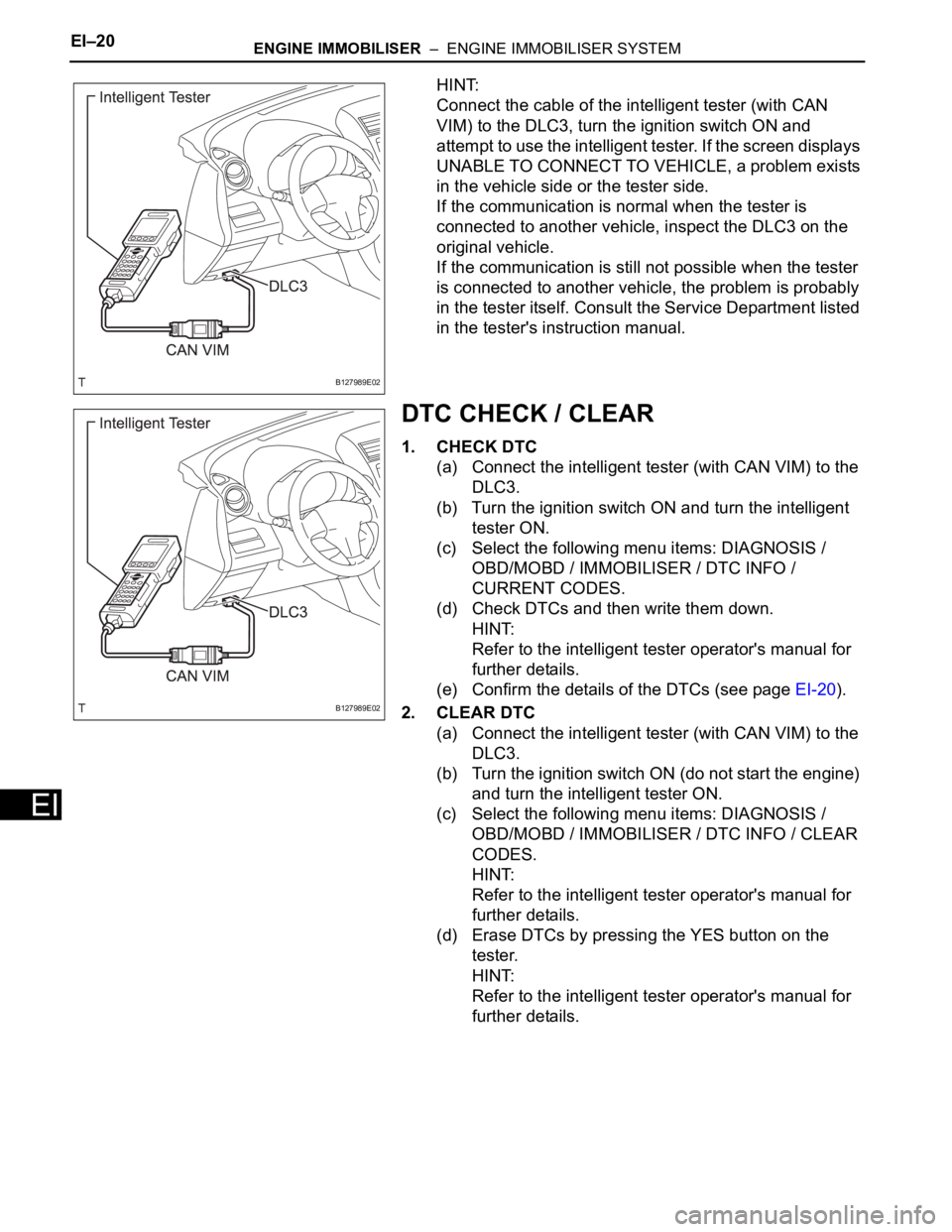
HINT:
Connect the cable of the intelligent tester (with CAN
VIM) to the DLC3, turn the ignition switch ON and
attempt to use the intelligent tester. If the screen displays
UNABLE TO CONNECT TO VEHICLE, a problem exists
in the vehicle side or the tester side.
If the communication is normal when the tester is
connected to another vehicle, inspect the DLC3 on the
original vehicle.
If the communication is still not possible when the tester
is connected to another vehicle, the problem is probably
in the tester itself. Consult the Service Department listed
in the tester's instruction manual.
DTC CHECK / CLEAR
1. CHECK DTC
(a) Connect the intelligent tester (with CAN VIM) to the
DLC3.
(b) Turn the ignition switch ON and turn the intelligent
tester ON.
(c) Select the following menu items: DIAGNOSIS /
OBD/MOBD / IMMOBILISER / DTC INFO /
CURRENT CODES.
(d) Check DTCs and then write them down.
HINT:
Refer to the intelligent tester operator's manual for
further details.
(e) Confirm the details of the DTCs (see page EI-20).
2. CLEAR DTC
(a) Connect the intelligent tester (with CAN VIM) to the
DLC3.
(b) Turn the ignition switch ON (do not start the engine)
and turn the intelligent tester ON.
(c) Select the following menu items: DIAGNOSIS /
OBD/MOBD / IMMOBILISER / DTC INFO / CLEAR
CODES.
HINT:
Refer to the intelligent tester operator's manual for
further details.
(d) Erase DTCs by pressing the YES button on the
tester.
HINT:
Refer to the intelligent tester operator's manual for
further details.
B127989E02
B127989E02
Page 1845 of 2000

LI–14LIGHTING – LIGHTING SYSTEM
LI
CUSTOMIZE PARAMETERS
HINT:
The following items can be customized.
NOTICE:
• When the customer requests a change in a function,
first make sure that the function can be customized.
• Be sure to make a note of the current settings before
customizing.
• When troubleshooting a function, first make sure that
the function is set to the default setting.
Illuminated entry
Light control (USA)
HINT:
Sensitivity adjustments are difficult to confirm. Check by
driving the customer's vehicle.
Display (Item) Default Contents Setting
LIGHTING TIME
(Lighting Time)15 secondsChanges illumination duration
after door closure.
(It will quickly fade out in case of
turning ignition switch ON.)7.5/15/30 (seconds)
I/L ON /ACC OFF
(Room light illuminates when
ignition switch turned OFF)ONIlluminates light when ignition
switch turned to ACC.
(Room light illuminated when
interior light switch in DOOR
position)ON/OFF
I/L ON / UNLOCK
(Room light illuminates when
door key unlocked.)ONFunction to light up room light
when unlocking with door key
cylinder.
(Room light illuminated when
interior light switch in DOOR
position)ON/OFF
LIGHT CONTROL ONFunction to light up foot light
when ignition switch is ON and
shift position is not P.ON/OFF
Display (Item) Default Contents Setting
DRL FUNCTION ONDaytime running light function ON
or OFF.ON/OFF
Page 1857 of 2000
LI–26LIGHTING – LIGHTING SYSTEM
LI
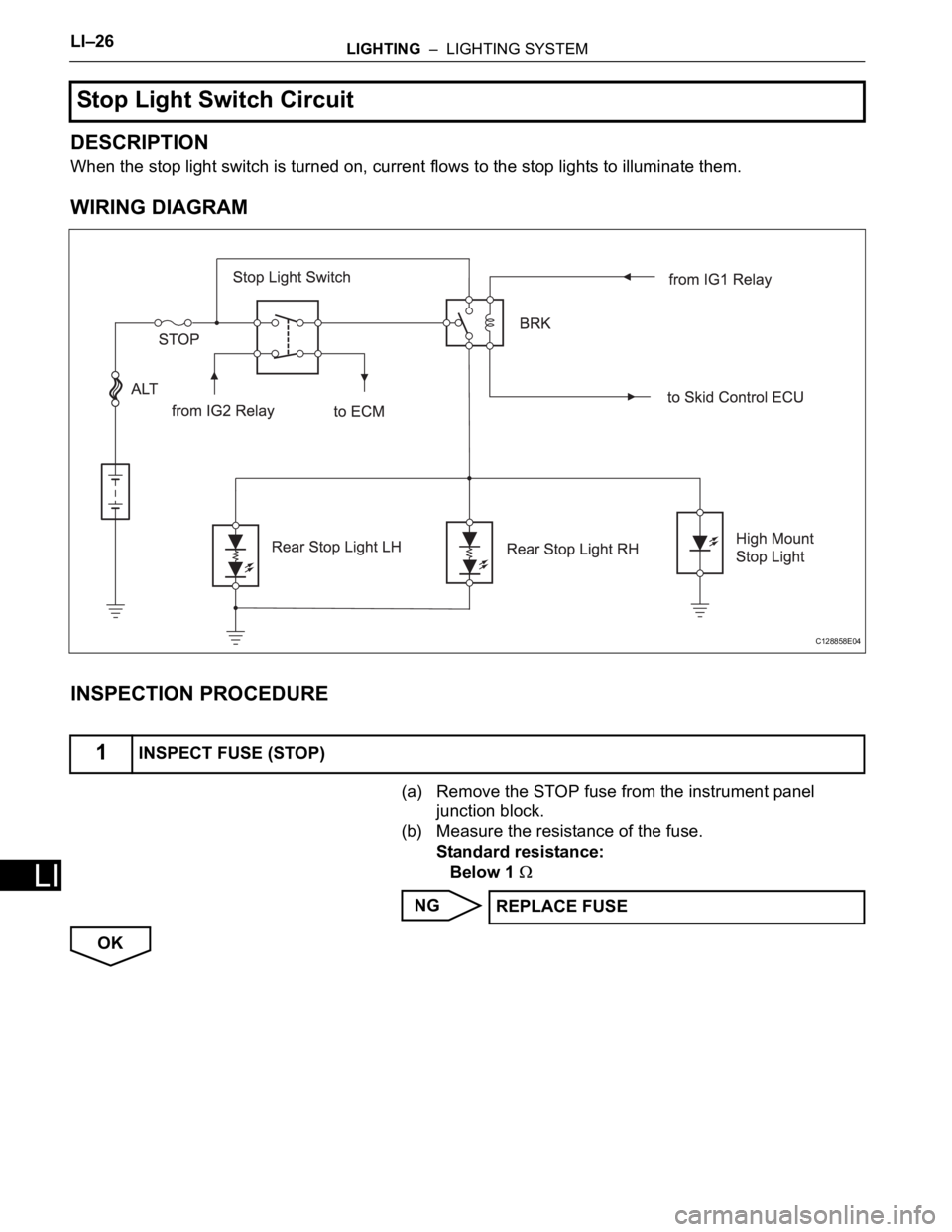
DESCRIPTION
When the stop light switch is turned on, current flows to the stop lights to illuminate them.
WIRING DIAGRAM
INSPECTION PROCEDURE
(a) Remove the STOP fuse from the instrument panel
junction block.
(b) Measure the resistance of the fuse.
Standard resistance:
Below 1
NG
OK
Stop Light Switch Circuit
1INSPECT FUSE (STOP)
C128858E04
REPLACE FUSE
Page 1904 of 2000

DL–8DOOR LOCK – POWER DOOR LOCK CONTROL SYSTEM
DL
CUSTOMIZE PARAMETERS
1. CUSTOMIZING FUNCTION WITH INTELLIGENT
TESTER (REFERENCE)
HINT:
The following item can be customized.
NOTICE:
• When the customer requests a change in a
function, first make sure that the function can be
customized.
• Make a note of the current settings before
customizing.
• When troubleshooting a function, first make sure
that the function is set to the default setting.
Power door lock control system:
Display (Item) Default Function Setting
UNLK/KEY TWICE ON Unlocks only driver side door
when driver side door key
cylinder turned to unlock once,
and unlocks all doors when
turned to unlock twice. For OFF
setting, turning it once unlocks all
doors.ON/OFF
Page 1934 of 2000

ES–462AZ-FE ENGINE CONTROL SYSTEM – SFI SYSTEM
ES
FAIL-SAFE CHART
If any of the following DTCs are set, the ECM enters fail-safe
mode to allow the vehicle to be driven temporarily.
HINT:
*: The vehicle can be driven slowly when the accelerator
pedal is depressed firmly and slowly. If the accelerator pedal
is depressed quickly, the vehicle may speed up and slow
down erratically.
DTCs Components Fail-Safe OperationsFail-Safe Deactivation
Conditions
P0031 and P0032Air-Fuel Ratio (A/F) Sensor
HeaterECM turns off A/F sensor heater. Ignition switch OFF
P0037 and P0038Heated Oxygen (HO2) Sensor
HeaterECM turns off HO2 sensor heater. Ignition switch OFF
P0100, P0102 and P0103 Mass Air Flow (MAF) MeterECM calculates ignition timing
according to engine speed and
throttle valve position.Pass condition detected
P0110, P0112 and P0113Intake Air Temperature (IAT)
SensorECM estimates IAT to be 20
C
(68
F).Pass condition detected
P0115, P0117 and P0118Engine Coolant Temperature
(ECT) SensorECM estimates ECT to be 80
C
(176
F).Pass condition detected
P0120, P0121, P0122, P0123,
P0220, P0222, P0223, P0604,
P0606, P0607, P0657, P2102,
P2103, P2111, P2112, P2118,
P2119 and P2135Electronic Throttle Control
System (ETCS)ECM cuts off throttle actuator
current and throttle valve returned
to 6
throttle position by return
spring.
ECM then adjusts engine output
by controlling fuel injection
(intermittent fuel-cut) and ignition
timing in accordance with
accelerator pedal opening angle
to allow vehicle to continue at
minimal speed*.Pass condition detected and then
ignition switch turned OFF
P0327 and P0328 Knock SensorECM sets ignition timing to
maximum retard.Ignition switch OFF
P0351 to P0354 Igniter ECM cuts fuel. Pass condition detected
P1550, P1551, P1552 and P1602 Generator Alternator command is fixed. Pass condition detected
P2120, P2121, P2122, P2123,
P2125, P2127, P2128 and P2138Accelerator Pedal Position (APP)
SensorAPP sensor has 2 sensor circuits:
Main and Sub.
If either circuit malfunctions, ECM
controls engine using other
circuit.
If both circuits malfunction, ECM
regards accelerator pedal as
being released. As result, throttle
valve closed and engine idles.Pass condition detected and then
ignition switch turned OFF
Page 1936 of 2000

ES–482AZ-FE ENGINE CONTROL SYSTEM – SFI SYSTEM
ES
PURGE DENSITY Learning value of purge density:
Min.: -50, Max.: 350-40 to 10: Idling -
EVAP PURGE FLOWRatio of evaporative purge flow to
intake air volume:
Min.: 0 %, Max.: 102.4 %0 to 10 %: Idling -
EVAP PURGE VSVEVAP (PURGE) VSV control duty:
Min.: 0 %, Max.: 100 %10 to 50 %: Idling Order signal from ECM
VAPOR PRES PUMPVapor pressure:
Min.: 33.853 kPa, Max.: 125.596
kPaApproximately 100 kPa: Ignition
switch ONEVAP system pressure monitored
by canister pressure sensor
VAPOR PRES CALCVapor pressure (calculated):
Min.: -5.632 kPa, Max.: 715.264
kPaApproximately 100 kPa: Ignition
switch ONEVAP system pressure monitored
by canister pressure sensor
KNOCK CRRT VALKnock correction learning value:
Min: -64
CA, Max.: 1,984CA0 to 20
CA: Driving at 70 km/h
(44 mph)Service data
KNOCK FB VALKnock feedback value:
Min: -64
CA, Max.: 1,984CA-20 to 0
CA: Driving at 70 km/h
(44 mph)Service data
CLUTCHClutch current:
Min.: 0 A, Max.: 2.49 A--
EVAP VAPOR PRESEVAP vapor pressure:
Min.: 0 kPa, Max.: 327.675 kPaApproximately 100 kPa: Ignition
switch ONEVAP system pressure monitored
by canister pressure sensor
ACCEL POS #1Absolute Accelerator Pedal
Position (APP) No. 1:
Min.: 0 %, Max.: 100 %10 to 22 %: Accelerator pedal
released
52 to 90 %: Accelerator pedal
fully depressedRead value with ignition switch ON
(Do not start engine)
ACCEL POS #2Absolute APP No. 2:
Min.: 0 %, Max.: 100 %24 to 40 %: Accelerator pedal
released
68 to 100 %: Accelerator pedal
fully depressedRead value with ignition switch ON
(Do not start engine)
ACCEL POS #1APP sensor No. 1 voltage:
Min.: 0 V, Max.: 4.98 V- ETCS freeze data
ACCEL POS #2APP sensor No. 2 voltage:
Min.: 0 V, Max.: 4.98 V- ETCS freeze data
ACCEL POS #1APP sensor No. 1 voltage:
Min.: 0 V, Max.: 5 V0.5 to 1.1 V: Accelerator pedal
released
2.6 to 4.5 V: Accelerator pedal
fully depressedRead value with ignition switch ON
(Do not start engine)
ACCEL POS #2APP sensor No. 2 voltage:
Min.: 0 V, Max.: 5 V1.2 to 2.0 V: Accelerator pedal
released
3.4 to 5.0 V: Accelerator pedal
fully depressedRead value with ignition switch ON
(Do not start engine)
ACCEL IDL POSWhether or not accelerator pedal
position sensor detecting idle:
ON or OFFON: Idling -
THRTL LEARN VALThrottle valve fully closed
(learned value):
Min.: 0 V, Max.: 5 V0.4 to 0.8 V -
ACCEL SSR #1 ADAPP sensor No. 1 voltage (AD):
Min.: 0 V, Max.: 4.98 V-ETCS service data
ACCEL LRN VAL#1 Accelerator fully closed learning
value No. 1:
Min.: 0 deg, Max.: 124.512 deg-ETCS service data
ACCEL LRN VAL#2Accelerator fully closed learning
value No. 2:
Min.: 0 deg, Max.: 124.512 deg-ETCS service data
FAIL #1 Whether or not fail safe function
executed:
ON or OFFON: ETCS has failed -
FAIL #2 Whether or not fail safe function
executed:
ON or OFFON: ETCS has failed - Intelligent Tester Display Measurement: Range (Display) Normal Condition*1 Diagnostic Note
Page 1937 of 2000

2AZ-FE ENGINE CONTROL SYSTEM – SFI SYSTEMES–49
ES
ST1Brake pedal signal:
ON or OFFON: Brake pedal depressed -
SYS GUARD JUDGESystem guard:
ON or OFF-ETCS service data
OPN MALFUNCTIONOpen side malfunction:
ON or OFF-ETCS service data
THROTTLE POSThrottle position sensor:
Min.: 0%, Max.: 100 %• 10 to 22 %: Throttle fully
closed
• 66 to 98 %: Throttle fully
open• Calculated value based on
VTA1
• Read value with ignition switch
ON (Do not start engine)
THROTTL IDL POSWhether or not throttle position
sensor detecting idle:
ON or OFFON: Idling -
THRTL REQ POSThrottle requirement position:
Min.: 0 V, Max.: 5 V0.5 to 1.0 V: Idling -
THROTTLE POSThrottle position:
Min.: 0 %, Max.: 100 %• 0 %: Throttle fully closed
• 50 to 80 %: Throttle fully
open• Recognition value for throttle
opening angle on ECM
• Read value with ignition switch
ON (Do not start engine)
THROTTLE POS #2Throttle position No. 2 sensor:
Min.: 0 %, Max.: 100 %• 42 to 62 %: Throttle fully
closed
• 92 to 100 %: Throttle fully
open• Calculated value based on
VTA2
• Read value with ignition switch
ON (Do not start engine)
THROTTLE POS #1Throttle position sensor No. 1
output voltage:
Min.: 0 V, Max.: 4.98 V- ETCS freeze data
THROTTLE POS #2Throttle position sensor No. 2
output voltage:
Min.: 0 V, Max.: 4.98 V- ETCS freeze data
THROTTLE POS #1Throttle position sensor No. 1
output voltage:
Min.: 0 V, Max.: 5 V• 0.5 to 1.1 V: Throttle fully
closed
• 3.3 to 4.9 V: Throttle fully
openRead value with ignition switch ON
(Do not start engine)
THROTTLE POS #2Throttle position sensor No. 2
output voltage:
Min.: 0 V, Max.: 5 V• 2.1 to 3.1 V: Throttle fully
closed
• 4.6 to 5.0 V: Throttle fully
openRead value with ignition switch ON
(Do not start engine)
THRTL COMND VALThrottle position command value:
Min.: 0 V, Max.: 4.9804 V0.5 to 4.9 VRead value with ignition switch ON
(Do not start engine)
THROTTLE SSR #1Throttle sensor opener position
No. 1:
Min.: 0 V, Max.: 4.9804 V-ETCS service data
THROTTLE SSR #2Throttle sensor opener position
No. 2:
Min.: 0 V, Max.: 4.9804 V-ETCS service data
THRTL SSR #1 ADThrottle position sensor No. 1
output voltage (AD):
Min.: 0 V, Max.: 4.9804 V0.5 to 4.9 VRead value with ignition switch ON
(Do not start engine)
THROTTLE MOTWhether or not throttle actuator
control permitted:
ON or OFFON: IdlingRead value with ignition switch ON
(Do not start engine)
THROTTLE MOTThrottle actuator current:
Min.: 0 A, Max.: 80 A0 to 3.0 A: Idling -
THROTTLE MOTThrottle actuator:
Min.: 0 %, Max.: 100 %0.5 to 40 %: Idling -
THROTTLE MOT Throttle actuator current:
Min.: 0 A, Max.: 19.92 A0 to 3.0 A: Idling - Intelligent Tester Display Measurement: Range (Display) Normal Condition*1 Diagnostic Note
Page 1938 of 2000

ES–502AZ-FE ENGINE CONTROL SYSTEM – SFI SYSTEM
ES
THROTL OPN DUTYThrottle actuator opening duty
ratio:
Min.: 0 %, Max.: 100 %0 to 40 %: During idling• When accelerator pedal
depressed, duty ratio
increased
• Read value with ignition switch
ON (Do not start engine)
THROTL CLS DUTYThrottle actuator closed duty ratio:
Min.: 0 %, Max.: 100 %0 to 40 %: During idling• When accelerator pedal
released quickly, duty ratio
increased
• Read value with ignition switch
ON (Do not start engine)
THRTL MOT (OPN)Throttle actuator duty ratio (open):
Min.: 0 %, Max.: 100 %0 to 40 %: During idling ETCS service data
THRTL MOT (CLS)Throttle actuator duty ratio
(closed):
Min.: 0 %, Max.: 100 %0 to 40 %: During idling ETCS service data
O2S B1 S2Heated oxygen sensor output
voltage for sensor 2:
Min.: 0 V Max.: 1.275 V0.1 to 0.9 V: Driving at 70 km/h
(44 mph)Performing INJ VOL or A/F
CONTROL function of ACTIVE
TEST enables technician to check
output voltage of sensor
AFS B1 S1A/F sensor output voltage for
sensor 1:
Min.: 0 V Max.: 7.999 V2.8 to 3.8 V: IdlingPerforming INJ VOL or A/F
CONTROL function of ACTIVE
TEST enables technician to check
output voltage of sensor
TOTAL FT #1Total fuel trim value for fuel
system:
Min.: -0.5, Max.: 0.496-0.2 to 0.2 -
SHORT FT #1Short-term fuel trim:
Min.: -100 %, Max.: 99.2 %-20 to 20 %Short-term fuel compensation
used to maintain air-fuel ratio at
stoichiometric air-fuel ratio
LONG FT #1Long-term fuel trim:
Min.: -100 %, Max.: 99.2 %-20 to 20 %Overall fuel compensation carried
out in long-term to compensate
continual deviation of short-term
fuel trim from central value
FUEL SYS #1Fuel system status:
OL or CL or OL DRIVE or OL
FAULT or CL FAULTCL: Idling after warming up• OL (Open Loop): Has not yet
satisfied conditions to go
closed loop
• CL (Closed Loop): Using A/F
sensor as feedback for fuel
control
• OL DRIVE: Open loop due to
driving conditions (fuel
enrichment)
• OL FAULT: Open loop due to
detected system fault
• CL FAULT: Closed loop but A/
F sensor, which used for fuel
control malfunctioning
O2FT B1 S2Short-term fuel trim associated
with sensor 2:
Min.: -100 %, Max.: 99.2 %--
AF FT B1 S1Short-term fuel trim associated
with sensor 1:
Min.: 0, Max.: 1.999• Value less than 1 (0.000 to
0.999) =Lean
• Stoichiometric air-fuel
ratio=1
• Value greater than 1 (1.001
to 1.999) = Rich-
AFS B1 S1A/F sensor current:
Min.: -128 mA, Max.: 127.99 mA--
CAT TEMP B1S1Estimated catalyst temperature
(sensor 1):
Min.: -40
C, Max.: 6,513.5C-- Intelligent Tester Display Measurement: Range (Display) Normal Condition*1 Diagnostic Note
Page 1939 of 2000

2AZ-FE ENGINE CONTROL SYSTEM – SFI SYSTEMES–51
ES
CAT TEMP B1S2Estimated catalyst temperature
(sensor 2):
Min.: -40C, Max.: 6,513.5C--
S O2S B1S2Sub heated oxygen sensor
impedance (sensor2):
Min.: 0
, Max.: 21247.68
--
INI COOL TEMPEngine coolant temperature at
engine start:
Min.: -40
C, Max.: 120CClose to ambient air
temperature-
INI INTAKE TEMPIntake air temperature at engine
start:
Min.: -40
C, Max.: 120CClose to ambient air
temperature-
INJ VOLInjection volume (Cylinder 1):
Min.: 0 ml, Max.: 2.048 ml0 to 0.15 ml: IdlingQuantity of fuel injection volume
for 10 times
STARTER SIGStarter switch (STSW) signal:
ON or OFFON: Cranking -
PS SWPower steering signal:
ON or OFFON: Power steering operation -
PS SIGNALPower steering signal (history):
ON or OFFON: When steering wheel first
turned after battery terminals
connectedSignal status usually ON until
battery terminals disconnected
CTP SWClosed throttle position switch:
ON or OFF• ON: Throttle fully closed
• OFF: Throttle open-
A/C SIGNALA/C signal:
ON or OFFON: A/C ON -
PNP SW [NSW]PNP switch status:
ON or OFFON: P or N position -
ELECT LOAD SIGElectrical load signal:
ON or OFFON: Headlights or defogger
turned ON-
STOP LIGHT SWStop light switch:
ON or OFFON: Brake pedal depressed -
+BMWhether or not electric throttle
control system power inputted:
ON or OFFON: Ignition switch ON and
system normal-
+BM VOLTAGE+BM voltage:
Min.: 0, Max.: 19.9229 to 14 (V): Ignition switch ON
and system normalETCS service data
BATTERY VOLTAGEBattery voltage:
Min.: 0 V, Max.: 65.535 V9 to 14 V: Ignition switch ON -
ACTUATOR POWERActuator power supply:
ON or OFFON: Idling ETCS service data
ATM PRESSUREAtmospheric pressure:
Min.: 0 kPa, Max.: 255 kPaApproximately 100 kPa: Ignition
switch ON-
BATTERY CURRENTBattery current:
Min.: -100 A, Max.: 100 A--
BATTERY TEMPBattery temperature:
Min.: -45
C, Max.: 156.4 F--
ALT OUTPUT DUTYGenerator output duty ratio:
Min.: 0 %, Max.: 100 %- During charge control
ALT V NORMALRequest voltage when regulator
not under forced activation:
Min.: 0 V, Max.: 20 VBattery electrolyte temperature
varies (12.5 to 14.8 V) while
driving:
After engine startAlternator regulator output voltage
is out put
When performing Active Test,
value is 0V
ALT V TSTRequest voltage when regulator
under forced activation:
Min.: 0 V, Max.: 20 VRequest instruction voltage
value:
After engine startCharging control service data
When not performing Active Test,
value is 0V
EVAP (Purge) VSVPurge VSV status:
ON or OFF--
FUEL PUMP / SPDFuel pump status:
ON or OFFON: Engine running Active Test support data Intelligent Tester Display Measurement: Range (Display) Normal Condition*1 Diagnostic Note