current TOYOTA RAV4 2006 Service Manual PDF
[x] Cancel search | Manufacturer: TOYOTA, Model Year: 2006, Model line: RAV4, Model: TOYOTA RAV4 2006Pages: 2000, PDF Size: 45.84 MB
Page 1953 of 2000
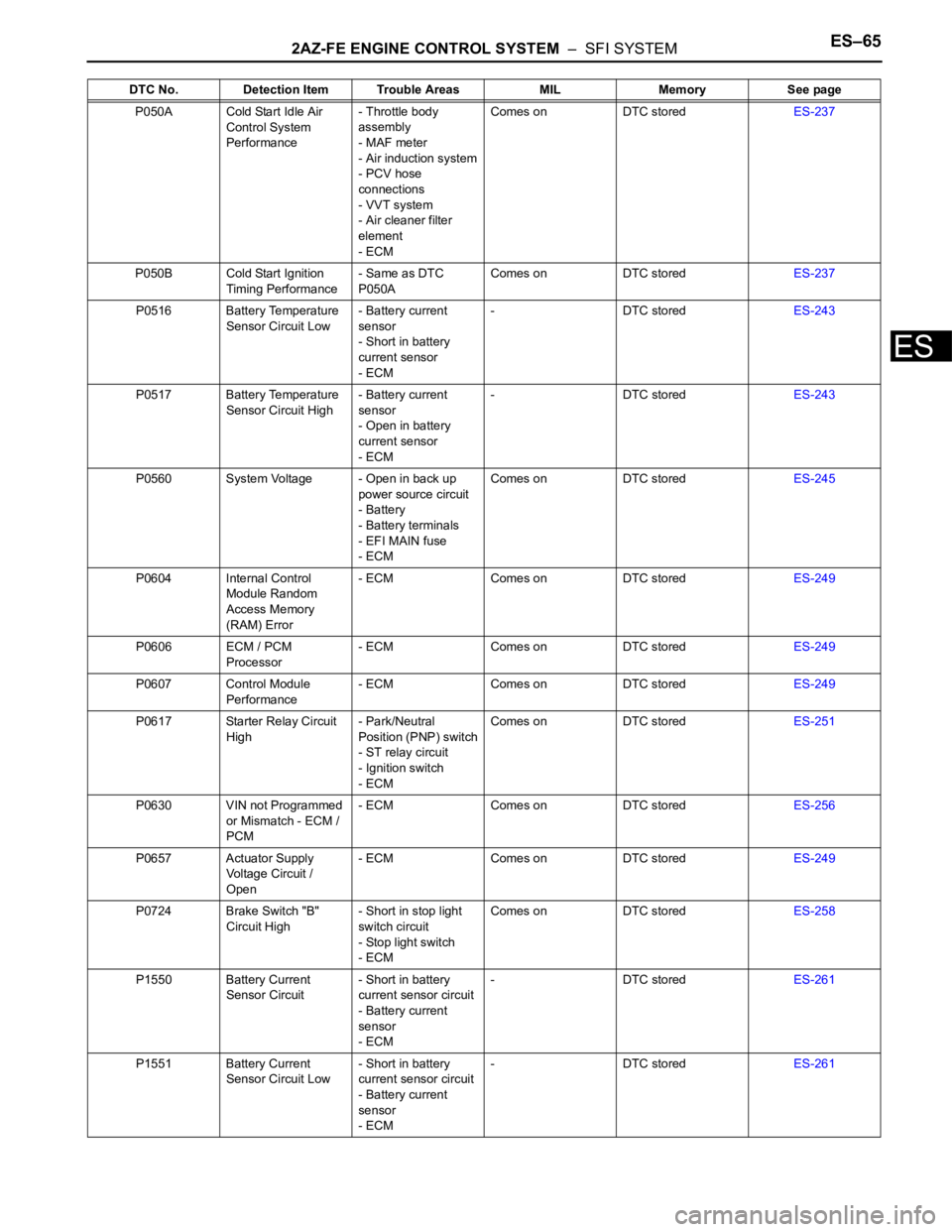
2AZ-FE ENGINE CONTROL SYSTEM – SFI SYSTEMES–65
ES
P050A Cold Start Idle Air
Control System
Performance- Throttle body
assembly
- MAF meter
- Air induction system
- PCV hose
connections
- VVT system
- Air cleaner filter
element
- ECMComes on DTC storedES-237
P050B Cold Start Ignition
Timing Performance- Same as DTC
P050AComes on DTC storedES-237
P0516 Battery Temperature
Sensor Circuit Low- Battery current
sensor
- Short in battery
current sensor
- ECM- DTC storedES-243
P0517 Battery Temperature
Sensor Circuit High- Battery current
sensor
- Open in battery
current sensor
- ECM- DTC storedES-243
P0560 System Voltage - Open in back up
power source circuit
- Battery
- Battery terminals
- EFI MAIN fuse
- ECMComes on DTC storedES-245
P0604 Internal Control
Module Random
Access Memory
(RAM) Error- ECM Comes on DTC storedES-249
P0606 ECM / PCM
Processor- ECM Comes on DTC storedES-249
P0607 Control Module
Performance- ECM Comes on DTC storedES-249
P0617 Starter Relay Circuit
High- Park/Neutral
Position (PNP) switch
- ST relay circuit
- Ignition switch
- ECMComes on DTC storedES-251
P0630 VIN not Programmed
or Mismatch - ECM /
PCM- ECM Comes on DTC storedES-256
P0657 Actuator Supply
Voltage Circuit /
Open- ECM Comes on DTC storedES-249
P0724 Brake Switch "B"
Circuit High- Short in stop light
switch circuit
- Stop light switch
- ECMComes on DTC storedES-258
P1550 Battery Current
Sensor Circuit- Short in battery
current sensor circuit
- Battery current
sensor
- ECM- DTC storedES-261
P1551 Battery Current
Sensor Circuit Low- Short in battery
current sensor circuit
- Battery current
sensor
- ECM- DTC storedES-261 DTC No. Detection Item Trouble Areas MIL Memory See page
Page 1954 of 2000
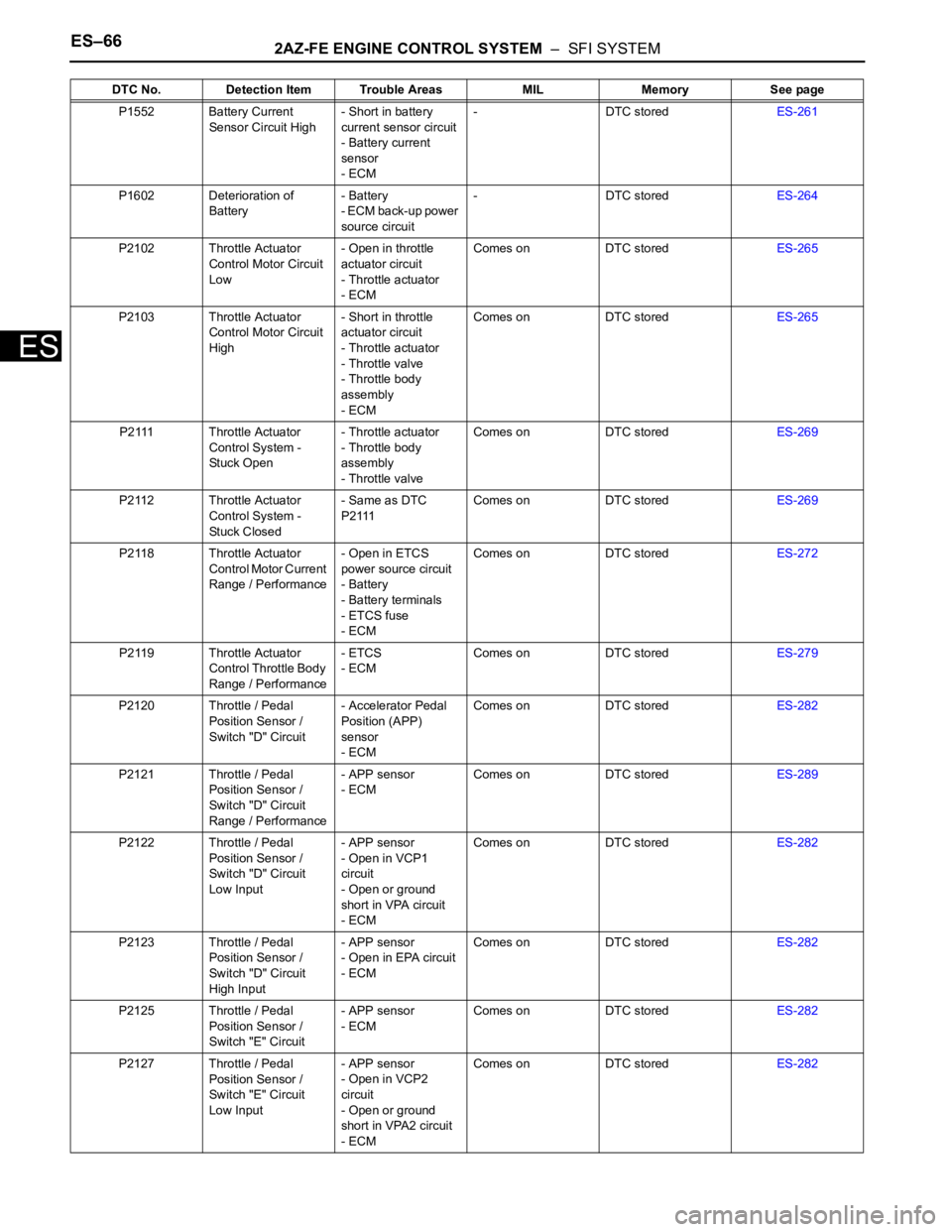
ES–662AZ-FE ENGINE CONTROL SYSTEM – SFI SYSTEM
ES
P1552 Battery Current
Sensor Circuit High- Short in battery
current sensor circuit
- Battery current
sensor
- ECM- DTC storedES-261
P1602 Deterioration of
Battery- Battery
- ECM back-up power
source circuit- DTC storedES-264
P2102 Throttle Actuator
Control Motor Circuit
Low- Open in throttle
actuator circuit
- Throttle actuator
- ECMComes on DTC storedES-265
P2103 Throttle Actuator
Control Motor Circuit
High- Short in throttle
actuator circuit
- Throttle actuator
- Throttle valve
- Throttle body
assembly
- ECMComes on DTC storedES-265
P2111 Throttle Actuator
Control System -
Stuck Open- Throttle actuator
- Throttle body
assembly
- Throttle valveComes on DTC storedES-269
P2112 Throttle Actuator
Control System -
Stuck Closed- Same as DTC
P2111Comes on DTC storedES-269
P2118 Throttle Actuator
Control Motor Current
Range / Performance- Open in ETCS
power source circuit
- Battery
- Battery terminals
- ETCS fuse
- ECMComes on DTC storedES-272
P2119 Throttle Actuator
Control Throttle Body
Range / Performance- ETCS
- ECMComes on DTC storedES-279
P2120 Throttle / Pedal
Position Sensor /
Switch "D" Circuit- Accelerator Pedal
Position (APP)
sensor
- ECMComes on DTC storedES-282
P2121 Throttle / Pedal
Position Sensor /
Switch "D" Circuit
Range / Performance- APP sensor
- ECMComes on DTC storedES-289
P2122 Throttle / Pedal
Position Sensor /
Switch "D" Circuit
Low Input- APP sensor
- Open in VCP1
circuit
- Open or ground
short in VPA circuit
- ECMComes on DTC storedES-282
P2123 Throttle / Pedal
Position Sensor /
Switch "D" Circuit
High Input- APP sensor
- Open in EPA circuit
- ECMComes on DTC storedES-282
P2125 Throttle / Pedal
Position Sensor /
Switch "E" Circuit- APP sensor
- ECMComes on DTC storedES-282
P2127 Throttle / Pedal
Position Sensor /
Switch "E" Circuit
Low Input- APP sensor
- Open in VCP2
circuit
- Open or ground
short in VPA2 circuit
- ECMComes on DTC storedES-282 DTC No. Detection Item Trouble Areas MIL Memory See page
Page 1955 of 2000
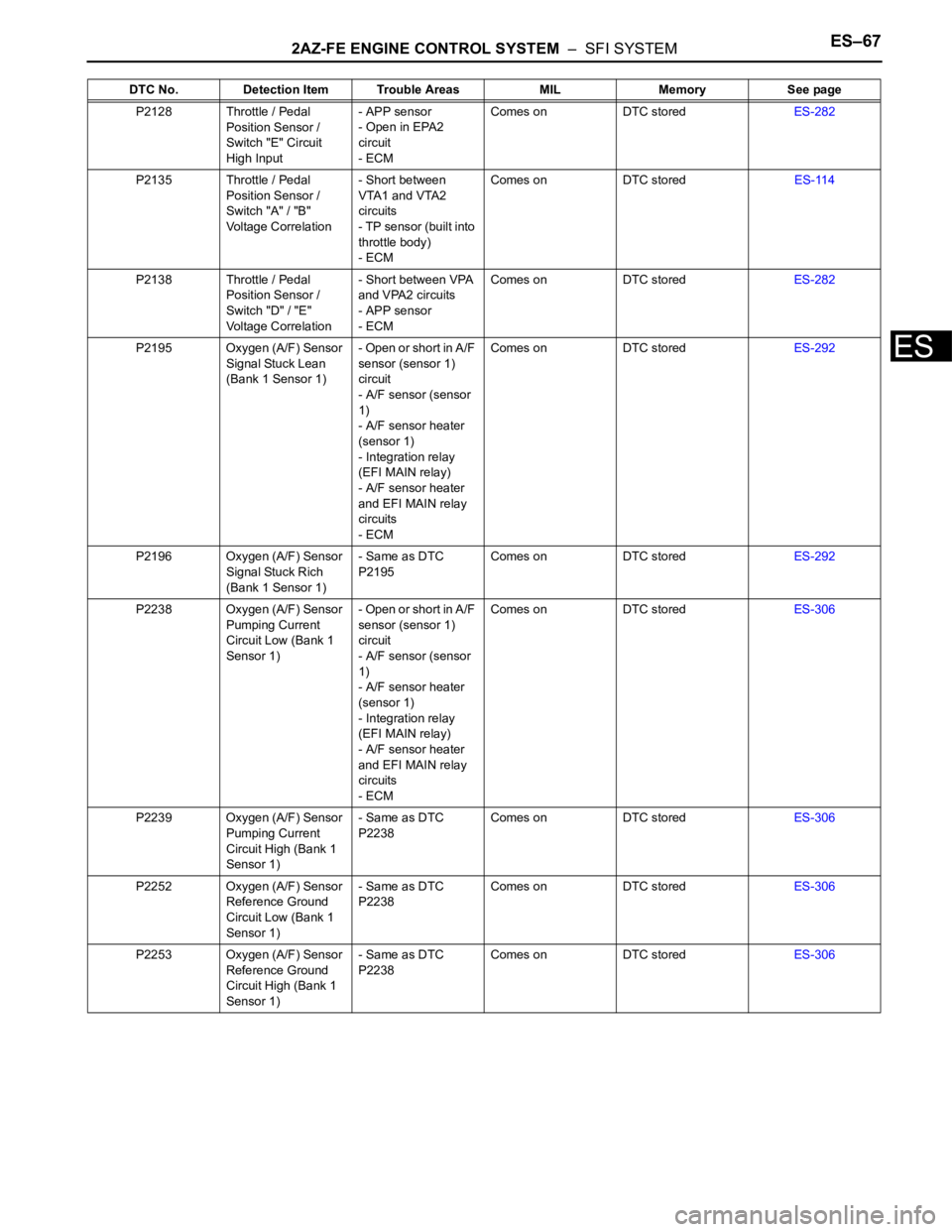
2AZ-FE ENGINE CONTROL SYSTEM – SFI SYSTEMES–67
ES
P2128 Throttle / Pedal
Position Sensor /
Switch "E" Circuit
High Input- APP sensor
- Open in EPA2
circuit
- ECMComes on DTC storedES-282
P2135 Throttle / Pedal
Position Sensor /
Switch "A" / "B"
Voltage Correlation- Short between
VTA1 and VTA2
circuits
- TP sensor (built into
throttle body)
- ECMComes on DTC storedES-114
P2138 Throttle / Pedal
Position Sensor /
Switch "D" / "E"
Voltage Correlation- Short between VPA
and VPA2 circuits
- APP sensor
- ECMComes on DTC storedES-282
P2195 Oxygen (A/F) Sensor
Signal Stuck Lean
(Bank 1 Sensor 1)- Open or short in A/F
sensor (sensor 1)
circuit
- A/F sensor (sensor
1)
- A/F sensor heater
(sensor 1)
- Integration relay
(EFI MAIN relay)
- A/F sensor heater
and EFI MAIN relay
circuits
- ECMComes on DTC storedES-292
P2196 Oxygen (A/F) Sensor
Signal Stuck Rich
(Bank 1 Sensor 1)- Same as DTC
P2195Comes on DTC storedES-292
P2238 Oxygen (A/F) Sensor
Pumping Current
Circuit Low (Bank 1
Sensor 1)- Open or short in A/F
sensor (sensor 1)
circuit
- A/F sensor (sensor
1)
- A/F sensor heater
(sensor 1)
- Integration relay
(EFI MAIN relay)
- A/F sensor heater
and EFI MAIN relay
circuits
- ECMComes on DTC storedES-306
P2239 Oxygen (A/F) Sensor
Pumping Current
Circuit High (Bank 1
Sensor 1)- Same as DTC
P2238Comes on DTC storedES-306
P2252 Oxygen (A/F) Sensor
Reference Ground
Circuit Low (Bank 1
Sensor 1)- Same as DTC
P2238Comes on DTC storedES-306
P2253 Oxygen (A/F) Sensor
Reference Ground
Circuit High (Bank 1
Sensor 1)- Same as DTC
P2238Comes on DTC storedES-306 DTC No. Detection Item Trouble Areas MIL Memory See page
Page 1958 of 2000

E S –702AZ-FE ENGINE CONTROL SYSTEM – SFI SYSTEM
ES
MONITOR DESCRIPTION
The ECM optimizes the valve timing using the VVT system to control the intake camshaft. The VVT
system includes the ECM, the OCV and the VVT controller. The ECM sends a target duty-cycle control
signal to the OCV. This control signal regulates the oil pressure supplied to the VVT controller. The VVT
controller can advance or retard the intake camshaft.
After the ECM sends the target duty-cycle control signal to the OCV, the ECM monitors the OCV current
to establish an actual duty-cycle. The ECM determines the existence of a malfunction and sets the DTC
when the actual duty-cycle ratio varies from the target duty-cycle ratio.
MONITOR STRATEGY
TYPICAL ENABLING CONDITIONS
TYPICAL MALFUNCTION THRESHOLDS
COMPONENT OPERATING RANGE
Related DTCs P0010: VVT OCV range check
Required Sensors/Components (Main) VVT OCV
Required Sensors/Components (Related) -
Frequency of Operation Continuous
Duration 1 second
MIL Operation Immediate
Sequence of Operation None
Monitor runs whenever following DTCs not present None
All of following conditions met -
Starter OFF
Ignition switch ON
Time after ignition switch OFF to ON 0.5 seconds or more
One of following conditions met -
A. All of following conditions met -
Battery voltage 11 to 13 V
Target duty ratio Less than 70 %
Output signal duty ratio 100 %
B. All of following conditions met -
Battery voltage 13 V or more
Target duty ratio Less than 80 %
Output signal duty ratio 100 %
C. Both of following conditions met -
Current cut status Not cut
Output signal duty ratio 3 % or less
VVT OCV duty ratio 3 to 100 %
Page 1962 of 2000

ES–742AZ-FE ENGINE CONTROL SYSTEM – SFI SYSTEM
ES
MONITOR DESCRIPTION
The ECM optimizes the intake valve timing using the VVT (Variable Valve Timing) system to control the
intake camshaft. The VVT system includes the ECM, the Oil Control Valve (OCV) and the VVT controller.
The ECM sends a target duty-cycle control signal to the OCV. This control signal regulates the oil
pressure supplied to the VVT controller. The VVT controller can advance or retard the intake camshaft.
If the difference between the target and actual intake valve timings is large, and changes in the actual
intake valve timing are small, the ECM interprets this as the VVT controller stuck malfunction and sets a
DTC.
Example:
A DTC is set when the following conditions 1, 2 and 3 are met:
1. The difference between the target and actual intake valve timing is more than 5
CA (Crankshaft
Angle) and the condition continues for more than 4.5 seconds.
2. It takes 5 seconds or more to change the valve timing by 5
CA.
3. After above conditions 1 and 2 are met, the OCV is forcibly activated 63 times or more.
DTC P0011 (Advanced Cam Timing) is subject to 1 trip detection logic.
DTC P0012 (Retarded Cam Timing) is subject to 2 trip detection logic.
These DTCs indicate that the VVT controller cannot operate properly due to OCV malfunctions or the
presence of foreign objects in the OCV.
The monitor will run if all of the following conditions are met:
– The engine is warm (the engine coolant temperature is 75
C [167F] or more).
– The vehicle has been driven at more than 64 km/h (40 mph) for 3 minutes.
– The engine has idled for 3 minutes.
MONITOR STRATEGY
DTC No. DTC Detection Conditions Trouble Areas
P0011Advanced camshaft timing:
With warm engine and engine speed of between 550 rpm and
4,000 rpm, all conditions (1), (2) and (3) met (1 trip detection
logic):
1. Difference between target and actual intake valve timings
more than 5
CA (Crankshaft Angle) for 4.5 seconds
2. Current intake valve timing fixed (timing changes less than
5
CA in 5 seconds)
3. Variations in VVT controller timing more than 19
CA of
maximum delayed timing (malfunction in advance timing)• Valve timing
•OCV
• OCV filter
• Camshaft timing gear assembly
•ECM
P0012Retarded camshaft timing:
With warm engine and engine speed of between 550 rpm and
4,000 rpm, all conditions (1), (2) and (3) met (2 trip detection
logic):
1. Difference between target and actual intake valve timings
more than 5
CA (Crankshaft Angle) for 4.5 seconds
2. Current intake valve timing fixed (timing changes less than
5
CA in 5 seconds)
3. Variations in VVT controller timing 19CA or less of
maximum delayed timing (malfunction in retarded timing)• Valve timing
•OCV
• OCV filter
• Camshaft timing gear assembly
•ECM
Related DTCsP0011: Advanced camshaft timing
P0012: Retarded camshaft timing
Required Sensors/Components (Main) VVT OCV and VVT Actuator
Required Sensors/Components (Related)Crankshaft position sensor, camshaft position sensor and Engine
coolant temperature sensor
Frequency of Operation Once per driving cycle
Duration Within 10 seconds
MIL OperationAdvanced camshaft timing: Immediate
Retarded camshaft timing: 2 driving cycles
Sequence of Operation None
Page 1963 of 2000

2AZ-FE ENGINE CONTROL SYSTEM – SFI SYSTEMES–75
ES
TYPICAL ENABLING CONDITIONS
TYPICAL MALFUNCTION THRESHOLDS
Advanced camshaft timing:
Retard camshaft timing:
If the difference between the target and actual camshaft timings is greater than the specified value, the
ECM operates the VVT actuator.
Then, the ECM monitors the camshaft timing change for 5 seconds.
WIRING DIAGRAM
Refer to DTC P0010 (see page ES-64).
INSPECTION PROCEDURE
NOTICE:
DTC P0011 or P0012 may be set when foreign objects in the engine oil are caught in some parts of
the system. The DTC will remain set even if the system returns to normal after a short time.
Foreign objects are filtered out by the oil filter.
HINT:
If DTC P0011 or P0012 is present, check the VVT (Variable Valve Timing) system.
Read freeze frame data using the intelligent tester. Freeze frame data records the engine condition when
malfunctions are detected. When troubleshooting, freeze frame data can help determine if the vehicle was
moving or stationary, if the engine was warmed up or not, if the air-fuel ratio was lean or rich, and other
data from the time the malfunction occurred.
(a) Connect the intelligent tester to the DLC3.
(b) Turn the ignition switch ON and turn the tester ON.
(c) Select the following menu items: DIAGNOSIS /
ENHANCED OBD II / DTC INFO / CURRENT CODES.
(d) Read DTCs.
Result
Monitor runs whenever following DTCs not presentP0100 - P0103 (MAF meter)
P0115 - P0118 (ECT sensor)
P0125 (Insufficient ECT for closed loop)
P0335 (CKP sensor)
P0340 (CMP sensor)
P0351 - P0354 (Igniter)
Battery voltage 11 V or more
Engine RPM 550 to 4,000 rpm
ECT 75
C (167F) to 100C (212F)
All of following conditions met -
Crank angle between reference position and actual intake camshaft
angle67
CA or more
Valve timing No change at advanced valve timing
All of following conditions met -
Crank angle between reference point and actual intake camshaft
angleLess than 67
CA
Valve timing No change at retarded valve timing
1CHECK ANY OTHER DTCS OUTPUT (IN ADDITION TO DTC P0011 OR P0012)
Display (DTC Output) Proceed To
Page 1969 of 2000
2AZ-FE ENGINE CONTROL SYSTEM – SFI SYSTEMES–81
ES
HINT:
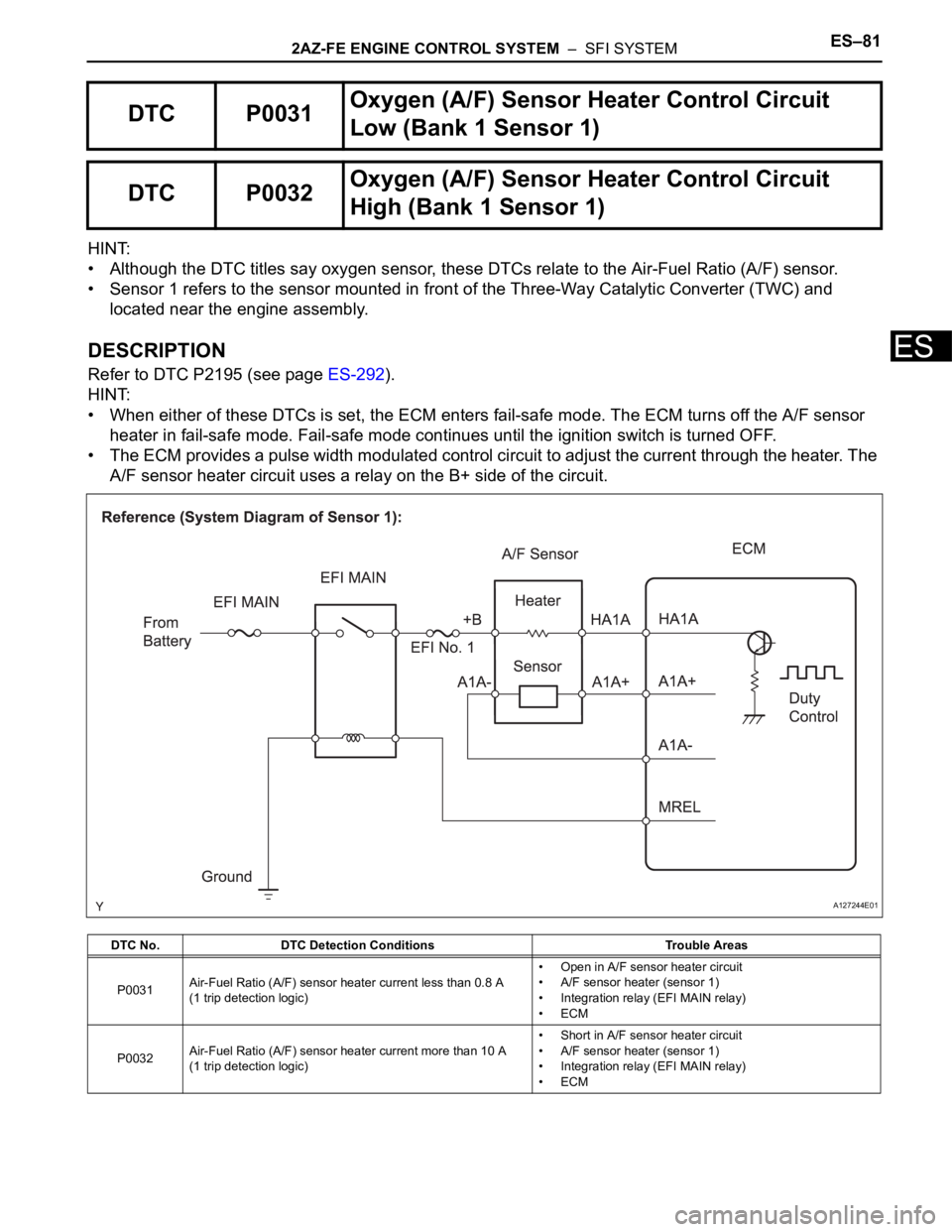
• Although the DTC titles say oxygen sensor, these DTCs relate to the Air-Fuel Ratio (A/F) sensor.
• Sensor 1 refers to the sensor mounted in front of the Three-Way Catalytic Converter (TWC) and
located near the engine assembly.
DESCRIPTION
Refer to DTC P2195 (see page ES-292).
HINT:
• When either of these DTCs is set, the ECM enters fail-safe mode. The ECM turns off the A/F sensor
heater in fail-safe mode. Fail-safe mode continues until the ignition switch is turned OFF.
• The ECM provides a pulse width modulated control circuit to adjust the current through the heater. The
A/F sensor heater circuit uses a relay on the B+ side of the circuit.
DTC P0031Oxygen (A/F) Sensor Heater Control Circuit
Low (Bank 1 Sensor 1)
DTC P0032Oxygen (A/F) Sensor Heater Control Circuit
High (Bank 1 Sensor 1)
DTC No. DTC Detection Conditions Trouble Areas
P0031Air-Fuel Ratio (A/F) sensor heater current less than 0.8 A
(1 trip detection logic)• Open in A/F sensor heater circuit
• A/F sensor heater (sensor 1)
• Integration relay (EFI MAIN relay)
•ECM
P0032Air-Fuel Ratio (A/F) sensor heater current more than 10 A
(1 trip detection logic)• Short in A/F sensor heater circuit
• A/F sensor heater (sensor 1)
• Integration relay (EFI MAIN relay)
•ECM
A127244E01
Page 1970 of 2000

ES–822AZ-FE ENGINE CONTROL SYSTEM – SFI SYSTEM
ES
MONITOR DESCRIPTION
The ECM uses information from the Air-Fuel Ratio (A/F) sensor to regulate the air-fuel ratio and keep it
close to the stoichiometric level. This maximizes the ability of the Three-Way Catalytic Converter (TWC) to
purify the exhaust gases.
The A/F sensor detects oxygen levels in the exhaust gas and transmits the information to the ECM. The
inner surface of the sensor element is exposed to the outside air. The outer surface of the sensor element
is exposed to the exhaust gas. The sensor element is made of platinum coated zirconia and includes an
integrated heating element.
The zirconia element generates a small voltage when there is a large difference in the oxygen
concentrations between the exhaust gas and outside air. The platinum coating amplifies this voltage
generation.
The A/F sensor is more efficient when heated. When the exhaust gas temperature is low, the sensor
cannot generate useful voltage signals without supplementary heating. The ECM regulates the
supplementary heating using a duty-cycle approach to adjust the average current in the sensor heater
element. If the heater current is outside the normal range, the signal transmitted by the A/F sensor
becomes inaccurate, as a result, the ECM is unable to regulate air-fuel ratio properly.
When the current in the A/F sensor heater is outside the normal operating range, the ECM interprets this
as a malfunction in the sensor heater and sets a DTC.
Example:
The ECM sets DTC P0032 when the current in the A/F sensor heater is more than 10 A. Conversely,
when the heater current is less than 0.8 A, DTC P0031 is set.
MONITOR STRATEGY
TYPICAL ENABLING CONDITIONS
All:
P0031:
P0032:
TYPICAL MALFUNCTION THRESHOLDS
P0031:
P0032:
Related DTCsP0031: A/F sensor heater open/short (Low electrical current)
P0032: A/F sensor heater open/short (High electrical current)
Required Sensors/Components (Main) A/F sensor heater
Required Sensors/Components (Related) -
Frequency of Operation Continuous
Duration 10 seconds
MIL Operation Immediate
Sequence of Operation None
Monitor runs whenever following DTCs not present None
Battery voltage 10.5 V or more
A/F sensor heater duty-cycle ratio 50 % or more
Time after engine start 10 seconds or more
Time after engine start 10 seconds or more
A/F sensor heater current Less than 0.8 A
A/F sensor heater current More than 10 A
Page 1971 of 2000
2AZ-FE ENGINE CONTROL SYSTEM – SFI SYSTEMES–83
ES
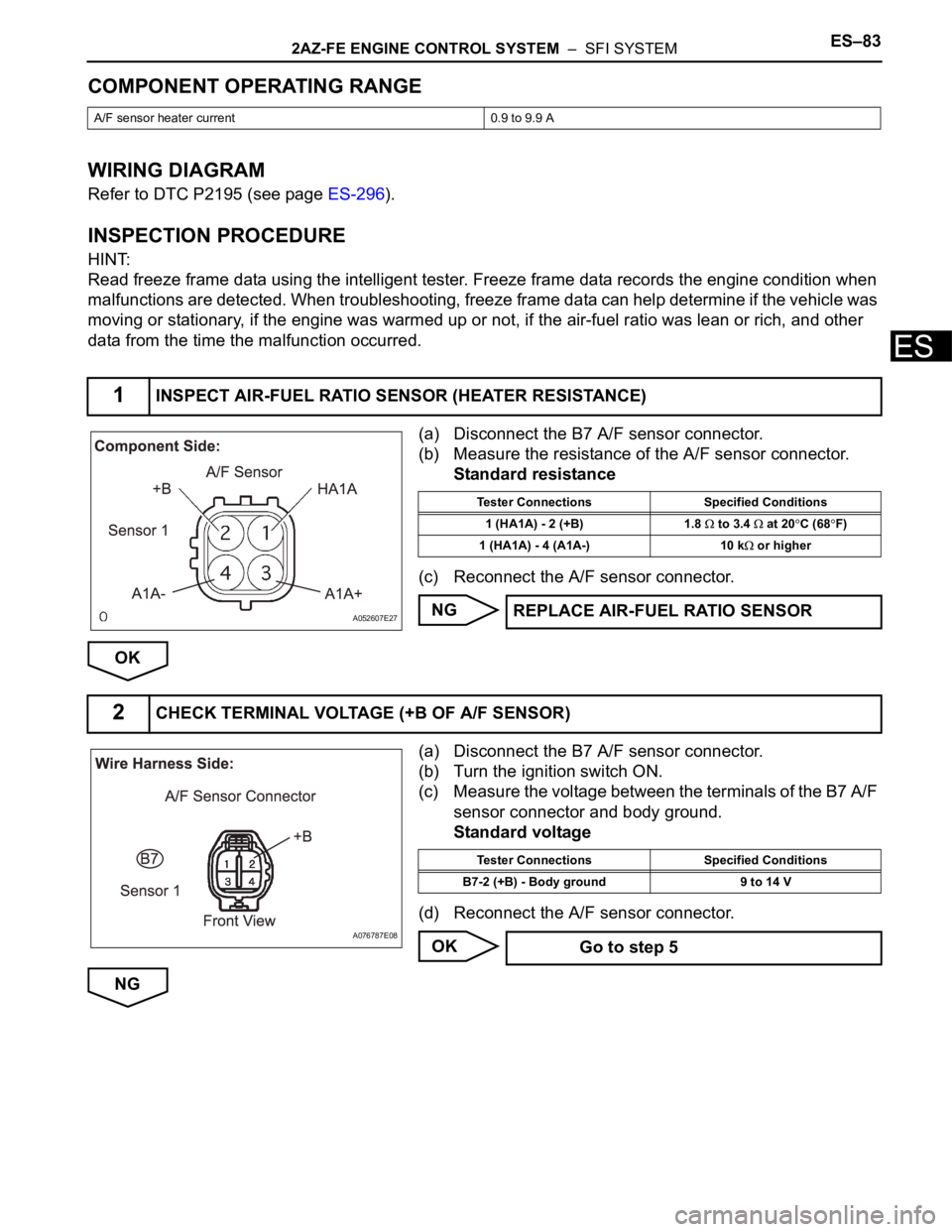
COMPONENT OPERATING RANGE
WIRING DIAGRAM
Refer to DTC P2195 (see page ES-296).
INSPECTION PROCEDURE
HINT:
Read freeze frame data using the intelligent tester. Freeze frame data records the engine condition when
malfunctions are detected. When troubleshooting, freeze frame data can help determine if the vehicle was
moving or stationary, if the engine was warmed up or not, if the air-fuel ratio was lean or rich, and other
data from the time the malfunction occurred.
(a) Disconnect the B7 A/F sensor connector.
(b) Measure the resistance of the A/F sensor connector.
Standard resistance
(c) Reconnect the A/F sensor connector.
NG
OK
(a) Disconnect the B7 A/F sensor connector.
(b) Turn the ignition switch ON.
(c) Measure the voltage between the terminals of the B7 A/F
sensor connector and body ground.
Standard voltage
(d) Reconnect the A/F sensor connector.
OK
NG
A/F sensor heater current 0.9 to 9.9 A
1INSPECT AIR-FUEL RATIO SENSOR (HEATER RESISTANCE)
A052607E27
Tester Connections Specified Conditions
1 (HA1A) - 2 (+B) 1.8
to 3.4 at 20C (68F)
1 (HA1A) - 4 (A1A-) 10 k
or higher
REPLACE AIR-FUEL RATIO SENSOR
2CHECK TERMINAL VOLTAGE (+B OF A/F SENSOR)
A076787E08
Tester Connections Specified Conditions
B7-2 (+B) - Body ground 9 to 14 V
Go to step 5
Page 1974 of 2000
ES–862AZ-FE ENGINE CONTROL SYSTEM – SFI SYSTEM
ES
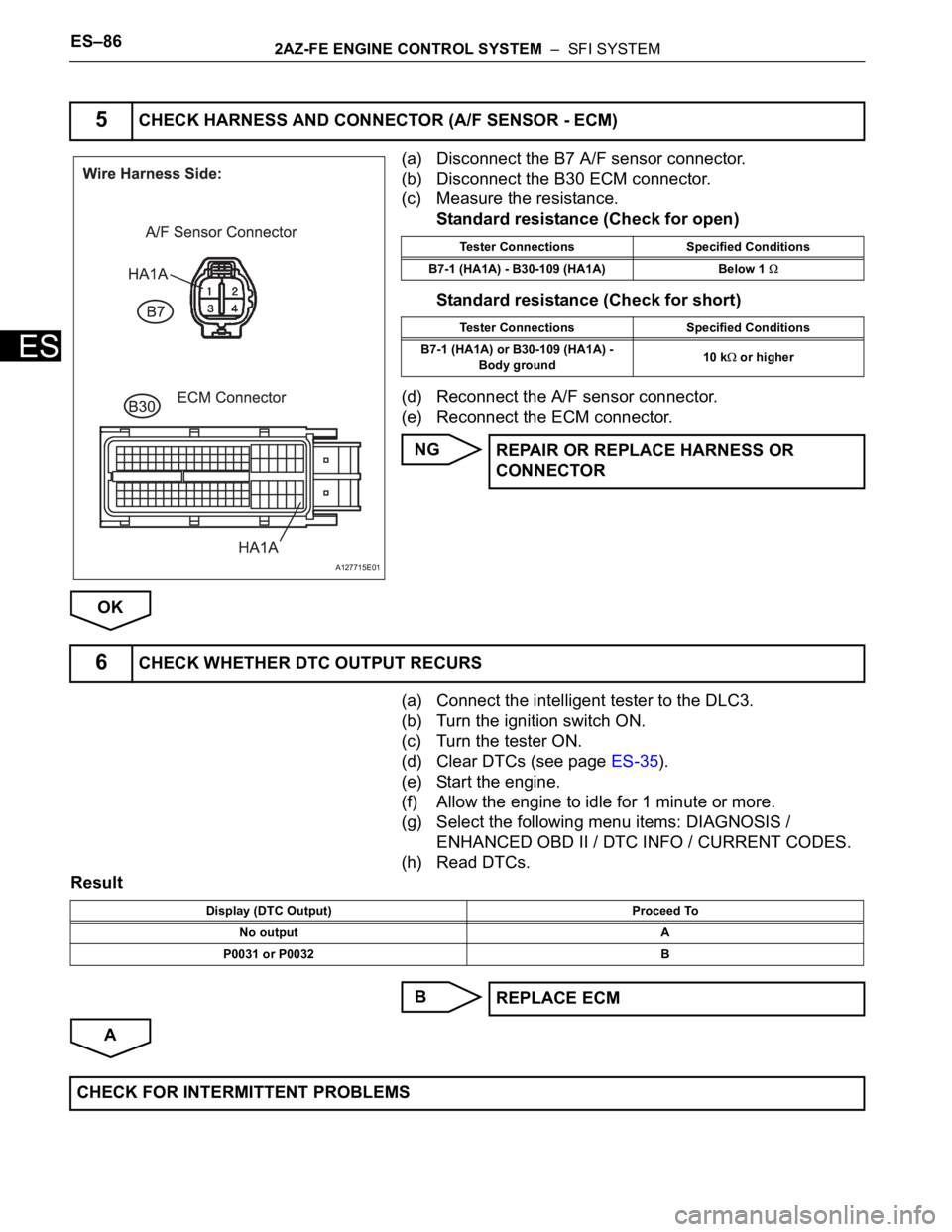
(a) Disconnect the B7 A/F sensor connector.
(b) Disconnect the B30 ECM connector.
(c) Measure the resistance.
Standard resistance (Check for open)
Standard resistance (Check for short)
(d) Reconnect the A/F sensor connector.
(e) Reconnect the ECM connector.
NG
OK
(a) Connect the intelligent tester to the DLC3.
(b) Turn the ignition switch ON.
(c) Turn the tester ON.
(d) Clear DTCs (see page ES-35).
(e) Start the engine.
(f) Allow the engine to idle for 1 minute or more.
(g) Select the following menu items: DIAGNOSIS /
ENHANCED OBD II / DTC INFO / CURRENT CODES.
(h) Read DTCs.
Result
B
A
5CHECK HARNESS AND CONNECTOR (A/F SENSOR - ECM)
A127715E01
Tester Connections Specified Conditions
B7-1 (HA1A) - B30-109 (HA1A) Below 1
Tester Connections Specified Conditions
B7-1 (HA1A) or B30-109 (HA1A) -
Body ground10 k
or higher
REPAIR OR REPLACE HARNESS OR
CONNECTOR
6CHECK WHETHER DTC OUTPUT RECURS
Display (DTC Output) Proceed To
No output A
P0031 or P0032 B
REPLACE ECM
CHECK FOR INTERMITTENT PROBLEMS