engine TOYOTA RAV4 2006 Service Repair Manual
[x] Cancel search | Manufacturer: TOYOTA, Model Year: 2006, Model line: RAV4, Model: TOYOTA RAV4 2006Pages: 2000, PDF Size: 45.84 MB
Page 897 of 2000
2GR-FE IGNITION – IGNITION SYSTEMIG–7
IG
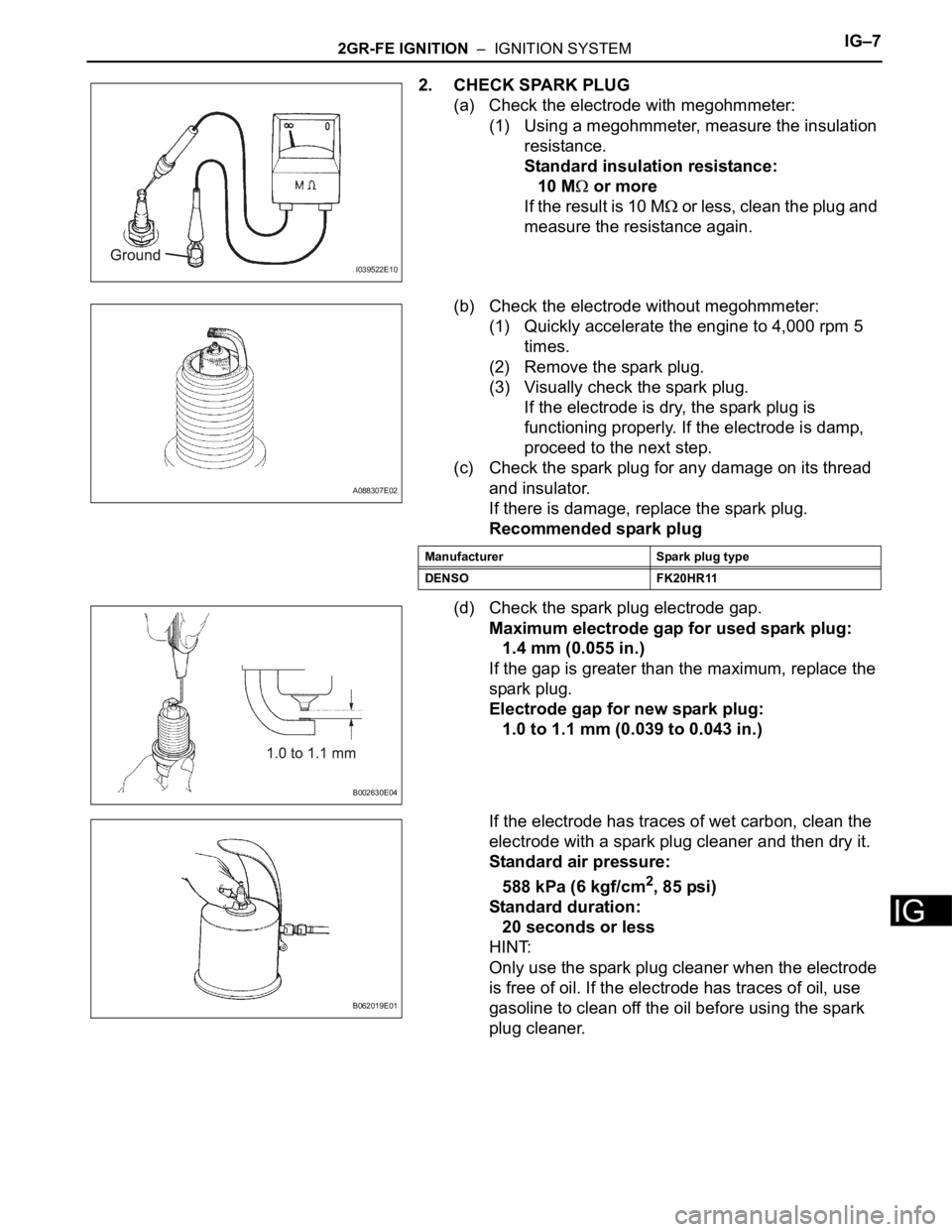
2. CHECK SPARK PLUG
(a) Check the electrode with megohmmeter:
(1) Using a megohmmeter, measure the insulation
resistance.
Standard insulation resistance:
10 M
or more
If the result is 10 M
or less, clean the plug and
measure the resistance again.
(b) Check the electrode without megohmmeter:
(1) Quickly accelerate the engine to 4,000 rpm 5
times.
(2) Remove the spark plug.
(3) Visually check the spark plug.
If the electrode is dry, the spark plug is
functioning properly. If the electrode is damp,
proceed to the next step.
(c) Check the spark plug for any damage on its thread
and insulator.
If there is damage, replace the spark plug.
Recommended spark plug
(d) Check the spark plug electrode gap.
Maximum electrode gap for used spark plug:
1.4 mm (0.055 in.)
If the gap is greater than the maximum, replace the
spark plug.
Electrode gap for new spark plug:
1.0 to 1.1 mm (0.039 to 0.043 in.)
If the electrode has traces of wet carbon, clean the
electrode with a spark plug cleaner and then dry it.
Standard air pressure:
588 kPa (6 kgf/cm
2, 85 psi)
Standard duration:
20 seconds or less
HINT:
Only use the spark plug cleaner when the electrode
is free of oil. If the electrode has traces of oil, use
gasoline to clean off the oil before using the spark
plug cleaner.
I039522E10
A088307E02
Manufacturer Spark plug type
DENSO FK20HR11
B002630E04
B062019E01
Page 909 of 2000
ST–62GR-FE STARTING – STARTER
ST
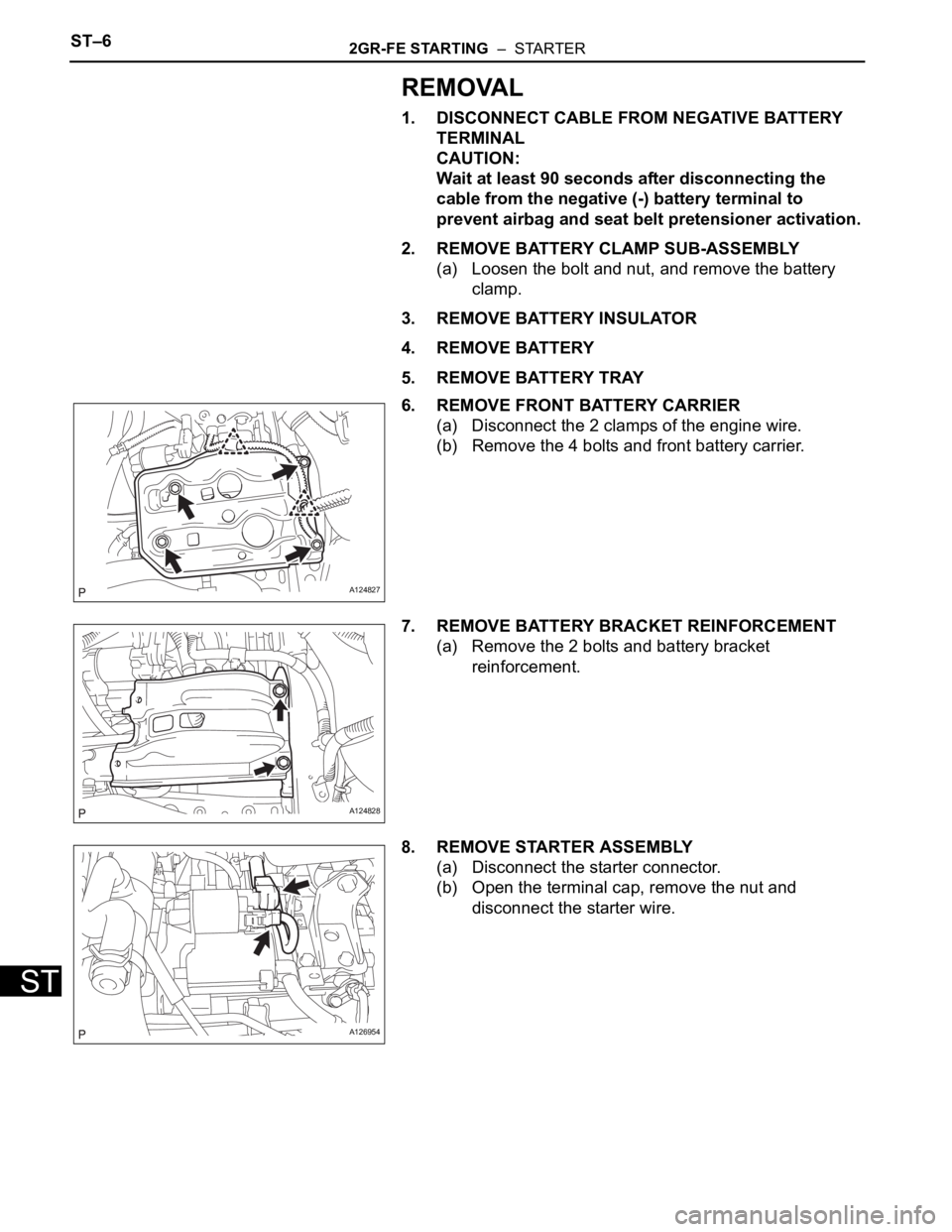
REMOVAL
1. DISCONNECT CABLE FROM NEGATIVE BATTERY
TERMINAL
CAUTION:
Wait at least 90 seconds after disconnecting the
cable from the negative (-) battery terminal to
prevent airbag and seat belt pretensioner activation.
2. REMOVE BATTERY CLAMP SUB-ASSEMBLY
(a) Loosen the bolt and nut, and remove the battery
clamp.
3. REMOVE BATTERY INSULATOR
4. REMOVE BATTERY
5. REMOVE BATTERY TRAY
6. REMOVE FRONT BATTERY CARRIER
(a) Disconnect the 2 clamps of the engine wire.
(b) Remove the 4 bolts and front battery carrier.
7. REMOVE BATTERY BRACKET REINFORCEMENT
(a) Remove the 2 bolts and battery bracket
reinforcement.
8. REMOVE STARTER ASSEMBLY
(a) Disconnect the starter connector.
(b) Open the terminal cap, remove the nut and
disconnect the starter wire.
A124827
A124828
A126954
Page 918 of 2000
2GR-FE STARTING – STARTERST–15
ST
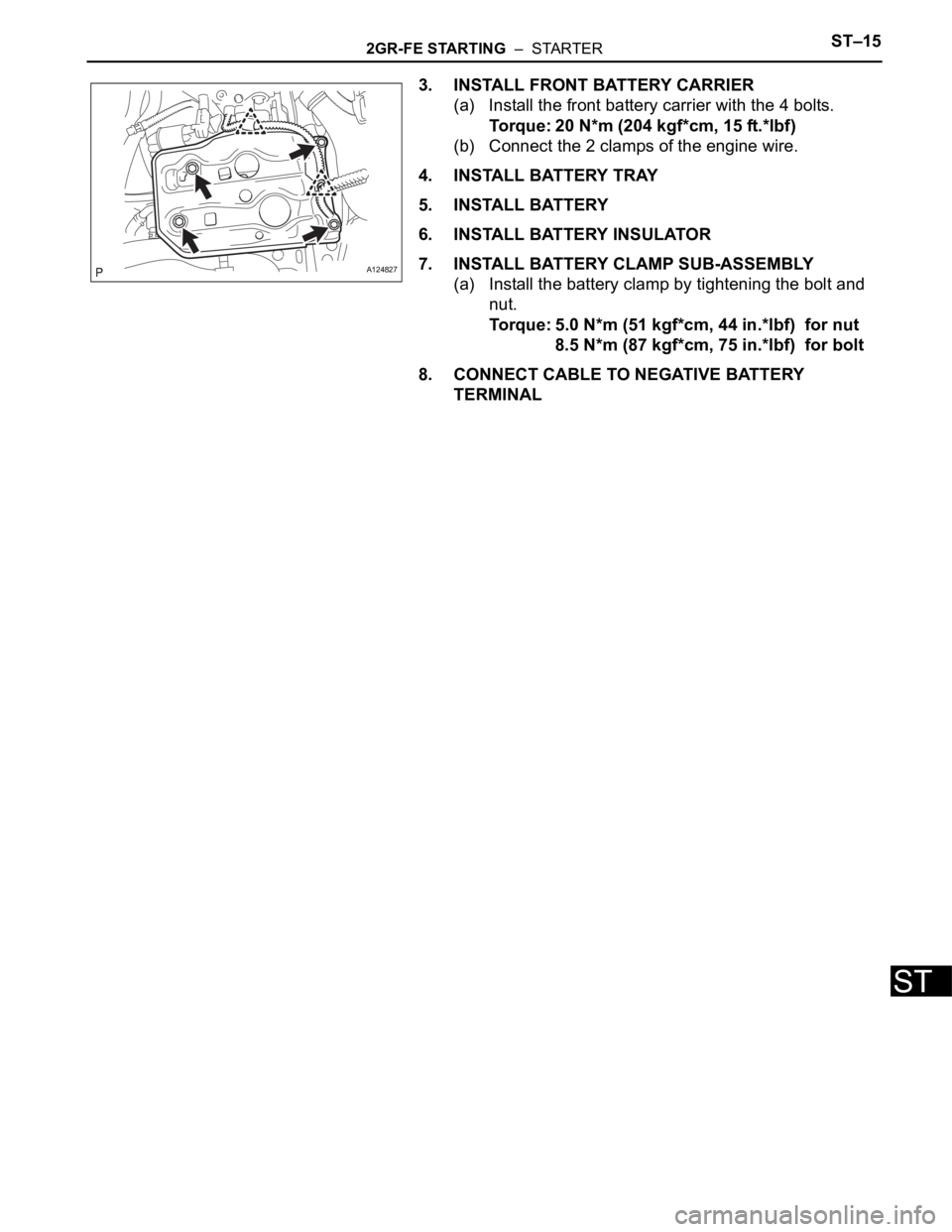
3. INSTALL FRONT BATTERY CARRIER
(a) Install the front battery carrier with the 4 bolts.
Torque: 20 N*m (204 kgf*cm, 15 ft.*lbf)
(b) Connect the 2 clamps of the engine wire.
4. INSTALL BATTERY TRAY
5. INSTALL BATTERY
6. INSTALL BATTERY INSULATOR
7. INSTALL BATTERY CLAMP SUB-ASSEMBLY
(a) Install the battery clamp by tightening the bolt and
nut.
Torque: 5.0 N*m (51 kgf*cm, 44 in.*lbf) for nut
8.5 N*m (87 kgf*cm, 75 in.*lbf) for bolt
8. CONNECT CABLE TO NEGATIVE BATTERY
TERMINAL
A124827
Page 928 of 2000
2GR-FE CHARGING – CHARGING SYSTEMCH–5
CH
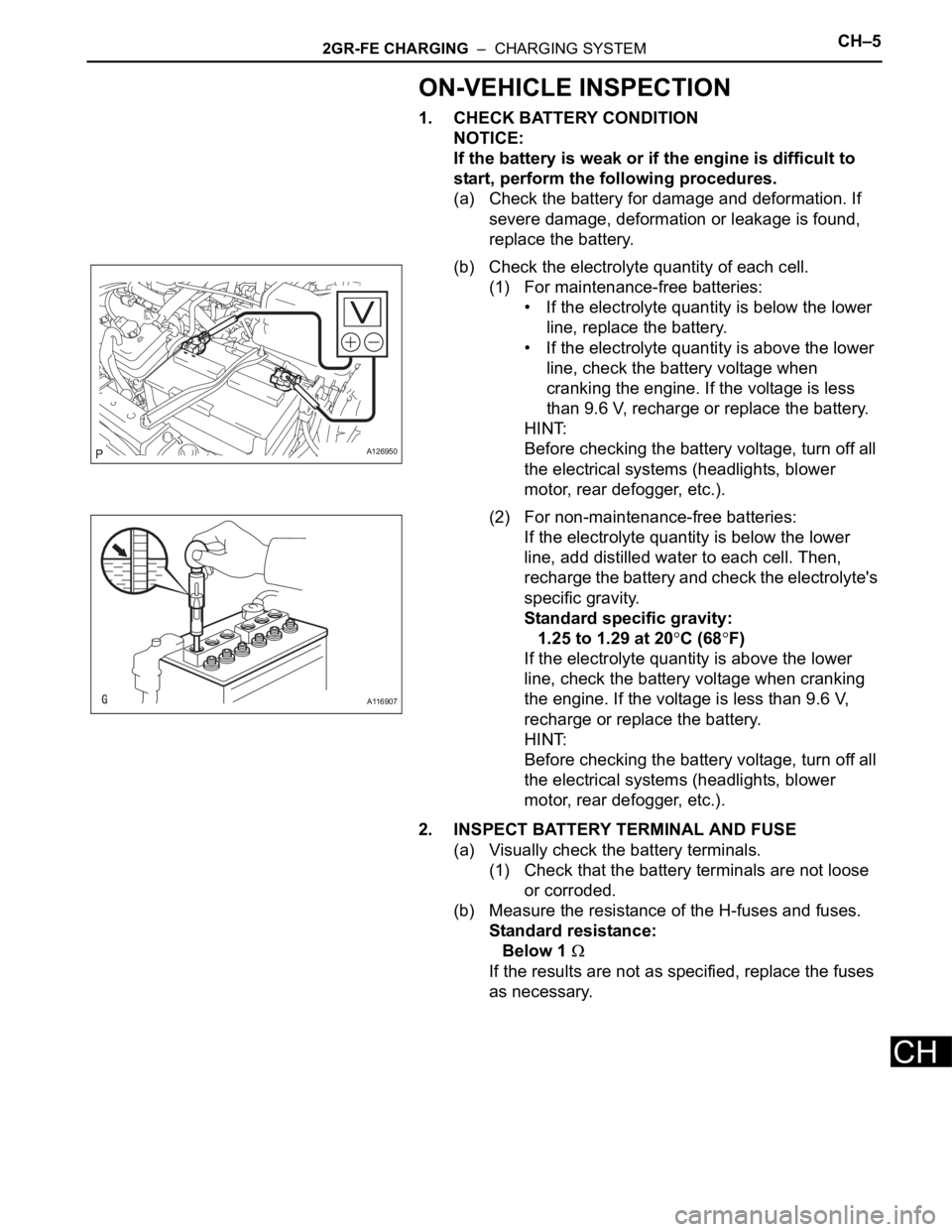
ON-VEHICLE INSPECTION
1. CHECK BATTERY CONDITION
NOTICE:
If the battery is weak or if the engine is difficult to
start, perform the following procedures.
(a) Check the battery for damage and deformation. If
severe damage, deformation or leakage is found,
replace the battery.
(b) Check the electrolyte quantity of each cell.
(1) For maintenance-free batteries:
• If the electrolyte quantity is below the lower
line, replace the battery.
• If the electrolyte quantity is above the lower
line, check the battery voltage when
cranking the engine. If the voltage is less
than 9.6 V, recharge or replace the battery.
HINT:
Before checking the battery voltage, turn off all
the electrical systems (headlights, blower
motor, rear defogger, etc.).
(2) For non-maintenance-free batteries:
If the electrolyte quantity is below the lower
line, add distilled water to each cell. Then,
recharge the battery and check the electrolyte's
specific gravity.
Standard specific gravity:
1.25 to 1.29 at 20
C (68F)
If the electrolyte quantity is above the lower
line, check the battery voltage when cranking
the engine. If the voltage is less than 9.6 V,
recharge or replace the battery.
HINT:
Before checking the battery voltage, turn off all
the electrical systems (headlights, blower
motor, rear defogger, etc.).
2. INSPECT BATTERY TERMINAL AND FUSE
(a) Visually check the battery terminals.
(1) Check that the battery terminals are not loose
or corroded.
(b) Measure the resistance of the H-fuses and fuses.
Standard resistance:
Below 1
If the results are not as specified, replace the fuses
as necessary.
A126950
A116907
Page 929 of 2000
CH–62GR-FE CHARGING – CHARGING SYSTEM
CH
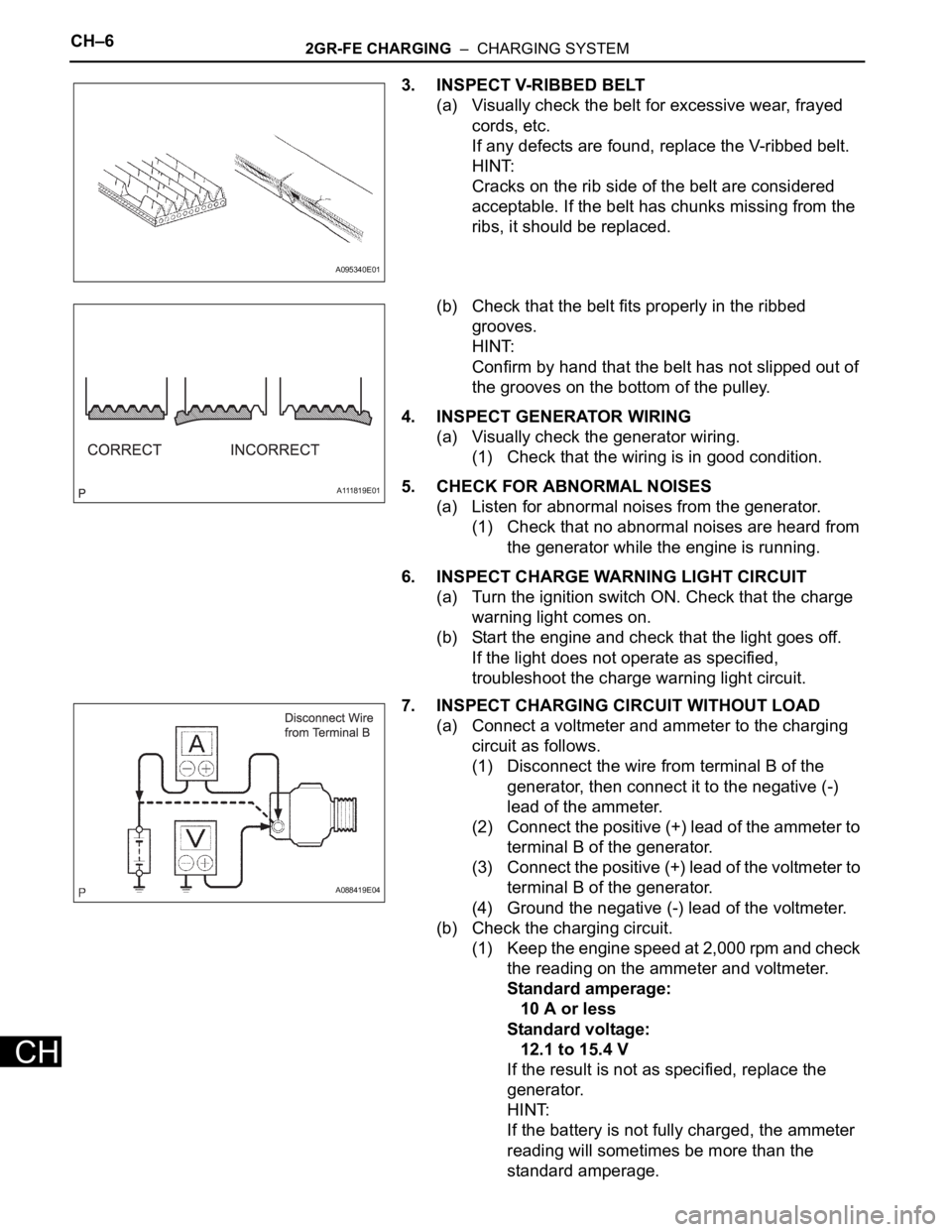
3. INSPECT V-RIBBED BELT
(a) Visually check the belt for excessive wear, frayed
cords, etc.
If any defects are found, replace the V-ribbed belt.
HINT:
Cracks on the rib side of the belt are considered
acceptable. If the belt has chunks missing from the
ribs, it should be replaced.
(b) Check that the belt fits properly in the ribbed
grooves.
HINT:
Confirm by hand that the belt has not slipped out of
the grooves on the bottom of the pulley.
4. INSPECT GENERATOR WIRING
(a) Visually check the generator wiring.
(1) Check that the wiring is in good condition.
5. CHECK FOR ABNORMAL NOISES
(a) Listen for abnormal noises from the generator.
(1) Check that no abnormal noises are heard from
the generator while the engine is running.
6. INSPECT CHARGE WARNING LIGHT CIRCUIT
(a) Turn the ignition switch ON. Check that the charge
warning light comes on.
(b) Start the engine and check that the light goes off.
If the light does not operate as specified,
troubleshoot the charge warning light circuit.
7. INSPECT CHARGING CIRCUIT WITHOUT LOAD
(a) Connect a voltmeter and ammeter to the charging
circuit as follows.
(1) Disconnect the wire from terminal B of the
generator, then connect it to the negative (-)
lead of the ammeter.
(2) Connect the positive (+) lead of the ammeter to
terminal B of the generator.
(3) Connect the positive (+) lead of the voltmeter to
terminal B of the generator.
(4) Ground the negative (-) lead of the voltmeter.
(b) Check the charging circuit.
(1) Keep the engine speed at 2,000 rpm and check
the reading on the ammeter and voltmeter.
Standard amperage:
10 A or less
Standard voltage:
12.1 to 15.4 V
If the result is not as specified, replace the
generator.
HINT:
If the battery is not fully charged, the ammeter
reading will sometimes be more than the
standard amperage.
A095340E01
A111819E01
A088419E04
Page 930 of 2000

2GR-FE CHARGING – CHARGING SYSTEMCH–7
CH
8. INSPECT CHARGING CIRCUIT WITH LOAD
(a) With the engine running at 2,000 rpm, turn the high
beam headlights ON and turn the heater blower
switch to the "HI" position.
(b) Check the reading on the ammeter.
Standard amperage:
30 A or more
If the ammeter reading is less than the standard
amperage, repair the generator.
HINT:
If the battery is fully charged, the indication will
sometimes be less than the standard amperage.
If this is the case, add more electrical load (operate
the wipers, rear window defogger, etc.) and check
the reading on the ammeter again.
Page 931 of 2000
CH–122GR-FE CHARGING – GENERATOR
CH
REMOVAL
1. REMOVE RADIATOR ASSEMBLY
(a) Remove the radiator (see page CO-36).
2. REMOVE FRONT WHEEL RH
3. REMOVE ENGINE UNDER COVER REAR RH (See
page EM-21)
4. REMOVE FRONT SUSPENSION MEMBER
REINFORCEMENT RH (See page EM-7)
5. REMOVE RADIATOR RESERVOIR TANK (See page
CO-19)
6. REMOVE FAN AND GENERATOR V BELT (See page
EM-8)
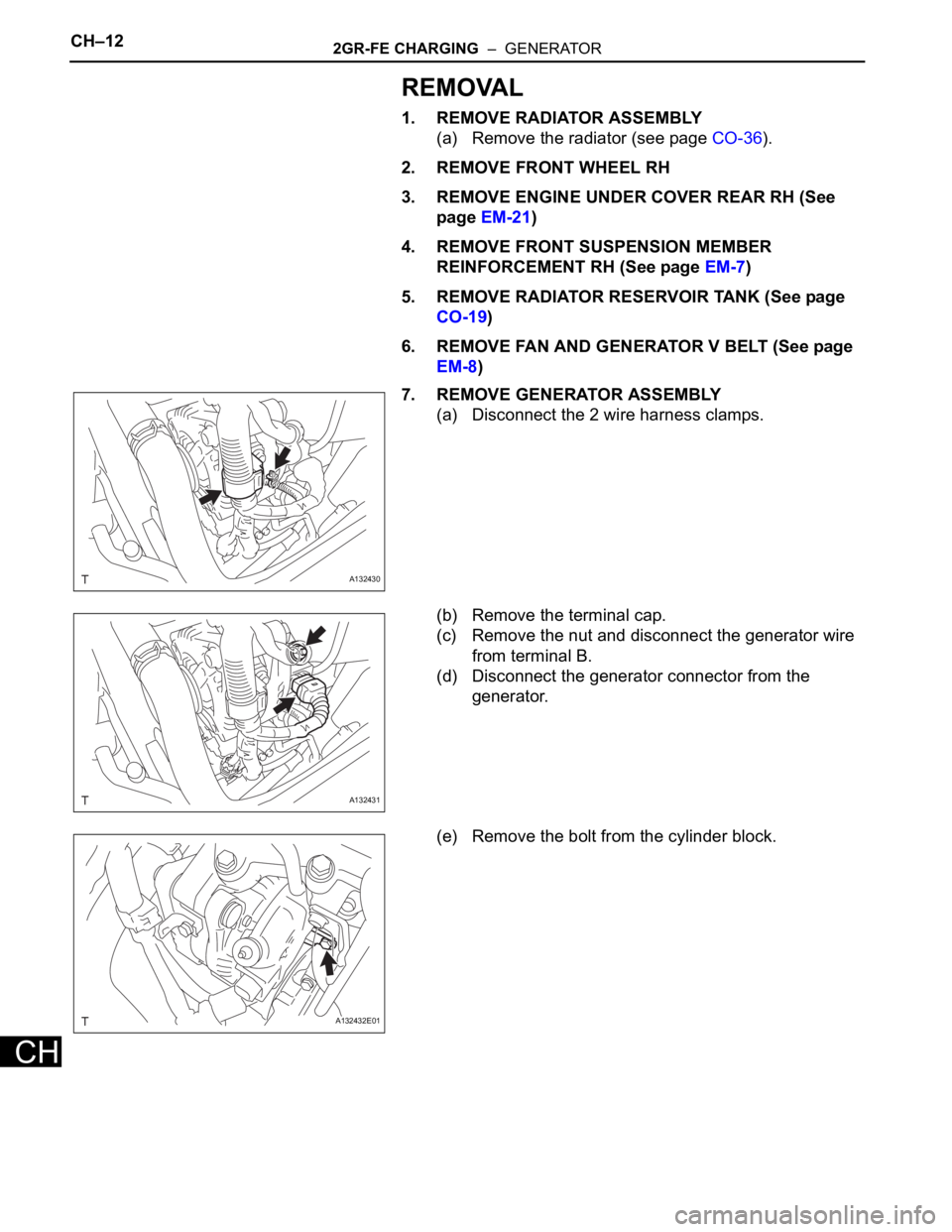
7. REMOVE GENERATOR ASSEMBLY
(a) Disconnect the 2 wire harness clamps.
(b) Remove the terminal cap.
(c) Remove the nut and disconnect the generator wire
from terminal B.
(d) Disconnect the generator connector from the
generator.
(e) Remove the bolt from the cylinder block.
A132430
A132431
A132432E01
Page 939 of 2000
CH–202GR-FE CHARGING – GENERATOR
CH
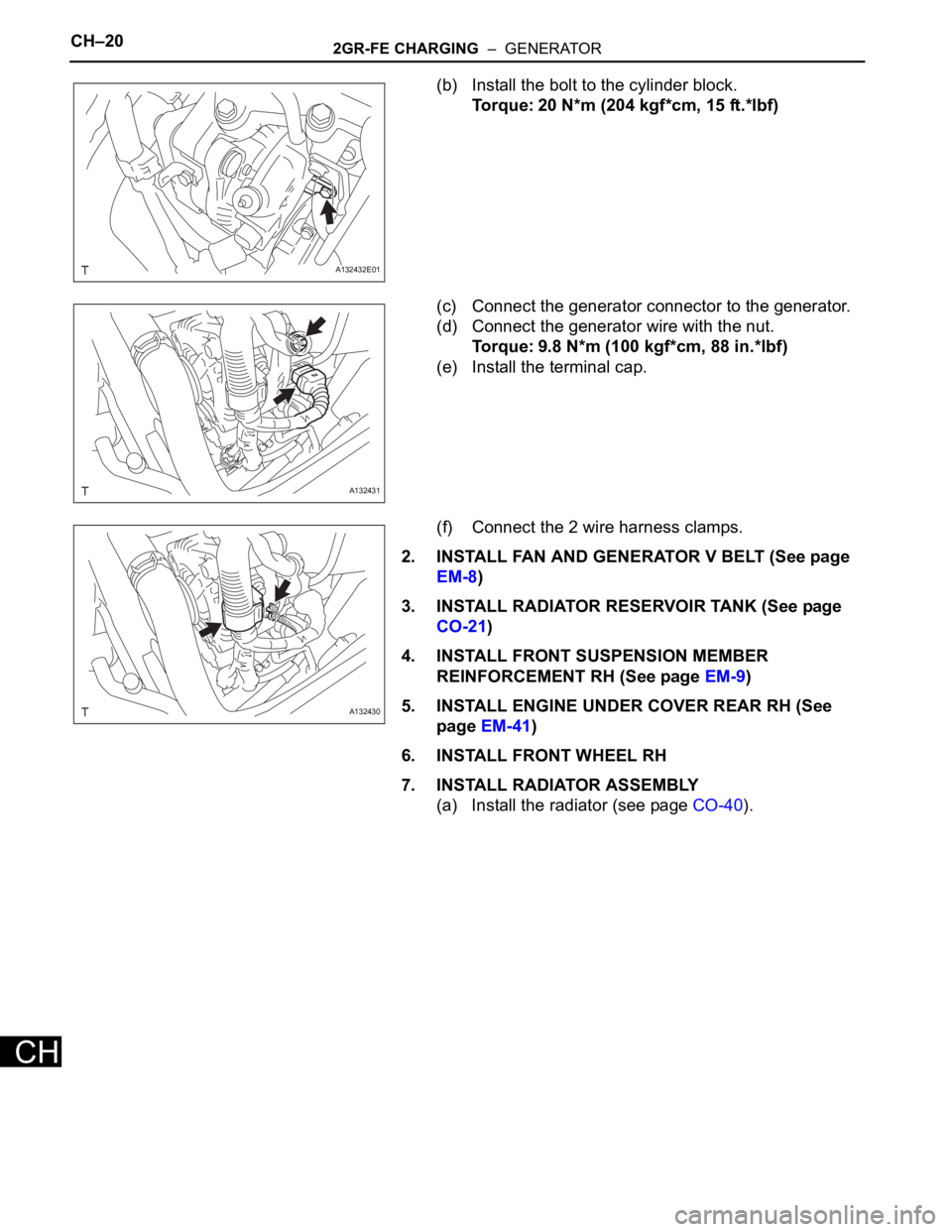
(b) Install the bolt to the cylinder block.
Torque: 20 N*m (204 kgf*cm, 15 ft.*lbf)
(c) Connect the generator connector to the generator.
(d) Connect the generator wire with the nut.
Torque: 9.8 N*m (100 kgf*cm, 88 in.*lbf)
(e) Install the terminal cap.
(f) Connect the 2 wire harness clamps.
2. INSTALL FAN AND GENERATOR V BELT (See page
EM-8)
3. INSTALL RADIATOR RESERVOIR TANK (See page
CO-21)
4. INSTALL FRONT SUSPENSION MEMBER
REINFORCEMENT RH (See page EM-9)
5. INSTALL ENGINE UNDER COVER REAR RH (See
page EM-41)
6. INSTALL FRONT WHEEL RH
7. INSTALL RADIATOR ASSEMBLY
(a) Install the radiator (see page CO-40).
A132432E01
A132431
A132430
Page 944 of 2000

AX–10U140F AUTOMATIC TRANSAXLE – AUTOMATIC TRANSAXLE SYSTEM
AX
SYSTEM DESCRIPTION
1. SYSTEM DESCRIPTION
(a) The Electronic Controlled Automatic Transaxle
(ECT) is an automatic transaxle that electronically
controls shift timing using the Engine Control
Module (ECM). The ECM detects electrical signals
that indicate engine and driving conditions, and
controls the shift point based on driver habits and
road conditions. As a result, fuel efficiency and
power transaxle performance are improved.
Shift shock is reduced by controlling the engine and
transaxle simultaneously.
In addition, the ECT has the following features:
• Diagnostic function.
• Fail-safe function when a malfunction occurs.
Page 949 of 2000
U140F AUTOMATIC TRANSAXLE – AUTOMATIC TRANSAXLE SYSTEMAX–15
AX
ROAD TEST
1. PROBLEM SYMPTOM CONFIRMATION
(a) Based on the result of the customer problem
analysis, try to reproduce the symptoms. If the
problem is that the transaxle does not shift up, shift
down, or the shift point is too high or too low,
conduct the following road test referring to the
automatic shift schedule and simulate the problem
symptoms.
2. ROAD TEST
NOTICE:
Perform the test at the normal operating ATF
temperature of 50 to 80
C (122 to 176F).
(a) D position test
Move the shift lever to D and fully depress the
accelerator pedal. Check the following:
(1) Check up-shift operation.
Check that the 1
2, 2 3 and 3 O/D up-
shifts take place at the shift point shown in the
automatic shift schedule (see page SS-55).
HINT:
O/D Gear Up-shift Prohibition Control
• Engine coolant temperature is 55
C (131F)
or less and vehicle speed is at 70 km/h (43
mph) or less.
• ATF temperature is 5
C (41F) or less.
O/D Gear Lock-up Prohibition Control
• Brake pedal is depressed.
• Accelerator pedal is released.
• Engine coolant temperature is 60
C (140F)
or less.
(2) Check for shift shock and slip.
Check for shock and slip at the 1
2, 2 3 and
3
O/D up-shifts.
(3) Check for abnormal noise and vibration.
Check for abnormal noise and vibration when
up-shifting from 1
2, 2 3 and 3 O/D while
driving with the shift lever on D, and check while
driving in the lock-up condition.
HINT:
The check for the cause of abnormal noise and
vibration must be done thoroughly as it could
also be due to loss of balance in the differential,
torque converter clutch, etc.
(4) Check kick-down operation.
While driving the vehicle in the 2nd, 3rd and O/D
gears with the shift lever on D, check that the
possible kick-down vehicle speed limits for 2
1, 3
2 and O/D 3 kick-downs conform to
those indicated in the automatic shift schedule
(see page SS-55).
(5) Check for abnormal shock and slip at kick-down.