airbag off TOYOTA RAV4 2006 Service Repair Manual
[x] Cancel search | Manufacturer: TOYOTA, Model Year: 2006, Model line: RAV4, Model: TOYOTA RAV4 2006Pages: 2000, PDF Size: 45.84 MB
Page 27 of 2000

ENGINE - 2AZ-FE ENGINE EG-30
ENGINE CONTROL SYSTEM
1. General
The engine control system for the 2AZ-FE engine has the following systems.
System
Outline
SFI
Sequential Multiport
Fuel InjectionAn L-type SFI system directly detects the intake air volume with a hot-wire
type mass air flow meter.
The fuel injection system is a sequential multiport fuel injection system.
ESA
Electronic Spark
AdvanceIgnition timing is determined by the ECM based on signals from various sensors.
The ECM corrects ignition timing in response to engine knocking.
ETCS-i
Electronic
Optimally controls the throttle valve opening in accordance with the amount of
accelerator pedal effort and the condition of the engine and the vehicle.
Electronic
Throttle Control
System-intelligent
(See page-43)A linkless-type is used, without an accelerator cable.
An accelerator pedal position sensor is provided on the accelerator pedal.
A non-contact type throttle position sensor and accelerator pedal position
sensor are used.
VVT-i
Va r i a b l e Va l v e
Timing-intelligent
(See page EG-48)
Controls the intake camshaft to an optimal valve timing in accordance with the
engine condition.
Air-fuel Ratio
Sensor, Oxygen
Sensor Heater
ControlMaintains the temperature of the air-fuel ratio sensor or oxygen sensor at an
appropriate level to realize accuracy of detection of the oxygen concentration in
the exhaust gas.
Air Conditioning
Cut-off ControlBy turning the air conditioning compressor ON or OFF in accordance with the
engine condition, drivability is maintained.
Cooling Fan Control
(See page EG-52)Radiator cooling fan operation is controlled by signals from ECM based on the
engine coolant temperature sensor signal and the condition of the air
conditioning operation.
Fuel Pump Control
(See page EG-53)Fuel pump operation is controlled by signal from the ECM.
The fuel pump is stopped when the SRS driver’s and front passenger’s airbags
are deployed.
Evapotative Emission
The ECM controls the purge flow of evaporative emissions (HC) in the canister
in accordance with engine conditions.
Evapotative Emission
Control
(See page EG-54)Approximately five hours after the ignition switch has been turned OFF, the
ECM operates the canister pump module to detect any evaporative emission
leakage occurring in the EVAP (evaporative emission) control system through
changes in the 0.02 in. leak pressure.
Charging Control
(See page EG-65)The ECM regulates the charging voltage of the generator in accordance with the
driving conditions and the charging state of the battery.
(Continued)
Page 50 of 2000

ENGINE - 2AZ-FE ENGINE
00REG18Y
Front Airbag
Sensor
(RH and LH)
Curtain Shield
Airbag Sensor*
(RH and LH)Airbag
Sensor
Side Airbag
Sensor*
(RH or LH)ECMCircuit
Opening
Relay
Fuel
Pump
Motor
: CANEG-53
9. Fuel Pump Control
A fuel cut control is used to stop the fuel pump when the SRS airbag is deployed at the front collision. In this
system, the airbag deployment signal from the airbag sensor is detected by the ECM, which turns OFF the
circuit opening relay.
After the fuel cut control has been activated, turning the ignition switch from OFF to ON cancels the fuel cut
control, and the engine can be restarted.
*: Models with SRS Driver, Front Passenger, Side and Curtain Shield Airbags
Page 97 of 2000

ENGINE - 2GR-FE ENGINEEG-101
ENGINE CONTROL SYSTEM
1. General
The engine control system of the 2GR-FE engine has the following features.
System
Outline
SFI
(Sequential Multiport
Fuel Injection)
[See page EG-117]
An L-type SFI system detects the intake air mass with a hot-wire type air
flow meter.
ESA
(Electronic Spark
Advance)
Ignition timing is determined by the ECM based on signals from various
sensors. The ECM corrects ignition timing in response to engine
knocking.
This system selects the optimal ignition timing in accordance with the
signals received from the sensors and sends the (IGT) ignition signal to
the igniter.
ETCS-i
(Electronic Throttle
Control
System-intelligent)
[See page EG-118]
Optimally controls the throttle valve opening in accordance with the amount
of accelerator pedal effort and the condition of the engine and the vehicle.
Dual VVT-i
(Variable Valve
Timing-intelligent)
System
[See page EG-120]
Controls the intake and exhaust camshafts to an optimal valve timing in
accordance with the engine condition.
ACIS
(Acoustic Control
Induction System)
[See page EG-126]The intake air passages are switched according to the engine speed and
throttle valve opening angle to provided high performance in all speed
ranges.
Air Intake Control
System
[See page EG-128]The intake air duct is divided into two areas, and the ECM controls the air
intake control valve and the actuator that are provided in one of the areas to
reduce the amount of engine noise.
Fuel Pump Control
[See page EG-53 in
2AZ-FE section]Fuel pump operation is controlled by signals from the ECM.
The fuel pump is stopped, when the SRS airbag is deployed in a frontal,
side, and rear side collision.
Air Conditioning Cut-off
ControlBy turning the air conditioning compressor ON or OFF in accordance with
the engine condition, drivability is maintained.
Charging Control
[See page EG-65 in
2AZ-FE section]The engine ECU regulates the charging voltage of the generator in
accordance with the driving conditions and the charging state of the battery.
Cooling Fan Control
[See page EG-129]
The cooling fan ECU steplessly controls the speed of the fans in accordance
with the engine coolant temperature, vehicle speed, engine speed, and air
conditioning operating conditions. As a result, the cooling performance is
improved.
(Continued)
Page 422 of 2000
SR–4STEERING COLUMN – STEERING SYSTEM
SR
REPAIR
1. CORRECT STEERING OFF CENTER
(a) Check whether the steering wheel is off-center.
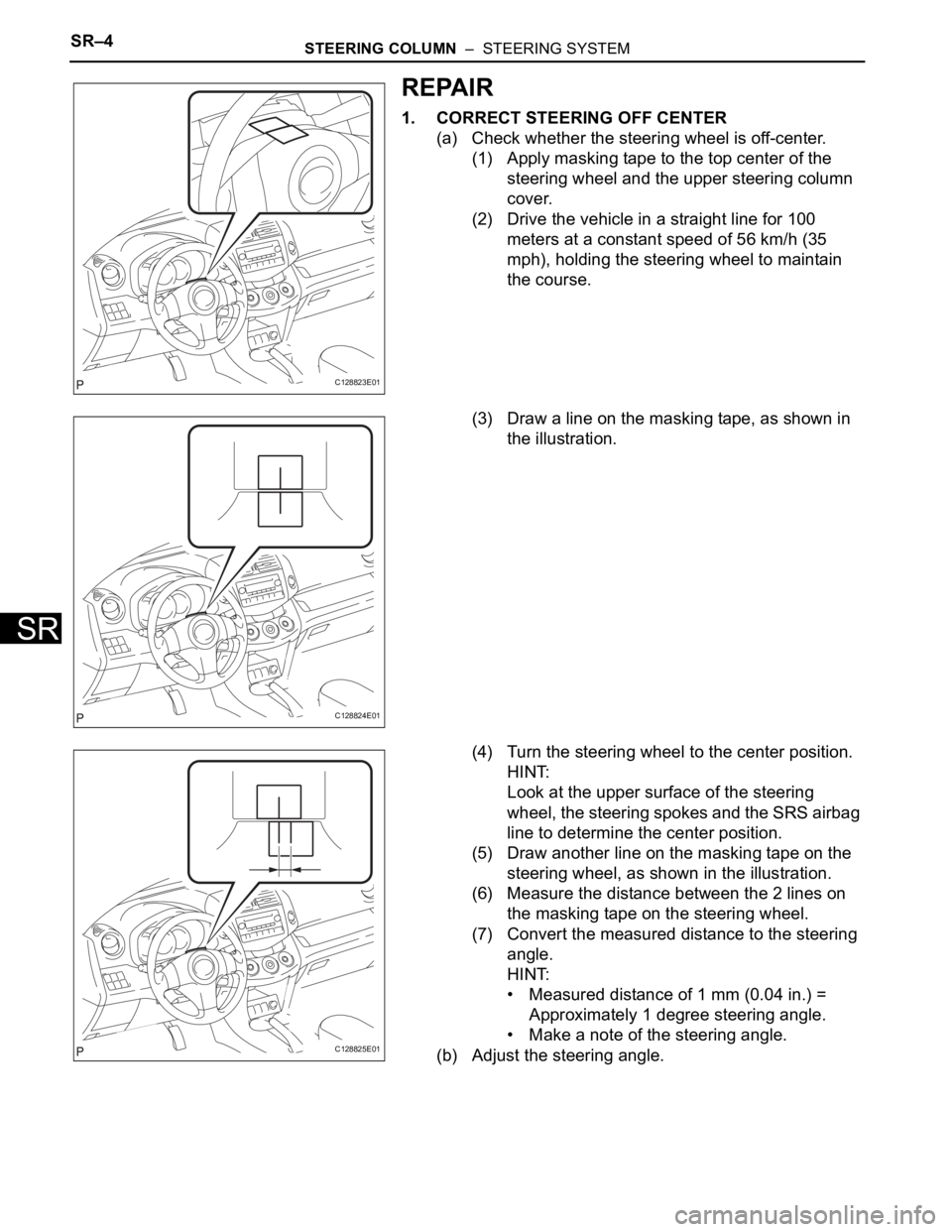
(1) Apply masking tape to the top center of the
steering wheel and the upper steering column
cover.
(2) Drive the vehicle in a straight line for 100
meters at a constant speed of 56 km/h (35
mph), holding the steering wheel to maintain
the course.
(3) Draw a line on the masking tape, as shown in
the illustration.
(4) Turn the steering wheel to the center position.
HINT:
Look at the upper surface of the steering
wheel, the steering spokes and the SRS airbag
line to determine the center position.
(5) Draw another line on the masking tape on the
steering wheel, as shown in the illustration.
(6) Measure the distance between the 2 lines on
the masking tape on the steering wheel.
(7) Convert the measured distance to the steering
angle.
HINT:
• Measured distance of 1 mm (0.04 in.) =
Approximately 1 degree steering angle.
• Make a note of the steering angle.
(b) Adjust the steering angle.
C128823E01
C128824E01
C128825E01
Page 769 of 2000
2AZ-FE FUEL – FUEL INJECTORFU–9
FU
REMOVAL
1. DISCHARGE FUEL SYSTEM PRESSURE
CAUTION:
• DISCHARGE FUEL SYSTEM PRESSURE
procedures must be performed before
disconnecting any part of the fuel system.
• After performing the DISCHARGE FUEL SYSTEM
PRESSURE procedures, pressure will remain in
the fuel line. When disconnecting the fuel line,
place a cloth or equivalent over fittings to reduce
the risk of fuel spray.
(a) Remove the console box (see page IR-83).
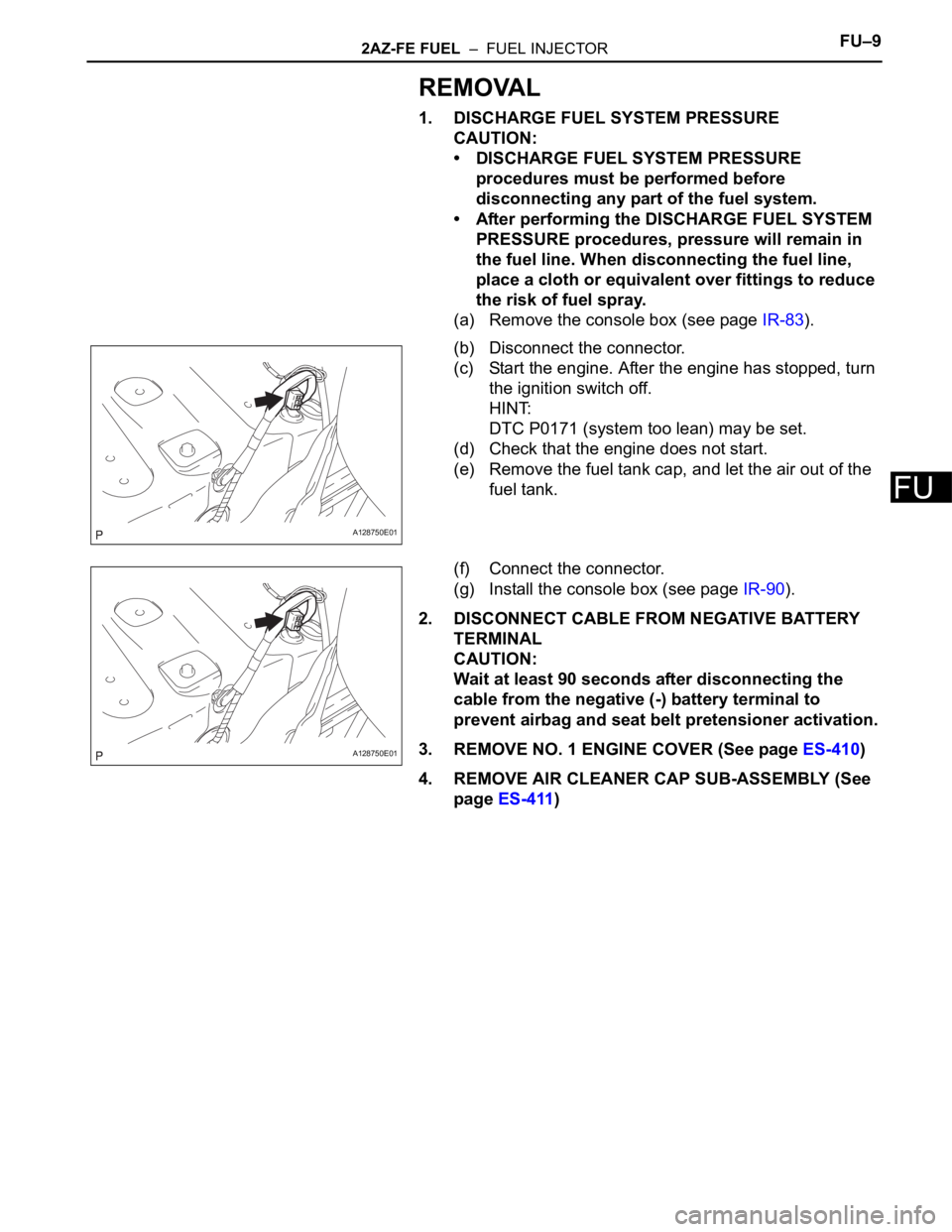
(b) Disconnect the connector.
(c) Start the engine. After the engine has stopped, turn
the ignition switch off.
HINT:
DTC P0171 (system too lean) may be set.
(d) Check that the engine does not start.
(e) Remove the fuel tank cap, and let the air out of the
fuel tank.
(f) Connect the connector.
(g) Install the console box (see page IR-90).
2. DISCONNECT CABLE FROM NEGATIVE BATTERY
TERMINAL
CAUTION:
Wait at least 90 seconds after disconnecting the
cable from the negative (-) battery terminal to
prevent airbag and seat belt pretensioner activation.
3. REMOVE NO. 1 ENGINE COVER (See page ES-410)
4. REMOVE AIR CLEANER CAP SUB-ASSEMBLY (See
page ES-411)
A128750E01
A128750E01
Page 803 of 2000
2GR-FE FUEL – FUEL INJECTORFU–13
FU
REMOVAL
CAUTION:
Do not allow fuel to spray when removing the pipe
between the high pressure side fuel pump and the fuel
injector. The fuel in the pipe is highly pressurized.
1. DISCHARGE FUEL SYSTEM PRESSURE
CAUTION:
• The "DISCHARGE FUEL SYSTEM PRESSURE"
procedures must be performed before
disconnecting any part of the fuel system.
• After performing the "DISCHARGE FUEL SYSTEM
PRESSURE" procedures, pressure will remain in
the fuel line. When disconnecting the fuel line,
place a cloth or equivalent over fittings to reduce
the risk of fuel spray.
(a) Remove the console box (see page IP-16).
(b) Start the engine. After the engine has stopped, turn
the ignition switch OFF.
HINT:
DTC P0171/P0172 (system too lean) may be set.
(c) Check that the engine does not start.
(d) Remove the fuel tank cap, and let the air out of the
fuel tank.
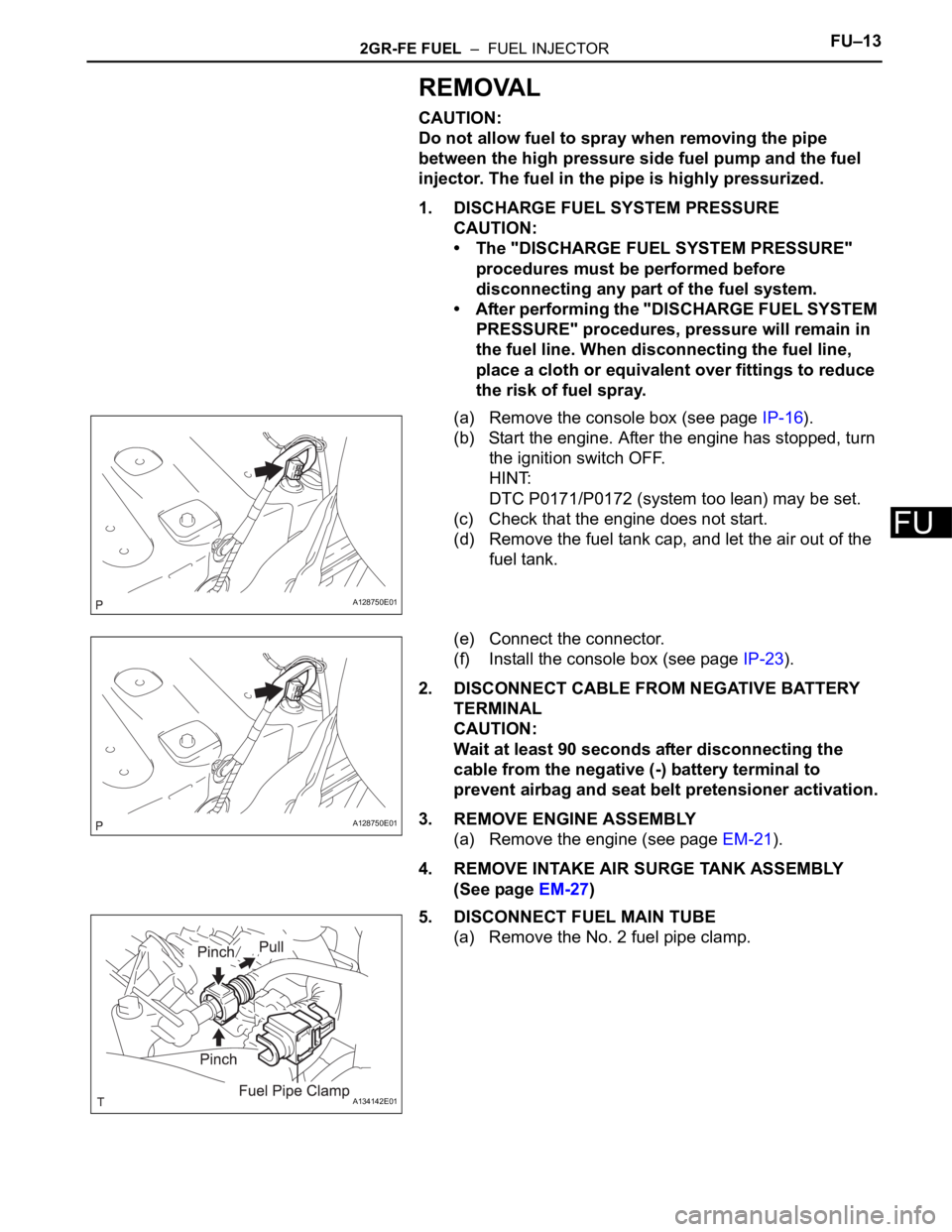
(e) Connect the connector.
(f) Install the console box (see page IP-23).
2. DISCONNECT CABLE FROM NEGATIVE BATTERY
TERMINAL
CAUTION:
Wait at least 90 seconds after disconnecting the
cable from the negative (-) battery terminal to
prevent airbag and seat belt pretensioner activation.
3. REMOVE ENGINE ASSEMBLY
(a) Remove the engine (see page EM-21).
4. REMOVE INTAKE AIR SURGE TANK ASSEMBLY
(See page EM-27)
5. DISCONNECT FUEL MAIN TUBE
(a) Remove the No. 2 fuel pipe clamp.
A128750E01
A128750E01
A134142E01
Page 920 of 2000
2AZ-FE CHARGING – GENERATORCH–9
CH
REMOVAL
1. DISCONNECT CABLE FROM NEGATIVE BATTERY
TERMINAL
CAUTION:
Wait at least 90 seconds after disconnecting the
cable from the negative (-) battery terminal to
prevent airbag and seat belt pretensioner activation.
2. REMOVE FAN AND GENERATOR V BELT
(a) Remove the belt (see page EM-6).
3. REMOVE GENERATOR ASSEMBLY
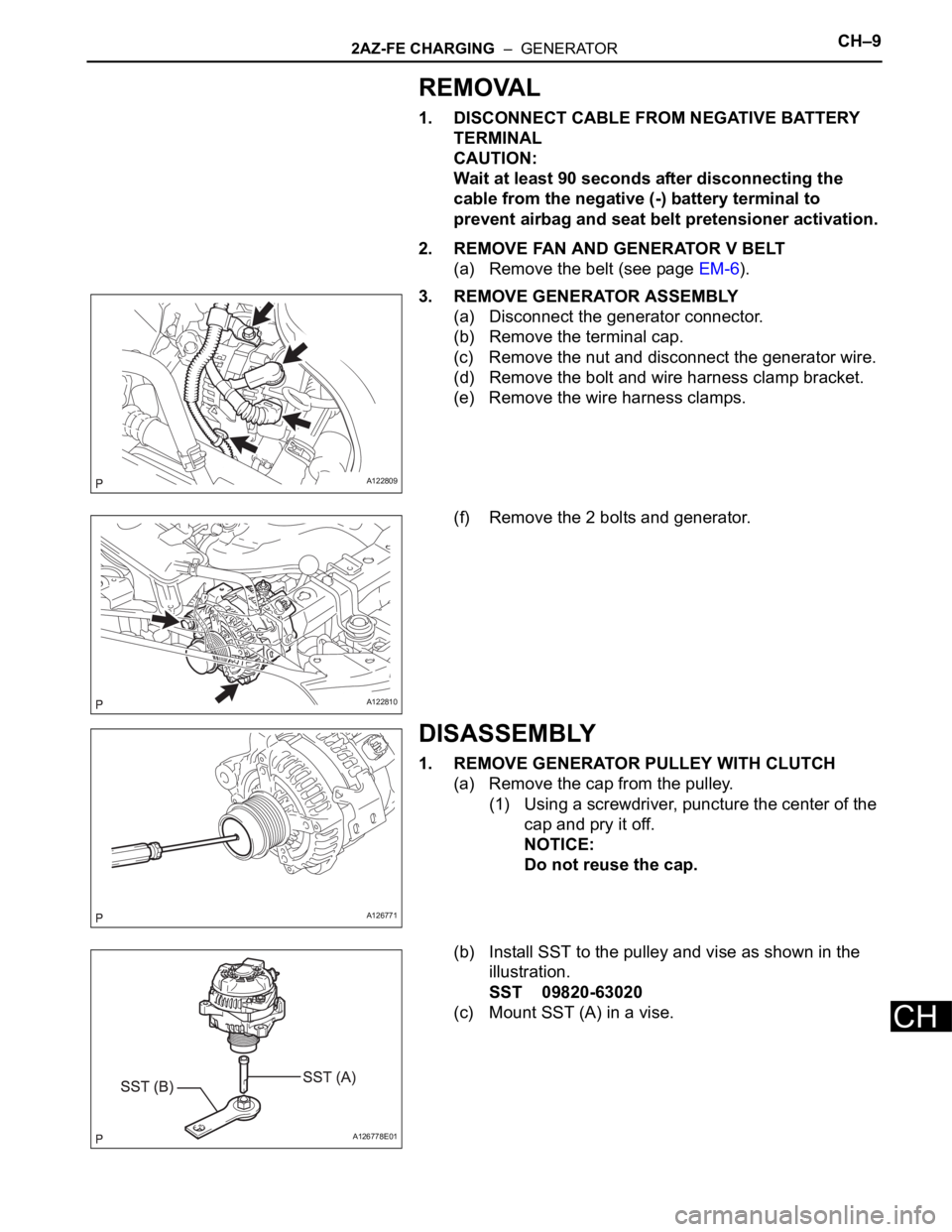
(a) Disconnect the generator connector.
(b) Remove the terminal cap.
(c) Remove the nut and disconnect the generator wire.
(d) Remove the bolt and wire harness clamp bracket.
(e) Remove the wire harness clamps.
(f) Remove the 2 bolts and generator.
DISASSEMBLY
1. REMOVE GENERATOR PULLEY WITH CLUTCH
(a) Remove the cap from the pulley.
(1) Using a screwdriver, puncture the center of the
cap and pry it off.
NOTICE:
Do not reuse the cap.
(b) Install SST to the pulley and vise as shown in the
illustration.
SST 09820-63020
(c) Mount SST (A) in a vise.
A122809
A122810
A126771
A126778E01
Page 1677 of 2000
RS–28SUPPLEMENTAL RESTRAINT SYSTEM – AIRBAG SYSTEM
RS
(e) SRS WARNING LIGHT
(1) The SRS warning light is located on the telltale
light. It comes on to inform the driver of system
trouble when a malfunction is detected in the
self-diagnosis of the center airbag sensor. Under
normal operating conditions when the ignition
switch is turned on, it comes on for
approximately 6 seconds and then goes off.
3. DEPLOYMENT CONDITION
When the vehicle collides and the shock is greater than
the specified value, the SRS is activated automatically.
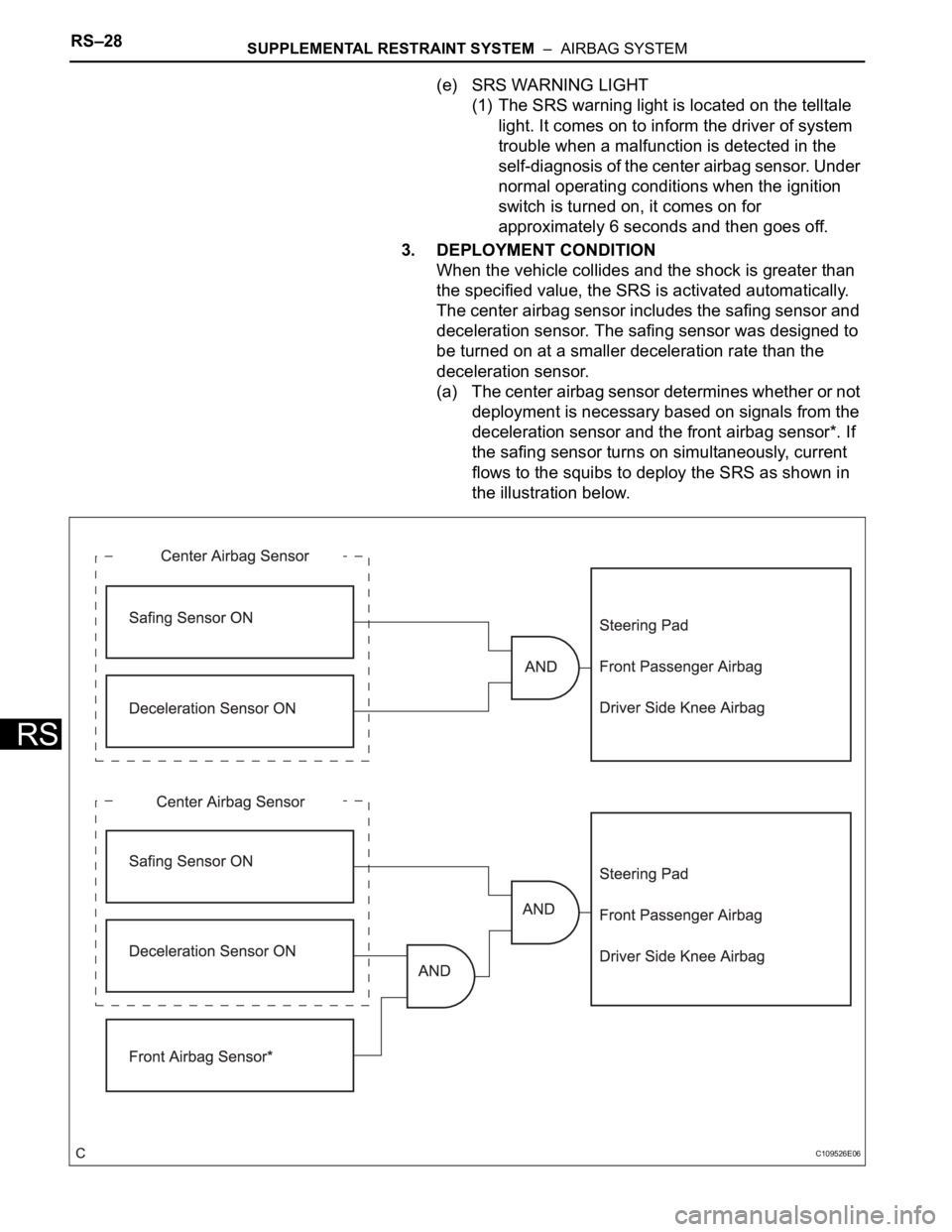
The center airbag sensor includes the safing sensor and
deceleration sensor. The safing sensor was designed to
be turned on at a smaller deceleration rate than the
deceleration sensor.
(a) The center airbag sensor determines whether or not
deployment is necessary based on signals from the
deceleration sensor and the front airbag sensor*. If
the safing sensor turns on simultaneously, current
flows to the squibs to deploy the SRS as shown in
the illustration below.
C109526E06
Page 1684 of 2000
SUPPLEMENTAL RESTRAINT SYSTEM – AIRBAG SYSTEMRS–35
RS
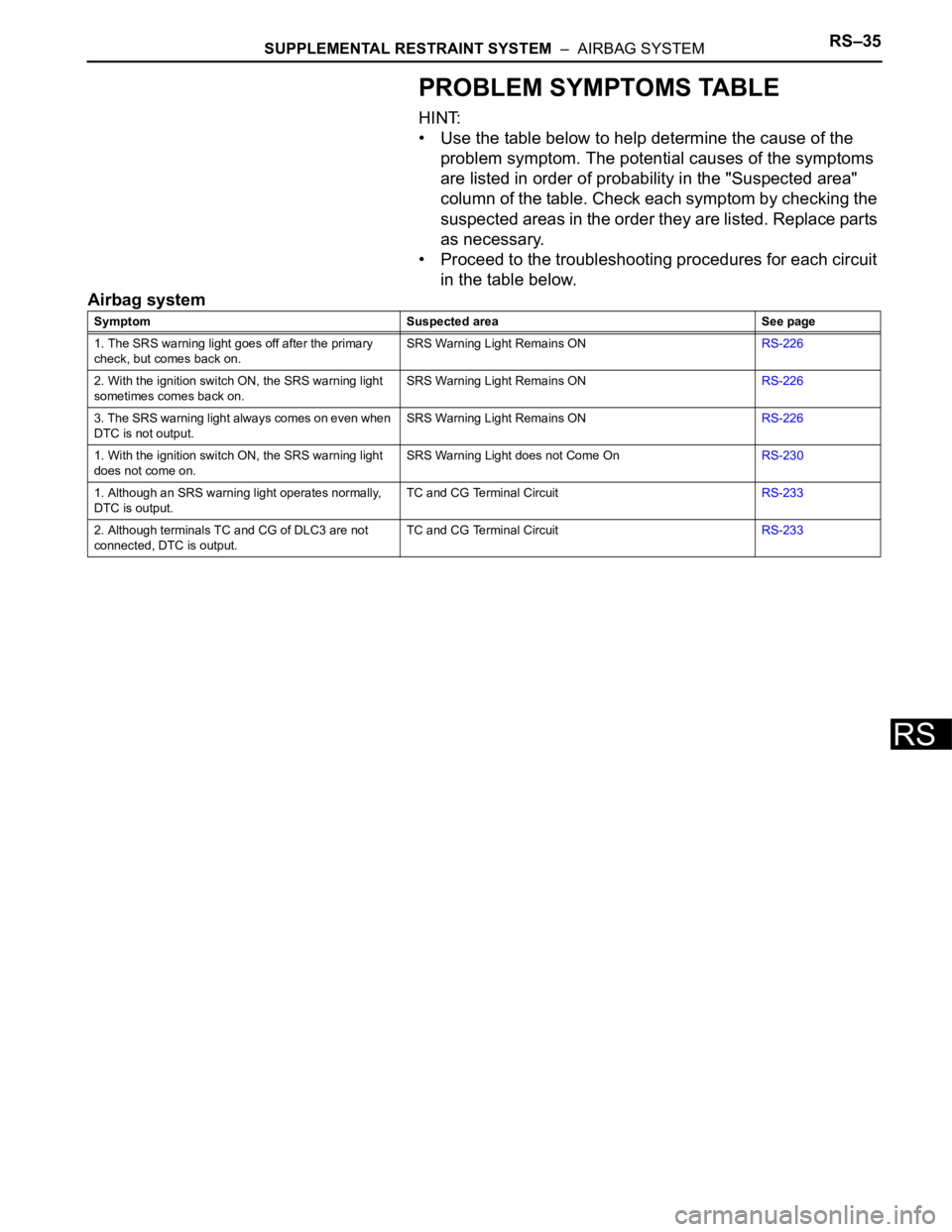
PROBLEM SYMPTOMS TABLE
HINT:
• Use the table below to help determine the cause of the
problem symptom. The potential causes of the symptoms
are listed in order of probability in the "Suspected area"
column of the table. Check each symptom by checking the
suspected areas in the order they are listed. Replace parts
as necessary.
• Proceed to the troubleshooting procedures for each circuit
in the table below.
Airbag system
Symptom Suspected area See page
1. The SRS warning light goes off after the primary
check, but comes back on.SRS Warning Light Remains ONRS-226
2. With the ignition switch ON, the SRS warning light
sometimes comes back on.SRS Warning Light Remains ONRS-226
3. The SRS warning light always comes on even when
DTC is not output.SRS Warning Light Remains ONRS-226
1. With the ignition switch ON, the SRS warning light
does not come on.SRS Warning Light does not Come OnRS-230
1. Although an SRS warning light operates normally,
DTC is output.TC and CG Terminal CircuitRS-233
2. Although terminals TC and CG of DLC3 are not
connected, DTC is output.TC and CG Terminal CircuitRS-233
Page 1686 of 2000
SUPPLEMENTAL RESTRAINT SYSTEM – AIRBAG SYSTEMRS–37
RS
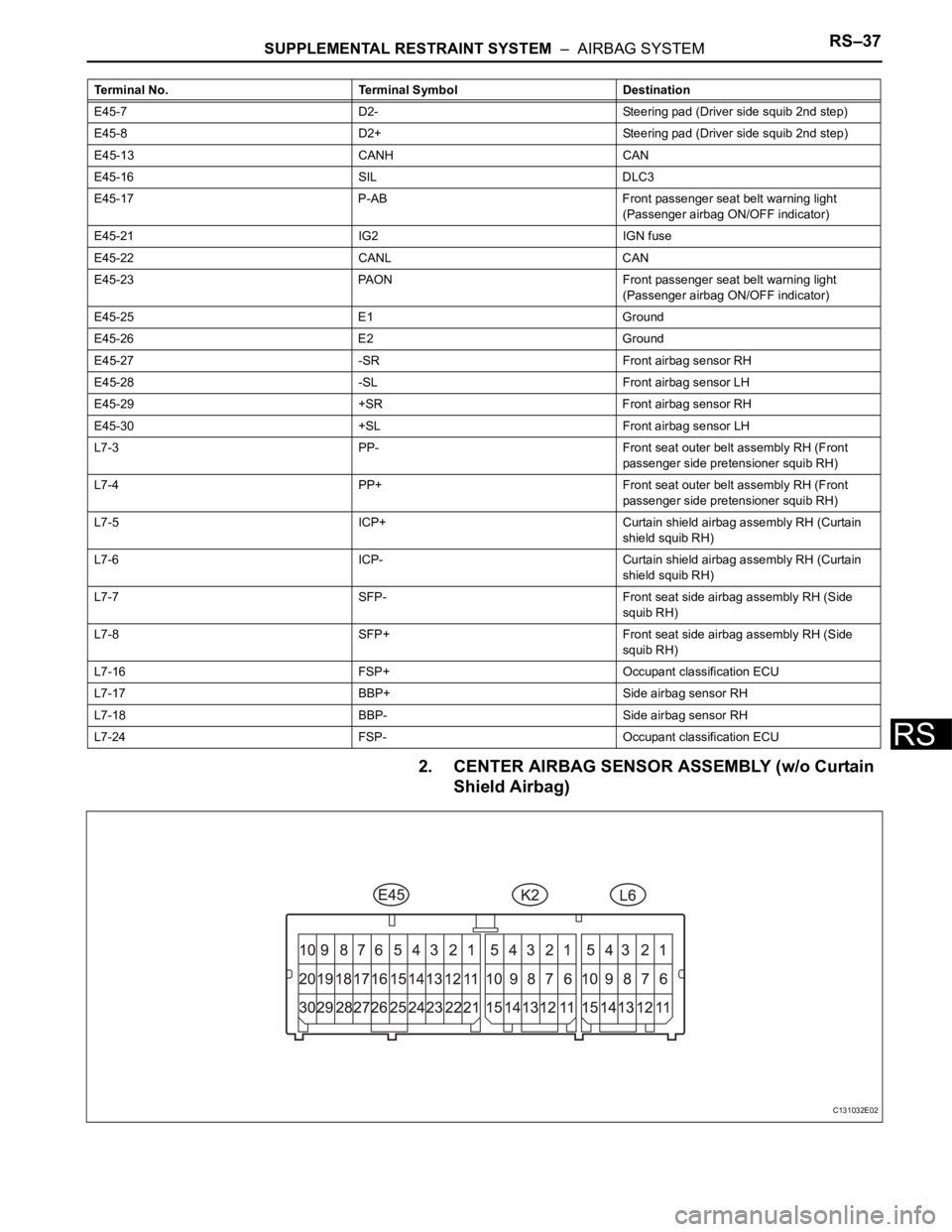
2. CENTER AIRBAG SENSOR ASSEMBLY (w/o Curtain
Shield Airbag)
E45-7 D2- Steering pad (Driver side squib 2nd step)
E45-8 D2+ Steering pad (Driver side squib 2nd step)
E45-13 CANH CAN
E45-16 SIL DLC3
E45-17 P-AB Front passenger seat belt warning light
(Passenger airbag ON/OFF indicator)
E45-21 IG2 IGN fuse
E45-22 CANL CAN
E45-23 PAON Front passenger seat belt warning light
(Passenger airbag ON/OFF indicator)
E45-25 E1 Ground
E45-26 E2 Ground
E45-27 -SR Front airbag sensor RH
E45-28 -SL Front airbag sensor LH
E45-29 +SR Front airbag sensor RH
E45-30 +SL Front airbag sensor LH
L7-3 PP- Front seat outer belt assembly RH (Front
passenger side pretensioner squib RH)
L7-4 PP+ Front seat outer belt assembly RH (Front
passenger side pretensioner squib RH)
L7-5 ICP+ Curtain shield airbag assembly RH (Curtain
shield squib RH)
L7-6 ICP- Curtain shield airbag assembly RH (Curtain
shield squib RH)
L7-7 SFP- Front seat side airbag assembly RH (Side
squib RH)
L7-8 SFP+ Front seat side airbag assembly RH (Side
squib RH)
L7-16 FSP+ Occupant classification ECU
L7-17 BBP+ Side airbag sensor RH
L7-18 BBP- Side airbag sensor RH
L7-24 FSP- Occupant classification ECU Terminal No. Terminal Symbol Destination
C131032E02