ECU TOYOTA RAV4 PHEV 2021 Manual Online
[x] Cancel search | Manufacturer: TOYOTA, Model Year: 2021, Model line: RAV4 PHEV, Model: TOYOTA RAV4 PHEV 2021Pages: 666, PDF Size: 161.28 MB
Page 567 of 666
565
8
8-2. Steps to take in an emergency
When trouble arises
When using a flat-bed truck to
transport the vehicle, use tire strap -
ping belts. Refer to the owner’s
manual of the flat-bed truck for the
tire strapping method.
In order to supp ress vehicle move-
ment during transportation, set the
parking brake and turn the power
switch off.
If a tow truck is not available in an
emergency, your vehicle may be
temporarily towed using cables or
chains secured to the emergency
towing eyelets. This should only be
attempted on hard surfaced roads
for short distances at under 30
km/h (18 mph).
A driver must be i n the vehicle to
steer and operate the brakes. The
vehicle’s wheels, drive train, axles,
steering and brakes must be in
good condition.
To have your vehicle towed by
another vehicle, the towing eyelet
must be installed to your vehicle.
Install the towing eyelet using the
following procedure.
1 Take out the wheel nut wrench
and towing eyelet. ( →P.583,
594)
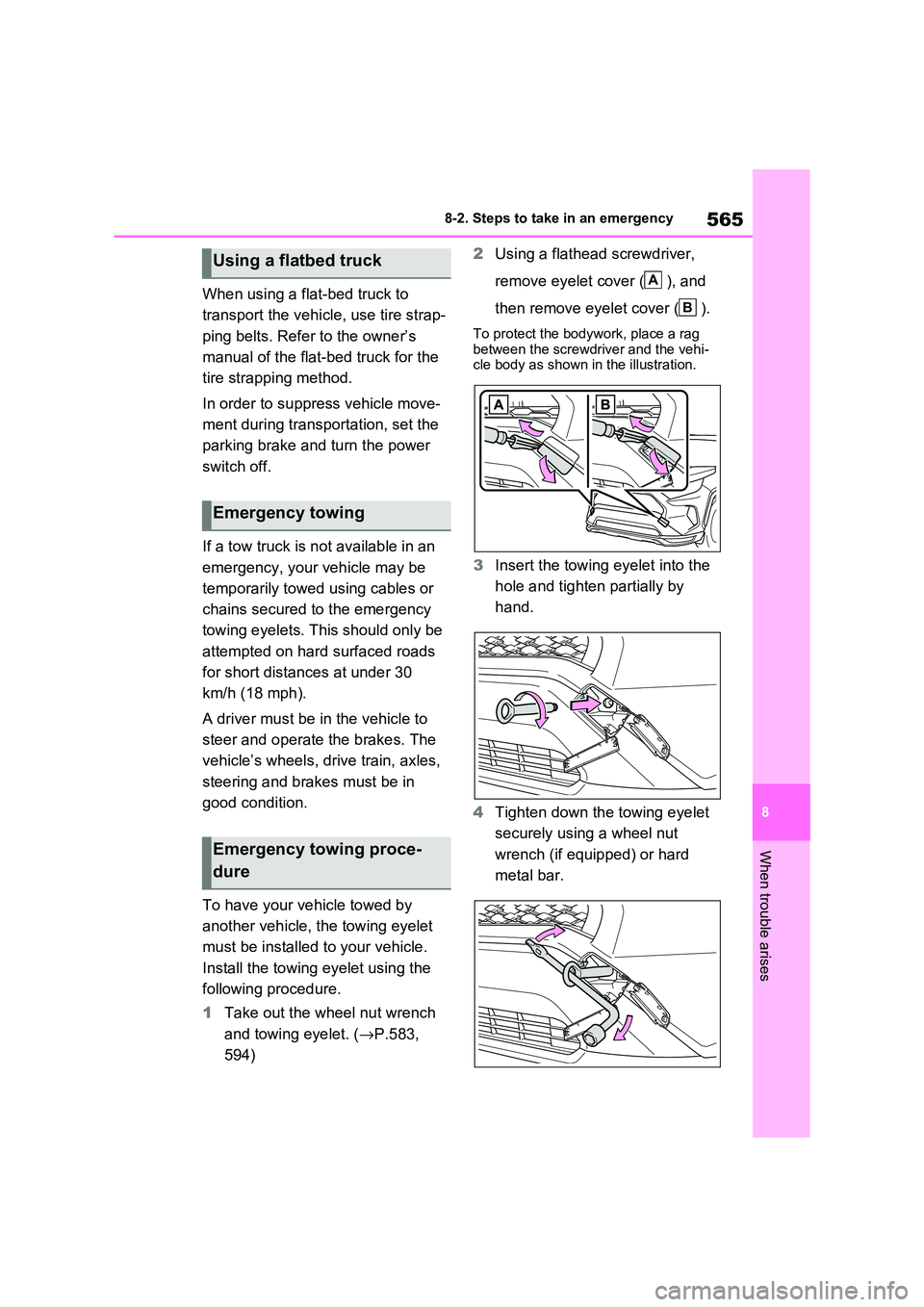
2 Using a flathead screwdriver,
remove eyelet cover ( ), and
then remove eyelet cover ( ).
To protect the bodywork, place a rag
between the screwdriver and the vehi - cle body as shown in the illustration.
3 Insert the towing eyelet into the
hole and tighten partially by
hand.
4 Tighten down the towing eyelet
securely using a wheel nut
wrench (if equipped) or hard
metal bar.
Using a flatbed truck
Emergency towing
Emergency towing proce -
dure
A
B
Page 568 of 666
5668-2. Steps to take in an emergency
5Securely attach cables or chains
to the towing eyelet.
Take care not to damage the vehicle
body.
6 Enter the vehicle being towed
and start the hybrid system.
Turn off the Parking Support Brake
function. (if equipped): →P.420
If the hybrid system d oes not start, turn
the power switch to ON.
7 Shift the shift lever to N and
release the parking brake.
Turn automatic mode off. ( →P.327)
When the shift lever cannot be shifted:
→ P.323
■While towing
If the hybrid system is not running, the
power assist for the brakes and steering will not function, making steering and
braking more difficult.
■Wheel nut wrench (if equipped)
Wheel nut wrench is installed in the deck under tray. ( →P.583, 594)
Fluid leaks under the vehicle
(Water dripping from the air con -
ditioning after use is normal.)
Flat-looking tires or uneven tire
wear
High coolant temperature warn-
ing light flashes or come on
Changes in exhaust sound
Excessive tire squeal when cor-
nering
Strange noises related to the
suspension system
Pinging or other noises related to
the hybrid system
Engine missing, stumbling or
running roughly
Appreciable loss of power
If you think something is
wrong
If you notice any of the follow -
ing symptoms, your vehicle
probably needs adjustment or
repair. Contact any authorized
Toyota retailer or Toyota
authorized repairer, or any reli -
able repairer as soon as possi -
ble.
Visible symptoms
Audible symptoms
Operational symptoms
Page 588 of 666
5868-2. Steps to take in an emergency
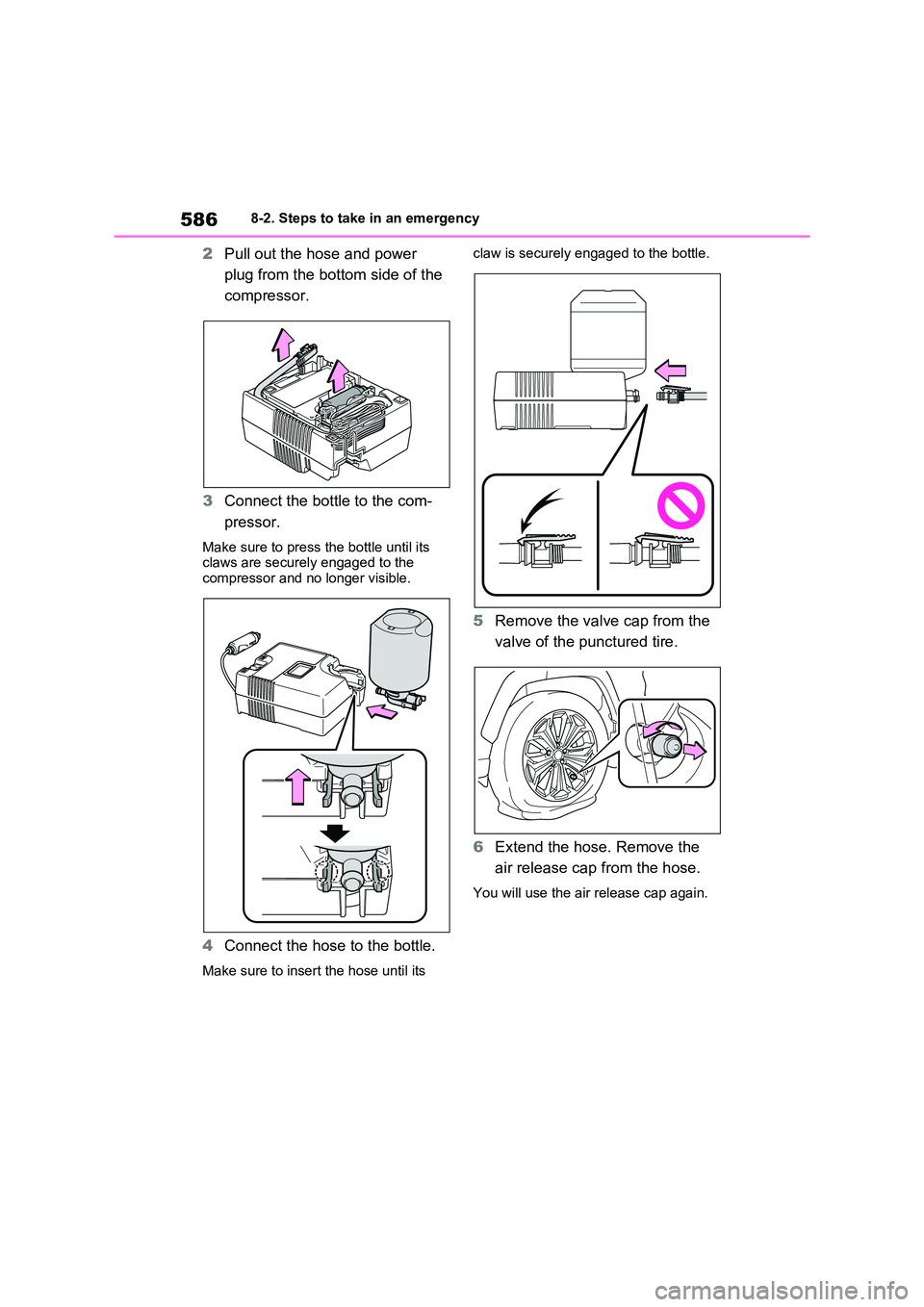
2Pull out the hose and power
plug from the bottom side of the
compressor.
3 Connect the bottle to the com-
pressor.
Make sure to press the bottle until its claws are securely engaged to the
compressor and no longer visible.
4 Connect the hose to the bottle.
Make sure to insert the hose until its
claw is securely engaged to the bottle.
5 Remove the valve cap from the
valve of the p unctured tire.
6 Extend the hose. Remove the
air release cap from the hose.
You will use the air release cap again.
Page 592 of 666
5908-2. Steps to take in an emergency
may get dirty.
24 Store the bottle in the luggage
compartment while it is con -
nected to the compressor.
25 Taking precautions to avoid
sudden braking, sudden accel -
eration and sharp turns, drive
carefully at under 80 km/h (50
mph) to the nearest authorized
Toyota retailer or Toyota autho -
rized repairer, or reliable
repairer that is less than 100 km
(62 miles) away for tire repair or
replacement.
For repair and replacement of a tire or
disposal of the tire puncture repair kit, contact any authoriz ed Toyota retailer
or Toyota authorized repairer, or any
reliable repairer.
When having the tire repaired or
replaced, make sure to tell the autho -
rized Toyota retaile r or Toyota autho- rized repairer, or reliable repairer that
the sealant is injected.
■If the tire is inflated to more than
the specified air pressure
1 Disconnect the hose from the valve.
2 Install the air release cap to the end of the hose and push the protrusion
on the air release cap into the tire
valve to let some air out.
3 Disconnect the hose from the valve, remove the air rel ease cap from the
hose and then reconnect the hose.
4 Turn the compressor switch on and
wait for several s econds, and then turn it off. Check that the air pres -
sure indicator shows the specified
air pressure.
If the air pressure is under the desig -
nated pressure, turn the compressor
switch on again and repeat the inflation procedure until the specified air pres-
sure is reached.
■After a tire is re paired with the
emergency tire puncture repair kit
●The tire pressure warning valve and
transmitter should be replaced.
●Even if the tire inflat ion pressure is at
the recommended level, the tire pres - sure warning light may come on/flash.
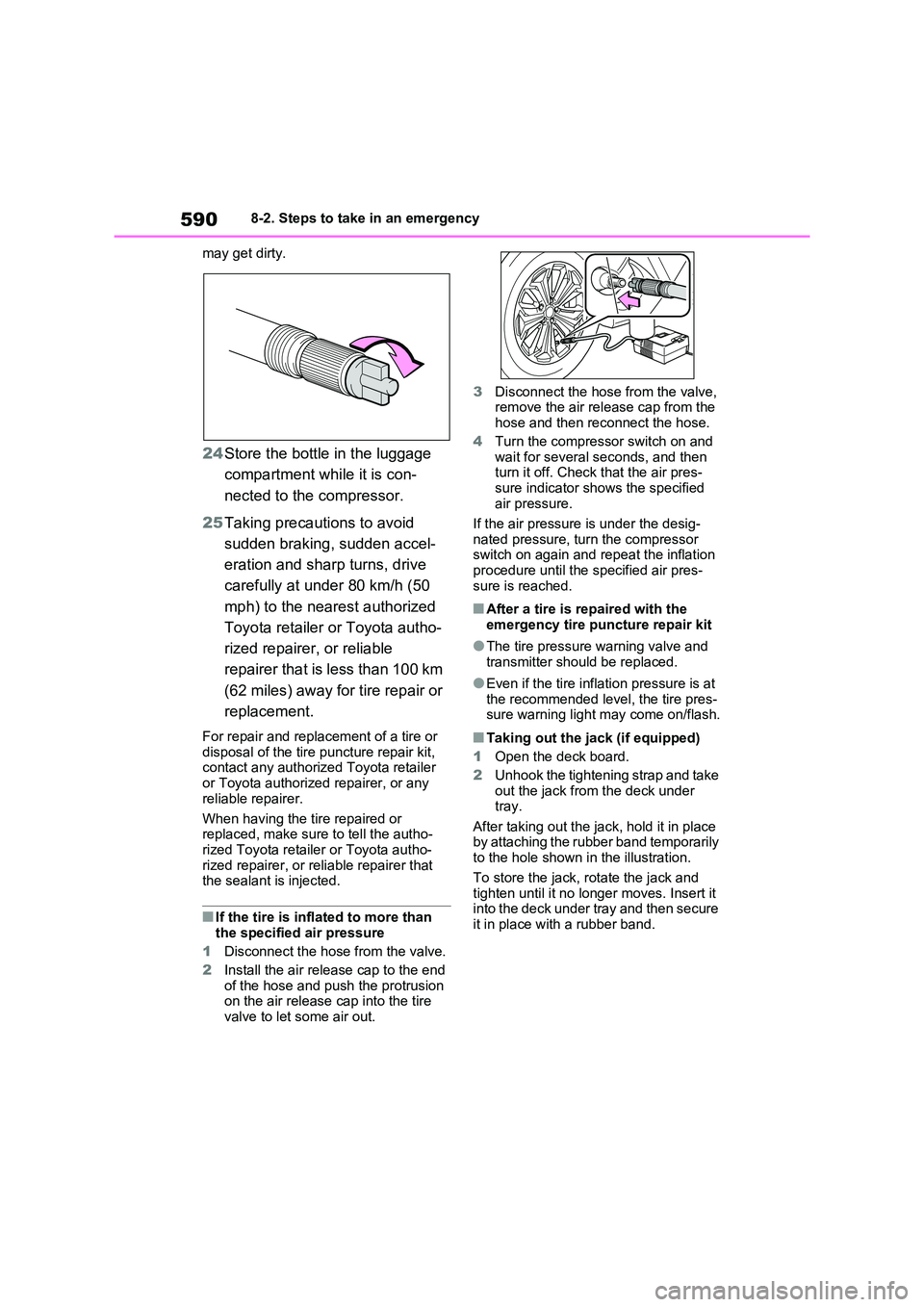
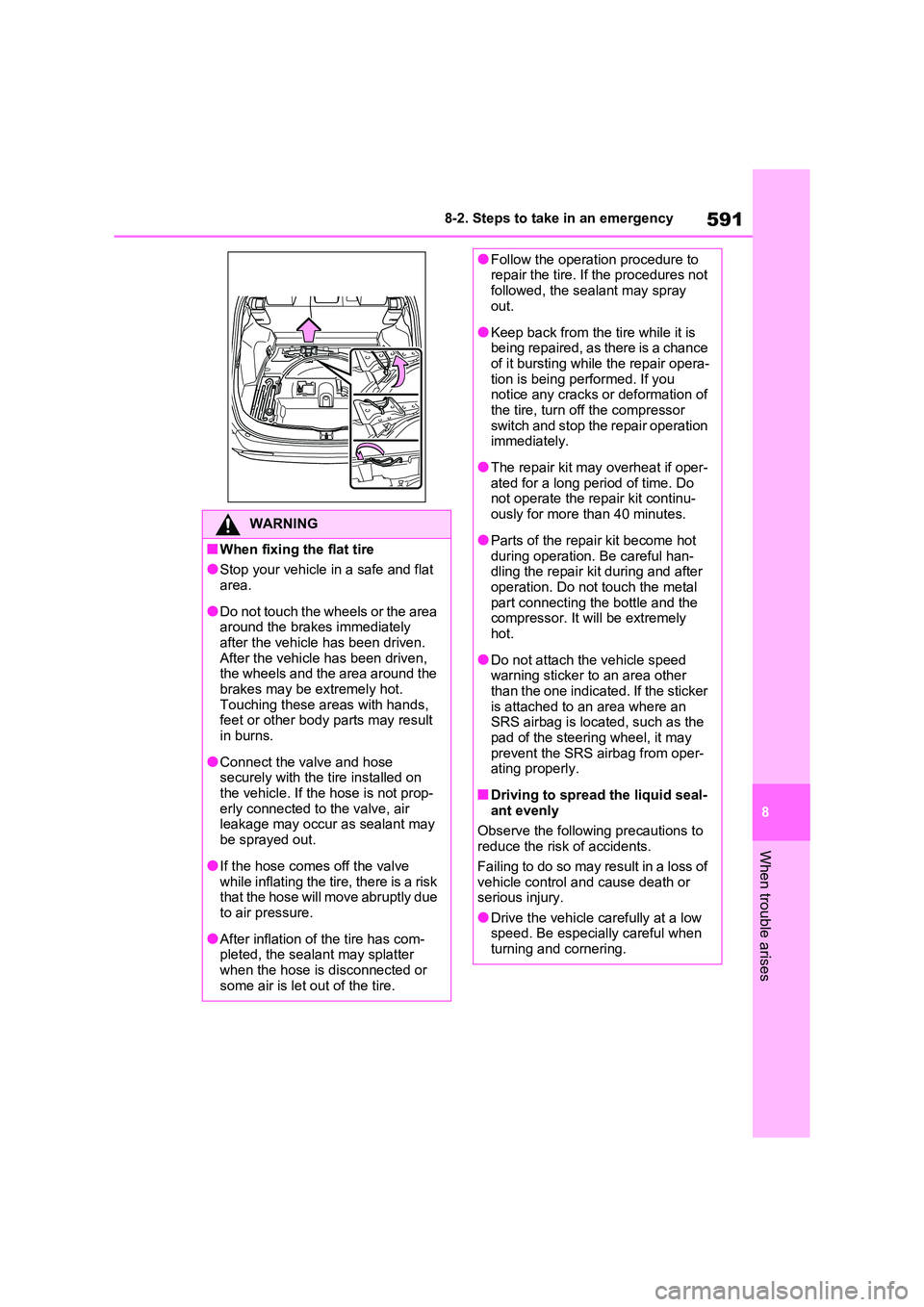
■Taking out the jack (if equipped)
1 Open the deck board.
2 Unhook the tightening strap and take out the jack from the deck under
tray.
After taking out the ja ck, hold it in place by attaching the rubber band temporarily
to the hole shown in the illustration.
To store the jack, rotate the jack and tighten until it no longer moves. Insert it
into the deck under tray and then secure
it in place with a rubber band.
Page 593 of 666
591
8
8-2. Steps to take in an emergency
When trouble arises
WARNING
■When fixing the flat tire
●Stop your vehicle in a safe and flat area.
●Do not touch the wheels or the area
around the brakes immediately after the vehicle has been driven.
After the vehicle has been driven,
the wheels and the area around the brakes may be extremely hot.
Touching these areas with hands,
feet or other body parts may result in burns.
●Connect the valve and hose securely with the tire installed on
the vehicle. If the hose is not prop-
erly connected to the valve, air leakage may occur as sealant may
be sprayed out.
●If the hose comes off the valve
while inflating the tire, there is a risk
that the hose will move abruptly due to air pressure.
●After inflation of the tire has com - pleted, the sealant may splatter
when the hose is disconnected or
some air is let out of the tire.
●Follow the operation procedure to repair the tire. If the procedures not
followed, the seal ant may spray
out.
●Keep back from the tire while it is
being repaired, as there is a chance of it bursting while the repair opera -
tion is being performed. If you
notice any cracks or deformation of the tire, turn off the compressor
switch and stop the repair operation
immediately.
●The repair kit may overheat if oper-
ated for a long period of time. Do not operate the repair kit continu -
ously for more than 40 minutes.
●Parts of the repair kit become hot
during operation. Be careful han -
dling the repair kit during and after operation. Do not touch the metal
part connecting the bottle and the
compressor. It will be extremely hot.
●Do not attach the vehicle speed warning sticker to an area other
than the one indicated. If the sticker
is attached to an area where an SRS airbag is located, such as the
pad of the steering wheel, it may
prevent the SRS airbag from oper - ating properly.
■Driving to spread the liquid seal- ant evenly
Observe the following precautions to
reduce the risk of accidents.
Failing to do so may result in a loss of
vehicle control and cause death or
serious injury.
●Drive the vehicle carefully at a low speed. Be especially careful when
turning and cornering.
Page 597 of 666
595
8
8-2. Steps to take in an emergency
When trouble arises
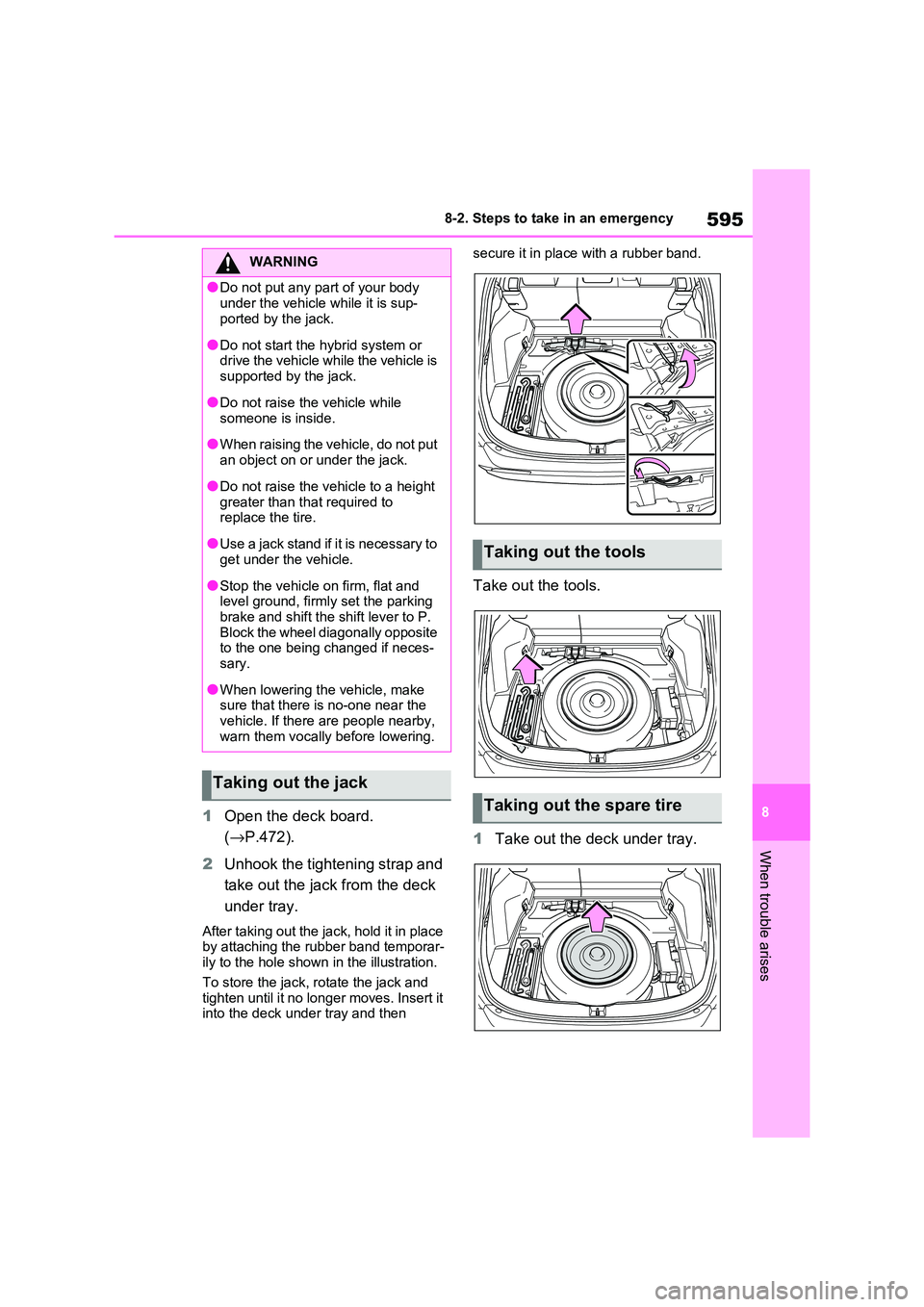
1 Open the deck board.
( →P.472).
2 Unhook the tightening strap and
take out the jack from the deck
under tray.
After taking out the jack, hold it in place
by attaching the r ubber band temporar- ily to the hole shown in the illustration.
To store the jack, rotate the jack and
tighten until it no longer moves. Insert it into the deck under tray and then
secure it in place with a rubber band.
Take out the tools.
1 Take out the deck under tray.
WARNING
●Do not put any part of your body
under the vehicle while it is sup-
ported by the jack.
●Do not start the h ybrid system or
drive the vehicle while the vehicle is supported by the jack.
●Do not raise the vehicle while
someone is inside.
●When raising the vehicle, do not put
an object on or under the jack.
●Do not raise the v ehicle to a height
greater than that required to replace the tire.
●Use a jack stand if it is necessary to get under the vehicle.
●Stop the vehicle on firm, flat and level ground, firml y set the parking
brake and shift the shift lever to P.
Block the wheel diagonally opposite to the one being changed if neces -
sary.
●When lowering the vehicle, make
sure that there is no-one near the
vehicle. If there a re people nearby, warn them vocally before lowering.
Taking out the jack
Taking out the tools
Taking out the spare tire
Page 598 of 666
5968-2. Steps to take in an emergency
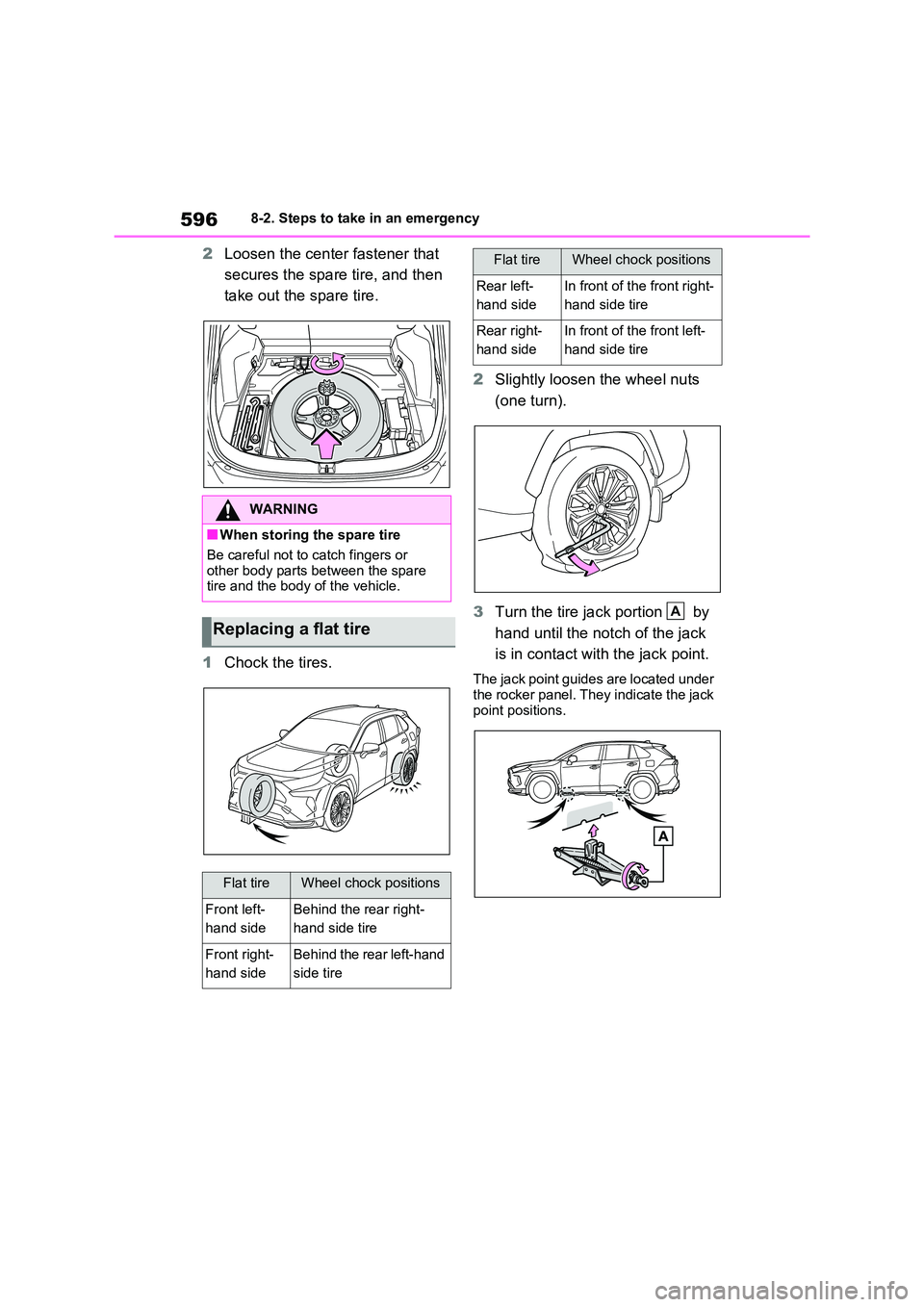
2Loosen the center fastener that
secures the spar e tire, and then
take out the spare tire.
1 Chock the tires.
2 Slightly loosen the wheel nuts
(one turn).
3 Turn the tire jack portion by
hand until the notch of the jack
is in contact with the jack point.
The jack point guides are located under
the rocker panel. They indicate the jack
point positions.
WARNING
■When storing the spare tire
Be careful not to catch fingers or
other body parts bet ween the spare tire and the body of the vehicle.
Replacing a flat tire
Flat tireWheel chock positions
Front left-
hand side
Behind the rear right-
hand side tire
Front right-
hand side
Behind the rear left-hand
side tire
Rear left-
hand side
In front of the front right-
hand side tire
Rear right-
hand side
In front of the front left-
hand side tire
Flat tireWheel chock positions
A
Page 602 of 666
6008-2. Steps to take in an emergency
WARNING
■When using the compact spare
tire
●Remember that the compact spare tire provided is specifically
designed for use with your vehicle.
Do not use your compact spare tire on another vehicle.
●Do not use more than one compact
spare tire simultaneously.
●Replace the compact spare tire with
a standard tire as soon as possible.
●Avoid sudden acceleration, abrupt
steering, sudden braking and shift - ing operations that cause sudden
engine braking.
■When the compact spare tire is
attached
The vehicle speed may not be cor - rectly detected, and the following sys -
tems may not oper ate correctly:
• ABS & Brake assist
• VSC/Trailer Sway Control
•TRC
• Cruise control (if equipped)
• Dynamic radar cruise control with
full-speed range (if equipped)
• PCS (Pre-Collision System) (if
equipped)
• EPS
• LTA (Lane Tracing Assist) (if
equipped)
• Tire pressure warning system
• AHB (Automatic High Beam) (if equipped)
• BSM (Blind Spot Monitor) (if equipped)
• Rear view monitor system (if equipped)
• Panoramic view monitor (if equipped)
• Toyota parking assist monitor (if equipped)
• Toyota parking assist-sensor (if equipped)
• PKSB (Parking Support Brake) (if equipped)
• Navigation system (if equipped)
Also, not only can the following sys-
tem not be utilized fully, but it may actually negatively affect the drive-
train components:
• E-Four (Electro nic On-Demand AWD system)
■Speed limit when using the com - pact spare tire
Do not drive at speeds in excess of 80
km/h (50 mph) when a compact spare tire is installed on the vehicle.
The compact spare tire is not
designed for driving at high speeds. Failure to observe this precaution
may lead to an accident causing
death or serious injury.
■After using the tools and jack
Before driving, make sure all the tools and jack are securely in place in their
storage location to reduce the possi -
bility of personal i njury during a colli- sion or sudden braking.
NOTICE
■Be careful when driving over
bumps with the compact spare
tire installed on the vehicle
The vehicle height may become lower
when driving with the compact spare
tire compared to w hen driving with standard tires. Be careful when driv-
ing over uneven road surfaces.
Page 610 of 666
6088-2. Steps to take in an emergency
minutes to recharge the 12-volt
battery of your vehicle.
6 Open and close any of the doors
of your vehicle with the power
switch off.
7 Maintain the engine speed of
the second vehicle and start the
hybrid system of your vehicle by
turning the power switch to ON.
8 Make sure the “READY” indica-
tor comes on. If the indicator
light does not come on, contact
any authorized Toyota retailer or
Toyota authorized repairer, or
any reliable repairer.
9 Once the hybrid system has
started, remove the jumper
cables in the exact reverse
order from which they were con -
nected.
10 Close the exclusive jump start-
ing terminal cover, and reinstall
the fuse box cover to its original
position.
Once the hybrid system starts,
have the vehicle inspected at any
authorized Toyota retailer or Toyota
authorized repairer, or any reliable
repairer as soon as possible.
■Starting the hybrid system when
the 12-volt battery is discharged
The hybrid system c annot be started by push-starting.
■To prevent 12-volt battery dis -
charge
●Turn off the headlights and the audio
system while the hybrid system is off.
●Turn off any unnecessary electrical
components when the vehicle is run - ning at a low speed for an extended
period, such as in heavy traffic.
■When the 12-volt battery is
removed or discharged
●Information stored in the ECU is
cleared. When the 12 -volt battery is depleted, have the vehicle inspected
at any authorized Toyota retailer or
Toyota authorized repairer, or any reli - able repairer.
●Some systems may r equire initializa- tion. ( →P.643)
■When removing the 12-volt battery
terminals
When the 12-volt batte ry terminals are removed, the in formation stored in the
ECU is cleared. Before removing the 12-
volt battery termi nals, contact any authorized Toyota r etailer or Toyota
authorized repairer, or any reliable
repairer.
■Charging the 12-volt battery
The electricity stor ed in the 12-volt bat-
tery will discharge gr adually even when
the vehicle is not in use, due to natural discharge and the dr aining effects of
certain electrical appliances. If the vehi -
cle is left for a long time, the 12-volt bat- tery may discharge, and the hybrid
system may be unable t o start. (The 12-
volt battery recharges automatically while the hybrid syst em is operating.)
■When recharging or replacing the
12-volt battery
●In some cases, it may not be possible
to unlock the doors using the smart
entry & start system when the 12-volt
battery is discharged. Use the wire - less remote control o r the mechanical
key to lock or unlock the doors.
●The hybrid system may not start on
the first attempt after reinstalling the
12-volt battery. In t hat case, start the hybrid system in t he same manner as
when the electr onic key does not
operate properly ( →P.605). This is not
Page 611 of 666
609
8
8-2. Steps to take in an emergency
When trouble arises
a malfunction, as the hybrid system
will start normally on the second attempt.
●The power switch mode is memorized by the vehicle. When the 12-volt bat-
tery is reconnected , the system will
return to the mode it was in before the 12-volt battery was discharged.
Before disconnecting the 12-volt bat -
tery, turn the power switch off. If you are unsure what mode the
power switch was in before the 12-volt
battery discharged, be especially careful when reconnecting the 12-volt
battery.
■When replacing the 12-volt battery
●Use a 12-volt battery that conforms to
European regulations.
●Use a 12-volt batt ery that the case
size is same as the previous one
(LN2), 20 hours rate capacity (20HR) is equivalent (55Ah ) or greater, and
performance rating (CCA) is equiva -
lent (345A) or greater. • If the sizes differ, the 12-volt battery
cannot be properly secured.
• If the 20 hour rate capacity is low, even if the time period where the vehi -
cle is not used is a short time, the 12-
volt battery may discharge and hybrid system may not be able to start.
●Use a ventilation type calcium battery
●Use a 12-volt battery with a handle. If
a 12-volt battery without a handle is used, removal is more difficult.
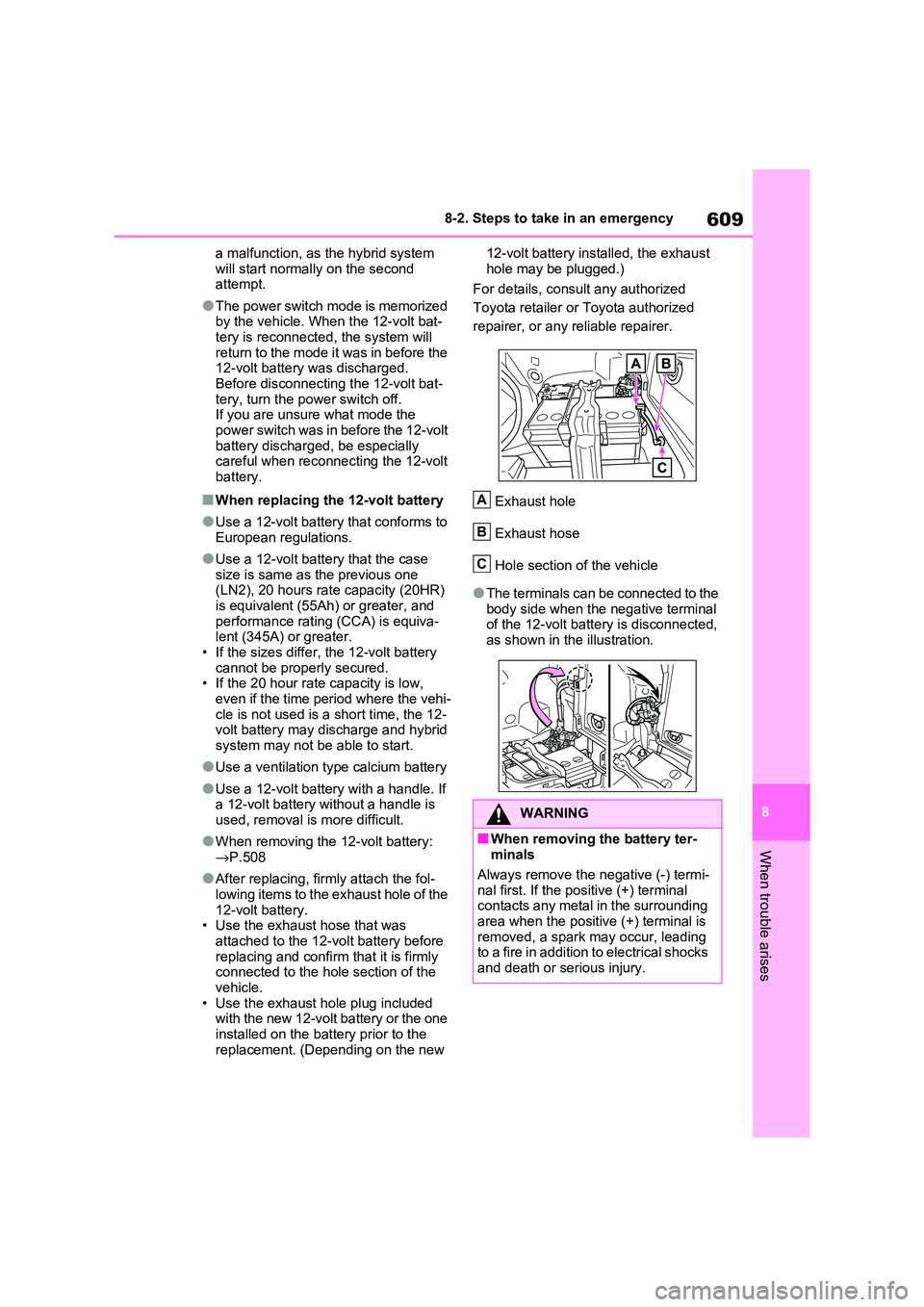
●When removing the 12-volt battery: → P.508
●After replacing, firmly attach the fol- lowing items to the exhaust hole of the
12-volt battery.
• Use the exhaust hose that was
attached to the 12-volt battery before replacing and confirm that it is firmly
connected to the hole section of the
vehicle. • Use the exhaust hole plug included
with the new 12-volt battery or the one
installed on the battery prior to the replacement. (Depending on the new
12-volt battery installed, the exhaust
hole may be plugged.)
For details, consult any authorized
Toyota retailer or Toyota authorized
repairer, or any reliable repairer.
Exhaust hole
Exhaust hose
Hole section of the vehicle
●The terminals can be connected to the
body side when the negative terminal of the 12-volt batte ry is disconnected,
as shown in the illustration.
WARNING
■When removing the battery ter -
minals
Always remove the negative (-) termi-
nal first. If the posi tive (+) terminal
contacts any metal in the surrounding area when the positiv e (+) terminal is
removed, a spark m ay occur, leading
to a fire in addition to electrical shocks and death or serious injury.
A
B
C