emergency towing TOYOTA RAV4 PLUG-IN HYBRID 2021 Owners Manual
[x] Cancel search | Manufacturer: TOYOTA, Model Year: 2021, Model line: RAV4 PLUG-IN HYBRID, Model: TOYOTA RAV4 PLUG-IN HYBRID 2021Pages: 666, PDF Size: 161.28 MB
Page 17 of 666
15Pictorial index
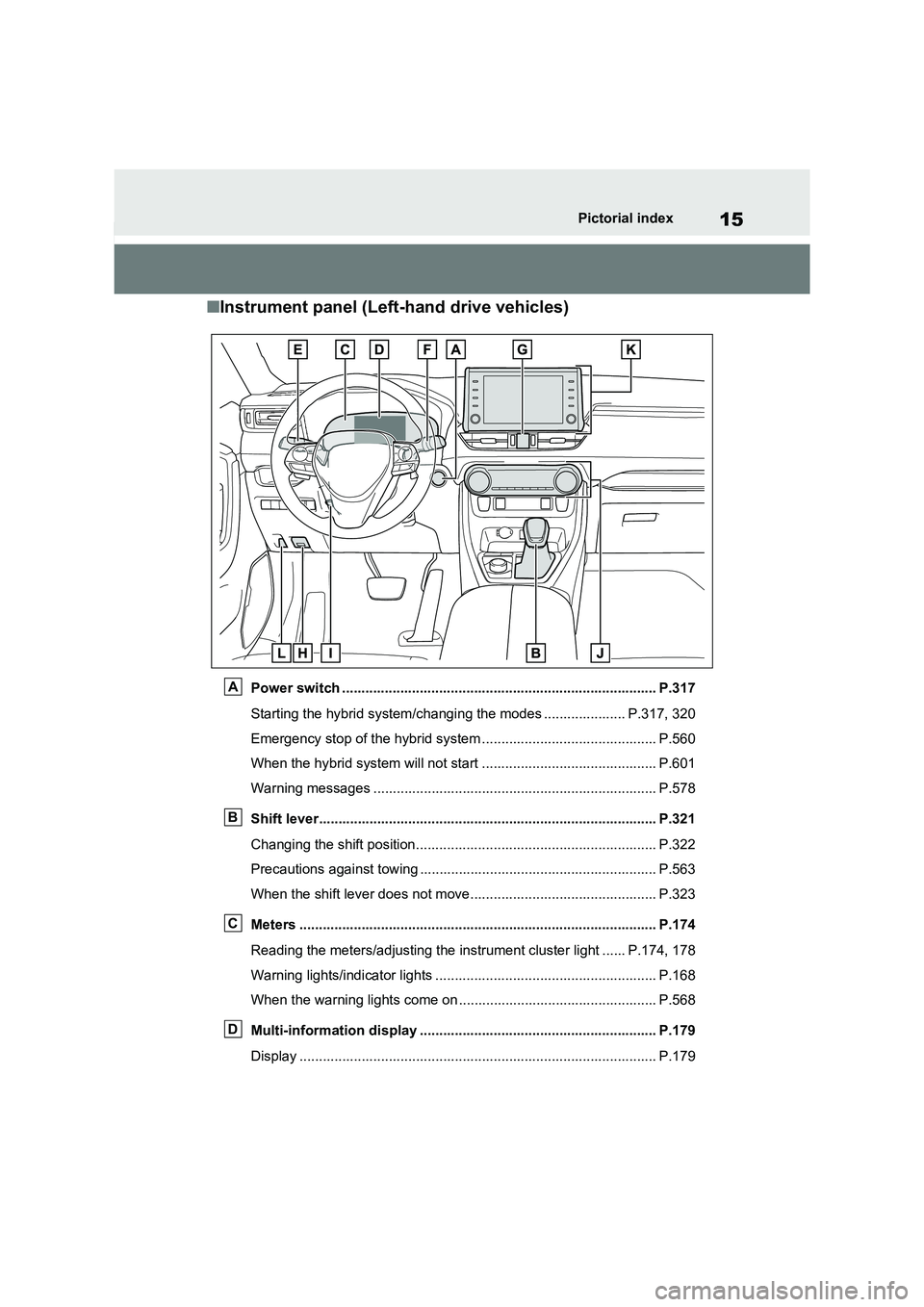
■Instrument panel (Left-hand drive vehicles)
Power switch ................................................................................. P.317
Starting the hybrid system/ch anging the modes ..................... P.317, 320
Emergency stop of the hybrid system ............................................. P.560
When the hybrid syst em will not start ............................................. P.601
Warning messages ............................................... .......................... P.578
Shift lever.................................................... ................................... P.321
Changing the shift position.. ............................................................ P.322
Precautions against towing ..................................... ........................ P.563
When the shift lever does not m ove................................................ P.323
Meters ......................................................... ................................... P.174
Reading the meters/adjusting the instrument cluster light ......P.174, 178
Warning lights/indicator lig hts ......................................................... P.168
When the warning lights come on ................................ ................... P.568
Multi-information display ...................................... ....................... P.179
Display ........................................................ .................................... P.179
A
B
C
D
Page 25 of 666
23Pictorial index
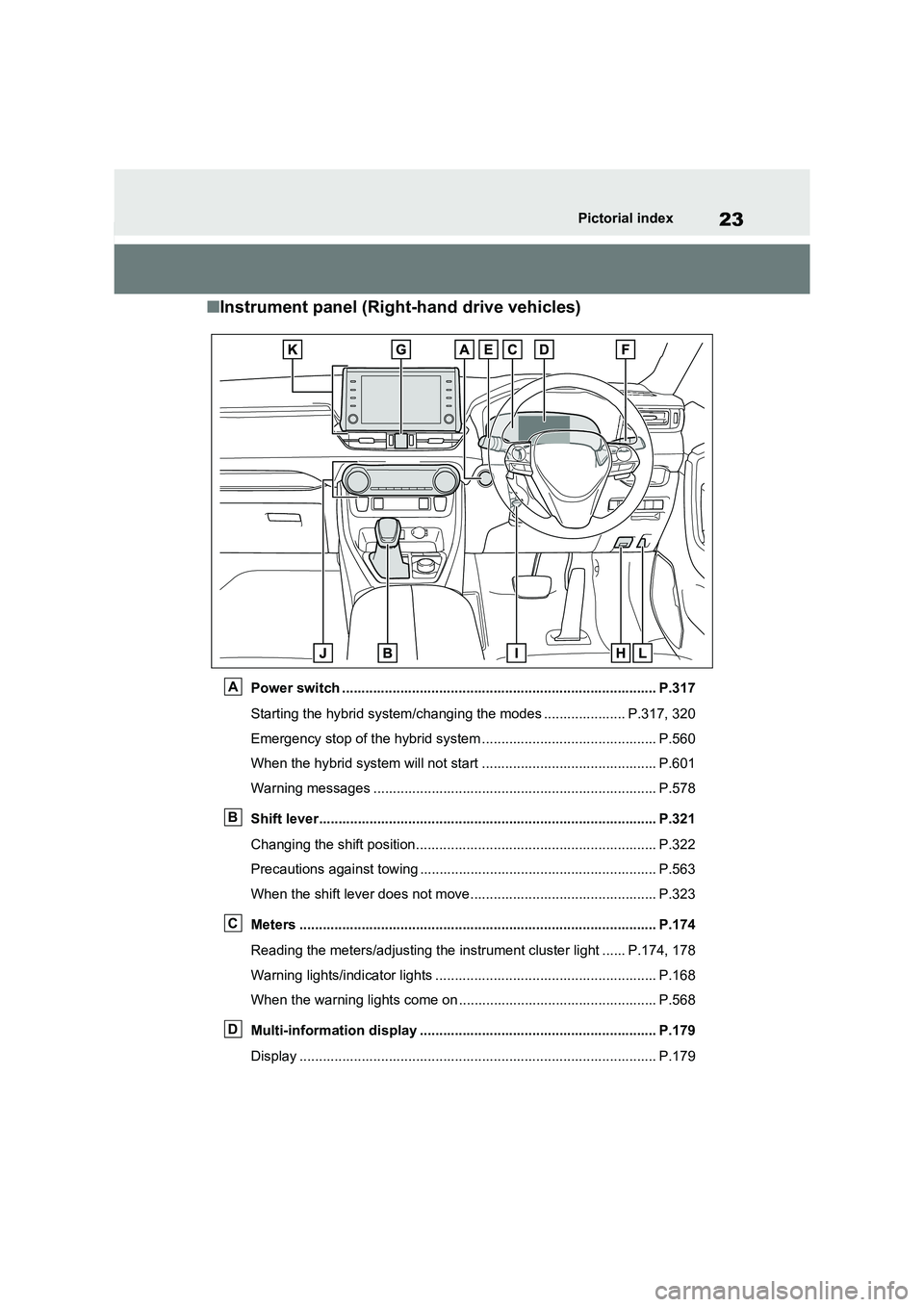
■Instrument panel (Right-hand drive vehicles)
Power switch ................................................................................. P.317
Starting the hybrid system/ch anging the modes ..................... P.317, 320
Emergency stop of the hybrid system ............................................. P.560
When the hybrid syst em will not start ............................................. P.601
Warning messages ............................................... .......................... P.578
Shift lever.................................................... ................................... P.321
Changing the shift position.. ............................................................ P.322
Precautions against towing ..................................... ........................ P.563
When the shift lever does not m ove................................................ P.323
Meters ......................................................... ................................... P.174
Reading the meters/adjusting the instrument cluster light ......P.174, 178
Warning lights/indicator lig hts ......................................................... P.168
When the warning lights come on ................................ ................... P.568
Multi-information display ...................................... ....................... P.179
Display ........................................................ .................................... P.179
A
B
C
D
Page 310 of 666
3085-1. Before driving
■Tire information
●Increase the tire inflation pressure to
20.0 kPa (0.2 kgf/cm2 or bar, 3 psi) greater than the recommended value
when towing. ( →P.624)
●Increase the air pressure of the trailer
tires in accordance with the total
trailer weight and according to the val - ues recommended by the manufac -
turer of your trailer.
■Safety checks before towing
●Check that the maximum load limit for
the towing hitch/bracket and hitch ball
is not exceeded. Bear in mind that the coupling weight of the trailer will add
to the load exerted on the vehicle.
Also make sure tha t the total load exerted on the vehi cle is within the
range of the weight limits. ( →P.309)
●Ensure that the trailer load is secure.
●Supplementary outside rear view mir- rors should be added to the vehicle if
the traffic behind c annot be clearly
seen with standard mirrors. Adjust the extending arms of these mirrors on
both sides of the vehicle so that they
always provide maxi mum visibility of the road behind.
Trailer towing
Your vehicle is designed pri -
marily as a passenger carry -
ing vehicle. Towing a trailer
will have an adverse effect on
handling, performance, brak -
ing, durability, and fuel con -
sumption. Your safety and
satisfaction depend on the
proper use of correct equip -
ment and cautious driving hab -
its. For your safety and the
safety of others, do not over -
load the vehicle or trailer.
To tow a trailer safely, use
extreme care and drive the
vehicle in accordance with the
trailer’s characteristics and
operating conditions.
Toyota warranties do not apply
to damage or malfunction
caused by towing a trailer for
commercial purposes.
Ask your local authorized
Toyota retailer or Toyota
authorized repairer, or any reli -
able repairer for further details
before towing, as there are
additional legal requirements
in some countries.
WARNING
Follow all the instructions described in
this section.
Failure to do so could cause an acci - dent resulting in death or serious
injury.
■Trailer towing precautions
When towing, make sure that none of
the weight limits are exceeded.
( →P.309)
■To avoid accident or injury
●Vehicles with compact spare tire: Do not tow a trailer when the com -
pact spare tire is installed on your
vehicle.
●Vehicles with emergency tire punc -
ture repair kit: Do not tow a traile r when the tire
installed is repa ired with the emer-
gency tire puncture repair kit.
Page 365 of 666
363
5
5-5. Using the driving support systems
Driving
WARNING
■Before using LTA system
●Do not rely sole ly upon the LTA
system. The LTA system does not automatically drive the vehicle or
reduce the amount of attention that
must be paid to the area in front of the vehicle. The driver must always
assume full responsibility for driving
safely by paying careful attention to
the surrounding conditions and operating the stee ring wheel to cor-
rect the path of t he vehicle. Also,
the driver must take adequate breaks when fatigued, such as from
driving for a long period of time.
●Failure to perform appropriate driv -
ing operations and pay careful
attention may lead to an accident, resulting in death or serious injury.
●When not u sing the LTA system, use the LTA switch to turn the sys -
tem off.
■Situations unsuitable for LTA
system
In the following situations, use the LTA switch to tu rn the system off.
Failure to do so may lead to an acci -
dent, resulting in death or serious injury.
●Vehicle is driven on a road surface which is slippery due to rainy
weather, fallen snow, freezing, etc.
●Vehicle is driven on a snow-cov -
ered road.
●White (yellow) lines are difficult to
see due to rain, snow, fog, dust,
etc.
●Vehicle is driven in a temporary
lane or restricted lane due to con - struction work.
●Vehicle is driven in a construction zone.
●A spare tire, tire chains, etc. are equipped.
●When the tires have been exces - sively worn, or when the tire infla -
tion pressure is low.
●When tires of a size other than
specified are installed.
●Vehicle is driven in traffic lanes
other than that highways and free -
ways.
●When your vehicle is towing a
trailer or during emergency towing
■Preventing LTA system malfunc -
tions and operations performed by mistake
●Do not modify the headlights or
place stickers, etc. on the surface of the lights.
●Do not modify the suspension etc. If the suspension etc. needs to be
replaced, contact any authorized
Toyota retailer or Toyota authorized repairer, or any reliable repairer.
●Do not install or place anything on the hood or grille. Also, do not
install a grille guar d (bull bars, kan-
garoo bar, etc.).
●If your windshield needs repairs,
contact any autho rized Toyota retailer or Toyota authorized
repairer, or any reliable repairer.
■Conditions in which functions
may not operate properly
In the following situ ations, the func- tions may not operate properly and
the vehicle may depart from its lane.
Drive safely by always paying careful
attention to your surroundings and operate the steering wheel to correct
the path of the vehicle without relying
solely on the functions.
Page 381 of 666
379
5
5-5. Using the driving support systems
Driving
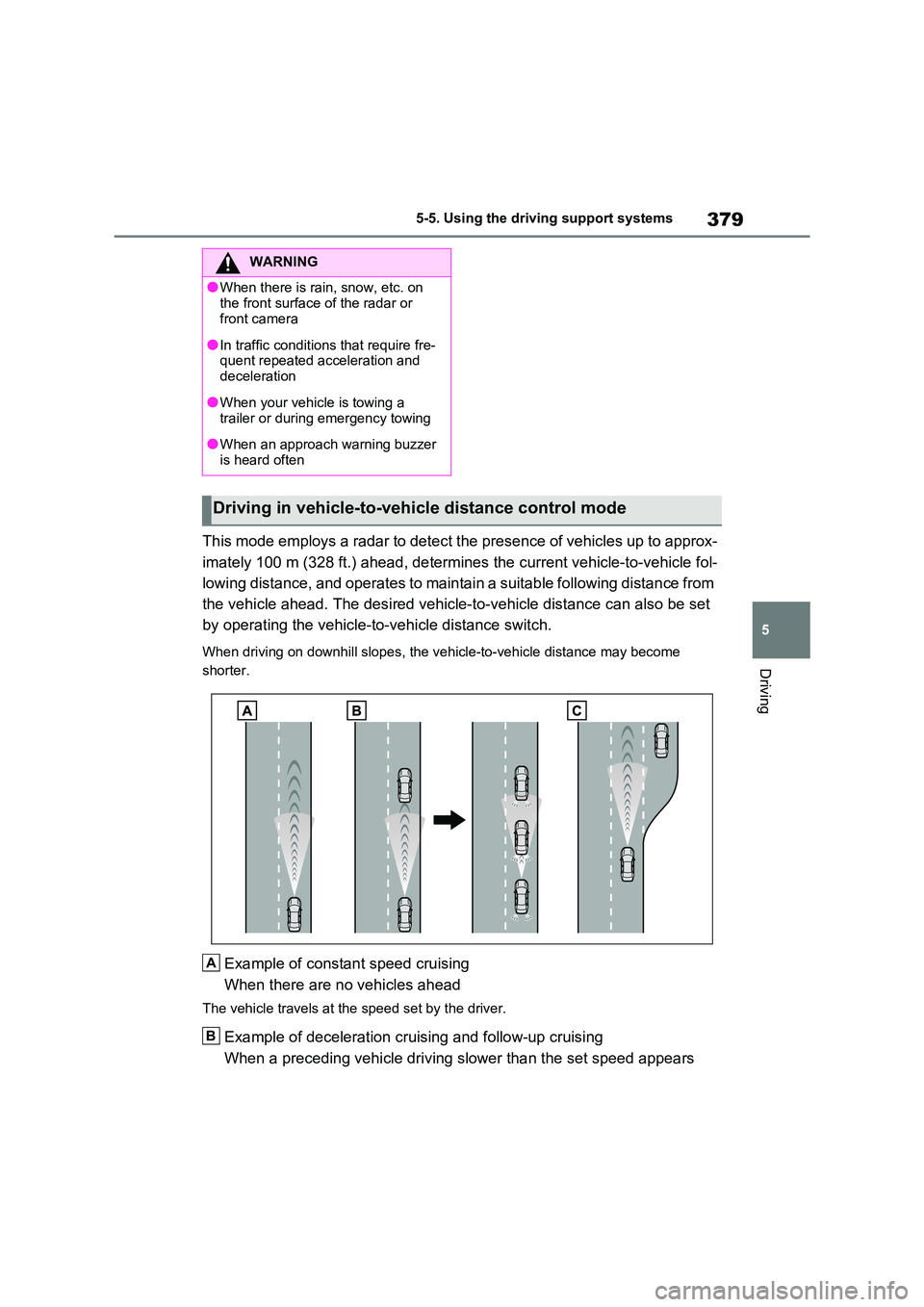
This mode employs a radar to detect the presence of vehicles up to approx-
imately 100 m (328 ft.) ahead, det ermines the current vehicle-to-vehicle fol-
lowing distance, and operates to m aintain a suitable following distance from
the vehicle ahead. The desired v ehicle-to-vehicle distance can also be set
by operating the vehicle-to -vehicle distance switch.
When driving on downhill slopes, the vehicle-to-vehicle distance may become
shorter.
Example of constant speed cruising
When there are no vehicles ahead
The vehicle travels at the speed set by the driver.
Example of deceleration cruising and follow-up cruising
When a preceding vehicle driving slower than the set speed appe ars
WARNING
●When there is rain, snow, etc. on
the front surface of the radar or
front camera
●In traffic conditions that require fre -
quent repeated acceleration and deceleration
●When your vehicle is towing a
trailer or during emergency towing
●When an approach warning buzzer
is heard often
Driving in vehicle-to-vehicle distance control mode
A
B
Page 390 of 666
3885-5. Using the driving support systems
*: If equipped
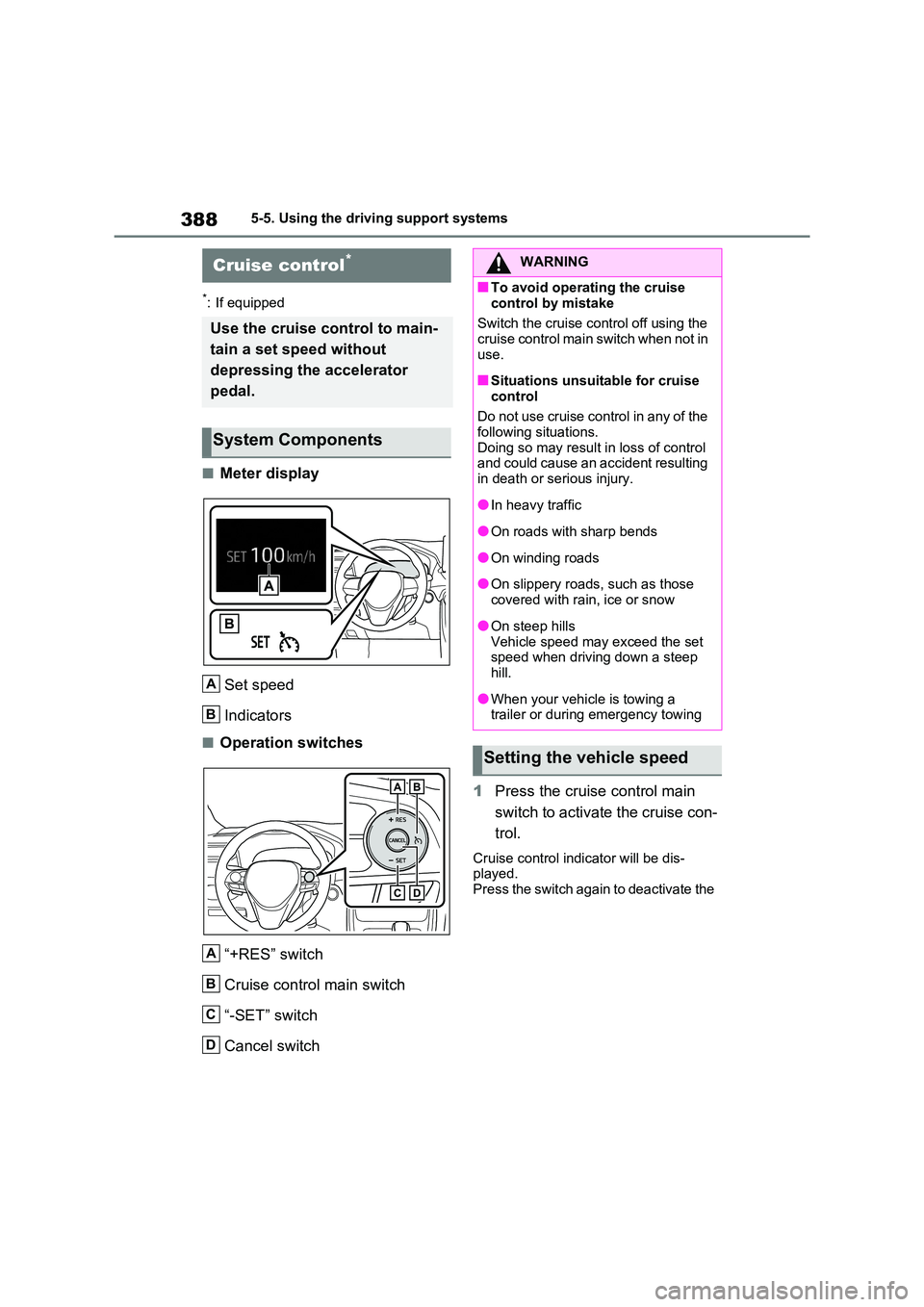
■Meter display
Set speed
Indicators
■Operation switches
“+RES” switch
Cruise control main switch
“-SET” switch
Cancel switch
1 Press the cruise control main
switch to activate the cruise con -
trol.
Cruise control indicator will be dis - played.
Press the switch again to deactivate the
Cruise control*
Use the cruise control to main -
tain a set speed without
depressing the accelerator
pedal.
System Components
A
B
A
B
C
D
WARNING
■To avoid operating the cruise
control by mistake
Switch the cruise control off using the cruise control main switch when not in
use.
■Situations unsuitable for cruise
control
Do not use cruise control in any of the
following situations. Doing so may result in loss of control
and could cause an accident resulting
in death or serious injury.
●In heavy traffic
●On roads with sharp bends
●On winding roads
●On slippery roads, such as those
covered with rain, ice or snow
●On steep hills
Vehicle speed may exceed the set speed when driving down a steep
hill.
●When your vehicle is towing a
trailer or during emergency towing
Setting the vehicle speed
Page 393 of 666
391
5
5-5. Using the driving support systems
Driving
*: If equipped
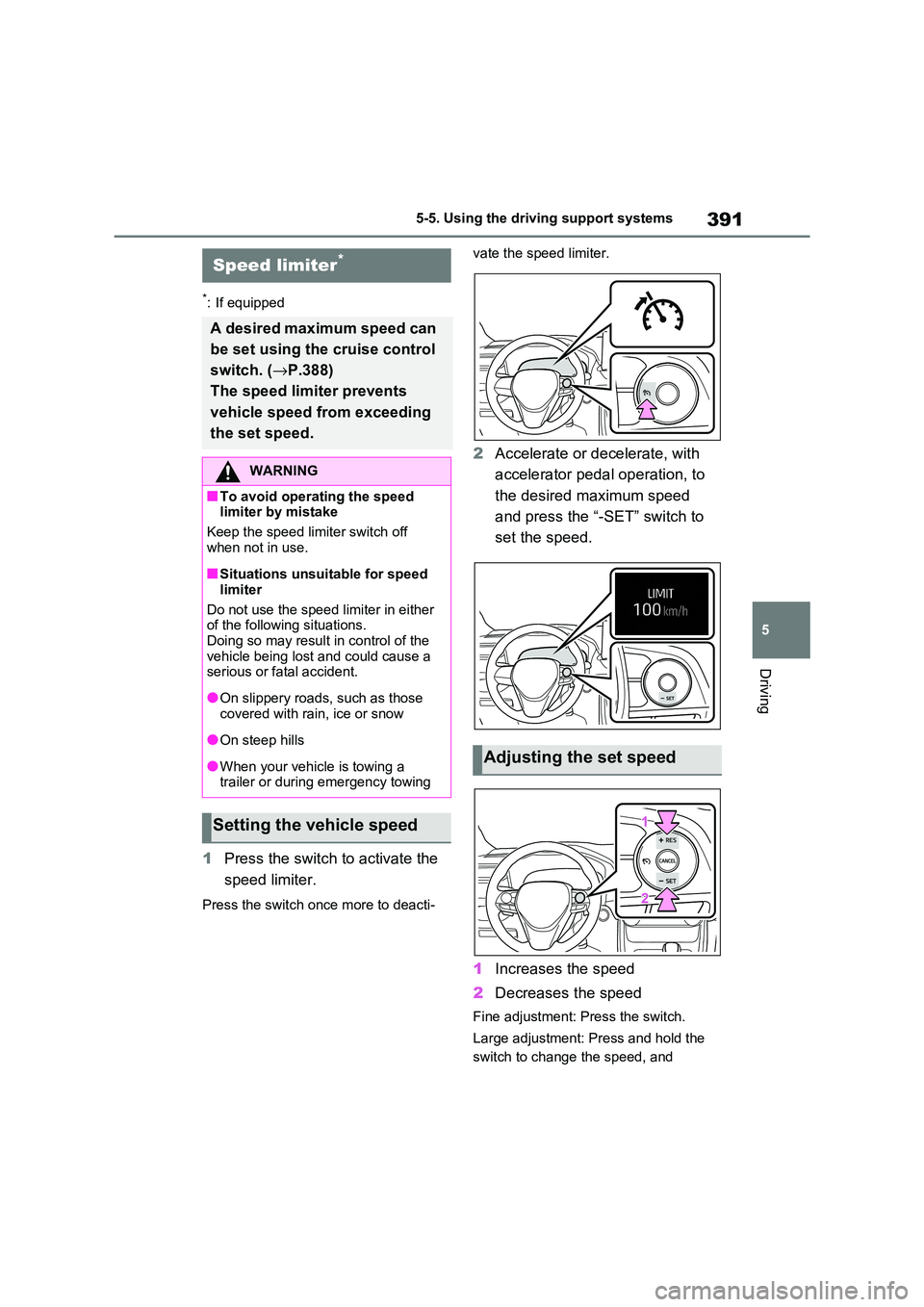
1 Press the switch to activate the
speed limiter.
Press the switch once more to deacti -
vate the speed limiter.
2 Accelerate or decelerate, with
accelerator pedal operation, to
the desired maximum speed
and press the “-SET” switch to
set the speed.
1 Increases the speed
2 Decreases the speed
Fine adjustment: Press the switch.
Large adjustment: Press and hold the
switch to change the speed, and
Speed limiter*
A desired maximum speed can
be set using the cruise control
switch. ( →P.388)
The speed limiter prevents
vehicle speed from exceeding
the set speed.
WARNING
■To avoid operating the speed
limiter by mistake
Keep the speed lim iter switch off
when not in use.
■Situations unsuitable for speed
limiter
Do not use the speed limiter in either of the following situations.
Doing so may result in control of the
vehicle being lost and could cause a serious or fatal accident.
●On slippery roads, such as those
covered with ra in, ice or snow
●On steep hills
●When your vehicle is towing a
trailer or during emergency towing
Setting the vehicle speed
Adjusting the set speed
Page 565 of 666
563
8
8-2. Steps to take in an emergency
When trouble arises
8-2.Steps to take in an emergency
If your vehicle needs to
be towed
If towing is necessary, we rec -
ommend having your vehicle
towed by any authorized
Toyota retailer or Toyota
authorized repairer, or any reli -
able repairer or commercial
towing service, using a wheel-
lift type truck or flatbed truck.
Use a safety chain system for
all towing, and abide by all
state/provincia l and local laws.
If towing your vehicle with a
wheel-lift type truck, use a tow -
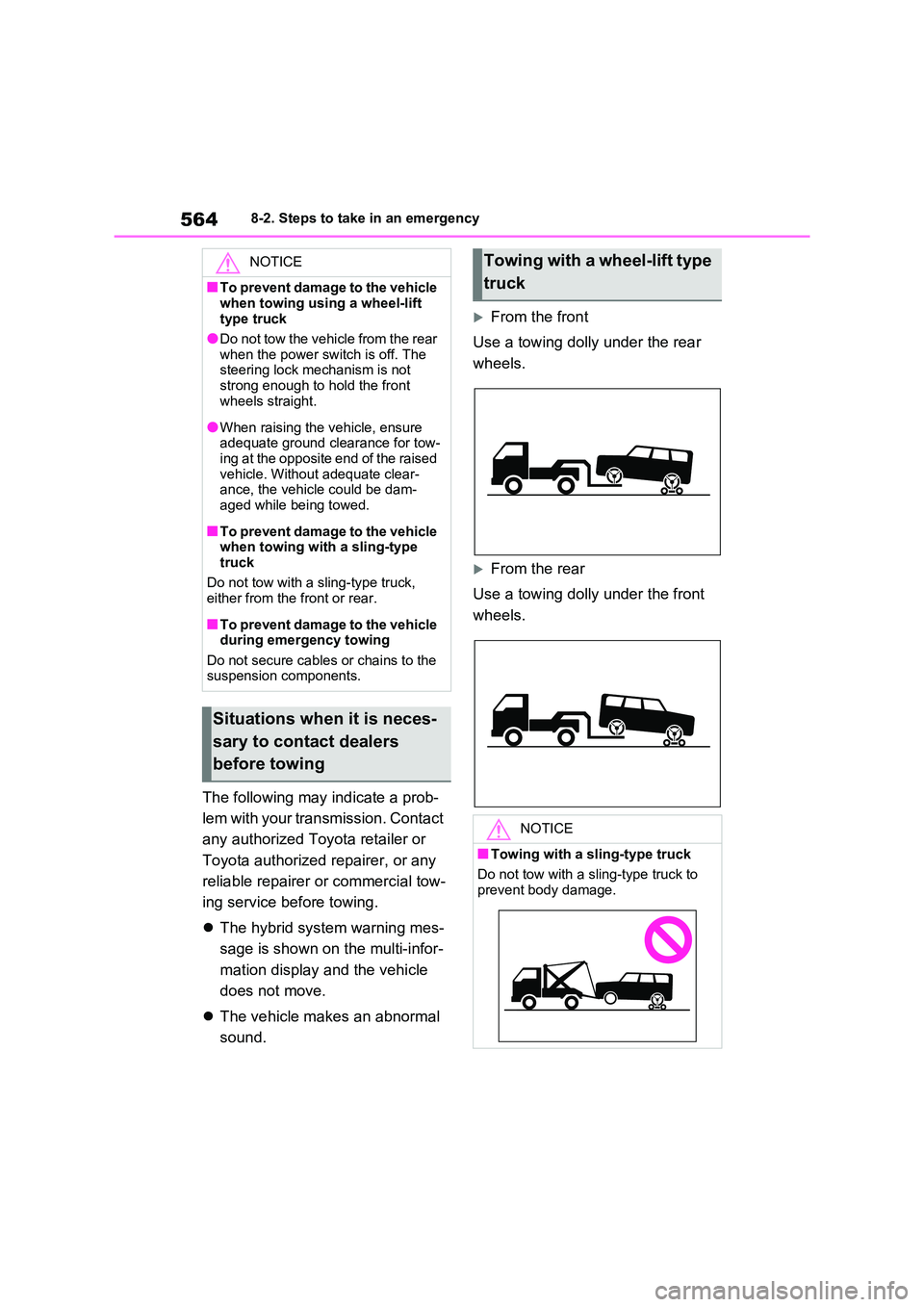
ing dolly. ( →P.563, 564)
WARNING
Observe the following precautions.
Failure to do so may result in death or
serious injury.
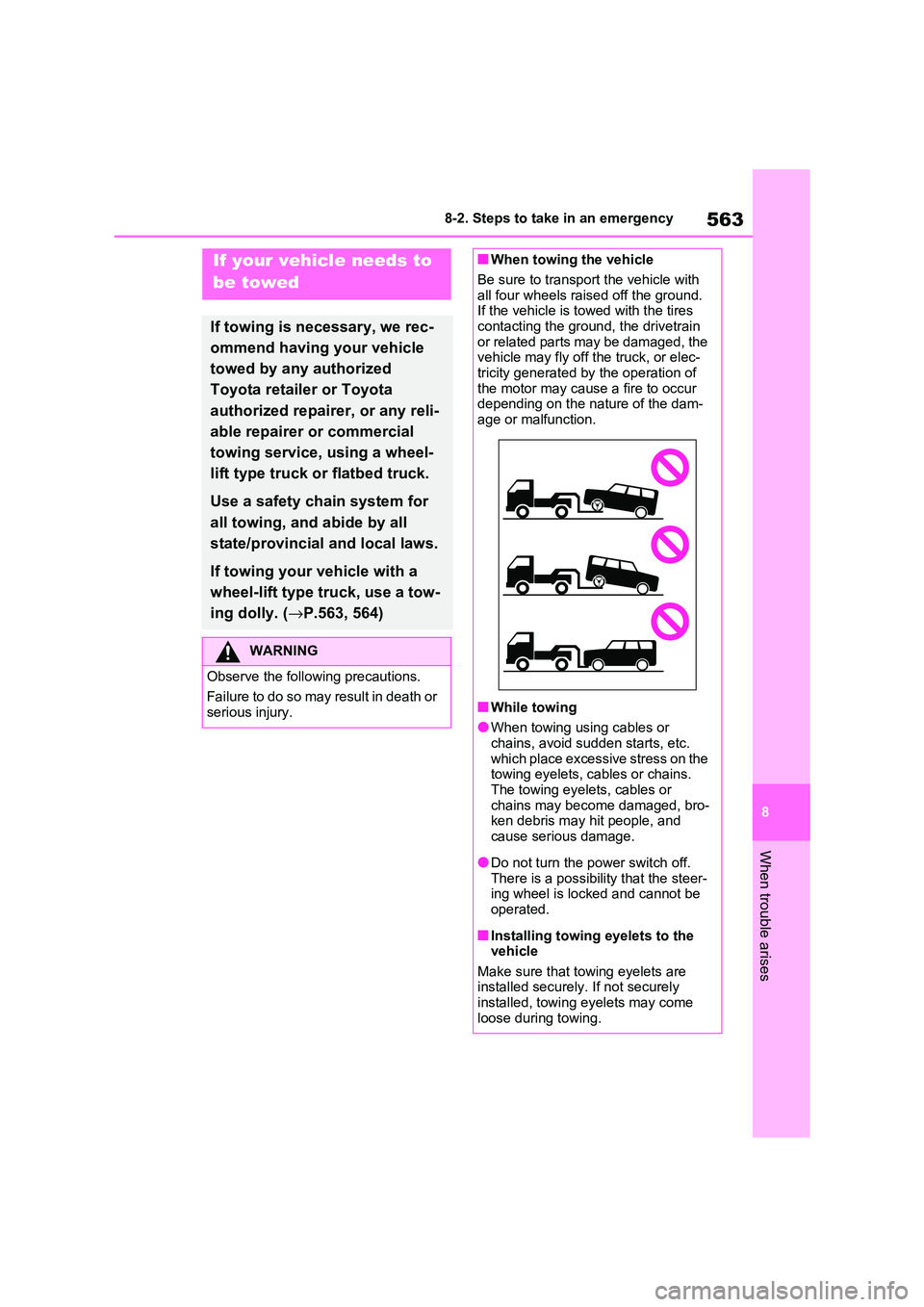
■When towing the vehicle
Be sure to transport the vehicle with
all four wheels raise d off the ground.
If the vehicle is t owed with the tires contacting the groun d, the drivetrain
or related parts may be damaged, the
vehicle may fly off the truck, or elec- tricity generated by the operation of
the motor may caus e a fire to occur
depending on the nature of the dam- age or malfunction.
■While towing
●When towing using cables or
chains, avoid sudden starts, etc. which place excessive stress on the
towing eyelets, cables or chains.
The towing eyelets, cables or chains may become damaged, bro -
ken debris may hit people, and
cause serious damage.
●Do not turn the power switch off.
There is a possibility that the steer - ing wheel is locked and cannot be
operated.
■Installing towing eyelets to the
vehicle
Make sure that towing eyelets are installed securely . If not securely
installed, towing ey elets may come
loose during towing.
Page 566 of 666
5648-2. Steps to take in an emergency
The following may indicate a prob-
lem with your transmission. Contact
any authorized Toyota retailer or
Toyota authorized repairer, or any
reliable repairer or commercial tow -
ing service before towing.
The hybrid system warning mes-
sage is shown on the multi-infor -
mation display and the vehicle
does not move.
The vehicle makes an abnormal
sound.
From the front
Use a towing dolly under the rear
wheels.
From the rear
Use a towing dolly under the front
wheels.
NOTICE
■To prevent damage to the vehicle
when towing using a wheel-lift
type truck
●Do not tow the vehicle from the rear
when the power switch is off. The
steering lock mechanism is not strong enough to hold the front
wheels straight.
●When raising the vehicle, ensure adequate ground clearance for tow -
ing at the opposite end of the raised
vehicle. Without adequate clear - ance, the vehicle could be dam -
aged while being towed.
■To prevent damage to the vehicle
when towing with a sling-type
truck
Do not tow with a sling-type truck,
either from the front or rear.
■To prevent damage to the vehicle
during emergency towing
Do not secure cables or chains to the suspension components.
Situations when it is neces -
sary to contact dealers
before towing
Towing with a wheel-lift type
truck
NOTICE
■Towing with a sling-type truck
Do not tow with a s ling-type truck to prevent body damage.
Page 567 of 666
565
8
8-2. Steps to take in an emergency
When trouble arises
When using a flat-bed truck to
transport the vehicle, use tire strap -
ping belts. Refer to the owner’s
manual of the flat-bed truck for the
tire strapping method.
In order to supp ress vehicle move-
ment during transportation, set the
parking brake and turn the power
switch off.
If a tow truck is not available in an
emergency, your vehicle may be
temporarily towed using cables or
chains secured to the emergency
towing eyelets. This should only be
attempted on hard surfaced roads
for short distances at under 30
km/h (18 mph).
A driver must be i n the vehicle to
steer and operate the brakes. The
vehicle’s wheels, drive train, axles,
steering and brakes must be in
good condition.
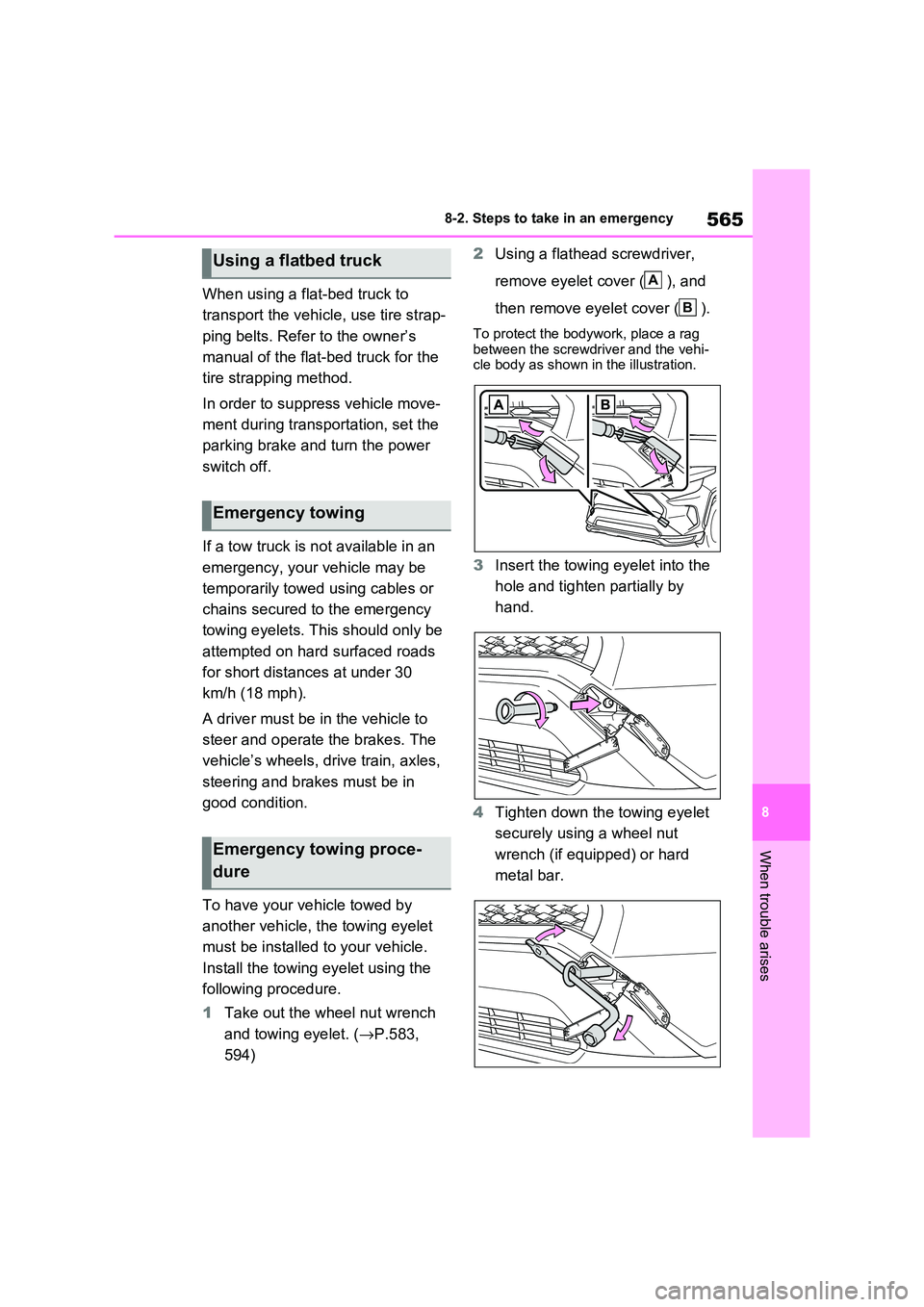
To have your vehicle towed by
another vehicle, the towing eyelet
must be installed to your vehicle.
Install the towing eyelet using the
following procedure.
1 Take out the wheel nut wrench
and towing eyelet. ( →P.583,
594)
2 Using a flathead screwdriver,
remove eyelet cover ( ), and
then remove eyelet cover ( ).
To protect the bodywork, place a rag
between the screwdriver and the vehi - cle body as shown in the illustration.
3 Insert the towing eyelet into the
hole and tighten partially by
hand.
4 Tighten down the towing eyelet
securely using a wheel nut
wrench (if equipped) or hard
metal bar.
Using a flatbed truck
Emergency towing
Emergency towing proce -
dure
A
B