fuel TOYOTA RAV4 PLUG-IN HYBRID 2021 Owners Manual
[x] Cancel search | Manufacturer: TOYOTA, Model Year: 2021, Model line: RAV4 PLUG-IN HYBRID, Model: TOYOTA RAV4 PLUG-IN HYBRID 2021Pages: 666, PDF Size: 161.28 MB
Page 3 of 666
RAV4 Plug-in Hybrid_OM_OM42E06E_(EE)
1
6
5
4
3
2
8
7
9
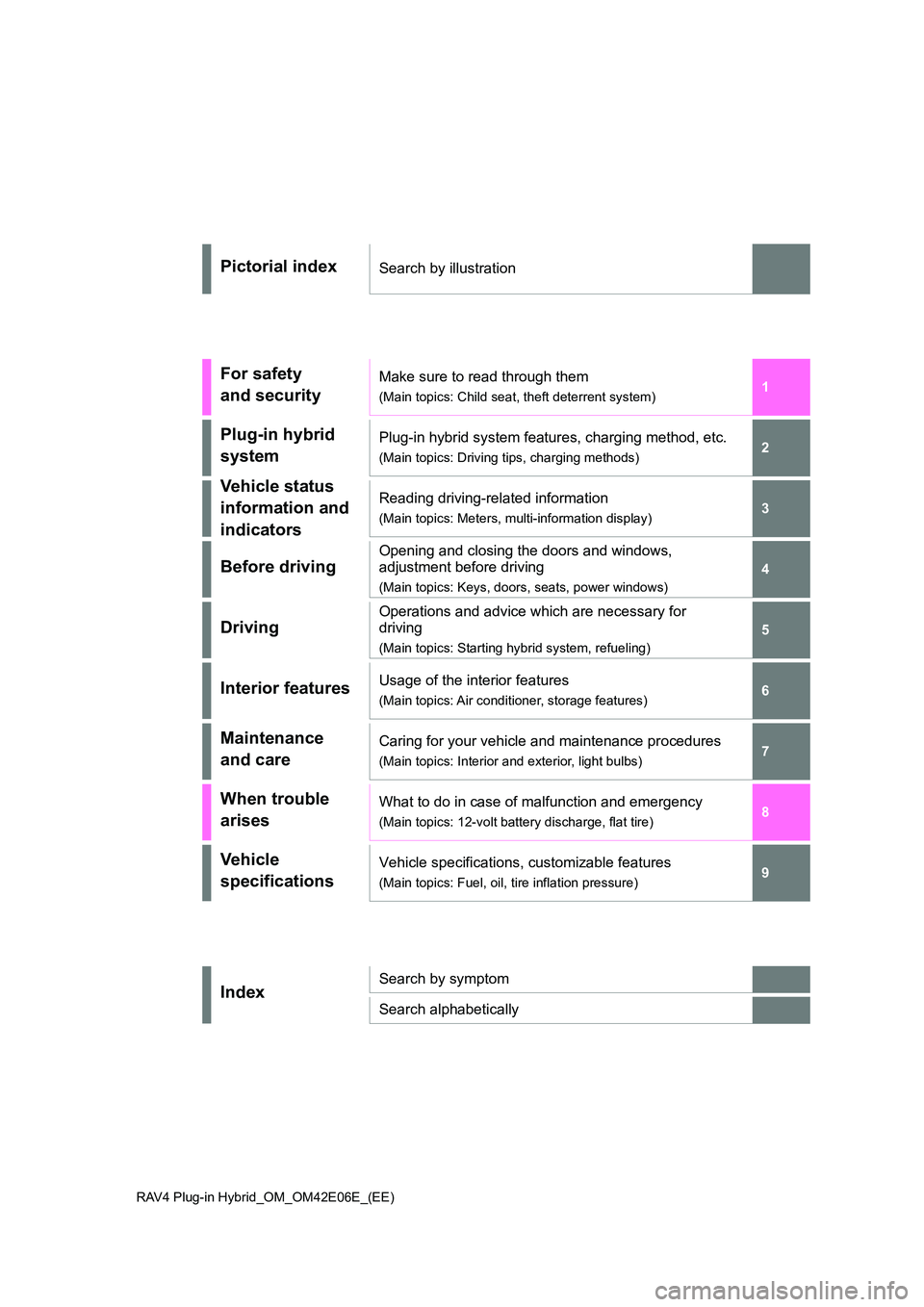
Pictorial indexSearch by illustration
For safety
and security
Make sure to read through them
(Main topics: Child seat, theft deterrent system)
Plug-in hybrid
system
Plug-in hybrid system features, charging method, etc.
(Main topics: Driving tips, charging methods)
Vehicle status
information and
indicators
Reading driving-related information
(Main topics: Meters, multi-information display)
Before driving
Opening and closing the doors and windows,
adjustment before driving
(Main topics: Keys, doors, seats, power windows)
Driving
Operations and advice which are necessary for
driving
(Main topics: Starting hybrid system, refueling)
Interior featuresUsage of the interior features
(Main topics: Air conditioner, storage features)
Maintenance
and care
Caring for your vehicle and maintenance procedures
(Main topics: Interior and exterior, light bulbs)
When trouble
arises
What to do in case of malfunction and emergency
(Main topics: 12-volt battery discharge, flat tire)
Vehicle
specifications
Vehicle specifications, customizable features
(Main topics: Fuel, oil, tire inflation pressure)
IndexSearch by symptom
Search alphabetically
Page 5 of 666
3TABLE OF CONTENTS
1
6
5
4
3
2
8
7
9
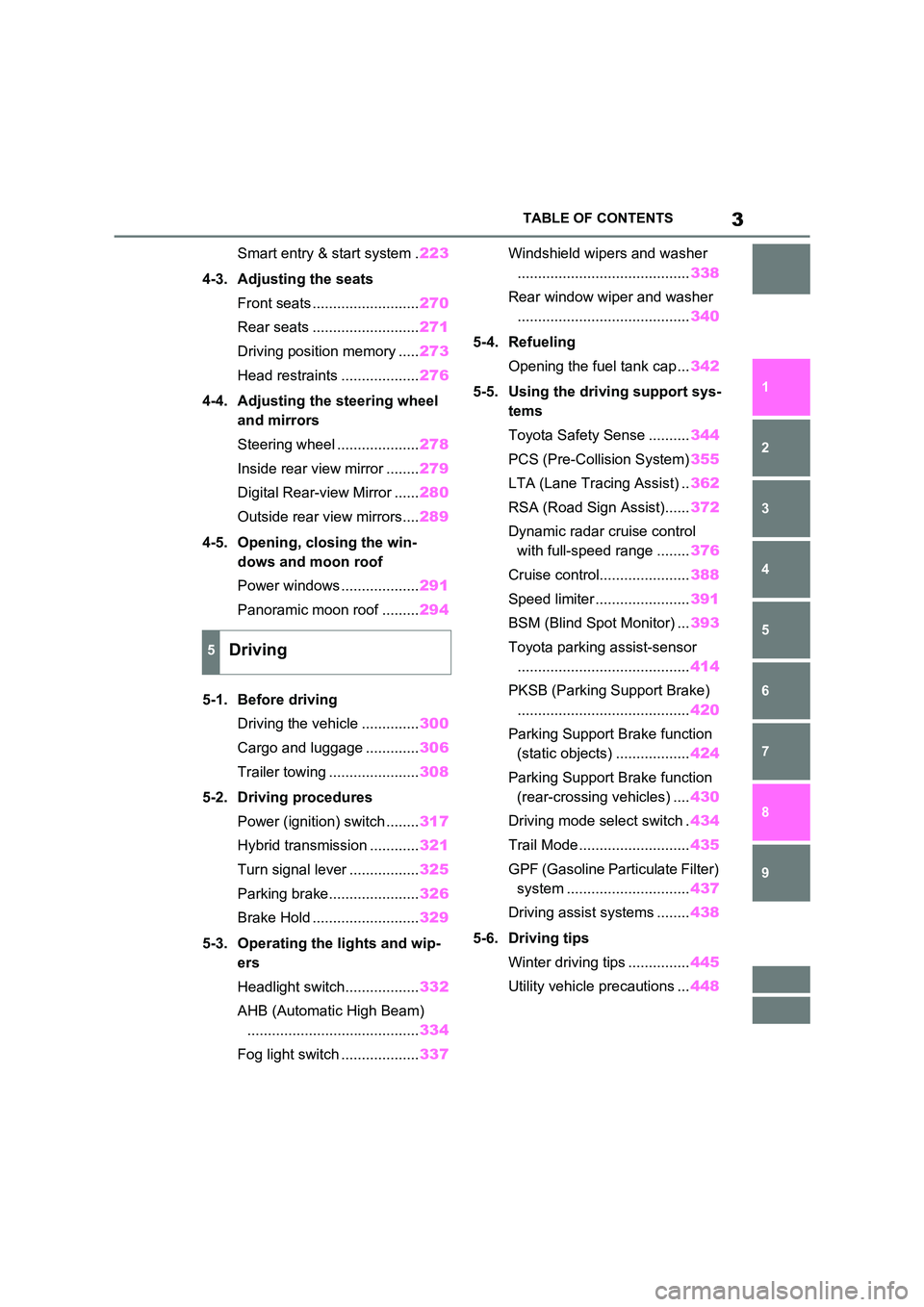
Smart entry & start system . 223
4-3. Adjusting the seats
Front seats .......................... 270
Rear seats .......................... 271
Driving position memory ..... 273
Head restraints ................... 276
4-4. Adjusting the steering wheel
and mirrors
Steering wheel .................... 278
Inside rear view mirror ........ 279
Digital Rear-view Mirror ...... 280
Outside rear view mirrors.... 289
4-5. Opening, closing the win -
dows and moon roof
Power windows ................... 291
Panoramic moon roof ......... 294
5-1. Before driving
Driving the vehicle .............. 300
Cargo and luggage ............. 306
Trailer towing ...................... 308
5-2. Driving procedures
Power (ignition) switch ........ 317
Hybrid transmission ............ 321
Turn signal lever ................. 325
Parking brake...................... 326
Brake Hold .......................... 329
5-3. Operating the lights and wip -
ers
Headlight switch.................. 332
AHB (Automatic High Beam)
.......................................... 334
Fog light switch ................... 337
Windshield wipers and washer
.......................................... 338
Rear window wiper and washer
.......................................... 340
5-4. Refueling
Opening the fuel tank cap ... 342
5-5. Using the driving support sys -
tems
Toyota Safety Sense .......... 344
PCS (Pre-Collision System) 355
LTA (Lane Tracing Assist) .. 362
RSA (Road Sign Assist)...... 372
Dynamic radar cruise control
with full-speed range ........ 376
Cruise control...................... 388
Speed limiter ....................... 391
BSM (Blind Spot Monitor) ... 393
Toyota parking assist-sensor
.......................................... 414
PKSB (Parking Support Brake)
.......................................... 420
Parking Support Brake function
(static objects) .................. 424
Parking Support Brake function
(rear-crossing vehicles) .... 430
Driving mode select switch . 434
Trail Mode ........................... 435
GPF (Gasoline Particulate Filter)
system .............................. 437
Driving assist systems ........ 438
5-6. Driving tips
Winter driving tips ............... 445
Utility vehicle precautions ... 448
5Driving
Page 7 of 666
5TABLE OF CONTENTS
1
6
5
4
3
2
8
7
9
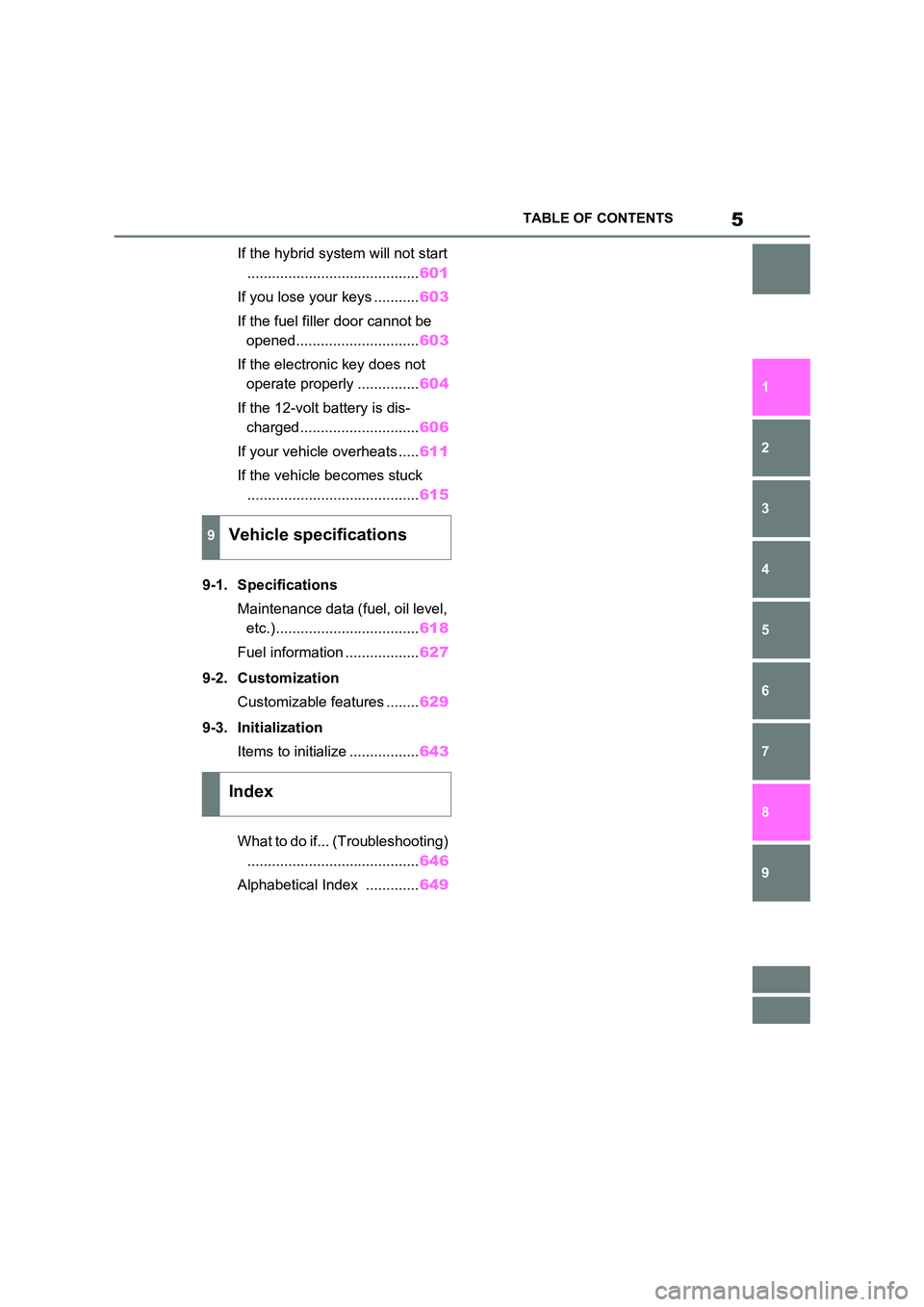
If the hybrid system will not start
.......................................... 601
If you lose your keys ........... 603
If the fuel filler door cannot be
opened.............................. 603
If the electronic key does not
operate properly ............... 604
If the 12-volt battery is dis -
charged............................. 606
If your vehicle overheats ..... 611
If the vehicle becomes stuck
.......................................... 615
9-1. Specifications
Maintenance data (fuel, oil level,
etc.)................................... 618
Fuel information .................. 627
9-2. Customization
Customizable features ........ 629
9-3. Initialization
Items to initialize ................. 643
What to do if... (Troubleshooting)
.......................................... 646
Alphabetical Index ............. 649
9Vehicle specifications
Index
Page 8 of 666
6
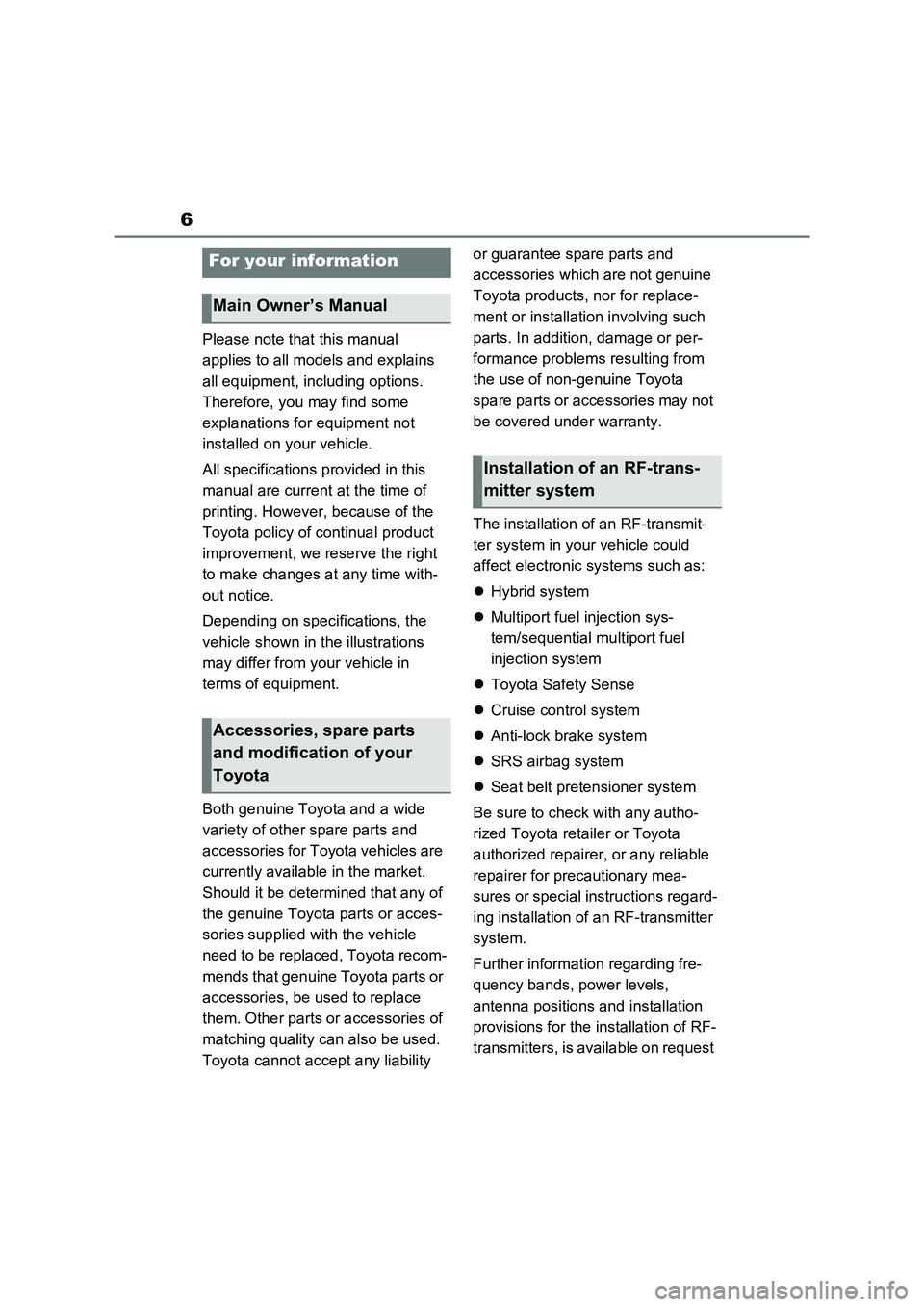
Please note that this manual
applies to all models and explains
all equipment, including options.
Therefore, you may find some
explanations for equipment not
installed on your vehicle.
All specifications provided in this
manual are current at the time of
printing. However, because of the
Toyota policy of c ontinual product
improvement, we reserve the right
to make changes at any time with -
out notice.
Depending on specifications, the
vehicle shown in the illustrations
may differ from your vehicle in
terms of equipment.
Both genuine Toy ota and a wide
variety of other spare parts and
accessories for Toyota vehicles are
currently available in the market.
Should it be determined that any of
the genuine Toyot a parts or acces-
sories supplied with the vehicle
need to be replaced, Toyota recom -
mends that genuine Toyota parts or
accessories, be used to replace
them. Other parts or accessories of
matching quality can also be used.
Toyota cannot accept any liability
or guarantee sp are parts and
accessories which are not genuine
Toyota products, nor for replace -
ment or installati on involving such
parts. In addition, damage or per -
formance problems resulting from
the use of non-genuine Toyota
spare parts or accessories may not
be covered under warranty.
The installation of an RF-transmit -
ter system in your vehicle could
affect electronic systems such as:
Hybrid system
Multiport fuel injection sys-
tem/sequential multiport fuel
injection system
Toyota Safety Sense
Cruise control system
Anti-lock brake system
SRS airbag system
Seat belt pretensioner system
Be sure to check with any autho -
rized Toyota retailer or Toyota
authorized repairer, or any reliable
repairer for precautionary mea -
sures or special instructions regard -
ing installation of an RF-transmitter
system.
Further information regarding fre -
quency bands, power levels,
antenna positions and installation
provisions for the installation of RF-
transmitters, is available on request
For your information
Main Owner’s Manual
Accessories, spare parts
and modification of your
Toyota
Installation of an RF-trans -
mitter system
Page 15 of 666
13Pictorial index
Precautions against winter season ................................................. P.445
To prevent freezing (windshield wiper de-icer)*1............................. P.457
Precautions against car wash ................................... ...................... P.489
Replacing the wiper insert..................................... .......................... P.539
Fuel filler door ............................................... ................................ P.342
Refueling method ............................................... ............................. P.342
Fuel type/fuel tank capacity ................................... ......................... P.620
Charging port .................................................. .............................. P.105
Charging method ................................................ ............................ P.127
Tires .......................................................... ..................................... P.509
Tire size/inflation pressure .............................................................. P.624
Winter tires/tire chain ........................................ .............................. P.445
Checking/rotation/tire pressu re warning system ............................. P.509
Coping with flat tires......................................... ....................... P.582, 593
Hood ........................................................... .................................... P.498
Opening ........................................................ .................................. P.498
Engine oil ..................................................... ................................... P.621
Coping with overheat ........................................... ........................... P.611
Warning messages ............................................... .......................... P.578
Headlights/front position lights/daytime running lights ........ ... P.332
Turn signal lights ............................................. ............................. P.325
Front fog lights............................................... ............................... P.337
Tail lights .................................................... ................................... P.332
Tail lights .................................................... ................................... P.332
Back-up lights
Shifting the shift lever to R .................................. ............................ P.321
Light bulbs of the exterior lights for driving
(Replacing method: P.548, Watts: P.626)
E
F
G
H
I
J
K
L
M
Page 18 of 666
16Pictorial index
Energy monitor................................................. ............................... P.195
When the warning messages are displayed ................................... P.578
Turn signal lever .............................................. ............................. P.325
Headlight switch ............................................... ............................ P.332
Headlights/front posit ion lights/tail lights/
license plate lights/daytime r unning lights....................................... P.332
Front fog lights/rear fog light ................................ ........................... P.337
Windshield wiper and washer switch ............................. ............ P.338
Rear window wiper and washer switch ............................ ............... P.340
Usage.......................................................... ............................ P.338, 340
Adding washer fluid............................................ ............................. P.505
Warning messages ............................................... .......................... P.578
Emergency flasher switch....................................... ..................... P.560
Hood lock release lever .... ............................................................ P.498
Tilt and telescopic steering lock release lever................ ........... P.278
Adjustment ..................................................... ................................. P.278
Air conditioning system ........................................ ....................... P.452
Usage.......................................................... .................................... P.452
Rear window defogger ........................................... ......................... P.454
Audio system*
Fuel filler door opener switch ................................. ..................... P.343
*: Refer to “Navigation and Multimedia System Owner’s Manual” or “Multimedia
Owner’s Manual”.
E
F
G
H
I
J
K
L
Page 26 of 666
24Pictorial index
Energy monitor................................................. ............................... P.195
When the warning messages are displayed ................................... P.578
Turn signal lever .............................................. ............................. P.325
Headlight switch ............................................... ............................ P.332
Headlights/front posit ion lights/tail lights/
license plate lights/daytime r unning lights....................................... P.332
Front fog lights/rear fog light ................................ ........................... P.337
Windshield wiper and washer switch ............................. ............ P.338
Rear window wiper and washer switch ............................ ............... P.340
Usage.......................................................... ............................ P.338, 340
Adding washer fluid............................................ ............................. P.505
Warning messages ............................................... .......................... P.578
Emergency flasher switch....................................... ..................... P.560
Hood lock release lever .... ............................................................ P.498
Tilt and telescopic steering control lever ..................... .............. P.278
Adjustment ..................................................... ................................. P.278
Air conditioning system ........................................ ....................... P.452
Usage.......................................................... .................................... P.452
Rear window defogger ........................................... ......................... P.454
Audio system*
Fuel filler door opener switch ................................. ..................... P.343
*: Refer to “Navigation and Multimedia System Owner’s Manual” or “Multimedia
Owner’s Manual”.
E
F
G
H
I
J
K
L
Page 43 of 666
41
1
1-1. For safe use
For safety and security
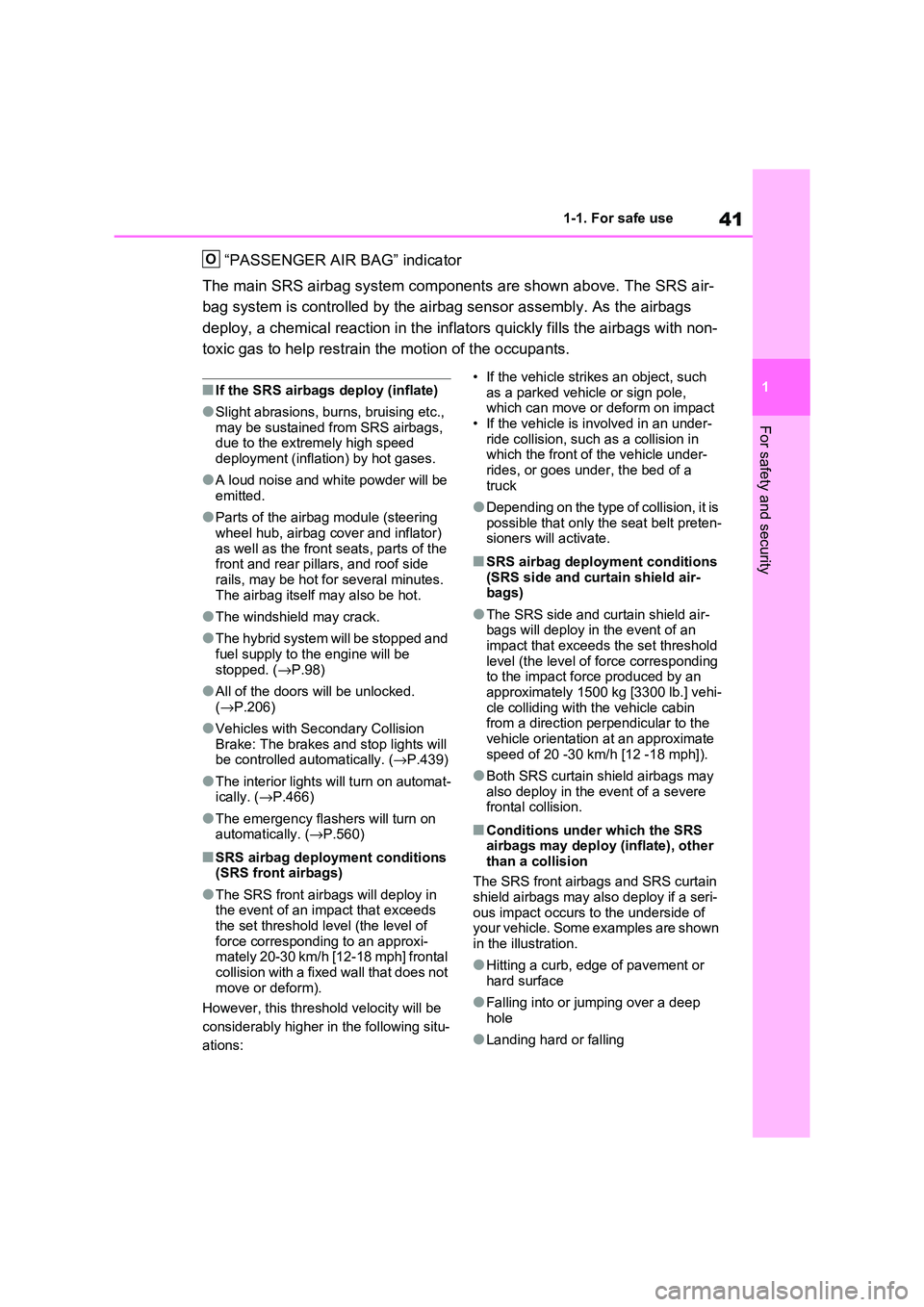
“PASSENGER AIR BAG” indicator
The main SRS airbag system comp onents are shown above. The SRS air-
bag system is controlled by the airbag sensor assembly. As the airbags
deploy, a chemical reaction in t he inflators quickly fills the airbags with non-
toxic gas to help restrain t he motion of the occupants.
■If the SRS airbags deploy (inflate)
●Slight abrasions, burns, bruising etc.,
may be sustained from SRS airbags, due to the extrem ely high speed
deployment (inflation) by hot gases.
●A loud noise and white powder will be
emitted.
●Parts of the airbag module (steering
wheel hub, airbag cover and inflator)
as well as the fron t seats, parts of the front and rear pillars, and roof side
rails, may be hot for several minutes.
The airbag itself m ay also be hot.
●The windshield may crack.
●The hybrid system will be stopped and
fuel supply to t he engine will be
stopped. ( →P.98)
●All of the doors will be unlocked.
( →P.206)
●Vehicles with Secondary Collision
Brake: The brakes and stop lights will be controlled au tomatically. (→P.439)
●The interior lights will turn on automat- ically. ( →P.466)
●The emergency flashers will turn on automatically. ( →P.560)
■SRS airbag deployment conditions
(SRS front airbags)
●The SRS front airb ags will deploy in
the event of an impact that exceeds
the set threshold level (the level of force corresponding to an approxi -
mately 20-30 km/h [12-18 mph] frontal
collision with a fixed wall that does not move or deform).
However, this threshold velocity will be
considerably higher in the following situ -
ations:
• If the vehicle strikes an object, such as a parked vehicle or sign pole,
which can move or deform on impact
• If the vehicle is involved in an under -
ride collision, such as a collision in which the front of the vehicle under -
rides, or goes under , the bed of a
truck
●Depending on the type of collision, it is
possible that only the seat belt preten - sioners will activate.
■SRS airbag deployment conditions
(SRS side and cu rtain shield air-
bags)
●The SRS side and curtain shield air -
bags will deploy in the event of an impact that exceeds the set threshold
level (the level of force corresponding
to the impact forc e produced by an approximately 1500 kg [3300 lb.] vehi -
cle colliding with the vehicle cabin
from a direction perpendicular to the vehicle orientation at an approximate
speed of 20 -30 km/h [12 -18 mph]).
●Both SRS curtain shield airbags may
also deploy in the event of a severe
frontal collision.
■Conditions under which the SRS airbags may deploy (inflate), other
than a collision
The SRS front airbags and SRS curtain shield airbags may a lso deploy if a seri-
ous impact occurs to the underside of
your vehicle. Some e xamples are shown in the illustration.
●Hitting a curb, edge of pavement or hard surface
●Falling into or jumping over a deep hole
●Landing hard or falling
O
Page 88 of 666
862-1. Plug-in hybrid system
engine and electric motor. (→P.89)
• If electricity needed for EV driv -
ing in EV mode or AUTO EV/HV
mode is not remaining, the oper -
ation mode will be automatically
switched to HV mode.
• The operation mode can be
switched to HV mode at any tim -
ing by operating the switch to
keep electricity for EV driving
etc.* ( →P.86). Switching to HV
mode when driving on a highway
or when driving uphill is recom -
mended in order to conserve bat -
tery power.
When in HV mode, t he HV drive mode
indicator illuminates.
*: The EV driving range may reduce
even after switching to HV mode.
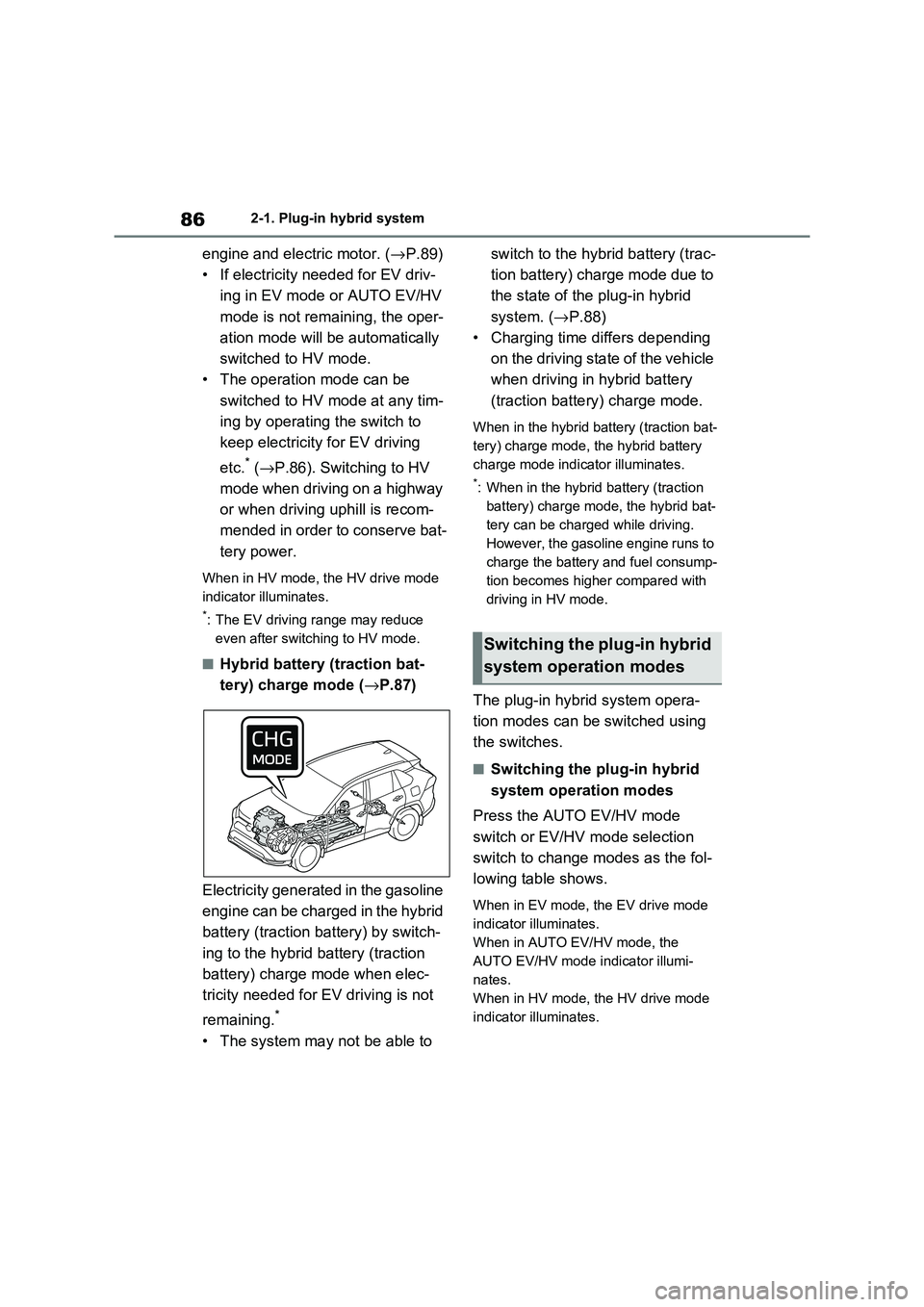
■Hybrid battery (traction bat -
tery) charge mode ( →P.87)
Electricity generated in the gasoline
engine can be charged in the hybrid
battery (traction battery) by switch -
ing to the hybrid battery (traction
battery) charge mode when elec -
tricity needed for EV driving is not
remaining.*
• The system may not be able to
switch to the hybrid battery (trac -
tion battery) charge mode due to
the state of the plug-in hybrid
system. ( →P.88)
• Charging time differs depending
on the driving state of the vehicle
when driving in hybrid battery
(traction battery) charge mode.
When in the hybrid battery (traction bat -
tery) charge mode, the hybrid battery
charge mode indicator illuminates.
*: When in the hybrid b attery (traction
battery) charge mode, the hybrid bat -
tery can be charged while driving.
However, the gasoline engine runs to
charge the battery and fuel consump-
tion becomes higher compared with
driving in HV mode.
The plug-in hybrid system opera -
tion modes can be switched using
the switches.
■Switching the plug-in hybrid
system operation modes
Press the AUTO EV/HV mode
switch or EV/HV mode selection
switch to change modes as the fol -
lowing table shows.
When in EV mode, the EV drive mode
indicator illuminates.
When in AUTO EV/HV mode, the
AUTO EV/HV mode indicator illumi -
nates.
When in HV mode, the HV drive mode
indicator illuminates.
Switching the plug-in hybrid
system operation modes
Page 91 of 666
89
2
2-1. Plug-in hybrid system
Plug-in hybrid system
charge will deplete quickly. Also,
EV driving may be canceled by
rapid acceleration or vehicle
speed.
Restrain your speed as much as
possible. The distance that can
be driven in EV mode will reduce
considerably at high speeds.
*: The EV driving range can be checked
using the multi-information display.
( →P.181)
■When in AUTO EV/HV mode
Only the electric motor is used for
EV driving* during normal driving,
but when the accelerator pedal is
strongly depressed, the gasoline
engine starts. ( →P.90)
Also, when the hybrid battery (trac -
tion battery) level is low, the mode
switches to HV mode automatically
the same as in EV mode.
AUTO EV/HV mode i s suitable for
driving conditions when more
power is required, such as for driv -
ing uphill or accelerating suddenly.
However, because the gasoline
engine will start more easily, it is
recommended to drive in EV mode
usually.
*: The EV driving range can be checked
using the multi-information display.
( →P.181)
■When in HV mode
The vehicle can be used in the
same way as a standard hybrid
vehicle.
In HV mode, controls are primarily
carried out as follows in accor -
dance with the driving conditions.
The gasoline engine stops* when
the vehicle is stopped.
During start off, the electric
motor (traction motor) drives the
vehicle.
During normal driving, the gaso-
line engine and electric motor
(traction motor) are controlled
effectively, and the vehicle is
driven with optimum fuel effi -
ciency. Also, when necessary,
the electric motor (traction
motor) operates as an electrical
generator to charge the hybrid
battery (traction battery).
When the accelerator pedal is
depressed heavily, drive force
from both the gasoline engine
and the electric motor (traction
motor) is used to accelerate.
*: When the hybrid battery (traction bat -
tery) requires char ging or the engine
is warming up, etc., the gasoline
engine will not autom atically stop.
( →P.91)
■When braking (regenerative
braking)
The electric motor (traction motor)
charges the hybrid battery (traction
battery).
The EV driving range can be
extended by actively using this
regenerative braking to store elec -
tricity in the hybrid battery (traction
battery).