parking brake TOYOTA SEQUOIA 2009 2.G Owners Manual
[x] Cancel search | Manufacturer: TOYOTA, Model Year: 2009, Model line: SEQUOIA, Model: TOYOTA SEQUOIA 2009 2.GPages: 612
Page 2 of 612
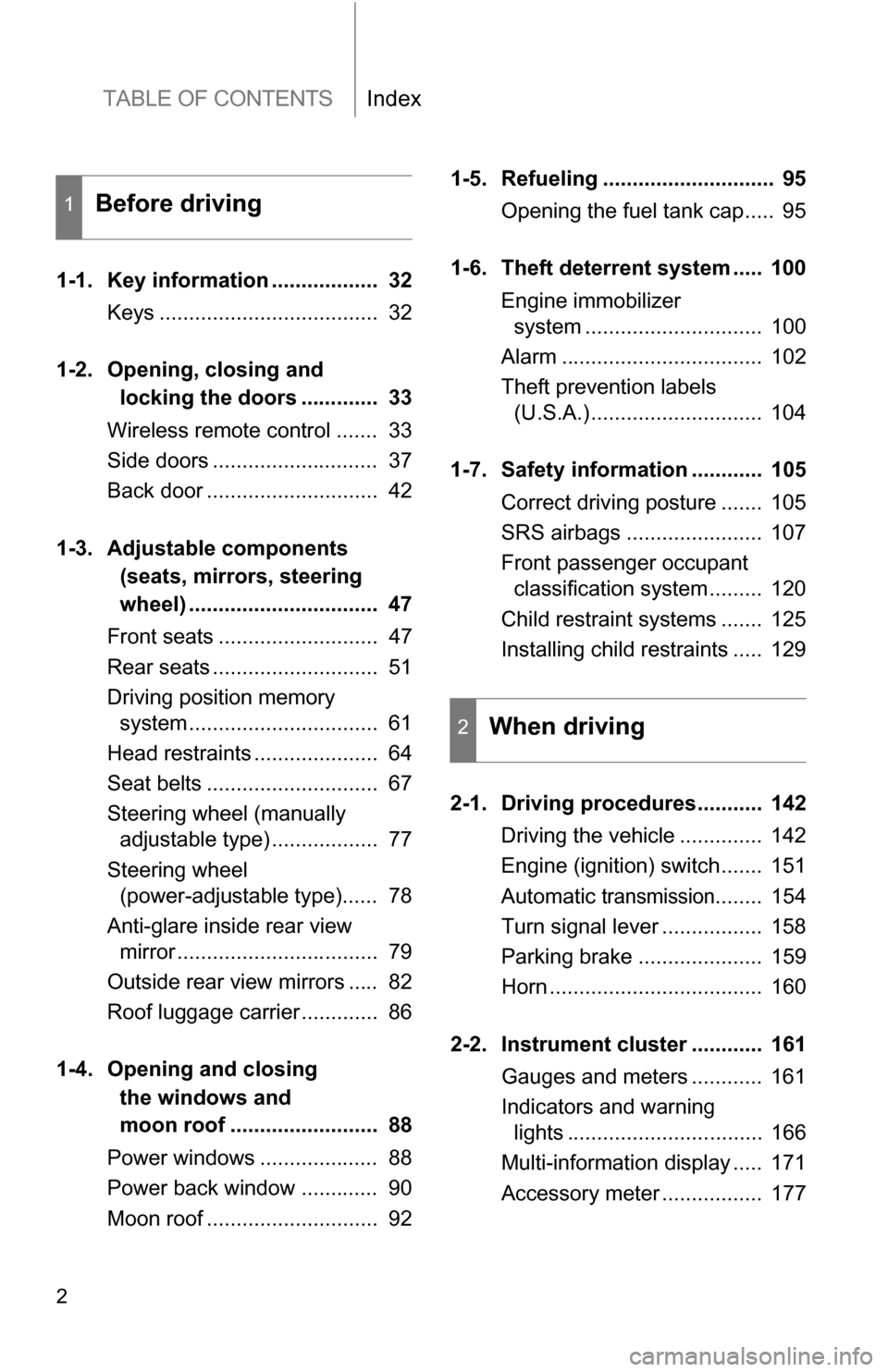
TABLE OF CONTENTSIndex
2
1-1. Key information .................. 32Keys ..................................... 32
1-2. Opening, closing and locking the doors ............. 33
Wireless remote control ....... 33
Side doors ............................ 37
Back door ............................. 42
1-3. Adjustable components (seats, mirrors, steering
wheel) ................................ 47
Front seats ........................... 47
Rear seats ............................ 51
Driving position memory system ................................ 61
Head restraints ..................... 64
Seat belts ............................. 67
Steering wheel (manually adjustable type) .................. 77
Steering wheel (power-adjustable type)...... 78
Anti-glare inside rear view mirror .................................. 79
Outside rear view mirrors ..... 82
Roof luggage carrier............. 86
1-4. Opening and closing the windows and
moon roof ......................... 88
Power windows .................... 88
Power back window ............. 90
Moon roof ............................. 92 1-5. Refueling ............................. 95
Opening the fuel tank cap..... 95
1-6. Theft deterrent system ..... 100 Engine immobilizer system .............................. 100
Alarm .................................. 102
Theft prevention labels (U.S.A.)............................. 104
1-7. Safety information ............ 105 Correct driving posture ....... 105
SRS airbags ....................... 107
Front passenger occupant classification system ......... 120
Child restraint systems ....... 125
Installing child restraints ..... 129
2-1. Driving procedures........... 142 Driving the vehicle .............. 142
Engine (ignition) switch....... 151
Automatic
transmission........ 154
Turn signal lever ................. 158
Parking brake ..................... 159
Horn .................................... 160
2-2. Instrument cluster ............ 161 Gauges and meters ............ 161
Indicators and warning lights ................................. 166
Multi-information display ..... 171
Accessory meter ................. 177
1Before driving
2When driving
Page 18 of 612
18
Pictorial indexInstrument panel
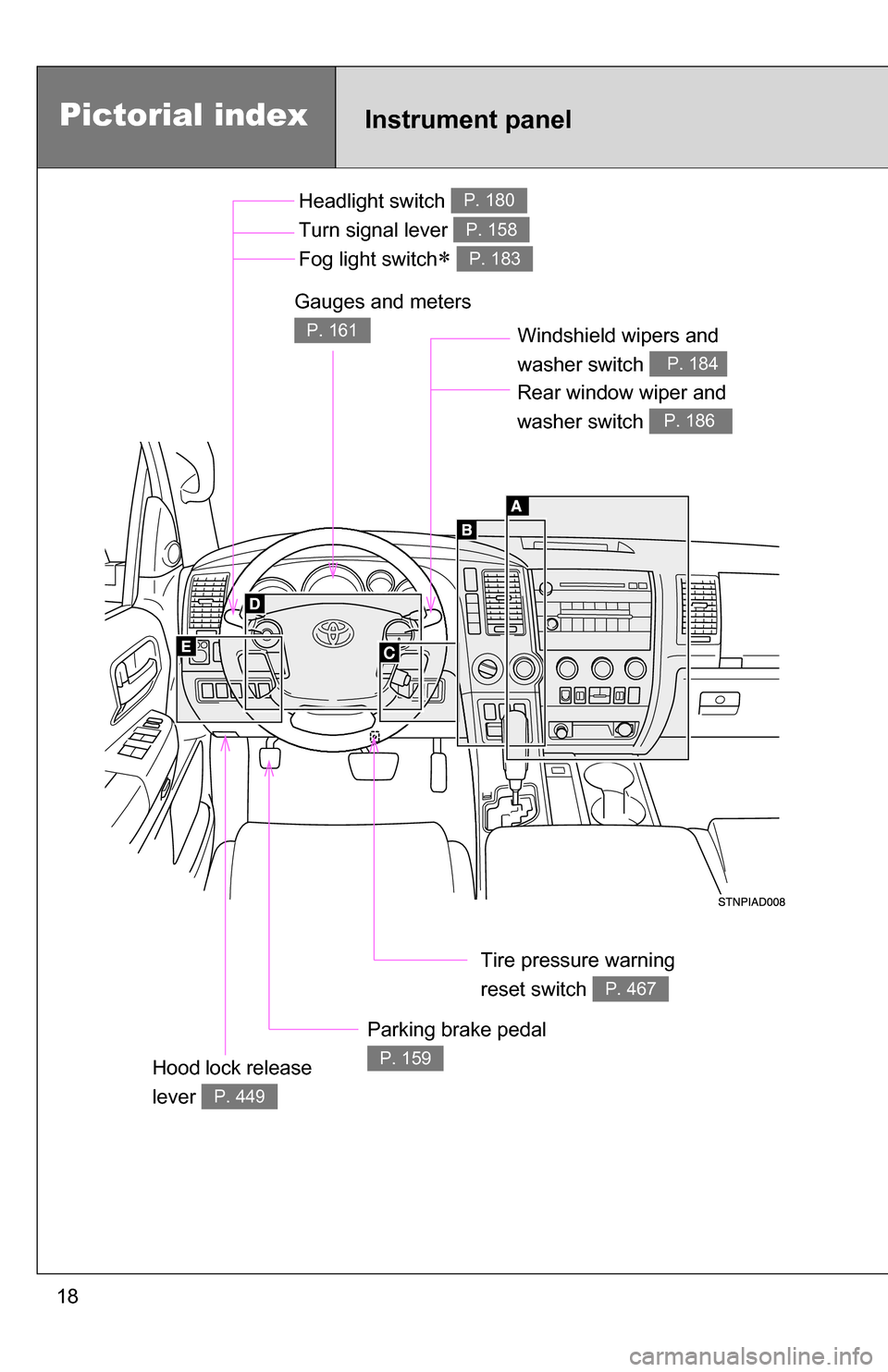
Headlight switch
Turn signal lever
Fog light switch
P. 180
P. 158
P. 183
Windshield wipers and
washer switch
P. 184
Parking brake pedal
P. 159
Gauges and meters
P. 161
Hood lock release
lever
P. 449
Tire pressure warning
reset switch
P. 467
Rear window wiper and
washer switch
P. 186
Page 141 of 612
When driving2
141
2-1. Driving procedures ........ 142Driving the vehicle............ 142
Engine (ignition) switch .... 151
Automatic
transmission..... 154
Turn signal lever .............. 158
Parking brake ................... 159
Horn ................................. 160
2-2. Instrument cluster.......... 161 Gauges and meters ......... 161
Indicators and warning lights .............................. 166
Multi-information display............................ 171
Accessory meter .............. 177
2-3. Operating the lights and wipers ........................... 180
Headlight switch ............... 180
Fog light switch ................ 183
Windshield wipers and washer ........................... 184
Rear window wiper and washer ........................... 186
Headlight cleaner switch ............................. 187 2-4. Using other driving
systems ........................ 188
Cruise control ................... 188
Dynamic laser cruise control ............................ 191
Intuitive parking assist...... 202
Electronically modulated air suspension ................ 208
AVS (Adaptive Variable Suspension System) ...... 213
Four-wheel drive system ........................... 214
AUTO LSD system........... 219
Driving assist systems ..... 221
2-5. Driving information ........ 227 Off-road precautions ........ 227
Cargo and luggage .......... 232
Vehicle load limits ............ 236
Winter driving tips ............ 237
Trailer towing ................... 241
Dinghy towing .................. 257
Page 142 of 612
142
2-1. Driving procedures
Driving the vehicle
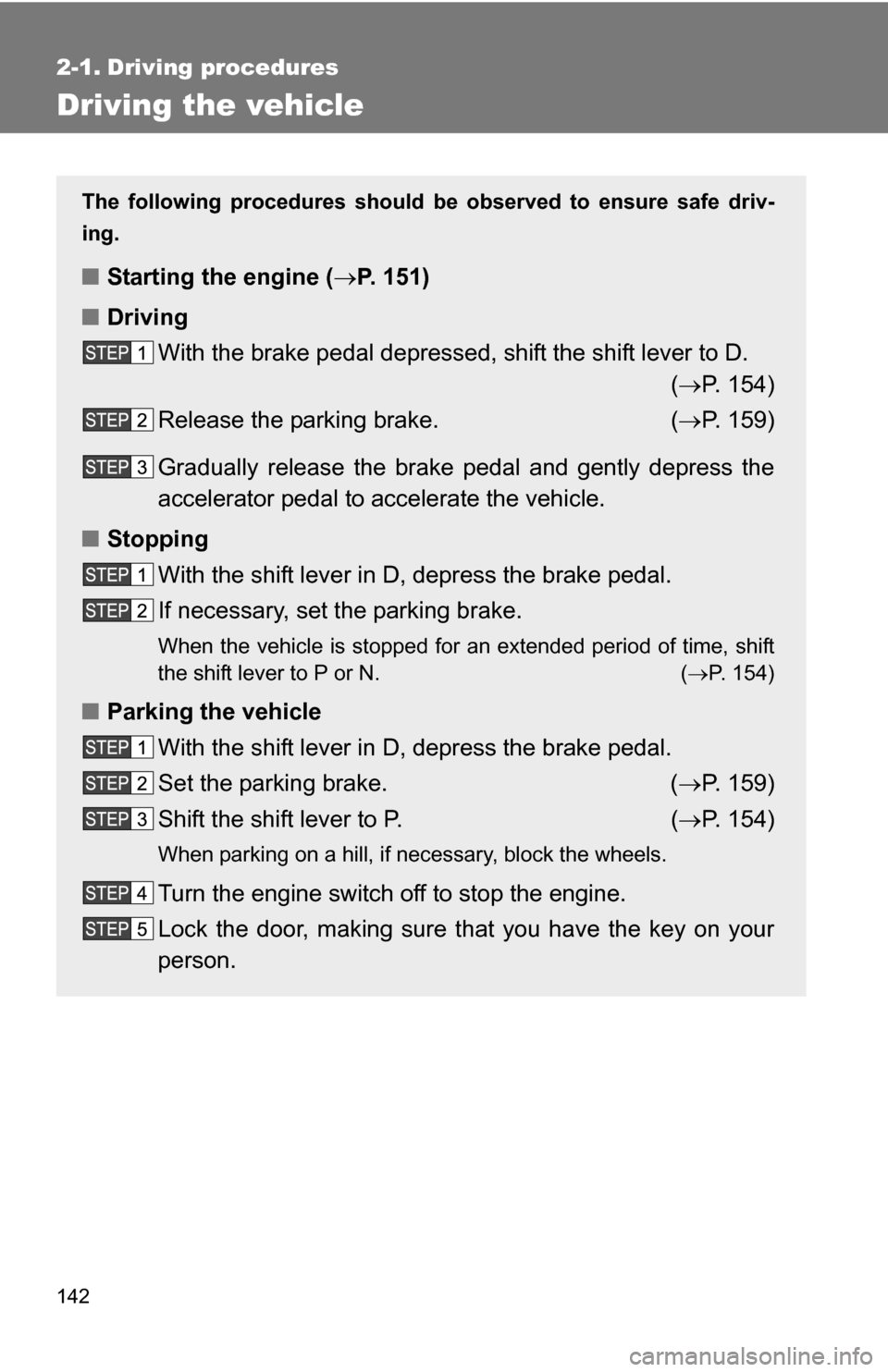
The following procedures should be observed to ensure safe driv-
ing.
■ Starting the engine ( P. 151)
■ Driving
With the brake pedal depressed, shift the shift lever to D. ( P. 154)
Release the parking brake. ( P. 159)
Gradually release the brake pedal and gently depress the
accelerator pedal to accelerate the vehicle.
■ Stopping
With the shift lever in D, depress the brake pedal.
If necessary, set the parking brake.
When the vehicle is stopped for an extended period of time, shift
the shift lever to P or N. ( P. 154)
■Parking the vehicle
With the shift lever in D, depress the brake pedal.
Set the parking brake. ( P. 159)
Shift the shift lever to P. ( P. 154)
When parking on a hill, if necessary, block the wheels.
Turn the engine switch off to stop the engine.
Lock the door, making sure that you have the key on your
person.
Page 143 of 612
143
2-1. Driving procedures
2
When driving
Starting on a steep uphill
With the brake pedal depressed, firmly set the parking brake
and shift the shift lever to D.
Gently depress the accelerator pedal.
Release the parking brake.
■Driving in the rain
●Drive carefully when it is raining, because visibility will be reduced, the
windows may become fogged-up, and the road will be slippery.
● Drive carefully when it starts to rain, because the road surface will be
especially slippery.
● Refrain from high speeds when driving on an expressway in the rain,
because there may be a layer of water between the tires and the road
surface, preventing the steering and brakes from operating properly.
■ Breaking in your new Toyota
To extend the life of the vehicle, the following precautions are recommended
to observe:
●For the first 200 miles (300 km):
Avoid sudden stops.
● For the first 500 miles (800 km):
Do not tow a trailer.
● For the first 1000 miles (1600 km):
• Do not drive at extremely high speeds.
• Avoid sudden acceleration.
• Do not drive continuously in the low gears.
• Do not drive at a constant speed for extended periods.
■ Drum-in disc type parking brake system
Your vehicle has a drum-in-disc type parking brake system. This type of
brake system needs bedding-down of the brake shoes periodically or when-
ever the parking brake shoes and/or drum are replaced. Have your Toyota
dealer perform the bedding down.
Page 145 of 612
145
2-1. Driving procedures
2
When driving
CAUTION
■
When driving the vehicle
●If the smell of exhaust is noticed inside the vehicle, open the windows and
check that the back door and power back window are closed. Large
amounts of exhaust in the vehicle can cause driver drowsiness and an
accident, resulting in death or a serious health hazard. Have the vehicle
inspected by your Toyota dealer immediately.
● Do not under any circumstances shift the shift lever to P, R or N while the
vehicle is moving.
Doing so can cause significant damage to the transmission system and
may result in a loss of vehicle control.
● Do not shift the shift lever to N while the vehicle is moving.
Doing so may cause the engine brake to not operate properly and lead to
an accident.
● Do not turn the engine off while driving.
The power steering and brake booster systems will not operate properly if
the engine is not running.
● Use engine braking (downshift) to maintain a safe speed when driving
down a steep hill.
Using the brakes continuously may cause the brakes to overheat and lose
effectiveness. ( P. 154)
● When stopped on an inclined surface, use the brake pedal and parking
brake to prevent the vehicle from rolling backward or forward and causing
an accident.
● Do not adjust the position of the steering wheel, the seat, or the inside or
outside rear view mirrors while driving.
Doing so may result in a loss of vehicle control that can cause accidents
that may result in death or serious injury.
● Always check that all passengers’ arms, heads or other parts of their bod-
ies are not outside the vehicle, as this may result in death or serious injury.
● Do not drive in excess of the speed limit. Even if the legal speed limit per-
mits it, do not drive over 85 mph (140 km/h) unless your vehicle has high-
speed capability tires. Driving over 85 mph (140 km/h) may result in tire
failure, loss of control and possible injury. Be sure to consult a tire dealer
to determine whether the tires on your vehicle are high-speed capability
tires or not before driving at such speeds.
Page 147 of 612
147
2-1. Driving procedures
2
When driving
CAUTION
■
When the vehicle is parked
●Do not leave glasses, cigarette lighters, spray cans, or soft drink cans in
the vehicle when it is in the sun.
Doing so may result in the following.
• Gas may leak from a cigarette lighter or spray can, and may lead to a
fire.
• The temperature inside the vehicle may cause the plastic lenses and plastic material of eye glasses to deform or crack.
• Soft drink cans may fracture, causing the contents to spray over the interior of the vehicle, and may also cause a short circuit in the vehi-
cle’s electrical components.
● Always apply the parking brake, shift the shift lever to P, stop the engine
and lock the vehicle.
Do not leave the vehicle unattended while the engine is running.
● If the shift lever is moved before the 4LO indicator turns on/off, the transfer
mode may not be shifted completely. The transfer mode disengages both
the front and rear driveshafts from the powertrain and allows the vehicle to
move regardless of the shift position. (At this time, the indicator blinks and
the buzzer sounds.)
Therefore, the vehicle is free to roll even if the automatic transmission is in
P. You or someone else could be seriously injured. You must complete the
shifting of the transfer mode. ( P. 214)
● Do not touch the exhaust pipe while the engine is running or immediately
after turning the engine off.
Doing so may cause burns.
● Do not leave the engine running in an area with snow build-up, or where it
is snowing. If snowbanks build up around the vehicle while the engine is
running, exhaust gases may collect and enter the vehicle. This may lead
to death or a serious health hazard.
■ Exhaust gases
Exhaust gases include harmful carbon monoxide (CO) that is colorless and
odorless. Inhaling exhaust gases may lead to death or a serious health haz-
ard.
Page 148 of 612
148 2-1. Driving procedures
CAUTION
■Exhaust gases
●If the vehicle is in a poorly ventilated area, stop the engine. In a closed
area, such as a garage, exhaust gases may collect and enter the vehicle.
This may lead to death or a serious health hazard.
● The exhaust should be checked occasionally. If there is a hole or crack
caused by corrosion, damage to a joint or abnormal exhaust noise, be
sure to have the vehicle inspected and repaired by your Toyota dealer.
Failure to do so may allow exhaust gases to enter the vehicle, resulting in
death or a serious health hazard.
■ When taking a nap in the vehicle
Always turn the engine off. Otherwise, you may accidentally move the shift
lever or depress the accelerator pedal, which could cause an accident or fire
due to engine overheating. Additionally, if the vehicle is parked in a poorly
ventilated area, exhaust gases may collect and enter the vehicle, leadin\
g to
death or a serious health hazard.
■ When braking the vehicle
●When the brakes are wet, drive more cautiously.
Braking distance increases when the brakes are wet, and may cause one
side of the vehicle to brake differently than the other side. Also the parking
brake may not securely hold the vehicle.
● If the power brake assist function does not operate, do not follow other
vehicles closely and avoid downhills or sharp turns that require braking.
In this case, braking is still possible, but it will require more force on the
pedal than usual. Braking distance may also increase.
● Do not pump the brake pedal if the engine stalls.
Each push on the brake pedal uses up the reserve for the power-assisted
brakes.
● The brake system consists of 2 individual hydraulic systems: If one of the
systems fails, the other will still operate. In this case, the brake pedal
should be depressed more firmly than usual and braking distance
becomes longer.
Do not drive your vehicle with only a single brake system. Have your
brakes fixed immediately.
Page 149 of 612
149
2-1. Driving procedures
2
When driving
NOTICE
■
When driving the vehicle
●Do not use the accelerator pedal or depress accelerator and brake pedals
together to hold the vehicle on a hill.
■ When parking the vehicle
Always put the shift lever in P.
Failure to do so may cause the vehicle to move or the vehicle may acceler-
ate suddenly if the accelerator pedal is accidentally depressed.
■ Avoiding damage to vehicle parts
●Do not turn the steering wheel fully in either direction and hold it there for a
long time.
Doing so may damage the power steering pump.
● When driving over bumps in the road, drive as slowly as possible to avoid
damaging the wheels, underside of the vehicle, etc.
■ If you hear a squealing or scrapin g noise while driving (brake pad wear
limit indicators)
Have the brake pads checked and replaced by your Toyota dealer as soon
as possible.
The rotor damage can result if the pads are not replaced when needed.
It is dangerous to drive the vehicle when the wear limits of the brake pads
and/or that of the brake discs are exceeded.
■ If you get a flat tire while driving
A flat or damaged tire may cause the following situations. Hold the steering
wheel firmly and gradually press the brake pedal to slow down the vehicle.
●It may be difficult to control your vehicle.
● The vehicle will make abnormal sounds.
● The vehicle will behave abnormally.
Replace a flat tire with a new one. ( P. 532)
Page 151 of 612
151
2-1. Driving procedures
2
When driving
Engine (ignition) switch
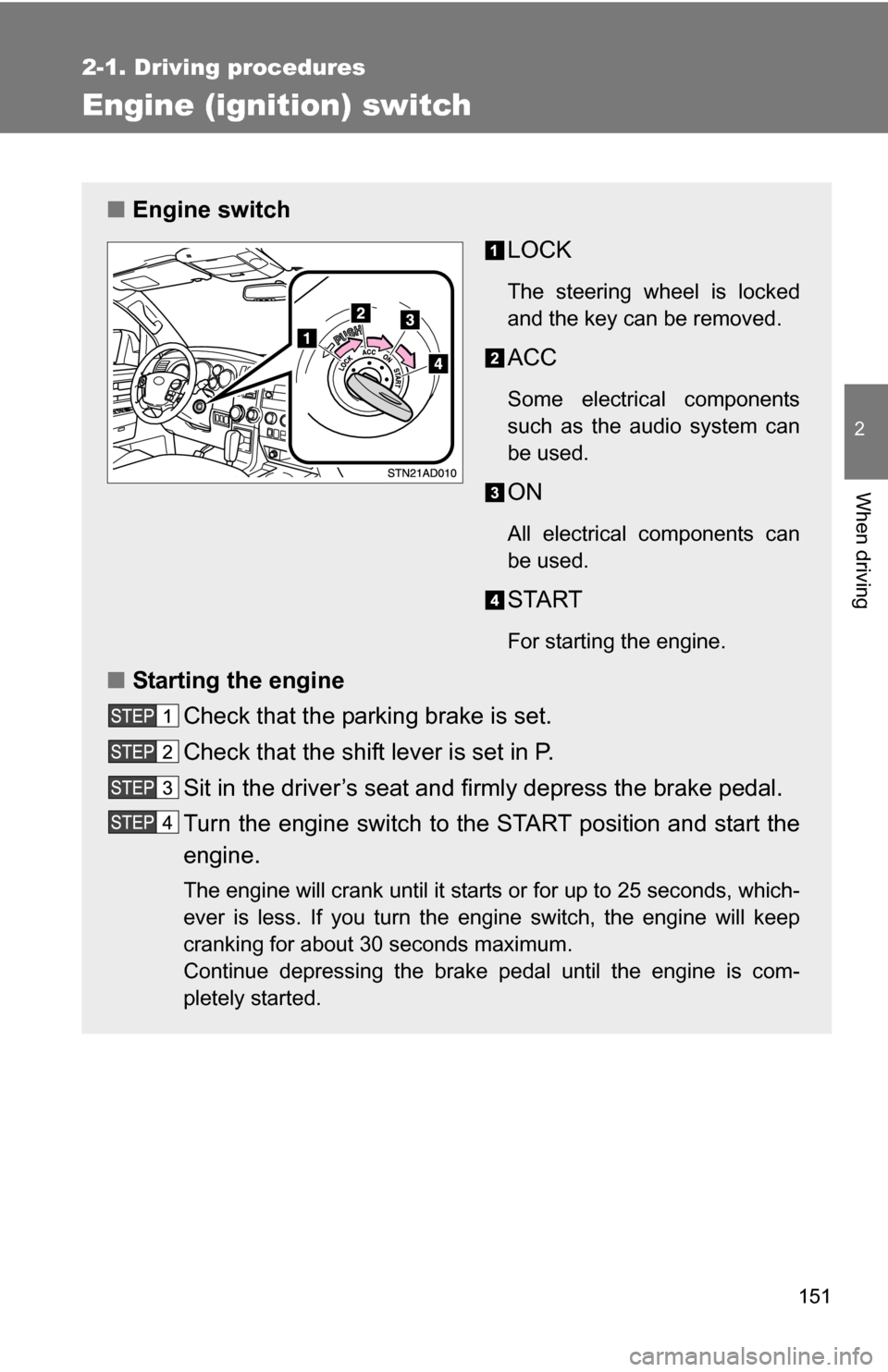
■Engine switch
LOCK
The steering wheel is locked
and the key can be removed.
ACC
Some electrical components
such as the audio system can
be used.
ON
All electrical components can
be used.
START
For starting the engine.
■Starting the engine
Check that the parking brake is set.
Check that the shift lever is set in P.
Sit in the driver’s seat and firmly depress the brake pedal.
Turn the engine switch to the START position and start the
engine.
The engine will crank until it starts or for up to 25 seconds, which-
ever is less. If you turn the engine switch, the engine will keep
cranking for about 30 seconds maximum.
Continue depressing the brake pedal until the engine is com-
pletely started.