check engine TOYOTA SIENNA 2007 Service Repair Manual
[x] Cancel search | Manufacturer: TOYOTA, Model Year: 2007, Model line: SIENNA, Model: TOYOTA SIENNA 2007Pages: 3000, PDF Size: 52.26 MB
Page 579 of 3000

ES–2862GR-FE ENGINE CONTROL SYSTEM – SFI SYSTEM
ES
DTC SUMMARY
DESCRIPTION
The circuit description can be found in the EVAP (Evaporative Emission) System (See page ES-409).
INSPECTION PROCEDURE
Refer to the EVAP System (See page ES-412).
MONITOR DESCRIPTION
5 hours*1 after the ignition switch is turned off, the electric vacuum pump creates negative pressure
(vacuum) in the EVAP (Evaporative Emission) system. The ECM monitors for leaks and actuator
malfunctions based on the EVAP pressure.
HINT:
*1: If the engine coolant temperature is not below 35
C (95F) 5 hours after the ignition switch is turned
off, the monitor check starts 2 hours later. If it is still not below 35
C (95F) 7 hours after the ignition switch
is turned off, the monitor check starts 2.5 hours later.
DTC P0455Evaporative Emission Control System Leak
Detected (Gross Leak)
DTC P0456Evaporative Emission Control System Leak
Detected (Very Small Leak)
DTCs Monitoring ItemMalfunction Detection
ConditionTrouble Area Detection TimingDetection
Logic
P0455 EVAP gross leakVacuum pump creates negative
pressure (vacuum) in EVAP
system and EVAP system
pressure is measured. 0.02 inch
leak pressure standard is
measured at start and end of leak
check.
If stabilized pressure is higher
than [second 0.02 inch leak
pressure standard x 0.2], ECM
determines that EVAP system
has a large leak.• Fuel tank cap (loose)
• Leakage from EVAP
line (Canister - Fuel
tank)
• Leakage from EVAP
line (Purge VSV -
Canister)
• Leakage from pump
module
• Leakage from fuel
tank
• Leakage from canisterWhile ignition
switch OFF2 trip
P0456 EVAP small leakVacuum pump creates negative
pressure (vacuum) in EVAP
system and EVAP system
pressure is measured. 0.02 inch
leak pressure standard measured
at start and end of leak check.
If stabilized pressure is higher
than second 0.02 inch leak
pressure standard, ECM
determines that EVAP system
has a small leak.While ignition
switch OFF2 trip
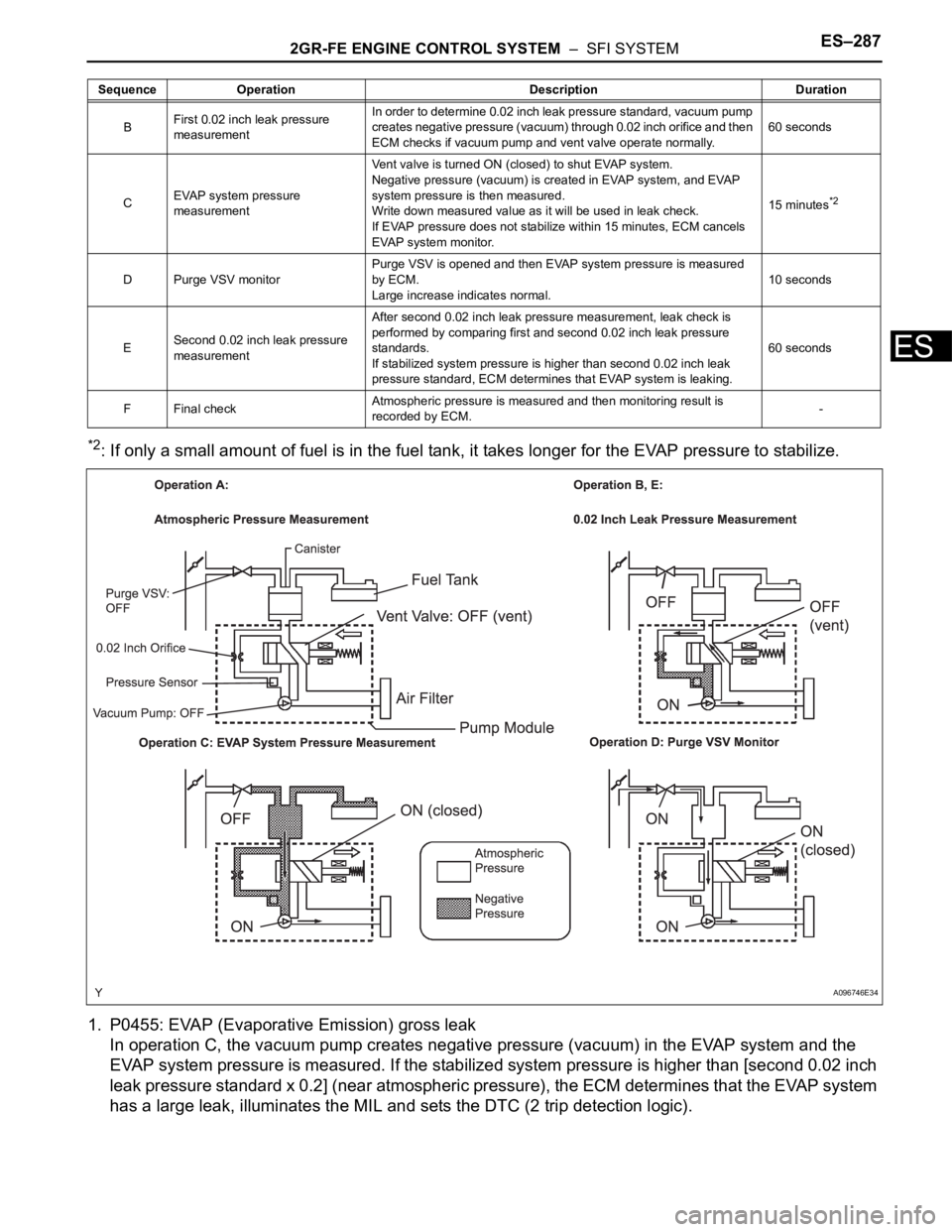
Sequence Operation Description Duration
- ECM activationActivated by soak timer, 5 hours (7 or 9.5 hours) after ignition switch is
turned off.-
AAtmospheric pressure
measurementVent valve is turned OFF (vent) and EVAP system pressure is
measured by ECM in order to register atmospheric pressure.
If pressure in EVAP system is not between 70 kPa and 110 kPa (525
mmHg and 825 mmHg), ECM cancels EVAP system monitor.10 seconds
Page 580 of 3000
2GR-FE ENGINE CONTROL SYSTEM – SFI SYSTEMES–287
ES
*2: If only a small amount of fuel is in the fuel tank, it takes longer for the EVAP pressure to stabilize.
1. P0455: EVAP (Evaporative Emission) gross leak
In operation C, the vacuum pump creates negative pressure (vacuum) in the EVAP system and the
EVAP system pressure is measured. If the stabilized system pressure is higher than [second 0.02 inch
leak pressure standard x 0.2] (near atmospheric pressure), the ECM determines that the EVAP system
has a large leak, illuminates the MIL and sets the DTC (2 trip detection logic).
BFirst 0.02 inch leak pressure
measurementIn order to determine 0.02 inch leak pressure standard, vacuum pump
creates negative pressure (vacuum) through 0.02 inch orifice and then
ECM checks if vacuum pump and vent valve operate normally.60 seconds
CEVAP system pressure
measurementVent valve is turned ON (closed) to shut EVAP system.
Negative pressure (vacuum) is created in EVAP system, and EVAP
system pressure is then measured.
Write down measured value as it will be used in leak check.
If EVAP pressure does not stabilize within 15 minutes, ECM cancels
EVAP system monitor.15 minutes
*2
D Purge VSV monitorPurge VSV is opened and then EVAP system pressure is measured
by ECM.
Large increase indicates normal.10 seconds
ESecond 0.02 inch leak pressure
measurementAfter second 0.02 inch leak pressure measurement, leak check is
performed by comparing first and second 0.02 inch leak pressure
standards.
If stabilized system pressure is higher than second 0.02 inch leak
pressure standard, ECM determines that EVAP system is leaking.60 seconds
F Final checkAtmospheric pressure is measured and then monitoring result is
recorded by ECM.- Sequence Operation Description Duration
A096746E34
Page 582 of 3000

2GR-FE ENGINE CONTROL SYSTEM – SFI SYSTEMES–289
ES
Key-off monitor sequence 1 to 8
1. Atmospheric pressure measurement
2. First reference pressure measurement
3. EVAP canister vent valve close stuck check
4. Vacuum introduction
5. EVAP canister purge valve close stuck check
6. Second reference pressure measurement
7. Leak check
8. Atmospheric pressure measurement
TYPICAL MALFUNCTION THRESHOLDS
P0455: EVAP gross leak
P0456: EVAP 0.02 inch leak
2. EVAP purge operation Performed
ECT 4.4 to 35
C (40 to 95F)
IAT 4.4 to 35
C (40 to 95F)
Next sequence is run if the following condition is met -
Atmospheric pressure change Less than 0.3 kPa (2.25 mmHg) in 1 second
Next sequence is run if the following conditions are met Conditions 1, 2 and 3
1. EVAP pressure just after reference pressure
measurement-1 kPa (-7.5 mmHg) or less
2. Reference pressure -4.85 to -1.057 kPa (-36.384 to -7.929 mmHg)
3. Reference pressure Saturated within 1 minutes
Next sequence is run if the following condition is met -
EVAP pressure change after vent valve is ON 0.3 kPa (2.25 mmHg) or more
Next sequence is run if the following condition is met -
EVAP pressure Saturated within 15 minutes
Next sequence is run if the following condition is met -
EVAP pressure change after purge valve is open 0.3 kPa (2.25 mmHg) or more
Next sequence is run if the following conditions are met Conditions 1, 2, 3 and 4
1. EVAP pressure just after reference pressure
measurement-1 kPa (-7.5 mmHg) or less
2. Reference pressure -4.85 to -1.057 kPa (-36.384 to -7.929 mmHg)
3. Reference pressure Saturated
4. Difference between first reference pressure and
second reference pressureLess than 0.7 kPa (5.25 mmHg)
Next sequence is run if the following condition is met -
EVAP pressure when vacuum introduction was
completeLower than second reference pressure
EVAP monitor is complete if the following condition was
met-
Atmospheric pressure difference between sequence 1
and 8Within 0.3 kPa (2.25 mmHg)
EVAP pressure when vacuum introduction is complete Between reference pressure and reference pressure x 0.2
EVAP pressure when vacuum introduction is complete Higher than reference pressure x 0.2
Page 583 of 3000

ES–2902GR-FE ENGINE CONTROL SYSTEM – SFI SYSTEM
ES
MONITOR RESULT
Refer to CHECKING MONITOR STATUS (See page ES-19).
Page 586 of 3000
2GR-FE ENGINE CONTROL SYSTEM – SFI SYSTEMES–293
ES
(a) Drive the vehicle and check whether the operation of the
speedometer in the combination meter is normal.
HINT:
• The vehicle speed sensor is operating normally if the
speedometer reading is normal.
• If the speedometer does not operate, check it by
following the procedure described in speedometer
malfunction.
NG
OK
(a) Connect the intelligent tester to the DLC3.
(b) Turn the ignition switch to the ON position.
(c) Turn the tester on.
(d) Select the following menu items: DIAGNOSIS /
ENHANCED OBD II / DATA LIST / PRIMARY / VEHICLE
SPD.
(e) Drive the vehicle.
(f) Read the value displayed on the tester.
OK:
Vehicle speeds displayed on tester and
speedometer display are equal.
NG
OK
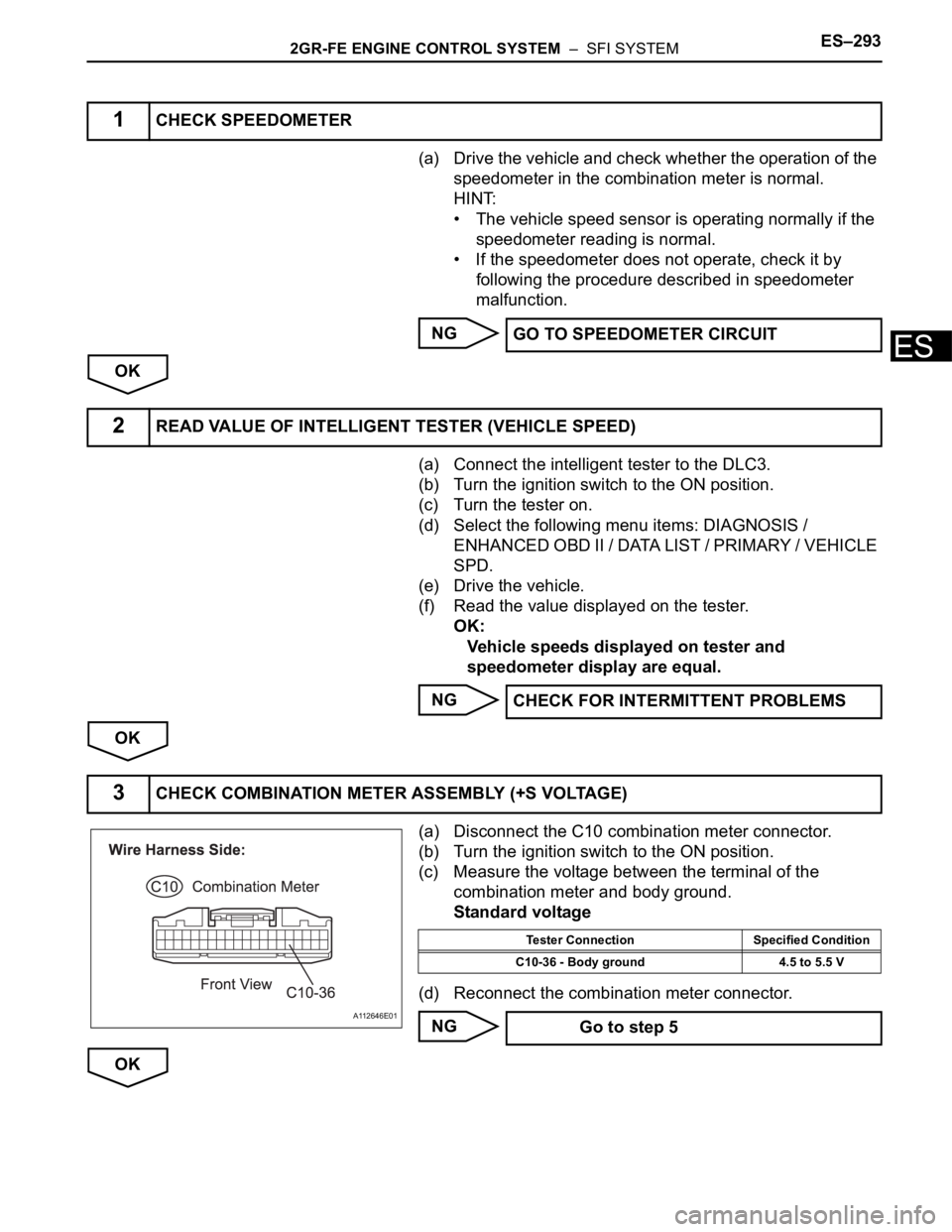
(a) Disconnect the C10 combination meter connector.
(b) Turn the ignition switch to the ON position.
(c) Measure the voltage between the terminal of the
combination meter and body ground.
Standard voltage
(d) Reconnect the combination meter connector.
NG
OK
1CHECK SPEEDOMETER
GO TO SPEEDOMETER CIRCUIT
2READ VALUE OF INTELLIGENT TESTER (VEHICLE SPEED)
CHECK FOR INTERMITTENT PROBLEMS
3CHECK COMBINATION METER ASSEMBLY (+S VOLTAGE)
A112646E01
Tester Connection Specified Condition
C10-36 - Body ground 4.5 to 5.5 V
Go to step 5
Page 587 of 3000
ES–2942GR-FE ENGINE CONTROL SYSTEM – SFI SYSTEM
ES
(a) Shift the transmission gear selector lever to the neutral
position.
(b) Jack up the vehicle.
(c) Turn the ignition switch to the ON position.
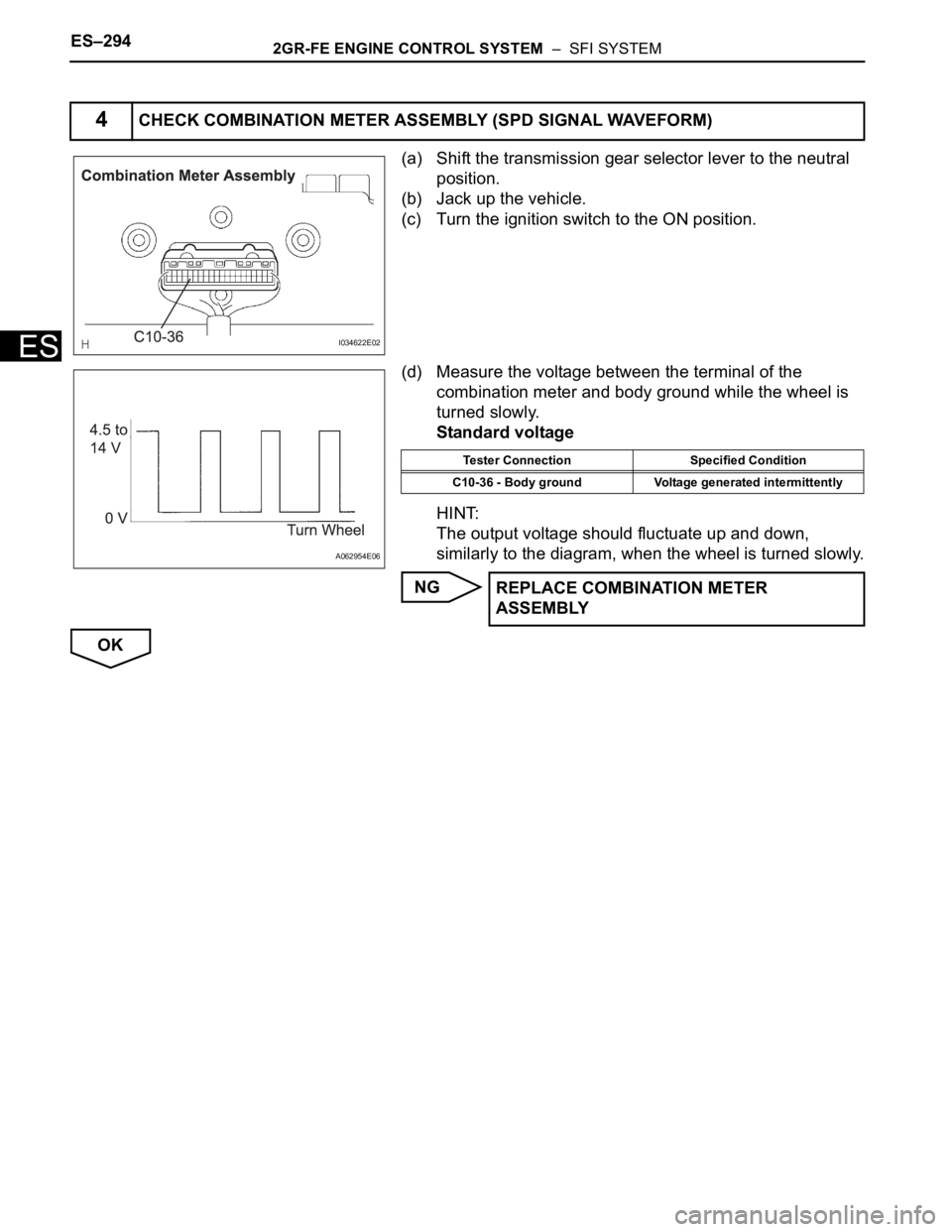
(d) Measure the voltage between the terminal of the
combination meter and body ground while the wheel is
turned slowly.
Standard voltage
HINT:
The output voltage should fluctuate up and down,
similarly to the diagram, when the wheel is turned slowly.
NG
OK
4CHECK COMBINATION METER ASSEMBLY (SPD SIGNAL WAVEFORM)
I034622E02
A062954E06
Tester Connection Specified Condition
C10-36 - Body ground Voltage generated intermittently
REPLACE COMBINATION METER
ASSEMBLY
Page 588 of 3000
2GR-FE ENGINE CONTROL SYSTEM – SFI SYSTEMES–295
ES
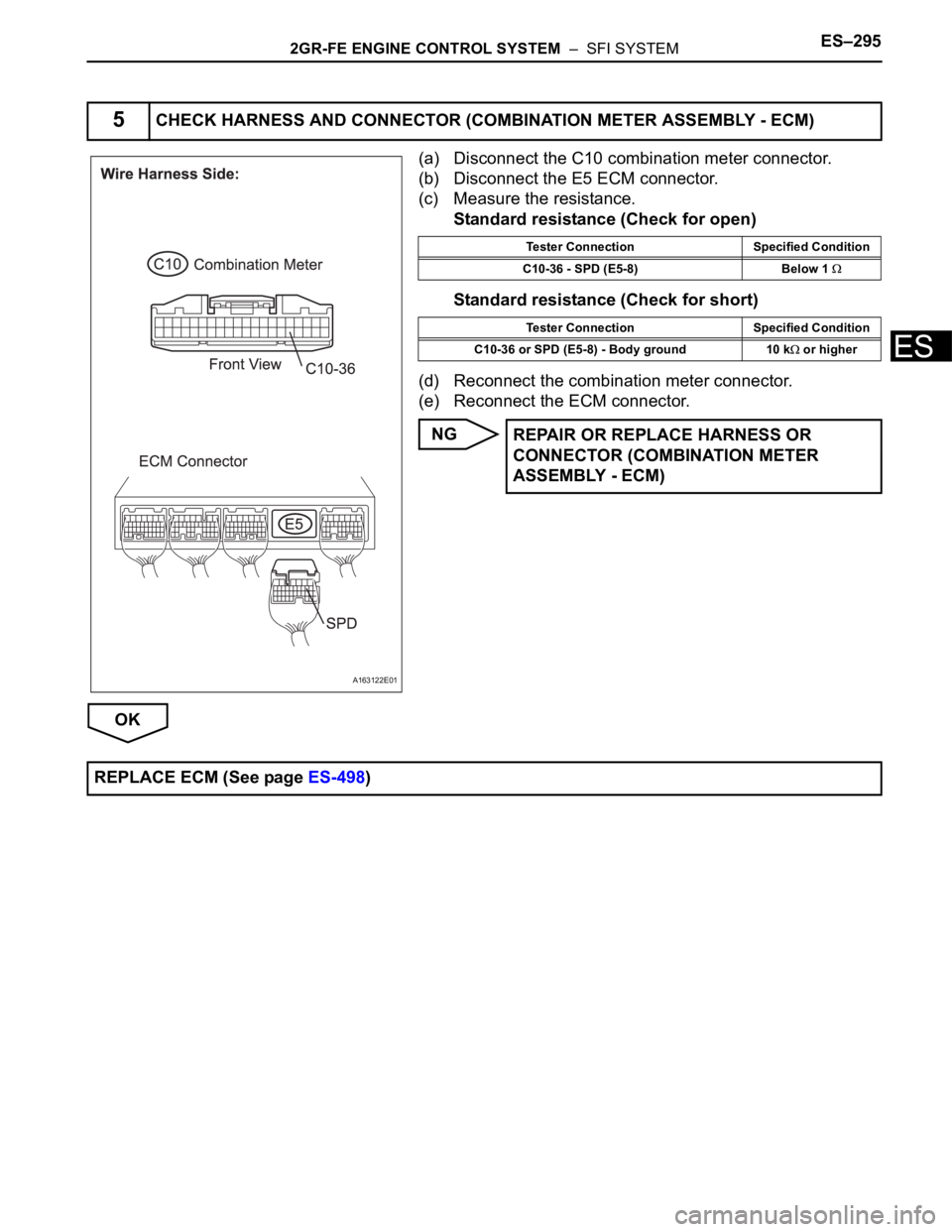
(a) Disconnect the C10 combination meter connector.
(b) Disconnect the E5 ECM connector.
(c) Measure the resistance.
Standard resistance (Check for open)
Standard resistance (Check for short)
(d) Reconnect the combination meter connector.
(e) Reconnect the ECM connector.
NG
OK
5CHECK HARNESS AND CONNECTOR (COMBINATION METER ASSEMBLY - ECM)
A163122E01
Tester Connection Specified Condition
C10-36 - SPD (E5-8) Below 1
Tester Connection Specified Condition
C10-36 or SPD (E5-8) - Body ground 10 k
or higher
REPAIR OR REPLACE HARNESS OR
CONNECTOR (COMBINATION METER
ASSEMBLY - ECM)
REPLACE ECM (See page ES-498)
Page 590 of 3000
2GR-FE ENGINE CONTROL SYSTEM – SFI SYSTEMES–297
ES
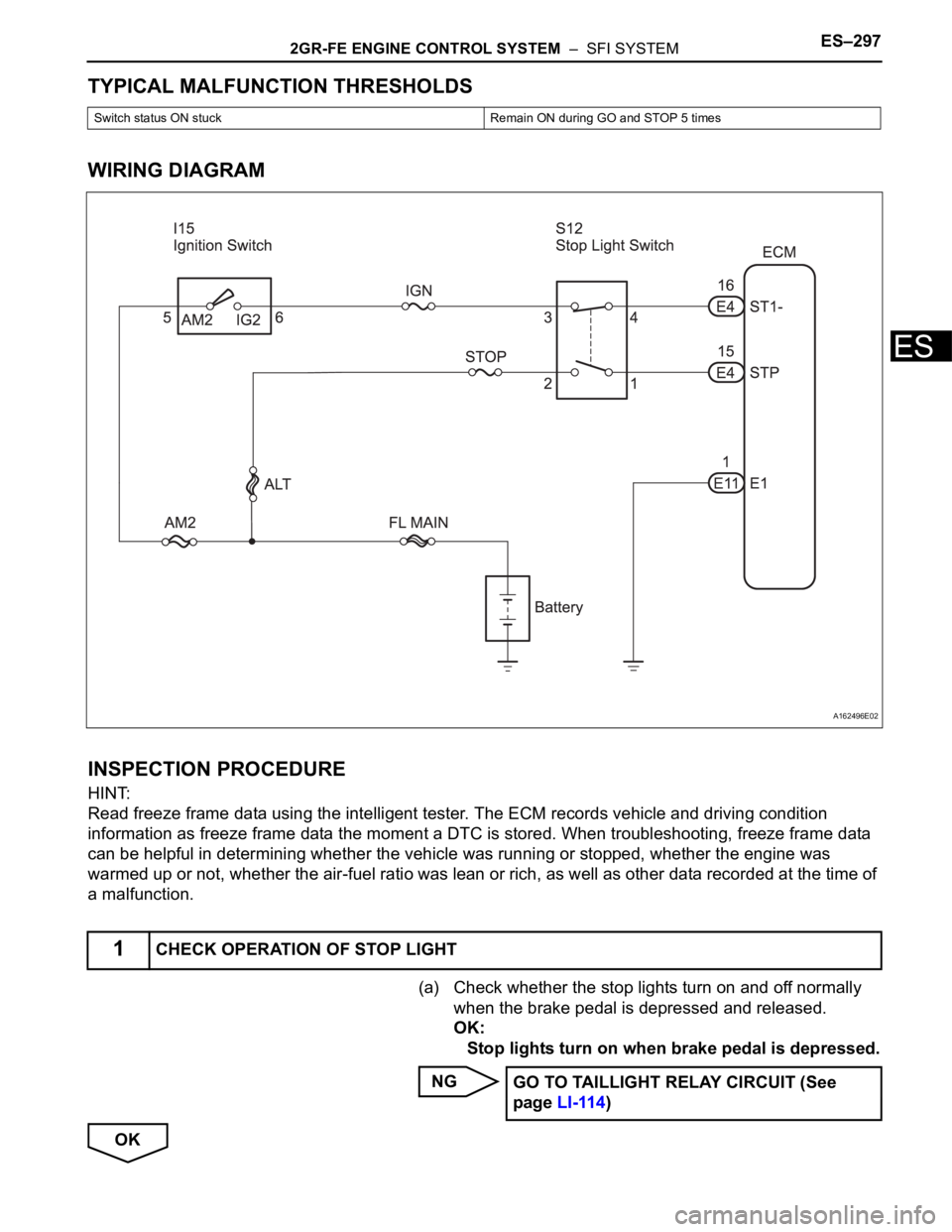
TYPICAL MALFUNCTION THRESHOLDS
WIRING DIAGRAM
INSPECTION PROCEDURE
HINT:
Read freeze frame data using the intelligent tester. The ECM records vehicle and driving condition
information as freeze frame data the moment a DTC is stored. When troubleshooting, freeze frame data
can be helpful in determining whether the vehicle was running or stopped, whether the engine was
warmed up or not, whether the air-fuel ratio was lean or rich, as well as other data recorded at the time of
a malfunction.
(a) Check whether the stop lights turn on and off normally
when the brake pedal is depressed and released.
OK:
Stop lights turn on when brake pedal is depressed.
NG
OK
Switch status ON stuck Remain ON during GO and STOP 5 times
1CHECK OPERATION OF STOP LIGHT
A162496E02
GO TO TAILLIGHT RELAY CIRCUIT (See
page LI-114)
Page 591 of 3000
ES–2982GR-FE ENGINE CONTROL SYSTEM – SFI SYSTEM
ES
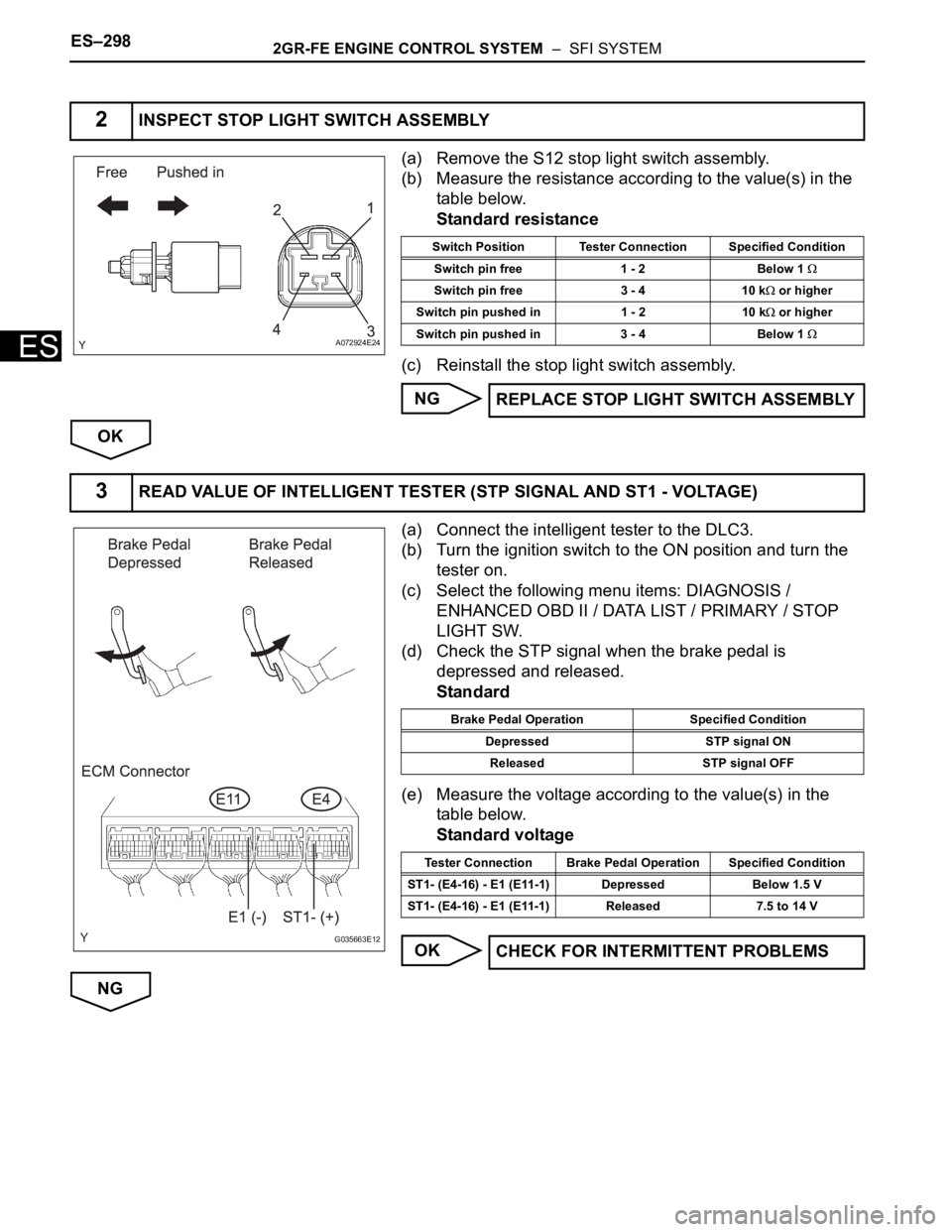
(a) Remove the S12 stop light switch assembly.
(b) Measure the resistance according to the value(s) in the
table below.
Standard resistance
(c) Reinstall the stop light switch assembly.
NG
OK
(a) Connect the intelligent tester to the DLC3.
(b) Turn the ignition switch to the ON position and turn the
tester on.
(c) Select the following menu items: DIAGNOSIS /
ENHANCED OBD II / DATA LIST / PRIMARY / STOP
LIGHT SW.
(d) Check the STP signal when the brake pedal is
depressed and released.
Standard
(e) Measure the voltage according to the value(s) in the
table below.
Standard voltage
OK
NG
2INSPECT STOP LIGHT SWITCH ASSEMBLY
A072924E24
Switch Position Tester Connection Specified Condition
Switch pin free 1 - 2 Below 1
Switch pin free 3 - 4 10 k or higher
Switch pin pushed in 1 - 2 10 k
or higher
Switch pin pushed in 3 - 4 Below 1
REPLACE STOP LIGHT SWITCH ASSEMBLY
3READ VALUE OF INTELLIGENT TESTER (STP SIGNAL AND ST1 - VOLTAGE)
G035663E12
Brake Pedal Operation Specified Condition
Depressed STP signal ON
Released STP signal OFF
Tester Connection Brake Pedal Operation Specified Condition
ST1- (E4-16) - E1 (E11-1) Depressed Below 1.5 V
ST1- (E4-16) - E1 (E11-1) Released 7.5 to 14 V
CHECK FOR INTERMITTENT PROBLEMS
Page 592 of 3000
2GR-FE ENGINE CONTROL SYSTEM – SFI SYSTEMES–299
ES
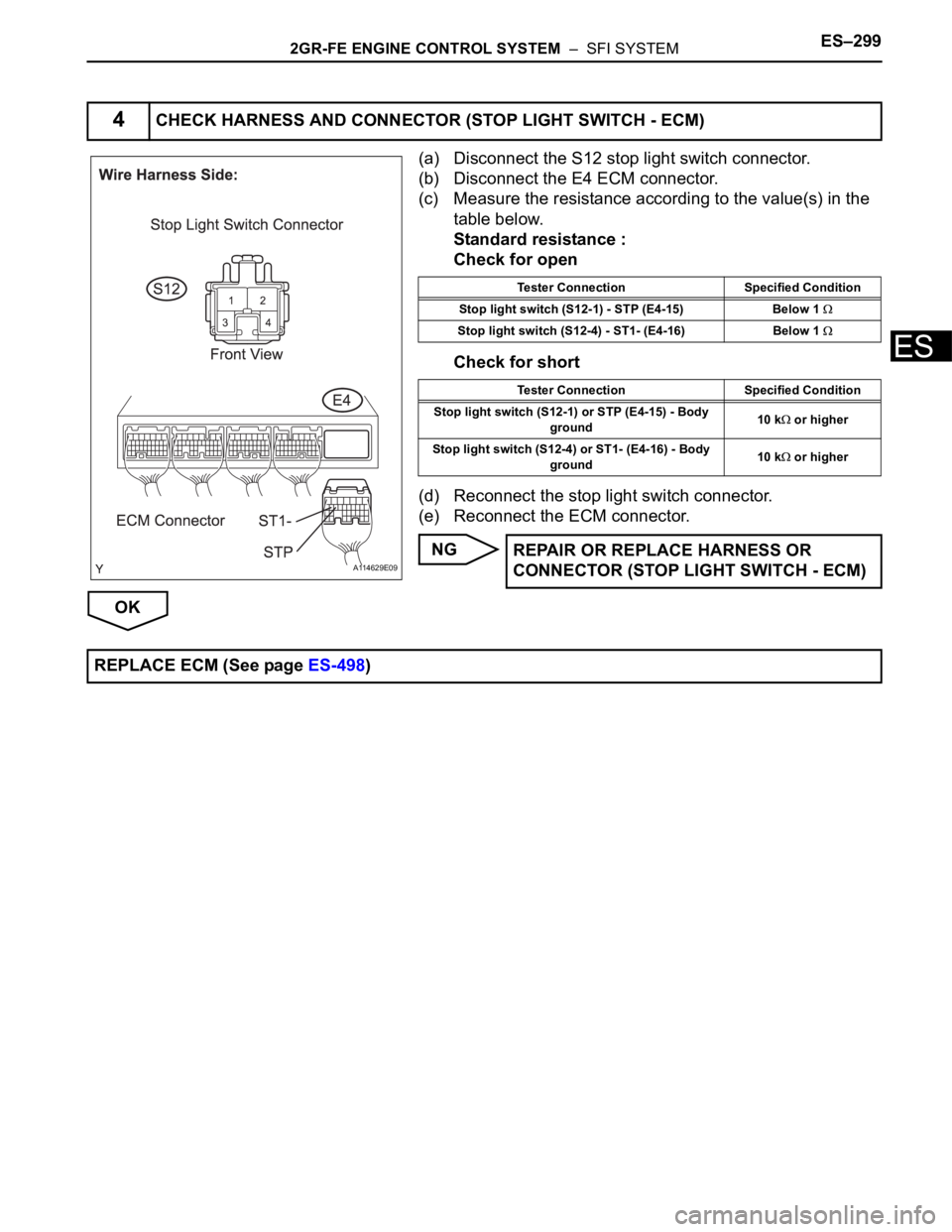
(a) Disconnect the S12 stop light switch connector.
(b) Disconnect the E4 ECM connector.
(c) Measure the resistance according to the value(s) in the
table below.
Standard resistance :
Check for open
Check for short
(d) Reconnect the stop light switch connector.
(e) Reconnect the ECM connector.
NG
OK
4CHECK HARNESS AND CONNECTOR (STOP LIGHT SWITCH - ECM)
A114629E09
Tester Connection Specified Condition
Stop light switch (S12-1) - STP (E4-15) Below 1
Stop light switch (S12-4) - ST1- (E4-16) Below 1
Tester Connection Specified Condition
Stop light switch (S12-1) or STP (E4-15) - Body
ground10 k
or higher
Stop light switch (S12-4) or ST1- (E4-16) - Body
ground10 k
or higher
REPAIR OR REPLACE HARNESS OR
CONNECTOR (STOP LIGHT SWITCH - ECM)
REPLACE ECM (See page ES-498)