check engine TOYOTA SIENNA 2007 Service Owner's Guide
[x] Cancel search | Manufacturer: TOYOTA, Model Year: 2007, Model line: SIENNA, Model: TOYOTA SIENNA 2007Pages: 3000, PDF Size: 52.26 MB
Page 314 of 3000
ES–102GR-FE ENGINE CONTROL SYSTEM – SFI SYSTEM
ES
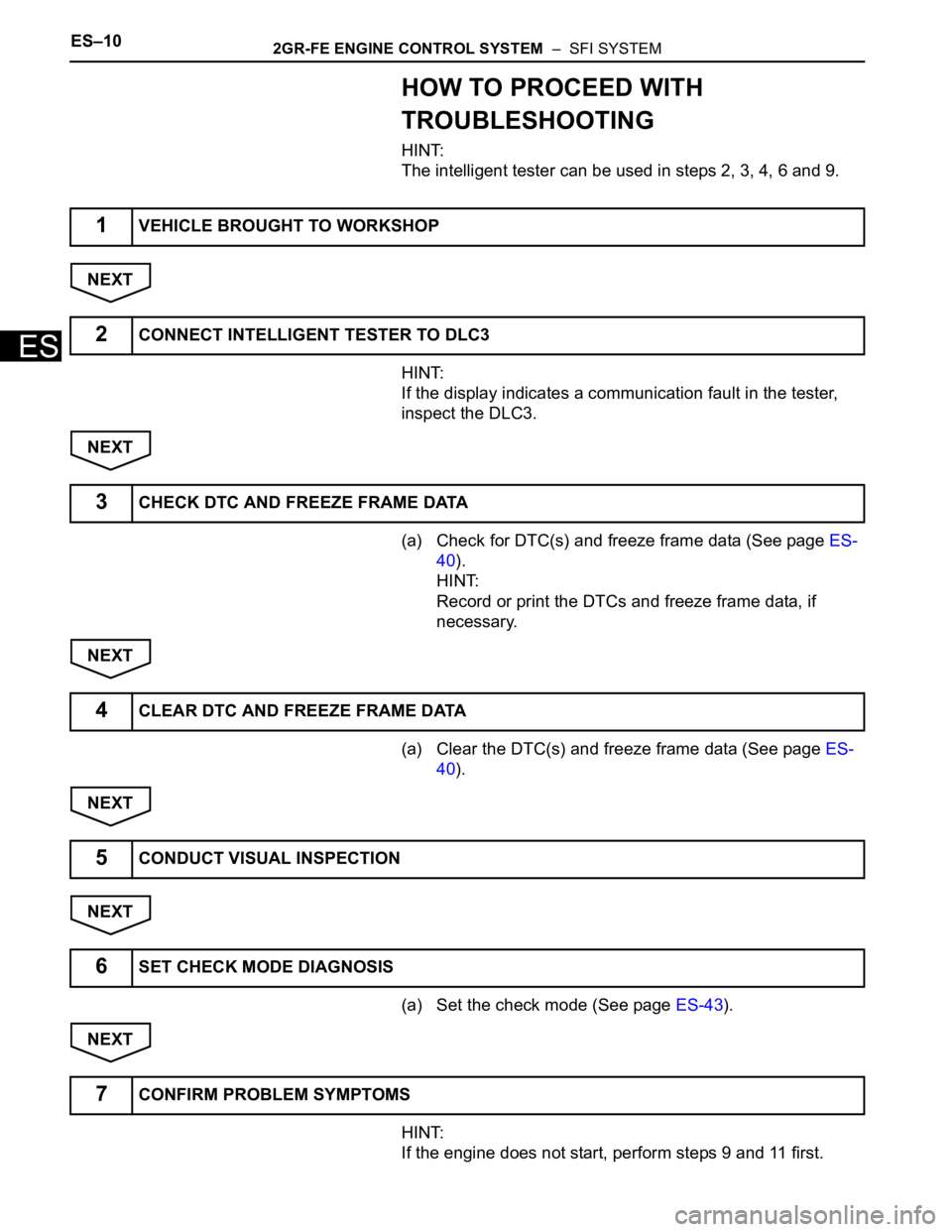
HOW TO PROCEED WITH
TROUBLESHOOTING
HINT:
The intelligent tester can be used in steps 2, 3, 4, 6 and 9.
NEXT
HINT:
If the display indicates a communication fault in the tester,
inspect the DLC3.
NEXT
(a) Check for DTC(s) and freeze frame data (See page ES-
40).
HINT:
Record or print the DTCs and freeze frame data, if
necessary.
NEXT
(a) Clear the DTC(s) and freeze frame data (See page ES-
40).
NEXT
NEXT
(a) Set the check mode (See page ES-43).
NEXT
HINT:
If the engine does not start, perform steps 9 and 11 first.
1VEHICLE BROUGHT TO WORKSHOP
2CONNECT INTELLIGENT TESTER TO DLC3
3CHECK DTC AND FREEZE FRAME DATA
4CLEAR DTC AND FREEZE FRAME DATA
5CONDUCT VISUAL INSPECTION
6SET CHECK MODE DIAGNOSIS
7CONFIRM PROBLEM SYMPTOMS
Page 315 of 3000
2GR-FE ENGINE CONTROL SYSTEM – SFI SYSTEMES–11
ES
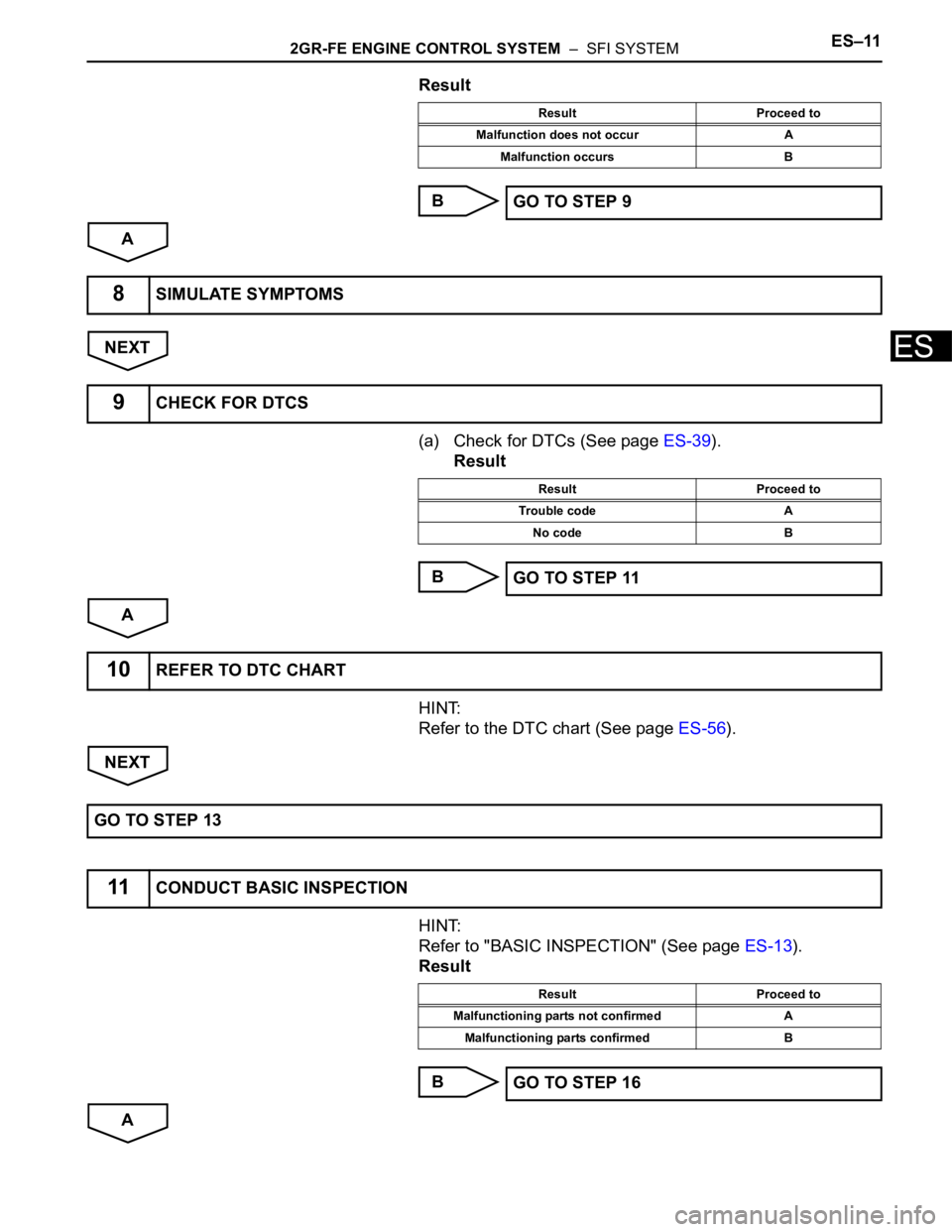
Result
B
A
NEXT
(a) Check for DTCs (See page ES-39).
Result
B
A
HINT:
Refer to the DTC chart (See page ES-56).
NEXT
HINT:
Refer to "BASIC INSPECTION" (See page ES-13).
Result
B
A
Result Proceed to
Malfunction does not occur A
Malfunction occurs B
GO TO STEP 9
8SIMULATE SYMPTOMS
9CHECK FOR DTCS
Result Proceed to
Trouble code A
No code B
GO TO STEP 11
10REFER TO DTC CHART
GO TO STEP 13
11CONDUCT BASIC INSPECTION
Result Proceed to
Malfunctioning parts not confirmed A
Malfunctioning parts confirmed B
GO TO STEP 16
Page 316 of 3000
ES–122GR-FE ENGINE CONTROL SYSTEM – SFI SYSTEM
ES
HINT:
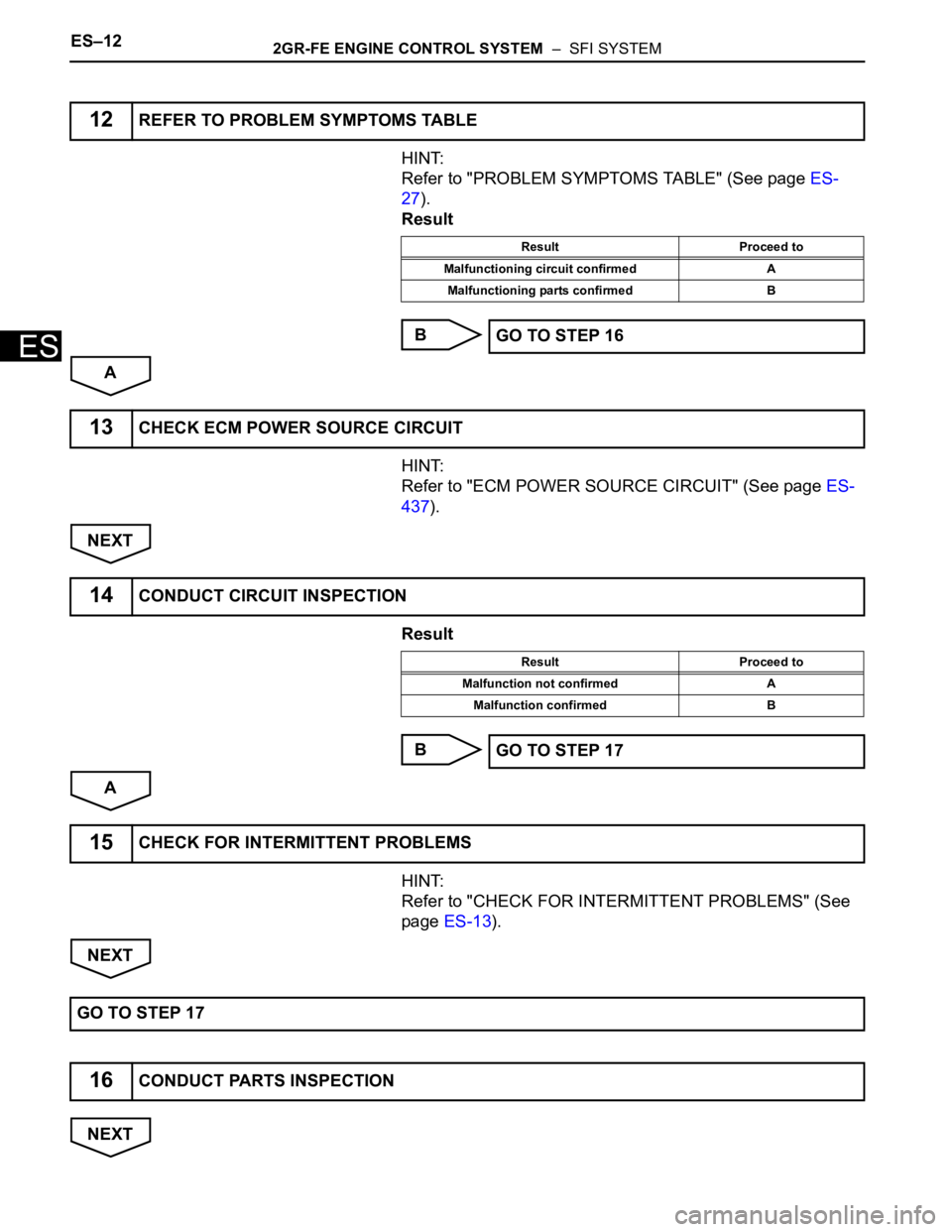
Refer to "PROBLEM SYMPTOMS TABLE" (See page ES-
27).
Result
B
A
HINT:
Refer to "ECM POWER SOURCE CIRCUIT" (See page ES-
437).
NEXT
Result
B
A
HINT:
Refer to "CHECK FOR INTERMITTENT PROBLEMS" (See
page ES-13).
NEXT
NEXT
12REFER TO PROBLEM SYMPTOMS TABLE
Result Proceed to
Malfunctioning circuit confirmed A
Malfunctioning parts confirmed B
GO TO STEP 16
13CHECK ECM POWER SOURCE CIRCUIT
14CONDUCT CIRCUIT INSPECTION
Result Proceed to
Malfunction not confirmed A
Malfunction confirmed B
GO TO STEP 17
15CHECK FOR INTERMITTENT PROBLEMS
GO TO STEP 17
16CONDUCT PARTS INSPECTION
Page 319 of 3000

ES–22GR-FE ENGINE CONTROL SYSTEM – SFI SYSTEM
ES
DEFINITION OF TERMS
Terms Definitions
Monitor Description Description of what ECM monitors and how to detect malfunctions (monitoring purpose and details).
Related DTCs A group of diagnostic trouble codes that are output by ECM based on the same malfunction detection logic.
Typical Enabling
ConditionsPreconditions that allow ECM to detect malfunction.
With all preconditions satisfied, ECM sets DTC when monitored value(s) exceeds malfunction threshold(s).
Sequence of OperationOrder of monitor priority, applied if multiple sensors and components are involved in single malfunction detection
process.
Each sensor and component monitored in turn and not monitored until previous detection operation is completed.
Required Sensors /
ComponentsSensors and components used by ECM to detect each malfunction.
Frequency of OperationNumber of times ECM checks for each malfunction during each driving cycle.
"Once per driving cycle" means ECM performs checks for that malfunction only once in single driving cycle.
"Continuous" means ECM performs checks for that malfunction whenever enabling conditions are met.
DurationMinimum time for which ECM must detect continuous deviation in monitored value(s) in order to set DTC. Timing
begins when typical enabling conditions are met.
Malfunction Thresholds Values, beyond which, ECM determines malfunctions exist and sets DTCs.
MIL OperationTiming of MIL illumination after defect is detected.
"Immediate" means ECM illuminates MIL as soon as malfunction is detected.
"2 driving cycles" means ECM illuminates MIL if the same malfunction is detected twice during the next sequential
driving cycle.
Page 321 of 3000

2GR-FE ENGINE CONTROL SYSTEM – SFI SYSTEMES–253
ES
MONITOR STRATEGY
TYPICAL ENABLING CONDITIONS
All:
Exhaust Camshaft Sensor Range Check / Rationality (While starting engine):
Exhaust Camshaft Sensor Range Check / Rationality (After starting engine):
Exhaust Camshaft Sensor Range Check (Chattering, Low voltage, High voltage):
TYPICAL MALFUNCTION THRESHOLDS
Exhaust Camshaft Sensor Range Check / Rationality (While starting engine):
Exhaust Camshaft Sensor Range Check / Rationality (After starting engine):
Exhaust Camshaft Sensor Range Check (Chattering):
Related DTCsP0365: Exhaust camshaft sensor (Bank 1) range check / rationality (while starting
engine)
P0365: Exhaust camshaft sensor (Bank 1) range check / rationality (after starting
engine)
P0365: Exhaust camshaft sensor (Bank 1) range check (chattering)
P0367: Exhaust camshaft sensor (Bank 1) range check (low voltage)
P0368: Exhaust camshaft sensor (Bank 1) range check (high voltage)
P0390: Exhaust camshaft sensor (Bank 2) range check / rationality (while starting
engine)
P0390: Exhaust camshaft sensor (Bank 2) range check / rationality (after starting
engine)
P0390: Exhaust camshaft sensor (Bank 2) range check (chattering)
P0392: Exhaust camshaft sensor (Bank 2) range check (low voltage)
P0393: Exhaust camshaft sensor (Bank 2) range check (high voltage)
Required Sensors / Components (Main) Exhaust camshaft sensor (Bank 1 and 2)
Required Sensors / Components (Related) Exhaust camshaft sensor
Frequency of Operation Continuous
Duration5 seconds: Exhaust camshaft sensor range check / rationality (After starting engine)
4 seconds: Others
MIL Operation2 driving cycles: Exhaust camshaft sensor range check / rationality (After starting
engine)
Immediate: Others
Sequence of Operation None
The monitor will run whenever these DTCs are not
presentNone
Sta r t e r ON
Battery voltage while starter is ON at least once Less than 11 V
Engine RPM 600 rpm or more
Sta r t e r OF F
Battery voltage 8 V or more
Ignition Switch ON
Sta r t e r OF F
Ignition Switch ON and time after ignition switch is OFF
to ON2 seconds or more
Battery voltage 8 V or more
Exhaust camshaft sensor signal No signal
Exhaust camshaft sensor signal No signal
Exhaust camshaft sensor signal Less than 0.3 V, or more than 4.7 V
Page 322 of 3000
ES–2542GR-FE ENGINE CONTROL SYSTEM – SFI SYSTEM
ES
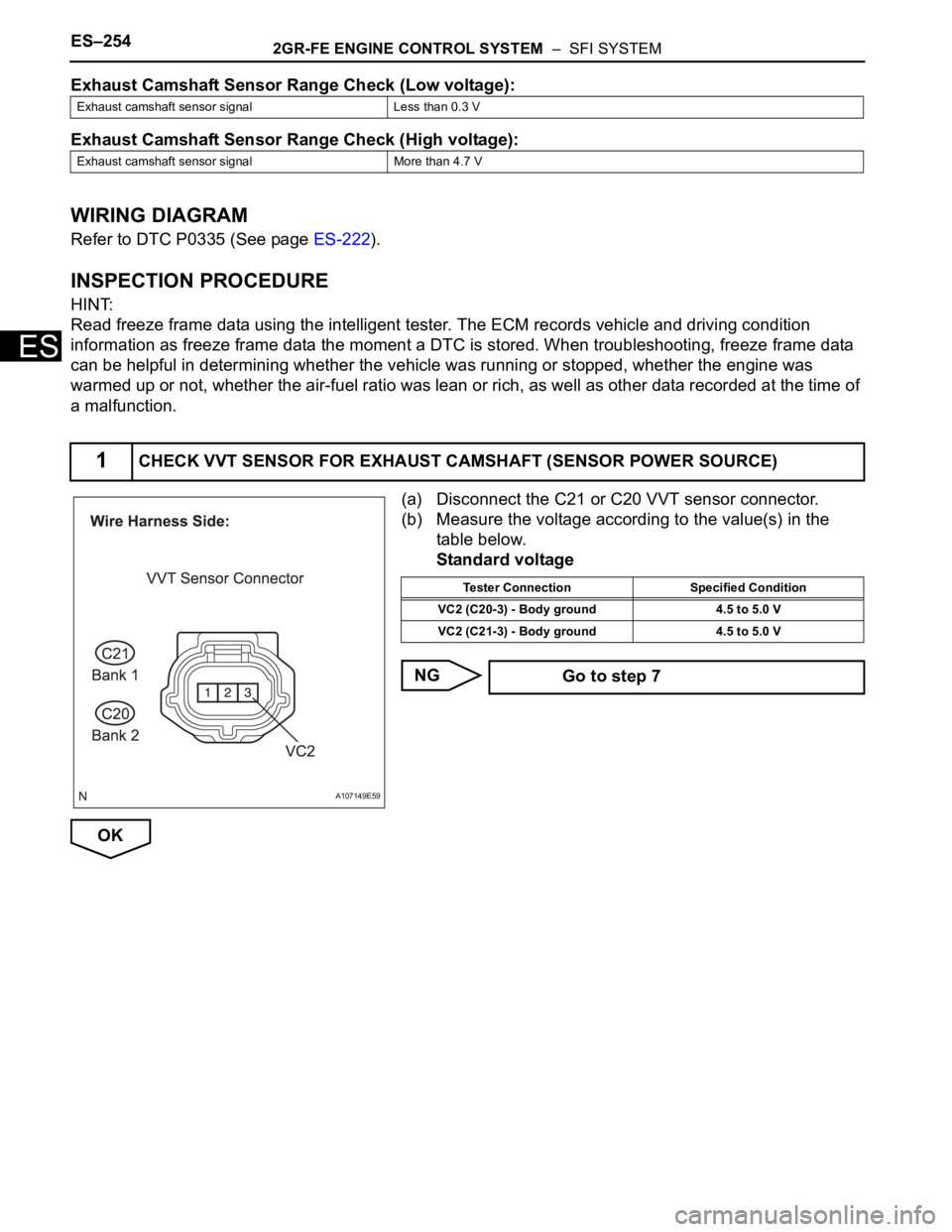
Exhaust Camshaft Sensor Range Check (Low voltage):
Exhaust Camshaft Sensor Range Check (High voltage):
WIRING DIAGRAM
Refer to DTC P0335 (See page ES-222).
INSPECTION PROCEDURE
HINT:
Read freeze frame data using the intelligent tester. The ECM records vehicle and driving condition
information as freeze frame data the moment a DTC is stored. When troubleshooting, freeze frame data
can be helpful in determining whether the vehicle was running or stopped, whether the engine was
warmed up or not, whether the air-fuel ratio was lean or rich, as well as other data recorded at the time of
a malfunction.
(a) Disconnect the C21 or C20 VVT sensor connector.
(b) Measure the voltage according to the value(s) in the
table below.
Standard voltage
NG
OK
Exhaust camshaft sensor signal Less than 0.3 V
Exhaust camshaft sensor signal More than 4.7 V
1CHECK VVT SENSOR FOR EXHAUST CAMSHAFT (SENSOR POWER SOURCE)
A107149E59
Tester Connection Specified Condition
VC2 (C20-3) - Body ground 4.5 to 5.0 V
VC2 (C21-3) - Body ground 4.5 to 5.0 V
Go to step 7
Page 323 of 3000
2GR-FE ENGINE CONTROL SYSTEM – SFI SYSTEMES–255
ES
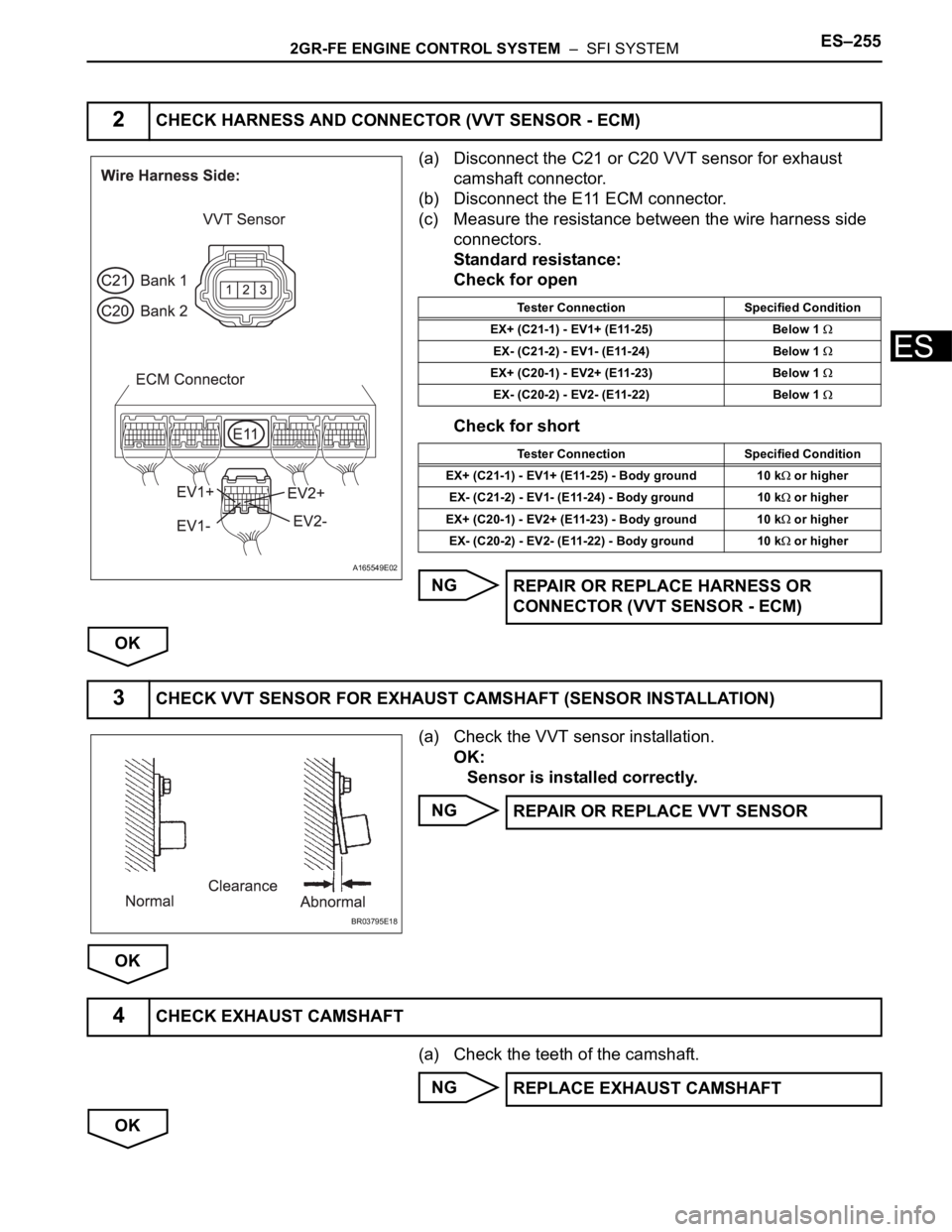
(a) Disconnect the C21 or C20 VVT sensor for exhaust
camshaft connector.
(b) Disconnect the E11 ECM connector.
(c) Measure the resistance between the wire harness side
connectors.
Standard resistance:
Check for open
Check for short
NG
OK
(a) Check the VVT sensor installation.
OK:
Sensor is installed correctly.
NG
OK
(a) Check the teeth of the camshaft.
NG
OK
2CHECK HARNESS AND CONNECTOR (VVT SENSOR - ECM)
A165549E02
Tester Connection Specified Condition
EX+ (C21-1) - EV1+ (E11-25) Below 1
EX- (C21-2) - EV1- (E11-24) Below 1
EX+ (C20-1) - EV2+ (E11-23) Below 1
EX- (C20-2) - EV2- (E11-22) Below 1
Tester Connection Specified Condition
EX+ (C21-1) - EV1+ (E11-25) - Body ground 10 k
or higher
EX- (C21-2) - EV1- (E11-24) - Body ground 10 k
or higher
EX+ (C20-1) - EV2+ (E11-23) - Body ground 10 k
or higher
EX- (C20-2) - EV2- (E11-22) - Body ground 10 k
or higher
REPAIR OR REPLACE HARNESS OR
CONNECTOR (VVT SENSOR - ECM)
3CHECK VVT SENSOR FOR EXHAUST CAMSHAFT (SENSOR INSTALLATION)
BR03795E18
REPAIR OR REPLACE VVT SENSOR
4CHECK EXHAUST CAMSHAFT
REPLACE EXHAUST CAMSHAFT
Page 324 of 3000
ES–2562GR-FE ENGINE CONTROL SYSTEM – SFI SYSTEM
ES
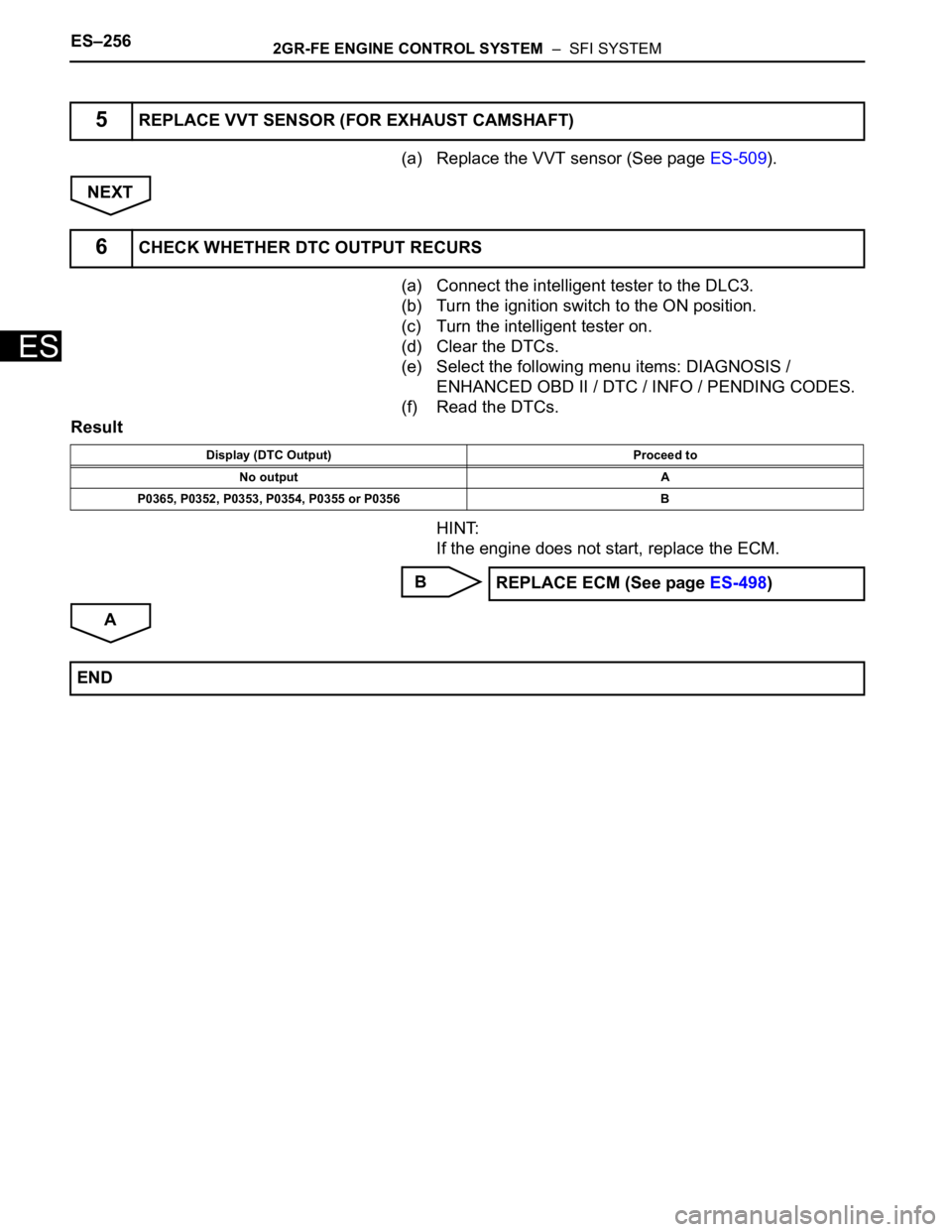
(a) Replace the VVT sensor (See page ES-509).
NEXT
(a) Connect the intelligent tester to the DLC3.
(b) Turn the ignition switch to the ON position.
(c) Turn the intelligent tester on.
(d) Clear the DTCs.
(e) Select the following menu items: DIAGNOSIS /
ENHANCED OBD II / DTC / INFO / PENDING CODES.
(f) Read the DTCs.
Result
HINT:
If the engine does not start, replace the ECM.
B
A
5REPLACE VVT SENSOR (FOR EXHAUST CAMSHAFT)
6CHECK WHETHER DTC OUTPUT RECURS
Display (DTC Output) Proceed to
No output A
P0365, P0352, P0353, P0354, P0355 or P0356 B
REPLACE ECM (See page ES-498)
END
Page 325 of 3000
2GR-FE ENGINE CONTROL SYSTEM – SFI SYSTEMES–257
ES
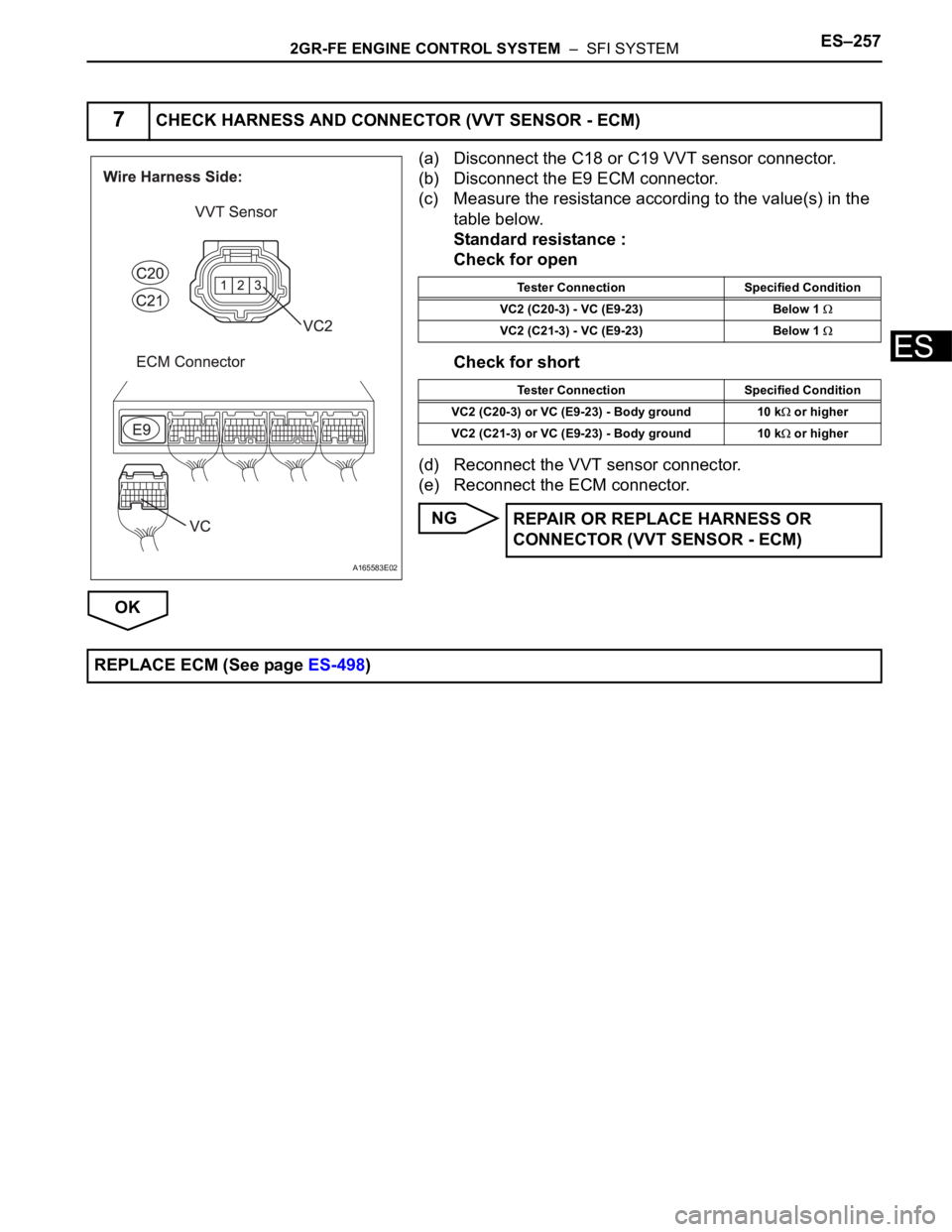
(a) Disconnect the C18 or C19 VVT sensor connector.
(b) Disconnect the E9 ECM connector.
(c) Measure the resistance according to the value(s) in the
table below.
Standard resistance :
Check for open
Check for short
(d) Reconnect the VVT sensor connector.
(e) Reconnect the ECM connector.
NG
OK
7CHECK HARNESS AND CONNECTOR (VVT SENSOR - ECM)
A165583E02
Tester Connection Specified Condition
VC2 (C20-3) - VC (E9-23) Below 1
VC2 (C21-3) - VC (E9-23) Below 1
Tester Connection Specified Condition
VC2 (C20-3) or VC (E9-23) - Body ground 10 k
or higher
VC2 (C21-3) or VC (E9-23) - Body ground 10 k
or higher
REPAIR OR REPLACE HARNESS OR
CONNECTOR (VVT SENSOR - ECM)
REPLACE ECM (See page ES-498)
Page 327 of 3000
2GR-FE ENGINE CONTROL SYSTEM – SFI SYSTEMES–259
ES
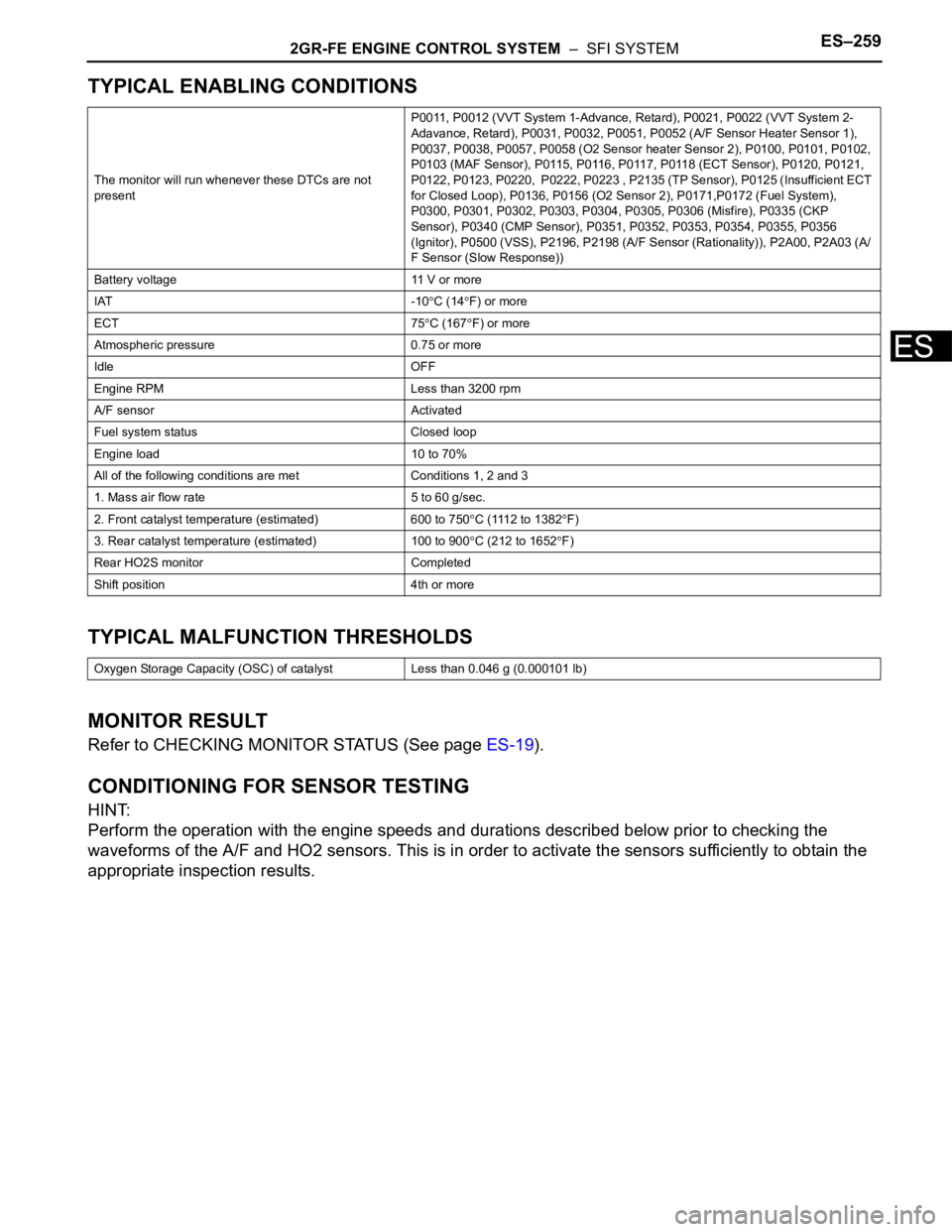
TYPICAL ENABLING CONDITIONS
TYPICAL MALFUNCTION THRESHOLDS
MONITOR RESULT
Refer to CHECKING MONITOR STATUS (See page ES-19).
CONDITIONING FOR SENSOR TESTING
HINT:
Perform the operation with the engine speeds and durations described below prior to checking the
waveforms of the A/F and HO2 sensors. This is in order to activate the sensors sufficiently to obtain the
appropriate inspection results.
The monitor will run whenever these DTCs are not
presentP0011, P0012 (VVT System 1-Advance, Retard), P0021, P0022 (VVT System 2-
Adavance, Retard), P0031, P0032, P0051, P0052 (A/F Sensor Heater Sensor 1),
P0037, P0038, P0057, P0058 (O2 Sensor heater Sensor 2), P0100, P0101, P0102,
P0103 (MAF Sensor), P0115, P0116, P0117, P0118 (ECT Sensor), P0120, P0121,
P0122, P0123, P0220, P0222, P0223 , P2135 (TP Sensor), P0125 (Insufficient ECT
for Closed Loop), P0136, P0156 (O2 Sensor 2), P0171,P0172 (Fuel System),
P0300, P0301, P0302, P0303, P0304, P0305, P0306 (Misfire), P0335 (CKP
Sensor), P0340 (CMP Sensor), P0351, P0352, P0353, P0354, P0355, P0356
(Ignitor), P0500 (VSS), P2196, P2198 (A/F Sensor (Rationality)), P2A00, P2A03 (A/
F Sensor (Slow Response))
Battery voltage 11 V or more
IAT -10
C (14F) or more
ECT 75
C (167F) or more
Atmospheric pressure 0.75 or more
Idle OFF
Engine RPM Less than 3200 rpm
A/F sensor Activated
Fuel system status Closed loop
Engine load 10 to 70%
All of the following conditions are met Conditions 1, 2 and 3
1. Mass air flow rate 5 to 60 g/sec.
2. Front catalyst temperature (estimated) 600 to 750
C (1112 to 1382F)
3. Rear catalyst temperature (estimated) 100 to 900
C (212 to 1652F)
Rear HO2S monitor Completed
Shift position 4th or more
Oxygen Storage Capacity (OSC) of catalyst Less than 0.046 g (0.000101 lb)