check engine TOYOTA SIENNA 2007 Service Manual PDF
[x] Cancel search | Manufacturer: TOYOTA, Model Year: 2007, Model line: SIENNA, Model: TOYOTA SIENNA 2007Pages: 3000, PDF Size: 52.26 MB
Page 394 of 3000

ES–882GR-FE ENGINE CONTROL SYSTEM – SFI SYSTEM
ES
HINT:
If DTC P0011, P0012, P0021 or P0022 is present, check the VVT (Variable Valve Timing) system.
DESCRIPTION
Refer to DTC P0010 (See page ES-75).
MONITOR DESCRIPTION
The ECM optimizes the intake valve timing using the VVT (Variable Valve Timing) system to control the
intake camshaft. The VVT system includes the ECM, the Oil Control Valve (OCV) and the VVT controller.
The ECM sends a target duty-cycle control signal to the OCV. This control signal regulates the oil
pressure applied to the VVT controller. The VVT controller can advance or retard the intake camshaft.
If the difference between the target and actual intake valve timings is large, and changes in actual intake
valve timing are small, the ECM interprets this as the VVT controller stuck malfunction and sets a DTC.
Example:
A DTC will be set when the following conditions 1), 2) and 3) are met:
1) The difference between the target and actual intake valve timings is more than 5
CA (Crankshaft
Angle) and the condition continues for more than 4.5 seconds.
2) It takes 5 seconds or more to change the valve timing by 5
CA.
DTC P0011Camshaft Position "A" - Timing Over-Advanced
or System Performance (Bank 1)
DTC P0012Camshaft Position "A" - Timing Over-Retarded
(Bank 1)
DTC P0021Camshaft Position "A" - Timing Over-Advanced
or System Performance (Bank 2)
DTC P0022Camshaft Position "A" - Timing Over-Retarded
(Bank 2)
DTC No. DTC Detection Condition Trouble Area
P0011
P0021Advanced cam timing:
With warm engine and engine speed of between 500
rpm and 4000 rpm, all conditions (a), (b) and (c) are
met (1 trip detection logic):
(a) Difference between target and actual intake valve
timings is more than 5
CA (Crankshaft Angle) for 4.5
seconds
(b) Current intake valve timing is fixed (timing changes
less than 5
CA in 5 seconds)
(c) Variations in VVT controller timing are more than 19
CA of maximum delayed timing (advanced)• Valve timing
• OCV for intake camshaft
• OCV filter
• Intake camshaft (bank 1) timing gear assembly
•ECM
P0012
P0022Retarded cam timing:
With warm engine and engine speed of between 500
rpm and 4000 rpm, all conditions (a), (b) and (c) are
met (2 trip detection logic):
(a) Difference between target and actual intake valve
timings is more than 5
CA (Crankshaft Angle) for 4.5
seconds
(b) Current intake valve timing is fixed (timing changes
less than 5
CA in 5 seconds)
(c) Variations in VVT controller timing is 19
CA or less
of maximum delayed timing (retarded)• Valve timing
• OCV for intake camshaft
• OCV filter
• Intake camshaft (bank 2) timing gear assembly
•ECM
Page 396 of 3000
ES–902GR-FE ENGINE CONTROL SYSTEM – SFI SYSTEM
ES
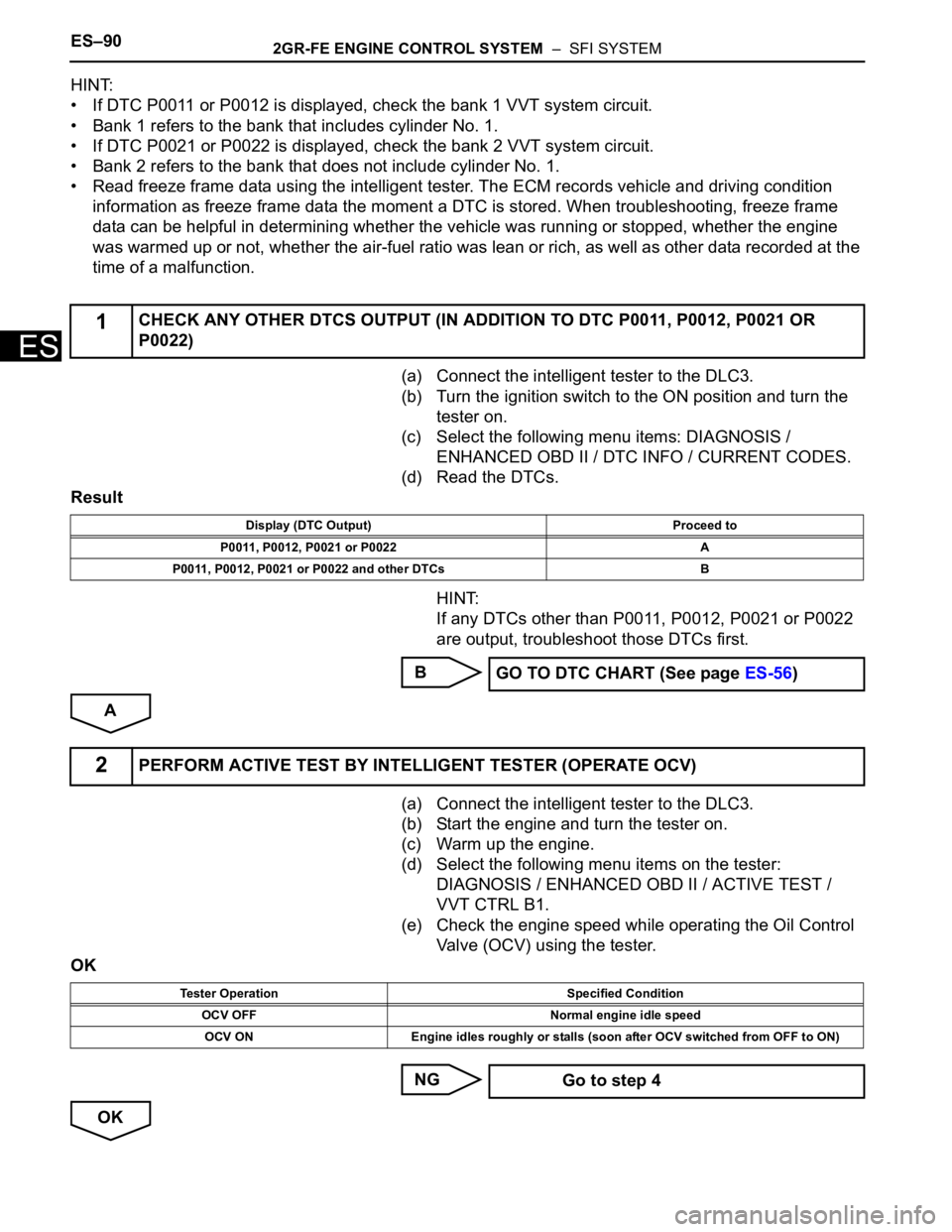
HINT:
• If DTC P0011 or P0012 is displayed, check the bank 1 VVT system circuit.
• Bank 1 refers to the bank that includes cylinder No. 1.
• If DTC P0021 or P0022 is displayed, check the bank 2 VVT system circuit.
• Bank 2 refers to the bank that does not include cylinder No. 1.
• Read freeze frame data using the intelligent tester. The ECM records vehicle and driving condition
information as freeze frame data the moment a DTC is stored. When troubleshooting, freeze frame
data can be helpful in determining whether the vehicle was running or stopped, whether the engine
was warmed up or not, whether the air-fuel ratio was lean or rich, as well as other data recorded at the
time of a malfunction.
(a) Connect the intelligent tester to the DLC3.
(b) Turn the ignition switch to the ON position and turn the
tester on.
(c) Select the following menu items: DIAGNOSIS /
ENHANCED OBD II / DTC INFO / CURRENT CODES.
(d) Read the DTCs.
Result
HINT:
If any DTCs other than P0011, P0012, P0021 or P0022
are output, troubleshoot those DTCs first.
B
A
(a) Connect the intelligent tester to the DLC3.
(b) Start the engine and turn the tester on.
(c) Warm up the engine.
(d) Select the following menu items on the tester:
DIAGNOSIS / ENHANCED OBD II / ACTIVE TEST /
VVT CTRL B1.
(e) Check the engine speed while operating the Oil Control
Valve (OCV) using the tester.
OK
NG
OK
1CHECK ANY OTHER DTCS OUTPUT (IN ADDITION TO DTC P0011, P0012, P0021 OR
P0022)
Display (DTC Output) Proceed to
P0011, P0012, P0021 or P0022 A
P0011, P0012, P0021 or P0022 and other DTCs B
GO TO DTC CHART (See page ES-56)
2PERFORM ACTIVE TEST BY INTELLIGENT TESTER (OPERATE OCV)
Tester Operation Specified Condition
OCV OFF Normal engine idle speed
OCV ON Engine idles roughly or stalls (soon after OCV switched from OFF to ON)
Go to step 4
Page 397 of 3000
2GR-FE ENGINE CONTROL SYSTEM – SFI SYSTEMES–91
ES
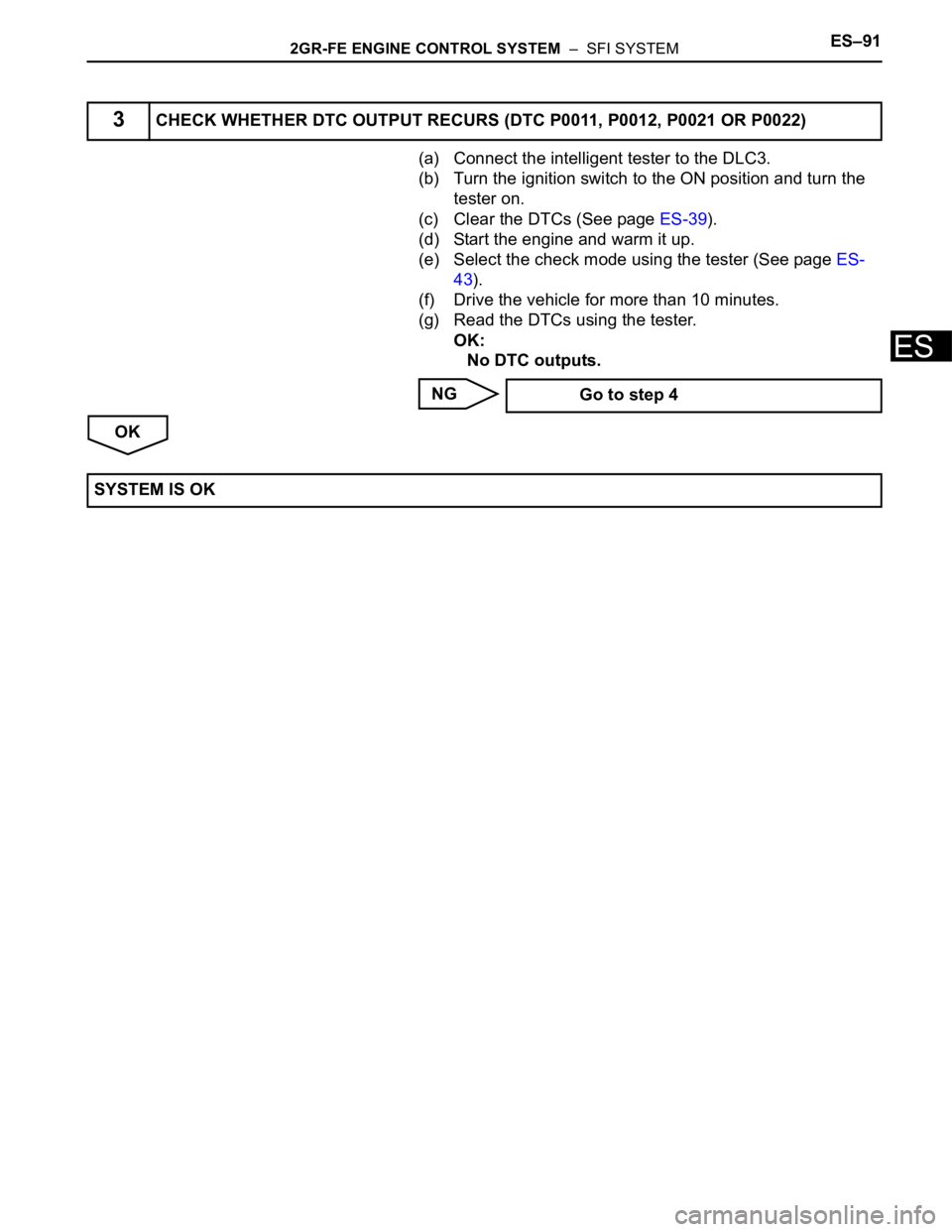
(a) Connect the intelligent tester to the DLC3.
(b) Turn the ignition switch to the ON position and turn the
tester on.
(c) Clear the DTCs (See page ES-39).
(d) Start the engine and warm it up.
(e) Select the check mode using the tester (See page ES-
43).
(f) Drive the vehicle for more than 10 minutes.
(g) Read the DTCs using the tester.
OK:
No DTC outputs.
NG
OK
3CHECK WHETHER DTC OUTPUT RECURS (DTC P0011, P0012, P0021 OR P0022)
Go to step 4
SYSTEM IS OK
Page 398 of 3000
ES–922GR-FE ENGINE CONTROL SYSTEM – SFI SYSTEM
ES
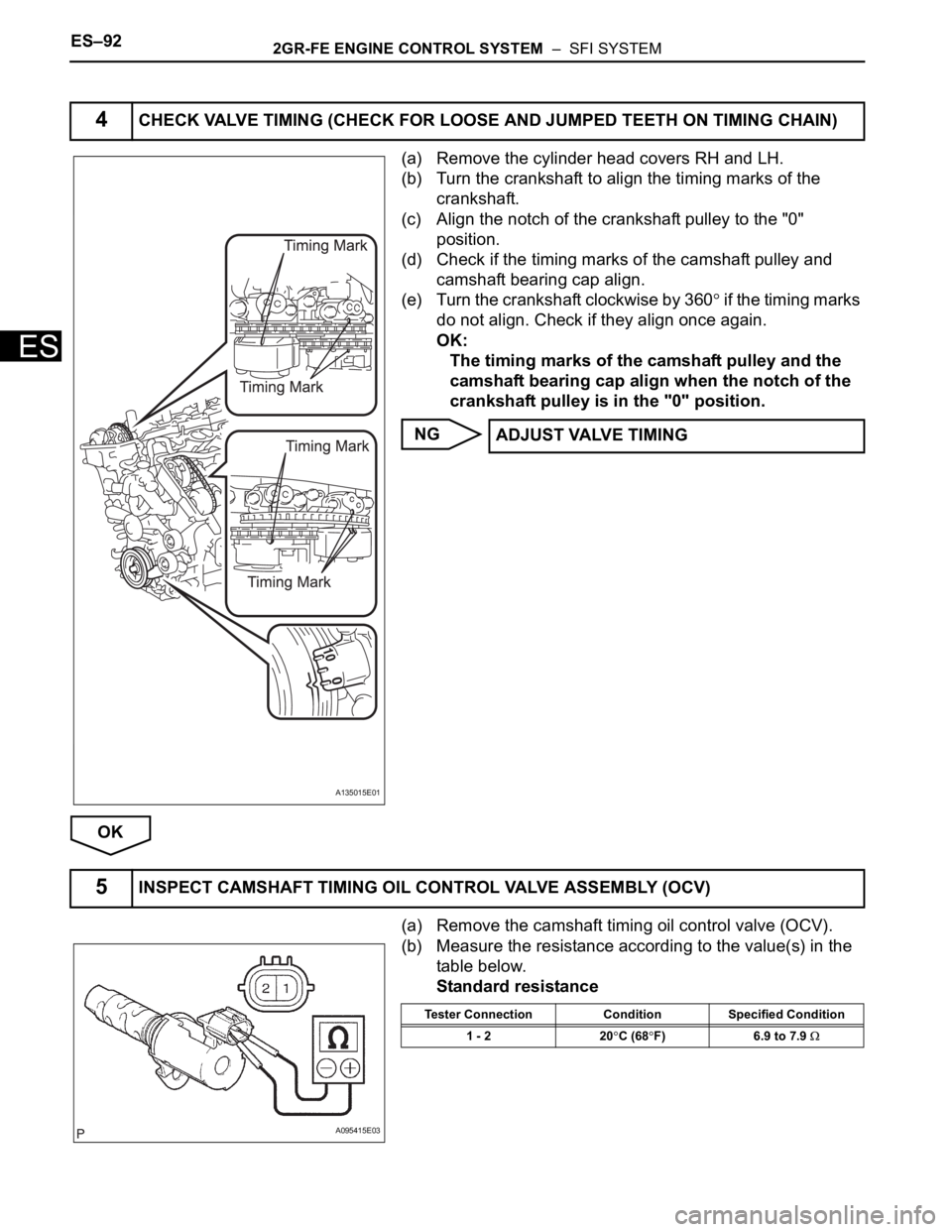
(a) Remove the cylinder head covers RH and LH.
(b) Turn the crankshaft to align the timing marks of the
crankshaft.
(c) Align the notch of the crankshaft pulley to the "0"
position.
(d) Check if the timing marks of the camshaft pulley and
camshaft bearing cap align.
(e) Turn the crankshaft clockwise by 360
if the timing marks
do not align. Check if they align once again.
OK:
The timing marks of the camshaft pulley and the
camshaft bearing cap align when the notch of the
crankshaft pulley is in the "0" position.
NG
OK
(a) Remove the camshaft timing oil control valve (OCV).
(b) Measure the resistance according to the value(s) in the
table below.
Standard resistance
4CHECK VALVE TIMING (CHECK FOR LOOSE AND JUMPED TEETH ON TIMING CHAIN)
A135015E01
ADJUST VALVE TIMING
5INSPECT CAMSHAFT TIMING OIL CONTROL VALVE ASSEMBLY (OCV)
A095415E03
Tester Connection Condition Specified Condition
1 - 2 20
C (68F) 6.9 to 7.9
Page 399 of 3000
2GR-FE ENGINE CONTROL SYSTEM – SFI SYSTEMES–93
ES
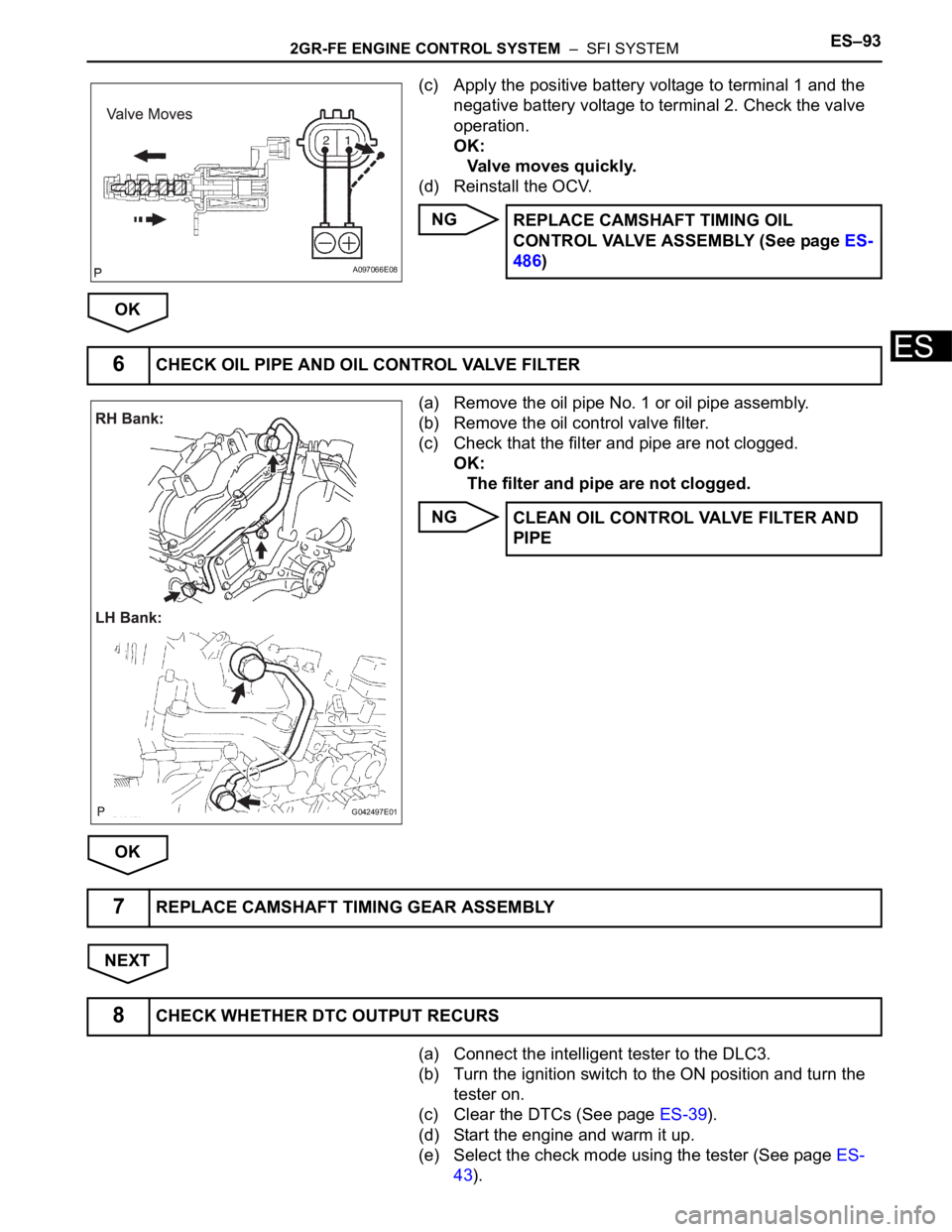
(c) Apply the positive battery voltage to terminal 1 and the
negative battery voltage to terminal 2. Check the valve
operation.
OK:
Valve moves quickly.
(d) Reinstall the OCV.
NG
OK
(a) Remove the oil pipe No. 1 or oil pipe assembly.
(b) Remove the oil control valve filter.
(c) Check that the filter and pipe are not clogged.
OK:
The filter and pipe are not clogged.
NG
OK
NEXT
(a) Connect the intelligent tester to the DLC3.
(b) Turn the ignition switch to the ON position and turn the
tester on.
(c) Clear the DTCs (See page ES-39).
(d) Start the engine and warm it up.
(e) Select the check mode using the tester (See page ES-
43).
A097066E08
REPLACE CAMSHAFT TIMING OIL
CONTROL VALVE ASSEMBLY (See page ES-
486)
6CHECK OIL PIPE AND OIL CONTROL VALVE FILTER
G042497E01
CLEAN OIL CONTROL VALVE FILTER AND
PIPE
7REPLACE CAMSHAFT TIMING GEAR ASSEMBLY
8CHECK WHETHER DTC OUTPUT RECURS
Page 403 of 3000
2GR-FE ENGINE CONTROL SYSTEM – SFI SYSTEMES–97
ES
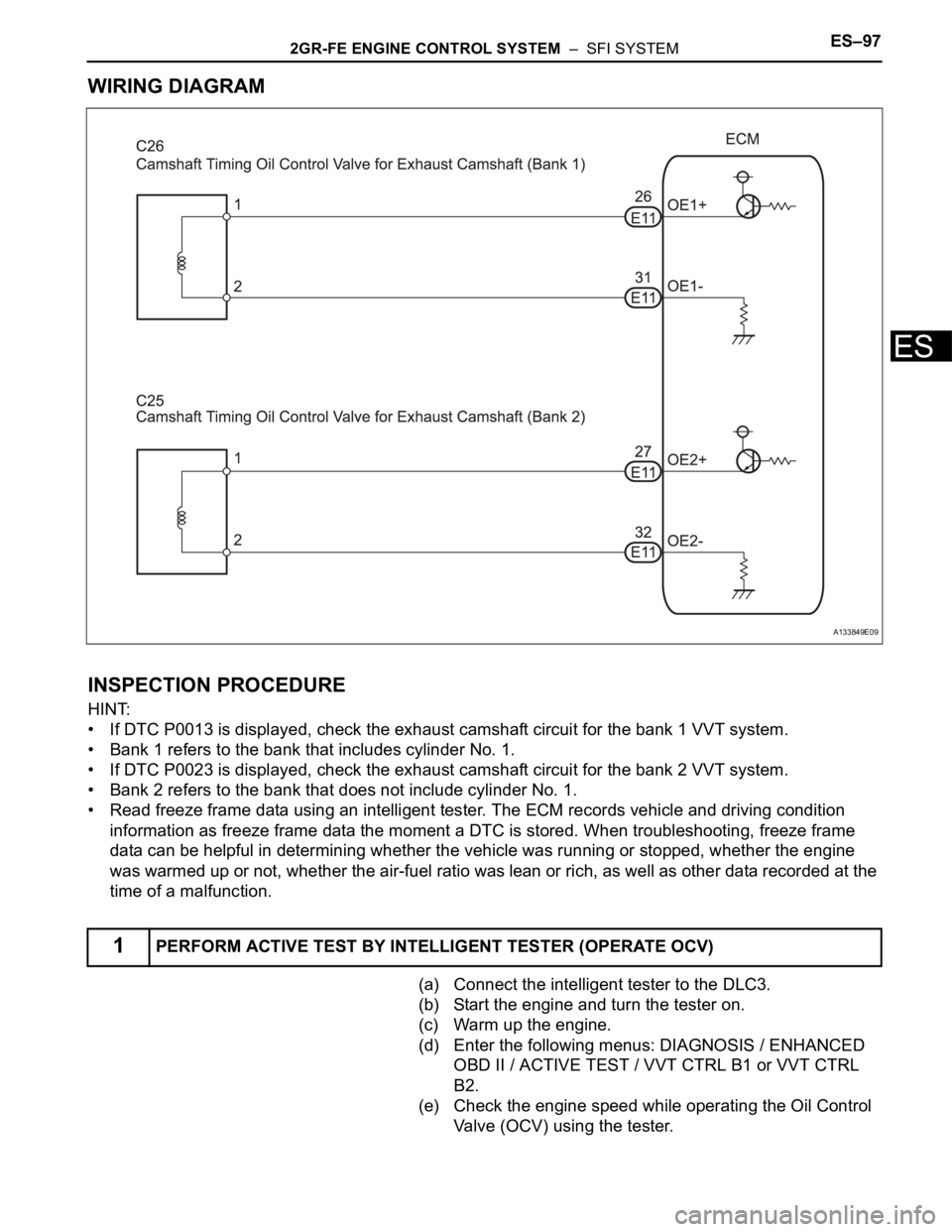
WIRING DIAGRAM
INSPECTION PROCEDURE
HINT:
• If DTC P0013 is displayed, check the exhaust camshaft circuit for the bank 1 VVT system.
• Bank 1 refers to the bank that includes cylinder No. 1.
• If DTC P0023 is displayed, check the exhaust camshaft circuit for the bank 2 VVT system.
• Bank 2 refers to the bank that does not include cylinder No. 1.
• Read freeze frame data using an intelligent tester. The ECM records vehicle and driving condition
information as freeze frame data the moment a DTC is stored. When troubleshooting, freeze frame
data can be helpful in determining whether the vehicle was running or stopped, whether the engine
was warmed up or not, whether the air-fuel ratio was lean or rich, as well as other data recorded at the
time of a malfunction.
(a) Connect the intelligent tester to the DLC3.
(b) Start the engine and turn the tester on.
(c) Warm up the engine.
(d) Enter the following menus: DIAGNOSIS / ENHANCED
OBD II / ACTIVE TEST / VVT CTRL B1 or VVT CTRL
B2.
(e) Check the engine speed while operating the Oil Control
Valve (OCV) using the tester.
1PERFORM ACTIVE TEST BY INTELLIGENT TESTER (OPERATE OCV)
A133849E09
Page 404 of 3000
ES–982GR-FE ENGINE CONTROL SYSTEM – SFI SYSTEM
ES
OK
NG
OK
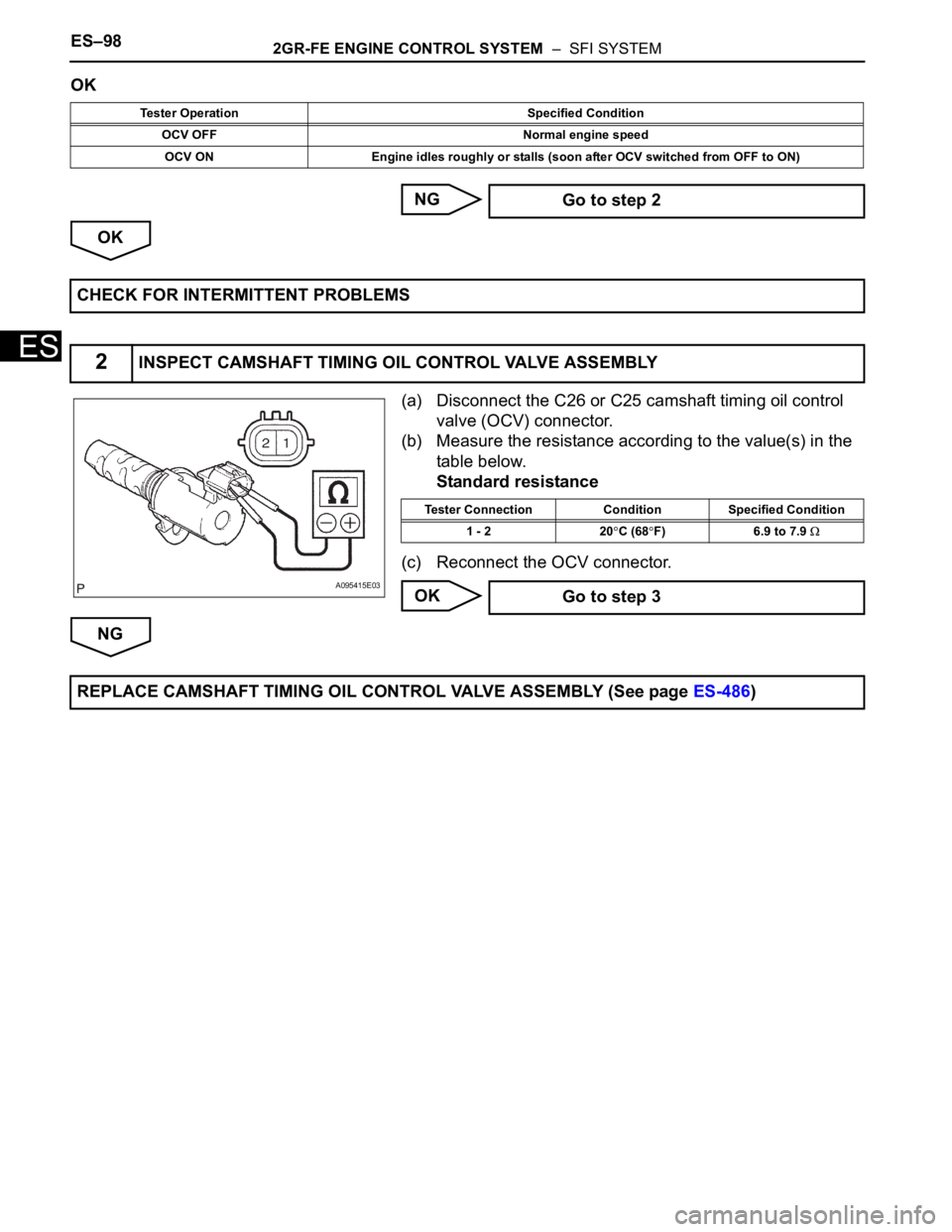
(a) Disconnect the C26 or C25 camshaft timing oil control
valve (OCV) connector.
(b) Measure the resistance according to the value(s) in the
table below.
Standard resistance
(c) Reconnect the OCV connector.
OK
NG
Tester Operation Specified Condition
OCV OFF Normal engine speed
OCV ON Engine idles roughly or stalls (soon after OCV switched from OFF to ON)
Go to step 2
CHECK FOR INTERMITTENT PROBLEMS
2INSPECT CAMSHAFT TIMING OIL CONTROL VALVE ASSEMBLY
A095415E03
Tester Connection Condition Specified Condition
1 - 2 20
C (68F) 6.9 to 7.9
Go to step 3
REPLACE CAMSHAFT TIMING OIL CONTROL VALVE ASSEMBLY (See page ES-486)
Page 405 of 3000
2GR-FE ENGINE CONTROL SYSTEM – SFI SYSTEMES–99
ES
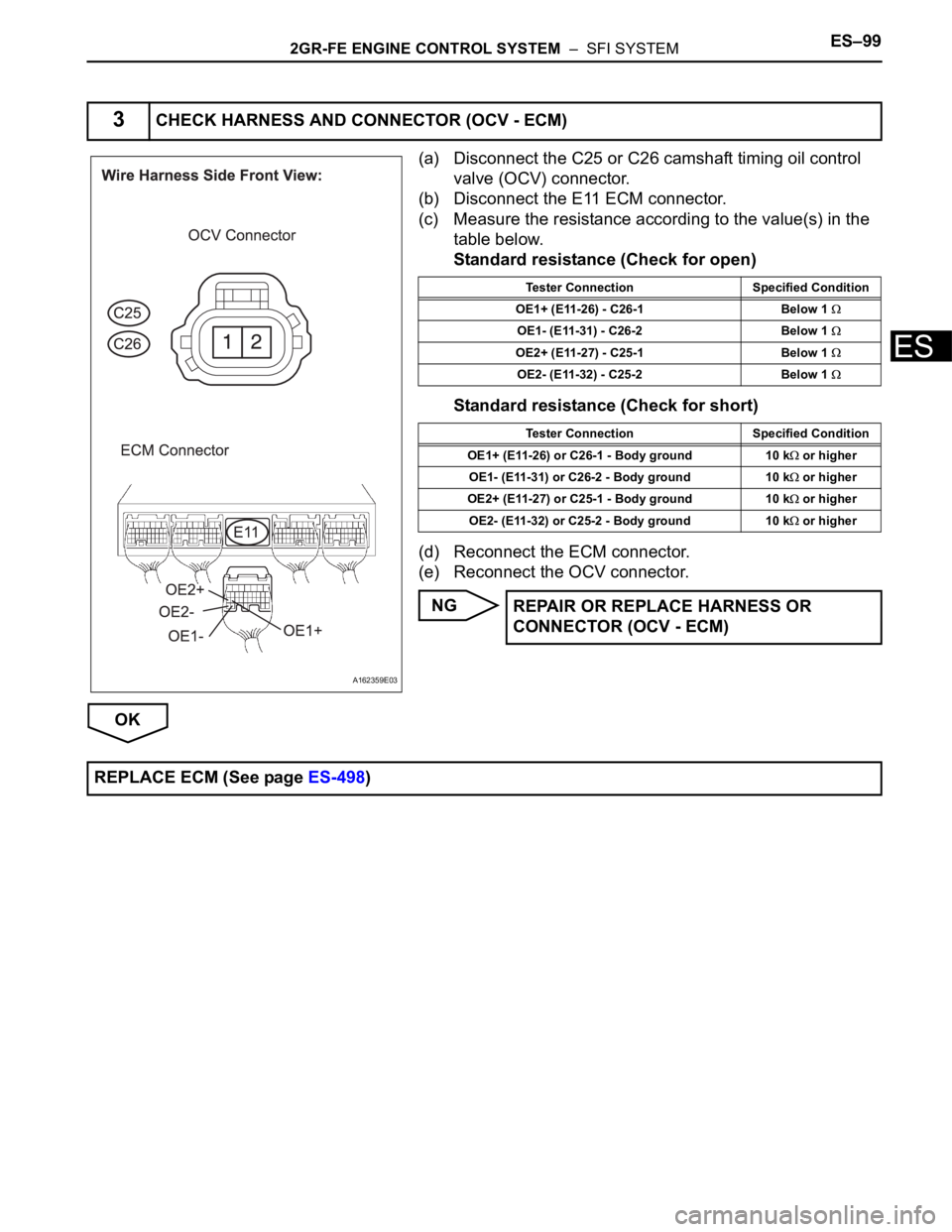
(a) Disconnect the C25 or C26 camshaft timing oil control
valve (OCV) connector.
(b) Disconnect the E11 ECM connector.
(c) Measure the resistance according to the value(s) in the
table below.
Standard resistance (Check for open)
Standard resistance (Check for short)
(d) Reconnect the ECM connector.
(e) Reconnect the OCV connector.
NG
OK
3CHECK HARNESS AND CONNECTOR (OCV - ECM)
A162359E03
Tester Connection Specified Condition
OE1+ (E11-26) - C26-1 Below 1
OE1- (E11-31) - C26-2 Below 1
OE2+ (E11-27) - C25-1 Below 1
OE2- (E11-32) - C25-2 Below 1
Tester Connection Specified Condition
OE1+ (E11-26) or C26-1 - Body ground 10 k
or higher
OE1- (E11-31) or C26-2 - Body ground 10 k
or higher
OE2+ (E11-27) or C25-1 - Body ground 10 k
or higher
OE2- (E11-32) or C25-2 - Body ground 10 k
or higher
REPAIR OR REPLACE HARNESS OR
CONNECTOR (OCV - ECM)
REPLACE ECM (See page ES-498)
Page 406 of 3000

ES–1002GR-FE ENGINE CONTROL SYSTEM – SFI SYSTEM
ES
HINT:
If DTC P0014, P0015, P0024 or P0025 is present, check the VVT (Variable Valve Timing) system.
DESCRIPTION
Refer to DTC P0013 (See page ES-87).
MONITOR DESCRIPTION
DTC P0014 and P0024
The ECM compares current valve timing with target valve timing, while the engine is running and after
being warmed up, in order to monitor the VVT system on the exhaust side. Valve timing is calculated from
the positions of the camshaft and crankshaft. The ECM controls the engine so that current valve timing
meets target valve timing. If these timings are not met, the ECM determines this as a malfunction.
DTC P0015 and P0025
The ECM compares current valve timing with target valve timing, while the engine is running and after
being warmed up, in order to monitor the VVT system on the exhaust side. Valve timing is calculated from
the positions of the camshaft and crankshaft. The ECM controls the engine so that current valve timing
meets target valve timing. If these timings are not met, the ECM determines this as a malfunction.
DTC P0014Camshaft Position "B" - Timing Over-Advanced
or System Performance (Bank 1)
DTC P0015Camshaft Position "B" - Timing Over-Retarded
(Bank 1)
DTC P0024Camshaft Position "B" - Timing Over-Advanced
or System Performance (Bank 2)
DTC P0025Camshaft Position "B" - Timing Over-Retarded
(Bank 2)
DTC No. DTC Detection Condition Trouble Area
P0014
P0024Advanced cam timing:
With warm engine and engine speed of between 500
rpm and 4,000 rpm, all conditions (a), (b) and (c) are
met
(2 trip detection logic):
(a) Difference between target and actual exhaust valve
timing is more than 5
CA (Crankshaft Angle) for 4.5
seconds
(b) Current exhaust valve timing is fixed (timing
changes less than 5
CA in 5 seconds)
(c) Variations in VVT controller timing are more than
19
CA of maximum delayed timing (advanced)• Valve timing
• OCV for exhaust camshaft
• OCV filter
• Exhaust camshaft timing gear assembly
•ECM
P0015
P0025Retarded cam timing:
With warm engine and engine speed of between 500
rpm and 4,000 rpm, all conditions (a), (b) and (c) are
met
(1 trip detection logic):
(a) Difference between target and actual exhaust valve
timing is more than 5
CA (Crankshaft Angle) for 4.5
seconds
(b) Current exhaust valve timing is fixed (timing
changes less than 5
CA in 5 seconds)
(c) Variations in VVT controller timing are more than
19
CA or less of maximum delayed timing (retarded)• Valve timing
• OCV for exhaust camshaft
• OCV filter
• Exhaust camshaft timing gear assembly
•ECM
Page 407 of 3000

2GR-FE ENGINE CONTROL SYSTEM – SFI SYSTEMES–101
ES
MONITOR STRATEGY
TYPICAL ENABLING CONDITIONS
TYPICAL MALFUNCTION THRESHOLDS
Advanced camshaft timing:
Retarded camshaft timing:
If the difference between the target and actual camshaft timings is greater than the specified value, the
ECM operates the VVT actuator.
Then, the ECM monitors the camshaft timing change for 5 seconds.
WIRING DIAGRAM
Refer to DTC P0013 (See page ES-89).
INSPECTION PROCEDURE
HINT:
• If DTC P0014 or P0015 is displayed, check the bank 1 VVT system circuit.
• Bank 1 refers to the bank that includes cylinder No. 1.
• If DTC P0024 or P0025 is displayed, check the bank 2 VVT system circuit.
• Bank 2 refers to the bank that does not include cylinder No. 1.
Related DTCsP0014: Advanced exhaust camshaft timing (bank 1)
P0015: Retarded exhaust camshaft timing (bank 1)
P0024: Advanced exhaust camshaft timing (bank 2)
P0025: Retarded exhaust camshaft timing (bank 2)
Required Sensors / Components (Main) VVT OCV and VVT Actuator
Required Sensors / Components (Related)P0014 and P0015:
Exhaust camshaft control actuator bank 1
Exhaust OCV bank 1
P0024 and P0025:
Exhaust camshaft control actuator bank 2
Exhaust OCV bank 2
Frequency of Operation Continuously
Duration Less than 10 seconds
MIL OperationP0014 and P0024: Immediate
P0015 and P0025: 2 driving cycles
Sequence of Operation None
The monitor will run whenever these DTCs are not
presentNone
Battery voltage 11 V or more
Engine RPM 500 to 4000 rpm
Engine coolant temperature 75 to 100
C (167 to 212F)
Valve timing No change
Valve timing Advanced position
Valve timing No change
Valve timing Retarded position
Abnormal bankAdvanced timing over
(Valve timing is out of specified range)Retarded timing over
(Valve timing is out of specified range)
Bank 1 P0014 P0015
Bank 2 P0024 P0025