weight TOYOTA SUPRA 2022 Owners Manual
[x] Cancel search | Manufacturer: TOYOTA, Model Year: 2022, Model line: SUPRA, Model: TOYOTA SUPRA 2022Pages: 498, PDF Size: 104.06 MB
Page 110 of 498
1083-1. CONTROLS
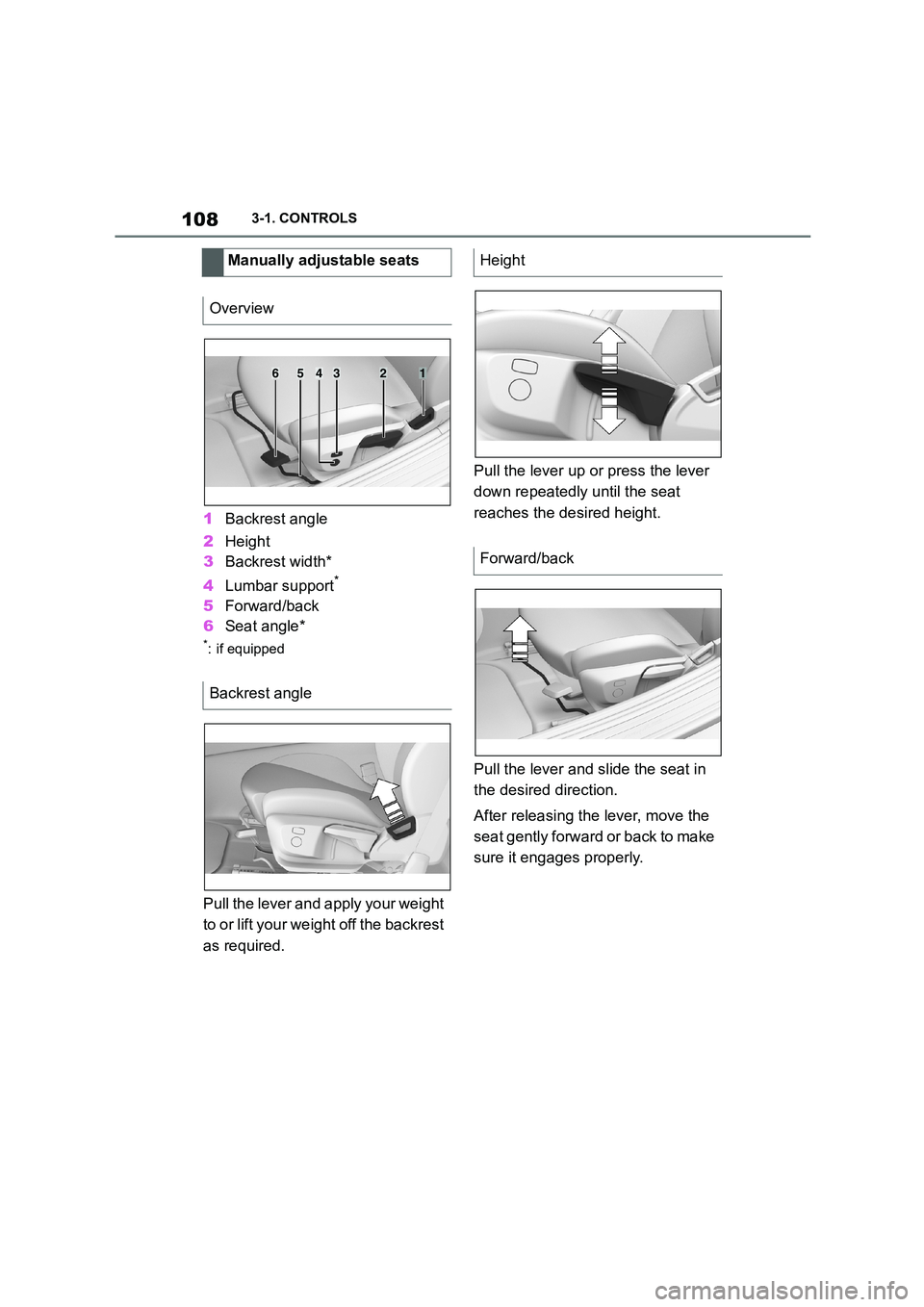
1Backrest angle
2 Height
3 Backrest width*
4 Lumbar support*
5Forward/back
6 Seat angle*
*: if equipped
Pull the lever and apply your weight
to or lift your weight off the backrest
as required.
Pull the lever up or press the lever
down repeatedly until the seat
reaches the desired height.
Pull the lever and slide the seat in
the desired direction.
After releasing the lever, move the
seat gently forward or back to make
sure it engages properly.
Manually adjustable seats
Overview
Backrest angle
654321
Height
Forward/back
Page 124 of 498
1223-1. CONTROLS
WA R N I N G
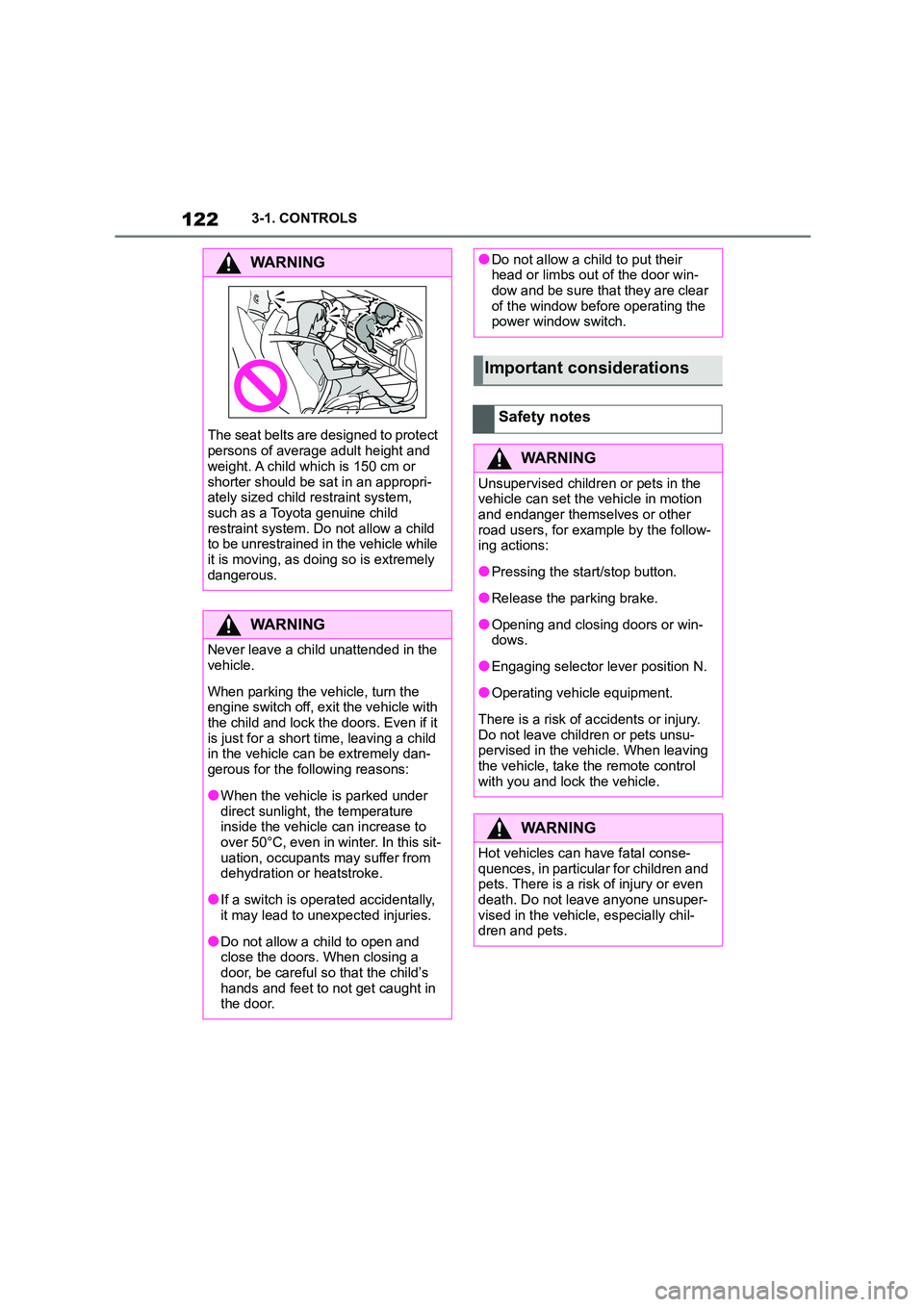
The seat belts are designed to protect
persons of average adult height and
weight. A child which is 150 cm or
shorter should be sat in an appropri- ately sized child restraint system,
such as a Toyota genuine child
restraint system. Do not allow a child to be unrestrained in the vehicle while
it is moving, as doing so is extremely
dangerous.
WA R N I N G
Never leave a child unattended in the
vehicle.
When parking the vehicle, turn the
engine switch off, exit the vehicle with
the child and lock the doors. Even if it
is just for a short time, leaving a child in the vehicle can be extremely dan-
gerous for the following reasons:
●When the vehicle is parked under
direct sunlight, the temperature
inside the vehicle can increase to over 50°C, even in winter. In this sit-
uation, occupants may suffer from
dehydration or heatstroke.
●If a switch is operated accidentally,
it may lead to unexpected injuries.
●Do not allow a child to open and
close the doors. When closing a door, be careful so that the child’s
hands and feet to not get caught in
the door.
●Do not allow a child to put their head or limbs out of the door win-
dow and be sure that they are clear
of the window before operating the power window switch.
Important considerations
Safety notes
WA R N I N G
Unsupervised children or pets in the vehicle can set the vehicle in motion
and endanger themselves or other
road users, for example by the follow- ing actions:
●Pressing the start/stop button.
●Release the parking brake.
●Opening and closing doors or win-
dows.
●Engaging selector lever position N.
●Operating vehicle equipment.
There is a risk of accidents or injury.
Do not leave children or pets unsu- pervised in the vehicle. When leaving
the vehicle, take the remote control
with you and lock the vehicle.
WA R N I N G
Hot vehicles can have fatal conse-
quences, in particular for children and
pets. There is a risk of injury or even death. Do not leave anyone unsuper-
vised in the vehicle, especially chil-
dren and pets.
Page 125 of 498
123
3
3-1. CONTROLS
CONTROLS
When using a child restraint system
on the front passenger seat, make
sure that the front and side airbags
on the passenger side are deacti-
vated. Front passenger airbags can
only be deactivated with the key
switch for front passenger airbags,
see page 202.
Appropriate child restraint systems
for every age and weight class are
available from any authorized
Toyota retailer or Toyota authorized
repairer, or any reliable repairer.
Please comply with the operating
and safety instructions provided by
the child restraint system manufac-
turer when selecting, attaching and
using child restraint systems.
WA R N I N G
Child restraint systems and their parts
can get very hot when exposed to
direct sunlight. Contact with hot parts can cause burns. There is a risk of
injury. Do not expose the child
restraint system to direct sunlight. Cover the child restraint system if
necessary. It may be necessary to
allow the child restraint system to cool
down before strapping a child in. Do not leave children unsupervised in the
vehicle.
WA R N I N G
Children under 150 cm, 5 ft tall cannot
wear the seat belt correctly without
using additional child restraint sys- tems. The protective function of the
seat belts may be limited or may even
fail completely if the seat belts are worn incorrectly. If a seat belt is not
worn correctly, additional injuries can
be caused, for example in the event of an accident or when braking or car-
rying out evasive manoeuvres. There
is a risk of injury or even death. Chil-
dren under 150 cm, 5 ft tall must be secured in suitable child restraint sys-
tems.
Not for Austra lia/New Zea-
land: Children on the front
passenger seat
General
Safety note
WA R N I N G
Active front passenger airbags can
injure a child in a child restraint sys- tem if they are deployed. There is a
risk of injury. Make sure that the front
passenger airbags are deactivated and the PASSENGER AIRBAG OFF
indicator lamp is illuminated.
WA R N I N G
Children less than 150 cm, 5 ft in height cannot wear the seat belt cor-
rectly without using additional child
restraint systems. The protective function of the seat belts may be lim-
ited or may even fail completely if the
seat belts are worn incorrectly. If a seat belt is not worn correctly, addi-
tional injuries can be caused, for
example in the event of an accident or braking and evasive manoeuvres.
There is a danger of injury or even
death. Children smaller than 150 cm,
5 ft in height must be secured in suita- ble child restraint systems.
Fitting child restraints
General
Page 129 of 498
127
3
3-1. CONTROLS
CONTROLS
Australia.
Please comply with the operating
and safety instructions provided by
the child restraint system manufac-
turer when selecting, attaching and
using ISOFIX child restraint sys-
tems.
Only certain ISOFIX child restraints
may be used in the seats intended
for this purpose. The corresponding
size class and size category are
denoted by a letter or ISO refer-
ence on a plate on the child seat.
For information about which child
restraint systems can be used on
the seats in question and if the child
restraint systems are suitable for or
comply with ISOFIX, see: seats that
are suitable for ch ild restraint sys-
tems, see page 129.
Observe the following when attach-
ing child restraint systems with an
integrated strap to the lower
ISOFIX anchors:
Do not exceed the total weight of
the child and child restraint system
of 33 kg, 73 lbs.
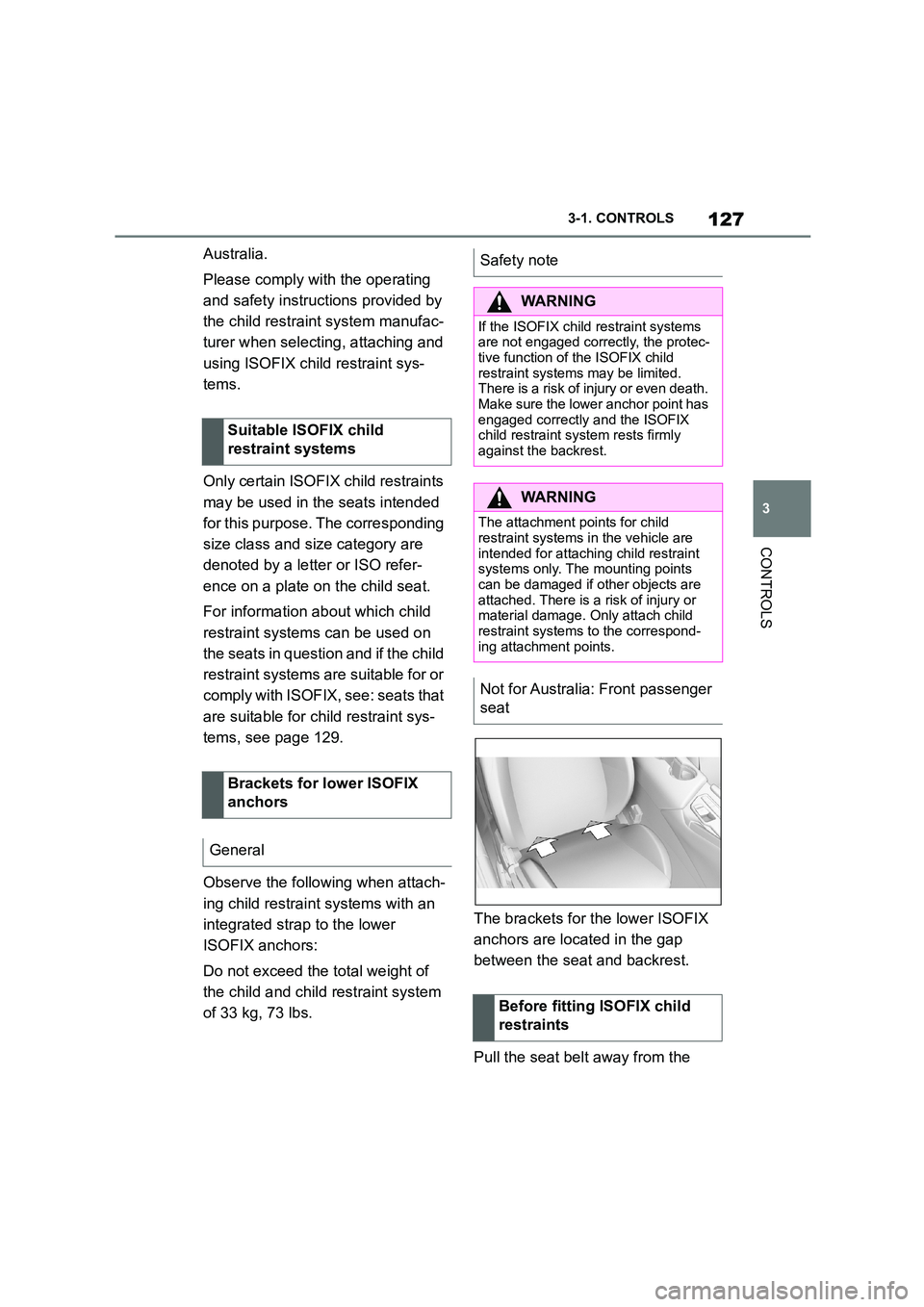
The brackets for the lower ISOFIX
anchors are located in the gap
between the seat and backrest.
Pull the seat belt away from the
Suitable ISOFIX child
restraint systems
Brackets for lower ISOFIX
anchors
General
Safety note
WA R N I N G
If the ISOFIX child restraint systems
are not engaged correctly, the protec- tive function of the ISOFIX child
restraint systems may be limited.
There is a risk of injury or even death. Make sure the lower anchor point has
engaged correctly and the ISOFIX
child restraint system rests firmly
against the backrest.
WA R N I N G
The attachment points for child
restraint systems in the vehicle are intended for attaching child restraint
systems only. The mounting points
can be damaged if other objects are attached. There is a risk of injury or
material damage. Only attach child
restraint systems to the correspond- ing attachment points.
Not for Australia: Front passenger
seat
Before fitting ISOFIX child
restraints
Page 277 of 498
275
3
3-1. CONTROLS
CONTROLS
This chapter describes all standard,
country-specific and special equip-
ment available for the model series.
It may therefore describe equip-
ment and functions which are not
installed in your vehicle, for exam-
ple on account of the special equip-
ment selected or the country
specification. This also applies to
safety-relevant functions and sys-
tems. Please comply with the rele-
vant laws and regulations when
using the corresponding functions
and systems.
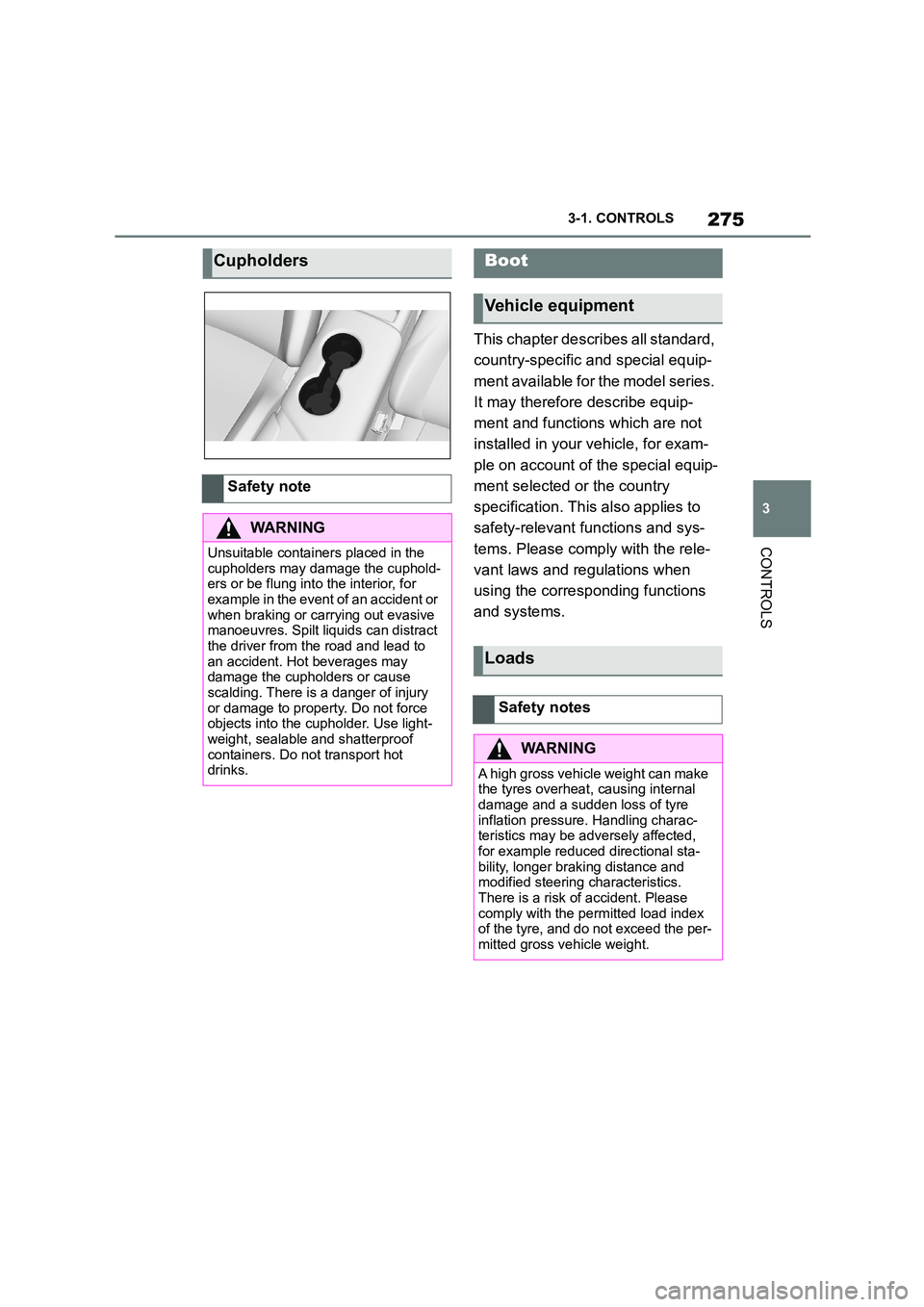
Cupholders
Safety note
WA R N I N G
Unsuitable containers placed in the
cupholders may damage the cuphold- ers or be flung into the interior, for
example in the event of an accident or
when braking or carrying out evasive manoeuvres. Spilt liquids can distract
the driver from the road and lead to
an accident. Hot beverages may damage the cupholders or cause
scalding. There is a danger of injury
or damage to property. Do not force objects into the cupholder. Use light-
weight, sealable and shatterproof
containers. Do not transport hot drinks.
Boot
Vehicle equipment
Loads
Safety notes
WA R N I N G
A high gross vehicle weight can make
the tyres overheat, causing internal
damage and a sudden loss of tyre inflation pressure. Handling charac-
teristics may be adversely affected,
for example reduced directional sta- bility, longer braking distance and
modified steering characteristics.
There is a risk of accident. Please comply with the permitted load index
of the tyre, and do not exceed the per-
mitted gross vehicle weight.
Page 278 of 498
2763-1. CONTROLS
Wrap protective material around
any sharp corners and edges on
the load.
Heavy transported loads: stow
as far forward and as low down
as possible, ideally directly
behind the boot partition.
Small and lightweight loads:
secure with retaining straps, a
luggage net or other suitable
straps.
Large and heavy loads: secure
with lashing straps.
*: if equipped
Equipment for securing the trans-
ported load, for example lashing
straps, tensioning straps or luggage
nets, must be secured to the lash-
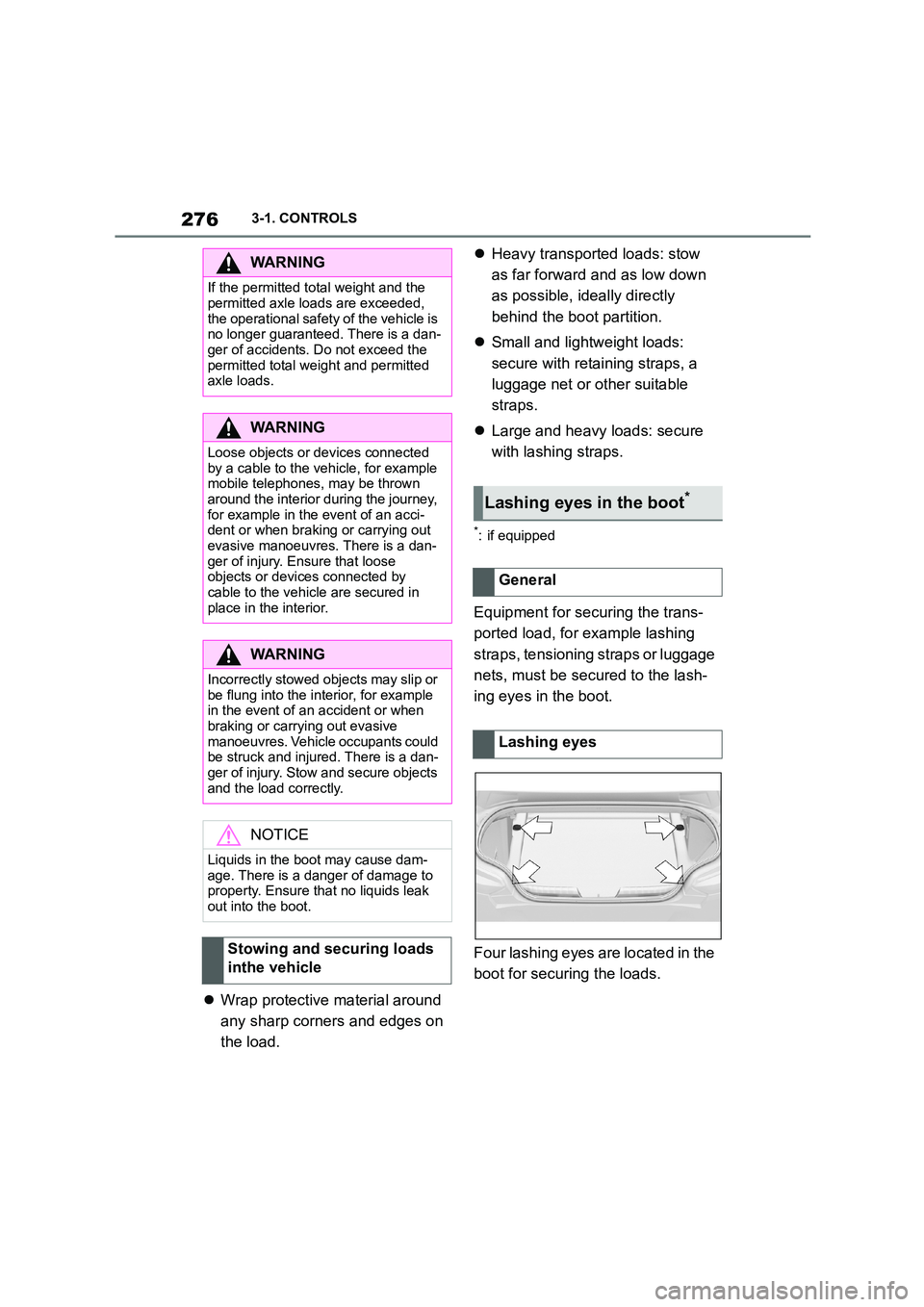
ing eyes in the boot.
Four lashing eyes are located in the
boot for securing the loads.
WA R N I N G
If the permitted total weight and the
permitted axle loads are exceeded,
the operational safety of the vehicle is no longer guaranteed. There is a dan-
ger of accidents. Do not exceed the
permitted total weight and permitted axle loads.
WA R N I N G
Loose objects or devices connected
by a cable to the vehicle, for example mobile telephones, may be thrown
around the interior during the journey,
for example in the event of an acci- dent or when braking or carrying out
evasive manoeuvres. There is a dan-
ger of injury. Ensure that loose objects or devices connected by
cable to the vehicle are secured in
place in the interior.
WA R N I N G
Incorrectly stowed objects may slip or
be flung into the interior, for example
in the event of an accident or when braking or carrying out evasive
manoeuvres. Vehicle occupants could
be struck and injured. There is a dan- ger of injury. Stow and secure objects
and the load correctly.
NOTICE
Liquids in the boot may cause dam- age. There is a danger of damage to
property. Ensure that no liquids leak
out into the boot.
Stowing and securing loads
inthe vehicle
Lashing eyes in the boot*
General
Lashing eyes
Page 288 of 498
2864-1. DRIVING HINTS
This chapter describes all standard,
country-specific and special equip-
ment available for the model series.
It may therefore describe equip-
ment and functions which are not
installed in your vehicle, for exam-
ple on account of the special equip-
ment selected or the country
specification. This also applies to
safety-relevant functions and sys-
tems. Please comply with the rele-
vant laws and regulations when
using the corresponding functions
and systems.
The vehicle has a wide range of
technologies for reducing con-
sumption and emissions.
The fuel consumption depends on
various factors, for example driving
style, road conditions, service or
environmental factors.
A number of measures, such as a
moderate driving style and regular
maintenance, can influence fuel
consumption and reduce the bur-
den on the environment.
Extra weight increases fuel con-
sumption.
Add-on parts on the vehicle can
adversely affect its aerodynamic
performance and increase fuel con-
sumption.
Open windows increase drag and
consequently fuel consumption.
Tyres can have diff ering effects on
fuel consumption figures. The tyre
size, for example, can influence
how much fuel a vehicle uses.
Check and, if necessary, correct the
tyre inflation pressures at least
twice a month and before setting off
on a longer journey.
Insufficient tyre inflation pressure
increases rolling resistance and
consequently fuel consumption and
tyre wear.
Do not warm up the engine with the
vehicle at a stands till, but instead
Saving fuel
Vehicle equipment
Reducing fuel consumption
General
Remove unnecessary loads
Remove add-on parts after
use
Close windows
Ty r e s
General
Checking tyre inflation pressure
regularly
Drive off immediately
Page 362 of 498
3605-1. MOBILITY
The towing eyes of both vehicles
should be on the same side.
If it is impossible to avoid attaching
the tow bar at an angle, note the
following:
Tow bar clearance may be lim-
ited when cornering.
The tow bar will generate lateral
forces if it is attached at an
angle.
Note the following if using a towing
rope:
• Use nylon ropes or straps that
will allow the vehi cle to be towed
smoothly.
• Fasten the towing rope so it is
not twisted.
• Check the towing eye and towing
rope fastening regularly.
• Do not exceed a towing speed of
50 km/h, 30 mph.
• Do not exceed a towing distance
of 5 km, 3 miles.
• Ensure that the towing rope is
taut when the towing vehicle
drives off.
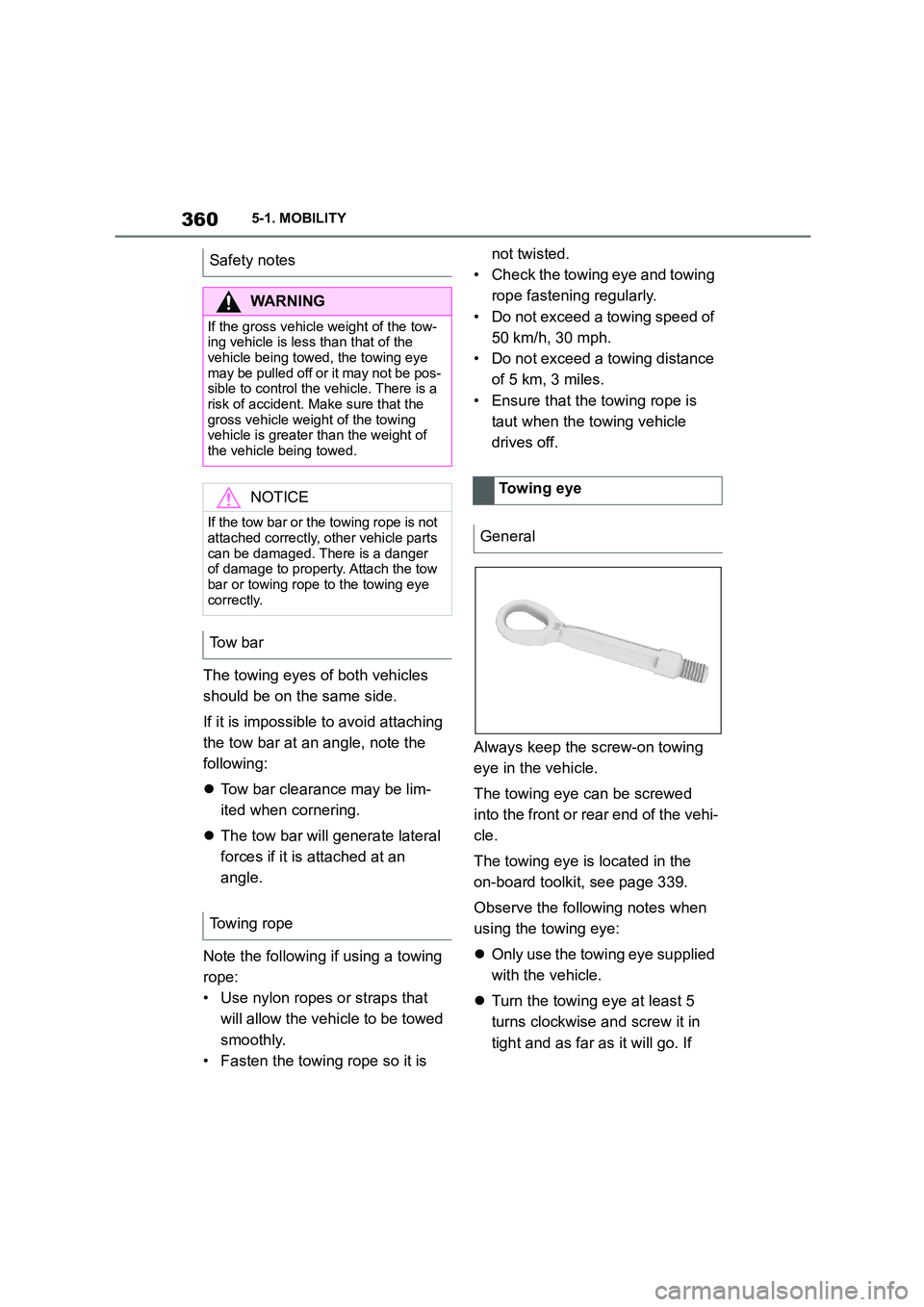
Always keep the screw-on towing
eye in the vehicle.
The towing eye can be screwed
into the front or rear end of the vehi-
cle.
The towing eye is located in the
on-board toolkit, see page 339.
Observe the following notes when
using the towing eye:
Only use the towing eye supplied
with the vehicle.
Turn the towing eye at least 5
turns clockwise an d screw it in
tight and as far as it will go. If
Safety notes
WA R N I N G
If the gross vehicle weight of the tow-
ing vehicle is less than that of the vehicle being towed, the towing eye
may be pulled off or it may not be pos-
sible to control the vehicle. There is a risk of accident. Ma ke sure that the
gross vehicle weight of the towing
vehicle is greater than the weight of
the vehicle being towed.
NOTICE
If the tow bar or the towing rope is not
attached correctly, other vehicle parts can be damaged. There is a danger
of damage to property. Attach the tow
bar or towing rope to the towing eye correctly.
To w b a r
Towing rope
Towing eye
General
Page 373 of 498
371
6
6-1. REFERENCE
REFERENCE
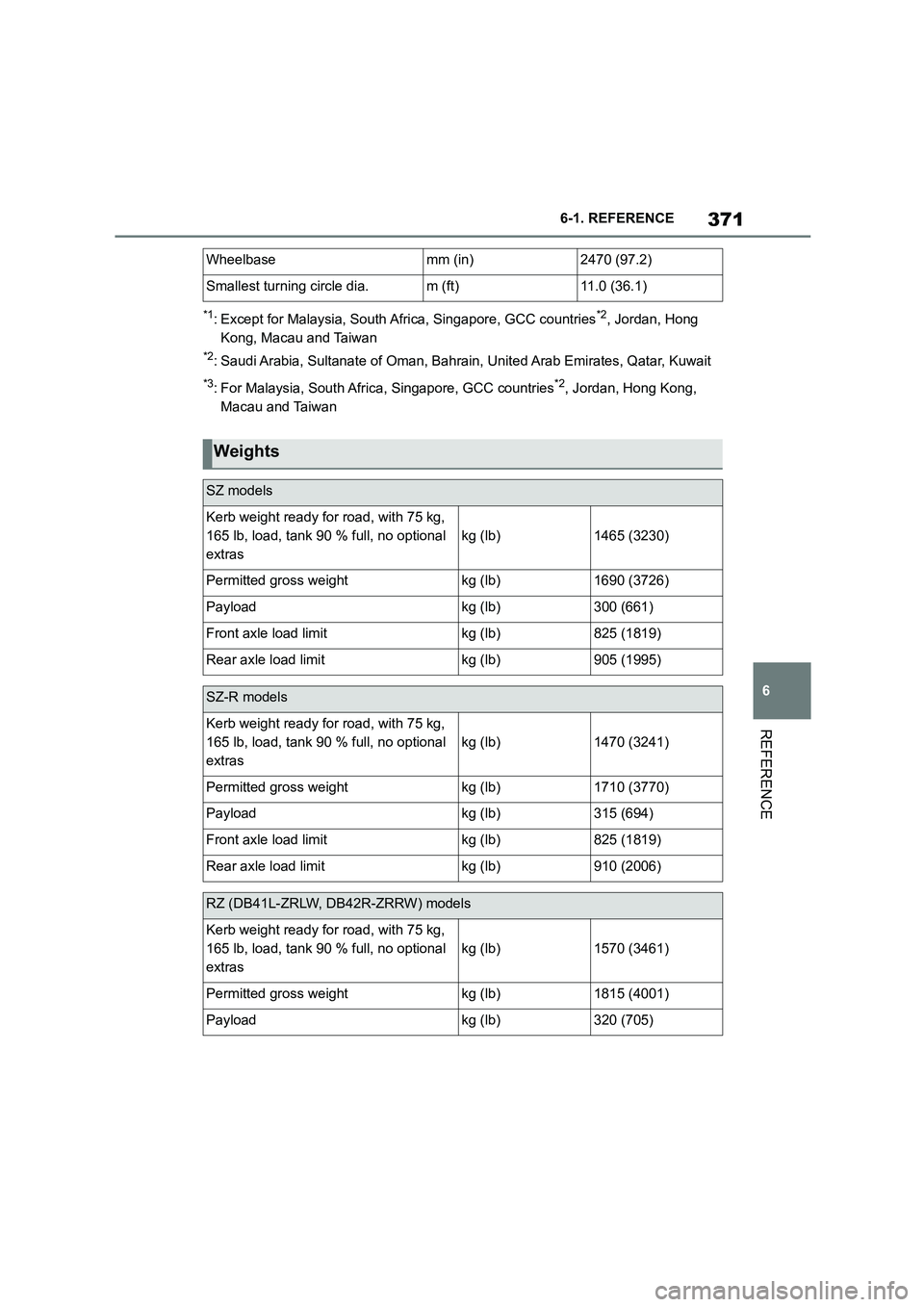
*1: Except for Malaysia, South Africa, Singapore, GCC countries*2, Jordan, Hong
Kong, Macau and Taiwan
*2: Saudi Arabia, Sultanate of Oman, Bahrain, United Arab Emirates, Qatar, Kuwait
*3: For Malaysia, South Africa, Singapore, GCC countries*2, Jordan, Hong Kong,
Macau and Taiwan
Wheelbasemm (in)2470 (97.2)
Smallest turning circle dia.m (ft)11.0 (36.1)
Weights
SZ models
Kerb weight ready for road, with 75 kg,
165 lb, load, tank 90 % full, no optional
extras
kg (lb)1465 (3230)
Permitted gross weightkg (lb)1690 (3726)
Payloadkg (lb)300 (661)
Front axle load limitkg (lb)825 (1819)
Rear axle load limitkg (lb)905 (1995)
SZ-R models
Kerb weight ready for road, with 75 kg,
165 lb, load, tank 90 % full, no optional
extras
kg (lb)1470 (3241)
Permitted gross weightkg (lb)1710 (3770)
Payloadkg (lb)315 (694)
Front axle load limitkg (lb)825 (1819)
Rear axle load limitkg (lb)910 (2006)
RZ (DB41L-ZRLW, DB42R-ZRRW) models
Kerb weight ready for road, with 75 kg,
165 lb, load, tank 90 % full, no optional
extras
kg (lb)1570 (3461)
Permitted gross weightkg (lb)1815 (4001)
Payloadkg (lb)320 (705)
Page 374 of 498
3726-1. REFERENCE
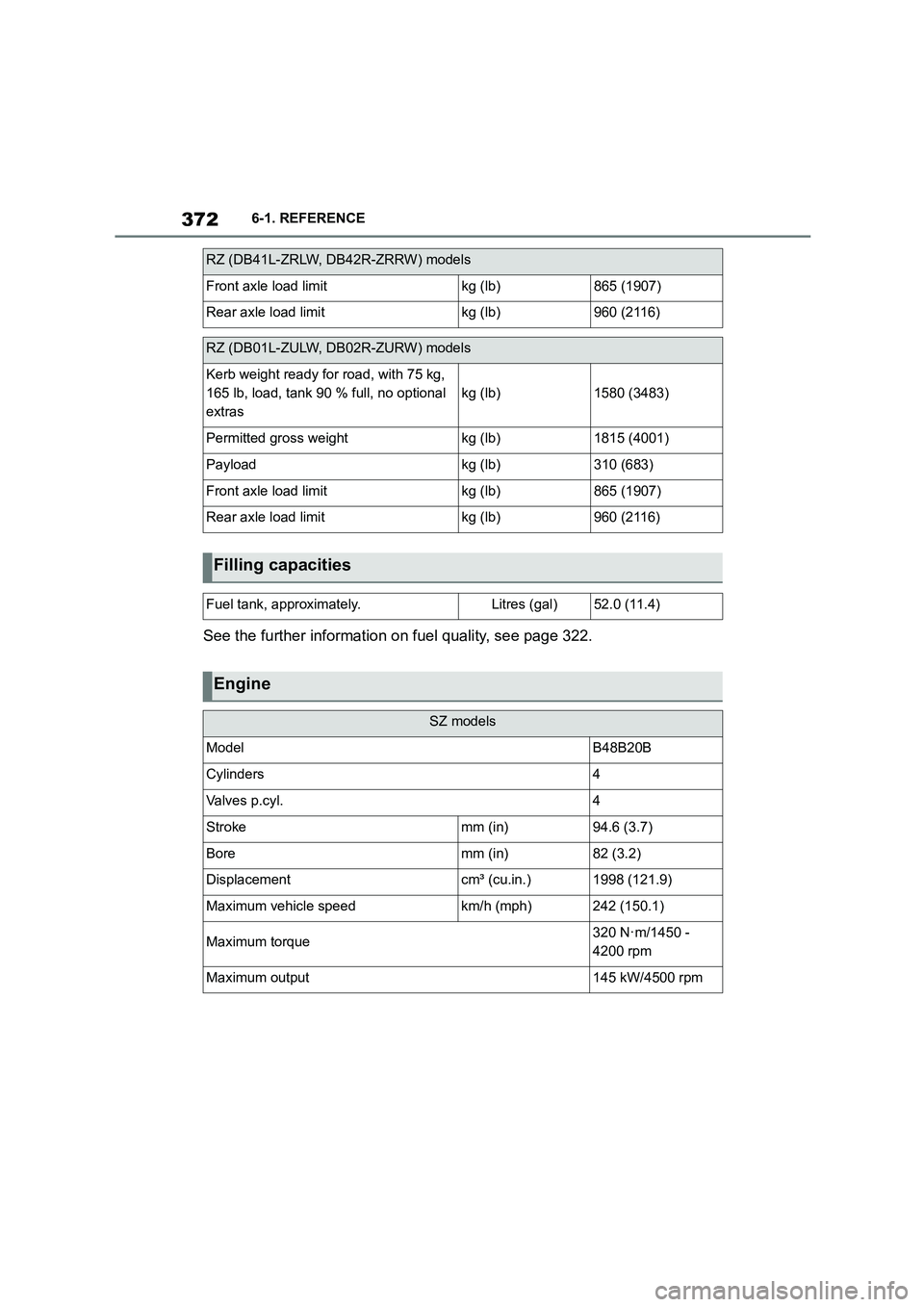
See the further information on fuel quality, see page 322.
Front axle load limitkg (lb)865 (1907)
Rear axle load limitkg (lb)960 (2116)
RZ (DB01L-ZULW, DB02R-ZURW) models
Kerb weight ready for road, with 75 kg,
165 lb, load, tank 90 % full, no optional
extras
kg (lb)1580 (3483)
Permitted gross weightkg (lb)1815 (4001)
Payloadkg (lb)310 (683)
Front axle load limitkg (lb)865 (1907)
Rear axle load limitkg (lb)960 (2116)
Filling capacities
Fuel tank, approximately.Litres (gal)52.0 (11.4)
RZ (DB41L-ZRLW, DB42R-ZRRW) models
Engine
SZ models
ModelB48B20B
Cylinders4
Valves p.cyl.4
Strokemm (in)94.6 (3.7)
Boremm (in)82 (3.2)
Displacementcm³ (cu.in.)1998 (121.9)
Maximum vehicle speedkm/h (mph)242 (150.1)
Maximum torque320 N·m/1450 -
4200 rpm
Maximum output145 kW/4500 rpm