automatic TOYOTA VERSO 2014 User Guide
[x] Cancel search | Manufacturer: TOYOTA, Model Year: 2014, Model line: VERSO, Model: TOYOTA VERSO 2014Pages: 650, PDF Size: 36.61 MB
Page 77 of 650
77 1-2. Opening, closing and locking the doors
1
Before driving
Setting and canceling the functions
Vehicles without Navigation/Multimedia system
To switch between setting and canceling, follow the procedure
below:
Vehicles without smart entry & start system: Close all the
doors and turn the engine switch to the “ON” position. (Per-
form within 10 seconds.)
Vehicles with smart entry & start system: Close all the doors
and turn the “ENGINE START STOP” switch to IGNITION ON
mode. (Perform within 10 seconds.)
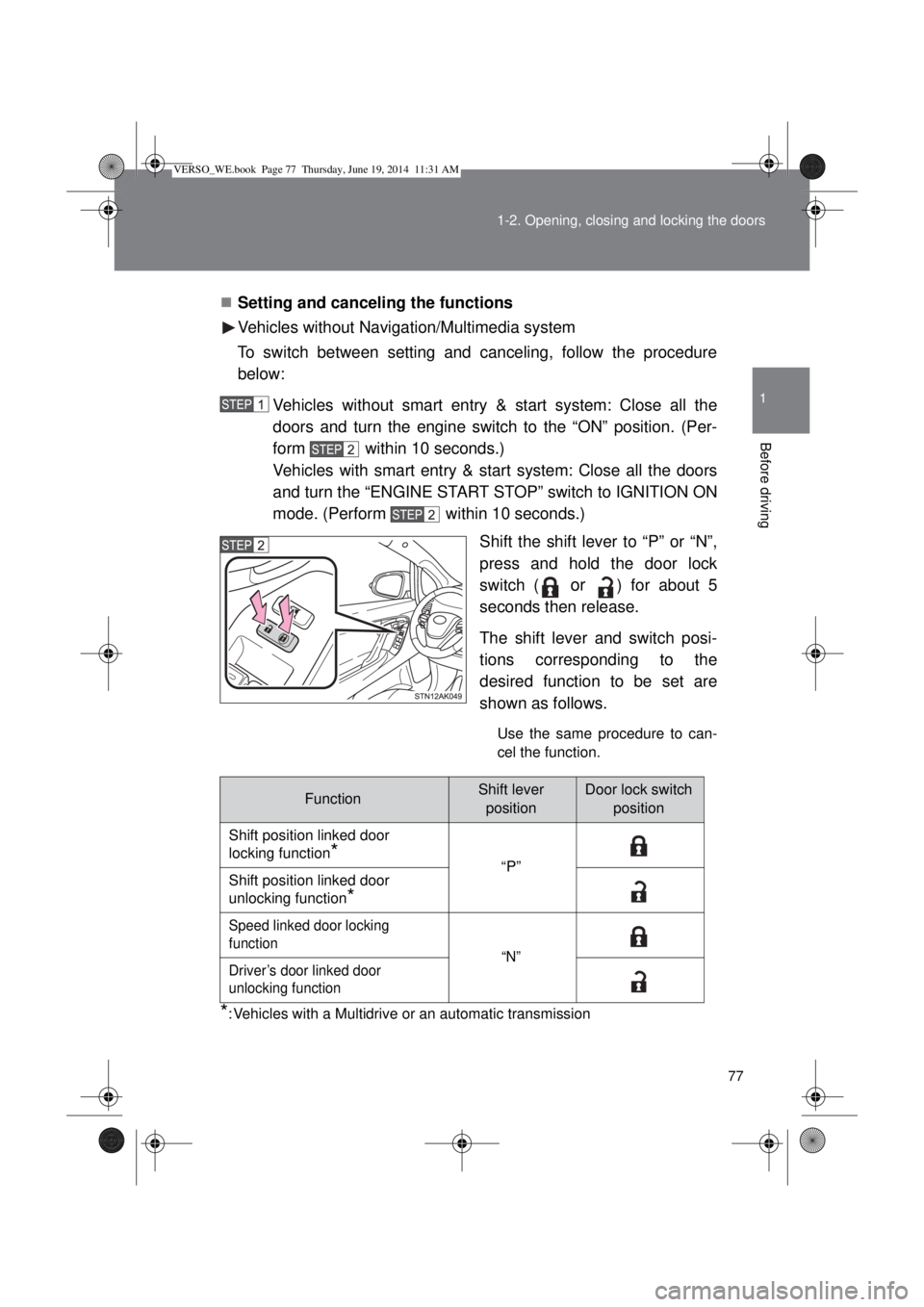
Shift the shift lever to “P” or “N”,
press and hold the door lock
switch (
or ) for about 5
seconds then release.
The shift lever and switch posi-
tions corresponding to the
desired function to be set are
shown as follows.
Use the same procedure to can-
cel the function.
*: Vehicles with a Multidrive or an automatic transmission
FunctionShift lever
positionDoor lock switch
position
Shift position linked door
locking function
*“P”
Shift position linked door
unlocking function
*
Speed linked door locking
function
“N”
Driver’s door linked door
unlocking function
VERSO_WE.book Page 77 Thursday, June 19, 2014 11:31 AM
Page 92 of 650
92 1-3. Adjustable components (seats, mirrors, steering wheel)
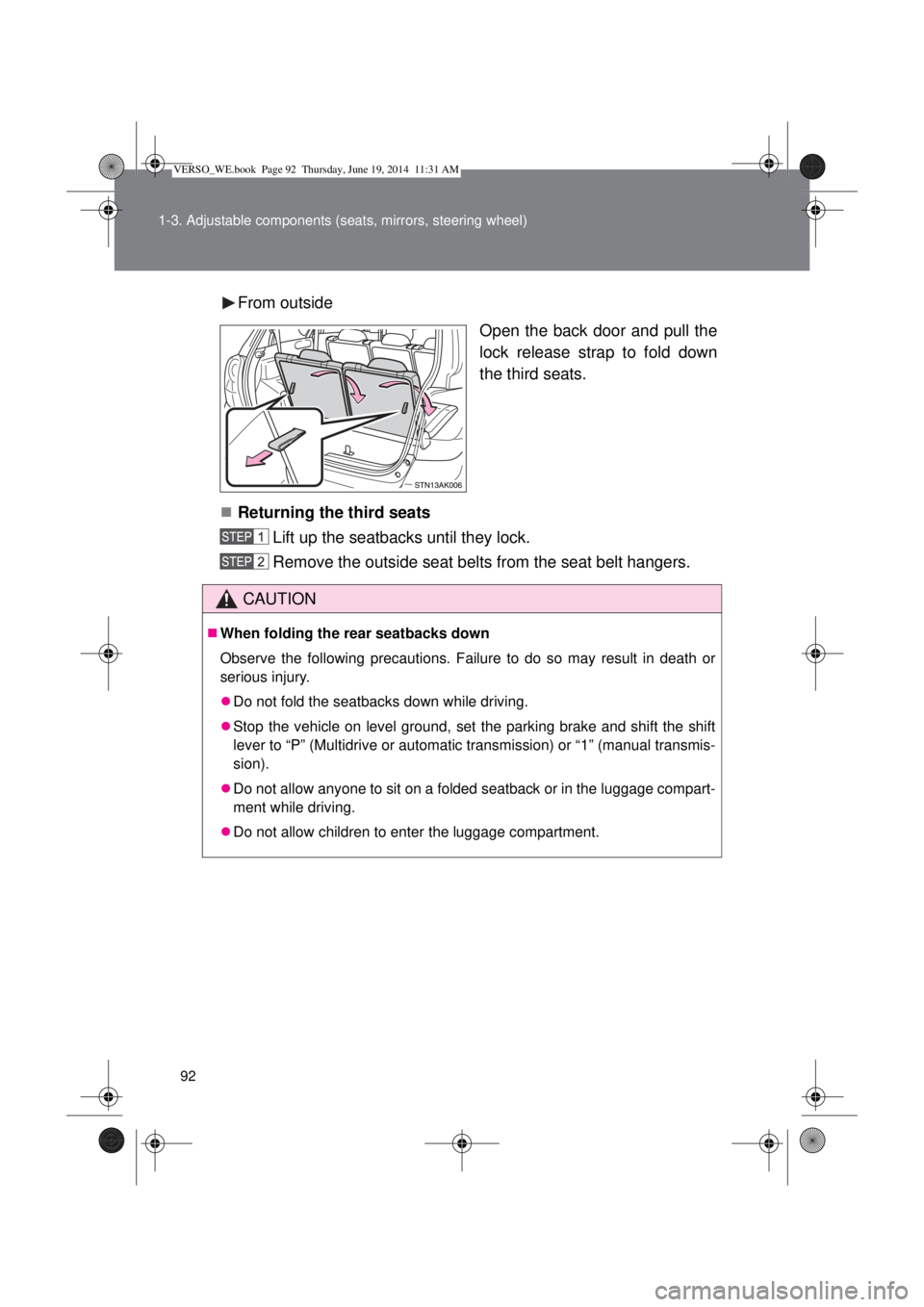
From outside
Open the back door and pull the
lock release strap to fold down
the third seats.
Returning the third seats
Lift up the seatbacks until they lock.
Remove the outside seat belts from the seat belt hangers.
CAUTION
When folding the rear seatbacks down
Observe the following precautions. Failure to do so may result in death or
serious injury.
Do not fold the seatbacks down while driving.
Stop the vehicle on level ground, set the parking brake and shift the shift
lever to “P” (Multidrive or automatic transmission) or “1” (manual transmis-
sion).
Do not allow anyone to sit on a folded seatback or in the luggage compart-
ment while driving.
Do not allow children to enter the luggage compartment.
VERSO_WE.book Page 92 Thursday, June 19, 2014 11:31 AM
Page 107 of 650
107 1-3. Adjustable components (seats, mirrors, steering wheel)
1
Before driving
Auto anti-glare inside rear view mirror
Responding to the level of brightness of the headlights of vehicles
behind, the reflected light is automatically reduced.
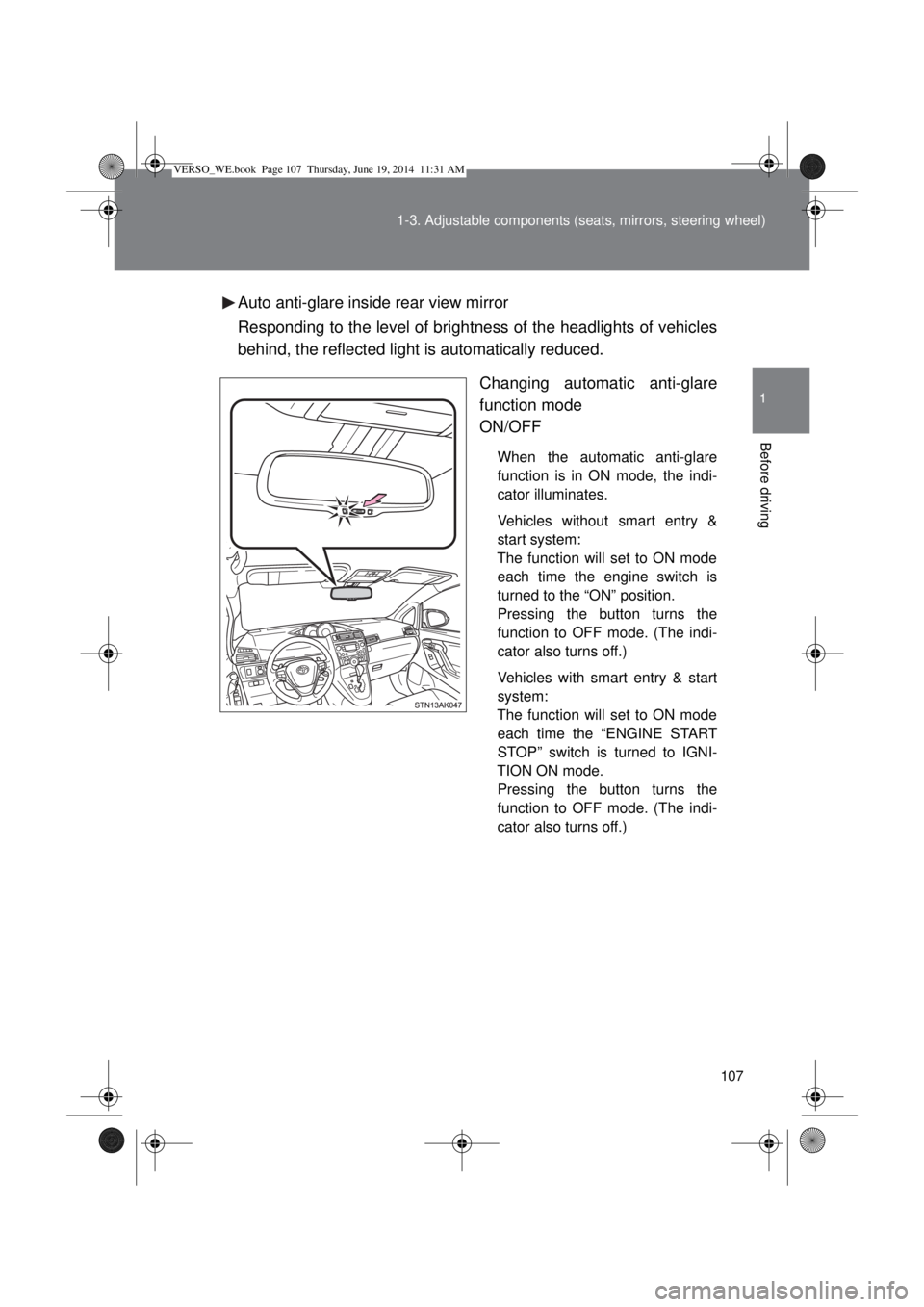
Changing automatic anti-glare
function mode
ON/OFF
When the automatic anti-glare
function is in ON mode, the indi-
cator illuminates.
Vehicles without smart entry &
start system:
The function will set to ON mode
each time the engine switch is
turned to the “ON” position.
Pressing the button turns the
function to OFF mode. (The indi-
cator also turns off.)
Vehicles with smart entry & start
system:
The function will set to ON mode
each time the “ENGINE START
STOP” switch is turned to IGNI-
TION ON mode.
Pressing the button turns the
function to OFF mode. (The indi-
cator also turns off.)
VERSO_WE.book Page 107 Thursday, June 19, 2014 11:31 AM
Page 115 of 650
115
1
1-4. Opening and closing the windows and panoramic roof shade
Before driving
Panoramic roof shade
: If equipped
The panoramic roof shade can be operated when
Vehicles without smart entry & start system
The engine switch is in the “ON” position.
Vehicles with smart entry & start system
The “ENGINE START STOP” switch is in IGNITION ON mode.
Jam protection function
If an object is detected between the panoramic roof shade and the frame
while closing, travel is stopped and the panoramic roof shade opens slightly.
If the panoramic roof shade cannot be closed automatically
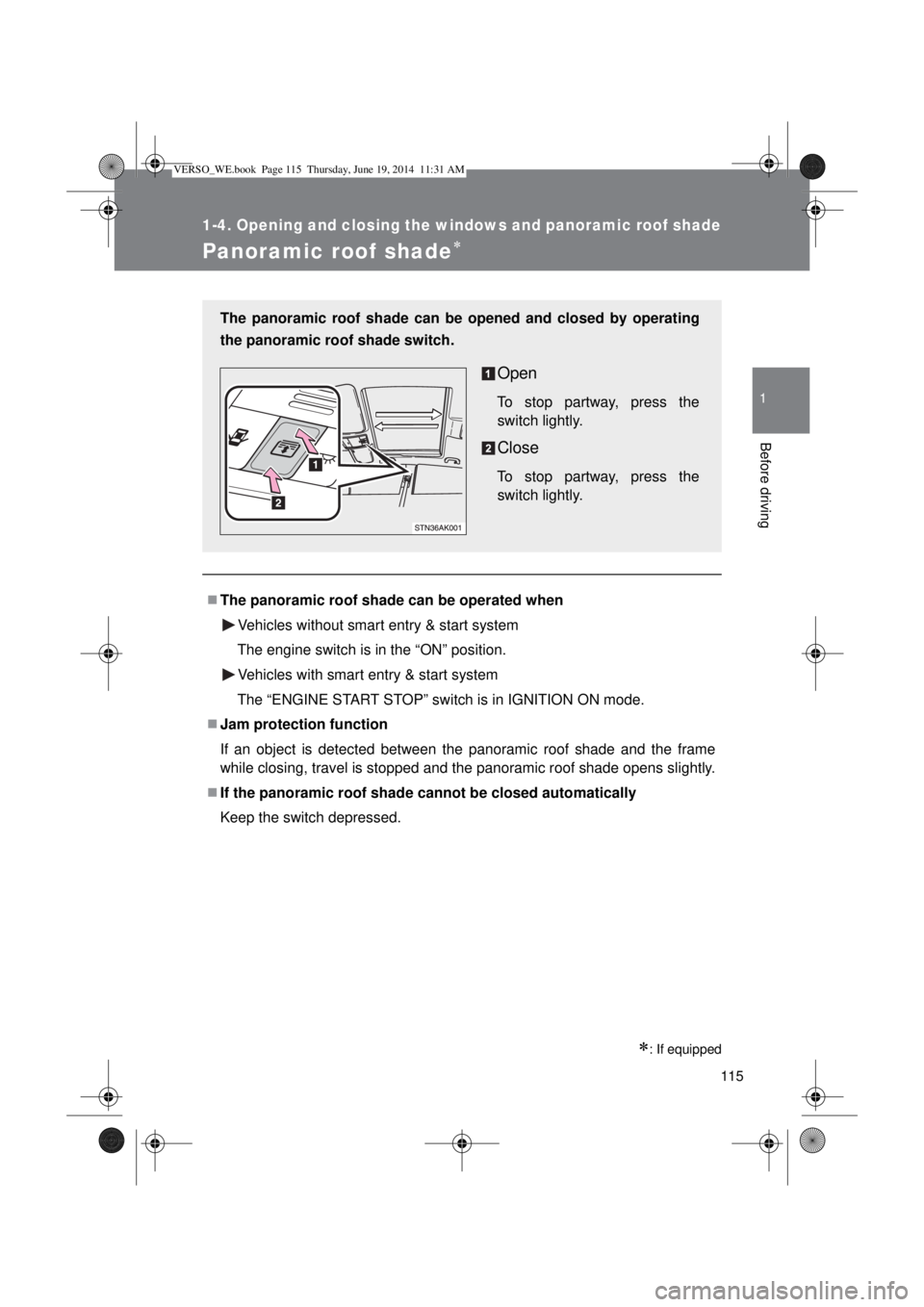
Keep the switch depressed. The panoramic roof shade can be opened and closed by operating
the panoramic roof shade switch.
Open
To stop partway, press the
switch lightly.
Close
To stop partway, press the
switch lightly.
VERSO_WE.book Page 115 Thursday, June 19, 2014 11:31 AM
Page 122 of 650
122 1-5. Refueling
CAUTION
Refueling the vehicle
Observe the following precautions while refueling the vehicle.
Failure to do so may result in death or serious injury.
After exiting the vehicle and before opening the fuel door, touch an
unpainted metal surface to discharge any static electricity. It is important to
discharge static electricity before refueling because sparks resulting from
static electricity can cause fuel vapors to ignite while refueling.
Always hold the grips on the fuel tank cap and turn it slowly to remove it.
A whooshing sound may be heard when the fuel tank cap is loosened.
Wait until the sound cannot be heard before fully removing the cap.
In hot weather, pressurized fuel may spray out of the filler neck and cause
injury.
Do not allow anyone that has not discharged static electricity from their
body to come close to an open fuel tank.
Do not inhale vaporized fuel.
Fuel contains substances that are harmful if inhaled.
Do not smoke while refueling the vehicle.
Doing so may cause the fuel to ignite and cause a fire.
Do not return to the vehicle or touch any person or object that is statically
charged.
This may cause static electricity to build up, resulting in a possible ignition
hazard.
When refueling
Observe the following precautions to prevent fuel overflowing from the fuel
tank:
Securely insert the fuel nozzle into the fuel filler neck
Stop filling the tank after the fuel nozzle automatically clicks off
Do not top off the fuel tank
When replacing the fuel tank cap
Do not use anything but a genuine Toyota fuel tank cap designed for your
vehicle. Doing so may cause a fire or other incident which may result in
death or serious injury.
VERSO_WE.book Page 122 Thursday, June 19, 2014 11:31 AM
Page 125 of 650
125 1-6. Theft deterrent system
1
Before driving
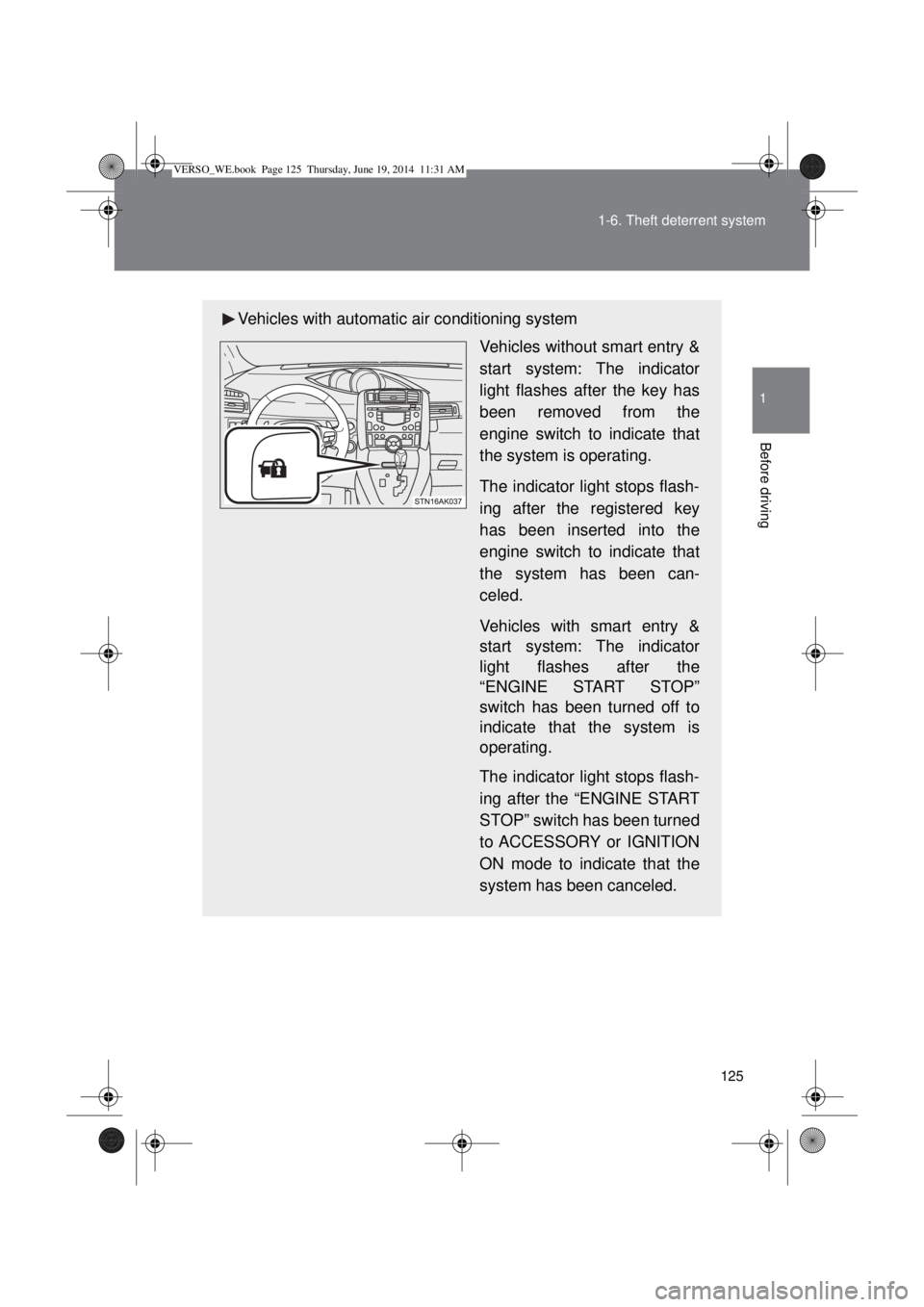
Vehicles with automatic air conditioning system
Vehicles without smart entry &
start system: The indicator
light flashes after the key has
been removed from the
engine switch to indicate that
the system is operating.
The indicator light stops flash-
ing after the registered key
has been inserted into the
engine switch to indicate that
the system has been can-
celed.
Vehicles with smart entry &
start system: The indicator
light flashes after the
“ENGINE START STOP”
switch has been turned off to
indicate that the system is
operating.
The indicator light stops flash-
ing after the “ENGINE START
STOP” switch has been turned
to ACCESSORY or IGNITION
ON mode to indicate that the
system has been canceled.
VERSO_WE.book Page 125 Thursday, June 19, 2014 11:31 AM
Page 136 of 650
136
1-6. Theft deterrent system
Alar m
: If equipped
The system sounds the alarm and flashes the lights when forcible
entry is detected.
Triggering of the alarm
The alarm is triggered in the following situations when the alarm
is set.
A locked door is unlocked or opened in any way other than
using the entry function (vehicles with smart entry & start sys-
tem) or wireless remote control. (The doors will lock again
automatically.)
The hood is opened.
Vehicles with the intrusion sensor: The intrusion sensor
detects something moving inside the vehicle. (An intruder gets
in the vehicle.)
Vehicles with the glass breakage sensor: The back door win-
dow is tapped or broken.
The battery is reconnected.
VERSO_WE.book Page 136 Thursday, June 19, 2014 11:31 AM
Page 137 of 650
137 1-6. Theft deterrent system
1
Before driving
Setting the alarm system
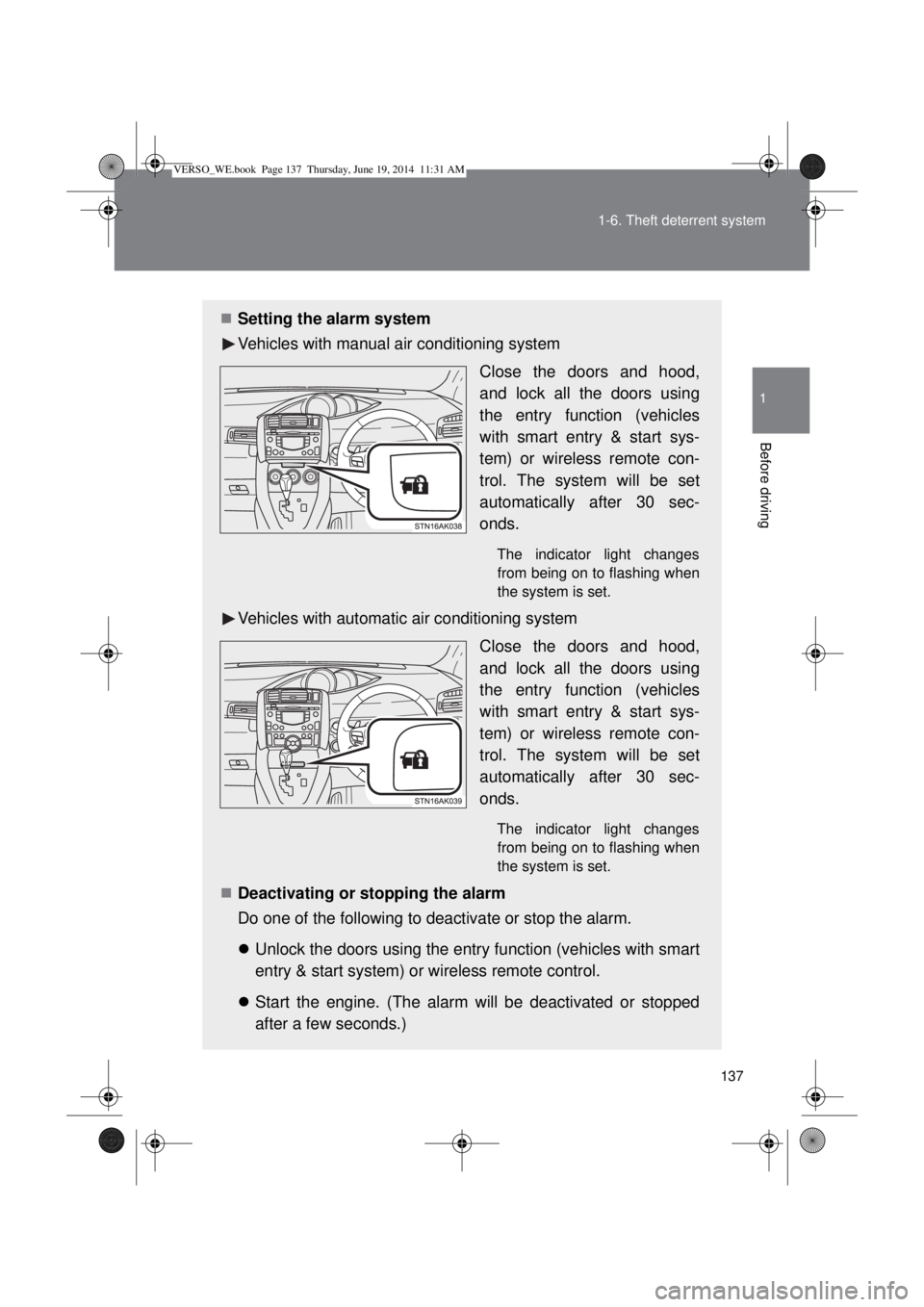
Vehicles with manual air conditioning system
Close the doors and hood,
and lock all the doors using
the entry function (vehicles
with smart entry & start sys-
tem) or wireless remote con-
trol. The system will be set
automatically after 30 sec-
onds.
The indicator light changes
from being on to flashing when
the system is set.
Vehicles with automatic air conditioning system
Close the doors and hood,
and lock all the doors using
the entry function (vehicles
with smart entry & start sys-
tem) or wireless remote con-
trol. The system will be set
automatically after 30 sec-
onds.
The indicator light changes
from being on to flashing when
the system is set.
Deactivating or stopping the alarm
Do one of the following to deactivate or stop the alarm.
Unlock the doors using the entry function (vehicles with smart
entry & start system) or wireless remote control.
Start the engine. (The alarm will be deactivated or stopped
after a few seconds.)
VERSO_WE.book Page 137 Thursday, June 19, 2014 11:31 AM
Page 139 of 650
139 1-6. Theft deterrent system
1
Before driving
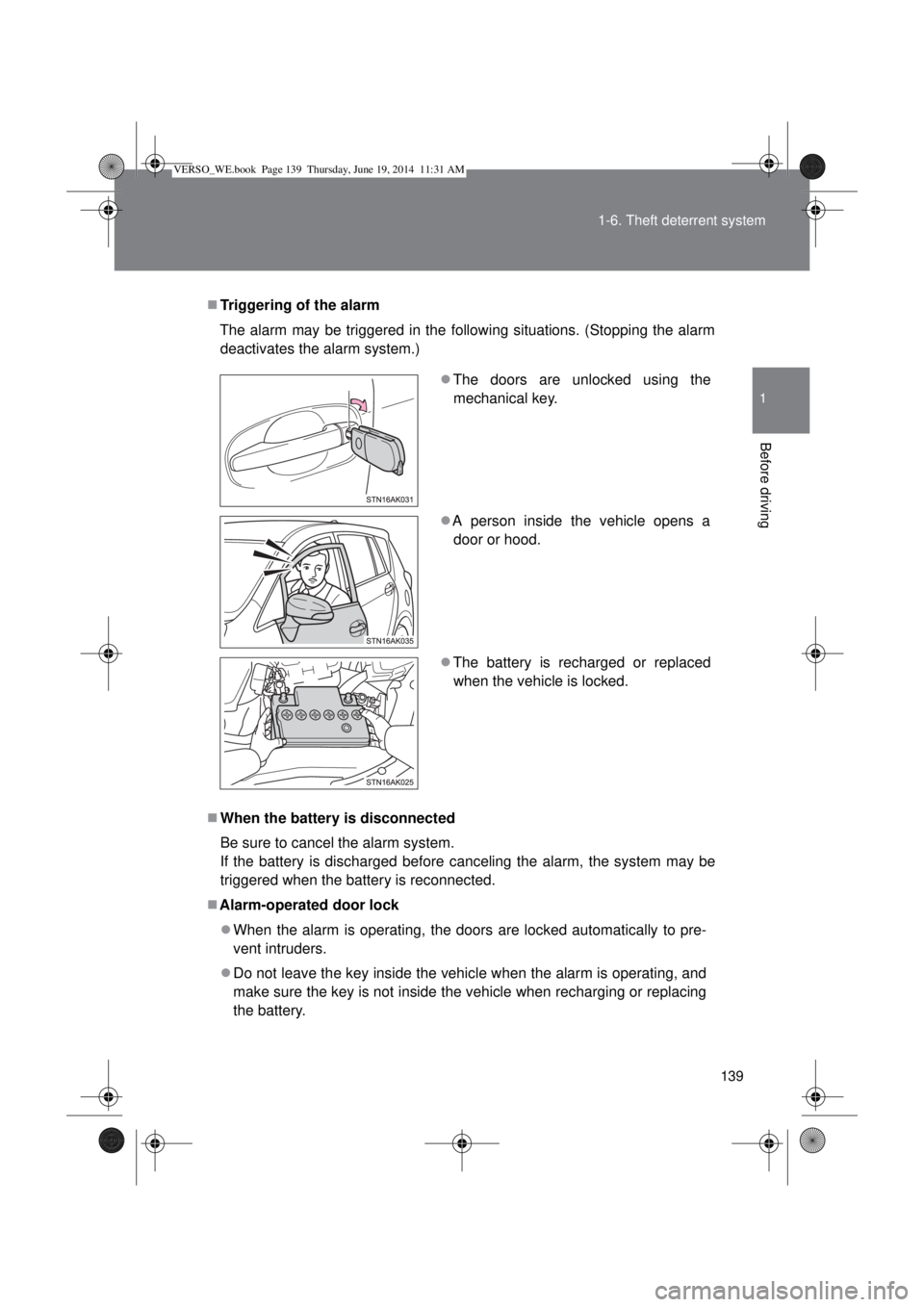
Triggering of the alarm
The alarm may be triggered in the following situations. (Stopping the alarm
deactivates the alarm system.)
When the battery is disconnected
Be sure to cancel the alarm system.
If the battery is discharged before canceling the alarm, the system may be
triggered when the battery is reconnected.
Alarm-operated door lock
When the alarm is operating, the doors are locked automatically to pre-
vent intruders.
Do not leave the key inside the vehicle when the alarm is operating, and
make sure the key is not inside the vehicle when recharging or replacing
the battery.The doors are unlocked using the
mechanical key.
A person inside the vehicle opens a
door or hood.
The battery is recharged or replaced
when the vehicle is locked.
VERSO_WE.book Page 139 Thursday, June 19, 2014 11:31 AM
Page 140 of 650
140 1-6. Theft deterrent system
Canceling and automatic re-enabling of the intrusion sensor
The alarm will still be set even when the intrusion sensor is canceled.
Vehicles without smart entry & start system: After the intrusion sensor is
canceled, turn the engine switch to the “ON” position or unlocking the
doors using the wireless remote control will re-enable the intrusion sen-
sor.
Vehicles with smart entry & start system: After the intrusion sensor is
canceled, pressing the “ENGINE START STOP” switch or unlocking the
doors using the smart entry & start system or wireless remote control will
re-enable the intrusion sensor.
When the alarm system is set again, the intrusion sensor will also be set.
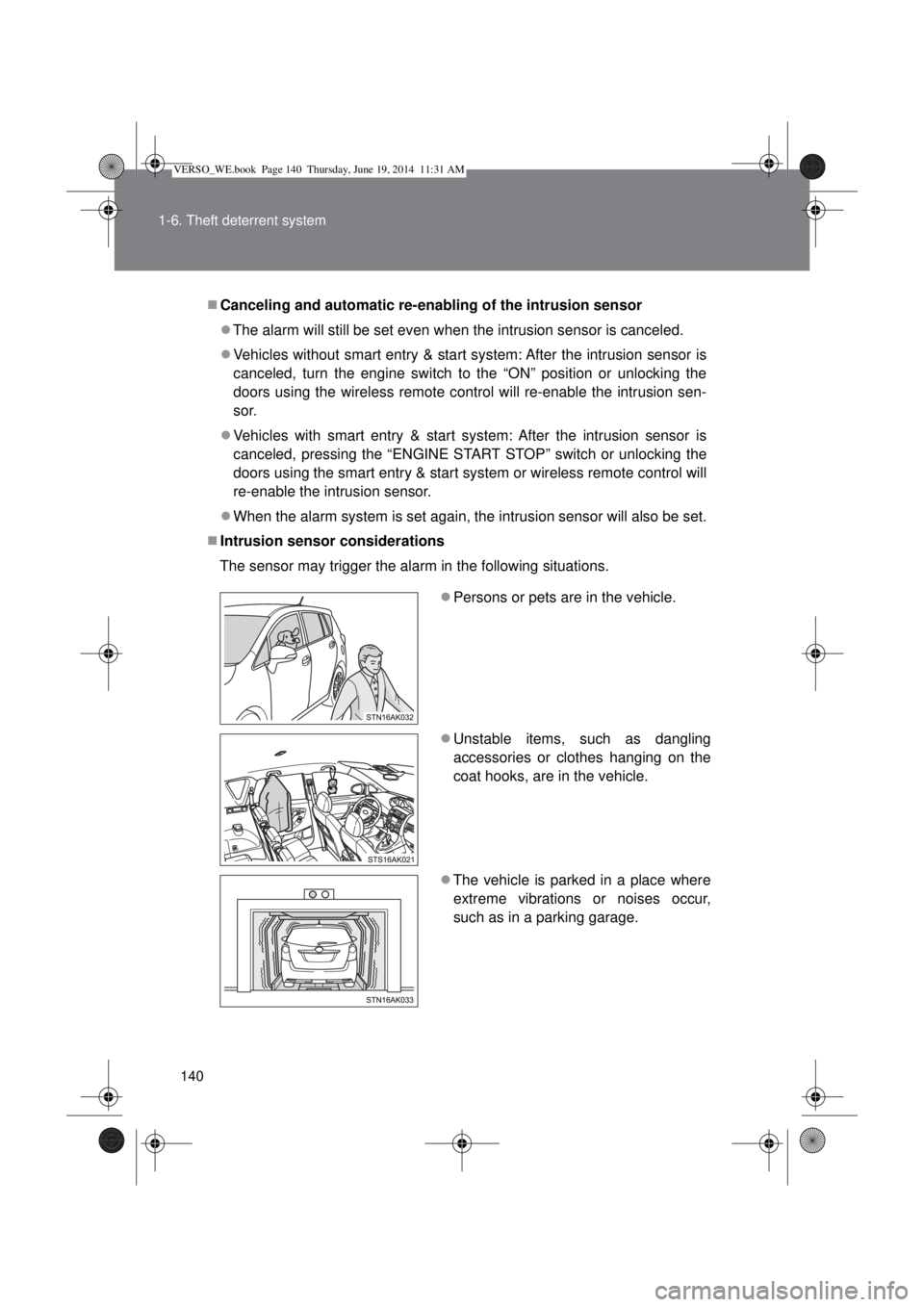
Intrusion sensor considerations
The sensor may trigger the alarm in the following situations.
Persons or pets are in the vehicle.
Unstable items, such as dangling
accessories or clothes hanging on the
coat hooks, are in the vehicle.
The vehicle is parked in a place where
extreme vibrations or noises occur,
such as in a parking garage.
VERSO_WE.book Page 140 Thursday, June 19, 2014 11:31 AM