automatic TOYOTA VERSO 2014 Owner's Guide
[x] Cancel search | Manufacturer: TOYOTA, Model Year: 2014, Model line: VERSO, Model: TOYOTA VERSO 2014Pages: 650, PDF Size: 36.61 MB
Page 190 of 650

190 2-1. Driving procedures
CAUTION
When the vehicle is stopped
Avoid revving or racing the engine. Running the engine at high speed
while the vehicle is stopped may cause the exhaust system to overheat,
which could result in a fire if combustible material is nearby.
When the vehicle is parked
Do not leave glasses, cigarette lighters, spray cans, or soft drink cans in
the vehicle when it is in the sun.
Doing so may result in the following:
• Gas may leak from a cigarette lighter or spray can, and may lead to a
fire.
• The temperature inside the vehicle may cause the plastic lenses and
plastic material of eye glasses to deform or crack.
• Soft drink cans may rupture, causing the contents to spray over the
interior of the vehicle, and may also cause a short circuit in the vehi-
cle’s electrical components.
Always apply the parking brake, shift the shift lever to “P” (Multidrive or
automatic transmission), stop the engine and lock the vehicle.
Do not leave the vehicle unattended while the engine is running.
Do not touch the exhaust pipe while the engine is running or immediately
after turning the engine off.
Doing so may cause burns.
Do not leave the engine running in an area with snow build up, or where it
is snowing. If snowbanks build up around the vehicle while the engine is
running, exhaust gases may collect and enter the vehicle. This may lead
to death or a serious health hazard.
VERSO_WE.book Page 190 Thursday, June 19, 2014 11:31 AM
Page 193 of 650
193 2-1. Driving procedures
2
When driving
NOTICE
When driving the vehicle
Vehicles with a Multidrive or an automatic transmission
Do not depress the accelerator and brake pedals at the same time during
driving, as this may restrain driving torque.
Do not use the accelerator pedal or depress the accelerator and brake
pedals at the same time to hold the vehicle on a hill.
Vehicles with a manual transmission
Do not depress the accelerator and brake pedals at the same time during
driving, as this may restrain driving torque.
Do not shift gears unless the clutch pedal is fully depressed. After shifting,
do not release the clutch pedal abruptly. Doing so may damage the clutch,
transmission and gears.
Observe the following to prevent the clutch from being damaged.
• Do not rest your foot on the clutch pedal while driving.
Doing so may cause clutch trouble.
• Do not use any gears other than the 1st gear when starting off and
moving forward.
Doing so may damage the clutch.
• Do not use the clutch to hold the vehicle when stopping on an uphill
grade.
Doing so may damage the clutch.
Do not shift the shift lever to “R” when the vehicle is still moving. Doing so
may damage the clutch, transmission and gears.
When parking the vehicle (vehicles with a Multidrive or an automatic
transmission)
Always put the shift lever in “P”. Failure to do so may cause the vehicle to
move or the vehicle may accelerate suddenly if the accelerator pedal is acci-
dentally depressed.
VERSO_WE.book Page 193 Thursday, June 19, 2014 11:31 AM
Page 196 of 650
196
2-1. Driving procedures
Engine (ignition) switch (vehicles without smar t entr y & star t system)
Starting the engine
Multidrive (gasoline engine)
Check that the parking brake is set.
Check that the shift lever is set in “P”.
Sit in the driver’s seat and firmly depress the brake pedal.
Turn the engine switch to the “START” position and start
the engine.
Automatic transmission (diesel engine)
Check that the parking brake is set.
Check that the shift lever is set in “P”.
Sit in the driver’s seat and firmly depress the brake pedal.
Turn the engine switch to the “ON” position.
indicator light turns on.
After indicator light goes out, turn the engine switch
to the “START” position and start the engine.
Manual transmission (gasoline engine)
Check that the parking brake is set.
Check that the shift lever is set in “N”.
Sit in the driver’s seat and firmly depress the clutch pedal.
Turn the engine switch to the “START” position and start
the engine.
VERSO_WE.book Page 196 Thursday, June 19, 2014 11:31 AM
Page 197 of 650
197 2-1. Driving procedures
2
When driving
Manual transmission (diesel engine)
Check that the parking brake is set.
Check that the shift lever is set in “N”.
Sit in the driver’s seat and firmly depress the clutch pedal.
Turn the engine switch to the “ON” position.
indicator light turns on.
After indicator light goes out, turn the engine switch
to the “START” position and start the engine.
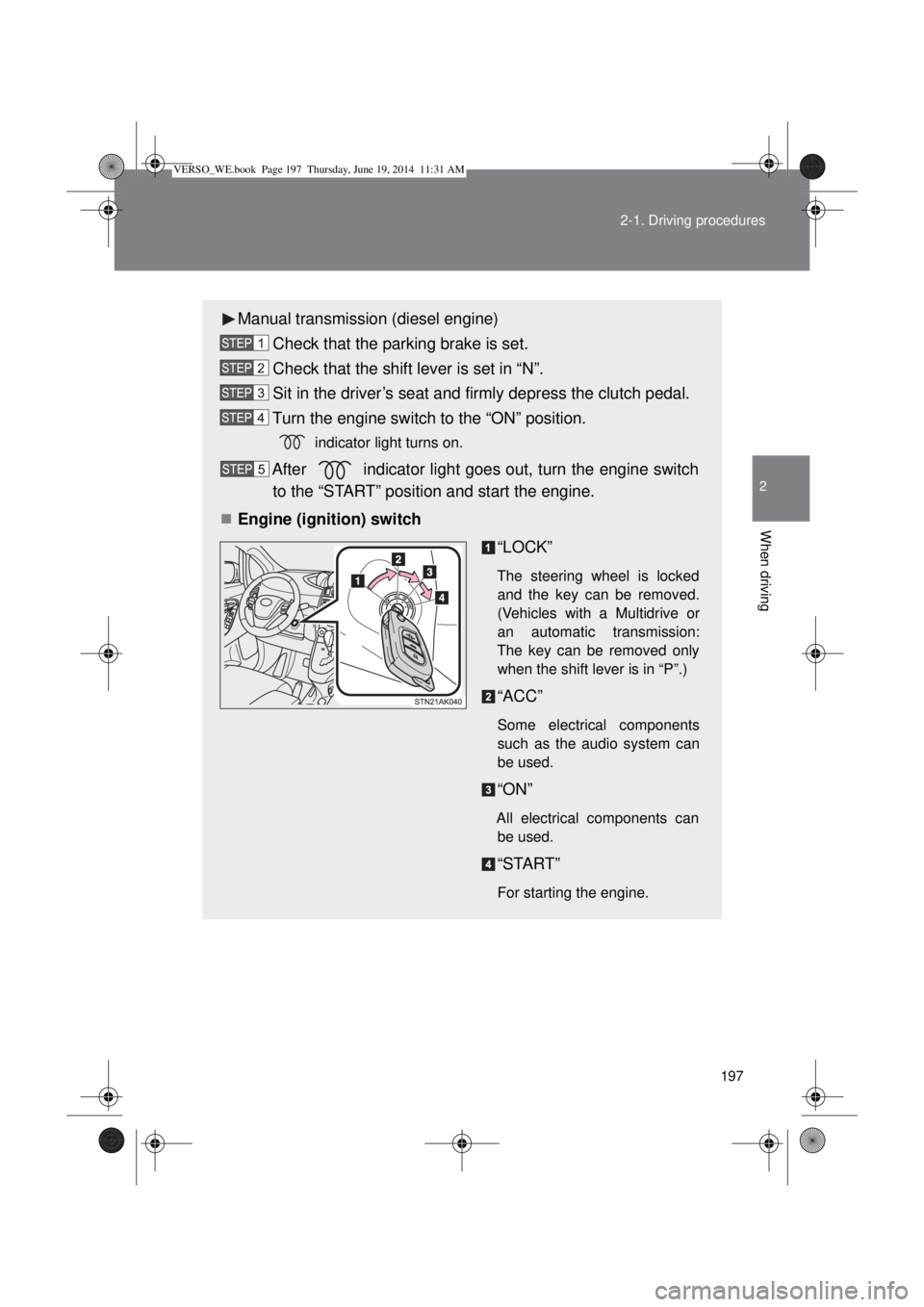
Engine (ignition) switch
“LOCK”
The steering wheel is locked
and the key can be removed.
(Vehicles with a Multidrive or
an automatic transmission:
The key can be removed only
when the shift lever is in “P”.)
“ACC”
Some electrical components
such as the audio system can
be used.
“ON”
All electrical components can
be used.
“START”
For starting the engine.
VERSO_WE.book Page 197 Thursday, June 19, 2014 11:31 AM
Page 200 of 650
200
2-1. Driving procedures
Engine (ignition) switch (vehicles with smart entr y & start system)
Performing the following operations when carrying the electronic
key on your person starts the engine or changes “ENGINE START
STOP” modes.
Starting the engine
Multidrive or automatic transmission
Check that the parking brake is set.
Check that the shift lever is set in “P”.
Sit in the driver’s seat and firmly depress the brake pedal.
The “ENGINE START STOP” switch indicator turns green.
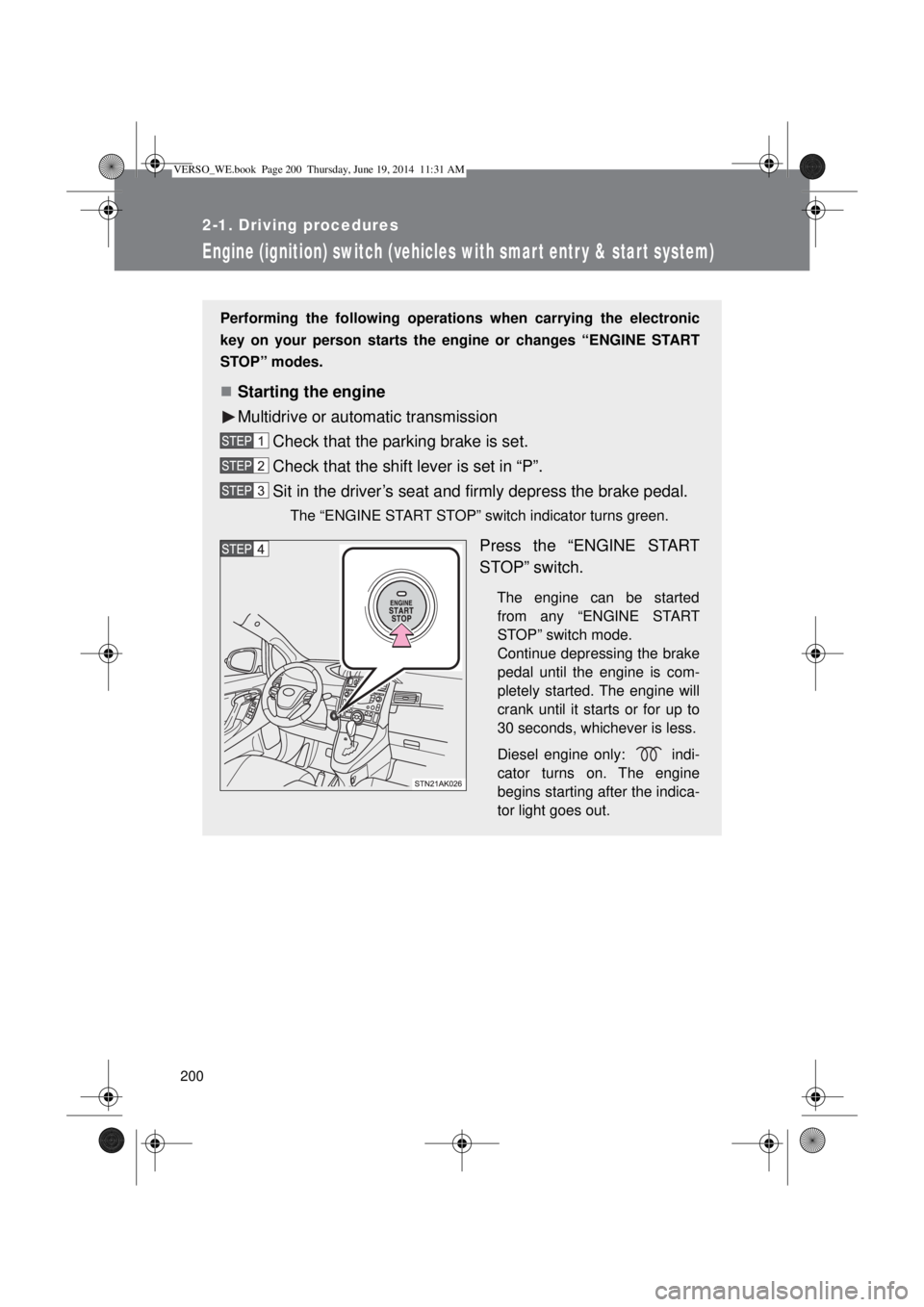
Press the “ENGINE START
STOP” switch.
The engine can be started
from any “ENGINE START
STOP” switch mode.
Continue depressing the brake
pedal until the engine is com-
pletely started. The engine will
crank until it starts or for up to
30 seconds, whichever is less.
Diesel engine only: indi-
cator turns on. The engine
begins starting after the indica-
tor light goes out.
VERSO_WE.book Page 200 Thursday, June 19, 2014 11:31 AM
Page 202 of 650
202 2-1. Driving procedures
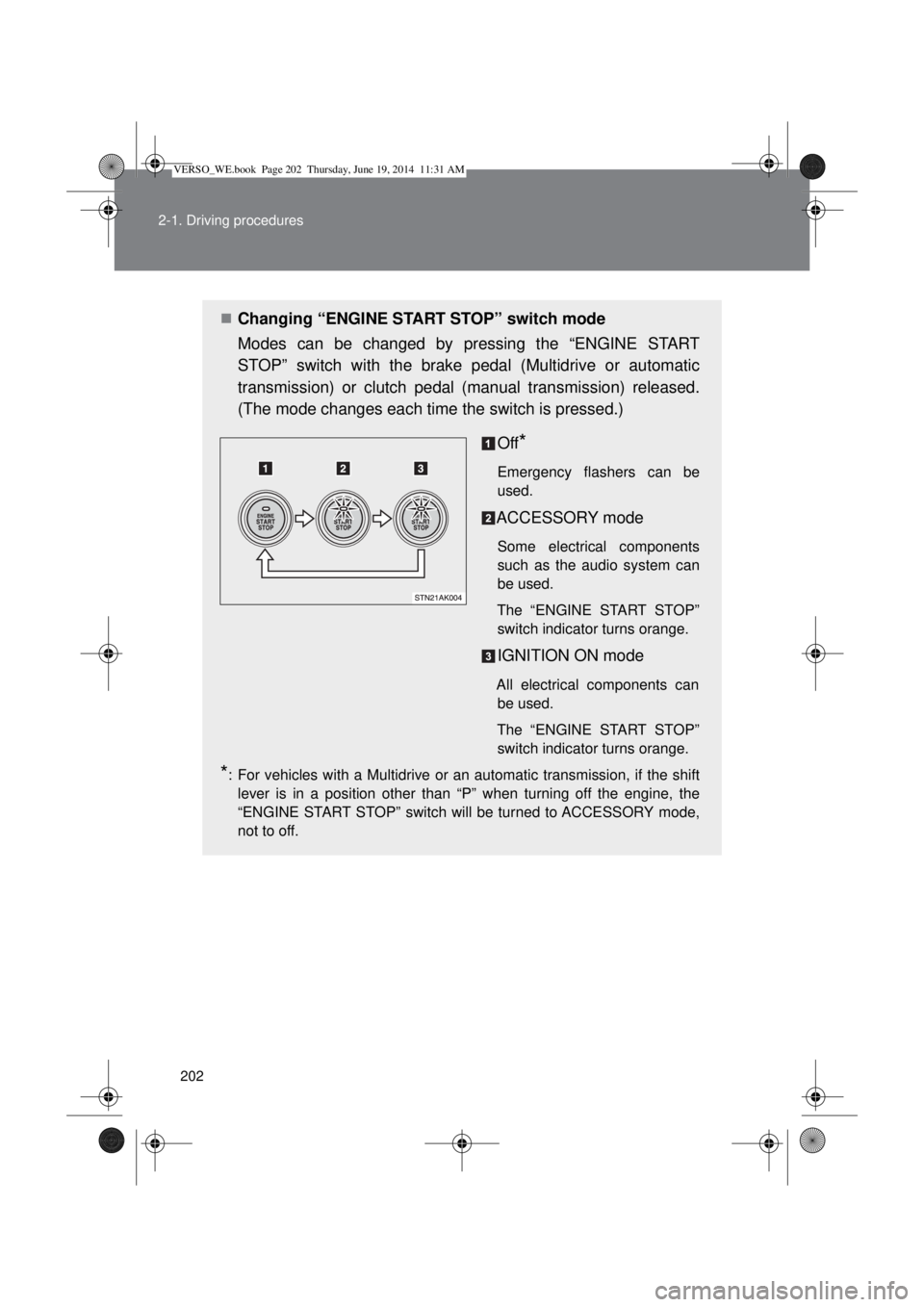
Changing “ENGINE START STOP” switch mode
Modes can be changed by pressing the “ENGINE START
STOP” switch with the brake pedal (Multidrive or automatic
transmission) or clutch pedal (manual transmission) released.
(The mode changes each time the switch is pressed.)
Off
*
Emergency flashers can be
used.
ACCESSORY mode
Some electrical components
such as the audio system can
be used.
The “ENGINE START STOP”
switch indicator turns orange.
IGNITION ON mode
All electrical components can
be used.
The “ENGINE START STOP”
switch indicator turns orange.
*: For vehicles with a Multidrive or an automatic transmission, if the shift
lever is in a position other than “P” when turning off the engine, the
“ENGINE START STOP” switch will be turned to ACCESSORY mode,
not to off.
VERSO_WE.book Page 202 Thursday, June 19, 2014 11:31 AM
Page 204 of 650
204 2-1. Driving procedures
Auto power off function
Vehicles with a Multidrive or an automatic transmission
If the vehicle is left in ACCESSORY mode for more than 20 minutes with
the shift lever in “P”, the “ENGINE START STOP” switch will automatically
turn off.
Vehicles with a manual transmission
If the vehicle is left in ACCESSORY mode for more than 20 minutes, the
“ENGINE START STOP” switch will automatically turn off.
“ENGINE START STOP” switch operation
When operating the “ENGINE START STOP” switch, push it quickly and
firmly. If the switch is not pushed firmly, the mode may not change or the
engine may not start. Furthermore, if the switch is pushed quickly and firmly,
there is no need to hold it down.
Electronic key battery depletion
P. 47
When the electronic key battery is discharged
P. 582
Conditions affecting operation
P. 63
Note for the smart entry & start system
P. 47
CAUTION
When starting the engine
Always start the engine while sitting in the driver’s seat. Do not depress the
accelerator pedal while starting the engine under any circumstances.
Doing so may cause an accident resulting in death or serious injury.
VERSO_WE.book Page 204 Thursday, June 19, 2014 11:31 AM
Page 208 of 650
208 2-1. Driving procedures
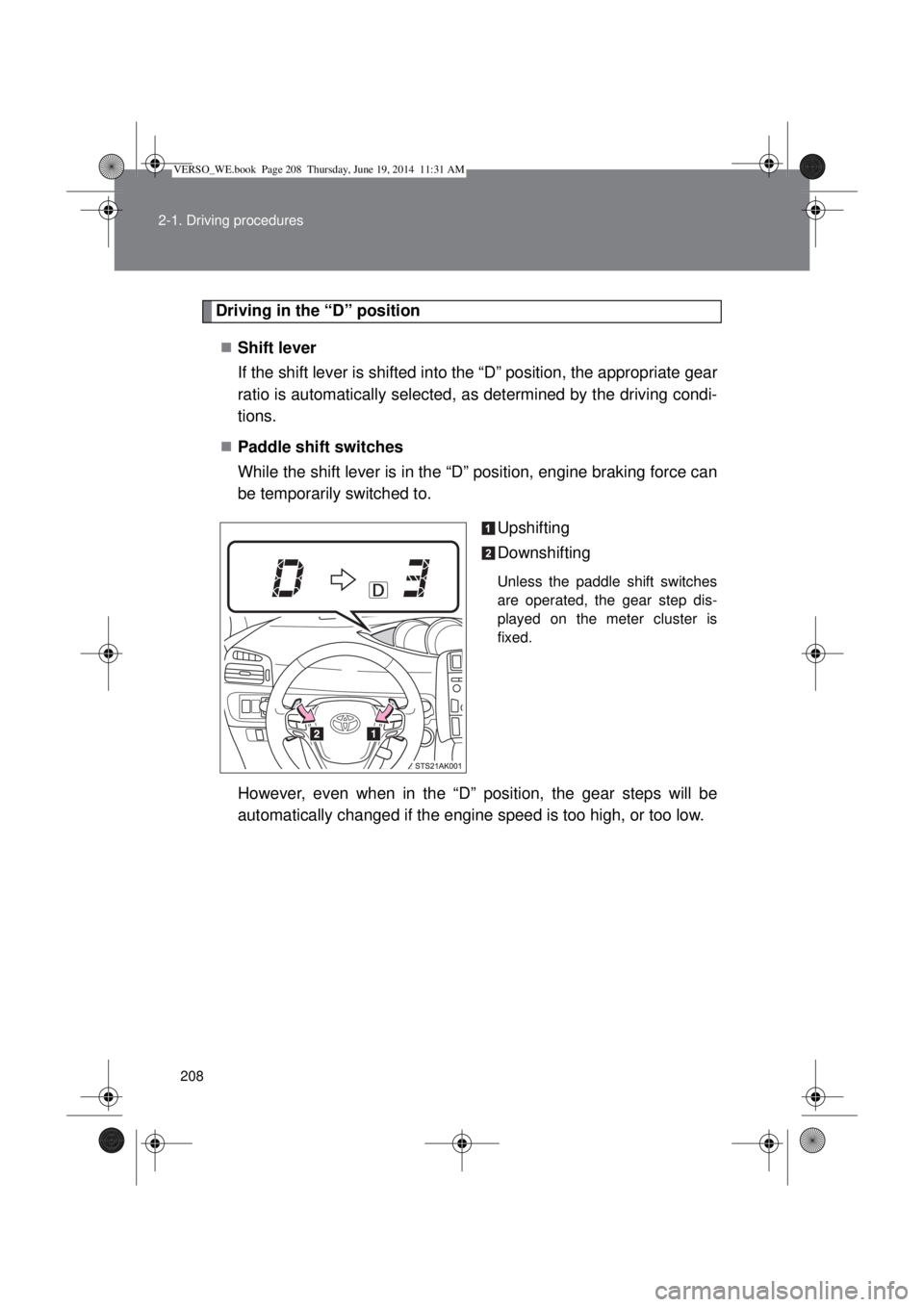
Driving in the “D” position
Shift lever
If the shift lever is shifted into the “D” position, the appropriate gear
ratio is automatically selected, as determined by the driving condi-
tions.
Paddle shift switches
While the shift lever is in the “D” position, engine braking force can
be temporarily switched to.
Upshifting
Downshifting
Unless the paddle shift switches
are operated, the gear step dis-
played on the meter cluster is
fixed.
However, even when in the “D” position, the gear steps will be
automatically changed if the engine speed is too high, or too low.
VERSO_WE.book Page 208 Thursday, June 19, 2014 11:31 AM
Page 209 of 650
209 2-1. Driving procedures
2
When driving
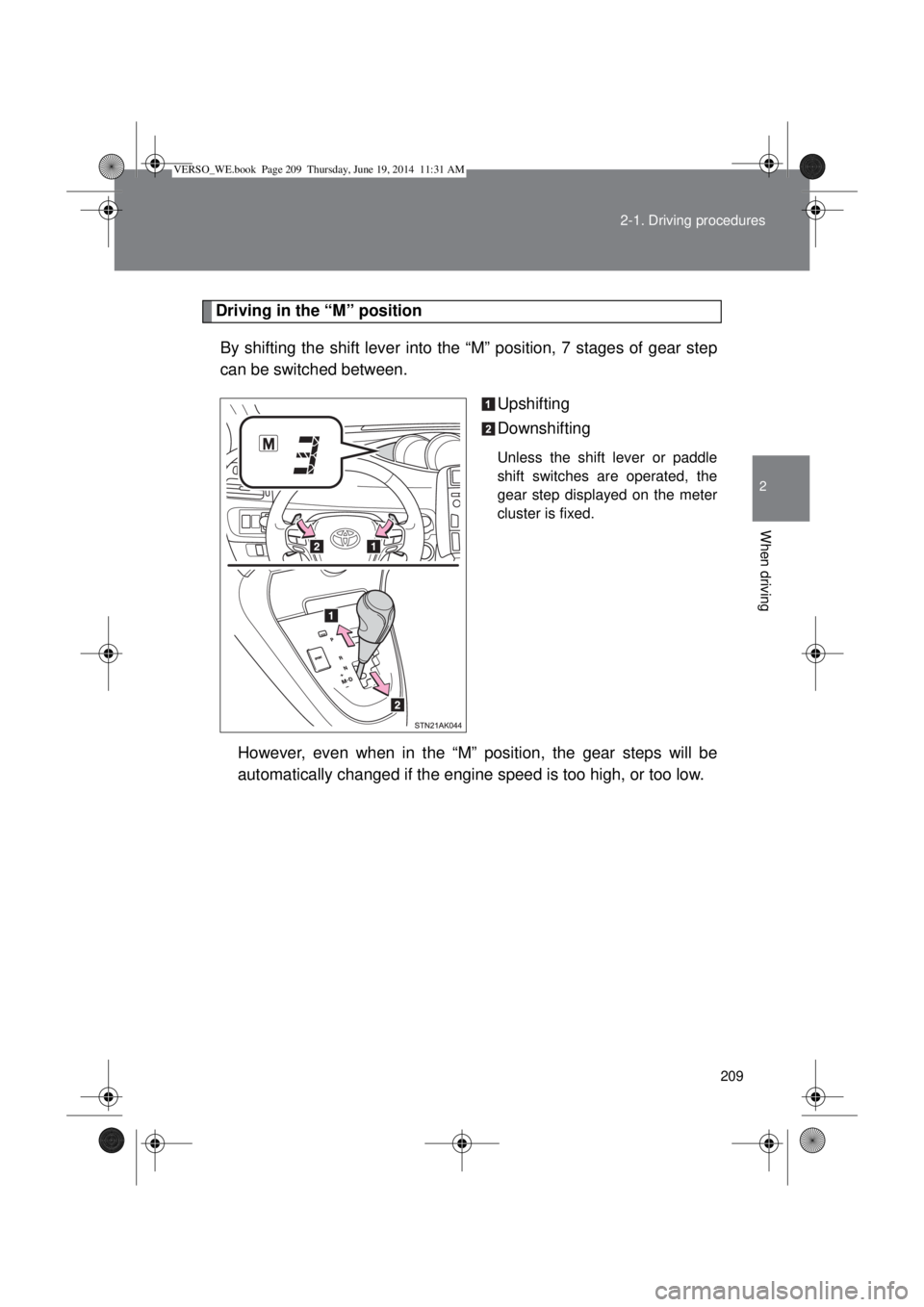
Driving in the “M” position
By shifting the shift lever into the “M” position, 7 stages of gear step
can be switched between.
Upshifting
Downshifting
Unless the shift lever or paddle
shift switches are operated, the
gear step displayed on the meter
cluster is fixed.
However, even when in the “M” position, the gear steps will be
automatically changed if the engine speed is too high, or too low.
VERSO_WE.book Page 209 Thursday, June 19, 2014 11:31 AM
Page 210 of 650

210 2-1. Driving procedures
Paddle shift switch
When the paddle shift switch is operated in the “D” position, a gear step
will be automatically selected according to the vehicle speed and driving
conditions.
Automatic deactivation of gear step selection in the “D” position.
Gear step selection in the “D” position will be deactivated in the following
situations:
• The “+” paddle shift switch is held down for a period of time
• When the vehicle comes to a stop
• If the accelerator pedal is depressed for longer than a certain period of
time in one gear step
Downshifting restrictions warning buzzer
To help ensure safety and driving performance, downshifting operation may
sometimes be restricted. In some circumstances, downshifting may not be
possible even when the shift lever or paddle shift switches are operated.
(The warning buzzer will sound twice.)
When driving with cruise control activated (if equipped)
Even when performing the following actions with the intent of enabling
engine braking, engine braking will not activate because cruise control will
not be canceled.
• While driving in “D” or 7-speed sport sequential shiftmatic mode, down-
shifting to “6”, “5” or “4”. (P. 208, 209)
• When switching the driving mode to “SPORT” mode while driving in “D”
position. (P. 207)
VERSO_WE.book Page 210 Thursday, June 19, 2014 11:31 AM