starting TOYOTA VERSO 2014 Owner's Manual
[x] Cancel search | Manufacturer: TOYOTA, Model Year: 2014, Model line: VERSO, Model: TOYOTA VERSO 2014Pages: 650, PDF Size: 36.61 MB
Page 293 of 650
293
2-4. Using other driving systems
2
When driving
Hill-star t assist control
Hill-start assist control operating conditions
The hill-start assist control system operates under the following condi-
tions.
• The shift lever is in a position other than “P” (Multidrive or automatic
transmission).
• The parking brake is not applied.
• The accelerator pedal is not depressed.
The hill-start assist control system cannot be operated while the slip indi-
cator light is illuminated.
Hill-start assist control
While hill-start assist control is operating, the brakes remain automati-
cally applied after the driver releases the brake pedal. The stop lights and
the high mounted stoplight turn on.
Hill-start assist control operates for about 2 seconds after the brake pedal
is released.
If the slip indicator does not flash and the buzzer does not sound when
the brake pedal is further depressed, slightly reduce the pressure on the
brake pedal (do not allow the vehicle to roll backward) and then firmly
depress it again. If the system still does not operate, check if the operat-
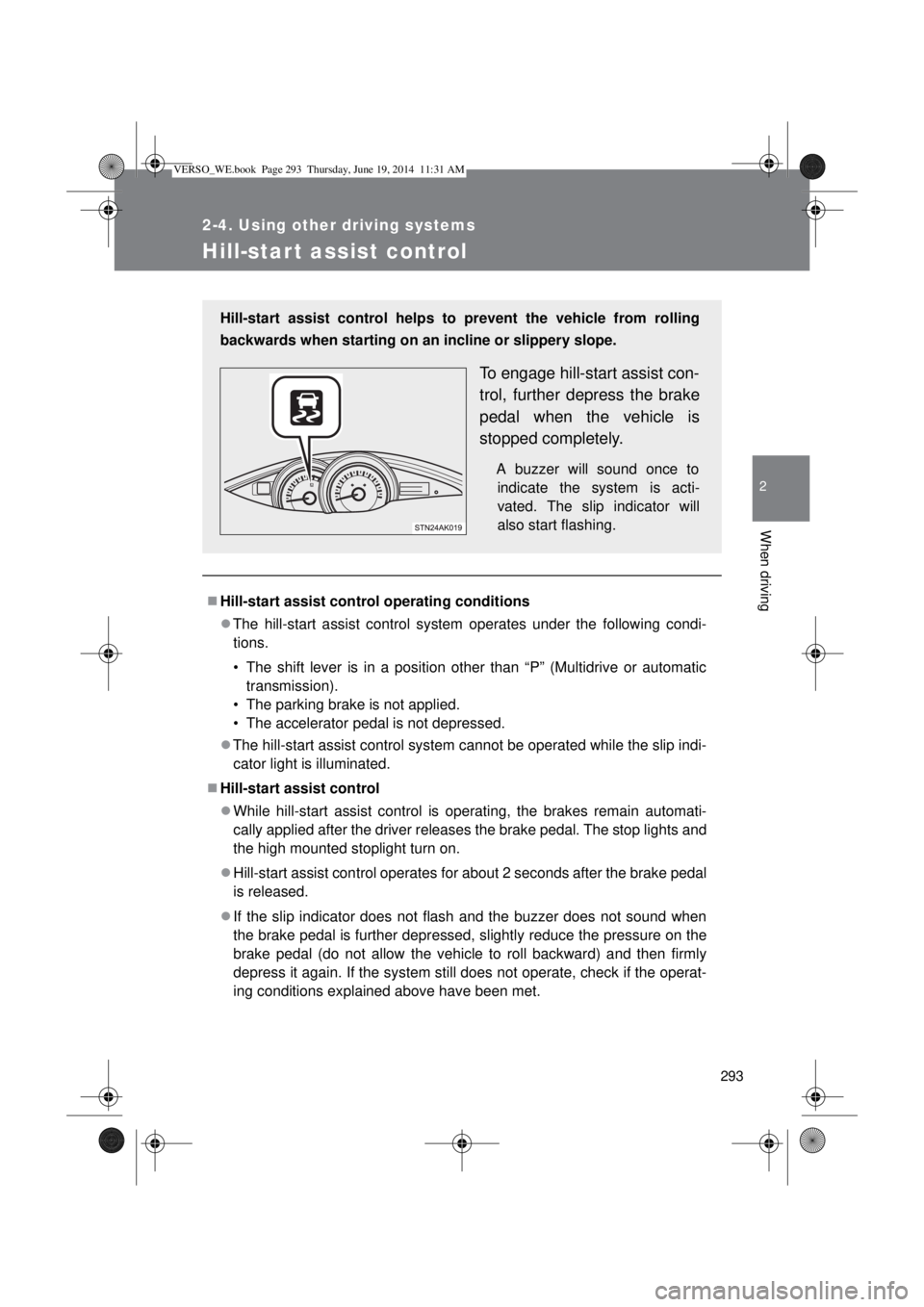
ing conditions explained above have been met. Hill-start assist control helps to prevent the vehicle from rolling
backwards when starting on an incline or slippery slope.
To engage hill-start assist con-
trol, further depress the brake
pedal when the vehicle is
stopped completely.
A buzzer will sound once to
indicate the system is acti-
vated. The slip indicator will
also start flashing.
VERSO_WE.book Page 293 Thursday, June 19, 2014 11:31 AM
Page 324 of 650
324
3-1. Using the air conditioning system and defogger
Power heater
: If equipped
Power heater can be operated when
The engine is running.
The engine coolant temperature is low.
Normal characteristics of power heater operation
The following cases do not indicate a malfunction.
When the power heater is turned on or off, some white smoke and a
slight odor may be emitted from the power heater exhaust that is located
under the floor.
When the power heater is used under extremely cold conditions, vapor
may be visible from its exhaust.
When the power heater is turned off, you may hear a sound in the engine
compartment for about 2 minutes until the power heater turns off com-
pletely.
After the heater is turned off
We recommend not restarting the heater for 10 minutes after you turn it off.
Otherwise, a noise may be heard as the heater ignites.
When refueling your vehicle
The engine must be turned off. Turning the engine off turns the power heater
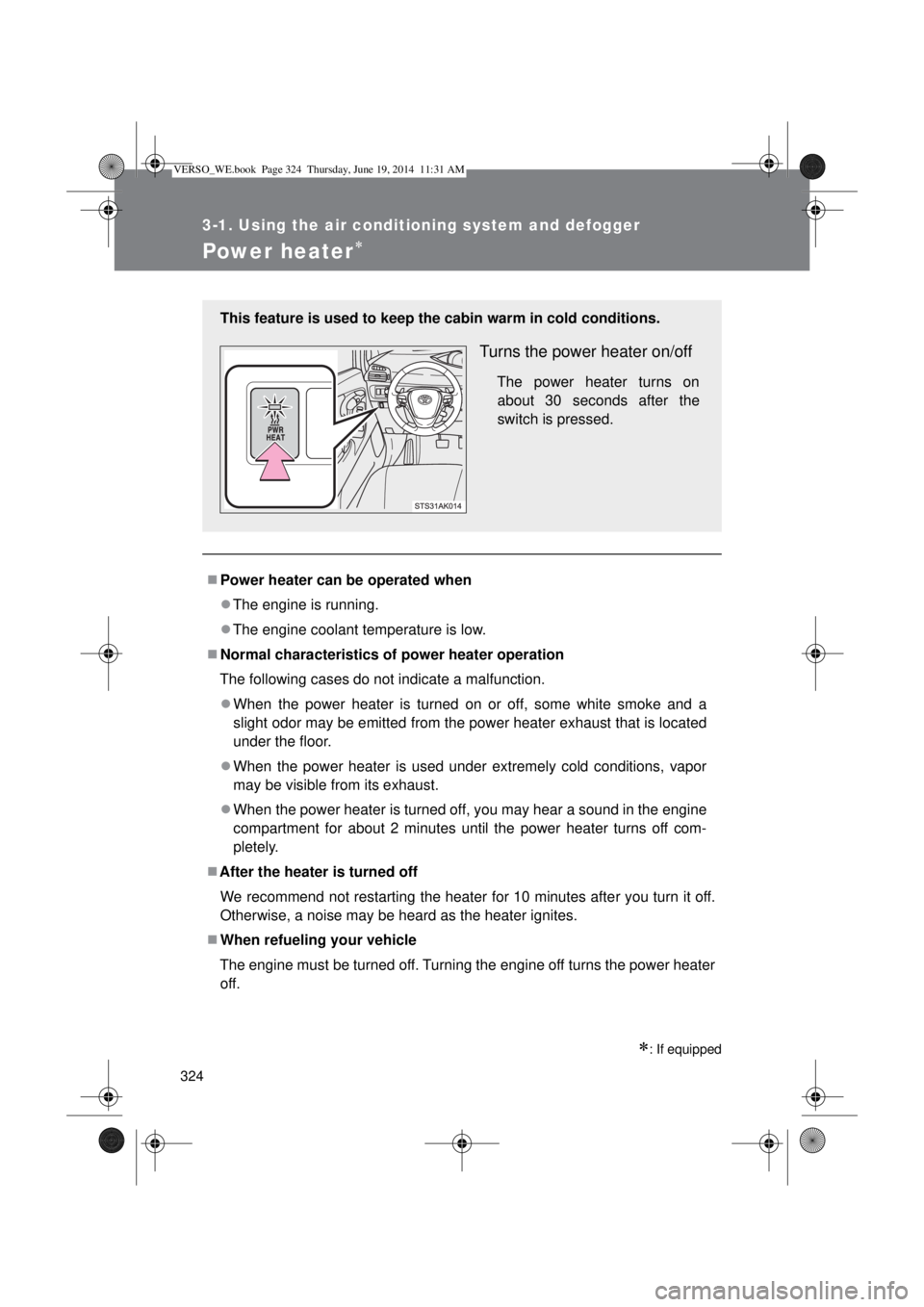
off. This feature is used to keep the cabin warm in cold conditions.
Turns the power heater on/off
The power heater turns on
about 30 seconds after the
switch is pressed.
VERSO_WE.book Page 324 Thursday, June 19, 2014 11:31 AM
Page 476 of 650
476 4-3. Do-it-yourself maintenance
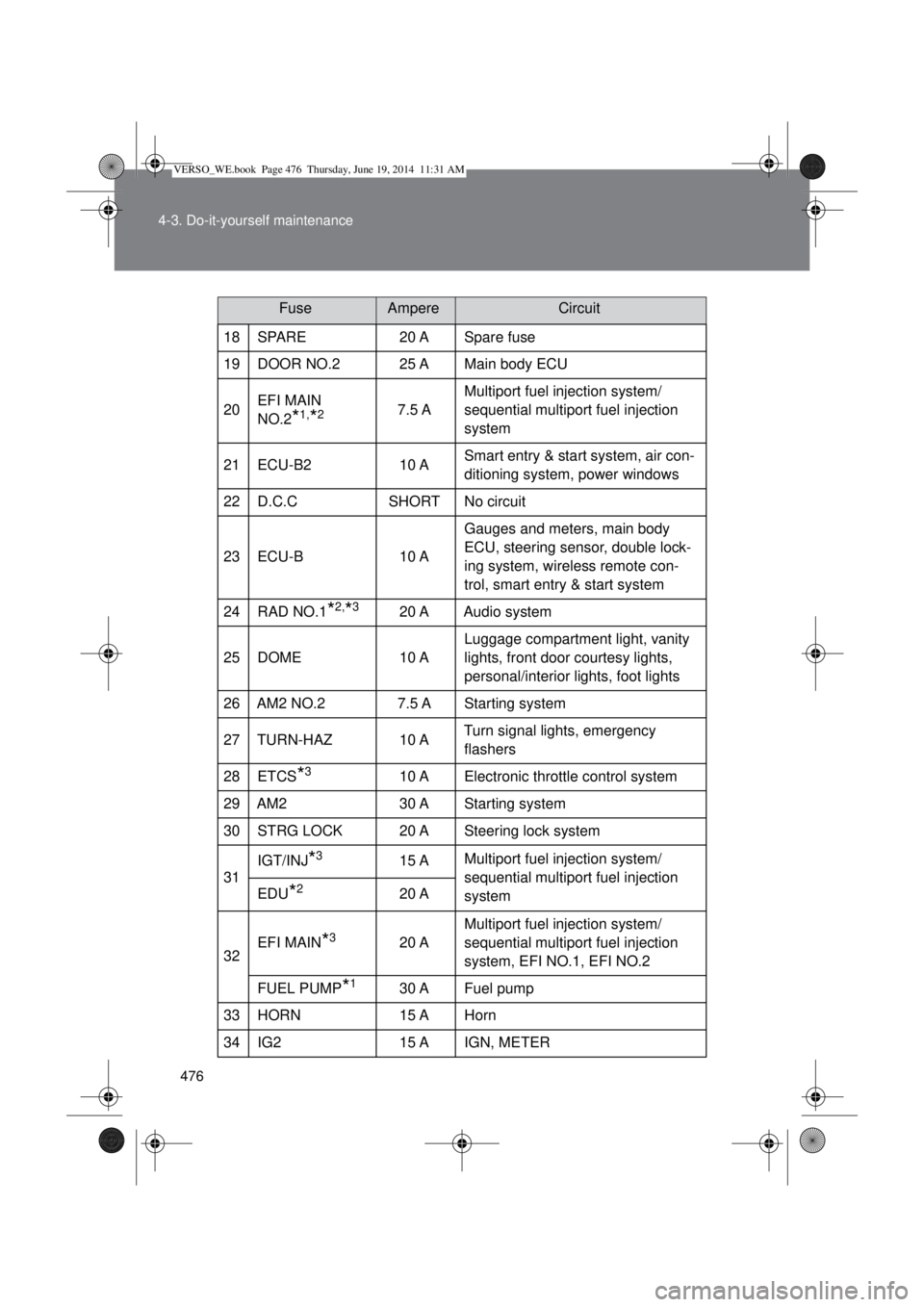
18 SPARE 20 A Spare fuse
19 DOOR NO.2 25 A Main body ECU
20EFI MAIN
NO.2
*1,*27.5 AMultiport fuel injection system/
sequential multiport fuel injection
system
21 ECU-B2 10 ASmart entry & start system, air con-
ditioning system, power windows
22 D.C.C SHORT No circuit
23 ECU-B 10 AGauges and meters, main body
ECU, steering sensor, double lock-
ing system, wireless remote con-
trol, smart entry & start system
24 RAD NO.1
*2,*320 A Audio system
25 DOME 10 ALuggage compartment light, vanity
lights, front door courtesy lights,
personal/interior lights, foot lights
26 AM2 NO.2 7.5 A Starting system
27 TURN-HAZ 10 ATurn signal lights, emergency
flashers
28 ETCS
*310 A Electronic throttle control system
29 AM2 30 A Starting system
30 STRG LOCK 20 A Steering lock system
31IGT/INJ
*315 AMultiport fuel injection system/
sequential multiport fuel injection
system EDU
*220 A
32EFI MAIN
*320 AMultiport fuel injection system/
sequential multiport fuel injection
system, EFI NO.1, EFI NO.2
FUEL PUMP
*130 A Fuel pump
33 HORN 15 A Horn
34 IG2 15 A IGN, METER
FuseAmpereCircuit
VERSO_WE.book Page 476 Thursday, June 19, 2014 11:31 AM
Page 477 of 650
477 4-3. Do-it-yourself maintenance
4
Maintenance and care
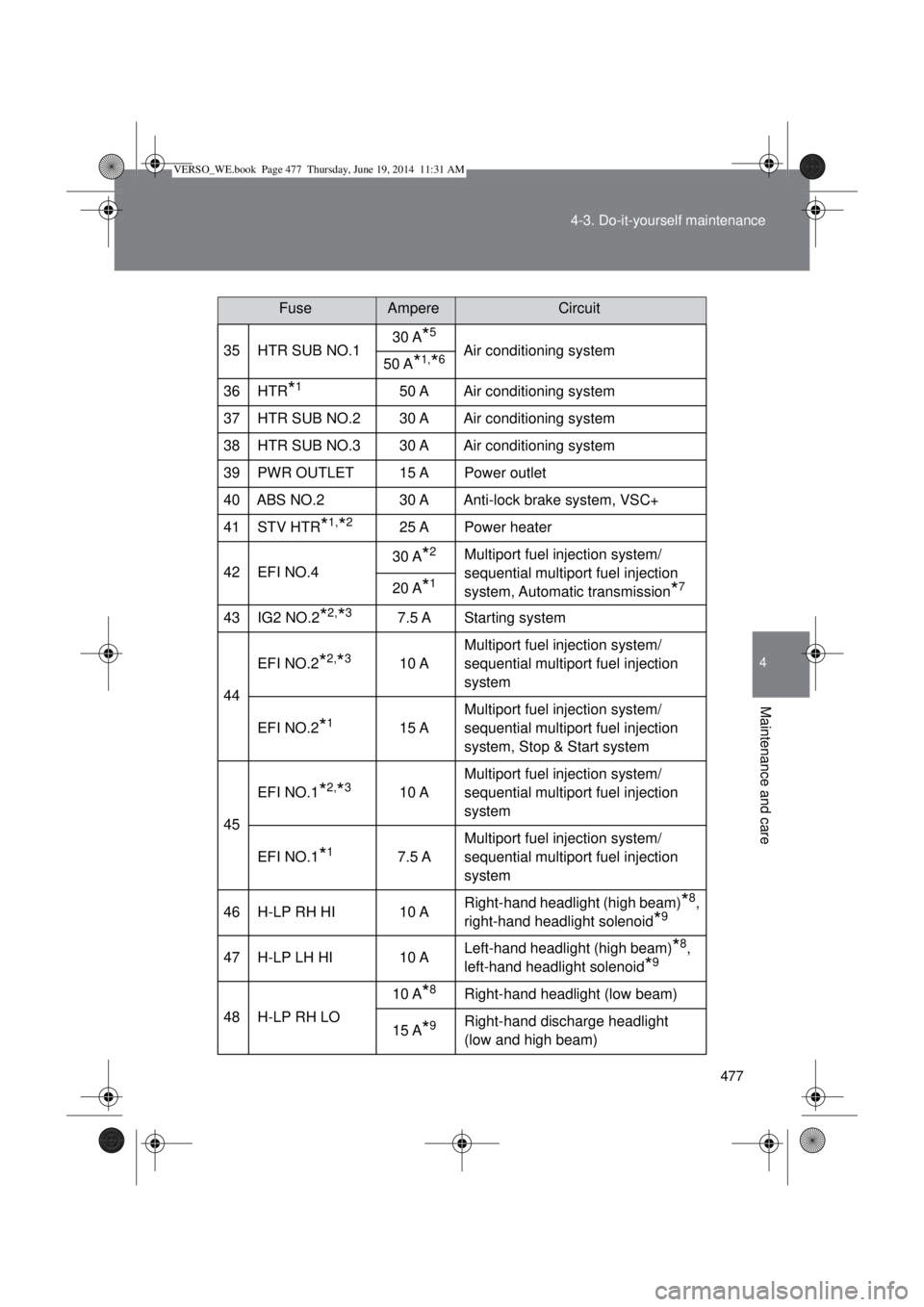
35 HTR SUB NO.130 A*5
Air conditioning system
50 A*1,*6
36 HTR*150 A Air conditioning system
37 HTR SUB NO.2 30 A Air conditioning system
38 HTR SUB NO.3 30 A Air conditioning system
39PWR OUTLET15 APower outlet
40 ABS NO.2 30 A Anti-lock brake system, VSC+
41 STV HTR
*1,*225 A Power heater
42 EFI NO.430 A
*2Multiport fuel injection system/
sequential multiport fuel injection
system, Automatic transmission
*720 A*1
43 IG2 NO.2*2,*37.5 A Starting system
44EFI NO.2
*2,*310 AMultiport fuel injection system/
sequential multiport fuel injection
system
EFI NO.2
*115 AMultiport fuel injection system/
sequential multiport fuel injection
system, Stop & Start system
45EFI NO.1
*2,*310 AMultiport fuel injection system/
sequential multiport fuel injection
system
EFI NO.1
*17.5 AMultiport fuel injection system/
sequential multiport fuel injection
system
46 H-LP RH HI 10 ARight-hand headlight (high beam)
*8,
right-hand headlight solenoid
*9
47 H-LP LH HI 10 ALeft-hand headlight (high beam)*8,
left-hand headlight solenoid
*9
48 H-LP RH LO10 A
*8Right-hand headlight (low beam)
15 A
*9Right-hand discharge headlight
(low and high beam)
FuseAmpereCircuit
VERSO_WE.book Page 477 Thursday, June 19, 2014 11:31 AM
Page 480 of 650
480 4-3. Do-it-yourself maintenance
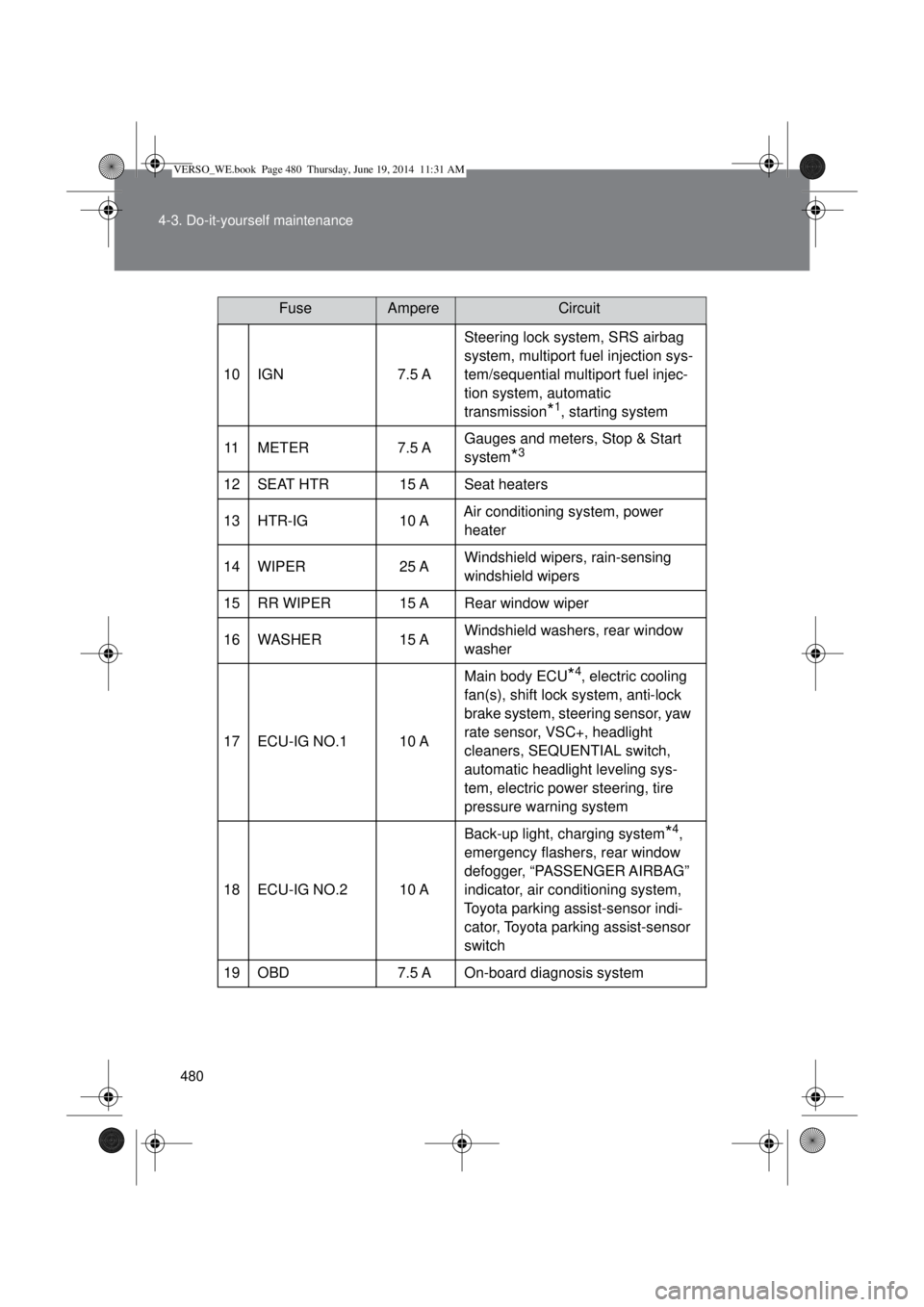
10 IGN 7.5 ASteering lock system, SRS airbag
system, multiport fuel injection sys-
tem/sequential multiport fuel injec-
tion system, automatic
transmission
*1, starting system
11 METER 7.5 AGauges and meters, Stop & Start
system
*3
12 SEAT HTR 15 A Seat heaters
13 HTR-IG 10 AAir conditioning system, power
heater
14 WIPER 25 AWindshield wipers, rain-sensing
windshield wipers
15 RR WIPER 15 A Rear window wiper
16 WASHER 15 AWindshield washers, rear window
washer
17 ECU-IG NO.1 10 AMain body ECU
*4, electric cooling
fan(s), shift lock system, anti-lock
brake system, steering sensor, yaw
rate sensor, VSC+, headlight
cleaners, SEQUENTIAL switch,
automatic headlight leveling sys-
tem, electric power steering, tire
pressure warning system
18 ECU-IG NO.2 10 ABack-up light, charging system
*4,
emergency flashers, rear window
defogger, “PASSENGER AIRBAG”
indicator, air conditioning system,
Toyota parking assist-sensor indi-
cator, Toyota parking assist-sensor
switch
19 OBD 7.5 A On-board diagnosis system
FuseAmpereCircuit
VERSO_WE.book Page 480 Thursday, June 19, 2014 11:31 AM
Page 481 of 650
481 4-3. Do-it-yourself maintenance
4
Maintenance and care
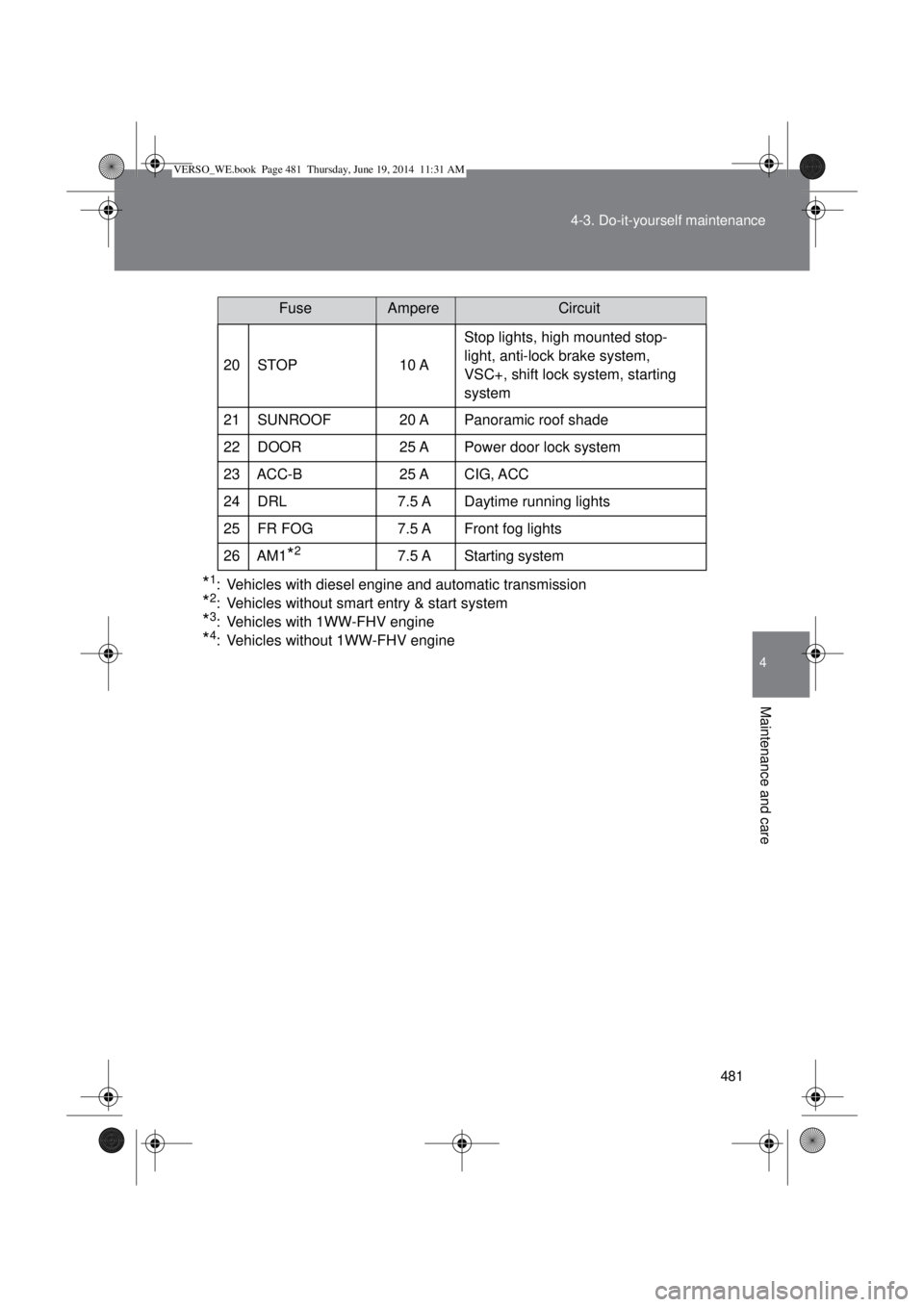
*1: Vehicles with diesel engine and automatic transmission
*2: Vehicles without smart entry & start system
*3: Vehicles with 1WW-FHV engine
*4: Vehicles without 1WW-FHV engine20 STOP 10 AStop lights, high mounted stop-
light, anti-lock brake system,
VSC+, shift lock system, starting
system
21 SUNROOF 20 A Panoramic roof shade
22 DOOR 25 A Power door lock system
23 ACC-B 25 A CIG, ACC
24 DRL 7.5 A Daytime running lights
25 FR FOG 7.5 A Front fog lights
26 AM1
*27.5 AStarting system
FuseAmpereCircuit
VERSO_WE.book Page 481 Thursday, June 19, 2014 11:31 AM
Page 513 of 650
5
513
5-1. Essential information
When trouble arises
Fuel pump shut off system (gasoline engine)
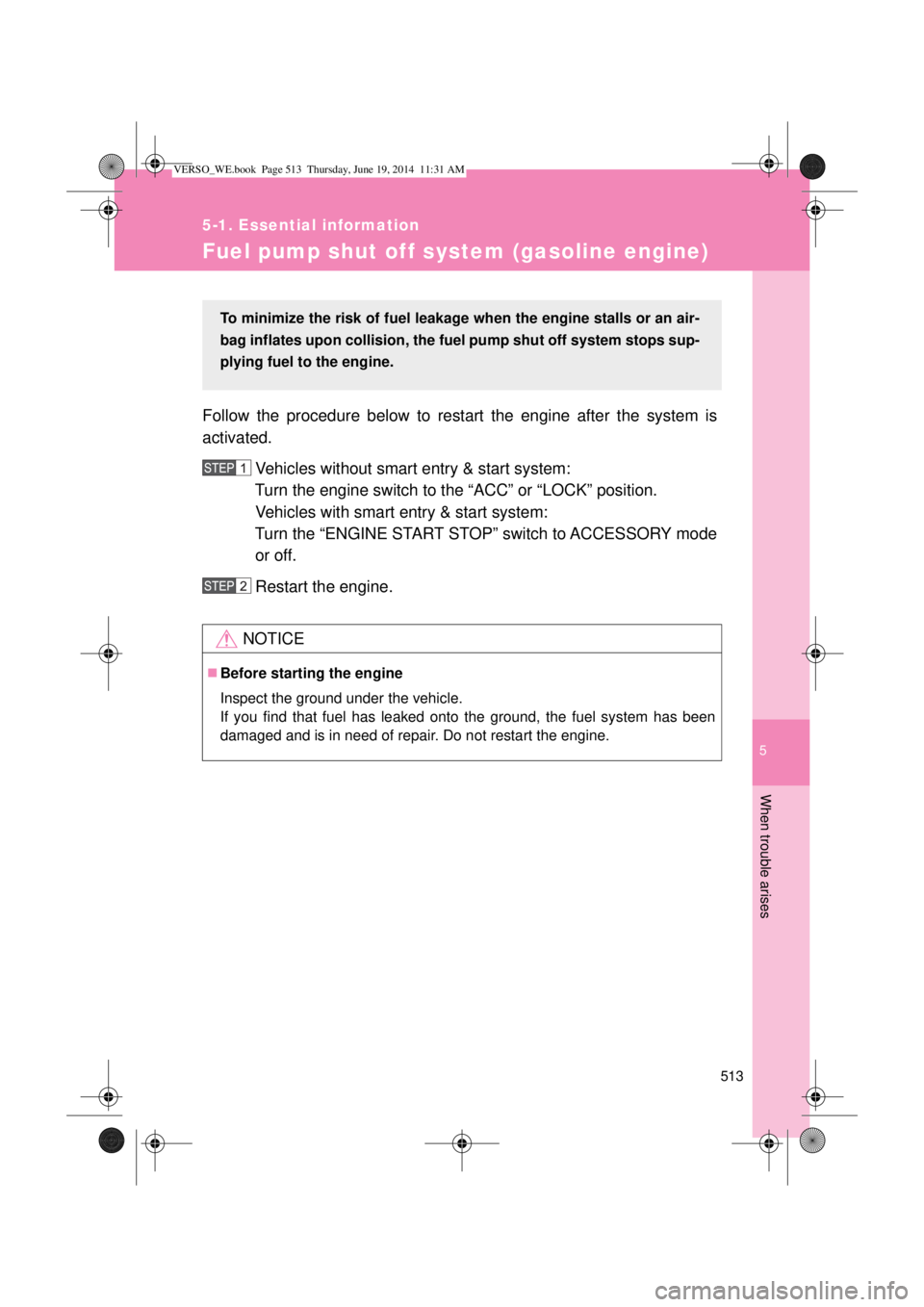
Follow the procedure below to restart the engine after the system is
activated.
Vehicles without smart entry & start system:
Turn the engine switch to the “ACC” or “LOCK” position.
Vehicles with smart entry & start system:
Turn the “ENGINE START STOP” switch to ACCESSORY mode
or off.
Restart the engine.
NOTICE
Before starting the engine
Inspect the ground under the vehicle.
If you find that fuel has leaked onto the ground, the fuel system has been
damaged and is in need of repair. Do not restart the engine.
To minimize the risk of fuel leakage when the engine stalls or an air-
bag inflates upon collision, the fuel pump shut off system stops sup-
plying fuel to the engine.
VERSO_WE.book Page 513 Thursday, June 19, 2014 11:31 AM
Page 576 of 650
576
5-2. Steps to take in an emergency
If the engine will not start
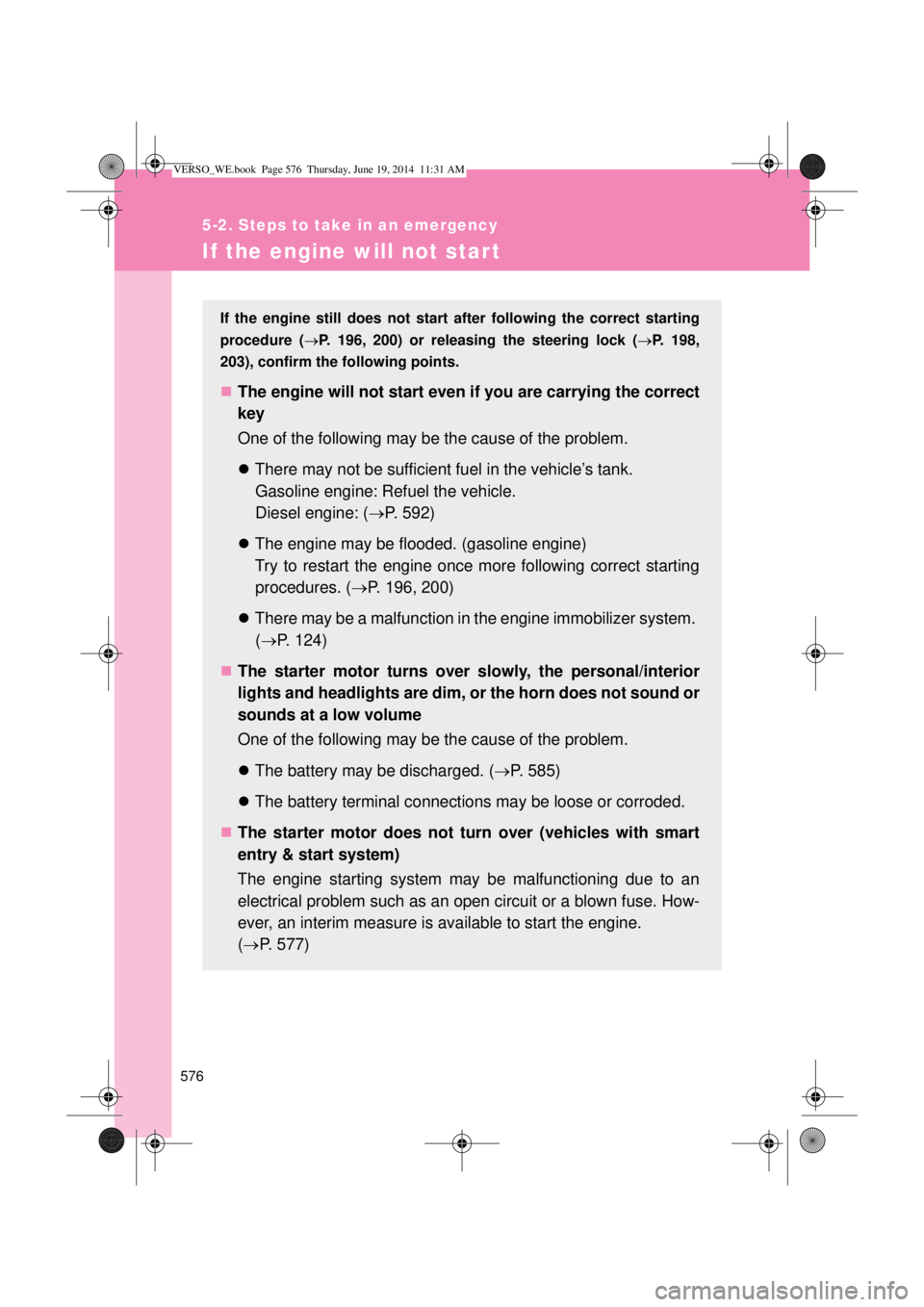
If the engine still does not start after following the correct starting
procedure (P. 196, 200) or releasing the steering lock (P. 198,
203), confirm the following points.
The engine will not start even if you are carrying the correct
key
One of the following may be the cause of the problem.
There may not be sufficient fuel in the vehicle’s tank.
Gasoline engine: Refuel the vehicle.
Diesel engine: (P. 592)
The engine may be flooded. (gasoline engine)
Try to restart the engine once more following correct starting
procedures. (P. 196, 200)
There may be a malfunction in the engine immobilizer system.
(P. 124)
The starter motor turns over slowly, the personal/interior
lights and headlights are dim, or the horn does not sound or
sounds at a low volume
One of the following may be the cause of the problem.
The battery may be discharged. (P. 585)
The battery terminal connections may be loose or corroded.
The starter motor does not turn over (vehicles with smart
entry & start system)
The engine starting system may be malfunctioning due to an
electrical problem such as an open circuit or a blown fuse. How-
ever, an interim measure is available to start the engine.
(P. 577)
VERSO_WE.book Page 576 Thursday, June 19, 2014 11:31 AM
Page 583 of 650
5
583 5-2. Steps to take in an emergency
When trouble arises
Starting the engine
Vehicles with a Multidrive or an automatic transmission: Shift
the shift lever to “P” and apply the brakes.
Vehicles with a manual transmission: Shift the shift lever to
“N” and depress the clutch pedal.
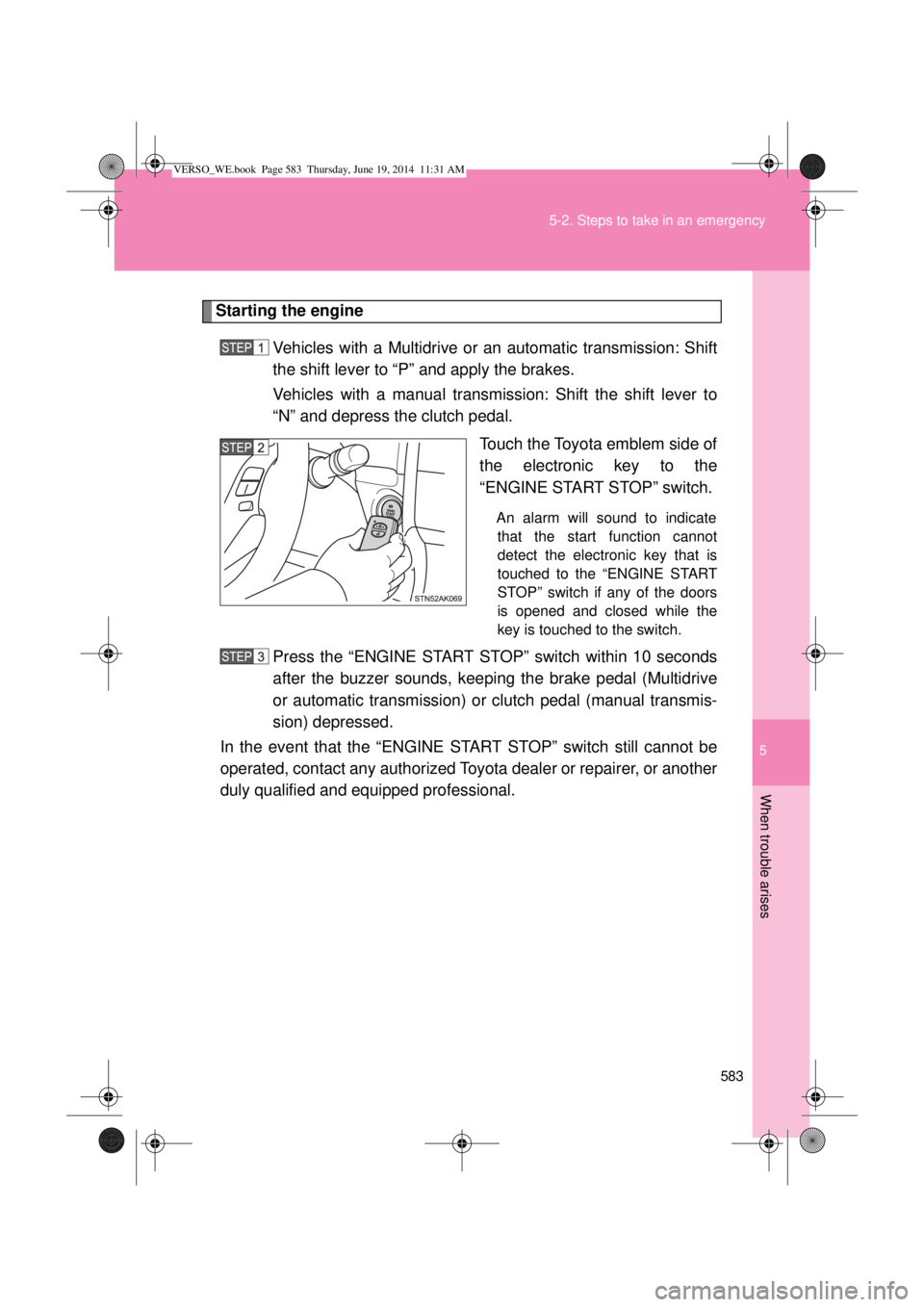
Touch the Toyota emblem side of
the electronic key to the
“ENGINE START STOP” switch.
An alarm will sound to indicate
that the start function cannot
detect the electronic key that is
touched to the “ENGINE START
STOP” switch if any of the doors
is opened and closed while the
key is touched to the switch.
Press the “ENGINE START STOP” switch within 10 seconds
after the buzzer sounds, keeping the brake pedal (Multidrive
or automatic transmission) or clutch pedal (manual transmis-
sion) depressed.
In the event that the “ENGINE START STOP” switch still cannot be
operated, contact any authorized Toyota dealer or repairer, or another
duly qualified and equipped professional.
VERSO_WE.book Page 583 Thursday, June 19, 2014 11:31 AM
Page 586 of 650
586 5-2. Steps to take in an emergency
Starting the engine when the battery is discharged (vehicles with a
Multidrive or an automatic transmission)
The engine cannot be started by push-starting.
Avoiding a discharged battery
Turn off the headlights and the audio system while the engine is turned
off.
Turn off any unnecessary electrical components when the vehicle is run-
ning at a low speed for an extended period, such as in heavy traffic, etc.
Charging the battery
The electricity stored in the battery will discharge gradually even when the
vehicle is not in use, due to natural discharge and the draining effects of cer-
tain electrical appliances. If the vehicle is left for a long time, the battery may
discharge, and the engine may be unable to start. (The battery recharges
automatically during driving.)
When the battery is removed or discharged (vehicles with alarm)
Make sure that the key is not inside the vehicle when recharging or replacing
the battery. The key may be locked in the vehicle if the alarm is activated.
(P. 139)
Vehicles without smart entry & start system: Maintain the
engine speed of the second vehicle and turn the engine
switch to the “ON” position, then start the vehicle’s engine.
Vehicles with smart entry & start system: Maintain the
engine speed of the second vehicle and turn the “ENGINE
START STOP” switch to IGNITION ON mode, then start the
vehicle’s engine.
Once the vehicle’s engine has started, remove the jumper
cables in the exact reverse order in which they were con-
nected.
Once the engine starts, have the vehicle checked at any autho-
rized Toyota dealer or repairer, or another duly qualified and
equipped professional, as soon as possible.
VERSO_WE.book Page 586 Thursday, June 19, 2014 11:31 AM