Power on TOYOTA VERSO 2014 Repair Manual
[x] Cancel search | Manufacturer: TOYOTA, Model Year: 2014, Model line: VERSO, Model: TOYOTA VERSO 2014Pages: 650, PDF Size: 36.61 MB
Page 556 of 650
556 5-2. Steps to take in an emergency
Before performing emergency repair
Check the degree of the tire
damage.
• Do not remove the nail or
screw from the tire. Removing
the object may widen the
opening and prevent emer-
gency repair with the repair kit.
• Type A: To avoid sealant leak-
age, move the vehicle until the
area of the puncture, if known,
is positioned at the top of the
tire.
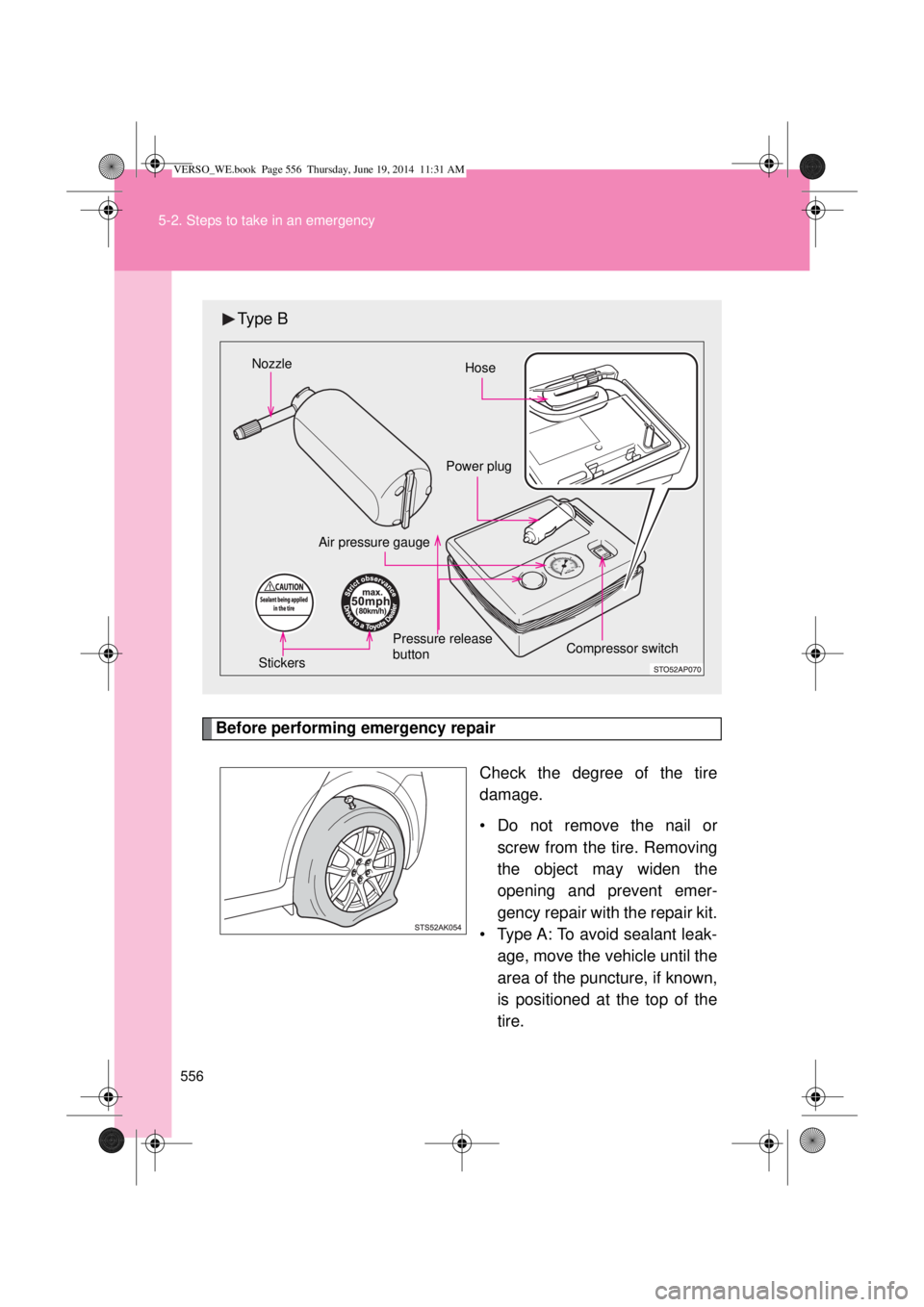
Type B
Power plug
Compressor switch
Air pressure gauge
HoseNozzle
Stickers
Pressure release
button
VERSO_WE.book Page 556 Thursday, June 19, 2014 11:31 AM
Page 560 of 650
560 5-2. Steps to take in an emergency
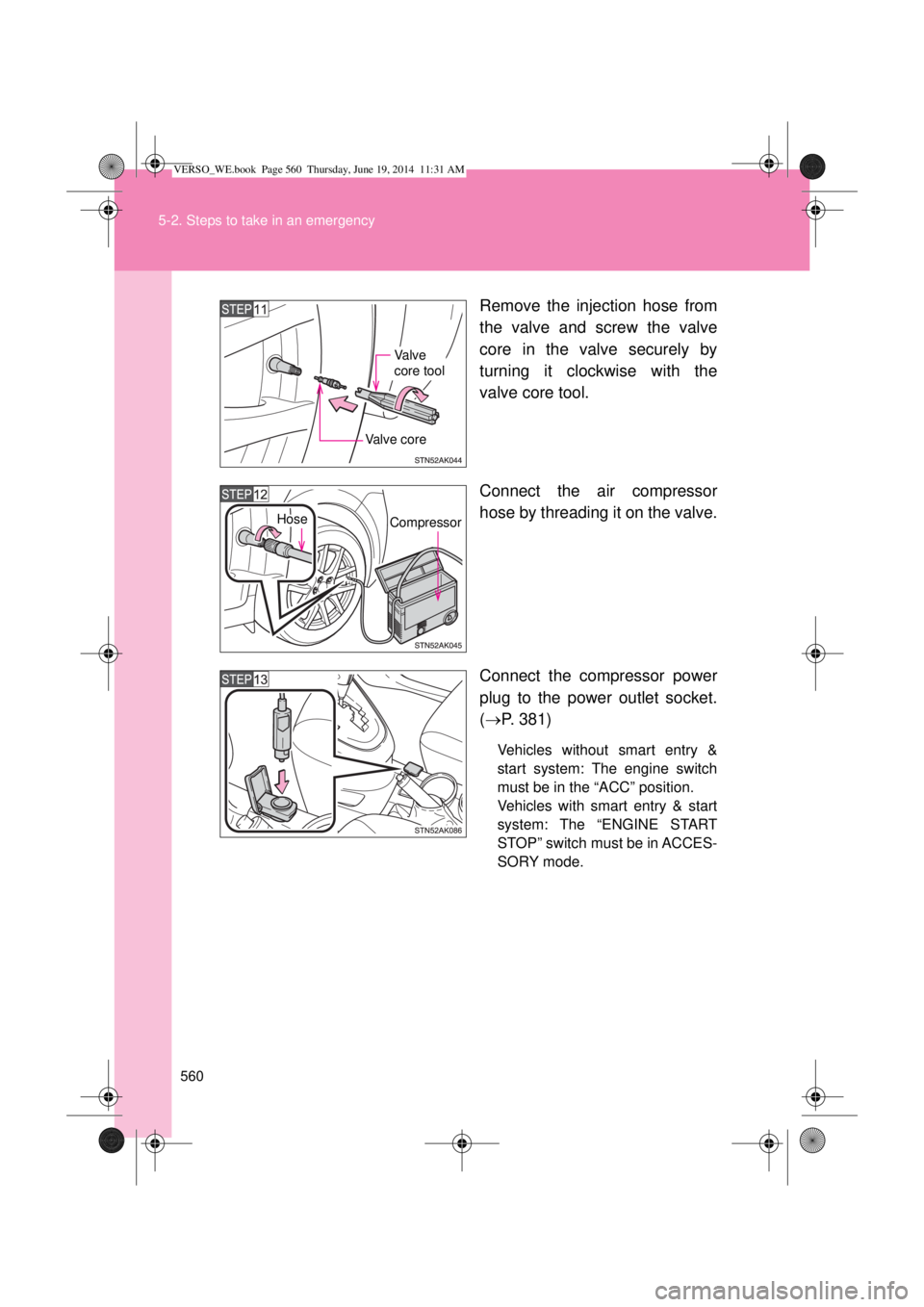
Remove the injection hose from
the valve and screw the valve
core in the valve securely by
turning it clockwise with the
valve core tool.
Connect the air compressor
hose by threading it on the valve.
Connect the compressor power
plug to the power outlet socket.
(P. 381)
Vehicles without smart entry &
start system: The engine switch
must be in the “ACC” position.
Vehicles with smart entry & start
system: The “ENGINE START
STOP” switch must be in ACCES-
SORY mode.
Valve core
Valve
core tool
CompressorHose
VERSO_WE.book Page 560 Thursday, June 19, 2014 11:31 AM
Page 562 of 650
562 5-2. Steps to take in an emergency
Turn the switch off when the pressure gauge connected to the
hose reads the specified pressure.
If the inflation pressure is not attained within 5 minutes, emergency
repair is not possible due to severe damage. Contact any authorized
Toyota dealer or repairer, or another duly qualified and equipped pro-
fessional.
After completely filling the tire with air, disconnect the hose
from the valve on the tire.
Pull the power plug of the compressor out of the power outlet
on the vehicle.
To spread the liquid sealant evenly in the tire, immediately
drive for about 5 km (3 miles) or 10 minutes.
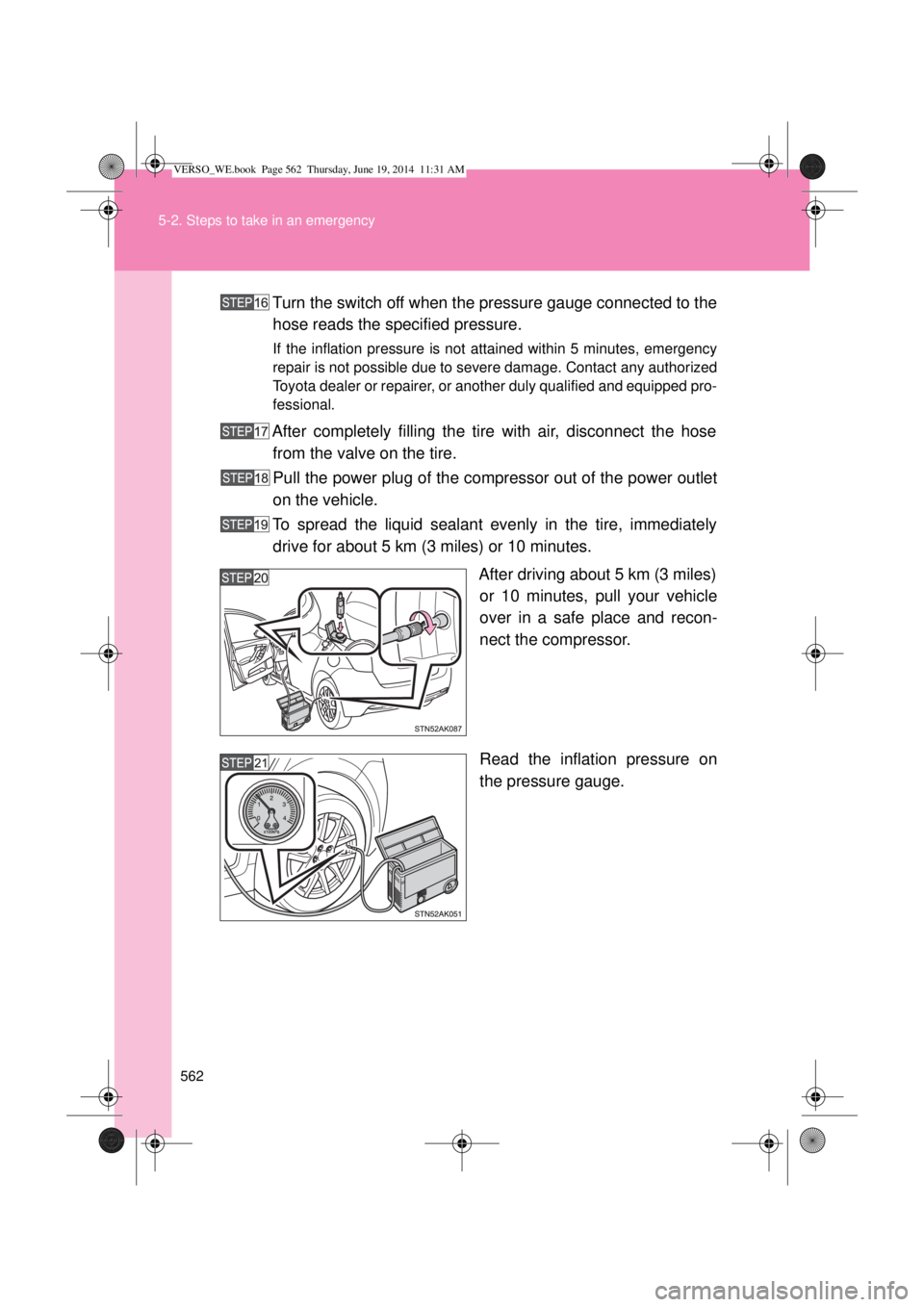
After driving about 5 km (3 miles)
or 10 minutes, pull your vehicle
over in a safe place and recon-
nect the compressor.
Read the inflation pressure on
the pressure gauge.
VERSO_WE.book Page 562 Thursday, June 19, 2014 11:31 AM
Page 566 of 650
566 5-2. Steps to take in an emergency
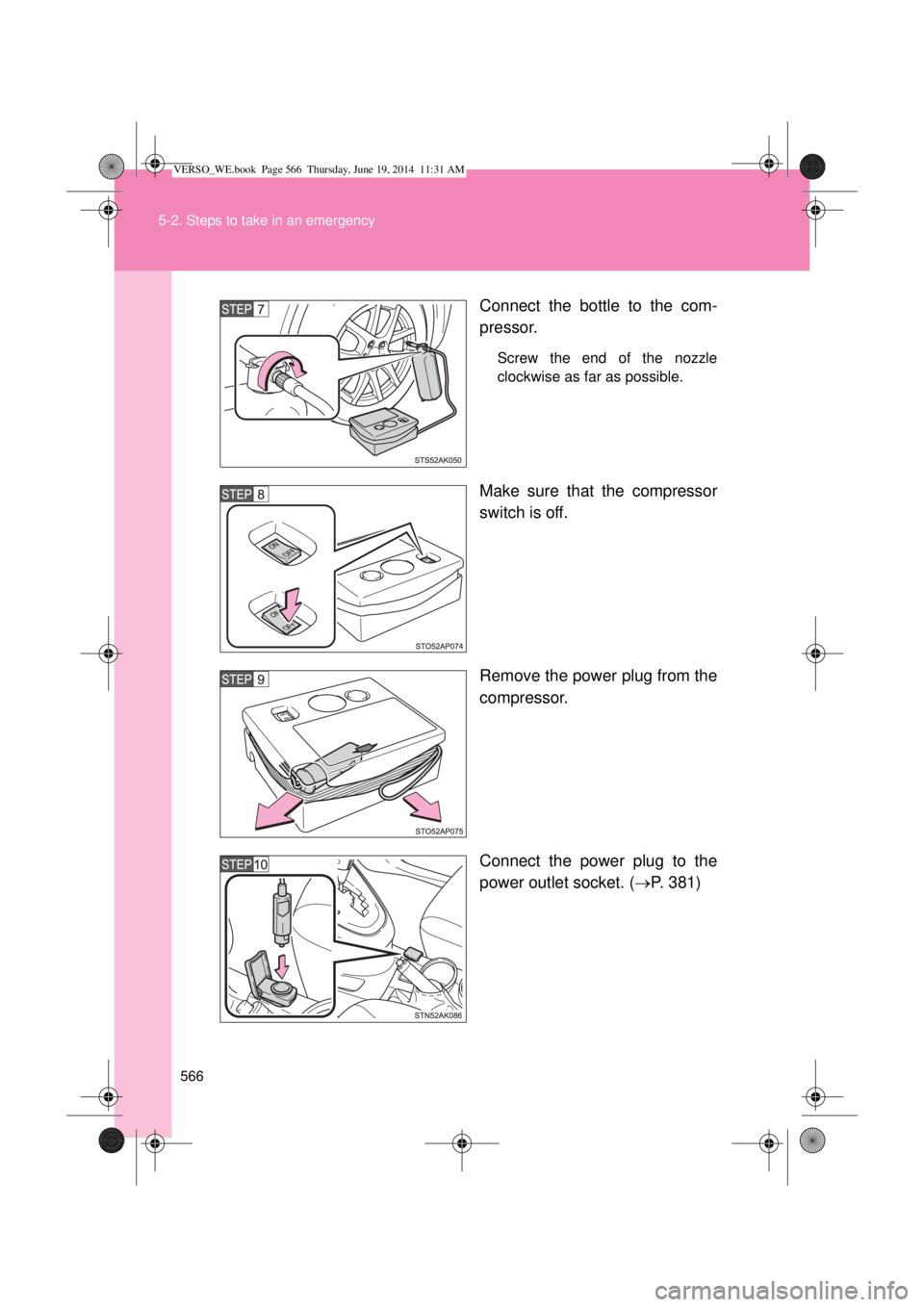
Connect the bottle to the com-
pressor.
Screw the end of the nozzle
clockwise as far as possible.
Make sure that the compressor
switch is off.
Remove the power plug from the
compressor.
Connect the power plug to the
power outlet socket. (P. 381)
VERSO_WE.book Page 566 Thursday, June 19, 2014 11:31 AM
Page 569 of 650

5
569 5-2. Steps to take in an emergency
When trouble arises
Disconnect the nozzle from the valve on the tire and then pull
out the power plug from the power outlet socket.
Some sealant may leak when the hose is removed.
Install the valve cap onto the valve of the repaired tire.
Disconnect the hose from the
bottle and attach the cap to the
bottle.
Place the bottle in the original bag
and zip it.
Temporarily store the bottle and compressor in the luggage
compartment.
To spread the liquid sealant evenly within the tire, immediately
drive safely for about 5 km (3 miles) below 80 km/h (50 mph).
After driving for about 5 km (3
miles), stop your vehicle in a
safe place on a hard, flat surface
and connect the compressor.
VERSO_WE.book Page 569 Thursday, June 19, 2014 11:31 AM
Page 575 of 650
5
575 5-2. Steps to take in an emergency
When trouble arises
NOTICE
When performing an emergency repair
A tire should only be repaired with the emergency tire puncture repair kit if
the damage is caused by a sharp object such as nail or screw passing
through the tire tread.
Do not remove the sharp object from the tire. Removing the object may
widen the opening and disenable emergency repair with the repair kit.
The repair kit is not waterproof. Make sure that the repair kit is not
exposed to water, such as when it is being used in the rain.
Do not put the repair kit directly onto dusty ground such as sand at the
side of the road. If the repair kit vacuums up dust etc., a malfunction may
occur.
Precautions for the emergency tire puncture repair kit
The repair kit power source should be 12 V DC suitable for vehicle use. Do
not connect the repair kit to any other source.
If gasoline splatters on the repair kit, the repair kit may deteriorate. Take
care not to allow gasoline to contact it.
Place the repair kit in a storage to prevent it from being exposed to dirt or
water.
Store the repair kit in the luggage room out of reach of children.
Do not disassemble or modify the repair kit. Do not subject parts such as
the air pressure indicator to impacts. This may cause a malfunction.
To avoid damage to the tire pressure warning valves and transmitters
(vehicles with the tire pressure warning system)
When a tire is repaired with liquid sealants, the tire pressure warning valve
and transmitter may not operate properly. If a liquid sealant is used, contact
any authorized Toyota dealer or repairer, or another duly qualified and
equipped professional or other qualified service shop as soon as possible.
Make sure to replace the tire pressure warning valve and transmitter when
replacing the tire. (P. 444)
VERSO_WE.book Page 575 Thursday, June 19, 2014 11:31 AM
Page 589 of 650
5
589
5-2. Steps to take in an emergency
When trouble arises
If your vehicle overheats
Correction procedures
Stop the vehicle in a safe place and turn off the air condition-
ing system, and then stop the engine.
If you see steam:
Carefully lift the hood after the steam subsides.
If you do not see steam:
Carefully lift the hood.
After the engine has cooled down sufficiently, inspect the
hoses and radiator core (radiator) for any leaks.
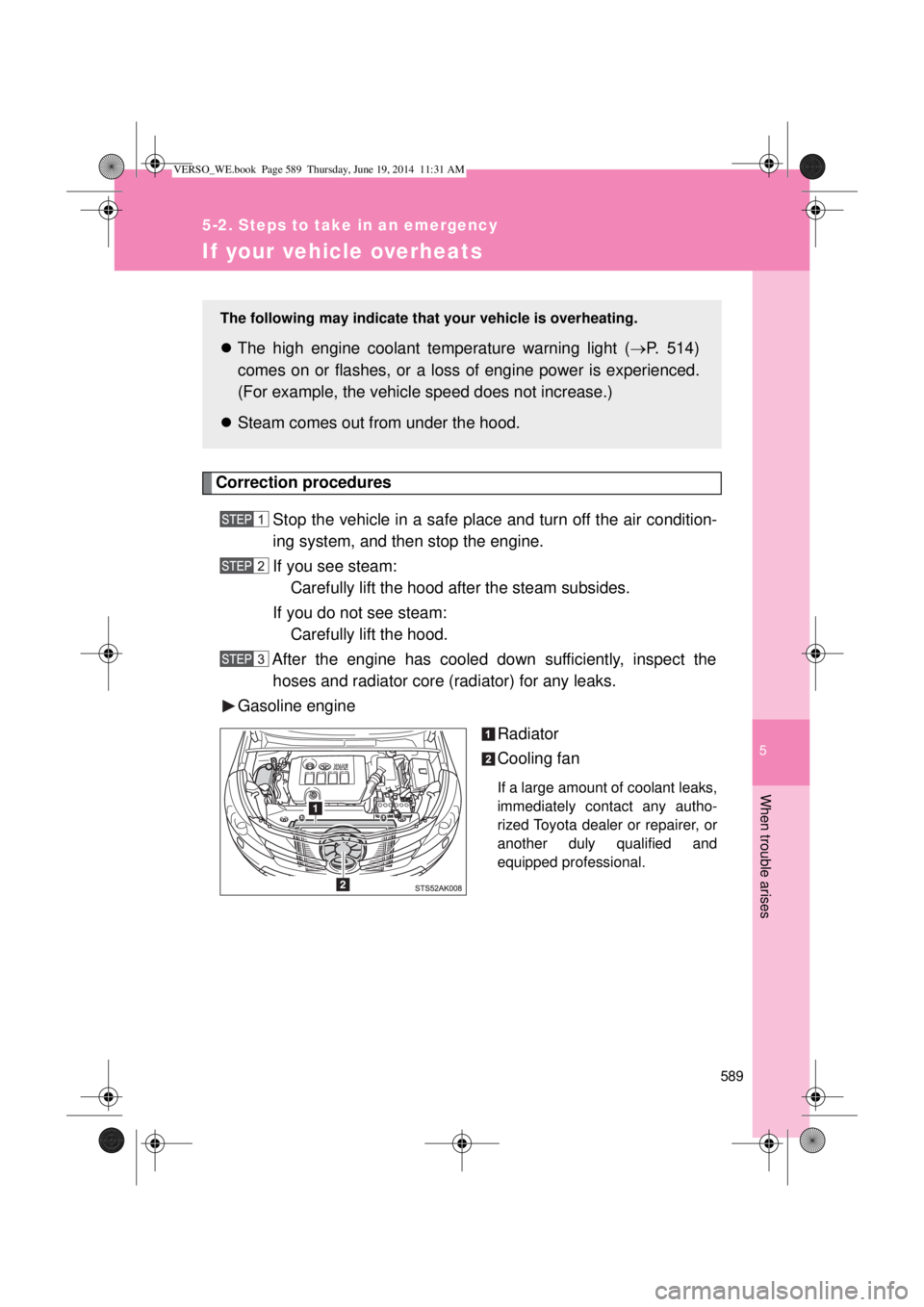
Gasoline engine
Radiator
Cooling fan
If a large amount of coolant leaks,
immediately contact any autho-
rized Toyota dealer or repairer, or
another duly qualified and
equipped professional.
The following may indicate that your vehicle is overheating.
The high engine coolant temperature warning light (P. 514)
comes on or flashes, or a loss of engine power is experienced.
(For example, the vehicle speed does not increase.)
Steam comes out from under the hood.
VERSO_WE.book Page 589 Thursday, June 19, 2014 11:31 AM
Page 596 of 650
596 5-2. Steps to take in an emergency
CAUTION
If the engine has to be turned off while driving
Power assist for the brakes and steering wheel will be lost, making the
brake pedal harder to depress and the steering wheel heavier to turn.
Decelerate as much as possible before turning off the engine.
Vehicles without smart entry & start system: Never attempt to remove the
key, as doing so will lock the steering wheel.
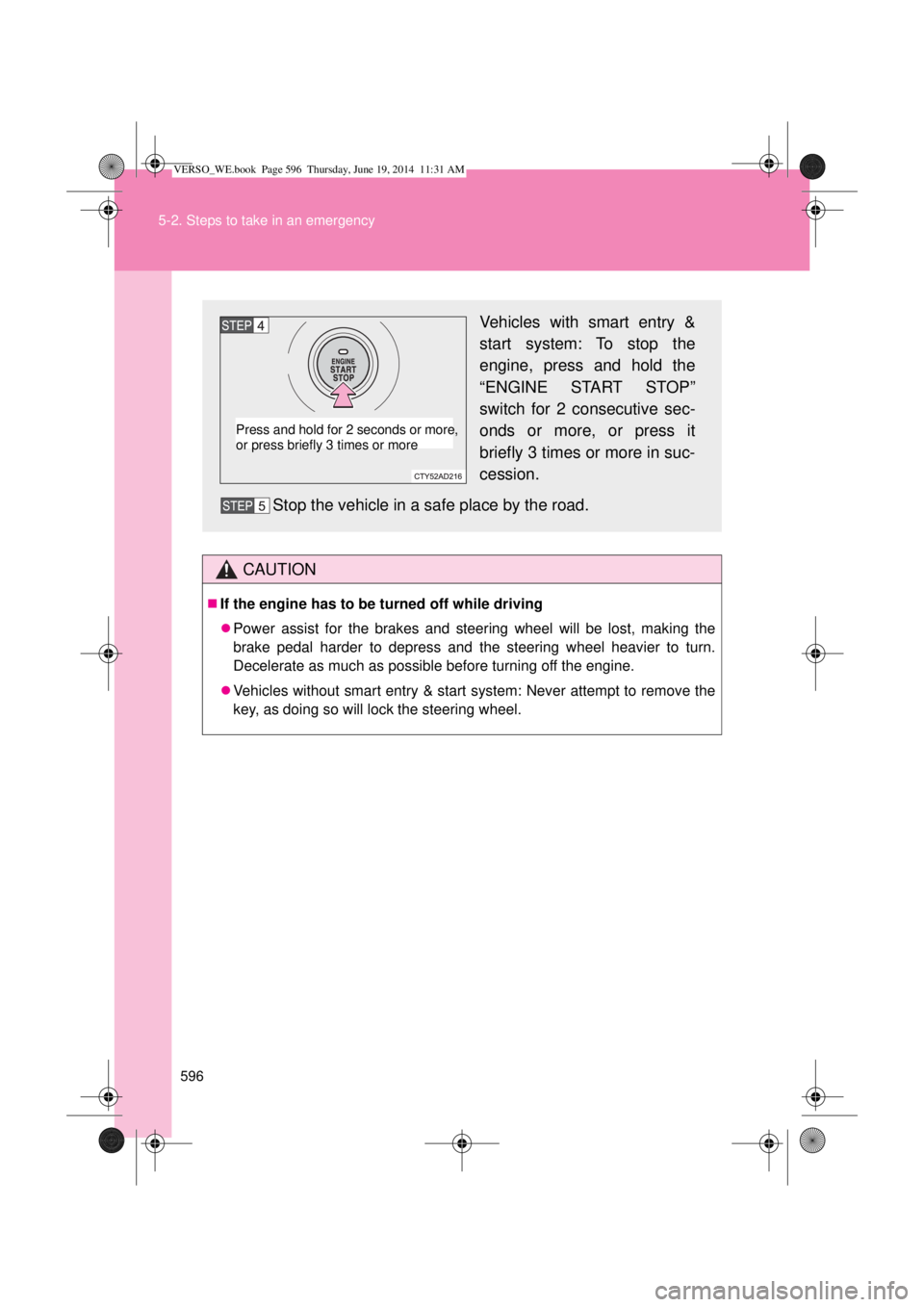
Vehicles with smart entry &
start system: To stop the
engine, press and hold the
“ENGINE START STOP”
switch for 2 consecutive sec-
onds or more, or press it
briefly 3 times or more in suc-
cession.
Stop the vehicle in a safe place by the road.
Press and hold for 2 seconds or more,
or press briefly 3 times or more
VERSO_WE.book Page 596 Thursday, June 19, 2014 11:31 AM
Page 615 of 650
615 6-1. Specifications
6
Vehicle specifications
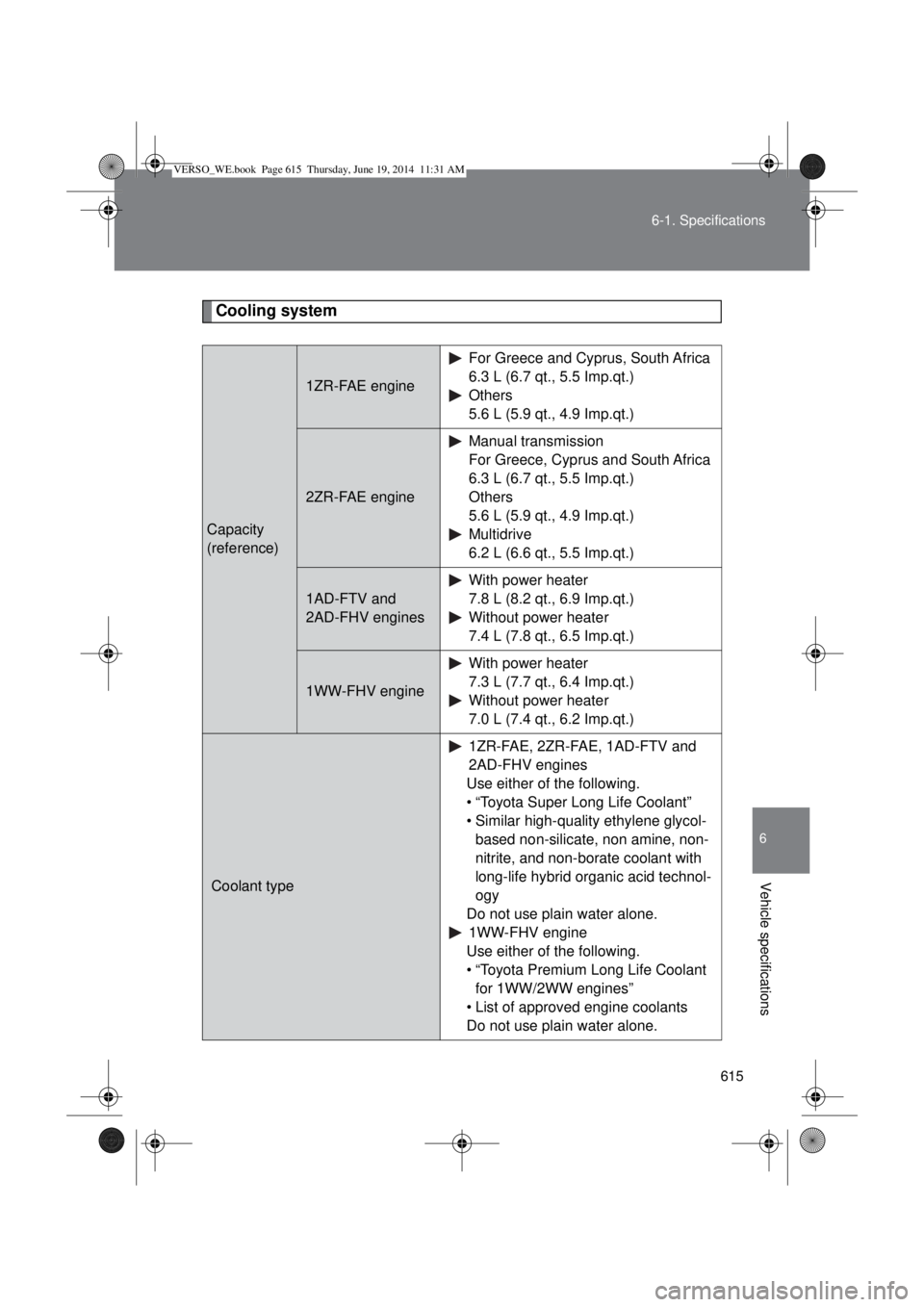
Cooling system
Capacity
(reference)
1ZR-FAE engine
For Greece and Cyprus, South Africa
6.3 L (6.7 qt., 5.5 Imp.qt.)
Others
5.6 L (5.9 qt., 4.9 Imp.qt.)
2ZR-FAE engine
Manual transmission
For Greece, Cyprus and South Africa
6.3 L (6.7 qt., 5.5 Imp.qt.)
Others
5.6 L (5.9 qt., 4.9 Imp.qt.)
Multidrive
6.2 L (6.6 qt., 5.5 Imp.qt.)
1AD-FTV and
2AD-FHV engines
With power heater
7.8 L (8.2 qt., 6.9 Imp.qt.)
Without power heater
7.4 L (7.8 qt., 6.5 Imp.qt.)
1WW-FHV engine
With power heater
7.3 L (7.7 qt., 6.4 Imp.qt.)
Without power heater
7.0 L (7.4 qt., 6.2 Imp.qt.)
Coolant type1ZR-FAE, 2ZR-FAE, 1AD-FTV and
2AD-FHV engines
Use either of the following.
• “Toyota Super Long Life Coolant”
• Similar high-quality ethylene glycol-
based non-silicate, non amine, non-
nitrite, and non-borate coolant with
long-life hybrid organic acid technol-
ogy
Do not use plain water alone.
1WW-FHV engine
Use either of the following.
• “Toyota Premium Long Life Coolant
for 1WW/2WW engines”
• List of approved engine coolants
Do not use plain water alone.
VERSO_WE.book Page 615 Thursday, June 19, 2014 11:31 AM
Page 636 of 650
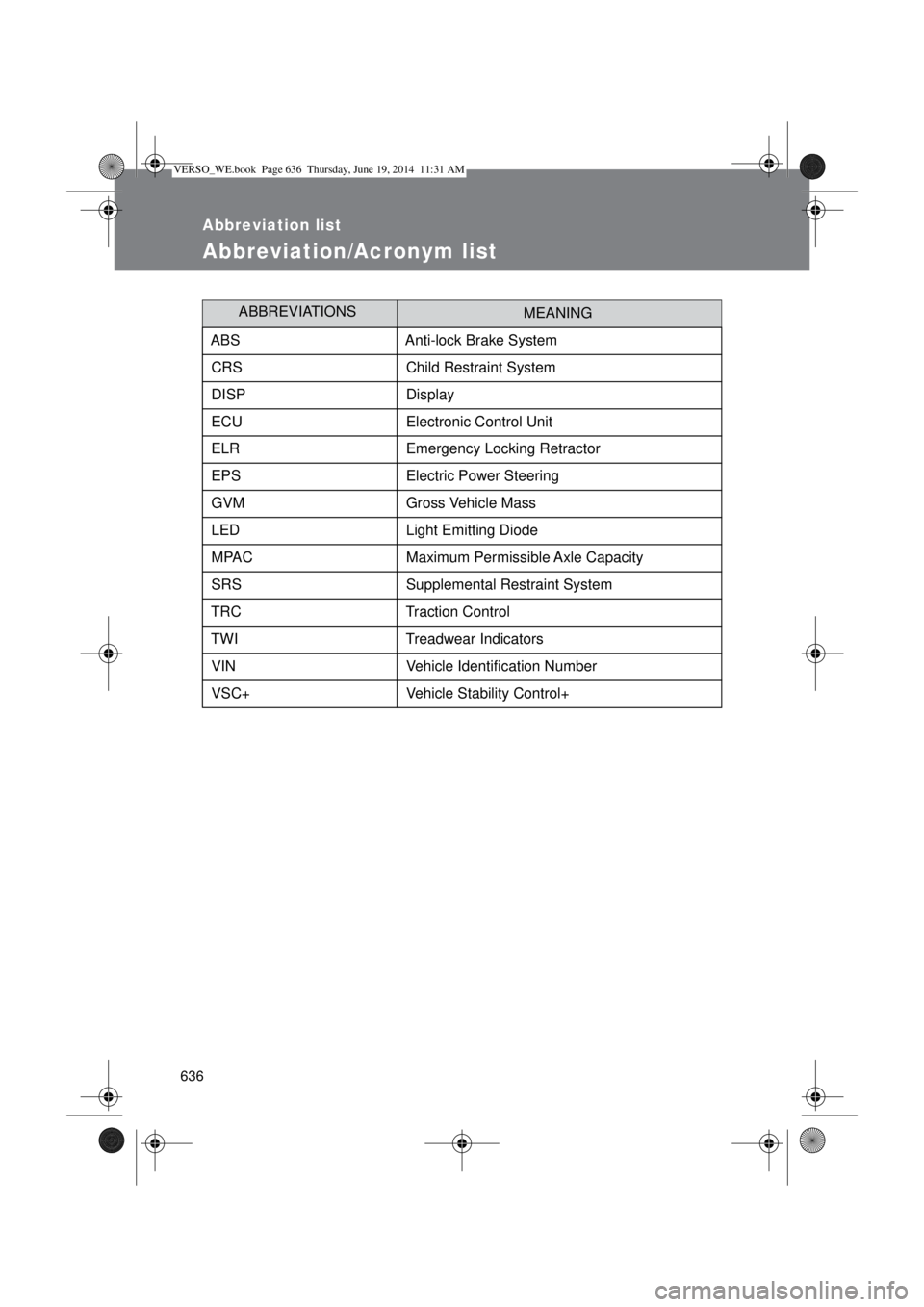
636
Abbreviation list
Abbreviation/Acronym list
ABBREVIATIONSMEANING
ABS Anti-lock Brake System
CRS Child Restraint System
DISP Display
ECU Electronic Control Unit
ELR Emergency Locking Retractor
EPS Electric Power Steering
GVM Gross Vehicle Mass
LED Light Emitting Diode
MPAC Maximum Permissible Axle Capacity
SRS Supplemental Restraint System
TRC Traction Control
TWI Treadwear Indicators
VIN Vehicle Identification Number
VSC+ Vehicle Stability Control+
VERSO_WE.book Page 636 Thursday, June 19, 2014 11:31 AM