ECU TOYOTA VERSO 2016 User Guide
[x] Cancel search | Manufacturer: TOYOTA, Model Year: 2016, Model line: VERSO, Model: TOYOTA VERSO 2016Pages: 664, PDF Size: 62.24 MB
Page 93 of 664
93
1-3. Adjustable components (seats, mirrors, steering wheel)
1
Before driving
VERSO_EE_OM64590E
WARNING
■ Seat adjustment
● Be careful not to get your hands pinched between the luggage cover and
the seat.
● To reduce the risk of sliding under the lap belt during a collision, do not
recline the seat more than necessary. If the seat is too reclined, the lap
belt may slide past the hips and apply restraint forces directly to the abdo-
men, or your neck may contact the shoulder belt, increasing the risk of
death or serious injury in the event of an accident. Adjustments should not
be made while driving as the seat may unexpectedly move and cause the
driver to lose control of the vehicle.
■ After returning the seatbacks to the upright position
Observe the following precautions. Failure to do so may result in death or
serious injury.
● Make sure the seatback is securely locked by pressing forward and rear-
ward on the top.
● Check that the seat belts are not twisted or caught in the seatback.
NOTICE
■Stowing the seat belts
The seat belts and the buckles must be stowed before you fold down the
rear seatbacks.
Page 98 of 664
98
1-3. Adjustable components (seats, mirrors, steering wheel)
VERSO_EE_OM64590E
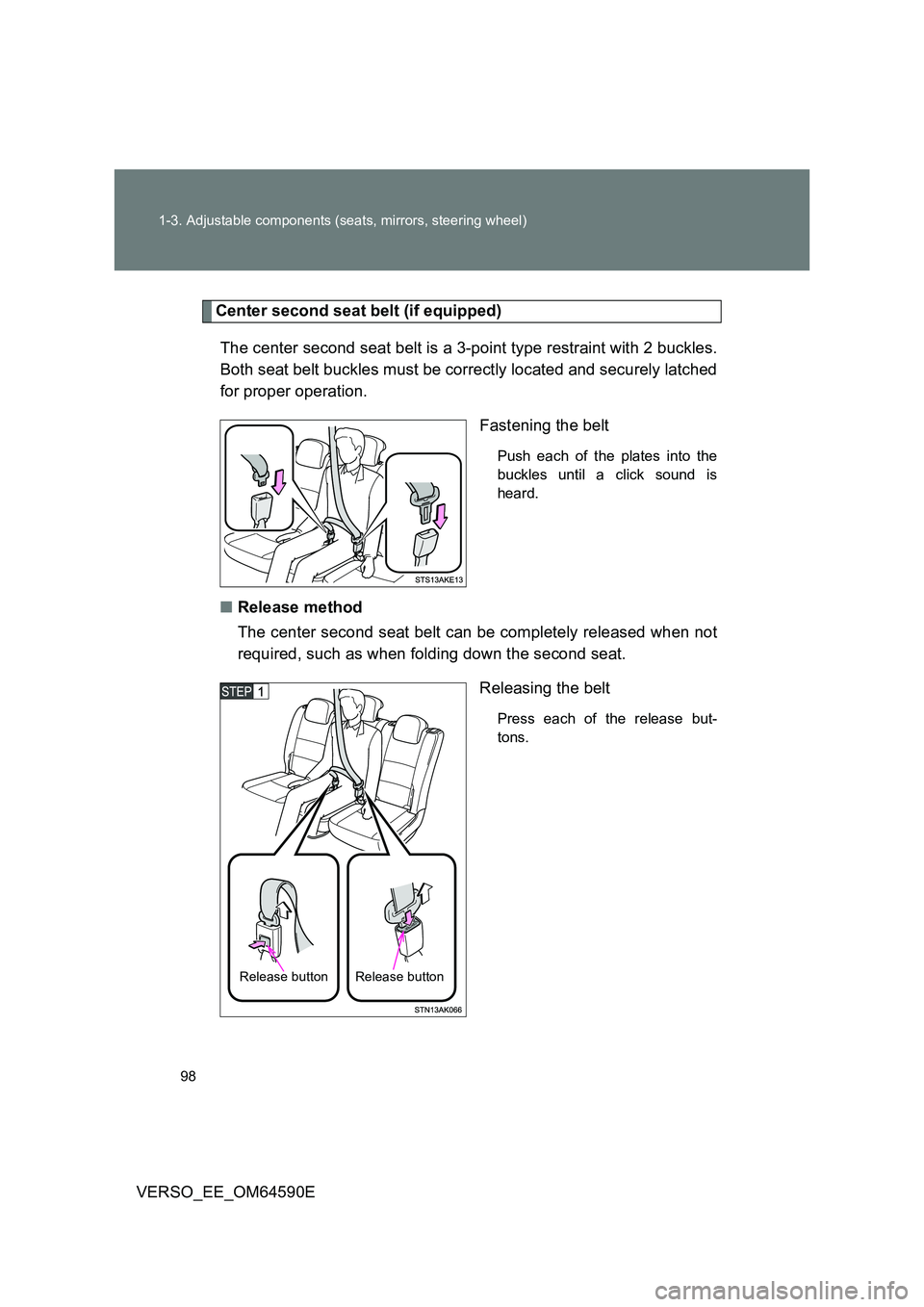
Center second seat belt (if equipped)
The center second seat belt is a 3-point type restraint with 2 buckles.
Both seat belt buckles must be correctly located and securely latched
for proper operation.
Fastening the belt
Push each of the plates into the
buckles until a click sound is
heard.
■ Release method
The center second seat belt can be completely released when not
required, such as when folding down the second seat.
Releasing the belt
Press each of the release but-
tons.
Release buttonRelease button
Page 104 of 664
104
1-3. Adjustable components (seats, mirrors, steering wheel)
VERSO_EE_OM64590E
Steering wheel
WARNING
■Caution while driving
Do not adjust the steering wheel.
Doing so may cause the driver to mishandle the vehicle and cause an acci-
dent, resulting in death or serious injury.
■ After adjusting the steering wheel
Make sure that the steering wheel is securely locked.
Otherwise, the steering wheel may move suddenly, possibly causing an
accident, and resulting in death or serious injury.
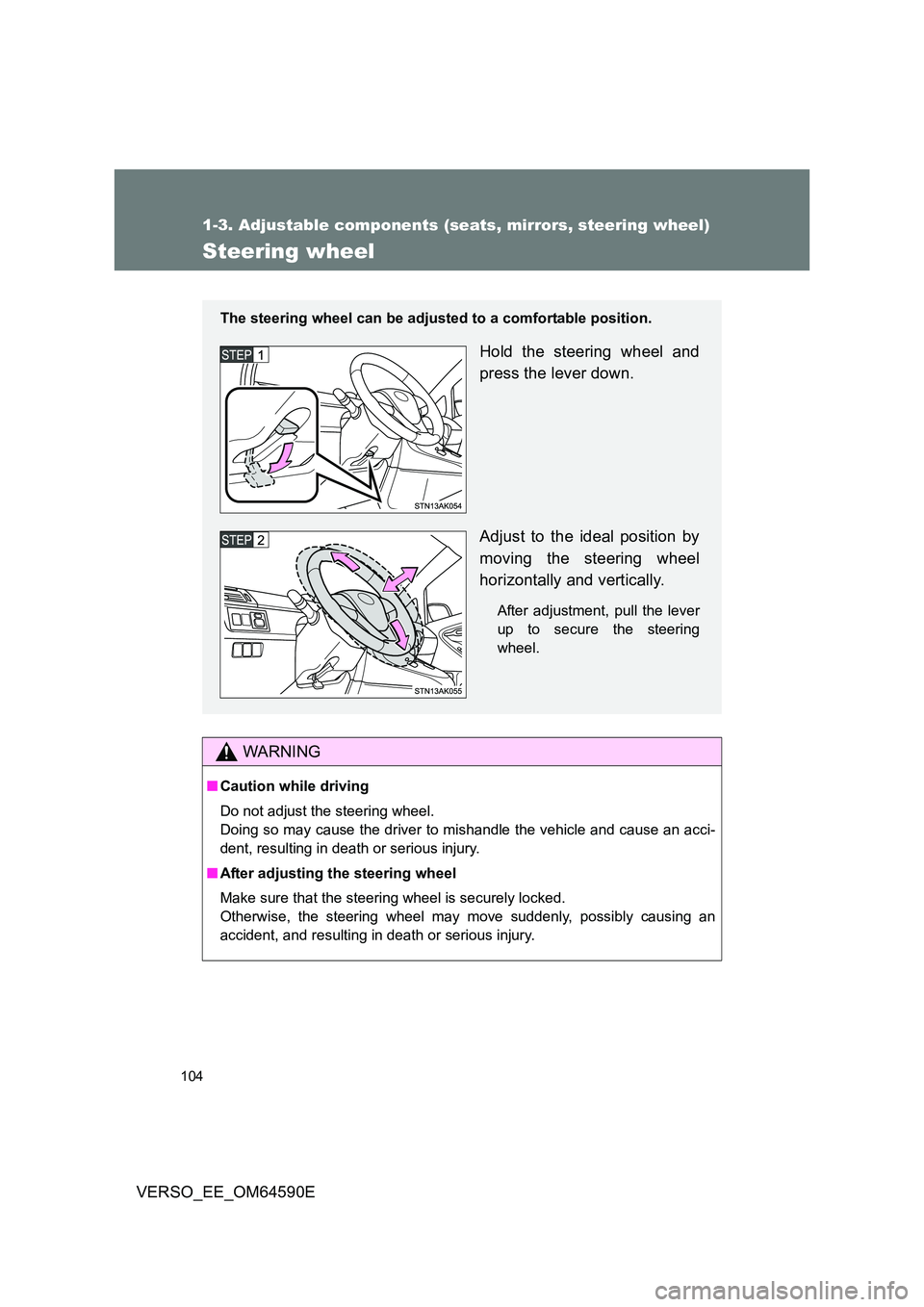
The steering wheel can be adjusted to a comfortable position.
Hold the steering wheel and
press the lever down.
Adjust to the ideal position by
moving the steering wheel
horizontally and vertically.
After adjustment, pull the lever
up to secure the steering
wheel.
Page 123 of 664
123
1-5. Refueling
1
Before driving
VERSO_EE_OM64590E
WARNING
■ When refueling
Observe the following precautions to prevent fuel overflowing from the fuel
tank:
● Securely insert the fuel nozzle into the fuel filler neck.
● Stop filling the tank after the fuel nozzle automatically clicks off.
● Do not top off the fuel tank.
■ When replacing the fuel tank cap
Do not use anything but a genuine Toyota fuel tank cap designed for your
vehicle. Doing so may cause a fire or other incident which may result in
death or serious injury.
NOTICE
■ Refueling
Do not spill fuel during refueling.
Doing so may damage the vehicle, such as causing the emission control
system to operate abnormally or damaging fuel system components or the
vehicle’s painted surface.
Page 124 of 664
124
VERSO_EE_OM64590E
1-6. Theft deterrent system
Engine immobilizer system
The vehicle’s keys have built-in transponder chips that prevent the
engine from starting if the key has not been previously registered in
the vehicle’s on-board computer.
Never leave the keys inside the vehicle when you leave the vehicle.
This system is designed to help prevent vehicle theft but does not
guarantee absolute security against all vehicle thefts.
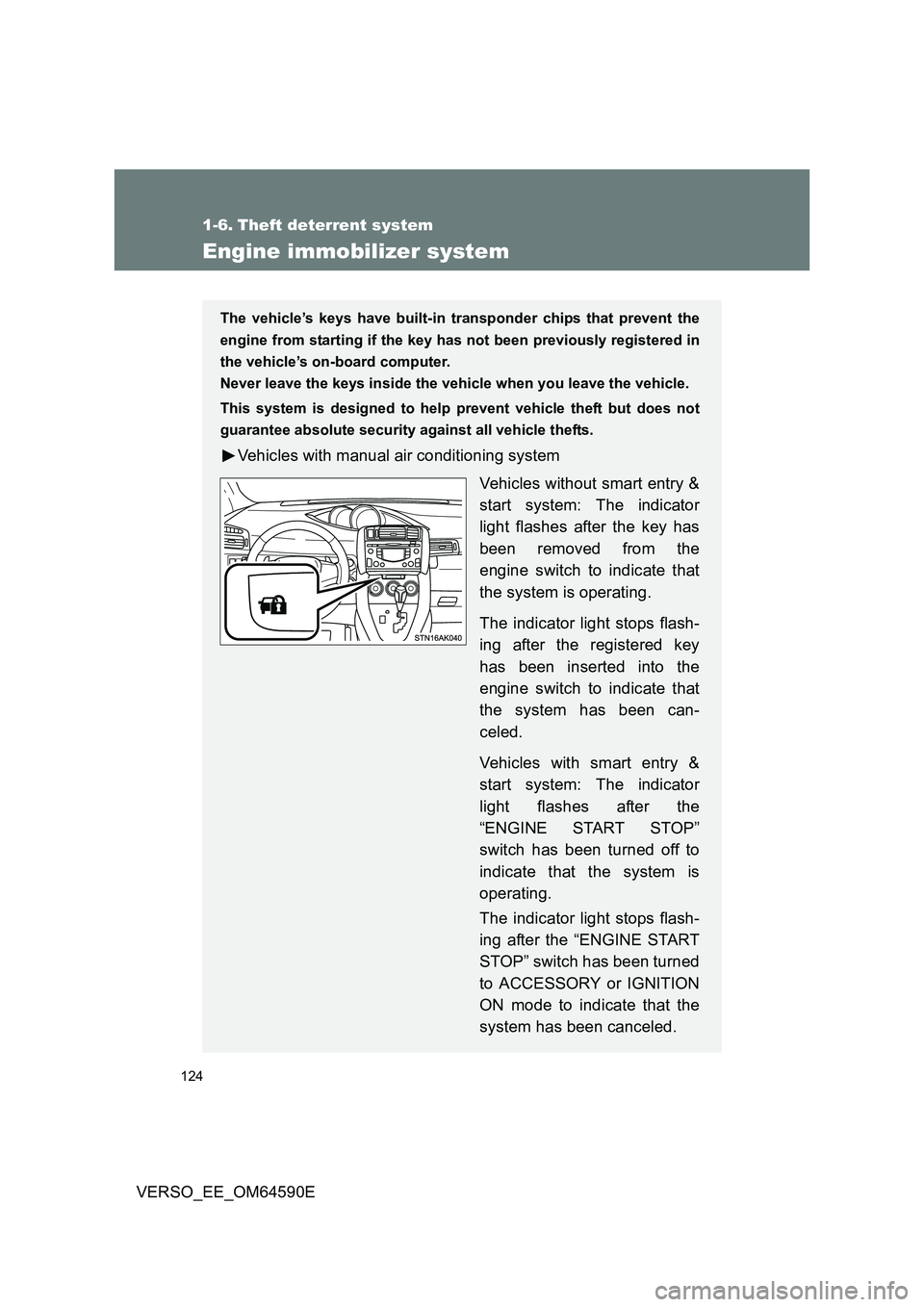
Vehicles with manual air conditioning system
Vehicles without smart entry &
start system: The indicator
light flashes after the key has
been removed from the
engine switch to indicate that
the system is operating.
The indicator light stops flash-
ing after the registered key
has been inserted into the
engine switch to indicate that
the system has been can-
celed.
Vehicles with smart entry &
start system: The indicator
light flashes after the
“ENGINE START STOP”
switch has been turned off to
indicate that the system is
operating.
The indicator light stops flash-
ing after the “ENGINE START
STOP” switch has been turned
to ACCESSORY or IGNITION
ON mode to indicate that the
system has been canceled.
Page 126 of 664
126
1-6. Theft deterrent system
VERSO_EE_OM64590E
■ System maintenance
The vehicle has a maintenance-free type engine immobilizer system.
■ Conditions that may cause the system to malfunction
● If the grip portion of the key is in contact with a metallic object
● If the key is in close proximity to or touching a key to the security system
(key with a built-in transponder chip) of another vehicle
Page 139 of 664
139
1-6. Theft deterrent system
1
Before driving
VERSO_EE_OM64590E
Intrusion sensor (if equipped)
The intrusion sensor detects an intruder or movement in the vehicle.
The intrusion sensor can be canceled using the cancel switch.
This system is designed to deter and prevent vehicle theft but does
not guarantee absolute security against all intrusions.
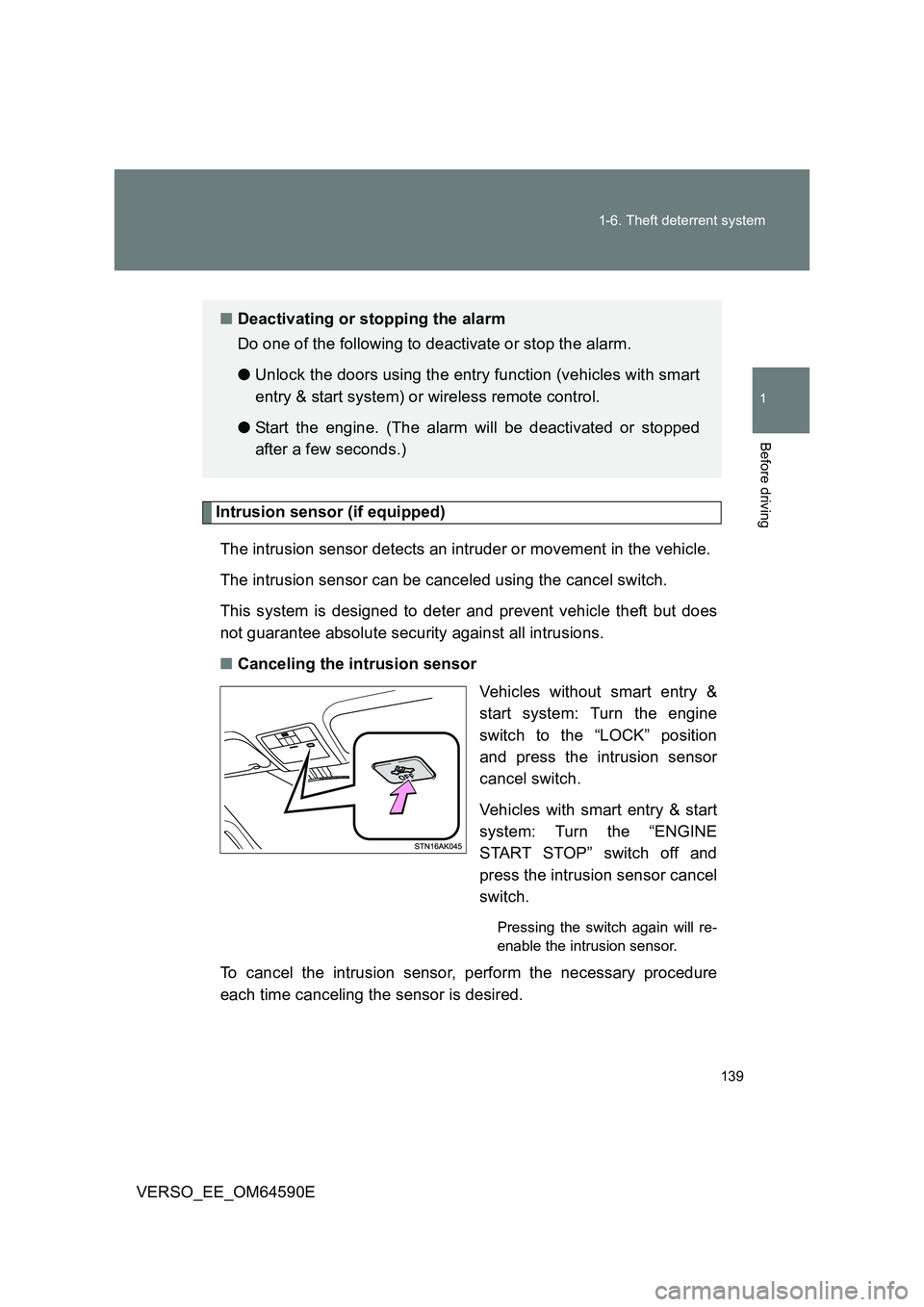
■ Canceling the intrusion sensor
Vehicles without smart entry &
start system: Turn the engine
switch to the “LOCK” position
and press the intrusion sensor
cancel switch.
Vehicles with smart entry & start
system: Turn the “ENGINE
START STOP” switch off and
press the intrusion sensor cancel
switch.
Pressing the switch again will re-
enable the intrusion sensor.
To cancel the intrusion sensor, perform the necessary procedure
each time canceling the sensor is desired.
■ Deactivating or stopping the alarm
Do one of the following to deactivate or stop the alarm.
● Unlock the doors using the entry function (vehicles with smart
entry & start system) or wireless remote control.
● Start the engine. (The alarm will be deactivated or stopped
after a few seconds.)
Page 155 of 664
155
1-7. Safety information
1
Before driving
VERSO_EE_OM64590E
WARNING
■ SRS airbag precautions
● The SRS front passenger airbag also deploys with considerable force, and
can cause death or serious injury especially if the front passenger is very
close to the airbag. The front passenger seat should be as far from the
airbag as possible with the seatback adjusted, so the front passenger sits
upright.
● Improperly seated and/or restrained infants and children can be killed or
seriously injured by a deploying airbag. An infant or child who is too small
to use a seat belt should be properly secured using a child restraint sys-
tem. Toyota strongly recommends that all infants and children be placed in
the rear seats of the vehicle and proper ly restrained. The rear seats are
safest for infants and children than the front passenger seat. ( P. 159)
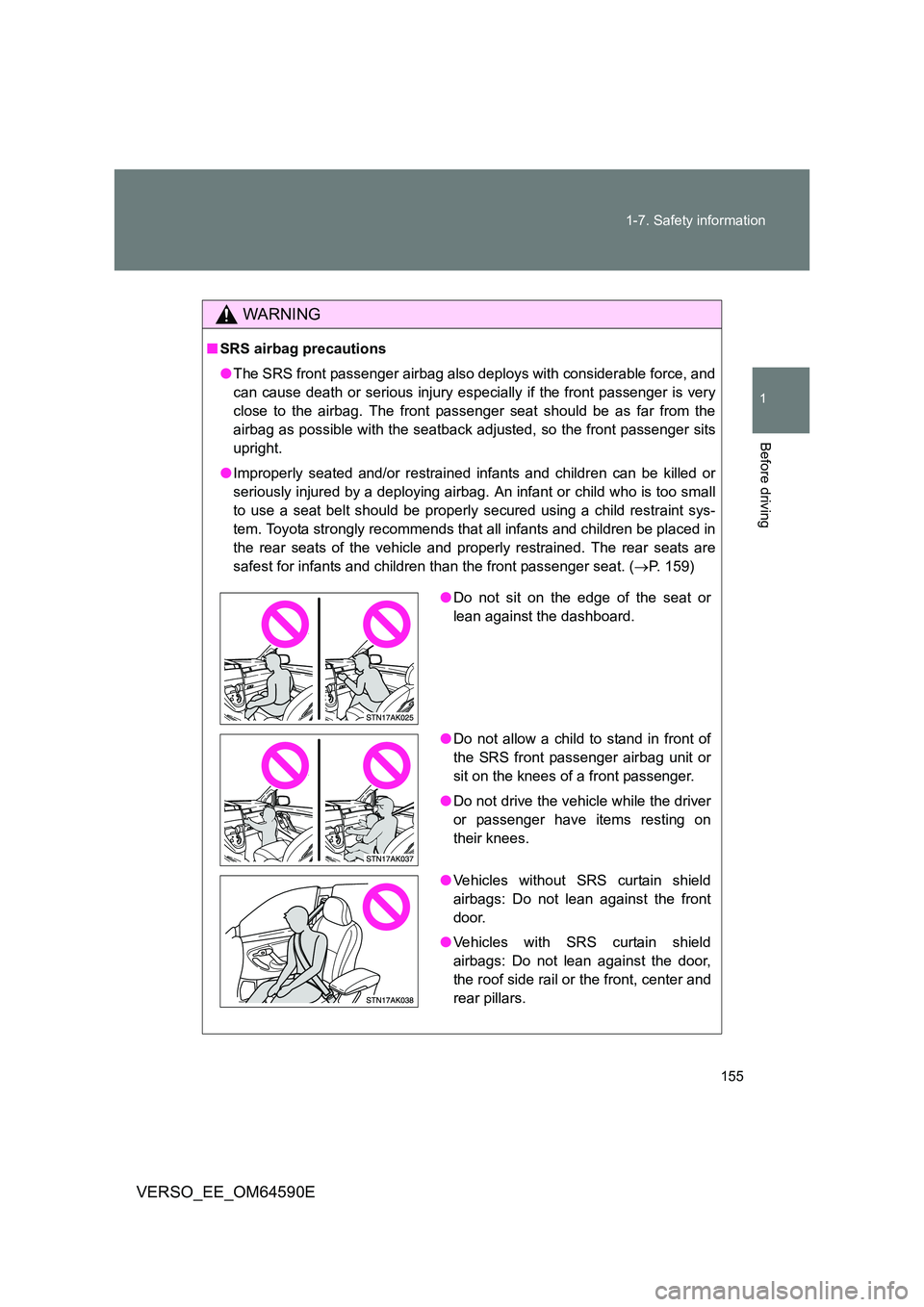
●Do not sit on the edge of the seat or
lean against the dashboard.
● Do not allow a child to stand in front of
the SRS front passenger airbag unit or
sit on the knees of a front passenger.
● Do not drive the vehicle while the driver
or passenger have items resting on
their knees.
● Vehicles without SRS curtain shield
airbags: Do not lean against the front
door.
● Vehicles with SRS curtain shield
airbags: Do not lean against the door,
the roof side rail or the front, center and
rear pillars.
Page 159 of 664
159
1
1-7. Safety information
Before driving
VERSO_EE_OM64590E
Child restraint systems
Points to remember
Studies have shown that installing a child restraint system on a rear
seat is much safer than installing one on the front passenger seat.
● Choose a child restraint system that suits your vehicle and is
appropriate to the age and size of the child.
● For installation details, follow the instructions provided with the
child restraint system.
General installation instructions are provided in this manual.
( P. 167)
● If child restraint system regulations exist in the country where you
reside, please contact your Toyota dealer or repairer, or another
duly qualified and equipped professional for the child restraint sys-
tem installation.
● Toyota recommends that you use a child restraint system which
conforms to the regulation “ECE No.44”.
Types of child restraints
Child restraint systems are classified into the following 5 groups
according to the regulation “ECE No.44”.
Group 0: Up to 10 kg (22 lb.) (0 - 9 months)
Group 0+: Up to 13 kg (28 lb.) (0 - 2 years)
Group I: 9 to 18 kg (20 to 39 lb.) (9 months - 4 years)
Group II: 15 to 25 kg (34 to 55 lb.) (4 years - 7 years)
Group III: 22 to 36 kg (49 to 79 lb.) (6 years - 12 years)
In this owner’s manual, the following 3 types of popular child restraint
systems that can be secured with the seat belts are explained.
Toyota strongly urges the u se of child restraint systems.
Page 165 of 664
165
1-7. Safety information
1
Before driving
VERSO_EE_OM64590E
WARNING
■ Using a child restraint system
The use of a child restraint system not suitable for the vehicle may not prop-
erly secure the infant or child. It may result in death or serious injury (in the
event of sudden braking or an accident).
■ Child restraint precautions
● For effective protection in automobile accidents and sudden stops, a child
must be properly restrained, using a seat belt or child restraint system
depending on the age and size of the child. Holding a child in your arms is
not a substitute for a child restraint system. In an accident, the child can be
crushed against the windshield, or between you and the vehicle’s interior.
● Toyota strongly urges the use of a proper child restraint system that con-
forms to the size of the child, installed on the rear seat. According to acci-
dent statistics, the child is safer when properly restrained in the rear seat
than in the front seat.
● Never install a rear-facing child restraint system on the front passenger
seat when the airbag manual on-off switch is “ON”. ( P. 179)
In the event of an accident, the force of the rapid inflation of the front pas-
senger airbag can cause death or serious injury to the child.
● A forward-facing child restraint system may be installed on the front pas-
senger seat only when it is unavoidable. A child restraint system that
requires a top tether strap should not be used in the front passenger seat
since there is no top tether strap anchor for the front passenger seat.
Adjust the seatback as upright as possible and always move the seat as
far back as possible because the front passenger airbag could inflate with
considerable speed and force. Otherwise, the child may be killed or seri-
ously injured.
● Vehicles without SRS curtain shield airbags: Do not allow the child to lean
his/her head or any part of his/her body against the door or the area of the
seat from which the SRS side airbags deploy even if the child is seated in
the child restraint system. It is dangerous if the SRS side airbags inflate,
and the impact could cause death or serious injury to the child.