lights TOYOTA VERSO 2017 Repair Manual
[x] Cancel search | Manufacturer: TOYOTA, Model Year: 2017, Model line: VERSO, Model: TOYOTA VERSO 2017Pages: 668, PDF Size: 49.7 MB
Page 518 of 668
518
4-3. Do-it-yourself maintenance
VERSO_EE_OM64517E
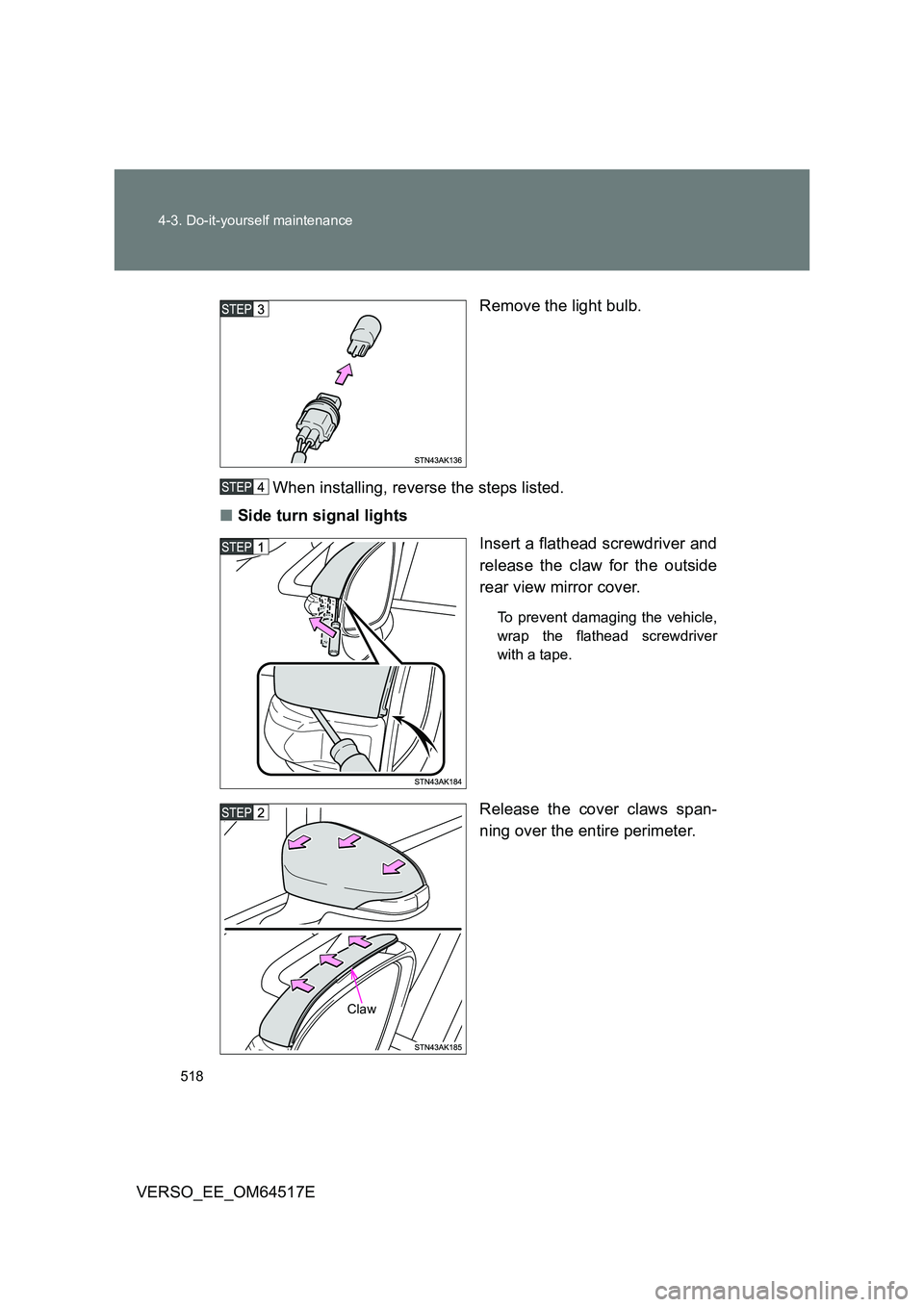
Remove the light bulb.
When installing, reverse the steps listed.
■ Side turn signal lights
Insert a flathead screwdriver and
release the claw for the outside
rear view mirror cover.
To prevent damaging the vehicle,
wrap the flathead screwdriver
with a tape.
Release the cover claws span-
ning over the entire perimeter.
Claw
Page 526 of 668
526
4-3. Do-it-yourself maintenance
VERSO_EE_OM64517E
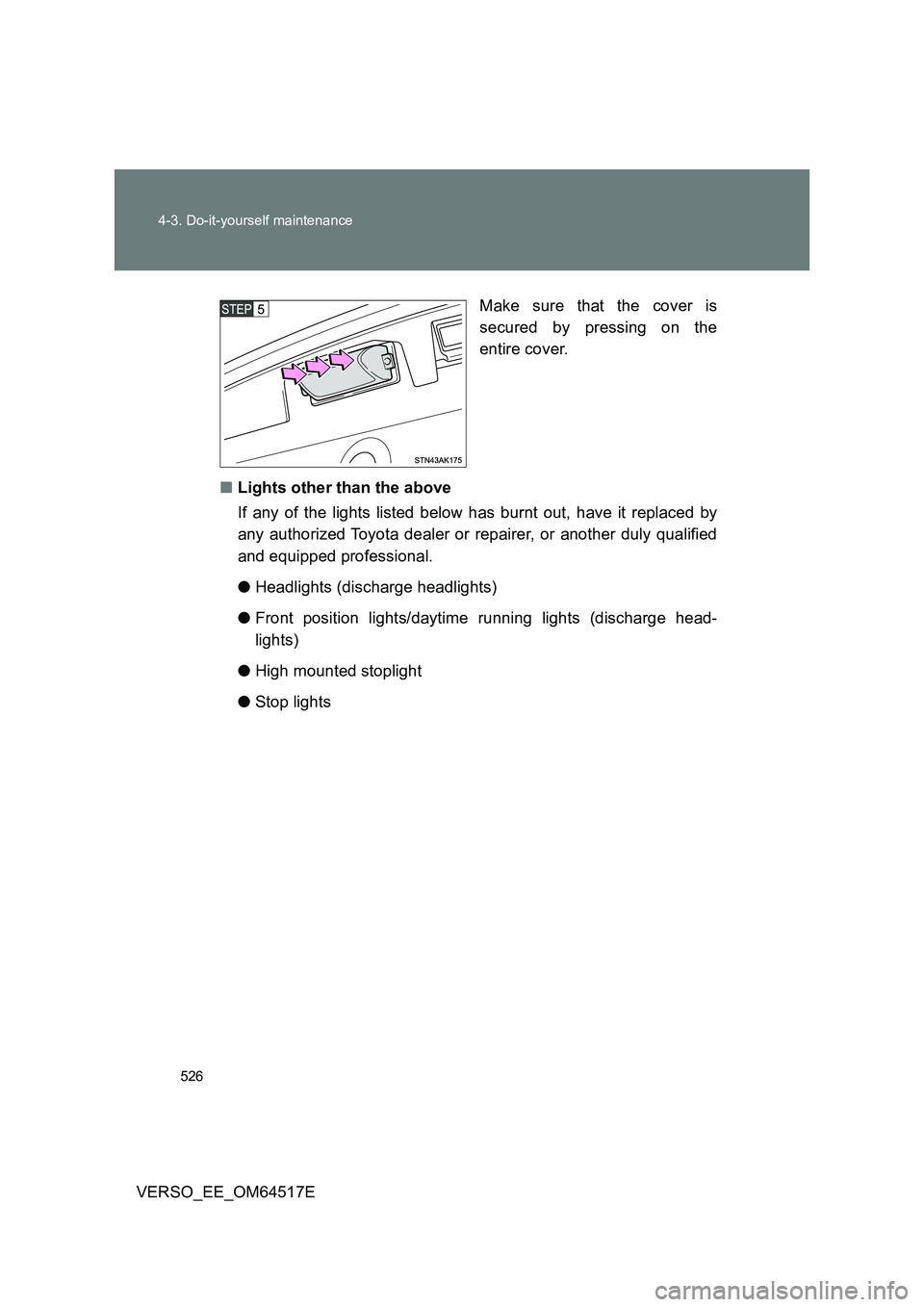
Make sure that the cover is
secured by pressing on the
entire cover.
■ Lights other than the above
If any of the lights listed below has burnt out, have it replaced by
any authorized Toyota dealer or repairer, or another duly qualified
and equipped professional.
● Headlights (discharge headlights)
● Front position lights/daytime running lights (discharge head-
lights)
● High mounted stoplight
● Stop lights
Page 527 of 668
527
4-3. Do-it-yourself maintenance
4
Maintenance and care
VERSO_EE_OM64517E
■ Condensation build-up on the inside of the lens
Temporary condensation build-up on the inside of the headlight lens does
not indicate a malfunction.
Contact any authorized Toyota dealer or repairer, or another duly qualified
and equipped professional, for more information in the following situations:
● Large drops of water are built up on the inside of the lens.
● Water has built up inside the headlight.
■ Discharge headlights (if equipped)
If voltage to the discharge bulbs is insufficient, the bulbs may not come on,
or may go out temporarily. The disc harge bulbs will come on when normal
power is restored.
■ LED light bulbs
The front position lights/daytime running lights (discharge headlights), stop
lights and high mounted stoplight consist of a number of LEDs. If any of the
LEDs burn out, take your vehicle to any authorized Toyota dealer or repairer,
or another duly qualified and equipped professional to have the light
replaced.
If two or more LEDs in a stop light burn out, your vehicle may not conform to
local laws (ECE).
■ When replacing light bulbs
P. 504
Page 528 of 668
528
4-3. Do-it-yourself maintenance
VERSO_EE_OM64517E
WARNING
■ Replacing light bulbs
● Turn off the lights. Do not attempt to replace the bulb immediately after
turning off the lights.
The bulbs become very hot and may cause burns.
● Do not touch the glass portion of the light bulb with bare hands.
When it is unavoidable to hold the gl ass portion, use and hold with a clean
dry cloth to avoid getting moisture and oils on the bulb.
Also, if the bulb is scratched or dropped, it may blow out or crack.
● Fully install light bulbs and any parts used to secure them. Failing to do so
may result in heat damage, fire, or water entering the headlight unit. This
may damage the headlights or cause condensation to build up on the lens.
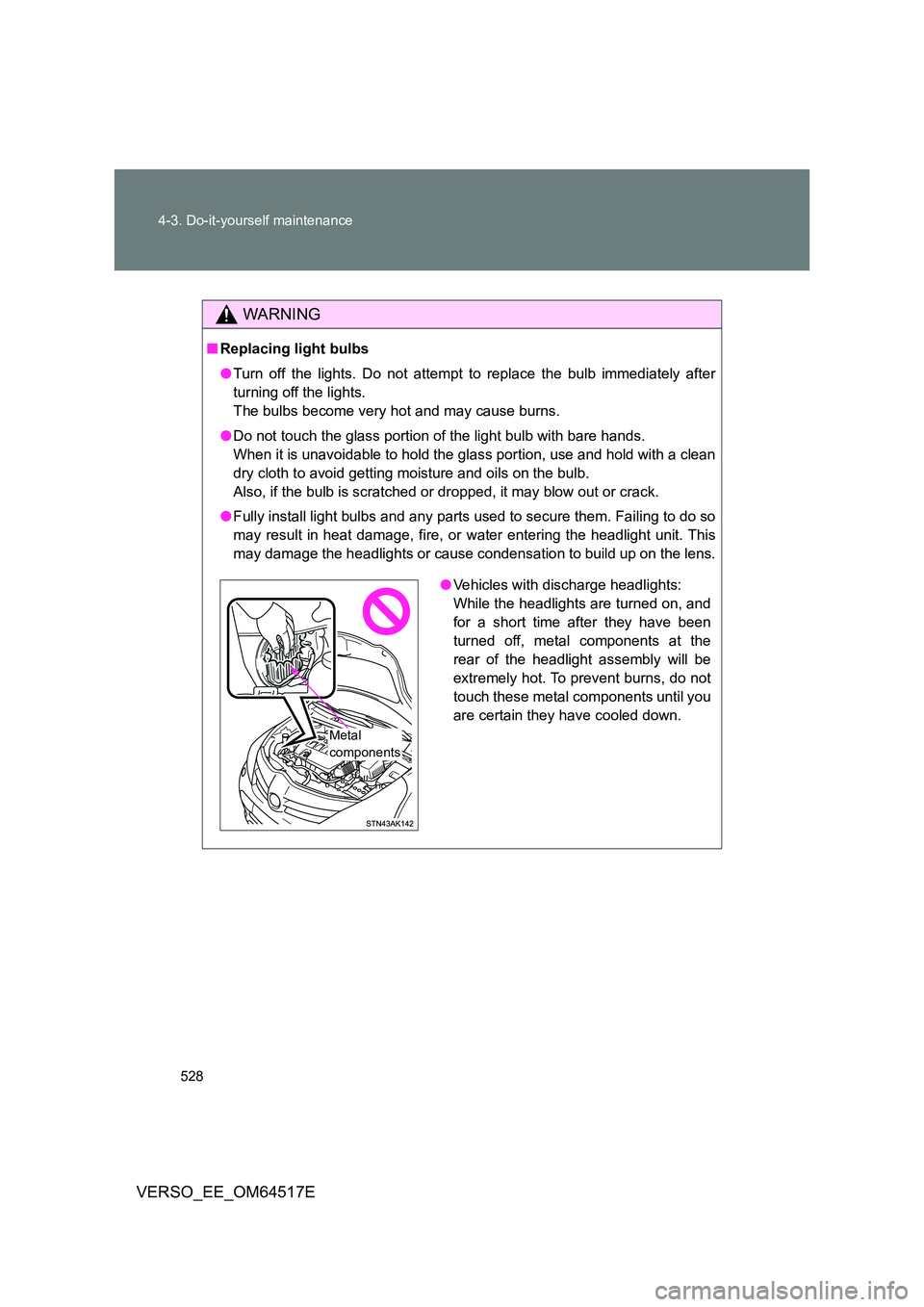
● Vehicles with discharge headlights:
While the headlights are turned on, and
for a short time after they have been
turned off, metal components at the
rear of the headlight assembly will be
extremely hot. To prevent burns, do not
touch these metal components until you
are certain they have cooled down.
Metal
components
Page 529 of 668
529
4-3. Do-it-yourself maintenance
4
Maintenance and care
VERSO_EE_OM64517E
WARNING
■ Discharge headlights (if equipped)
● Contact any authorized Toyota dealer or repairer, or another duly qualified
and equipped professional, before replacing the discharge headlights
(including light bulbs).
● Do not touch the high-intensity discharge headlight’s high voltage socket
when the headlights are turned on.
An extremely high voltage of 30000 V will be discharged and could result
in serious injury or death by electric shock.
● Do not attempt to repair or disassemble light bulbs, connectors, electric
circuits or component parts.
Doing so may result in death or serious injury due to electric shock.
■ To prevent damage or fire
Make sure bulbs are fully seated and locked.
Page 532 of 668
532
VERSO_EE_OM64517E
5-1. Essential information
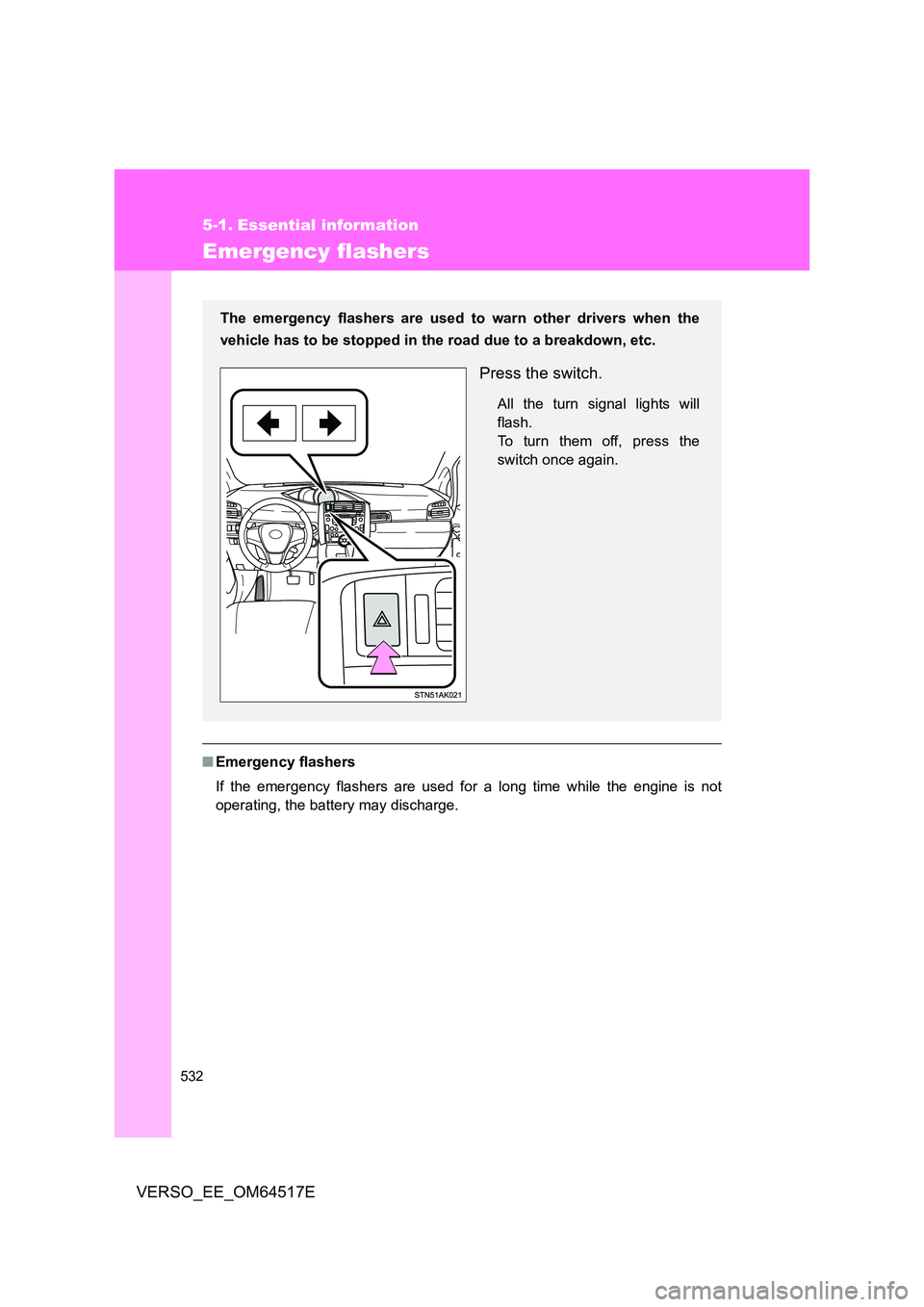
Emergency flashers
■Emergency flashers
If the emergency flashers are used for a long time while the engine is not
operating, the battery may discharge.
The emergency flashers are used to warn other drivers when the
vehicle has to be stopped in the road due to a breakdown, etc.
Press the switch.
All the turn signal lights will
flash.
To turn them off, press the
switch once again.
Page 542 of 668
542
VERSO_EE_OM64517E
5-2. Steps to take in an emergency
If a warning light turns on or a warning buzzer sounds...
Stop the vehicle immediately. Continuing to drive the vehicle
may be dangerous.
The following warning indicates a possible problem in the brake sys-
tem. Immediately stop the vehicle in a safe place and contact any
authorized Toyota dealer or repairer, or another duly qualified and
equipped professional.
*: Parking brake engaged warning buzzer: ( P. 5 5 5 )
Stop the vehicle immediately.
The following warnings indicate the possibility of damage to the vehi-
cle that may lead to an accident. Immediately stop the vehicle in a
safe place and contact any authorized Toyota dealer or repairer, or
another duly qualified and equipped professional.
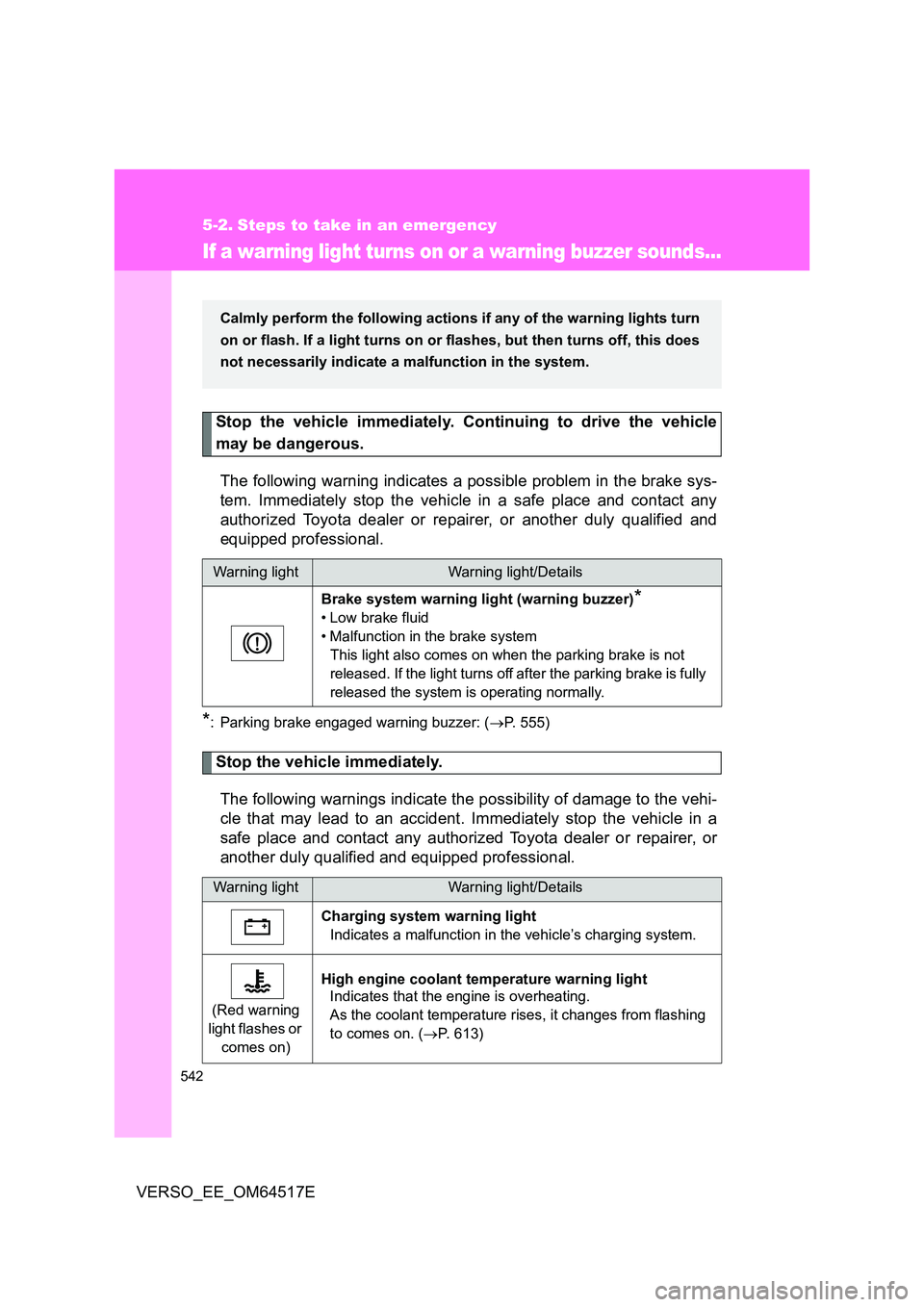
Warning lightWarning light/Details
Brake system warning light (warning buzzer)*
• Low brake fluid
• Malfunction in the brake system
This light also comes on when the parking brake is not
released. If the light turns off after the parking brake is fully
released the system is operating normally.
Warning lightWarning light/Details
Charging system warning light
Indicates a malfunction in the vehicle’s charging system.
(Red warning
light flashes or
comes on)
High engine coolant temperature warning light
Indicates that the engine is overheating.
As the coolant temperature rises, it changes from flashing
to comes on. ( P. 613)
Calmly perform the following actions if any of the warning lights turn
on or flash. If a light turns on or flashes, but then turns off, this does
not necessarily indicate a malfunction in the system.
Page 600 of 668
600
5-2. Steps to take in an emergency
VERSO_EE_OM64517E
If the engine will not start
If the engine still does not start after following the correct
starting procedure ( P. 198, 202) or releasing the steering lock
( P. 200, 205), confirm the following points.
■The engine will not start even if you are carrying the correct
key
One of the following may be the cause of the problem.
● There may not be sufficient fuel in the vehicle’s tank.
Refuel the vehicle.
● The engine may be flooded. (gasoline engine)
Try to restart the engine once more following correct starting
procedures. ( P. 198, 202)
● There may be a malfunction in the engine immobilizer system.
( P. 124)
■ The starter motor turns over slowly, the personal/interior
lights and headlights are dim, or the horn does not sound or
sounds at a low volume
One of the following may be the cause of the problem.
● The battery may be discharged. (P. 609)
● The battery terminal connections may be loose or corroded.
Page 601 of 668

5
601
5-2. Steps to take in an emergency
When trouble arises
VERSO_EE_OM64517E
■ The starter motor does not turn over (vehicles with smart
entry & start system)
The engine starting system may be malfunctioning due to an
electrical problem such as an open circuit or a blown fuse. How-
ever, an interim measure is available to start the engine.
( P. 602)
■ The starter motor does not turn over, the personal/interior
lights and headlights do not turn on, or the horn does not
sound
One of the following may be the cause of the problem.
● One or both of the battery terminals may be disconnected.
● The battery may be discharged. (P. 609)
● There may be a malfunction in the steering lock system. (vehi-
cles with smart entry & start system)
Contact any authorized Toyota dealer or repairer, or another duly
qualified and equipped professional, if the problem cannot be
repaired, or if repair procedures are unknown.
Page 610 of 668

610
5-2. Steps to take in an emergency
VERSO_EE_OM64517E
■ Starting the engine when the battery is discharged (vehicles with a
Multidrive)
The engine cannot be started by push-starting.
■ To prevent battery discharge
● Turn off the headlights and the audio system while the engine is stopped.
● Turn off any unnecessary electrical components when the vehicle is run-
ning at a low speed for an extended period, such as in heavy traffic, etc.
Start the engine of the second vehicle. Increase the engine
speed slightly and maintain at that level for approximately 5
minutes to recharge the battery of your vehicle.
Vehicles with smart entry & start system: Open and close
any of the doors with the “ENGINE START STOP” switch
off.
Vehicles without smart entry & start system: Maintain the
engine speed of the second vehicle and turn the engine
switch to the “ON” position, then start the vehicle’s engine.
Vehicles with smart entry & start system: Maintain the
engine speed of the second vehicle and turn the “ENGINE
START STOP” switch to IGNITION ON mode, then start the
vehicle’s engine.
Once the vehicle’s engine has started, remove the jumper
cables in the exact reverse order in which they were con-
nected.
Once the engine starts, have the vehicle checked at any autho-
rized Toyota dealer or repairer, or another duly qualified and
equipped professional, as soon as possible.